

Latent Retrieval for Weakly Supervised Open Domain Question Answering
Open accessThe DOI matches its Crossref record; 34 of the 34 references it cites were found in a registry or an index.
Abstract
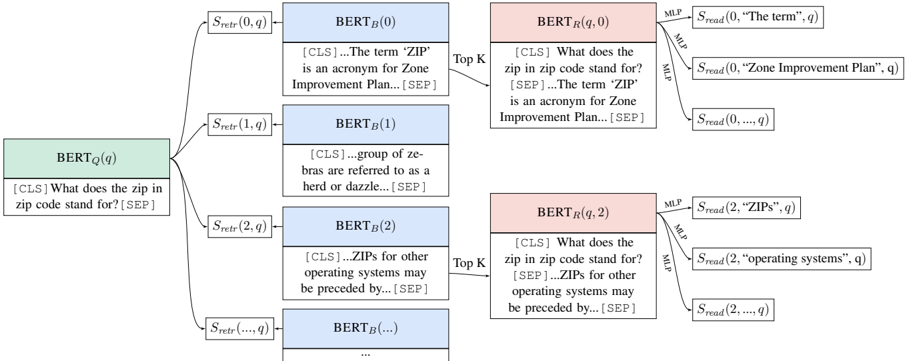
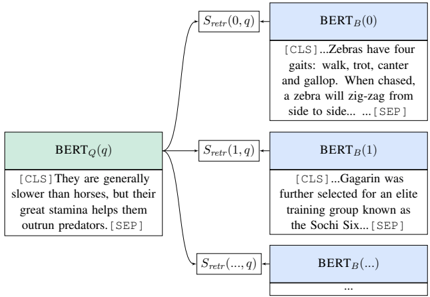
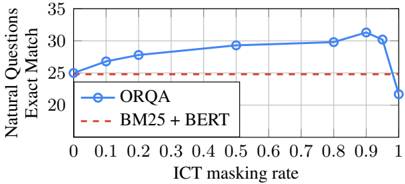
Recent work on open domain question answering (QA) assumes strong supervision of the supporting evidence and/or assumes a blackbox information retrieval (IR) system to retrieve evidence candidates.We argue that both are suboptimal, since gold evidence is not always available, and QA is fundamentally different from IR.We show for the first time that it is possible to jointly learn the retriever and reader from question-answer string pairs and without any IR system.In this setting, evidence retrieval from all of Wikipedia is treated as a latent variable.Since this is impractical to learn from scratch, we pre-train the retriever with an Inverse Cloze Task.We evaluate on open versions of five QA datasets.On datasets where the questioner already knows the answer, a traditional IR system such as BM25 is sufficient.On datasets where a user is genuinely seeking an answer, we show that learned retrieval is crucial, outperforming BM25 by up to 19 points in exact match.
Overview
The claims and statistics of this paper haven’t been checked yet.
Free: it reads the open-access text and checks the first 5 claims that cite a source we can check. Create a free account to check every claim.
Integrity signals
Registry
Cites
Statistics
Figures
Verification
Claims the paper makes
The claims and statistics of this paper haven’t been checked yet.
Free: it reads the open-access text and checks the first 5 claims that cite a source we can check. Create a free account to check every claim.
Claims other papers make about this one
Each is checked against this paper’s own text: does it say what the citing paper says it does?
The source backs part of the claim, not all of it — or backs it for a different population, condition or comparison.
In the citing paper
“Pretrained models with a differentiable access mechanism to explicit non-parametric memory have so far been only investigated for extractive downstream tasks.”
From Retrieval-Augmented Generation for Knowledge-Intensive NLP Tasks (2020) · cites this paper as [31]
Experimental — accuracy not yet measuredThe source backs part of the claim, not all of it — or backs it for a different population, condition or comparison.
In the citing paper
“The standard solution to these issues is to rely on Retrieval Augmented Generation (RAG) (Lee et al., 2019;Lewis et al., 2020;Guu et al., 2020).”
From RAGAs: Automated Evaluation of Retrieval Augmented Generation (2024) · cites this paper as Lee et al., 2019
Experimental — accuracy not yet measuredThe source backs part of the claim, not all of it — or backs it for a different population, condition or comparison.
In the citing paper
“Dense retrieval methods have thus never be shown to outperform TF-IDF/BM25 for opendomain QA before ORQA (Lee et al., 2019)”
From Dense passage retrieval for open-domain question answering (2020) · cites this paper as Lee et al., 2019
Experimental — accuracy not yet measuredThe cited source says what the claim attributes to it.
In the citing paper
“We instantiate this task with data from NaturalQuestions-Open (Lee et al., 2019;Kwiatkowski et al., 2019), which contains historical queries issued to the Google search engine, coupled with human-annotated answers extracted from Wikipedia.”
From Lost in the Middle: How Language Models Use Long Contexts (2024) · cites this paper as Lee et al., 2019
The cited source says what the claim attributes to it.
In the citing paper
“REALM [20] and ORQA [31], two recently introduced models that combine masked language models [8] with a differentiable retriever, have shown promising results, but have only explored open-domain extractive question answering.”
From Retrieval-Augmented Generation for Knowledge-Intensive NLP Tasks (2020) · cites this paper as [31]
8 more claims about this paper
Create a free account to see every claim other papers make about this one.
Self-check
Percentages, sums and reported differences re-computed from the paper’s own numbers.
The self-check needs the paper’s full text.
Citations
Cites
BERT: Pre-training of Deep Bidirectional Transformers for Language Understanding
Devlin, J., Chang, M.-W., Lee, K., & Toutanova, K. (2018) · arXiv · doi:10.48550/arxiv.1810.04805 · Cited by 73,173 · cited 3×
“Following recent advances in transfer learning, all scoring components are derived from BERT (Devlin et al., 2018), a bidirectional transformer that has been pre-trained on unsupervised language-modeling data.”
BackgroundMethodSelf-citationBERT: Pre-training of Deep Bidirectional Transformers for Language Understanding
Devlin, J., Chang, M.-W., Lee, K., & Toutanova, K. (2019) · Proceedings of the 2019 Conference of the North American Chapter of the Association for Computational Linguistics: Human Language Technologies, Volume 1 (Long and Short Papers) · doi:10.18653/v1/n19-1423 · Cited by 54,325 · cited 3×
“Following recent advances in transfer learning, all scoring components are derived from BERT (Devlin et al., 2018), a bidirectional transformer that has been pre-trained on unsupervised language-modeling data.”
BackgroundMethodSelf-citationEfficient Estimation of Word Representations in Vector Space
Mikolov, T., Chen, K., Corrado, G., & Dean, J. (2013) · arXiv · doi:10.48550/arxiv.1301.3781 · Cited by 26,568 · cited 1×
“ICT can be considered a generalization of the skip-gram objective (Mikolov et al., 2013), with a coarser granularity, deep architecture, and in-batch negative sampling from Logeswaran and Lee (2018).”
BackgroundDeep Contextualized Word Representations
Peters, M., Neumann, M., Iyyer, M., Gardner, M., Clark, C., Lee, K., & Zettlemoyer, L. (2018) · Proceedings of the 2018 Conference of the North American Chapter of the Association for Computational Linguistics: Human Language Technologies, Volume 1 (Long Papers) · doi:10.18653/v1/n18-1202 · Cited by 11,983 · cited 2×
“, 2003),4 and (2) ELMO (small), a context-dependent bidirectional LSTM (Peters et al., 2018).”
BackgroundMethodSelf-citationSQuAD: 100,000+ Questions for Machine Comprehension of Text
Rajpurkar, P., Zhang, J., Lopyrev, K., & Liang, P. (2016) · Proceedings of the 2016 Conference on Empirical Methods in Natural Language Processing · doi:10.18653/v1/d16-1264 · Cited by 6,208 · cited 8×
“In the strongly supervised setting popularized by DrQA (Chen et al., 2017), they also assume a reading comprehension model trained on question-answer-evidence triples, such as SQuAD (Rajpurkar et al., 2016).”
BackgroundMethodResultInfluentialThe probabilistic relevance framework: BM25 and beyond
Robertson, S., & Zaragoza, H. (2009) · Foundations and Trends® in Information Retrieval · doi:10.1561/1500000019 · Cited by 3,374
“Cloze Procedure”: A New Tool for Measuring Readability
Taylor, W. L. (1953) · Journalism Quarterly · doi:10.1177/107769905303000401 · Cited by 2,332 · cited 1×
“In the standard Cloze task (Taylor, 1953), the goal is to predict masked-out text based on its context.”
BackgroundNatural Questions: A benchmark for question answering research
Kwiatkowski, T., Palomaki, J., Redfield, O., Collins, M., Parikh, A., Alberti, C., Epstein, D., Polosukhin, I., Devlin, J., Lee, K., et al. (2019) · Transactions of the Association for Computational Linguistics · doi:10.1162/tacl_a_00276 · Cited by 2,069 · cited 3×
“Natural Questions contains question from aggregated queries to Google Search (Kwiatkowski et al., 2019).”
BackgroundSelf-citationTriviaQA: A Large Scale Distantly Supervised Challenge Dataset for Reading Comprehension
Joshi, M., Choi, E., Weld, D., & Zettlemoyer, L. (2017) · Proceedings of the 55th Annual Meeting of the Association for Computational Linguistics (Volume 1: Long Papers) · doi:10.18653/v1/p17-1147 · Cited by 1,690 · cited 8×
“TriviaQA is a collection of trivia questionanswer pairs that were scraped from the web (Joshi et al., 2017).”
BackgroundMethodInfluentialTriviaQA: A Large Scale Distantly Supervised Challenge Dataset for Reading Comprehension
Joshi, M., Choi, E., Weld, D. S., & Zettlemoyer, L. (2017) · arXiv · doi:10.48550/arxiv.1705.03551 · Cited by 1,650 · cited 8×
“TriviaQA is a collection of trivia questionanswer pairs that were scraped from the web (Joshi et al., 2017).”
BackgroundMethodInfluential
Research works printed but not linked: 5
- Yoshua Bengio, Réjean Ducharme, Pascal Vincent, and Christian Jauvin. 2003. A neural probabilistic lan- guage model. Journal of machine learning research, 3(Feb):1137-1155.
- Danqi Chen, Adam Fisch, Jason Weston, and Antoine Bordes. 2017. Reading wikipedia to answer open- domain questions. In Proceedings of the 55th An- nual Meeting of the Association for Computational Linguistics (Volume 1: Long Papers), volume 1, pages 1870-1879.
- Rajarshi Das, Shehzaad Dhuliawala, Manzil Zaheer, and Andrew McCallum. 2019. Multi-step retriever- reader interaction for scalable open-domain question answering. In International Conference on Learn- ing Representations.
- Matthew E. Peters, Mark Neumann, Mohit Iyyer, Matt Gardner, Christopher Clark, Kenton Lee, and Luke Zettlemoyer. 2018. Deep contextualized word rep- resentations. In Proc. of NAACL.
- Shuohang Wang, Mo Yu, Xiaoxiao Guo, Zhiguo Wang, Tim Klinger, Wei Zhang, Shiyu Chang, Gerry Tesauro, Bowen Zhou, and Jing Jiang. 2018. R 3: Reinforced ranker-reader for open-domain question answering. In Thirty-Second AAAI Conference on Artificial Intelligence.
Cited by
Items 401–500 of 849
AgentPoison: Red-teaming LLM Agents via Poisoning Memory or Knowledge Bases
Chen, Z., Xiang, Z., Xiao, C., Song, D., & Li, B. (2024) · arXiv · doi:10.48550/arxiv.2407.12784 · Cited by 246
“…two types based on their training scheme: (1) training both the retriever and generator in an end-to-end fashion and update the retriever with the language modeling loss (e.g. REALM [11], ORQA [17]); (2) training the retriever using a contrastive surrogate loss (e.g. DPR [14], ANCE [32], BGE [39]).”
Distilling Knowledge from Reader to Retriever for Question Answering
Izacard, G., & Grave, É. (2021) · HAL · Cited by 69
Building efficient and effective OpenQA systems for low-resource languages
Budur, E., Özçelik, R., Soylu, D., Khattab, O., Güngör, T., & Potts, C. (2024) · Knowledge-Based Systems · doi:10.1016/j.knosys.2024.112243 · Cited by 14
“Neural retrievers, despite their advantages, suffer from the drawback of requiring a significant amount of storage space, especially for their indexes.”
BackgroundWang, H., Zhang, D., Li, J., Feng, Z., & Zhang, F. (2025) · Applied Sciences · doi:10.3390/app15063134 · Cited by 11
From Missteps to Mastery: Enhancing Low-Resource Dense Retrieval through Adaptive Query Generation
Tong, Z., Qin, C., Fang, C., Yao, K., Chen, X., Zhang, J., Zhu, C., & Zhu, H. (2025) · ACM SIGKDD Conference on Knowledge Discovery and Data Mining (KDD) · doi:10.1145/3690624.3709225 · Cited by 17
“…BM25 [43] and its variant BM25-tuned [3], employing a Lucene index for enhanced retrieval efficiency; (2) Dense retrieval model via supervised learning with low resource data: Col-BERT [24]; and (3) Dense retrieval model trained via unsupervised learning: ICT [26], MSS [45], and Contriever [18].”
Xu, X., Wen, F., Chu, B., Fu, Z., Lin, Q., Liu, J., Fei, B., Li, Y., Zhou, L., & Yang, Z. (2025) · ACM SIGKDD Conference on Knowledge Discovery and Data Mining (KDD) · doi:10.1145/3711896.3737219 · Cited by 19
“Pre-training tasks designed specifically for retrieval (passage ranking), such as ICT [20], BFS [5], and RetroMAE [42] have proven effective, but it has also been shown that carefully fine-tuning a vanilla BERT model can also outperform these approaches [16, 24] Recent studies have explored the…”
Nandy, A., Sharma, S., Maddhashiya, S., Sachdeva, K., Goyal, P., & Ganguly, N. (2021) · Findings of the Association for Computational Linguistics: EMNLP (Findings of EMNLP) · doi:10.18653/v1/2021.findings-emnlp.392 · Cited by 32
Ni, A., Gardner, M., & Dasigi, P. (2021) · Conference on Empirical Methods in Natural Language Processing (EMNLP) · doi:10.18653/v1/2021.emnlp-main.497 · Cited by 15
“More recent work such as Lee et al. (2019); Karpukhin et al. (2020) focus on modeling retrieval for question answering, but focus more on an open-reading setting where the biggest challenge is to scale up models to let them retrieve from large corpora.”
BackgroundMethodImplicit Feedback for Dense Passage Retrieval: A Counterfactual Approach
Zhuang, S., Li, H., & Zuccon, G. (2022) · International ACM SIGIR Conference on Research and Development in Information Retrieval (SIGIR) · doi:10.1145/3477495.3531994 · Cited by 11
“However, current research directions in the DRs space focus on the development of effective training methods, especially related to negative sampling [11, 23, 42], and the integration of pseudo relevance feedback”
BackgroundMachine Reading at Scale: A Search Engine for Scientific and Academic Research
Sousa, N., Oliveira, N. R. B. D., & Praça, I. (2022) · Systems · doi:10.3390/systems10020043 · Cited by 10
“Their results for end-to-end QA accuracy also improved on ORQA, the first open-retrieval question answering system, introduced in [33] by Lee et al.”
BackgroundYou can’t pick your neighbors, or can you? When and How to Rely on Retrieval in the kNN-LM
Drozdov, A., Wang, S., Rahimi, R., McCallum, A., Zamani, H., & Iyyer, M. (2022) · Findings of the Association for Computational Linguistics: EMNLP (Findings of EMNLP) · doi:10.18653/v1/2022.findings-emnlp.218 · Cited by 35
TriSampler: A Better Negative Sampling Principle for Dense Retrieval
Zhen, Y., Shao, Z., Dong, Y., & Tang, J. (2024) · Proceedings of the AAAI Conference on Artificial Intelligence · doi:10.1609/aaai.v38i8.28779 · Cited by 28
Semantic Ranking for Automated Adversarial Technique Annotation in Security Text
Kumarasinghe, U., Lekssays, A., Sencar, H. T., Boughorbel, S., Elvitigala, C., & Nakov, P. (2024) · ACM Asia Conference on Computer and Communications Security (ASIA CCS) · doi:10.1145/3634737.3645000 · Cited by 24
Latent Retrieval for Large-Scale Fact-Checking and Question Answering with NLI training
Samarinas, C., Hsu, W., & Lee, M. L. (2020) · IEEE International Conference on Tools with Artificial Intelligence (ICTAI) · doi:10.1109/ictai50040.2020.00147 · Cited by 16
“Hence, we limit the computation to only passages in the current training batch as is widely used in [28]–[30], [39].”
MethodAnswer Complex Questions: Path Ranker Is All You Need
Zhang, X., Zhan, K., Hu, E., Fu, C., Luo, L., Jiang, H., Jia, Y., Yu, F., Dou, Z., Cao, Z., et al. (2021) · International ACM SIGIR Conference on Research and Development in Information Retrieval (SIGIR) · doi:10.1145/3404835.3462942 · Cited by 14
“In the works above, the negative samples for ranker are usually obtained by in-batch method [16] or random sampling from a fixed candidate set [18].”
BackgroundContrastive Document Representation Learning with Graph Attention Networks
Xu, P., Chen, X., Ma, X., Huang, Z., & Xiang, B. (2021) · Findings of the Association for Computational Linguistics: EMNLP (Findings of EMNLP) · doi:10.18653/v1/2021.findings-emnlp.327 · Cited by 17
A Few More Examples May Be Worth Billions of Parameters
Kirstain, Y., Lewis, P., Riedel, S., & Levy, O. (2022) · Findings of the Association for Computational Linguistics: EMNLP (Findings of EMNLP) · doi:10.18653/v1/2022.findings-emnlp.72 · Cited by 35
Multi-Task Dense Retrieval via Model Uncertainty Fusion for Open-Domain Question Answering
Li, M., Li, M., Xiong, K., & Lin, J. (2021) · Findings of the Association for Computational Linguistics: EMNLP (Findings of EMNLP) · doi:10.18653/v1/2021.findings-emnlp.26 · Cited by 21
Lewis, P., Oğuz, B., Xiong, W., Petroni, F., Yih, S., & Riedel, S. (2022) · Conference of the North American Chapter of the Association for Computational Linguistics: Human Language Technologies (NAACL-HLT) · doi:10.18653/v1/2022.naacl-main.226 · Cited by 15
A Multi-Domain Benchmark for Personalized Search Evaluation
Bassani, E., Kasela, P., Raganato, A., & Pasi, G. (2022) · ACM International Conference on Information and Knowledge Management (CIKM) · doi:10.1145/3511808.3557536 · Cited by 19
“For re-ranking the BM25 results, we consider a document popularity-based model (Pop), a bi-encoder-based retrieval model (BiEnc) similar to several recent neural retrieval approaches [34, 41, 43, 54], and two embedding-based personalized retrieval models.”
MethodToken-Level Fact Correction in Abstractive Summarization
Shin, J., Park, S.-B., & Song, H.-J. (2023) · IEEE Access · doi:10.1109/access.2022.3233854 · Cited by 10
“Finally, similarly to answer-span selection in the question answering tasks [16], [17], [18], the fact emender selects a span from the source text for each mask in the masked summary and then replaces the mask with the span.”
BackgroundContext Generation Improves Open Domain Question Answering
Su, D., Patwary, M. A., Prabhumoye, S., Xu, P., Prenger, R., Shoeybi, M., Fung, P., Anandkumar, A., & Catanzaro, B. (2023) · Findings of the Association for Computational Linguistics: EACL · doi:10.18653/v1/2023.findings-eacl.60 · Cited by 18
Frustratingly Hard Evidence Retrieval for QA Over Books
Mou, X., Yu, M., Yao, B., Yang, C., Guo, X., Potdar, S., & Su, H. (2020) · doi:10.18653/v1/2020.nuse-1.13 · Cited by 12
Accelerating Real-Time Question Answering via Question GenerationPreprint
Fang, Y., Wang, S., Gan, Z., Sun, S., Liu, J., & Zhu, C. (2020) · arXiv (Cornell University) · doi:10.48550/arxiv.2009.05167 · Cited by 20
Less is More: Pre-training a Strong Siamese Encoder Using a Weak Decoder.Preprint
Lu, S., Xiong, C., He, D., Ke, G., Malik, W., Dou, Z., Bennett, P. N., Liu, T., & Overwijk, A. (2021) · arXiv (Cornell University) · Cited by 10
Joint Retrieval and Generation Training for Grounded Text Generation.Preprint
Zhang, Y., Sun, S., Gao, X., Fang, Y., Brockett, C., Galley, M., Gao, J., & Dolan, B. (2021) · arXiv (Cornell University) · Cited by 13
Attacking Open-domain Question Answering by Injecting Misinformation
Pan, L., Chen, W., Kan, M.-Y., & Wang, W. Y. (2023) · Proceedings of the 13th International Joint Conference on Natural Language Processing and the 3rd Conference of the Asia-Pacific Chapter of the Association for Computational Linguistics (Volume 1: Long Papers) · doi:10.18653/v1/2023.ijcnlp-main.35 · Cited by 9
“Promising advances have been made towards improving the reader models (Yang et al., 2019; Izacard and Grave, 2021) and neural retrievers (Lee et al., 2019; Guu et al., 2020; San-thanam et al., 2022b).”
BackgroundWriting Style Matters: An Examination of Bias and Fairness in Information Retrieval Systems
Cao, H. (2025) · ACM International Conference on Web Search and Data Mining (WSDM) · doi:10.1145/3701551.3703514 · Cited by 27
“Dataset: Following the work of [1, 13], the test set of Natural Questions (NQ) [23] dataset which contains queries from Google search engine and answer from Wikipedia documents is selected in the section.”
Mucciaccia, S. S., Paixão, T. M., Mutz, F. W., Souza, A. F. D., Badue, C. S., & Oliveira-Santos, T. (2025) · Journal of the Brazilian Computer Society · doi:10.5753/jbcs.2025.5801 · Cited by 11
Combining Lexical and Dense Retrieval for Computationally Efficient Multi-hop Question Answering
Sidiropoulos, G., Voskarides, N., Vakulenko, S., & Kanoulas, E. (2021) · Workshop on Simple and Efficient Natural Language Processing (SustaiNLP) · doi:10.18653/v1/2021.sustainlp-1.7 · Cited by 10
“Given that often the answer cannot be found in the top-ranked passage, inference follows a standard beam-search procedure, where top-k passages are retrieved and the reader scores are computed for all k passages (Lee et al., 2019).”
LM-CORE: Language Models with Contextually Relevant External Knowledge
Kaur, J. N., Bhatia, S., Aggarwal, M., Bansal, R., & Krishnamurthy, B. (2022) · Findings of the Association for Computational Linguistics: NAACL · doi:10.18653/v1/2022.findings-naacl.57 · Cited by 16
“We used the same splits as Lee et al. (2019b) with training, dev and test sets containing 3417, 361 and 2032 samples respectively.”
MethodFine-Tuning BERT-based Language Models for Duplicate Trouble Report Retrieval
Bosch, N., Shalmashi, S., Yaghoubi, F., Holm, H., Gaim, F., & Payberah, A. H. (2022) · IEEE International Conference on Big Data (BigData) · doi:10.1109/bigdata55660.2022.10020825 · Cited by 11
“Other Bi-Encoder models build on or are similar to the sentence-BERT approach, e.g., [18]–[20].”
Survey of Large Language Models for Answering Questions Across Various Fields
Shailendra, P., Ghosh, R. C., Kumar, R., & Sharma, N. (2024) · International Conference on Advanced Computing and Communication Systems (ICACCS) · doi:10.1109/icaccs60874.2024.10717078 · Cited by 24
“The performance of 12 different models from Retriever-Reader, End-to-End, and Closed-book models are compared by Kamalloo et al. [16] on a random subset of the NQ-OPEN [17] dataset.”
MethodMulti-level retrieval with semantic Axiomatic Fuzzy Set clustering for question answering
Lang, Q., Liu, X., & Deng, Y. (2021) · Applied Soft Computing · doi:10.1016/j.asoc.2021.107858 · Cited by 10
Multimodal Inverse Cloze Task for Knowledge-Based Visual Question Answering
Lerner, P., Ferret, O., & Guinaudeau, C. (2023) · Lecture notes in computer science · doi:10.1007/978-3-031-28244-7_36 · Cited by 19
Recurrent Attention Networks for Long-text Modeling
Li, X., Li, Z., Luo, X., Xie, H., Lee, X. Z., Zhao, Y., Wang, F. L., & Li, Q. (2023) · Findings of the Association for Computational Linguistics: ACL (Findings of ACL) · doi:10.18653/v1/2023.findings-acl.188 · Cited by 24
Fast Semantic Matching via Flexible Contextualized Interaction
Ye, W., Liu, Y., Zou, L., Cai, H., Cheng, S., Wang, S., & Yin, D. (2022) · ACM International Conference on Web Search and Data Mining (WSDM) · doi:10.1145/3488560.3498442 · Cited by 13
“, BERT [5]) have achieved great success on many NLP tasks [2, 20, 38], and also significantly advanced the performance of semantic matching (e.”
BackgroundA Graph-guided Multi-round Retrieval Method for Conversational Open-domain Question AnsweringPreprint
Li, Y., Li, W., & Nie, L. (2021) · arXiv (Cornell University) · doi:10.48550/arxiv.2104.08443 · Cited by 12
“In addition to TF-IDF based retrievers, dense based retrievers have also been well developed recently [2, 16, 18], where all passages are offline encoded in advance to allow efficient large-scale retrieval.”
InfluentialRALF: Accuracy-Aware Scheduling for Feature Store Maintenance
Wooders, S., Mo, X., Narang, A., Lin, K., Stoica, I. G., Hellerstein, J. M., Crooks, N., & Gonzalez, J. E. (2023) · Proceedings of the VLDB Endowment · doi:10.14778/3632093.3632116 · Cited by 15
“RALF leverage downstream model feedback to prioritize expensive feature updates (§3.3.3). models increasingly depend on features of relevant context (eg. embeddings of past conversational history) to provide more grounded and personalized responses [25, 35, 36, 44].”
BackgroundInfluentialZhang, C., Wang, B., & Song, D. (2024) · ACM Transactions on Information Systems · doi:10.1145/3677375 · Cited by 8
“In this circumstance, these submodels can be learned in one run and be used flexibly according to concerned devices.”
Towards Brain Passage Retrieval: An Investigation of EEG Query Representations
McGuire, N., & Moshfeghi, Y. (2025) · International ACM SIGIR Conference on Research and Development in Information Retrieval (SIGIR) · doi:10.1145/3726302.3730097 · Cited by 10
“These choices, informed by prior work on regularisation in neural sequence models [9, 33], prevent the model from relying on simple heuristics such as length matching or exact term matching, encouraging it to learn deeper semantic relationships between the EEG query and the passage text.”
Triple-Fact Retriever: An explainable reasoning retrieval model for multi-hop QA problem
Wu, C., Hu, E., Zhan, K., Luo, L., Zhang, X., Jiang, H., Wang, Q., Cao, Z., Yu, F., & Chen, L. (2022) · IEEE International Conference on Data Engineering (ICDE) · doi:10.1109/icde53745.2022.00095 · Cited by 8
Liu, J., Liu, J., Yang, Y., Wang, J., Wu, W., Zhao, D., & Yan, R. (2022) · Findings of the Association for Computational Linguistics: EMNLP (Findings of EMNLP) · doi:10.18653/v1/2022.findings-emnlp.39 · Cited by 10
“Lee et al. (2019) pre-trains the re-triever with an unsupervised Inverse Cloze Task (ICT).”
MethodGraph reasoning over explicit semantic relation
Zhu, T., Liu, S., Li, B., Liu, J., Liu, P., & Zheng, F. (2023) · High-Confidence Computing · doi:10.1016/j.hcc.2023.100190 · Cited by 8
OmniSearchSage: Multi-Task Multi-Entity Embeddings for Pinterest Search
Agarwal, P., Islam, S. M., Pancha, N., Hazra, K. S., Xu, J., & Rosenberg, C. (2024) · International World Wide Web Conference (WWW) · doi:10.1145/3589335.3648309 · Cited by 23
“Prior research [9, 15, 16, 29] has empirically demonstrated that larger batches with a substantial number of negatives help in learning better representations.”
Phukan, A., Somasundaram, S., Saxena, A., Goswami, K., & Srinivasan, B. V. (2024) · Findings of the Association for Computational Linguistics: ACL (Findings of ACL) · doi:10.18653/v1/2024.findings-acl.682 · Cited by 39
Query Augmentation with Brain Signals
Ye, Z., Zhan, J., Ai, Q., Liu, Y., de Rijke, M., Lioma, C., & Ruotsalo, T. (2024) · ACM International Conference on Multimedia (ACM MM) · doi:10.1145/3664647.3681658 · Cited by 9
“More implementation details are provided in Appendix A.4.”
Li, R., Wang, Y., Wen, Z., Cui, M., & Miao, Q. (2024) · Knowledge-Based Systems · doi:10.1016/j.knosys.2024.112789 · Cited by 14
Towards building a Robust Industry-scale Question Answering System
Chakravarti, R., Ferritto, A., Iyer, B., Pan, L., Florian, R., Roukos, S., & Sil, A. (2020) · International Conference on Computational Linguistics · doi:10.18653/v1/2020.coling-industry.9 · Cited by 12
“Recently (Lee et al., 2019; Min et al., 2019) focus on “open” NQ, a modified version of the full NQ dataset for document retrieval QA that discards unanswerable questions.”
BackgroundSimple Local Attentions Remain Competitive for Long-Context Tasks
Xiong, W., Oğuz, B., Gupta, A., Chen, X., Liskovich, D., Levy, O., Yih, S., & Mehdad, Y. (2022) · Conference of the North American Chapter of the Association for Computational Linguistics: Human Language Technologies (NAACL-HLT) · doi:10.18653/v1/2022.naacl-main.144 · Cited by 20
Zemi: Learning Zero-Shot Semi-Parametric Language Models from Multiple Tasks
Wang, Z., Pan, X., Yu, D., Yu, D., Chen, J., & Ji, H. (2023) · Findings of the Association for Computational Linguistics: ACL (Findings of ACL) · doi:10.18653/v1/2023.findings-acl.246 · Cited by 13
The Web Can Be Your Oyster for Improving Language Models
Li, J., Tang, T., Zhao, W. X., Wang, J., Nie, J., & Wen, J.-R. (2023) · Findings of the Association for Computational Linguistics: ACL (Findings of ACL) · doi:10.18653/v1/2023.findings-acl.46 · Cited by 20
Efficient Nearest Neighbor Emotion Classification with BERT-whitening
Yin, W., & Shang, L. (2022) · Conference on Empirical Methods in Natural Language Processing · doi:10.18653/v1/2022.emnlp-main.312 · Cited by 12
“…tasks such as language modeling(Khandelwal et al., 2019; Guu et al., 2020), machine translation(Gu et al., 2018; Bapna and Fi-rat, 2019; Khandelwal et al., 2020; Zheng et al., 2021), question answering(Chen et al., 2017; Lee et al., 2019), and computer vision(Devlin et al., 2015; Gur et al., 2021).”
Mitigating Temporal Misalignment by Discarding Outdated Facts
Zhang, M., & Choi, E. (2023) · Conference on Empirical Methods in Natural Language Processing (EMNLP) · doi:10.18653/v1/2023.emnlp-main.879 · Cited by 39
Improving Transformer-Kernel Ranking Model Using Conformer and Query Term Independence
Mitra, B., Hofstätter, S., Zamani, H., & Craswell, N. (2021) · International ACM SIGIR Conference on Research and Development in Information Retrieval (SIGIR) · doi:10.1145/3404835.3463049 · Cited by 12
“One approach involves the dual encoder architecture where the query and document are encoded independently, and efficient retrieval is achieved by approximate nearest-neighbour search [1, 5, 27, 28, 31] or by employing inverted-index over latent representations [68].”
MethodAn Improved Sentence Embeddings based Information Retrieval Technique using Query Reformulation
Gupta, V., Dixit, A., & Sethi, S. (2023) · International Conference on Advancement in Computation & Computer Technologies (InCACCT) · doi:10.1109/incacct57535.2023.10141788 · Cited by 12
“The work in [30] and [31] employed BERT-based”
MethodGAR-meets-RAG Paradigm for Zero-Shot Information Retrieval
Arora, D., Kini, A., Chowdhury, S. R., Natarajan, N., Sinha, G., & Sharma, A. (2023) · arXiv · doi:10.48550/arxiv.2310.20158 · Cited by 8
EcoAssistant: Using LLM Assistant More Affordably and Accurately
Zhang, J., Krishna, R., Awadallah, A. H., & Wang, C. (2023) · arXiv · doi:10.48550/arxiv.2310.03046 · Cited by 8
“This characteristic differentiates code-driven question answering from existing question answering paradigms such as open-domain question answering (Lee et al., 2019; Chen et al., 2017) or browser-assistant question answering (Nakano et al.”
BackgroundHuman Evaluation of Spoken vs. Visual Explanations for Open-Domain QA
Gonzalez, A. V., Bansal, G., Fan, A., Jia, R., Mehdad, Y., & Iyer, S. (2020) · arXiv · doi:10.48550/arxiv.2012.15075 · Cited by 7
“ODQA models can justify their predictions by pointing to evidence text containing the predicted answer (Das et al., 2018; Lee et al., 2019a; Karpukhin et al., 2020).”
BackgroundROGER: Ranking-Oriented Generative Retrieval
Zhou, Y., Yao, J., Dou, Z., Tu, Y., Wu, L., Chua, T., & Wen, J.-R. (2024) · ACM Transactions on Information Systems · doi:10.1145/3603167 · Cited by 16
“The performance of the initial retrieval”
REPT: Bridging Language Models and Machine Reading Comprehension via Retrieval-Based Pre-training
Jiao, F., Guo, Y., Niu, Y., Ji, F., Li, F.-L., & Nie, L. (2021) · Findings of the Association for Computational Linguistics: ACL (Findings of ACL) · doi:10.18653/v1/2021.findings-acl.13 · Cited by 10
Zhao, C., Xiong, C., Boyd-Graber, J. L., & Daumé, H. (2021) · Conference on Empirical Methods in Natural Language Processing (EMNLP) · doi:10.18653/v1/2021.emnlp-main.756 · Cited by 15
“Dense Retrieval Dense retrieval (Lee et al., 2019) is based on a dual-encoder architecture, which uses BERT to represent both the query q and the passage p with dense vectors.”
MethodXMQAs: Constructing Complex-Modified Question-Answering Dataset for Robust Question Understanding
Chen, Y., Xiao, Y., Li, Z., & Liu, B. (2023) · IEEE Transactions on Knowledge and Data Engineering · doi:10.1109/tkde.2023.3303916 · Cited by 26
Zhao, C., Jiang, Y., Qiu, Y., Zhang, H., & Yang, W.-Y. (2023) · ACM International Conference on Information and Knowledge Management (CIKM) · doi:10.1145/3583780.3615210 · Cited by 12
“We compare our proposedmethodDragan with the below four baselines: • ORQA [19] stands for the model released by Google research, which contains an inverse cloze task(ICT) embedding retrieval model and a downstream model.”
BackgroundMethodExploring the Impact of Model Scaling on Parameter-Efficient Tuning
Su, Y., Chan, C.-M., Cheng, J., Qin, Y., Lin, Y., Hu, S., Yang, Z., Ding, N., Sun, X., Xie, G., et al. (2023) · Conference on Empirical Methods in Natural Language Processing (EMNLP) · doi:10.18653/v1/2023.emnlp-main.931 · Cited by 19
“In this paper, we choose NQ-Open (Lee et al., 2019), an open-world QA dataset without context.”
MethodSelf Data Augmentation for Open Domain Question Answering
Zhang, Q., Zheng, M., Chen, S., Liu, H., & Fang, M. (2025) · ACM Transactions on Information Systems · doi:10.1145/3707449 · Cited by 9
“Lee et al. [33] employed a joint learning approach for the retriever and the reader using question-answer pairs, without the necessity of gold standard labels for the retriever.”
Cadena-Bautista, Á., Lopez-Ponce, F. F., Ojeda-Trueba, S.-L., Sierra, G., & Bel-Enguix, G. (2025) · Information · doi:10.3390/info16020077 · Cited by 9
QAEA-DR: A Unified Text Augmentation Framework for Dense Retrieval
Tan, H., Zhan, S., Lin, H., Zheng, H.-T., & Chan, W. K. (2025) · IEEE Transactions on Knowledge and Data Engineering · doi:10.1109/tkde.2025.3543203 · Cited by 13
“[1], [2] is a information retrieval method that uses text embeddings to find the relevant texts for a given query.”
When Retriever-Reader Meets Scenario-Based Multiple-Choice Questions
Huang, Z., Wu, A., Shen, Y., Cheng, G., & Qu, Y. (2021) · Findings of the Association for Computational Linguistics: EMNLP (Findings of EMNLP) · doi:10.18653/v1/2021.findings-emnlp.84 · Cited by 9
Knowledge-Augmented Methods for Natural Language Processing
Zhu, C., Yi‐chong, X., Ren, X., Lin, B. Y., Jiang, M., & Yu, W. (2022) · doi:10.18653/v1/2022.acl-tutorials.3 · Cited by 19
TABi: Type-Aware Bi-Encoders for Open-Domain Entity Retrieval
Leszczynski, M., Fu, D. Y., Chen, M. F., & Ré, C. (2022) · Findings of the Association for Computational Linguistics: ACL (Findings of ACL) · doi:10.18653/v1/2022.findings-acl.169 · Cited by 13
Calibration of Machine Reading Systems at Scale
Dhuliawala, S., Adolphs, L., Das, R. K., & Sachan, M. (2022) · Findings of the Association for Computational Linguistics: ACL (Findings of ACL) · doi:10.18653/v1/2022.findings-acl.133 · Cited by 13
An Encoder Attribution Analysis for Dense Passage Retriever in Open-Domain Question Answering
Li, M., Ma, X., & Lin, J. (2022) · Workshop on Trustworthy Natural Language Processing (TrustNLP) · doi:10.18653/v1/2022.trustnlp-1.1 · Cited by 13
“, 2019) also make great advancements (Seo et al., 2019; Lee et al., 2019; Guu et al., 2020; Khattab and Zaharia, 2020).”
BackgroundEmpowering Dual-Encoder with Query Generator for Cross-Lingual Dense Retrieval
Ren, H., Shou, L., Wu, N., Gong, M., & Jiang, D. (2022) · Conference on Empirical Methods in Natural Language Processing (EMNLP) · doi:10.18653/v1/2022.emnlp-main.203 · Cited by 13
Large language model augmented exercise retrieval for personalized language learning
Xu, A., Monroe, W., & Bicknell, K. (2024) · International Conference on Learning Analytics and Knowledge (LAK) · doi:10.1145/3636555.3636883 · Cited by 12
“Exercise retrieval is naturally connected to the broad field of information retrieval, and in particular, dense retrieval [11, 12].”
BackgroundImproved Machine Reading Comprehension Using Data Validation for Weakly Labeled Data
Yang, Y., Kang, S., & Seo, J. (2020) · IEEE Access · doi:10.1109/access.2019.2963569 · Cited by 7
Designing a Minimal Retrieve-and-Read System for Open-Domain Question Answering
Yang, S., & Seo, M. (2021) · Conference of the North American Chapter of the Association for Computational Linguistics: Human Language Technologies (NAACL-HLT) · doi:10.18653/v1/2021.naacl-main.468 · Cited by 10
Decoding a Neural Retriever’s Latent Space for Query Suggestion
Adolphs, L., Huebscher, M. C., Buck, C., Girgin, S., Bachem, O., Ciaramita, M., & Hofmann, T. (2022) · Conference on Empirical Methods in Natural Language Processing (EMNLP) · doi:10.18653/v1/2022.emnlp-main.601 · Cited by 13
A Theoretical Analysis of Fine-tuning with Linear TeachersPreprint
Shachaf, G., Brutzkus, A., & Globerson, A. (2021) · arXiv (Cornell University) · doi:10.48550/arxiv.2107.01641 · Cited by 8
“, masked language modeling for BERT), and then it is further tuned using gradient descent methods on labeled data of a target task [1, 2, 3, 4].”
Retrieval-Augmented Generation: Methods, Applications and Challenges
Liu, Y. (2025) · Applied and Computational Engineering · doi:10.54254/2755-2721/2025.kl22312 · Cited by 8
Unveiling Knowledge Utilization Mechanisms in LLM-based Retrieval-Augmented Generation
Wang, Y., Ren, R., Wang, Y., Zhao, W. X., Liu, J., Wu, H., & Wang, H. (2025) · International ACM SIGIR Conference on Research and Development in Information Retrieval (SIGIR) · doi:10.1145/3726302.3730112 · Cited by 26
“Metrics include EM [18], CEM [21], and F1 scores [15], with average results reported.”
Unsupervised Context Aware Sentence Representation Pretraining for Multi-lingual Dense Retrieval
Wu, N., Liang, Y., Ren, H., Shou, L., Duan, N., Gong, M., & Jiang, D. (2022) · International Joint Conference on Artificial Intelligence · doi:10.24963/ijcai.2022/612 · Cited by 12
OmniscientDB: A Large Language Model-Augmented DBMS That Knows What Other DBMSs Do Not Know
Urban, M., Nguyen, D., & Binnig, C. (2023) · International Workshop on Exploiting Artificial Intelligence Techniques for Data Management (aiDM) · doi:10.1145/3593078.3593933 · Cited by 12
“For instance, new training procedures have been proposed to infuse even more knowledge into LLMs [15], they have been extended by retrieval mechanisms to retrieve external knowledge [8, 12, 13] and are by now even able to perform web searches [16] or interact with APIs [24].”
BackgroundRetrieval-Augmented Domain Adaptation of Language Models
Xu, B., Zhao, C., Jiang, W., Zhu, P., Dai, S., Pang, C., Sun, Z., Wang, S., & Sun, Y. (2023) · Workshop on Representation Learning for NLP (RepL4NLP) · doi:10.18653/v1/2023.repl4nlp-1.5 · Cited by 22
“Guu et al. (2020) and Lee et al. (2019) propose to learn differentiable retriever to better select helpful passages.”
BackgroundNguyen, D.-H., Le, N.-K., & Nguyen, L.-M. (2023) · Information Processing & Management · doi:10.1016/j.ipm.2023.103514 · Cited by 9
Techniques, datasets, evaluation metrics and future directions of a question answering system
Qamar, F., Latif, S., & Shah, A. (2023) · Knowledge and Information Systems · doi:10.1007/s10115-023-02019-w · Cited by 4
An evidence-based approach for open-domain question answering
Jafarzadeh, P., & Ensan, F. (2024) · Knowledge and Information Systems · doi:10.1007/s10115-024-02269-2 · Cited by 7
“ORQA [7] learns in a latent space embedding questions and passages jointly, using weak supervision.”
InfluentialAcTracer: Active Testing of Large Language Model via Multi-Stage Sampling
Huang, Y., Song, J., Hu, Q., Juefei-Xu, F., & Ma, L. (2026) · ACM Transactions on Software Engineering and Methodology · doi:10.1145/3744340 · Cited by 24
“We select TriviaQA ([61]) and NQ-open ([62]) as two question-answering datasets designed to evaluate the World Knowledge of LLM. • Mathematical Reasoning.”
Relation-Guided Pre-Training for Open-Domain Question Answering
Hu, Z., Sun, Y., & Chang, K.-W. (2021) · Findings of the Association for Computational Linguistics: EMNLP (Findings of EMNLP) · doi:10.18653/v1/2021.findings-emnlp.292 · Cited by 8
Li, R., Wang, L., Jiang, Z., Hu, Z., Zhao, M., & Lu, X. (2022) · Neural Computing and Applications · doi:10.1007/s00521-022-07072-0 · Cited by 7
“Specifi-cally, Lee et al. [30] introduce an unsupervised pre-training task named Inverse Cloze Task (ICT) to train the retriever.”
BackgroundRejimoan, R., Gnanapriya, B., & Jayasudha, J. S. (2023) · IEEE Delhi Section Conference (DELCON) · doi:10.1109/delcon57910.2023.10127327 · Cited by 8
“[11] developed a supervised QA model in which the retriever and reader collaborate to optimise the relatively modest log-likelihood of answers that are correct.”
MethodCross Encoding as Augmentation: Towards Effective Educational Text Classification
Lee, H. S., Choi, S. L., Lee, Y., Moon, H., Oh, S., Jeong, M., Go, H., & Wallraven, C. (2023) · Findings of the Association for Computational Linguistics: ACL (Findings of ACL) · doi:10.18653/v1/2023.findings-acl.137 · Cited by 6
Retrieval-Based Transformer for Table Augmentation
Glass, M., Wu, X., Naik, A. R., Rossiello, G., & Gliozzo, A. (2023) · Findings of the Association for Computational Linguistics: ACL (Findings of ACL) · doi:10.18653/v1/2023.findings-acl.348 · Cited by 12
WebUltron: An Ultimate Retriever on Webpages Under the Model-Centric Paradigm
Zhou, Y., Yao, J., Wu, L., Dou, Z., & Wen, J.-R. (2023) · IEEE Transactions on Knowledge and Data Engineering · doi:10.1109/tkde.2023.3332858 · Cited by 9
“Digital Object Identifier 10.1109/TKDE.2023.3332858 [5], [6], sophisticated representation learning approaches [7], [8], [9], [10], [11] have been employed.”
InfluentialDetrimental Contexts in Open-Domain Question Answering
Oh, P., & Thorne, J. (2023) · Findings of the Association for Computational Linguistics: EMNLP (Findings of EMNLP) · doi:10.18653/v1/2023.findings-emnlp.776 · Cited by 16
Cho, S., Seo, J., Jeong, S., & Park, J. C. (2023) · Findings of the Association for Computational Linguistics: EMNLP (Findings of EMNLP) · doi:10.18653/v1/2023.findings-emnlp.207 · Cited by 20
UTDRM: unsupervised method for training debunked-narrative retrieval models
Singh, I., Scarton, C., & Bontcheva, K. (2023) · EPJ Data Science · doi:10.1140/epjds/s13688-023-00437-y · Cited by 7
“In recent years, unsupervised training methods for information retrieval have gained significant interest [13, 27–30].”
BackgroundMethodInfluentialA simple and efficient dialogue generation model incorporating commonsense knowledge
Son, G., & Kim, M. (2024) · Expert Systems with Applications · doi:10.1016/j.eswa.2024.123584 · Cited by 6
Rethinking the Objectives of Extractive Question Answering
Fajčík, M., Jon, J., & Smrž, P. (2021) · Workshop on Machine Reading for Question Answering (MRQA) · doi:10.18653/v1/2021.mrqa-1.2 · Cited by 8
Learn with Noisy Data via Unsupervised Loss Correction for Weakly Supervised Reading Comprehension
Zhang, X., Zhou, K., Wang, S., Zhang, F., Wang, Z., & Liu, J. (2020) · International Conference on Computational Linguistics · doi:10.18653/v1/2020.coling-main.236 · Cited by 6
“Lin et al. (2018) and Lee et al. (2019a) adopted a paragraph selector to calculate confidences of paragraphs to help filter noisy ones before they are input into the main model.”
MethodInfluential
Metadata
- Authors
- Lee, K., Chang, M.-W., & Toutanova, K.
- Affiliations
- Google (United States) (US)
- Venue
- Proceedings of the 57th Annual Meeting of the Association for Computational Linguistics
- Published
- 2019
- Pages
- 6086-6096
- ISSN
- 0736-587X (ISSN-L)
- OpenAlex
- W2947497897
- Cited by
- 771
- References
- 30
- Citations by year
- 2026: 36 · 2025: 67 · 2024: 70 · 2023: 159 · 2022: 134 · 2021: 194 · 2020: 101 · 2019: 10
- FWCI
- 41.99
- Type
- conference paper
- Language
- en
- Open access
- hybrid
- doi.org
- Licence
- cc-by
- Locations
- Proceedings of the conference - Association for Computational Linguistics. Meeting (publishedVersion, cc-by)
- arXiv (Cornell University) (submittedVersion)
- arXiv (Cornell University)
- Topics
- Physical Sciences › Computer Science › Artificial Intelligence › Topic Modeling
- Physical Sciences › Computer Science › Information Systems › Information Retrieval and Search Behavior
- Physical Sciences › Computer Science › Computer Vision and Pattern Recognition › Multimodal Machine Learning Applications
- Keywords
- open-domain question answering, weakly supervised learning, evidence retrieval
About these checks
Registry, retraction, Cites and statistics results are computed, not judged, with one exception: a printed reference that no index lists is read once by a model before it counts as a citation error. Claims are extracted by a model and kept only when their quote appears verbatim in the text; each cited source is then checked, with a model’s help, for whether it says what the claim relies on. Those verdicts can be wrong — read the claim’s quote and the cited source before relying on one.
Statistics and arithmetic are recomputed, not judged.
Confidence bands are shown only for fields calibrated on our annotated test set. None is calibrated yet, so no band is shown.
What counts as a claim ›How we measure confidence ›How we check this ›
Are you an author, or do you see a problem with this page? Request a review
Data sources
Bibliographic data: Semantic Scholar, OpenAlex, Crossref.
Contains information from the Semantic Scholar Academic Graph Datasets, made available under the ODC Attribution License (ODC-BY 1.0).
Semantic Scholar’s data is described in: Kinney, R., et al. (2023). The Semantic Scholar Open Data Platform. arXiv:2301.10140.
