

Latent Retrieval for Weakly Supervised Open Domain Question Answering
Open accessThe DOI matches its Crossref record; 34 of the 34 references it cites were found in a registry or an index.
Abstract
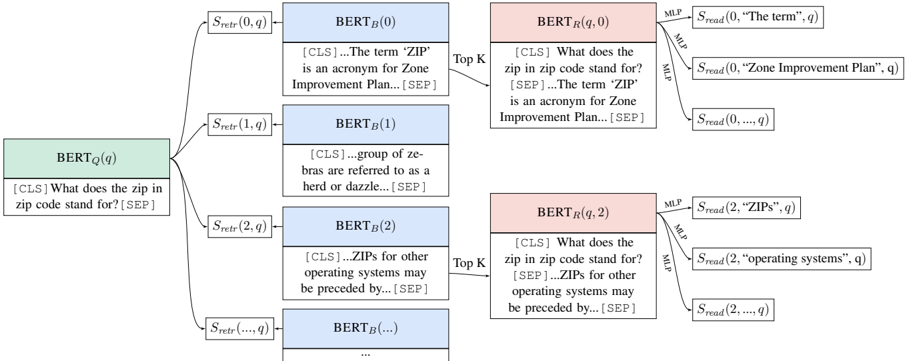
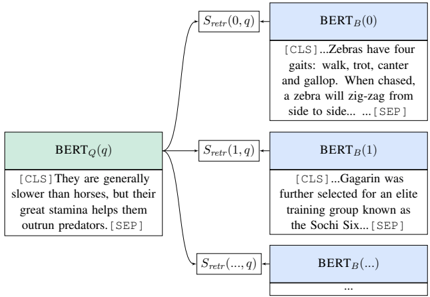
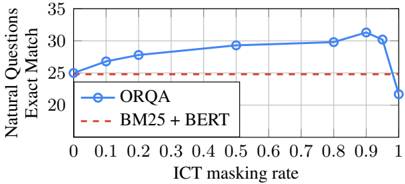
Recent work on open domain question answering (QA) assumes strong supervision of the supporting evidence and/or assumes a blackbox information retrieval (IR) system to retrieve evidence candidates.We argue that both are suboptimal, since gold evidence is not always available, and QA is fundamentally different from IR.We show for the first time that it is possible to jointly learn the retriever and reader from question-answer string pairs and without any IR system.In this setting, evidence retrieval from all of Wikipedia is treated as a latent variable.Since this is impractical to learn from scratch, we pre-train the retriever with an Inverse Cloze Task.We evaluate on open versions of five QA datasets.On datasets where the questioner already knows the answer, a traditional IR system such as BM25 is sufficient.On datasets where a user is genuinely seeking an answer, we show that learned retrieval is crucial, outperforming BM25 by up to 19 points in exact match.
Overview
The claims and statistics of this paper haven’t been checked yet.
Free: it reads the open-access text and checks the first 5 claims that cite a source we can check. Create a free account to check every claim.
Integrity signals
Registry
Cites
Statistics
Figures
Verification
Claims the paper makes
The claims and statistics of this paper haven’t been checked yet.
Free: it reads the open-access text and checks the first 5 claims that cite a source we can check. Create a free account to check every claim.
Claims other papers make about this one
Each is checked against this paper’s own text: does it say what the citing paper says it does?
The source backs part of the claim, not all of it — or backs it for a different population, condition or comparison.
In the citing paper
“Pretrained models with a differentiable access mechanism to explicit non-parametric memory have so far been only investigated for extractive downstream tasks.”
From Retrieval-Augmented Generation for Knowledge-Intensive NLP Tasks (2020) · cites this paper as [31]
Experimental — accuracy not yet measuredThe source backs part of the claim, not all of it — or backs it for a different population, condition or comparison.
In the citing paper
“The standard solution to these issues is to rely on Retrieval Augmented Generation (RAG) (Lee et al., 2019;Lewis et al., 2020;Guu et al., 2020).”
From RAGAs: Automated Evaluation of Retrieval Augmented Generation (2024) · cites this paper as Lee et al., 2019
Experimental — accuracy not yet measuredThe source backs part of the claim, not all of it — or backs it for a different population, condition or comparison.
In the citing paper
“Dense retrieval methods have thus never be shown to outperform TF-IDF/BM25 for opendomain QA before ORQA (Lee et al., 2019)”
From Dense passage retrieval for open-domain question answering (2020) · cites this paper as Lee et al., 2019
Experimental — accuracy not yet measuredThe cited source says what the claim attributes to it.
In the citing paper
“We instantiate this task with data from NaturalQuestions-Open (Lee et al., 2019;Kwiatkowski et al., 2019), which contains historical queries issued to the Google search engine, coupled with human-annotated answers extracted from Wikipedia.”
From Lost in the Middle: How Language Models Use Long Contexts (2024) · cites this paper as Lee et al., 2019
The cited source says what the claim attributes to it.
In the citing paper
“REALM [20] and ORQA [31], two recently introduced models that combine masked language models [8] with a differentiable retriever, have shown promising results, but have only explored open-domain extractive question answering.”
From Retrieval-Augmented Generation for Knowledge-Intensive NLP Tasks (2020) · cites this paper as [31]
8 more claims about this paper
Create a free account to see every claim other papers make about this one.
Self-check
Percentages, sums and reported differences re-computed from the paper’s own numbers.
The self-check needs the paper’s full text.
Citations
Cites
BERT: Pre-training of Deep Bidirectional Transformers for Language Understanding
Devlin, J., Chang, M.-W., Lee, K., & Toutanova, K. (2018) · arXiv · doi:10.48550/arxiv.1810.04805 · Cited by 73,173 · cited 3×
“Following recent advances in transfer learning, all scoring components are derived from BERT (Devlin et al., 2018), a bidirectional transformer that has been pre-trained on unsupervised language-modeling data.”
BackgroundMethodSelf-citationBERT: Pre-training of Deep Bidirectional Transformers for Language Understanding
Devlin, J., Chang, M.-W., Lee, K., & Toutanova, K. (2019) · Proceedings of the 2019 Conference of the North American Chapter of the Association for Computational Linguistics: Human Language Technologies, Volume 1 (Long and Short Papers) · doi:10.18653/v1/n19-1423 · Cited by 54,325 · cited 3×
“Following recent advances in transfer learning, all scoring components are derived from BERT (Devlin et al., 2018), a bidirectional transformer that has been pre-trained on unsupervised language-modeling data.”
BackgroundMethodSelf-citationEfficient Estimation of Word Representations in Vector Space
Mikolov, T., Chen, K., Corrado, G., & Dean, J. (2013) · arXiv · doi:10.48550/arxiv.1301.3781 · Cited by 26,568 · cited 1×
“ICT can be considered a generalization of the skip-gram objective (Mikolov et al., 2013), with a coarser granularity, deep architecture, and in-batch negative sampling from Logeswaran and Lee (2018).”
BackgroundDeep Contextualized Word Representations
Peters, M., Neumann, M., Iyyer, M., Gardner, M., Clark, C., Lee, K., & Zettlemoyer, L. (2018) · Proceedings of the 2018 Conference of the North American Chapter of the Association for Computational Linguistics: Human Language Technologies, Volume 1 (Long Papers) · doi:10.18653/v1/n18-1202 · Cited by 11,983 · cited 2×
“, 2003),4 and (2) ELMO (small), a context-dependent bidirectional LSTM (Peters et al., 2018).”
BackgroundMethodSelf-citationSQuAD: 100,000+ Questions for Machine Comprehension of Text
Rajpurkar, P., Zhang, J., Lopyrev, K., & Liang, P. (2016) · Proceedings of the 2016 Conference on Empirical Methods in Natural Language Processing · doi:10.18653/v1/d16-1264 · Cited by 6,208 · cited 8×
“In the strongly supervised setting popularized by DrQA (Chen et al., 2017), they also assume a reading comprehension model trained on question-answer-evidence triples, such as SQuAD (Rajpurkar et al., 2016).”
BackgroundMethodResultInfluentialThe probabilistic relevance framework: BM25 and beyond
Robertson, S., & Zaragoza, H. (2009) · Foundations and Trends® in Information Retrieval · doi:10.1561/1500000019 · Cited by 3,374
“Cloze Procedure”: A New Tool for Measuring Readability
Taylor, W. L. (1953) · Journalism Quarterly · doi:10.1177/107769905303000401 · Cited by 2,332 · cited 1×
“In the standard Cloze task (Taylor, 1953), the goal is to predict masked-out text based on its context.”
BackgroundNatural Questions: A benchmark for question answering research
Kwiatkowski, T., Palomaki, J., Redfield, O., Collins, M., Parikh, A., Alberti, C., Epstein, D., Polosukhin, I., Devlin, J., Lee, K., et al. (2019) · Transactions of the Association for Computational Linguistics · doi:10.1162/tacl_a_00276 · Cited by 2,069 · cited 3×
“Natural Questions contains question from aggregated queries to Google Search (Kwiatkowski et al., 2019).”
BackgroundSelf-citationTriviaQA: A Large Scale Distantly Supervised Challenge Dataset for Reading Comprehension
Joshi, M., Choi, E., Weld, D., & Zettlemoyer, L. (2017) · Proceedings of the 55th Annual Meeting of the Association for Computational Linguistics (Volume 1: Long Papers) · doi:10.18653/v1/p17-1147 · Cited by 1,690 · cited 8×
“TriviaQA is a collection of trivia questionanswer pairs that were scraped from the web (Joshi et al., 2017).”
BackgroundMethodInfluentialTriviaQA: A Large Scale Distantly Supervised Challenge Dataset for Reading Comprehension
Joshi, M., Choi, E., Weld, D. S., & Zettlemoyer, L. (2017) · arXiv · doi:10.48550/arxiv.1705.03551 · Cited by 1,650 · cited 8×
“TriviaQA is a collection of trivia questionanswer pairs that were scraped from the web (Joshi et al., 2017).”
BackgroundMethodInfluential
Research works printed but not linked: 5
- Yoshua Bengio, Réjean Ducharme, Pascal Vincent, and Christian Jauvin. 2003. A neural probabilistic lan- guage model. Journal of machine learning research, 3(Feb):1137-1155.
- Danqi Chen, Adam Fisch, Jason Weston, and Antoine Bordes. 2017. Reading wikipedia to answer open- domain questions. In Proceedings of the 55th An- nual Meeting of the Association for Computational Linguistics (Volume 1: Long Papers), volume 1, pages 1870-1879.
- Rajarshi Das, Shehzaad Dhuliawala, Manzil Zaheer, and Andrew McCallum. 2019. Multi-step retriever- reader interaction for scalable open-domain question answering. In International Conference on Learn- ing Representations.
- Matthew E. Peters, Mark Neumann, Mohit Iyyer, Matt Gardner, Christopher Clark, Kenton Lee, and Luke Zettlemoyer. 2018. Deep contextualized word rep- resentations. In Proc. of NAACL.
- Shuohang Wang, Mo Yu, Xiaoxiao Guo, Zhiguo Wang, Tim Klinger, Wei Zhang, Shiyu Chang, Gerry Tesauro, Bowen Zhou, and Jing Jiang. 2018. R 3: Reinforced ranker-reader for open-domain question answering. In Thirty-Second AAAI Conference on Artificial Intelligence.
Cited by
Items 801–849 of 849
Adaptive Retrieval Enhancement for Open-Domain Question Answering
Lin, L., & Zhu, X. (2025) · Lecture notes in computer science · doi:10.1007/978-981-95-3055-7_10
A multimodal fusion and symmetric dual-encoder based generation method for KB-VQA
Zheng, H., Sun, T., Liu, H., Zhang, Z., Yang, Z., Wang, X., & Liu, G. (2025) · Applied Intelligence · doi:10.1007/s10489-025-06992-3 · Cited by 1
“…our model does not rely on the API interface of large models (GPT-3), as we only extract implicit knowledge from the large model during data During answer evaluation, normalization is applied, which includes removing articles, punctuation, redundant spaces, and converting text to lowercase [ 39].”
Performance Measurement of LLM Classification for Imbalanced Class sizes
Dunne, J. (2025) · Irish Signals and Systems Conference · doi:10.1109/issc67739.2025.11291262
“Large language models (LLM) are artificial neural networks (ANN) initially designed for the information retrieval domain [2].”
Joint-Loss Composite Contrastive Learning for Enhanced Semantic Embeddings
Zhang, Y., Han, B., Gao, X., Xie, K., Deng, W., Liu, Y., Zhu, Y., & Zhang, Y. (2025) · IEEE International Conference on Industrial Electronics for Sustainable Energy Systems (IESES) · doi:10.1109/ieses66335.2025.11359830
“CL also supports neural text retrieval [24] via Inverse Cloze Test (ICT) [25] and document structures [26].”
Multi-Modal Refined Prompting for Advancing Knowledge-Based Visual Question Answering
Zhu, L., Ying, M., Zhang, C., Liu, D., Wu, L. Y., Zhang, S., & Li, X. (2026) · IEEE Transactions on Multimedia · doi:10.1109/tmm.2026.3660119 · Cited by 1
Domain Knowledge graph enhancement method
Liang, Z., & Lin, W. (2026) · International Conference on Consumer Electronics and Computer Engineering (ICCECE) · doi:10.1109/iccece69169.2026.11399755
“One method to mitigate this issue is Retrieval-Augmented Generation (RAG) [8], which employs document retrieval to provide more accurate answers to user queries by grounding the generated responses in factual information from retrieved documents.”
Disentangled Contrastive Representation Learning for Zero-Shot Biomedical Text Classification
Mukherjee, R., Dahal, S., & Jha, K. (2025) · Proceedings · doi:10.1109/icdm65498.2025.00152
“• ICT [42]: A BERT model was pre-trained using the Inverse Cloze Task (ICT) objective, specifically for predicting titles.”
A comprehensive survey on table question answering: Datasets, methods and future directions
Xu, W., Liu, Y., Lu, L., Li, H., & Sun, G. (2026) · Engineering Applications of Artificial Intelligence · doi:10.1016/j.engappai.2026.114459 · Cited by 2
Bonifazi, G., Buratti, C., Marchetti, M., Parlapiano, F., Traini, D., Ursino, D., & Virgili, L. (2026) · ACM Transactions on Intelligent Systems and Technology · doi:10.1145/3803797 · Cited by 1
Wang, H., Wang, Z., Zhou, W., & Deng, Y. (2026) · IEEE Transactions on Audio Speech and Language Processing · doi:10.1109/taslpro.2026.3675784 · Cited by 1
Xiong, L., Wang, X., & Liu, Q. (2026) · IEEE PES International Meeting (PES IM) · doi:10.1109/pesim67009.2026.11438397
“Large Language Models (LLMs), with their powerful natural language understanding, generation, and contextual learning capabilities, revolutionizes text processing and interaction, enabling information extraction or preliminary diagnostics via prompting [4].”
Question Answering with Hybrid Data and Models
Kamath, S. (2020) · theses.fr (ABES) · doi:10.70675/49d4e33bz05d5z4121z9d7azef3162487087
Reliable Batch-Sequential Model Editing via Enhanced Editing Anchor Compression
Xu, H., Peng, Z., Wang, X., Guo, H., & Ling, Z. (2026) · ACM Transactions on Intelligent Systems and Technology · doi:10.1145/3803803
“Open-domain QA on the Natural Question [24], and the results were measured by exact match with the reference answer after minor normalization as in [4] and [25].”
Towards Effective, Efficient and Explainable Neural Information Retrieval
Formal, T. (2023) · theses.fr (ABES) · doi:10.70675/0e6d7bcbz4ddbz45bczb909z78ab26702a56 · Cited by 1
Human-Machine Dialogue in the Medical Field. Using Dialog to Collect Important Patient Information
Liednikova, A. (2022) · theses.fr (ABES) · doi:10.70675/b572f8cbz5876z4683z828bzfb09085ddd78 · Cited by 1
Proactive models for open-domain conversational search
Erbacher, P. (2024) · theses.fr (ABES) · doi:10.70675/f7d68861zc694z49f1zb130z675cbf38ed1c · Cited by 1
Répondre aux questions visuelles à propos d'entités nommées
Lerner, P. J. (2023) · theses.fr (ABES) · doi:10.70675/78c96766zfc95z4da8zb67aze67555da6c75 · Cited by 1
MG$$^2$$-RAG: Multi-granularity Graph for Multimodal Retrieval-Augmented Generation
Dai, S., Huang, Q., You, X., & Yu, J. (2026) · Lecture notes in computer science · doi:10.1007/978-3-032-37167-6_32 · Cited by 8
Liu, Z., Wen, Z., Tian, Z., Huang, Z., Zhu, M., Wei, Z., Gao, Y., Ding, L., & Li, D. (2026) · International World Wide Web Conference (WWW) · doi:10.1145/3774904.3792085 · Cited by 4
Li, C., Chen, L., Tang, J., Bai, Y., Zhang, Y., Zheng, Z., Zhou, P., & Qu, Z. (2026) · International World Wide Web Conference (WWW) · doi:10.1145/3774904.3792550 · Cited by 1
“We evaluate all methods on five Q&A datasets spanning diverse domains: Biology (BioASQ [27]), Emotional Sociology(TweetQA [34]), Science (SimpleQA [31]), Medicine (PubmedQA [11]), and a general domain dataset (NQ-open [14]).”
CGPT: Cluster-Guided Partial Tables with LLM-Generated Supervision for Table Retrieval
Chou, T.-H., Yu, C.-J., Hsu, S.-H., & Fan, Y.-C. (2026) · International World Wide Web Conference (WWW) · doi:10.1145/3774904.3792916
“For large tables, this design can cause excessive semantic compression.”
Privacy-First AI: Building an Offline RAG System with Streamlit and Local LLMs
Chakraborty, P., Ghosh, D., Srivastav, S., Hait, S., & Chakraborty, S. (2026) · Lecture notes in electrical engineering · doi:10.1007/978-981-95-0429-9_3
Synapsen aus Sprache: Vom Prompt zum Dialog
Grasnick, A. (2026) · Springer eBooks · doi:10.1007/978-3-658-47898-8_14-1
Knowledge editing for multimodal LLMs from decomposed subspaces
Li, S.-C., Wang, M.-Q., Meng, Z., Liu, L.-Z., Su, F., & Zhao, Z.-C. (2026) · Expert systems with applications · doi:10.1016/j.eswa.2026.134313
Moutaoukkil, A., Mezouary, A. E., & Boumalek, K. (2026) · International Journal of Advanced Computer Science and Applications · doi:10.14569/ijacsa.2026.0170422
“However, most original work on RAG, such as the innovative framework in [19], has focused on architectural innovation, joint training of retrievers[25][26][27] and generators[28][29], or scaling to massive generic corpora.”
Retrieval-Enhanced Real Estate Appraisal
Popelier, S., Sarazin, M., Bohm, M., Gierski, M., Mergui, H., Ospici, M., & Bernhardt, A. (2026) · Communications in computer and information science · doi:10.1007/978-3-032-25311-8_35
SQA: SPARQL Query Annotating with Question-Answer Pairs
Bao, Y., Zhou, W., Wu, X., Hu, W., Xu, D., 钱铭佳, & Qu, Y. (2026) · Lecture notes in computer science · doi:10.1007/978-3-032-25156-5_3
Puneet Yadav, V. S. (2026) · International Journal of Advanced Research in Science Communication and Technology · doi:10.48175/ijarsct-35217
Open-Tag: A Generative Framework for Open-World Multimodal Tagging
Zhang, Z., Ma, Z., Wang, P., Li, B., Yuan, C., & Hu, W. (2026) · International Journal of Computer Vision · doi:10.1007/s11263-026-02844-w
Saliency-Guided Embedding Alignment for Query-to-Document Legal Case Retrieval
Shi, Y.-H., & Fan, Y.-C. (2026) · International World Wide Web Conference (WWW) · doi:10.1145/3774905.3795085
“Following the Inverse Cloze Task (ICT) [15], we adapt it to the legal domain as the Legal Inverse Cloze Task (LICT): given a target chunk, the model learns to predict its surrounding context, thereby capturing intra-document coherence.”
Jain, A. H., Yarrrabothu, S. R., Kande, N. K., & Kethireddy, D. R. (2026) · International Conference on Artificial Intelligence, Systems, and Emerging Technologies (ICAISET) · doi:10.1109/icaiset66439.2026.11541329
“Latent retrieval over large corpora was proposed by ORQA [7], retrieval-aware pretraining by REALM [8], and it was demonstrated by DPR that dense retrievers could help open-domain answer selection in a significant way [9].”
Jiang, Q., Zhang, L., & Gao, M. (2026) · International Conference on Artificial Intelligence and Industrial Technology Applications (AIITA) · doi:10.1109/aiita69518.2026.11567329
“…it suffers from three critical limitations: Semantic gap and context fragmentation, Mechanical text segmentation disrupts the inherent logical structure of documents, leading to retrieved fragments with insufficient contextual information — often resulting in incomplete or ambiguous outputs [1,2].”
Nidhom, A. (2026) · International Journal of Complexity in Applied Science and Technology · doi:10.1504/ijcast.2026.10079341
Scaling Down Hallucinations: Mitigation Strategies for Compact LLMs
Silva, S. G. G., & Ishii, R. P. (2026) · Lecture notes in computer science · doi:10.1007/978-3-032-30488-9_39
Chen, R., Xiang, Z., Wang, P., Fang, H., Li, M., Zeng, F., Zhu, Y., Yang, P., Zhang, X.-Y., & Cheng, J. (2026) · Findings of the Association for Computational Linguistics: ACL (Findings of ACL) · doi:10.18653/v1/2026.findings-acl.883
“FARSS delivers particularly strong performance on PIQA (Bisk et al., 2020), WinoGrande (Sakaguchi et al., 2021), and Open-BookQA (Mihaylov et al., 2018).”
InfluentialTowards Adaptive and Retriever-friendly Retrieval-augmented Generation via Reinforcement Learning
FANG, Y., Yu, H.-T., Joho, H., & Fujita, S. (2026) · ACM SIGIR International Conference on Theory of Information Retrieval (ICTIR) · doi:10.1145/3805713.3820432
“As demonstrated by prior studies [4, 11, 25, 44, 47], especially the empirical experiments by Zhou and Chen [47], a particularly critical issue lies in the inherent gap between the retriever and the generator, which lingers like a thorn in the system and persistently constrains the overall…”
Cross-Sensory Comparison of EEG Signals for Brain-Based Information Retrieval
McGuire, N., & Moshfeghi, Y. (2026) · International ACM SIGIR Conference on Research and Development in Information Retrieval (SIGIR) · doi:10.1145/3805712.3809922
“The framework employs the Inverse Cloze Task [5, 30] to generate query-document pairs from naturalistic reading data.”
Ahmed, T., & Choudhury, S. (2026) · SSRN Electronic Journal · doi:10.2139/ssrn.7181277
Rashmi, P. (2026) · International Journal of Innovative Research in Technology · doi:10.64643/ijirtv12i12-206817-459
TRIP: A Bi-level Travel Routing Intelligent Planner Informed from Human Planning Behaviors
Liu, Y., Zhang, R., Chen, Y. F., Sun, L., & Zhu, T. (2026) · ACM Transactions on Knowledge Discovery from Data · doi:10.1145/3836768 · Cited by 1
“Sparse retrieval methods, such as TF-IDF[24] and BM25[29], along with dense retrieval methods [5, 18, 19], have gained prominence in the application of RAG.”
Retrieval-augmented generation for medical question answering: a multi-metric performance evaluation
Kökver, Y. (2026) · PeerJ Computer Science · doi:10.7717/peerj-cs.4053
Toward effective Text-to-MongoDB query translation
Aggoune, A. (2026) · International Journal of Advances in Intelligent Informatics · doi:10.26555/ijain.v12i2.2360
Training Dense Retrievers with Multiple Positive Passages
Wang, B., Tang, M., Zhang, H., Guo, J., & Bi, K. (2026) · ACM SIGKDD Conference on Knowledge Discovery and Data Mining (KDD) · doi:10.1145/3770855.3818053 · Cited by 1
“Early approaches bridged this gapbyconstructingpseudo-relevancesignals—forinstance,through inverseclozetasks[17]orcontrastivespanprediction[13]—toalign queryanddocumentembeddingspaces.”
AyuRAG: A Retrieval-Augmented Generation Framework for Ayurvedic Knowledge Access
Kumar, M. A., Kanika, Sri, U., Bhuvana, & Garg, D. (2026) · Adroid Conference Series Engineering and Technology · doi:10.63503/acset.978-81-995593-9-4.48
From perception to governance: Knowledge-enhanced intelligence for smart sustainable buildings
Liu, S., Xie, H., Lei, Y., Zhao, J., Liu, J., Song, G., Zhang, L., Yang, W., Song, X., & Zhang, H. (2026) · Energy and Buildings · doi:10.1016/j.enbuild.2026.118128
Retrieval-Augmented Generation and Knowledge-Grounded Large Language ModelsPreprint
Bolledla, S. (2026) · SSRN Electronic Journal · doi:10.2139/ssrn.7357178
Yajima, R. (n.d.) · Institutional Repositories DataBase (IRDB) · doi:10.15002/00030622
A cognitive hierarchy-guided abstract forest knowledge base based on cognitive load theory
Zhao, F., Xu, K., & Feng, J. (2026) · Engineering Applications of Artificial Intelligence · doi:10.1016/j.engappai.2026.116241
Research on a Novel Semantic Representation Method Based on Reconstituted Sample Enhancement
Gao, X., Xie, K., Liu, Y., Zhu, Y., Lu, Y., Kong, X., & Zhang, I. Y. (2026) · ACM Transactions on Asian and Low-Resource Language Information Processing · doi:10.1145/3837065
“Inverse Cloze Test ( ICT ) [28] is one of the most commonly used contrastive pre-training tasks for retrieval, predicting sentences randomly selected from the remaining text.”
Metadata
- Authors
- Lee, K., Chang, M.-W., & Toutanova, K.
- Affiliations
- Google (United States) (US)
- Venue
- Proceedings of the 57th Annual Meeting of the Association for Computational Linguistics
- Published
- 2019
- Pages
- 6086-6096
- ISSN
- 0736-587X (ISSN-L)
- OpenAlex
- W2947497897
- Cited by
- 771
- References
- 30
- Citations by year
- 2026: 36 · 2025: 67 · 2024: 70 · 2023: 159 · 2022: 134 · 2021: 194 · 2020: 101 · 2019: 10
- FWCI
- 41.99
- Type
- conference paper
- Language
- en
- Open access
- hybrid
- doi.org
- Licence
- cc-by
- Locations
- Proceedings of the conference - Association for Computational Linguistics. Meeting (publishedVersion, cc-by)
- arXiv (Cornell University) (submittedVersion)
- arXiv (Cornell University)
- Topics
- Physical Sciences › Computer Science › Artificial Intelligence › Topic Modeling
- Physical Sciences › Computer Science › Information Systems › Information Retrieval and Search Behavior
- Physical Sciences › Computer Science › Computer Vision and Pattern Recognition › Multimodal Machine Learning Applications
- Keywords
- open-domain question answering, weakly supervised learning, evidence retrieval
About these checks
Registry, retraction, Cites and statistics results are computed, not judged, with one exception: a printed reference that no index lists is read once by a model before it counts as a citation error. Claims are extracted by a model and kept only when their quote appears verbatim in the text; each cited source is then checked, with a model’s help, for whether it says what the claim relies on. Those verdicts can be wrong — read the claim’s quote and the cited source before relying on one.
Statistics and arithmetic are recomputed, not judged.
Confidence bands are shown only for fields calibrated on our annotated test set. None is calibrated yet, so no band is shown.
What counts as a claim ›How we measure confidence ›How we check this ›
Are you an author, or do you see a problem with this page? Request a review
Data sources
Bibliographic data: Semantic Scholar, OpenAlex, Crossref.
Contains information from the Semantic Scholar Academic Graph Datasets, made available under the ODC Attribution License (ODC-BY 1.0).
Semantic Scholar’s data is described in: Kinney, R., et al. (2023). The Semantic Scholar Open Data Platform. arXiv:2301.10140.
