

Latent Retrieval for Weakly Supervised Open Domain Question Answering
Open accessThe DOI matches its Crossref record; 34 of the 34 references it cites were found in a registry or an index.
Abstract
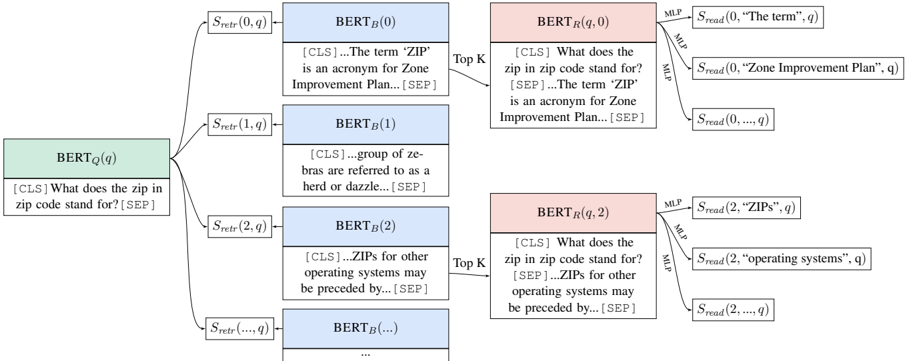
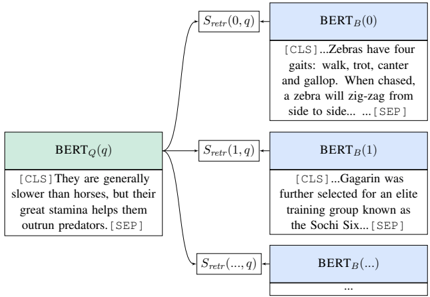
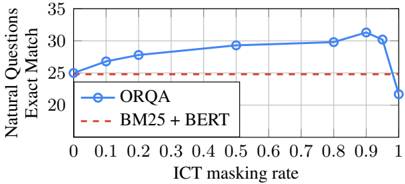
Recent work on open domain question answering (QA) assumes strong supervision of the supporting evidence and/or assumes a blackbox information retrieval (IR) system to retrieve evidence candidates.We argue that both are suboptimal, since gold evidence is not always available, and QA is fundamentally different from IR.We show for the first time that it is possible to jointly learn the retriever and reader from question-answer string pairs and without any IR system.In this setting, evidence retrieval from all of Wikipedia is treated as a latent variable.Since this is impractical to learn from scratch, we pre-train the retriever with an Inverse Cloze Task.We evaluate on open versions of five QA datasets.On datasets where the questioner already knows the answer, a traditional IR system such as BM25 is sufficient.On datasets where a user is genuinely seeking an answer, we show that learned retrieval is crucial, outperforming BM25 by up to 19 points in exact match.
Overview
The claims and statistics of this paper haven’t been checked yet.
Free: it reads the open-access text and checks the first 5 claims that cite a source we can check. Create a free account to check every claim.
Integrity signals
Registry
Cites
Statistics
Figures
Verification
Claims the paper makes
The claims and statistics of this paper haven’t been checked yet.
Free: it reads the open-access text and checks the first 5 claims that cite a source we can check. Create a free account to check every claim.
Claims other papers make about this one
Each is checked against this paper’s own text: does it say what the citing paper says it does?
The source backs part of the claim, not all of it — or backs it for a different population, condition or comparison.
In the citing paper
“Pretrained models with a differentiable access mechanism to explicit non-parametric memory have so far been only investigated for extractive downstream tasks.”
From Retrieval-Augmented Generation for Knowledge-Intensive NLP Tasks (2020) · cites this paper as [31]
Experimental — accuracy not yet measuredThe source backs part of the claim, not all of it — or backs it for a different population, condition or comparison.
In the citing paper
“The standard solution to these issues is to rely on Retrieval Augmented Generation (RAG) (Lee et al., 2019;Lewis et al., 2020;Guu et al., 2020).”
From RAGAs: Automated Evaluation of Retrieval Augmented Generation (2024) · cites this paper as Lee et al., 2019
Experimental — accuracy not yet measuredThe source backs part of the claim, not all of it — or backs it for a different population, condition or comparison.
In the citing paper
“Dense retrieval methods have thus never be shown to outperform TF-IDF/BM25 for opendomain QA before ORQA (Lee et al., 2019)”
From Dense passage retrieval for open-domain question answering (2020) · cites this paper as Lee et al., 2019
Experimental — accuracy not yet measuredThe cited source says what the claim attributes to it.
In the citing paper
“We instantiate this task with data from NaturalQuestions-Open (Lee et al., 2019;Kwiatkowski et al., 2019), which contains historical queries issued to the Google search engine, coupled with human-annotated answers extracted from Wikipedia.”
From Lost in the Middle: How Language Models Use Long Contexts (2024) · cites this paper as Lee et al., 2019
The cited source says what the claim attributes to it.
In the citing paper
“REALM [20] and ORQA [31], two recently introduced models that combine masked language models [8] with a differentiable retriever, have shown promising results, but have only explored open-domain extractive question answering.”
From Retrieval-Augmented Generation for Knowledge-Intensive NLP Tasks (2020) · cites this paper as [31]
8 more claims about this paper
Create a free account to see every claim other papers make about this one.
Self-check
Percentages, sums and reported differences re-computed from the paper’s own numbers.
The self-check needs the paper’s full text.
Citations
Cites
BERT: Pre-training of Deep Bidirectional Transformers for Language Understanding
Devlin, J., Chang, M.-W., Lee, K., & Toutanova, K. (2018) · arXiv · doi:10.48550/arxiv.1810.04805 · Cited by 73,173 · cited 3×
“Following recent advances in transfer learning, all scoring components are derived from BERT (Devlin et al., 2018), a bidirectional transformer that has been pre-trained on unsupervised language-modeling data.”
BackgroundMethodSelf-citationBERT: Pre-training of Deep Bidirectional Transformers for Language Understanding
Devlin, J., Chang, M.-W., Lee, K., & Toutanova, K. (2019) · Proceedings of the 2019 Conference of the North American Chapter of the Association for Computational Linguistics: Human Language Technologies, Volume 1 (Long and Short Papers) · doi:10.18653/v1/n19-1423 · Cited by 54,325 · cited 3×
“Following recent advances in transfer learning, all scoring components are derived from BERT (Devlin et al., 2018), a bidirectional transformer that has been pre-trained on unsupervised language-modeling data.”
BackgroundMethodSelf-citationEfficient Estimation of Word Representations in Vector Space
Mikolov, T., Chen, K., Corrado, G., & Dean, J. (2013) · arXiv · doi:10.48550/arxiv.1301.3781 · Cited by 26,568 · cited 1×
“ICT can be considered a generalization of the skip-gram objective (Mikolov et al., 2013), with a coarser granularity, deep architecture, and in-batch negative sampling from Logeswaran and Lee (2018).”
BackgroundDeep Contextualized Word Representations
Peters, M., Neumann, M., Iyyer, M., Gardner, M., Clark, C., Lee, K., & Zettlemoyer, L. (2018) · Proceedings of the 2018 Conference of the North American Chapter of the Association for Computational Linguistics: Human Language Technologies, Volume 1 (Long Papers) · doi:10.18653/v1/n18-1202 · Cited by 11,983 · cited 2×
“, 2003),4 and (2) ELMO (small), a context-dependent bidirectional LSTM (Peters et al., 2018).”
BackgroundMethodSelf-citationSQuAD: 100,000+ Questions for Machine Comprehension of Text
Rajpurkar, P., Zhang, J., Lopyrev, K., & Liang, P. (2016) · Proceedings of the 2016 Conference on Empirical Methods in Natural Language Processing · doi:10.18653/v1/d16-1264 · Cited by 6,208 · cited 8×
“In the strongly supervised setting popularized by DrQA (Chen et al., 2017), they also assume a reading comprehension model trained on question-answer-evidence triples, such as SQuAD (Rajpurkar et al., 2016).”
BackgroundMethodResultInfluentialThe probabilistic relevance framework: BM25 and beyond
Robertson, S., & Zaragoza, H. (2009) · Foundations and Trends® in Information Retrieval · doi:10.1561/1500000019 · Cited by 3,374
“Cloze Procedure”: A New Tool for Measuring Readability
Taylor, W. L. (1953) · Journalism Quarterly · doi:10.1177/107769905303000401 · Cited by 2,332 · cited 1×
“In the standard Cloze task (Taylor, 1953), the goal is to predict masked-out text based on its context.”
BackgroundNatural Questions: A benchmark for question answering research
Kwiatkowski, T., Palomaki, J., Redfield, O., Collins, M., Parikh, A., Alberti, C., Epstein, D., Polosukhin, I., Devlin, J., Lee, K., et al. (2019) · Transactions of the Association for Computational Linguistics · doi:10.1162/tacl_a_00276 · Cited by 2,069 · cited 3×
“Natural Questions contains question from aggregated queries to Google Search (Kwiatkowski et al., 2019).”
BackgroundSelf-citationTriviaQA: A Large Scale Distantly Supervised Challenge Dataset for Reading Comprehension
Joshi, M., Choi, E., Weld, D., & Zettlemoyer, L. (2017) · Proceedings of the 55th Annual Meeting of the Association for Computational Linguistics (Volume 1: Long Papers) · doi:10.18653/v1/p17-1147 · Cited by 1,690 · cited 8×
“TriviaQA is a collection of trivia questionanswer pairs that were scraped from the web (Joshi et al., 2017).”
BackgroundMethodInfluentialTriviaQA: A Large Scale Distantly Supervised Challenge Dataset for Reading Comprehension
Joshi, M., Choi, E., Weld, D. S., & Zettlemoyer, L. (2017) · arXiv · doi:10.48550/arxiv.1705.03551 · Cited by 1,650 · cited 8×
“TriviaQA is a collection of trivia questionanswer pairs that were scraped from the web (Joshi et al., 2017).”
BackgroundMethodInfluential
Research works printed but not linked: 5
- Yoshua Bengio, Réjean Ducharme, Pascal Vincent, and Christian Jauvin. 2003. A neural probabilistic lan- guage model. Journal of machine learning research, 3(Feb):1137-1155.
- Danqi Chen, Adam Fisch, Jason Weston, and Antoine Bordes. 2017. Reading wikipedia to answer open- domain questions. In Proceedings of the 55th An- nual Meeting of the Association for Computational Linguistics (Volume 1: Long Papers), volume 1, pages 1870-1879.
- Rajarshi Das, Shehzaad Dhuliawala, Manzil Zaheer, and Andrew McCallum. 2019. Multi-step retriever- reader interaction for scalable open-domain question answering. In International Conference on Learn- ing Representations.
- Matthew E. Peters, Mark Neumann, Mohit Iyyer, Matt Gardner, Christopher Clark, Kenton Lee, and Luke Zettlemoyer. 2018. Deep contextualized word rep- resentations. In Proc. of NAACL.
- Shuohang Wang, Mo Yu, Xiaoxiao Guo, Zhiguo Wang, Tim Klinger, Wei Zhang, Shiyu Chang, Gerry Tesauro, Bowen Zhou, and Jing Jiang. 2018. R 3: Reinforced ranker-reader for open-domain question answering. In Thirty-Second AAAI Conference on Artificial Intelligence.
Cited by
Items 501–600 of 849
Graph-based Retrieval for Claim Verification over Cross-document Evidence
Mongiovì, M., & Gangemi, A. (2022) · Studies in computational intelligence · doi:10.1007/978-3-030-93413-2_41 · Cited by 6
Question Rewriting for Open-Domain Conversational QA: Best Practices and Limitations
Tredici, M. D., Barlacchi, G., Shen, X., Cheng, W., & de Gispert, A. (2021) · ACM International Conference on Information and Knowledge Management (CIKM) · doi:10.1145/3459637.3482164 · Cited by 24
“To overcome such limitation, open-domain conversational QA (ODCQA) [1, 10, 14] has been proposed recently as yet another extension, where the models are given access to a large corpus or the entire web when answering the questions, instead of being limited to pre-selected passages or documents.”
MethodSil, A., Sen, J., Iyer, B., Franz, M., Fadnis, K., Bornea, M. A., Rosenthal, S., McCarley, S., Zhang, R., Kumar, V., et al. (2023) · Proceedings of the conference - Association for Computational Linguistics. Meeting · doi:10.18653/v1/2023.acl-demo.5 · Cited by 9
Technical Question Answering across Tasks and Domains
Yu, W., Wu, L., Deng, Y., Zeng, Q., Mahindru, R., Güven, S., & Jiang, M. (2021) · Conference of the North American Chapter of the Association for Computational Linguistics: Human Language Technologies (NAACL-HLT) · doi:10.18653/v1/2021.naacl-industry.23 · Cited by 10
Open-domain conversational search assistants: the Transformer is all you need
Ferreira, R., Leite, M., Semedo, D., & Magalhães, J. (2022) · Information Retrieval · doi:10.1007/s10791-022-09403-0 · Cited by 9
“These methods first extract embeddings for the full set of retrievable documents, from a pre-trained backbone model, that can be optionally fine-tuned (Lee et al. 2019; Guu et al. 2020).”
MethodLarge Language Models (LLMs) for Natural Language Processing (NLP) of Oil and Gas Drilling Data
Kumar, P., & Kathuria, S. (2023) · doi:10.2118/215167-ms · Cited by 6
Pruning the Index Contents for Memory Efficient Open-Domain QAPreprint
Fajčík, M., Dočekal, M., Ondrej, K., & Smrž, P. (2021) · arXiv (Cornell University) · doi:10.13140/rg.2.2.32959.02727 · Cited by 9
Efficient Retrieval Optimized Multi-task LearningPreprint
Fun, H., Gandhi, S., & Ravi, S. (2021) · arXiv (Cornell University) · doi:10.48550/arxiv.2104.10129 · Cited by 8
“Inverse Cloze Task (ICT) is a pre-training task introduced by (Lee et al., 2019).”
InfluentialSong, J., Jin, C., Zhao, W., McCallum, A., & Lee, J. Y. (2024) · Conference on Empirical Methods in Natural Language Processing (EMNLP) · doi:10.18653/v1/2024.emnlp-main.1242 · Cited by 8
RK-VQA: Rational knowledge-aware fusion-in-decoder for knowledge-based visual question answering
Chen, W., Huang, X. Q., Liu, Z., Liu, J., Yin, H., & Yo, L. (2025) · Information Fusion · doi:10.1016/j.inffus.2025.102969 · Cited by 7
Mori, L., Oliveira, C. S., Yih, Y., & Ventresca, M. (2025) · International Conference on Artificial Intelligence and Law · doi:10.1145/3769126.3769205 · Cited by 12
“A qualitative and quantitative analysis using three complementary metrics reveals that, when BM25 outperforms dense models, there is less overlap between the query and the target passage, with statistical significance (Section 5).”
Contrastive Refinement for Dense Retrieval Inference in the Open-Domain Question Answering Task
Zhai, Q., Zhu, W., Zhang, X., & Liu, C. (2023) · Future Internet · doi:10.3390/fi15040137 · Cited by 7
Meta-classifier free negative sampling for extreme multilabel classification
Qaraei, M., & Babbar, R. (2023) · Machine Learning · doi:10.1007/s10994-023-06468-w · Cited by 9
“Machine learning problems with large output spaces are common in a variety of domains such as face recognition (Schroff et al., 2015), open-domain question answering (Lee et al., 2019), and language models (Bengio & Senécal, 2008).”
Enhancing Robustness of Retrieval-Augmented Language Models with In-Context Learning
Park, S., Choi, S., Kim, N., & Lee, J.-Y. (2024) · doi:10.18653/v1/2024.knowledgenlp-1.7 · Cited by 10
Improving ranking-based question answering with weak supervision for low-resource Qur’anic texts
ElKoumy, M., & Sarhan, A. M. (2024) · Artificial Intelligence Review · doi:10.1007/s10462-024-10964-3 · Cited by 8
“Several works (Swayamdipta et al. 2017; Lee et al. 2019) proposed training methods for multi-mention cases in MRC by marginalizing over all possibly correct unlabelled answers under a weakly supervised setting.”
Zhou, C., Dong, J.-N., Huang, X., Liu, Z.-R., Zhou, K., & Xu, Z.-Z. (2024) · Conference on Empirical Methods in Natural Language Processing · doi:10.18653/v1/2024.findings-emnlp.226 · Cited by 17
“• Inverse Cloze Task (ICT) (Lee et al., 2019) retrieves evidence candidates to answer open-domain questions using a Bert-based model.”
Park, S.-I., & Lee, J.-Y. (2024) · Transactions of the Association for Computational Linguistics · doi:10.1162/tacl_a_00724 · Cited by 23
“We utilized four benchmark datasets: Natural Questions (NQ) (Lee et al., 2019), TriviaQA (TQA) (Joshi et al., 2017), Web Questions (WebQ) (Berant et al., 2013), and PopQA (Mallen et al., 2023).”
Context-Aware Contrastive Representation Learning for Zero-Shot Biomedical Text Classification
Mukherjee, R., & Jha, K. (2024) · IEEE International Conference on Bioinformatics and Biomedicine (BIBM) · doi:10.1109/bibm62325.2024.10822585 · Cited by 5
Li, K., Zhang, T., Tang, L., Li, J., Lu, H., Wu, X., & Meng, H. M. L. (2022) · DialDoc Workshop on Document-grounded Dialogue and Conversational Question Answering (DialDoc) · doi:10.18653/v1/2022.dialdoc-1.13 · Cited by 14
“Previous work (Lee et al., 2019, Guu et al., 2020) adopt end-to-end training strategy to jointly learn the retriever and reader with question-answer pairs.”
MethodGenerating Hashtags for Short-form Videos with Guided Signals
Yu, T., Yu, H., Liang, D., Mao, Y., Nie, S., Huang, P.-Y., Khabsa, M., Fung, P., & Wang, Y. (2023) · Proceedings of the conference - Association for Computational Linguistics. Meeting · doi:10.18653/v1/2023.acl-long.527 · Cited by 9
“…Generation (RAG) has been widely used in NLP tasks, such as neural machine transla-9483 tion (Gu et al., 2018; Hossain et al., 2020), open-domain question answering (Lee et al., 2019; Guu et al., 2020; Lewis et al., 2020b) and knowledge-grounded dialogue generation (Lian et al., 2019).”
MethodReduce Catastrophic Forgetting of Dense Retrieval Training with Teleportation Negatives
Sun, S., Xiong, C., Yu, Y., Overwijk, A., Liu, Z., & Bao, J. (2022) · Conference on Empirical Methods in Natural Language Processing (EMNLP) · doi:10.18653/v1/2022.emnlp-main.445 · Cited by 14
1-PAGER: One Pass Answer Generation and Evidence Retrieval
Jain, P., Soares, L. B., & Kwiatkowski, T. (2023) · Findings of the Association for Computational Linguistics: EMNLP (Findings of EMNLP) · doi:10.18653/v1/2023.findings-emnlp.967 · Cited by 10
Math Word Problem Generation via Disentangled Memory Retrieval
Qin, W., Wang, X., Hu, Z., Wang, L., Lan, Y., & Hong, R. (2024) · ACM Transactions on Knowledge Discovery from Data · doi:10.1145/3639569 · Cited by 12
A Multi-Granularity-Aware Aspect Learning Model for Multi-Aspect Dense Retrieval
Sun, X., Bi, K., Guo, J., Yang, S., Zhang, Q., Liu, Z., Zhang, G., & Cheng, X. (2024) · ACM International Conference on Web Search and Data Mining (WSDM) · doi:10.1145/3616855.3635770 · Cited by 10
Zhao, Y., & Li, D. (2024) · IEEE International Conference on Sensors, Electronics and Computer Engineering (ICSECE) · doi:10.1109/icsece61636.2024.10729522 · Cited by 5
“On the other hand, dense-vector retrieval leverages pre-trained language models, such as those based on BERT, to encode text into low-dimensional dense vectors [9].”
MethodAdaptive Batch Scheduling for Open-Domain Question Answering
Choi, D., Shin, M., Kim, E., & Shin, D. R. (2021) · IEEE Access · doi:10.1109/access.2021.3103963 · Cited by 7
End-to-end Distantly Supervised Information Extraction with Retrieval Augmentation
Zhang, Y., Fei, H., & Li, P. (2022) · International ACM SIGIR Conference on Research and Development in Information Retrieval (SIGIR) · doi:10.1145/3477495.3531876 · Cited by 11
“Retrieval-Augmentation has attractedmore andmore attention [15, 18, 26].”
Cross-Lingual QA as a Stepping Stone for Monolingual Open QA in Icelandic
Snæbjarnarson, V., & Einarsson, H. (2022) · doi:10.18653/v1/2022.mia-1.4 · Cited by 11
Pre-processing Matters! Improved Wikipedia Corpora for Open-Domain Question Answering
Tamber, M. S., Pradeep, R., & Lin, J. (2023) · Lecture notes in computer science · doi:10.1007/978-3-031-28241-6_11 · Cited by 13
Query Context Expansion for Open-Domain Question Answering
Zhu, W., Zhang, X., Liang, Y., & Zhai, Q. (2023) · ACM Transactions on Asian and Low-Resource Language Information Processing · doi:10.1145/3603498 · Cited by 6
NIR-Prompt: A Multi-task Generalized Neural Information Retrieval Training Framework
Xu, S., Pang, L., Shen, H., & Cheng, X. (2023) · ACM Transactions on Information Systems · doi:10.1145/3626092 · Cited by 6
“For example, RD needs to confirm the reply is a logical consequence of the post and dialogue history, and QA needs to pick out the answer that the question hardly contains.”
BackgroundPre-training with Aspect-Content Text Mutual Prediction for Multi-Aspect Dense Retrieval
Sun, X., Bi, K., Guo, J., Ma, X., Fan, Y., Shan, H., Zhang, Q., & Liu, Z. (2023) · ACM International Conference on Information and Knowledge Management (CIKM) · doi:10.1145/3583780.3615157 · Cited by 9
Hybrid First-stage Retrieval Models for Biomedical Literature.
Ma, J., Korotkov, I., Hall, K., & McDonald, R. (2020) · CLEF (Working Notes) · Cited by 5
Zhang, Y., Zhang, X., Hu, Y., Wang, G., & Yan, R. (2021) · ACM International Conference on Web Search and Data Mining (WSDM) · doi:10.1145/3437963.3441707 · Cited by 5
“As to the Open-QA, recent studies have achieved great progress on retrieving related documents from a large and static document set [3, 5, 7].”
BackgroundSimple and Efficient ways to Improve REALM
Balachandran, V., Vaswani, A., Tsvetkov, Y., & Parmar, N. (2021) · Workshop on Machine Reading for Question Answering (MRQA) · doi:10.18653/v1/2021.mrqa-1.16 · Cited by 6
Weakly Supervised Pre-Training for Multi-Hop Retriever
Seonwoo, Y., Lee, S.-W., Kim, J., Ha, J.-W., & Oh, A. H. (2021) · Findings of the Association for Computational Linguistics: ACL (Findings of ACL) · doi:10.18653/v1/2021.findings-acl.62 · Cited by 6
Shao, Z., Shang, L., Liu, Q., & Huang, M. (2021) · doi:10.18653/v1/2021.acl-long.318 · Cited by 6
“…et al., 2017; Tay et al., 2018; Talmor and Berant, 2019), training on all possible solutions with MML (Swayamdipta et al., 2018; Clark and Gardner, 2018; Lee et al., 2019; Wang et al., 2019), reinforcement learning (Liang et al., 2017, 2018), and hard EM (Min et al., 2019; Chen et al., 2020).”
Latent Reasoning for Low-Resource Question Generation
Huang, X., Qi, J., Sun, Y., & Zhang, R. (2021) · Findings of the Association for Computational Linguistics: ACL (Findings of ACL) · doi:10.18653/v1/2021.findings-acl.265 · Cited by 7
“…(Zhao et al., 2019; Huang et al., 2020b; Yang et al., 2020), policy learning (Huang et al., 2019, 2020c), sentiment analysis (Xu et al., 2017; Li et al., 2019), knowledge retrieval (Lee et al., 2019; Kim et al., 2020a; Su et al., 2021; Tan et al., 2021), and text style transfer (He et al., 2020).”
BackgroundToward Deconfounding the Effect of Entity Demographics for Question Answering Accuracy
Gor, M., Webster, K., & Boyd-Graber, J. L. (2021) · Conference on Empirical Methods in Natural Language Processing (EMNLP) · doi:10.18653/v1/2021.emnlp-main.444 · Cited by 7
“For the open-domain TriviaQA task, we use ORQA (Lee et al., 2019) with a BERT-based reader and retriever components.”
MethodSupervised Contrastive Learning Approach for Contextual Ranking
Anand, A., Leonhardt, J., Rudra, K., & Anand, A. (2022) · ACM SIGIR International Conference on Theory of Information Retrieval (ICTIR) · doi:10.1145/3539813.3545139 · Cited by 6
“Typically, dual encoders are used in the retrieval phase [1, 2, 19, 21, 22, 25] however there have been recent proposals that use dual encoders in the re-ranking phase [27].”
MethodRetrieval Data Augmentation Informed by Downstream Question Answering Performance
Ferguson, J., Hajishirzi, H., Dasigi, P., & Khot, T. (2022) · Fact Extraction and VERification Workshop (FEVER) · doi:10.18653/v1/2022.fever-1.1 · Cited by 6
Wang, J., Jatowt, A., & Yoshikawa, M. (2021) · arXiv (Cornell University) · doi:10.48550/arxiv.2109.03438 · Cited by 11
“18Note that another way to use the dataset is to train models without using the paragraph information [28].”
MethodBuilding an Efficient and Effective Retrieval-based Dialogue System via Mutual LearningPreprint
Tao, C., Feng, J., Liu, C., Li, J., Geng, X., & Jiang, D. (2021) · arXiv (Cornell University) · doi:10.48550/arxiv.2110.00159 · Cited by 8
“We then project the [CLS] representation to a vector as the context representation following Lee, Chang, and Toutanova (2019).”
Encoder Adaptation of Dense Passage Retrieval for Open-Domain Question AnsweringPreprint
Li, M., & Lin, J. (2021) · arXiv (Cornell University) · doi:10.48550/arxiv.2110.01599 · Cited by 11
“Recently, retrievers based on neural networks (Goodfellow et al., 2016) and pre-trained language models (Devlin et al., 2019) also make great advancement in open-domain question-answering (Seo et al., 2019; Lee et al., 2019; Guu et al., 2020).”
BackgroundHow Context Affects Language Models' Factual Predictions
Fabio Petroni, P. L. (2020) · Automated Knowledge Base Construction (AKBC) · doi:10.24432/c5201w · Cited by 4
“Finally, while we have chosen DrQA as our baseline to compare to recent work, there exist several more sophisticated supervised open-domain QA models that outperform it on a variety of open-domain QA tasks [Lee et al., 2019, Yang et al., 2019a, Guu et al., 2020].”
BackgroundMethodPLM-based World Models for Text-based Games
Kim, M., Jung, Y., Lee, D., & Hwang, S.-W. (2022) · Proceedings of the 2022 Conference on Empirical Methods in Natural Language Processing · doi:10.18653/v1/2022.emnlp-main.86 · Cited by 4
“In our case, it is possible to adopt BART enctext as a dense first-stage retriever (Lee et al., 2019; Karpukhin et al., 2020), as well as a re-ranker (Nogueira et al., 2019).”
MethodEnhancing Sparse Retrieval via Unsupervised Learning
Ma, X., Fun, H., Yin, X., Mallia, A., & Lin, J. (2023) · Annual International ACM SIGIR Conference on Research and Development in Information Retrieval in the Asia Pacific Region (SIGIR-AP) · doi:10.1145/3624918.3625334 · Cited by 5
GRAAL: Graph-Based Retrieval for Collecting Related Passages across Multiple Documents
Mongiovì, M., & Gangemi, A. (2024) · Information · doi:10.3390/info15060318 · Cited by 5
A Chinese Short Text Similarity Method Integrating Sentence-Level and Phrase-Level Semantics
Shen, Z., & Xiao, Z. (2024) · Electronics · doi:10.3390/electronics13244868 · Cited by 5
AgentFusion: A Multi-Agent Approach to Accurate Text Generation
Saeid, Y., & Kopinski, T. (2024) · International Conference on Electrical and Computer Engineering Researches (ICECER) · doi:10.1109/icecer62944.2024.10920460 · Cited by 8
“…basic retrieval methods, such as dense passage retrieval [3], which have since evolved into more advanced retrieval strategies, including latent retrieval with differentiable architectures [6] and modular RAG frameworks that support domain-specific embeddings and flexible retrieval mechanisms [7].”
AdQuestA: Knowledge-Guided Visual Question Answer Framework for Advertisements
Choudhary, N., Goyal, P., Siwatch, D., Chandak, A., Mahajan, H., Khurana, V., & Kumar, Y. (2025) · IEEE Winter Conference on Applications of Computer Vision · doi:10.1109/wacv61041.2025.00567 · Cited by 5
Lee, H. I., & Kim, J. W. (2025) · Knowledge-Based Systems · doi:10.1016/j.knosys.2025.113943 · Cited by 5
LexCLiPR: Cross-Lingual Paragraph Retrieval from Legal Judgments
Upadhya, R., & T.y.s.s, S. (2025) · Proceedings of the conference - Association for Computational Linguistics. Meeting · doi:10.18653/v1/2025.acl-long.683 · Cited by 16
“Our monolingual models include (C) BERT (Devlin, 2018) and (G) DPR (Karpukhin et al., 2020), which is trained on the English Natural Questions dataset (Lee et al., 2019; Kwiatkowski et al., 2019); these models are tested using English-translated queries.”
Integrating External Knowledge with LLMs: A Systematic Review of RAG Approaches
Mikulić, I., Vlaić, M., Delač, G., Šilić, M., & Vladimir, K. (2025) · International Convention on Information and Communication Technology, Electronics and Microelectronics · doi:10.1109/mipro65660.2025.11131735 · Cited by 6
“Lee et al. [29] introduced the Inverse Cloze Task (ICT), while subsequent works proposed tasks like Body First Selection (BFS) and Wiki Link Prediction (WLP) [30], Independent Cropping [31], and SimLM [32].”
Fajčík, M., Dočekal, M., Doležal, J., Ondrej, K., Beneš, K., Kapsa, J., Smrž, P., Polok, A., Hradiš, M., Nevěřilová, Z., et al. (2025) · Transactions of the Association for Computational Linguistics · doi:10.1162/tacl.a.32 · Cited by 24
Contrastive Retrieval Methodology for Turkish Metaphor Detection and Identification
İnan, E. (2025) · ACM Transactions on Asian and Low-Resource Language Information Processing · doi:10.1145/3770072 · Cited by 8
“By employing the Bi-Encoder mechanism, representations of these pairs can be precomputed at scale, enabling retrieval with satisfactory accuracy [31].”
RELIC: Enhancing Reward Model Generalization for Low-Resource Indic Languages with Few-Shot Examples
Ghosal, S. S., Singh, V., Ghosh, A. K., Pal, S., Baidya, S., Saha, S., & Manocha, D. (2025) · Findings of the Association for Computational Linguistics: EMNLP (Findings of EMNLP) · doi:10.18653/v1/2025.findings-emnlp.79 · Cited by 9
Unsupervised Dense Retrieval with Conterfactual Contrastive Learning
Chen, H., Ai, Q., Zhou, Y., Wang, X., Liu, Y., Fen, L., & Liu, Q. (2026) · ACM International Conference on Web Search and Data Mining (WSDM) · doi:10.1145/3773966.3778015 · Cited by 5
Retrieving Webpages Using Online Discussions
Ros, K., Jin, M., Levine, J., & Zhai, C. (2023) · ACM SIGIR International Conference on Theory of Information Retrieval (ICTIR) · doi:10.1145/3578337.3605139 · Cited by 5
“The Contriever [15] is a transformer-based dense passage retriever that has been pretrained in an unsupervised fashion using the Inverse Cloze Task [21] and independent cropping.”
MethodNoisy Pair Corrector for Dense Retrieval
Zhang, H., Gong, Y., He, X., Liu, D., Guo, D., Lv, J., & Guo, J. (2023) · Findings of the Association for Computational Linguistics: EMNLP (Findings of EMNLP) · doi:10.18653/v1/2023.findings-emnlp.765 · Cited by 13
Liu, J., Ren, J., Bai, R., Zhang, Z., & Lu, Z. (2024) · Expert Systems with Applications · doi:10.1016/j.eswa.2024.125701 · Cited by 5
Enhancing Reasoning Capacity of SLM Using Cognitive Enhancement
Pan, J., Wong, S. L., Chia, X. W., & Yuan, Y. (2025) · International Conference on Artificial Intelligence in Information and Communication (ICAIIC) · doi:10.1109/icaiic64266.2025.10920811 · Cited by 6
“The”
MGen: A Framework for Energy-Efficient In-ReRAM Acceleration of Multi-Task BERT
Kang, M., Shin, H., Kim, J., & Kim, L. (2023) · IEEE Transactions on Computers · doi:10.1109/tc.2023.3288749 · Cited by 6
“Recently, transformer-based language models (e.g., BERT [11], RoBERTa [12], ALBERT [13] have outperformed traditional algorithms (e.g., Seq2Seq [14]) in natural language processing (NLP) applications [15], [16], [17], [18].”
MethodData-Efficient Auto-Regressive Document Retrieval for Fact Verification
Thorne, J. (2022) · Workshop on Simple and Efficient Natural Language Processing (SustaiNLP) · doi:10.18653/v1/2022.sustainlp-1.7 · Cited by 11
Combining Multiple Supervision for Robust Zero-Shot Dense Retrieval
Fang, Y., Ai, Q., Zhan, J., Liu, Y., Wu, X., & Cao, Z. (2024) · Proceedings of the AAAI Conference on Artificial Intelligence · doi:10.1609/aaai.v38i16.29755 · Cited by 5
“The ICT method is used for the Lotte dataset and SCL for the BEIR dataset.”
MethodInfluentialPappas, D., & Androutsopoulos, I. (2021) · doi:10.18653/v1/2021.acl-long.301 · Cited by 5
“Lee et al. (2019) propose a joint model for direct snippet retrieval (and indexing) and answer span selection, again without retrieving documents.”
BackgroundA Framework for Area-efficient Multi-task BERT Execution on ReRAM-based Accelerators
Kang, M., Shin, H., Shin, J., & Kim, L. (2021) · International Conference on Computer Aided Design · doi:10.1109/iccad51958.2021.9643471 · Cited by 4
Efficient Open Domain Question Answering With Delayed Attention in Transformer-Based Models
Siblini, W., Challal, M., & Pasqual, C. (2022) · International Journal of Data Warehousing and Mining · doi:10.4018/ijdwm.298005 · Cited by 5
“Since then, a few proposals (Feldman & El-Yaniv, 2019; K. Lee, Chang, & Toutanova, 2019; Ren, Cheng, & Su, 2020; Z. Wang, Ng, Ma, Nallapati, & Xiang, 2019) have been focusing on better selection of passages and a better pooling of answers from them.”
BackgroundKnowledge-Based Systems in Medicine
Szolovits, P., & Alsentzer, E. (2022) · Cognitive informatics in biomedicine and healthcare · doi:10.1007/978-3-031-09108-7_4 · Cited by 5
Unsupervised Legal Evidence Retrieval via Contrastive Learning with Approximate Aggregated Positive
Yao, F., Zhang, J., Zhang, Y., Liu, X., Sun, C., Liu, Y., & Shen, W. (2023) · Proceedings of the AAAI Conference on Artificial Intelligence · doi:10.1609/aaai.v37i4.25603 · Cited by 11
“Previous works(Lee, Chang, and Toutanova 2019; Izacard et al. 2021b; Ram et al. 2022) typically leverage a sub-sequence sampling strategy that randomly selects a span from the initial document as the query and treats the rest part (all of them or another random span) as the positive sample.”
BackgroundMethodSPRINT: A Unified Toolkit for Evaluating and Demystifying Zero-shot Neural Sparse Retrieval
Thakur, N., Wang, K., Gurevych, I., & Lin, J. (2023) · International ACM SIGIR Conference on Research and Development in Information Retrieval (SIGIR) · doi:10.1145/3539618.3591902 · Cited by 9
“Dense retrieval [16, 19] method involves retrieving documents using semantic embedding similarities.”
MethodContext-Aware Transformer Pre-Training for Answer Sentence Selection
Liello, L. D., Garg, S., & Moschitti, A. (2023) · Proceedings of the conference - Association for Computational Linguistics. Meeting · doi:10.18653/v1/2023.acl-short.40 · Cited by 4
When to Read Documents or QA History: On Unified and Selective Open-domain QA
Lee, K., Han, S.-E., Hwang, S.-W., & Lee, M. (2023) · Findings of the Association for Computational Linguistics: ACL (Findings of ACL) · doi:10.18653/v1/2023.findings-acl.401 · Cited by 7
Self-citationSynthetic Target Domain Supervision for Open Retrieval QA
Reddy, R. G., Iyer, B., Sultan, M. A., Zhang, R., Sil, A., Castelli, V., Florian, R., & Roukos, S. (2021) · International ACM SIGIR Conference on Research and Development in Information Retrieval (SIGIR) · doi:10.1145/3404835.3463085 · Cited by 9
“We also evaluate the Inverse Cloze Task (ICT) method [26] as a second neural baseline, which masks out a sentence at random from a passage and uses it as a query to create a query-passage training pair.”
BackgroundMethodWeakly-Supervised Question Answering with Effective Rank and Weighted Loss over Candidates
Qin, H., Zhu, J., & Shen, B. (2021) · International World Wide Web Conference (WWW) · doi:10.1145/3442381.3449919 · Cited by 4
“Specifically, compared with traditional approaches which use the first or a random solution for supervision and MML/Hard-EM based update strategy, our method can achieve the new state-of-the-art performance.”
BackgroundMethodInfluentialTraditional IR rivals neural models on the MS MARCO Document Ranking LeaderboardPreprint
Boytsov, L. (2020) · arXiv (Cornell University) · doi:10.48550/arxiv.2012.08020 · Cited by 5
“Despite recent success in achieving this objective [14,13,20], existing studies have have at least one of the following flaws: –”
BackgroundMeta Adaptive Neural Ranking with Contrastive Synthetic Supervision.Preprint
Sun, S. Y., Qian, Y., Liu, Z., Xiong, C., Zhang, K., Bao, J., Liu, Z., & Bennett, P. N. (2020) · arXiv (Cornell University) · Cited by 5
Open Domain Question Answering over Virtual Documents: A Unified Approach for Data and Text.Preprint
Ma, K., Cheng, H., Liu, X., Nyberg, E., & Gao, J. (2021) · arXiv (Cornell University) · Cited by 6
Wang, Y., & Hong, L. (2023) · Workshop on Simple and Efficient Natural Language Processing (SustaiNLP) · doi:10.18653/v1/2023.sustainlp-1.23 · Cited by 11
FoodPuzzle: Toward Developing Large Language Model Agents as Autonomous Flavor Scientists
Huang, T., Lee, D. H., Sweeney, J., Shi, J., Steliotes, E., Lange, M. C., May, J., & Chen, M. (2025) · ACM SIGKDD Conference on Knowledge Discovery and Data Mining (KDD) · doi:10.1145/3711896.3737384 · Cited by 3
“Retrieval-Augmented Language Models (RALMs) enhance the reasoning process by incorporating external knowledge sources, thus providing additional contextual information (Chen et al., 2017; Lee et al., 2019b; Karpukhin et al., 2020; Borgeaud et al., 2022; Zhang, 2024).”
Data augmentation for dense passage retrieval using corpus-passage frequency-based token deletion
Moon, A.-S., Kim, K., & Lee, J. (2025) · Journal Of Big Data · doi:10.1186/s40537-025-01257-9 · Cited by 7
“Building on the methodology of previous studies [41], the English Wikipedia dump is used as the source of documents for answering the questions.”
Interpreting Patient Descriptions using Distantly Supervised Similar Case Retrieval
Alghanmi, I., Espinosa-Anke, L., & Schockaert, S. (2022) · International ACM SIGIR Conference on Research and Development in Information Retrieval (SIGIR) · doi:10.1145/3477495.3532003 · Cited by 5
“authors have also proposed models in which the retrieval model is jointly optimised with the rest of the QA model [22, 36].”
MethodIDS-Extract:Downsizing Deep Learning Model For Question and Answering
Guo, Z., Kavuri, S., Lee, J., & Lee, M. (2023) · International Conference on Electronics, Information, and Communication (ICEIC) · doi:10.1109/iceic57457.2023.10049915 · Cited by 7
“Also passages in low-dimensional semantic space have significantly outperformed traditional term-based techniques [16].”
BackgroundKnowledge-grounded Dialog State Tracking
Yu, D., Wang, M., Cao, Y., Shafey, L. E., Shafran, I., & Soltau, H. (2022) · Findings of the Association for Computational Linguistics: EMNLP (Findings of EMNLP) · doi:10.18653/v1/2022.findings-emnlp.250 · Cited by 5
Pairing EU directives and their national implementing measures: A dataset for semantic search
Ferrod, R., Bondarenko, D. A., Audrito, D., & Siragusa, G. (2023) · Computer law & security review · doi:10.1016/j.clsr.2023.105862 · Cited by 3
“@5 @10 ITA the literature ( Gao et al., 2021; Lee et al., 2019; Luan et al., 2021 ).”
LogBabylon: A Unified Framework for Cross-Log File Integration and Analysis
Lu, Y., Karanjai, R., Alsagheer, D., Kasichainula, K., Xu, L., Shi, W., & Huang, S. S. (2025) · ACM Symposium on Applied Computing · doi:10.1145/3672608.3707883 · Cited by 6
“LogBabylon incorporates two key strategies to enhance this crucial component: variable aware prompting and in-context learning.”
ColBERT-Serve: Efficient Multi-stage Memory-Mapped Scoring
Huang, K., Venkatesh, T., Dingankar, U., Mallia, A., Campos, D., Jiao, J., Potts, C., Zaharia, M., Boahen, K. A., Khattab, O., et al. (2025) · Lecture notes in computer science · doi:10.1007/978-3-031-88717-8_3 · Cited by 5
“To test out-of-domain (OOD) generalization, we use Wikipedia Open-QA NQ-dev with 8.7K queries and 21M passages [10,12] and LoTTE Search Lifestyle-dev with 417 queries and 269K passages [17].”
Investigating the Effect of Background Knowledge on Natural Questions
Balachandran, V., Dhingra, B., Sun, H., Collins, M., & Cohen, W. W. (2021) · Workshop on Knowledge Extraction and Integration for Deep Learning Architectures: Deep Learning Inside Out (DeeLIO) · doi:10.18653/v1/2021.deelio-1.3 · Cited by 4
“The questions in NQ are not artificially constructed, making the NQ task more difficult (Lee et al., 2019).”
BackgroundNavigating Uncertainty: Optimizing API Dependency for Hallucination Reduction in Closed-Book QA
Erbacher, P., Falissard, L., Guigue, V., & Soulier, L. (2024) · Lecture notes in computer science · doi:10.1007/978-3-031-56063-7_31 · Cited by 5
Liang, Z., Zhao, Y., & Surdeanu, M. (2021) · Lecture notes in computer science · doi:10.1007/978-3-030-72113-8_22 · Cited by 6
“Representation-based neural IR directions pre-encode the query and the document into a continuous representation learned using a subsample of the data, and use a shallow method to compute relevance scores at runtime (e.g., dot product) [12, 15].”
MethodA Search Engine for Scientific Publications: A Cybersecurity Case Study
Oliveira, N. R. B. D., Sousa, N., & Praça, I. (2021) · Lecture notes in networks and systems · doi:10.1007/978-3-030-86261-9_11 · Cited by 4
Training Adaptive Computation for Open-Domain Question Answering with Computational Constraints
Wu, Y., Minervini, P., Stenetorp, P., & Riedel, S. (2021) · doi:10.18653/v1/2021.acl-short.57 · Cited by 6
“Datasets Following (Lee et al., 2019; Izacard and Grave, 2020b), we evaluate our method on NaturalQuestions (Kwiatkowski et al., 2019) and TriviaQA (Joshi et al., 2017) whose statistics are shown in Table 1.”
MethodFact-checking: relevance assessment of references in the Polish political domain
Sawczyn, A., Binkowski, J., Janiak, D., Augustyniak, Ł., & Kajdanowicz, T. J. (2021) · Procedia Computer Science · doi:10.1016/j.procs.2021.08.132 · Cited by 4
What Makes us Curious? Analysis of a Corpus of Open-Domain Questions
Xu, Z., Howarth, A., Briggs, N. L., & Cristianini, N. (2021) · International Conference on Natural Language Computing (NATL) · doi:10.5121/csit.2021.112007 · Cited by 3
C-MORE: Pretraining to Answer Open-Domain Questions by Consulting Millions of References
Yue, X., Pan, X., Yao, W., Yu, D., Yu, D., & Chen, J. (2022) · Proceedings of the conference - Association for Computational Linguistics. Meeting · doi:10.18653/v1/2022.acl-short.41 · Cited by 6
Augmenting Training Data for Massive Semantic Matching Models in Low-Traffic E-commerce Stores
Joshi, A., Vishwanath, S., Teo, C. H., Petricek, V., Vishwanathan, S. V. N., Bhagat, R., & May, J. (2022) · Conference of the North American Chapter of the Association for Computational Linguistics: Human Language Technologies (NAACL-HLT) · doi:10.18653/v1/2022.naacl-industry.19 · Cited by 3
“These approaches, used in many retrieval tasks (Lee et al., 2019; Boytsov and Nyberg, 2020), do not capture customer behavior signals (purchase, stream, etc) and thus do not capture customer preferences.”
BackgroundGenerating Persuasive Responses to Customer Reviews with Multi-Source Prior Knowledge in E-commerce
Chen, B., Liu, J., Maimaiti, M., Gao, X., & Zhang, J. (2022) · ACM International Conference on Information and Knowledge Management (CIKM) · doi:10.1145/3511808.3557122 · Cited by 9
“Recently, multiple works [9, 12, 14] leverage pre-trained neural retriever to get knowledge from a large-scale textual corpus (e.”
Background
Metadata
- Authors
- Lee, K., Chang, M.-W., & Toutanova, K.
- Affiliations
- Google (United States) (US)
- Venue
- Proceedings of the 57th Annual Meeting of the Association for Computational Linguistics
- Published
- 2019
- Pages
- 6086-6096
- ISSN
- 0736-587X (ISSN-L)
- OpenAlex
- W2947497897
- Cited by
- 771
- References
- 30
- Citations by year
- 2026: 36 · 2025: 67 · 2024: 70 · 2023: 159 · 2022: 134 · 2021: 194 · 2020: 101 · 2019: 10
- FWCI
- 41.99
- Type
- conference paper
- Language
- en
- Open access
- hybrid
- doi.org
- Licence
- cc-by
- Locations
- Proceedings of the conference - Association for Computational Linguistics. Meeting (publishedVersion, cc-by)
- arXiv (Cornell University) (submittedVersion)
- arXiv (Cornell University)
- Topics
- Physical Sciences › Computer Science › Artificial Intelligence › Topic Modeling
- Physical Sciences › Computer Science › Information Systems › Information Retrieval and Search Behavior
- Physical Sciences › Computer Science › Computer Vision and Pattern Recognition › Multimodal Machine Learning Applications
- Keywords
- open-domain question answering, weakly supervised learning, evidence retrieval
About these checks
Registry, retraction, Cites and statistics results are computed, not judged, with one exception: a printed reference that no index lists is read once by a model before it counts as a citation error. Claims are extracted by a model and kept only when their quote appears verbatim in the text; each cited source is then checked, with a model’s help, for whether it says what the claim relies on. Those verdicts can be wrong — read the claim’s quote and the cited source before relying on one.
Statistics and arithmetic are recomputed, not judged.
Confidence bands are shown only for fields calibrated on our annotated test set. None is calibrated yet, so no band is shown.
What counts as a claim ›How we measure confidence ›How we check this ›
Are you an author, or do you see a problem with this page? Request a review
Data sources
Bibliographic data: Semantic Scholar, OpenAlex, Crossref.
Contains information from the Semantic Scholar Academic Graph Datasets, made available under the ODC Attribution License (ODC-BY 1.0).
Semantic Scholar’s data is described in: Kinney, R., et al. (2023). The Semantic Scholar Open Data Platform. arXiv:2301.10140.
