

Self-compassion, Positive and Negative Affect and Social Avoidance among Adolescence: Mediating Role of Mindfulness
Open accessThe DOI matches its Crossref record; 39 of the 40 references it cites were found in a registry or an index; none of the 4 sources its claims cite is checked for support yet.
Abstract
Mindfulness is an attribute of consciousness to manage social fear avoidance and promote well-being. Social anxiety is a common psychological experience noted among the general population. Social anxiety develops during adolescence and is prevalent among college students. This study investigates the factors contributing to social anxiety-fear and avoidance of social situations of female first-year undergraduates. Methods: The study used a survey research design. A sample of 821 first-year female undergraduate students aged between 17 and 19. Data were collected using the Liebowitz Social anxiety scale, the Five-Facet mindfulness questionnaire, A short form of the Self-compassion scale, and the Positive and Negative affect scale. Results: Mindfulness weakens social fear and reduces the tendency to avoid social situations. Mindfulness effectively mediates the impact of self-compassion's positive affect and negative effects on social fear. Mindfulness and social fear jointly mediate the impact of self-compassion, positive affect, and negative affect on social avoidance. Conclusion: Mindfulness is the awareness and acceptance of the feelings, thoughts and sensations attached to self and its possible reciprocity with social surroundings to mitigate fear—self-compassion and positive emotional affect augment, and negative emotional affect attenuate mindfulness. Results analysis highlights the mediation of mindfulness on social anxiety, self-compassion, positive affect, and negative affect. © 2023 The Author(s).
Overview
CoChat Summary
## TL;DR
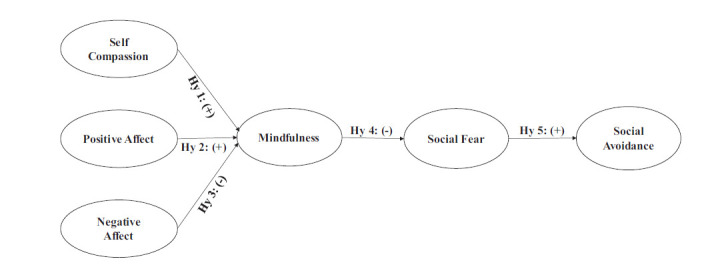
This survey study of 821 first-year female undergraduates in Chennai found that mindfulness was the main mediator linking self-compassion and affect to social fear and, in turn, social avoidance. Self-compassion and positive affect increased mindfulness, negative affect decreased it, and mindfulness reduced social fear.
## Key findings
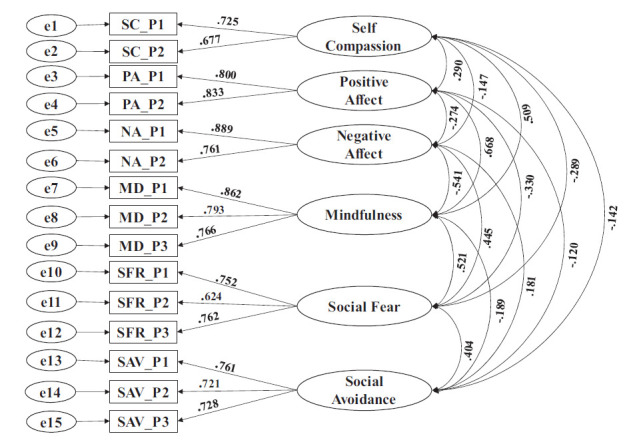
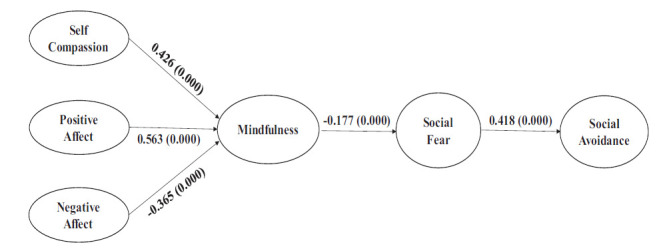
- In the final SEM, model fit was good: GFI = 0.979, CFI = 0.987, and RMSEA = 0.031.
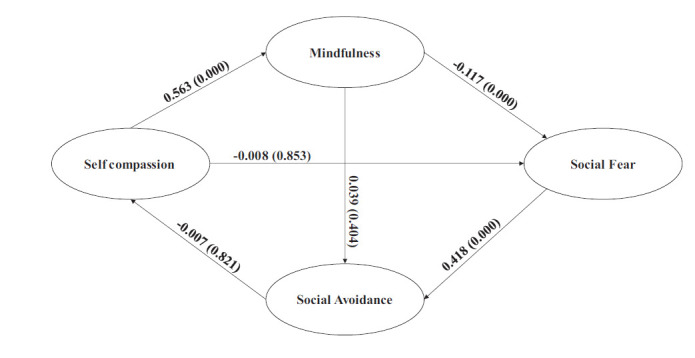
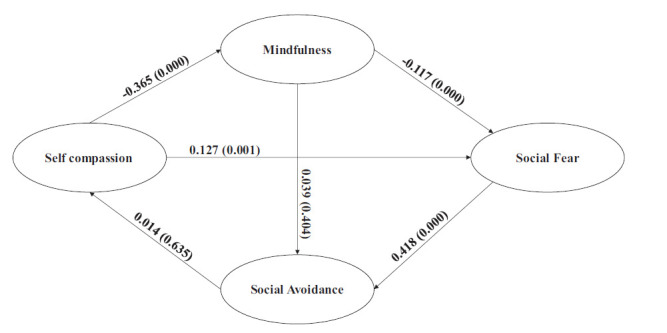
- Self-compassion (0.426; p=0.000) and positive affect (0.563; p=0.000) positively predicted mindfulness, while negative affect negatively predicted mindfulness (-0.365; p=0.000).
- Mindfulness negatively predicted social fear (-0.177; p=0.000), and social fear positively predicted social avoidance.
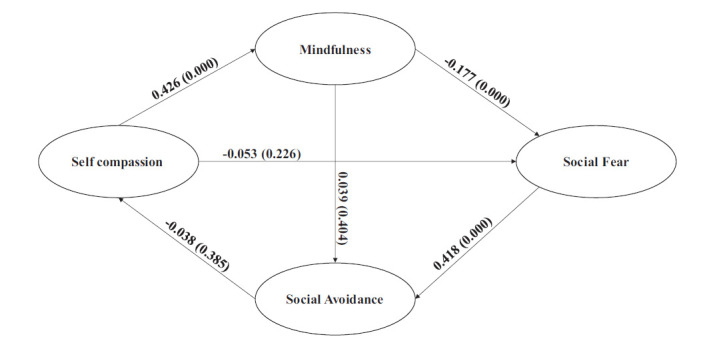
- Mediation results reported: mindfulness fully mediated the effect of self-compassion on social fear and of positive affect on social fear; mindfulness partially mediated negative affect on social fear. Mindfulness did not mediate self-compassion or positive affect on social avoidance directly, but mindfulness and social fear jointly mediated those paths.
## Methods
- Survey research design with a convenient sample of college students from eight arts and science colleges in Chennai, Southern India; 905 students responded, and 821 complete cases were analyzed. Participants were first-year female undergraduates aged 17–19.
- Measures were the Liebowitz Social Anxiety Scale, Five-Facet Mindfulness Questionnaire, short form Self-Compassion Scale, and Positive and Negative Affect Scale; the scales were translated into Tamil and pilot-tested on 50 college students.
- Main analysis used exploratory factor analysis, confirmatory factor analysis, and structural equation modeling with multiple mediation in AMOS 24; item parcels were created and mediation was tested by comparing paths before and after adding mediators.
## Limitations
- The paper states the data were cross-sectional, which limits causal inference.
- The sample was urban and educated college students; the paper says generalization to other demographic groups needs careful consideration.
- The paper says the translated measures can be validated in future cross-cultural studies, indicating limited external validation of the translated instruments.
Model-written summary. Check it against the paper before relying on it.
Integrity signals
Registry
Cites
Statistics
Figures
Verification
Claims the paper makes
0 Valid · 0 Not valid · 1 Not checked · 33 Own results and interpretations
A result the paper reports from its own data — it cites no other source for it, so there is none to check. The quote shows it is in the paper.
In the paper
“MD mediates the effect of PA on SFR (-0.099; p=0.000). The change in path coefficients of PA on SFR before (-0.107; p=0.001) and after (-0.008; p=0.853) mediation indicates full mediation.”
- Also stated in: § CONCLUSION · plain
“While mindfulness fully mediates with respect to self-compassion and positive affect, it partially mediates the negative effect.”
§ Self-compassion, Positive and Negative Affect and Social Avoidance among Adolescence: Mediating Role of Mindfulness > RESULTS > Mediation Effects
plainstates a cause- Asserted: passes — The authors put it forward as true.
- Checkable: passes — It can be checked against evidence.
- Load-bearing: passes — The paper’s conclusions depend on it.
- Based: passes — The paper gives a reason why it holds.
- Also stated in: § CONCLUSION · plain
A result the paper reports from its own data — it cites no other source for it, so there is none to check. The quote shows it is in the paper.
In the paper
“Mindfulness does not mediate the impact of self-compassion's positive and negative effects on social avoidance.”
§ Self-compassion, Positive and Negative Affect and Social Avoidance among Adolescence: Mediating Role of Mindfulness > CONCLUSION
plain- Asserted: passes — The authors put it forward as true.
- Checkable: passes — It can be checked against evidence.
- Load-bearing: passes — The paper’s conclusions depend on it.
- Based: passes — The paper gives a reason why it holds.
A result the paper reports from its own data — it cites no other source for it, so there is none to check. The quote shows it is in the paper.
In the paper
“MD partially mediates the impact of NA on SFR. The mediating effect (0.064; p=0.000) is significant, but the path coefficients from before (0.192; p=0.000) to after (0.127; p=0.001) are reduced but not substantial.”
- Also stated in: § CONCLUSION · plain
“While mindfulness fully mediates with respect to self-compassion and positive affect, it partially mediates the negative effect.”
§ Self-compassion, Positive and Negative Affect and Social Avoidance among Adolescence: Mediating Role of Mindfulness > RESULTS > Mediation Effects
plainstates a cause- Asserted: passes — The authors put it forward as true.
- Checkable: passes — It can be checked against evidence.
- Load-bearing: passes — The paper’s conclusions depend on it.
- Based: passes — The paper gives a reason why it holds.
- Also stated in: § CONCLUSION · plain
A result the paper reports from its own data — it cites no other source for it, so there is none to check. The quote shows it is in the paper.
In the paper
“As presumed in this study, the components of social anxiety-social fear and social avoidance- emerge as two distinct constructs.”
- Also stated in: § DISCUSSION · boosted
“Good convergent and discriminant validity of these two components warrant their treatment as two separate constructs influencing each other.”
§ Self-compassion, Positive and Negative Affect and Social Avoidance among Adolescence: Mediating Role of Mindfulness > DISCUSSION
boosted- Asserted: passes — The authors put it forward as true.
- Checkable: passes — It can be checked against evidence.
- Load-bearing: passes — The paper’s conclusions depend on it.
- Based: passes — The paper gives a reason why it holds.
- Also stated in: § DISCUSSION · boosted
A result the paper reports from its own data — it cites no other source for it, so there is none to check. The quote shows it is in the paper.
In the paper
“MD mediates the impact of SC on SFR. Before introducing MD, the effect of SC on SFR is significant (-0.128; p=0.000), and after introducing MD, this effect reduces to insignificance (-0.053; p=0.226). The mediating construct MD explains a substantial portion of this effect (-0.075; p=0.000).”
- Also stated in: § CONCLUSION · plain
“While mindfulness fully mediates with respect to self-compassion and positive affect, it partially mediates the negative effect.”
§ Self-compassion, Positive and Negative Affect and Social Avoidance among Adolescence: Mediating Role of Mindfulness > RESULTS > Mediation Effects
plainstates a cause- Asserted: passes — The authors put it forward as true.
- Checkable: passes — It can be checked against evidence.
- Load-bearing: passes — The paper’s conclusions depend on it.
- Based: passes — The paper gives a reason why it holds.
- Also stated in: § CONCLUSION · plain
13 more claims
Create a free account to see all 34 claims and to verify the 1 reference still open.
- It may state two separate claims as one. 12
- Probably not a substantial claim. 6
Citations
Cites
Podsakoff, P. M., MacKenzie, S. B., Lee, J.-Y., & Podsakoff, N. P. (2003) · Journal of Applied Psychology · doi:10.1037/0021-9010.88.5.879 · Cited by 82,194
Kessler, R. C., Berglund, P., Demler, O., Jin, R., Merikangas, K. R., & Walters, E. E. (2005) · Archives of General Psychiatry · doi:10.1001/archpsyc.62.6.593 · Cited by 20,391
Measuring individual differences in implicit cognition: the implicit association test
Greenwald, A. G., McGhee, D. E., & Schwartz, J. L. K. (1998) · Journal of Personality and Social Psychology · doi:10.1037/0022-3514.74.6.1464 · Cited by 9,210
Using Self-Report Assessment Methods to Explore Facets of Mindfulness
Baer, R. A., Smith, G. T., Hopkins, J., Krietemeyer, J., & Toney, L. (2006) · Assessment · doi:10.1177/1073191105283504 · Cited by 7,511
Self-Compassion: An Alternative Conceptualization of a Healthy Attitude Toward Oneself
NEFF, K. (2003) · Self and Identity · doi:10.1080/15298860309032 · Cited by 5,440
Construction and factorial validation of a short form of the Self-Compassion Scale
Raes, F., Pommier, E., Neff, K. D., & Van Gucht, D. (2011) · Clinical Psychology & Psychotherapy · doi:10.1002/cpp.702 · Cited by 2,997
A cognitive-behavioral model of anxiety in social phobia
Rapee, R. M., & Heimberg, R. G. (1997) · Behaviour Research and Therapy · doi:10.1016/s0005-7967(97)00022-3 · Cited by 2,987
Exploring compassion: A meta-analysis of the association between self-compassion and psychopathology
MacBeth, A., & Gumley, A. (2012) · Clinical Psychology Review · doi:10.1016/j.cpr.2012.06.003 · Cited by 1,838
Social anxiety and self-presentation: A conceptualization model.
Schlenker, B. R., & Leary, M. R. (1982) · Psychological Bulletin · doi:10.1037/0033-2909.92.3.641 · Cited by 1,590
The Liebowitz social anxiety scale as a self-report instrument: a preliminary psychometric analysis
Baker, S. L., Heinrichs, N., Kim, H.-J., & Hofmann, S. G. (2002) · Behaviour Research and Therapy · doi:10.1016/s0005-7967(01)00060-2 · Cited by 640
Social Anxiety and Social Anxiety Disorder
Morrison, A. S., & Heimberg, R. G. (2013) · Annual Review of Clinical Psychology · doi:10.1146/annurev-clinpsy-050212-185631 · Cited by 480
Emotion dysregulation in generalized anxiety disorder: A comparison with social anxiety disorder
Turk, C. L., Heimberg, R. G., Luterek, J. A., Mennin, D. S., & Fresco, D. M. (2005) · Cognitive Therapy and Research · doi:10.1007/s10608-005-1651-1 · Cited by 443
A Cognitive Behavioral Model of Social Anxiety Disorder
Heimberg, R. G., Brozovich, F. A., & Rapee, R. M. (2010) · Social Anxiety · doi:10.1016/b978-0-12-375096-9.00015-8 · Cited by 407
Watson, D., Gamez, W., & Simms, L. J. (2005) · Journal of Research in Personality · doi:10.1016/j.jrp.2004.09.006 · Cited by 340
An analysis of post-event processing in social anxiety disorder
Brozovich, F., & Heimberg, R. G. (2008) · Clinical Psychology Review · doi:10.1016/j.cpr.2008.01.002 · Cited by 277
McManus, F., Sacadura, C., & Clark, D. M. (2008) · Journal of Behavior Therapy and Experimental Psychiatry · doi:10.1016/j.jbtep.2006.12.002 · Cited by 265
Self-compassion and social anxiety disorder
Werner, K. H., Jazaieri, H., Goldin, P. R., Ziv, M., Heimberg, R. G., & Gross, J. J. (2012) · Anxiety, Stress, & Coping · doi:10.1080/10615806.2011.608842 · Cited by 249
Self-focused attention in social phobia and social anxiety
Spurr, J. M., & Stopa, L. (2002) · Clinical Psychology Review · doi:10.1016/s0272-7358(02)00107-1 · Cited by 247
Negative self-imagery in social anxiety contaminates social interactions
Hirsch, C., Meynen, T., & Clark, D. (2004) · Memory · doi:10.1080/09658210444000106 · Cited by 216
Positive affect regulation in anxiety disorders
Eisner, L. R., Johnson, S. L., & Carver, C. S. (2009) · Journal of Anxiety Disorders · doi:10.1016/j.janxdis.2009.02.001 · Cited by 204
Social anxiety disorder in childhood and adolescence: Descriptive psychopathology
Rao, P. A., Beidel, D. C., Turner, S. M., Ammerman, R. T., Crosby, L. E., & Sallee, F. R. (2007) · Behaviour Research and Therapy · doi:10.1016/j.brat.2006.07.015 · Cited by 190
Erwin, B. A., Heimberg, R. G., Schneier, F. R., & Liebowitz, M. R. (2003) · Behavior Therapy · doi:10.1016/s0005-7894(03)80004-7 · Cited by 186
Schneier, F. R., Blanco, C., Antia, S. X., & Liebowitz, M. R. (2002) · Psychiatric Clinics of North America · doi:10.1016/s0193-953x(02)00018-7 · Cited by 184
Social anxiety and the interpretation of positive social events
Alden, L. E., Taylor, C. T., Mellings, T. M. J. B., & Laposa, J. M. (2008) · Journal of Anxiety Disorders · doi:10.1016/j.janxdis.2007.05.007 · Cited by 177
Social anxiety and emotional suppression: The mediating role of beliefs
Spokas, M., Luterek, J. A., & Heimberg, R. G. (2009) · Journal of Behavior Therapy and Experimental Psychiatry · doi:10.1016/j.jbtep.2008.12.004 · Cited by 172
Self-Focused Attention and Social Anxiety in Social Phobics and Normal Controls
Woody, S. R., & Rodriguez, B. F. (2000) · Cognitive Therapy and Research · doi:10.1023/a:1005583820758 · Cited by 148
Comparing and Contrasting Fears of Positive and Negative Evaluation as Facets of Social Anxiety
Weeks, J. W., Jakatdar, T. A., & Heimberg, R. G. (2010) · Journal of Social and Clinical Psychology · doi:10.1521/jscp.2010.29.1.68 · Cited by 138
Moscovitch, D. A., Gavric, D. L., Merrifield, C., Bielak, T., & Moscovitch, M. (2011) · Behaviour Research and Therapy · doi:10.1016/j.brat.2011.05.009 · Cited by 136
Implicit views of the self in social anxiety
Tanner, R. J., Stopa, L. L., & Houwer, J. D. (2005) · Behaviour Research and Therapy · doi:10.1016/j.brat.2005.10.007 · Cited by 105
Safety behaviors and judgmental biases in social anxiety disorder
Taylor, C. T., & Alden, L. E. (2009) · Behaviour Research and Therapy · doi:10.1016/j.brat.2009.11.005 · Cited by 101
Malleability of attentional bias for positive emotional information and anxiety vulnerability.
Taylor, C. T., Bomyea, J., & Amir, N. (2011) · Emotion · doi:10.1037/a0021301 · Cited by 91
Makkar, S. R., & Grisham, J. R. (2011) · Behaviour Research and Therapy · doi:10.1016/j.brat.2011.07.004 · Cited by 89
The Relationship of Post-Event Processing to Self-Evaluation of Performance in Social Anxiety
Brozovich, F. A., & Heimberg, R. G. (2011) · Behavior Therapy · doi:10.1016/j.beth.2010.08.005 · Cited by 89
Effect of self-focused attention on post-event processing in social anxiety
Gaydukevych, D., & Kocovski, N. L. (2011) · Behaviour Research and Therapy · doi:10.1016/j.brat.2011.10.010 · Cited by 79
The Predictors and Contents of Post-Event Processing in Social Anxiety
Makkar, S. R., & Grisham, J. R. (2011) · Cognitive Therapy and Research · doi:10.1007/s10608-011-9357-z · Cited by 67
Clarke, P., MacLeod, C., & Shirazee, N. (2008) · Emotion · doi:10.1037/1528-3542.8.1.47 · Cited by 53
Cultural aspects of anxiety disorders in India
Khambaty, M., & Parikh, R. M. (2017) · Dialogues in Clinical Neuroscience · doi:10.31887/dcns.2017.19.2/rparikh · Cited by 48
Laposa, J. M., Cassin, S. E., & Rector, N. A. (2009) · Journal of Anxiety Disorders · doi:10.1016/j.janxdis.2009.10.009 · Cited by 45
Social Interaction Anxiety and the Discounting of Positive Interpersonal Events
Vassilopoulos, S. P., & Banerjee, R. (2010) · Behavioural and Cognitive Psychotherapy · doi:10.1017/s1352465810000433 · Cited by 40
Research works printed but not linked: 1
- Harman H.H. Modern factor analysis. Chicago, IL University of Chicago Press 1960
Cited by
Sharma, B., Kaur, S., & Sharma, V. M. (2025) · Journal of Education and Health Promotion · doi:10.4103/jehp.jehp_746_24 · Cited by 13
Macrynikola, N., Doerr, J., & Yen, S. (2026) · Journal of Adolescence · doi:10.1002/jad.70189 · Cited by 1
Umeda, A., & Ohtsuki, T. (2025) · Frontiers in Psychology · doi:10.3389/fpsyg.2025.1687442 · Cited by 1
Metadata
- Authors
- Sujamani, M. S., & Kanth, B.
- Affiliations
- Presidency College (IN)
- ORCID
- Kanth, Barani
- Venue
- Clinical Practice & Epidemiology in Mental Health
- Publisher
- Bentham Science Publishers Ltd.
- Published
- 2023-12-26
- Volume
- 19
- Issue
- 1
- Pages
- e17450179268979-e17450179268979
- ISSN
- 1745-0179 (ISSN-L)
- PMC
- PMC11041389
- OpenAlex
- W4390342146
- Cited by
- 3
- References
- 40
- Citations by year
- 2026: 1 · 2025: 2
- FWCI
- 0.87
- Type
- journal article
- Language
- en
- Open access
- diamond
- doi.org
- Locations
- Clinical Practice and Epidemiology in Mental Health (publishedVersion, cc-by)
- PubMed Central (publishedVersion, cc-by)
- PubMed (publishedVersion)
- Topics
- Social Sciences › Psychology › Clinical Psychology › Mindfulness and Compassion Interventions
- Social Sciences › Psychology › Experimental and Cognitive Psychology › Anxiety, Depression, Psychometrics, Treatment, Cognitive Processes
- Social Sciences › Psychology › Developmental and Educational Psychology › Student Stress and Coping
- Keywords
- self-compassion, positive affect, negative affect, social avoidance, social anxiety, mindfulness, mediation, adolescents, social fear
About these checks
Registry, retraction, Cites and statistics results are computed, not judged, with one exception: a printed reference that no index lists is read once by a model before it counts as a citation error. Claims are extracted by a model and kept only when their quote appears verbatim in the text; each cited source is then checked, with a model’s help, for whether it says what the claim relies on. Those verdicts can be wrong — read the claim’s quote and the cited source before relying on one.
A language model drew the claims from the paper on 2026-10-11, under version 3 of the claim definition (model deepseek-v4.1-flash, prompt extract-v3).
A second model labelled each claim on 2026-10-11 (model jev-1.13-20260917, definition revision gold-guideline-v0.2).
Statistics and arithmetic are recomputed, not judged.
Confidence bands are shown only for fields calibrated on our annotated test set. None is calibrated yet, so no band is shown.
What counts as a claim ›How we measure confidence ›How we check this ›
Are you an author, or do you see a problem with this page? Request a review
Data sources
Bibliographic data: Semantic Scholar, OpenAlex, Crossref.
Contains information from the Semantic Scholar Academic Graph Datasets, made available under the ODC Attribution License (ODC-BY 1.0).
Semantic Scholar’s data is described in: Kinney, R., et al. (2023). The Semantic Scholar Open Data Platform. arXiv:2301.10140.
