

mHealth for HIV Treatment & Prevention: A Systematic Review of the Literature
Open accessThe DOI matches its Crossref record; 62 of the 65 references it cites were found in a registry or an index; 6 of the 61 sources its claims cite were checked for support.
Abstract
This systematic review assesses the published literature to describe the landscape of mobile health technology (mHealth) for HIV/AIDS and the evidence supporting the use of these tools to address the HIV prevention, care, and treatment cascade. The speed of innovation, broad range of initiatives and tools, and heterogeneity in reporting have made it difficult to uncover and synthesize knowledge on how mHealth tools might be effective in addressing the HIV pandemic. To do address this gap, a team of reviewers collected literature on the use of mobile technology for HIV/AIDS among health, engineering, and social science literature databases and analyzed a final set of 62 articles. Articles were systematically coded, assessed for scientific rigor, and sorted for HIV programmatic relevance. The review revealed evidence that mHealth tools support HIV programmatic priorities, including: linkage to care, retention in care, and adherence to antiretroviral treatment. In terms of technical features, mHealth tools facilitate alerts and reminders, data collection, direct voice communication, educational messaging, information on demand, and more. Studies were mostly descriptive with a growing number of quasi-experimental and experimental designs. There was a lack of evidence around the use of mHealth tools to address the needs of key populations, including pregnant mothers, sex workers, users of injection drugs, and men who have sex with men. The science and practice of mHealth for HIV are evolving rapidly, but still in their early stages. Small-scale efforts, pilot projects, and preliminary descriptive studies are advancing and there is a promising trend toward implementing mHealth innovation that is feasible and acceptable within low-resource settings, positive program outcomes, operational improvements, and rigorous study design
Overview
CoChat Summary
TL;DR
This systematic review of 62 articles describes the early mHealth for HIV landscape and finds the strongest evidence for mobile reminders improving ART adherence, with some evidence for linkage/retention in care. It reports major gaps in rigorous evaluation, theoretical grounding, and mHealth for key populations, especially PMTCT.
Key findings
- Among 62 articles, 56% were research/evaluation studies; most were monitoring/evaluation reports, with 34% evaluation reports, 29% operations research, and 14% impact evaluations.
- Technical features included alerts/reminders (60%), field-based data collection (24%), direct voice communication (24%), educational messaging (13%), information on demand (11%), and provider decision-support (5%).
- ART adherence had the strongest evidence base: two Kenya RCTs found weekly SMS reminders significantly improved adherence, and Lester et al. also found improved viral suppression.
- Key populations were rarely addressed: projects focused on PLHIV (45%), pregnant women (3%), sex workers (5%), men who have sex with men (5%), and users of injection drugs (0%); no articles described mHealth for PMTCT.
Methods
- Systematic review searching health, engineering, technology, and social science databases, including Pubmed/Medline, Scopus, Embase, Cochrane, CABI Global Health, Compendex, Web of Science, INSPEC, Popline, WHO Technical Reports, and Google Scholar, limited to English articles from January 2001 to December 2011.
- Three independent reviewers coded articles for methods, design, implementation science category, rigor, purpose of technology, theoretical framework, location, population, community engagement, cascade stage, impact, findings, and conclusions; disagreements were resolved by a senior researcher.
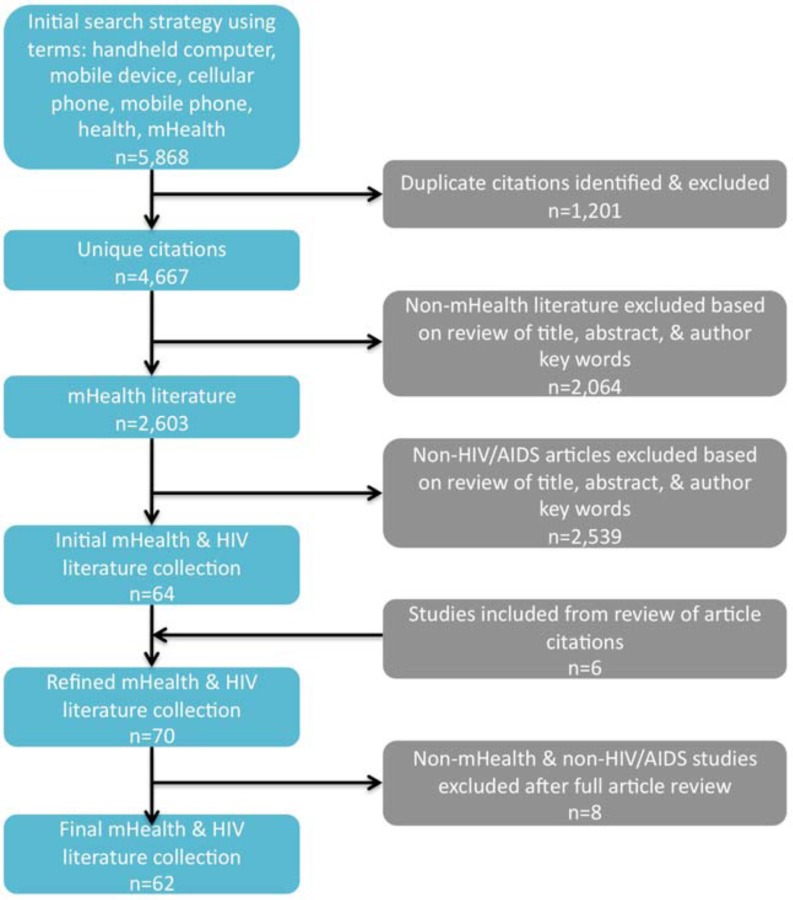
- From 2,603 mHealth articles, 64 were pertinent to HIV/AIDS, with additional reference-list articles yielding a final set of 62; articles were divided into research and non-research, and only research articles were used to assess evidence for HIV programmatic requirements.
Limitations
- Stated: mHealth is rapidly evolving and often led by commercial or small non-profit actors, so many initiatives may be unpublished; negative findings may be published less often, so the review may not reflect the full landscape.
- Stated: only articles explicitly reporting mobile information technology devices were included, excluding PC-, laptop-, and printer-based eHealth systems despite their potential relevance.
- Evident from the text: many studies were small pilots or descriptive, lacked comparison groups or multiple measurements, and only a few of 35 studies mentioned a theoretical or conceptual framework; none described an integrated mixed-methods approach.
Model-written summary. Check it against the paper before relying on it.
Integrity signals
Registry
Cites
Statistics
Figures
Verification
Claims the paper makes
4 Valid · 3 Not valid · 27 Not checked · 55 Own results and interpretations
Every source the paper cites for this claim was checked and supports it.
In the paper
“SMS was a feasible and acceptable way for vulnerable youth to receive information and referrals to clinical services [28].”
§ mHealth for HIV Treatment & Prevention: A Systematic Review of the Literature > FINDINGS > HIV Programmatic Objectives
What the sources say
- Supportedcites [28] Levine D McCright J Dobkin L Woodruff AJ Klausner JD SEXINFO: a sexual health text messaging service for San Francisco youth. Am J Public Health 2008 98 3 393 5 18235068 PMC2253571 source
The Conclusions section (p. 1 of our copy) states verbatim the substance of the claim: text messaging is 'a feasible and culturally acceptable way for at-risk youths to receive sexual health information and referrals to sexual and reproductive health services.' The Abstract and the DEVELOPMENT AND IMPLEMENTATION passage corroborate it (focus-group youths with unlimited texting 'considered SEXINFO a private and valuable service,' and the service delivers 'basic facts about sexual health and relationships, as well as referrals to youth-oriented clinical and social services'). 'Vulnerable youth' maps onto the paper's 'at-risk youths' (African American adolescents aged 15-19 in San Francisco), so the population qualifier holds. (LLM, conf=0.93)
plain- Asserted: passes — The authors put it forward as true.
- Checkable: passes — It can be checked against evidence.
- Load-bearing: unclear — It is unclear whether the paper’s conclusions depend on it.
- Based: passes — The paper gives a reason why it holds.
- Supported
The sources with a verdict support this claim; the rest weren’t checked yet, have no full text we could read, or their verdicts aren’t rated yet.
In the paper
“Among 35 studies, only a few [22-27] mentioned a theoretical basis or conceptual framework that guided their assumptions about why mHealth might facilitate or cause the intended change.”
§ mHealth for HIV Treatment & Prevention: A Systematic Review of the Literature > FINDINGS > Research & Evaluation Studies
What the sources say
- Not checked yetcites [22] Lester RT Ritvo P Mills EJ Effects of a mobile phone short message service on antiretroviral treatment adherence in Kenya (WelTel Kenya1): a randomised trial. Lancet 2010 376 9755 1838 45 21071074 source
- Supportedcites [23] Gold J Lim MSC Hellard ME Hocking JS Keogh L What's in a message?, delivering sexual health promotion to young people in Australia via text messaging. BMC Public Health 2010 10 792 21190584 PMC3022861 source
The citation identifies this paper as an example of a study that mentions a conceptual basis; it does not attribute the count of 35 studies to this paper. In the Background (page unavailable), the authors invoke Giddens’s concept of reflexivity to explain how incoming information can change practices and why that matters for health promotion through new communication channels. (LLM, conf=0.86)
- Could not verifycites [24] Samal L Hutton HE Erbelding EJ Brandon ES Finkelstein J Chander G Digital divide: variation in internet and cellular phone use among women attending an urban sexually transmitted infections clinic. Bull NY Acad Med J Urban Health 2010 87 1 122 8 PMC2821605 19941085 sourceExperimental — accuracy not yet measured
The Methods section describes a survey of internet and cellular-phone use among women attending an STI clinic, and the Discussion addresses the feasibility of future interventions. Our copy does not assess 35 studies or say which studies mentioned a theoretical basis or conceptual framework; searches for those terms found no relevant passage. (LLM, conf=0.72)
- Supportedcites [25] Swendeman D Rotheram-Borus MJ Innovation in sexually transmitted disease and HIV prevention: Internet and mobile phone delivery vehicles for global diffusion. Curr Opin Psychiatry 2010 23 2 139 44 20087189 PMC2881840 source
In “Evidence-based decision-making and practice” (page unavailable), the paper describes five common factors underlying effective HIV/STD prevention and applies them to adoption of information and communication technology. That supports citing it as an example of a paper that mentions a conceptual framework. The count of 35 studies is the citing authors’ framing, not a finding attributed to this individual source. (LLM, conf=0.84)
- Not checked yetcites [26] Tolly KDe Alexander H Town C Innovative use of cellphone technology for HIV / AIDS behaviour change communications?: 3 pilot projects Cellphones4 HIV project SMS ARV reminders?: TAC adherence clubs. Cell 2009 May 2008 1 13
- Not checked yetcites [27] Vidrine DJ Arduino RC Gritz ER Impact of a cell phone intervention on mediating mechanisms of smoking cessation in individuals living with HIV/AIDS. Nicotine Tobacco Res 2006 8 Suppl 1 S103 8 17491177 source
plain- Asserted: passes — The authors put it forward as true.
- Checkable: passes — It can be checked against evidence.
- Load-bearing: unclear — It is unclear whether the paper’s conclusions depend on it.
- Based: passes — The paper gives a reason why it holds.
The cited sources support only part of this claim — read each source’s verdict below.
In the paper
“Key populations -- such as pregnant mothers, sex workers, users of injection drugs, and men who have sex with men -- are not only at higher risk for HIV infection, but are also less likely to access standard treatment and the other related HIV health services due to stigma and discrimination they face from the general population as well as providers [64-70].”
§ mHealth for HIV Treatment & Prevention: A Systematic Review of the Literature > mHealth & HIV Treatment & Prevention Programmatic Needs
What the sources say
- Partly supportedcites [64] Mahajan AP Sayles JN Patel VA Stigma in the HIV/AIDS epidemic: a review of the literature and recommendations for the way forward. AIDS Lodon.England) 2008 22 Suppl 2 S67 79 PMC2835402 18641472 sourceExperimental — accuracy not yet measured
The Results section on defining stigma says that overlapping social disadvantages can predispose individuals to HIV infection. The Discussion identifies men who have sex with men, injecting drug users, and sex workers as groups facing stigma, but the paper does not state that all the listed groups—including pregnant mothers—are at higher risk of HIV infection. (LLM, conf=0.78)
- Not checked yetcites [65] Niang C Tapsoba P “It”s raining stones': Stigma. violence and HIV vulnerability among men who have sex with men in Dkar. Senegal. Culture. Health Sex 2003 5 6 499 512 source
- Not checked yetcites [66] PEPFAR Addressing gender and HIV/AIDS. Washington. D C PEPFAR 2010
- Not checked yetcites [67] Castronn A Farmern Pk Understanding and addressing AIDS-related stigma from anthropological theory to clinical practice in Haiti. J Inf. 2005 95 1 53 9 PMC1449851 15623859
- Not checked yetcites [68] Ogden J Nyblade L Common at its core HIV-related stigma across contexts. Washington DC ICRW. 2005
- Not checked yetcites [69] UNAIDS.HIV-related stigma discrimination and human rights violations: Case studies of successful programmes. Geneva UNAIDS. 2005
- Not checked yetcites [70] Farmer P Connors M Women poverty and AIDS sex drugs and structural violence 2nd ed. Monroe Common Courage Press. 2011
plainstates an association- Asserted: passes — The authors put it forward as true.
- Checkable: passes — It can be checked against evidence.
- Load-bearing: passes — The paper’s conclusions depend on it.
- Based: passes — The paper gives a reason why it holds.
- Partly supported
The cited sources support only part of this claim — read each source’s verdict below.
In the paper
“Key populations -- such as pregnant mothers, sex workers, users of injection drugs, and men who have sex with men -- are not only at higher risk for HIV infection, but are also less likely to access standard treatment and the other related HIV health services due to stigma and discrimination they face from the general population as well as providers [64-70].”
§ mHealth for HIV Treatment & Prevention: A Systematic Review of the Literature > mHealth & HIV Treatment & Prevention Programmatic Needs
What the sources say
- Partly supportedcites [64] Mahajan AP Sayles JN Patel VA Stigma in the HIV/AIDS epidemic: a review of the literature and recommendations for the way forward. AIDS Lodon.England) 2008 22 Suppl 2 S67 79 PMC2835402 18641472 sourceExperimental — accuracy not yet measured
The Results section (page not supplied) says HIV-related stigma impedes access to HIV care and treatment, and specifically describes pregnant women avoiding prevention-of-mother-to-child-transmission services for fear of stigma. The Recommendations section identifies sex workers, injecting drug users, and men who have sex with men as groups facing stigma, but does not establish that each of these groups is less likely to access treatment because of stigma from both the general population and providers. (LLM, conf=0.84)
- Not checked yetcites [65] Niang C Tapsoba P “It”s raining stones': Stigma. violence and HIV vulnerability among men who have sex with men in Dkar. Senegal. Culture. Health Sex 2003 5 6 499 512 source
- Not checked yetcites [66] PEPFAR Addressing gender and HIV/AIDS. Washington. D C PEPFAR 2010
- Not checked yetcites [67] Castronn A Farmern Pk Understanding and addressing AIDS-related stigma from anthropological theory to clinical practice in Haiti. J Inf. 2005 95 1 53 9 PMC1449851 15623859
- Not checked yetcites [68] Ogden J Nyblade L Common at its core HIV-related stigma across contexts. Washington DC ICRW. 2005
- Not checked yetcites [69] UNAIDS.HIV-related stigma discrimination and human rights violations: Case studies of successful programmes. Geneva UNAIDS. 2005
- Not checked yetcites [70] Farmer P Connors M Women poverty and AIDS sex drugs and structural violence 2nd ed. Monroe Common Courage Press. 2011
plainstates a cause- Asserted: passes — The authors put it forward as true.
- Checkable: passes — It can be checked against evidence.
- Load-bearing: passes — The paper’s conclusions depend on it.
- Based: passes — The paper gives a reason why it holds.
- Partly supported
A result the paper reports from its own data — it cites no other source for it, so there is none to check. The quote shows it is in the paper.
In the paper
“Nearly 80% of all articles were published between 2007 and 2011”
§ mHealth for HIV Treatment & Prevention: A Systematic Review of the Literature > FINDINGS > mHealth & HIV Landscape
plain- Asserted: passes — The authors put it forward as true.
- Checkable: passes — It can be checked against evidence.
- Load-bearing: unclear — It is unclear whether the paper’s conclusions depend on it.
- Based: passes — The paper gives a reason why it holds.
62 more claims
Create a free account to see all 89 claims and to verify the 55 references still open.
- It may state two separate claims as one. 11
- Probably not a substantial claim. 12
Claims other papers make about this one
Each is checked against this paper’s own text: does it say what the citing paper says it does?
The source backs part of the claim, not all of it — or backs it for a different population, condition or comparison.
In the citing paper
“Most reviews of use of digital communication with patients in sub-Saharan Africa, comment on the problems of implementation of the communication system, particularly technical and maintenance issues.26–28 54–58”
From mHealth text and voice communication for monitoring people with chronic diseases in low-resource settings: a realist review (2018) · cites this paper as [27]
Experimental — accuracy not yet measuredThe cited source says what the claim attributes to it.
In the citing paper
“Reviews have found variation in effect depending on how mechanisms were operationalised.”
From mHealth text and voice communication for monitoring people with chronic diseases in low-resource settings: a realist review (2018) · cites this paper as [27]
The cited source says what the claim attributes to it.
In the citing paper
“For example, weekly reminders worked better than daily reminders”
From mHealth text and voice communication for monitoring people with chronic diseases in low-resource settings: a realist review (2018) · cites this paper as [27]
In the citing paper
“A stronger theoretical understanding is likely to strengthen the mHealth evidence base.27”
From mHealth text and voice communication for monitoring people with chronic diseases in low-resource settings: a realist review (2018) · cites this paper as [27]
In the citing paper
“and messages had more impact when they were linked with patient–health worker interaction.17 27 49 51–53”
From mHealth text and voice communication for monitoring people with chronic diseases in low-resource settings: a realist review (2018) · cites this paper as [27]
Self-check
Percentages, sums and reported differences re-computed from the paper’s own numbers.
Each contradiction between two passages listed here was confirmed by an independent check.
Rated minor: it would not touch a result — a value no result rests on, a p-value that stays on the same side of the significance level, or a conflict that is clerical, resolved elsewhere in the paper, or outside its own findings.
In the paper
§ mHealth for HIV Treatment & Prevention: A Systematic Review of the Literature > mHealth & HIV Treatment & Prevention Programmatic Needs
“although one article on mHealth for improving efficiency of early infant diagnosis was published after the literature collection deadline [73].”
§ mHealth for HIV Treatment & Prevention: A Systematic Review of the Literature > References
“73. Rotheram-Borus M-J Richter L VanRooyen H Project masihambisane a cluster randomised controlled trial with peer mentors to improve outcomes for pregnant mothers living with HIV. Trials 2011 12 2 10.1186/1745-6215-12-2 PMC3022743 21205302”
Rated minor: it would not touch a result — a value no result rests on, a p-value that stays on the same side of the significance level, or a conflict that is clerical, resolved elsewhere in the paper, or outside its own findings.
In the paper
§ mHealth for HIV Treatment & Prevention: A Systematic Review of the Literature > FINDINGS > HIV Programmatic Objectives
“Pop-Eleches et al. found that treatment adherence improved significantly among patients randomized to receive weekly text message reminders during a 48-week intervention period in Kenya [20].”
§ mHealth for HIV Treatment & Prevention: A Systematic Review of the Literature > References
“20. Crankshaw T Corless IB Giddy J Nicholas PK Eichbaum Q Butler LM Exploring the patterns of use and the feasibility of using cellular phones for clinic appointment reminders and adherence messages in an antiretroviral treatment clinic.”
Rated minor: it would not touch a result — a value no result rests on, a p-value that stays on the same side of the significance level, or a conflict that is clerical, resolved elsewhere in the paper, or outside its own findings.
In the paper
“Four studies (20%) were monitoring reports, particularly descriptions of project activities, inputs, and outputs.”
§ mHealth for HIV Treatment & Prevention: A Systematic Review of the Literature > FINDINGS > Research & Evaluation Studies
Reported 20 · recomputed 11.428571
Rated minor: it would not touch a result — a value no result rests on, a p-value that stays on the same side of the significance level, or a conflict that is clerical, resolved elsewhere in the paper, or outside its own findings.
In the paper
§ mHealth for HIV Treatment & Prevention: A Systematic Review of the Literature > FINDINGS > mHealth & HIV Landscape
“Only one article, a brief news report, described the use of mobile technology for point-of-care diagnostics, specifically a mobile phone imaging tool that is currently in development to measure CD4 count from remote locations [17].”
§ mHealth for HIV Treatment & Prevention: A Systematic Review of the Literature > References
“17. Kho A Henderson LE Dressler DD Kripalani S Use of handheld computers in medical education.A systematic review.. J Gen Intern Med 2006 21 5 31 7 10.1111/j.1525-1497.2006.00444.x PMC1484794 16704405”
Rated minor: it would not touch a result — a value no result rests on, a p-value that stays on the same side of the significance level, or a conflict that is clerical, resolved elsewhere in the paper, or outside its own findings.
In the paper
§ mHealth for HIV Treatment & Prevention: A Systematic Review of the Literature > FINDINGS > Research & Evaluation Studies
“quantitative (71%) and qualitative (51%) methods”
§ mHealth for HIV Treatment & Prevention: A Systematic Review of the Literature > FINDINGS > Research & Evaluation Studies
“some (14%) used both qualitative/quantitative strategies”
Citations
Cites
(1998) · Sage eBooks · Cited by 38,631
Rogers, E. M., Singhal, A., & Quinlan, M. M. (2019) · An Integrated Approach to Communication Theory and Research · doi:10.4324/9780203710753-35 · Cited by 37,322
Social Cognitive Theory: An Agentic Perspective
Bandura, A. (2001) · Annual Review of Psychology · doi:10.1146/annurev.psych.52.1.1 · Cited by 15,510
Basics of Qualitative Research (3rd ed.): Techniques and Procedures for Developing Grounded Theory
Corbin, J., & Strauss, A. (2008) · SAGE · doi:10.4135/9781452230153 · Cited by 12,136 · cited 1×
“However, when RCTs are not feasible or ethical in practice-based contexts, implementers and researchers can push for more rigorous quasi-experimental studies [52-54] and further grounding [55] and analytical rigor [56] in qualitative studies.”
Qualitative research in health care: Analysing qualitative data
Pope, C. (2000) · BMJ · doi:10.1136/bmj.320.7227.114 · Cited by 8,131
(2008) · Cited by 7,674
Norman, D. (2016) · Vahlen eBooks · doi:10.15358/9783800648108 · Cited by 6,374
The Technology Acceptance Model: Past, Present, and Future
Lee, Y., Kozar, K. A., & Larsen, K. R. T. (2003) · Communications of the Association for Information Systems · doi:10.17705/1cais.01250 · Cited by 2,572 · cited 1×
“…review. mHealth interventions might benefit from the dozens if not hundreds of years of development of theories of individual, social, and institutional change, including social cognitive theory [48], unified theory of acceptance and use of technology [49], adoption of innovations [50], and others.”
BackgroundMale circumcision for HIV prevention in young men in Kisumu, Kenya: a randomised controlled trial.
Bailey, R. C., Moses, S., Parker, C. B., Agot, K., Maclean, I., Krieger, J. N., Williams, C. F., Campbell, R. T., & Ndinya-Achola, J. O. (2007) · The Lancet · doi:10.1016/s0140-6736(07)60312-2 · Cited by 2,292 · cited 1×
“For the first time since the dawn of the epidemic, major clinical trials have confirmed the effectiveness of several prevention strategies [2-5].”
BackgroundMale circumcision for HIV prevention in men in Rakai, Uganda: a randomised trial.
Gray, R. H., Kigozi, G., Serwadda, D., Makumbi, F., Watya, S., Nalugoda, F., Kiwanuka, N., Moulton, L. H., Chaudhary, M. A., Chen, M. Z., et al. (2007) · The Lancet · doi:10.1016/s0140-6736(07)60313-4 · Cited by 2,226 · cited 1×
“For the first time since the dawn of the epidemic, major clinical trials have confirmed the effectiveness of several prevention strategies [2-5].”
Background
Research works printed but not linked: 17
- WHO.WHO global observatory for e-health series - New horizons for health through mobile technologies. Observatory. Geneva: WHO 2011 3
- Baeten J Celum C Antiretroviral pre-exposure prophylaxis for HIV-1 prevention among heterosexual African men and women: the Partners PrEP study IAS Conference on HIV Pathogenesis. Treatment and Prevention. Rome 2011
- UNAIDS.Getting to zero: 2011-1015 Strategy. Development. Geneva: UNAIDS 2010
- Clinton HR Remarks on “Creating an AIDS-Free Generation”. Bethesda. National Institute of Health. 2011
- mHealth Alliance.What is mHealth?. Available at www.mhealthalliance.org 2012
- Torgan C The mHealth summit: local & global converge. Washingto D.C 2009, 00
- WHO M-Health Geneva. WHO 2013
- Marcus J Wong Kromhout W NIH recognizes engineering professor's innovative research with major award: pioneering work on cell-phone imaging could transform global health care. Los Angeles: UCLA Newsroom 2009
- Tolly KDe Alexander H Town C Innovative use of cellphone technology for HIV / AIDS behaviour change communications?: 3 pilot projects Cellphones4 HIV project SMS ARV reminders?: TAC adherence clubs. Cell 2009 May 2008 1 13
- Marcus J Wong Kromhout W NIH recognizes engineering professor's innovative research with major award: pioneering work on cell-phone imaging could transform global health care. Los Angeles. UCLA Newsroom 2009
- Micek M Gimbel-Sherr K João Baptista A Mozambique? Identifying obstacles to treatment. J Acquir Immune Defic Syndr. 2010 52 3 397 405 19550350 PMC2784145 · DOI
- Stansfield S Orobaton N Lubinski D Uggowitzer S Elec BE Mwanyika H The case for a national health information system architecture?a missing link to guiding Nat Dev Implementation. Belagio. 2009 1 9
- Rogers EM Diffusion of innovations. Glencoe Free Press 1962
- Swaminathan S Guay L How to conduct operational research and implementation science - definitions. de Methodology. 6th International AIDS Society Conference on HIV Pathogenesis. Treatment and Prevention. Rome 2011
- PEPFAR Addressing gender and HIV/AIDS. Washington. D C PEPFAR 2010
- Rotheram-Borus M-J Richter L VanRooyen H Project masihambisane a cluster randomised controlled trial with peer mentors to improve outcomes for pregnant mothers living with HIV. Trials 2011 12 2 PMC3022743 21205302
- World Health Organization (WHO).Antiretroviral drugs for treating pregnant women and preventing HIV infections in infants: Recommendations for a public health approach. Geneva WHO. 2010 26180894
Cited by
Muessig, K. E., Nekkanti, M., Bauermeister, J., Bull, S., & Hightow-Weidman, L. B. (2015) · Current HIV/AIDS Reports · doi:10.1007/s11904-014-0239-3 · Cited by 322
Odendaal, W. A., Anstey Watkins, J., Leon, N., Goudge, J., Griffiths, F., Tomlinson, M., & Daniels, K. (2020) · Cochrane Database of Systematic Reviews · doi:10.1002/14651858.cd011942.pub2 · Cited by 289
“Catalani 2013 Catalani C, Philbrick W, Fraser H, Mechael P, Israelski DM. MHealth for HIV treatment & prevention: a systematic review of the literature.”
BackgroundSantos, G.-M., Ackerman, B., Rao, A., Wallach, S., Ayala, G., Lamontage, E., Garner, A., Holloway, I. W., Arreola, S., Silenzio, V., et al. (2021) · AIDS and Behavior · doi:10.1007/s10461-020-02969-0 · Cited by 253
Schnall, R., Cho, H., & Liu, J. (2018) · JMIR mHealth and uHealth · doi:10.2196/mhealth.8851 · Cited by 239
“Mobile technology has the advantage of accessibility anywhere Internet access is available, relative affordability, and has been promoted specifically as a solution to reach stigmatized and disenfranchised populations [2,3].”
BackgroundAnstey Watkins, J. O. T., Goudge, J., Gómez-Olivé, F. X., & Griffiths, F. (2018) · Social Science & Medicine · doi:10.1016/j.socscimed.2018.01.011 · Cited by 196
“…of the effectiveness of mHealth solutions in LMICs have been inconsistent in systematic reviews (Bärnighausen et al., 2011; Bloomfield et al., 2014; Catalani et al., 2013; Cole-Lewis and Kershaw, 2010; Fjeldsoe et al., 2009; Free et al., 2013; Krishna et al., 2009; Mbuagbaw et al., 2015; Velthoven…”
BackgroundRebecca, S., Tracy, H., William, B., Alex, C.-D., & Suzanne, B. (2015) · Studies in Health Technology and Informatics · doi:10.3233/978-1-61499-564-7-467 · Cited by 196
“A number of studies have shown promise for the use of mHealth for supporting HIV care [6–9].”
BackgroundOdendaal, W. A., Goudge, J., Griffiths, F., Tomlinson, M., Leon, N., & Daniels, K. (2015) · Cochrane Database of Systematic Reviews · doi:10.1002/14651858.cd011942 · Cited by 173
mHealth Interventions To Support Self-Management In HIV: A Systematic Review
Cooper, V., Clatworthy, J., Whetham, J., & Consortium, E. (2017) · The Open AIDS Journal · doi:10.2174/1874613601711010119 · Cited by 139
“While there is evidence that weekly short message system (SMS) reminders can be effective for improving medication adherence [20], few studies have evaluated mHealth interventions that encompass other aspects of self-management, such as attendance of medical appointments, self-monitoring, information on demand, educat…”
BackgroundInfluentialLong, L.-A., Pariyo, G., & Kallander, K. (2018) · Global Health: Science and Practice · doi:10.9745/ghsp-d-18-00167 · Cited by 148
“38 Until the WHO published the classification of digital health interventions in 2018, an absence of shared language and approach to describe digital health interventions made it challenging to compare results across programs.”
BackgroundSchnall, R., Bakken, S., Rojas, M., Travers, J., & Carballo-Dieguez, A. (2015) · AIDS and Behavior · doi:10.1007/s10461-014-0984-8 · Cited by 134
“intervention studies have been conducted, none have incorporated user-centered design methods to inform the development of an intervention or a mobile app from the PLWH’s perspective [16].”
Dillingham, R., Ingersoll, K., Flickinger, T. E., Waldman, A. L., Grabowski, M., Laurence, C., Wispelwey, E., Reynolds, G., Conaway, M., & Cohn, W. F. (2018) · AIDS Patient Care and STDs · doi:10.1089/apc.2017.0303 · Cited by 132
“171 Mood query response rate 29 (24) 24 (32) 58 (35) 42 (36) 0.”
HIV treatment cascade in migrants and mobile populations
Tanser, F. C., Bärnighausen, T., Vandormael, A. M., & Dobra, A. (2015) · Current Opinion in HIV and AIDS · doi:10.1097/coh.0000000000000192 · Cited by 141
An ontology of and roadmap for mHealth research
Cameron, J. D., Ramaprasad, A., & Syn, T. (2017) · International Journal of Medical Informatics · doi:10.1016/j.ijmedinf.2017.01.007 · Cited by 119
Conserve, D. F., Jennings, L., Aguiar, C., Shin, G., Handler, L., & Maman, S. (2017) · Journal of Telemedicine and Telecare · doi:10.1177/1357633x16639186 · Cited by 111
Ames, H. M., Glenton, C., Lewin, S. A., Tamrat, T., Akama, E., & Leon, N. (2019) · Cochrane Database of Systematic Reviews · doi:10.1002/14651858.cd013447 · Cited by 116
“A number of reviews of the effect of mHealth programs in general have been carried out (Anglada-Martinez 2015; Ahmed 2017; Aranda-Jan 2014; Catalani 2013; Cole-Lewis 2010; Free 2013; Free 2016; Gurman 2012; Krishna 2009; Lee 2016; Peiris 2014).”
BackgroundInfluentialDevi, B. R., Syed-Abdul, S., Kumar, A., Iqbal, U., Nguyen, P.-A., Li, Y.-C. (., & Jian, W.-S. (2015) · Computer Methods and Programs in Biomedicine · doi:10.1016/j.cmpb.2015.08.003 · Cited by 110
“[16] C.”
BackgroundColeman, J., Bohlin, K. C., Thorson, A., Black, V., Mechael, P., Mangxaba, J., & Eriksen, J. (2017) · AIDS Care · doi:10.1080/09540121.2017.1280126 · Cited by 102
“…Israelski, 2013; Faal et al., 2011; Lester et al., 2010; Nglazi, Bekker, Wood, Hussey, & Wiysonge, 2013; Pop-Eleches et al., 2011), sexually transmitted infections (Lunny et al., 2014) and for key populations (e.g. sex workers, men who have sex with men, adolescents, etc.) (Catalani et al., 2013).”
BackgroundNguyen, L. H., Tran, B. X., Rocha, L. E. C., Nguyen, H. L. T., Yang, P., Latkin, C. A., Thorson, A. E., & Strömdahl, S. K. (2019) · AIDS and Behavior · doi:10.1007/s10461-019-02626-1 · Cited by 107
Shen, L., Xiong, B., Li, W., Lan, F., Evans, R. D., & Zhang, W. (2018) · JMIR mhealth and uhealth · doi:10.2196/mhealth.9581 · Cited by 110
“For example, some reviews have focused on mobile health apps [9,10] related to the most prevalent conditions (eg, headache disorders [11], heart failure [12], HIV/AIDS [13]), and short message service (SMS) text messaging for health improvement [14-16].”
BackgroundCampbell, J. I., Aturinda, I., Mwesigwa, E., Burns, B., Santorino, D., Haberer, J. E., Bangsberg, D. R., Holden, R. J., Ware, N. C., & Siedner, M. J. (2017) · AIDS and Behavior · doi:10.1007/s10461-017-1765-y · Cited by 105
The Paradoxes of Telehealth: a Review of the Literature 2000–2015
Standing, C., Standing, S., McDermott, M., Gururajan, R., & Kiani Mavi, R. (2018) · Systems Research and Behavioral Science · doi:10.1002/sres.2442 · Cited by 105
Shet, A., Costa, A. D., Kumarasamy, N., Rodrigues, R., Rewari, B. B., Ashorn, P., Eriksson, B., Diwan, V., & and the HIVIND Study Team (2014) · BMJ · doi:10.1136/bmj.g5978 · Cited by 91
Latkin, C. A., Mai, N. V. T., Hà, T. V., Sripaipan, T., Zelaya, C. E., Minh, N. L., Morales, G., & Go, V. F.-L. (2016) · AIDS Education and Prevention · doi:10.1521/aeap.2016.28.5.417 · Cited by 97
A Rapid Review of eHealth Interventions Addressing the Continuum of HIV Care (2007–2017)
Henny, K. D., Wilkes, A. L., McDonald, C. M., Denson, D. J., & Neumann, M. S. (2017) · AIDS and Behavior · doi:10.1007/s10461-017-1923-2 · Cited by 95
Burns, K., Keating, P., & Free, C. (2016) · BMC Public Health · doi:10.1186/s12889-016-3408-z · Cited by 92
“Despite calls for greater rigor in mHealth evaluation in 2008 [31], to date most known reviews have not exclusively focused on randomised studies or applied the Cochrane risk of bias [14, 32].”
BackgroundMushamiri, I., Luo, C., Iiams-Hauser, C., & Ben Amor, Y. (2015) · BMC Public Health · doi:10.1186/s12889-015-1358-5 · Cited by 76
Guo, Y., Hong, Y. A., Cai, W., Li, L., Hao, Y., Qiao, J., Xu, Z., Zhang, H., Zeng, C., Liu, C., et al. (2020) · Journal of Medical Internet Research · doi:10.2196/16715 · Cited by 81
“However, existing mobile health (mHealth) interventions for PLWH were mostly feasibility studies with small samples and pre-post designs or those typically used phone calls or SMS with a focus on medication adherence [9-12].”
Marent, B., Henwood, F., Darking, M., & EmERGE Consortium (2018) · JMIR mHealth and uHealth · doi:10.2196/mhealth.9856 · Cited by 84
“Systematic reviews in the field of HIV care have highlighted that mHealth interventions have significant potential to support patients’ self-management and treatment adherence [7,8].”
BackgroundHaldane, V. E., Koh, J. J. K., Srivastava, A., Teo, K. W. Q., Tan, Y. G., Cheng, R. X., Yap, Y. C., Ong, P.-S., van Dam, R. M., Foo, J. M., et al. (2019) · JMIR mhealth and uhealth · doi:10.2196/10465 · Cited by 82
“While mHealth shows promise in providing a far-reaching and cost-effective approach to facilitate adherence [28-30], caution is warranted in implementing these interventions indiscriminately to target populations.”
BackgroundSzinay, D., Forbes, C. C., Busse, H., DeSmet, A., Smit, E. S., & König, L. M. (2023) · Obesity Reviews · doi:10.1111/obr.13542 · Cited by 71
Establishing Standards to Evaluate the Impact of Integrating Digital Health into Health Systems
Labrique, A. B., Vasudevan, L., Weiss, W. M., & Wilson, K. S. (2018) · Global Health Science and Practice · doi:10.9745/ghsp-d-18-00230 · Cited by 77
“19 About 20% of the sources considered in the review were drawn from the non-peer-reviewed literature, highlighting the risk of publication bias that could limit the availability of research in a rapidly growing, novel field.”
BackgroundOpportunities and Challenges of Digital Technology for HIV Treatment and Prevention
Simoni, J. M., Kutner, B. A., & Horvath, K. J. (2015) · Current HIV/AIDS Reports · doi:10.1007/s11904-015-0289-1 · Cited by 73
“Catalani et al. [11] located 62 articles on the use of mobile technology for HIV/AIDS in 2001–2011.”
BackgroundInfluentialAbuogi, L., Smith, C., & McFarland, E. J. (2016) · PLoS ONE · doi:10.1371/journal.pone.0156506 · Cited by 70
Ogunbajo, A., Kershaw, T., Kushwaha, S., Boakye, F., Wallace-Atiapah, N.-D., & Nelson, L. E. (2017) · AIDS and Behavior · doi:10.1007/s10461-017-1806-6 · Cited by 69
“A recent systematic review exploring the use of mobile technology for HIV/ AIDS health services provided support for mHealth interventions, showing it to be associated with better outcomes across the HIV treatment cascade [34].”
Extending the framework for mobile health information systems Research: A content analysis
Miah, S. J., Gammack, J. G., & Hasan, N. (2017) · Information Systems · doi:10.1016/j.is.2017.04.001 · Cited by 69
“[8] 62 articles; qualitative data synthesis Relevance of M-health interventions for HIV treatment and its prevention Silva et al.”
BackgroundTso, L. S., Tang, W., Li, H., Yan, H. Y., & Tucker, J. D. (2015) · Current Opinion in Psychology · doi:10.1016/j.copsyc.2015.09.019 · Cited by 67
“Given that other reviews show how social media may increase risk behaviors [7, 8], we focus instead on using social media for HIV risk reduction.”
BackgroundNelson, K. M., Perry, N. S., Horvath, K. J., & Smith, L. R. (2020) · Translational Behavioral Medicine · doi:10.1093/tbm/ibaa007 · Cited by 64
The relevance of health literacy to mHealth
Kreps, G. L. (2017) · Information Services and Use · doi:10.3233/isu-170828 · Cited by 62
“There has also been a great deal of evidence that mHealth has been used effectively to promote consumers’ adoption of healthy behaviors and reduction of unhealthy behaviors [11], including the following behavioral health issues: consumer adherence with treatment recommendations and prescribed medications [14,18], redu…”
Henriquez-Camacho, C. A., Losa, J. E., Miranda, J. J., & Cheyne, N. (2014) · Emerging Themes in Epidemiology · doi:10.1186/s12982-014-0021-4 · Cited by 61
“mHealth tools have been tested in low and middleincome countries, where mobile devices have the added advantage of extended battery life, simple interface, voice operability, connectivity and relative affordability [28].”
Storey, D., Seifert-Ahanda, K., Andaluz, A., Tsoi, B. W., Matsuki, J. M., & Cutler, B. H. (2014) · JAIDS Journal of Acquired Immune Deficiency Syndromes · doi:10.1097/qai.0000000000000243 · Cited by 62
“Although quantitative evidence of the impact of new digital communication technologies on HIV/AIDS outcomes is still fairly limited, a 2013 systematic review indicated that mHealth tools (eg, alerts and reminders, direct voice communication, and information on demand services) can support linking to and retention in c…”
BackgroundInfluentialMayo‐Wilson, L. J., Lee, N., Shore, D., Strohminger, N., Allison, B., Conserve, D. F., & Cheskin, L. J. (2016) · Journal of Health Communication · doi:10.1080/10810730.2015.1103331 · Cited by 62
The WHF Roadmap for Reducing CV Morbidity and Mortality Through Prevention and Control of RHD
Palafox, B., Mocumbi, A. O., Kumar, R., Ali, S., Kennedy, E., Haileamlak, A., Watkins, D., Petricca, K., Wyber, R., Timeon, P., et al. (2017) · Global Heart · doi:10.1016/j.gheart.2016.12.001 · Cited by 61
“Applications have been developed to support adherence to antiretroviral and tuberculosis treatment, many of which have been designed for use and trialled in developing country settings [81,82].”
Backgroundde Lima, I. C. V., Galvão, M. T. G., Alexandre, H. D. O., Lima, F. E. T., & de Araújo, T. L. (2016) · International Journal of Medical Informatics · doi:10.1016/j.ijmedinf.2016.04.013 · Cited by 56
Balaji, D., He, L., Giani, S., Bosse, T., Wiers, R., & de Bruijn, G.-J. (2022) · Sexual Health · doi:10.1071/sh22016 · Cited by 44
Wirtz, A. L., Cooney, E. E., Chaudhry, A. B., Reisner, S. L., & Women, A. C. T. S. H. A. A. T. (2018) · Journal of Medical Internet Research · doi:10.2196/12569 · Cited by 53
Tufts, K. A., Johnson, K. F., Shepherd, J. G., Lee, J.-Y., Ajzoon, M. S. B., Mahan, L. B., & Kim, M. T. (2014) · Journal of the Association of Nurses in AIDS Care · doi:10.1016/j.jana.2014.08.002 · Cited by 52
Krishnan, A., Ferro, E. G., Weikum, D., Vagenas, P., Lama, J. R., Sanchez, J., & Altice, F. L. (2015) · AIDS Care · doi:10.1080/09540121.2014.963014 · Cited by 50
“Despite these promising trends, a systematic review of mHealth studies in HIV research (Fraser, 2013) points to a lack of evidence on the use of mHealth tools in addressing the needs of one particular group of PLWHA–MSM.”
BackgroundNwaozuru, U., Obiezu‐Umeh, C., Shato, T., Uzoaru, F., Mason, S., Carter, V., Manu, S., Modi, K., Parker, J., Ezechi, O., et al. (2021) · Implementation Science Communications · doi:10.1186/s43058-021-00230-w · Cited by 51
Laurence, C., Wispelwey, E., Flickinger, T., Grabowski, M., Waldman, A. L., Plews-Ogan, E., DeBolt, C. L., Reynolds, G., Cohn, W. F., Ingersoll, K. S., et al. (2019) · JMIR Formative Research · doi:10.2196/11578 · Cited by 49
“In particular, there is a need for (1) more evidence-based and user-centered design; (2) interventions that target hard-to-reach and vulnerable populations; (3) attention to linkage and retention in care; and (4) provision of connection to others while being private and secure [34,45-48].”
BackgroundLin, C. A., Roy, D., Dam, L., & Coman, E. (2017) · Journal of Communications In Healthcare · doi:10.1080/17538068.2017.1385575 · Cited by 48
“digital and mhealth channels could help promote HIV prevention [47,53,56].”
BackgroundMobile phone based ELISA (MELISA)
Zhdanov, A., Keefe, J., Franco-Waite, L., Konnaiyan, K. R., & Pyayt, A. L. (2017) · Biosensors and Bioelectronics · doi:10.1016/j.bios.2017.12.033 · Cited by 47
Purnomo, J., Coote, K., Mao, L., Fan, L., Gold, J., Ahmad, R., & Zhang, L. (2018) · BMC Infectious Diseases · doi:10.1186/s12879-018-2972-5 · Cited by 47
“Catalani et al. systematically reviewed the published literature and reported a lack of evidence concerning the use of eHealth to address the needs of a range of priority populations, including MSM up to 2011 [47].”
BackgroundSun, C. J., Anderson, K. M., Kuhn, T., Mayer, L., & Klein, C. H. (2020) · JMIR mhealth and uhealth · doi:10.2196/15888 · Cited by 48
“Furthermore, although there are very few studies evaluating transgender-specific eHealth or mHealth programs [21], a growing body of research about diverse communities shows that new media intervention programs are acceptable and can be effective in reducing HIV/sexually transmitted infection–related risk behaviors an…”
Patel, P., Kerzner, M., Reed, J. B., Sullivan, P. S., & El‐Sadr, W. (2022) · JMIR Public Health and Surveillance · doi:10.2196/37479 · Cited by 46
Anstey Watkins, J., Goudge, J., Gómez-Olivé, F. X., Huxley, C., Dodd, K., & Griffiths, F. (2018) · BMJ Global Health · doi:10.1136/bmjgh-2017-000543 · Cited by 45
“A stronger theoretical understanding is likely to strengthen the mHealth evidence base.(27) However, this search revealed that there is no systematic review set in LMICs specifically focusing on one-way and two-way mHealth communication for monitoring of chronic disease.”
BackgroundMbuagbaw, L. C. E., Hajizadeh, A., Wang, A. R., Mertz, D., Lawson, D. O., Smieja, M., Benoit, A. C., Álvarez, E., Ritchie, L. M. P., Rachlis, B., et al. (2020) · BMJ Open · doi:10.1136/bmjopen-2019-034793 · Cited by 46
Goldenberg, T., McDougal, S. J., Sullivan, P. S., Stekler, J. D., & Stephenson, R. B. (2015) · JMIR Public Health and Surveillance · doi:10.2196/publichealth.4449 · Cited by 43
“mHealth HIV interventions are becoming increasingly popular and include interventions that use mobile text messaging and mobile phone apps [4,10-24].”
BackgroundBiello, K. B., Hill-Rorie, J., Valente, P. K., Futterman, D. C., Sullivan, P. S., Hightow‐Weidman, L., Muessig, K. E., Dormitzer, J., Mimiaga, M. J., & Mayer, K. H. (2021) · Journal of Medical Internet Research · doi:10.2196/25107 · Cited by 42
Iteratively Developing an mHealth HIV Prevention Program for Sexual Minority Adolescent Men
Ybarra, M. L., Prescott, T. L., Philips, G. L., Bull, S. S., Parsons, J. T., & Mustanski, B. (2016) · AIDS and Behavior · doi:10.1007/s10461-015-1146-3 · Cited by 40
Use of the Whatsapp application in health follow-up of people with HIV: a thematic analysis
de Lima, I. C. V., Galvão, M. T. G., Pedrosa, S. C., da Cunha, G. H., & Costa, A. K. B. (2018) · Escola Anna Nery · doi:10.1590/2177-9465-ean-2017-0429 · Cited by 41
the WelTel BC1 Study Team, Murray, M. C. M., O’Shaughnessy, S., Smillie, K., Van Borek, N., Graham, R., Maan, E. J., van der Kop, M. L., Friesen, K., Albert, A., et al. (2015) · AIDS and Behavior · doi:10.1007/s10461-015-1151-6 · Cited by 38
Navarra, A.-M. D., Gwadz, M. V., Whittemore, R., Bakken, S. R., Cleland, C. M., Burleson, W., Jacobs, S. K., & Melkus, G. D. (2017) · AIDS and Behavior · doi:10.1007/s10461-017-1867-6 · Cited by 36
“These findings are consistent with current trends in published HIV technology intervention studies as few have referenced theoretical or conceptual frameworks, thereby limiting our understanding of key components of successful behavioral interventions [18, 26].”
King, E. M., Kinvig, K., Steif, J., Qiu, A. Q., Maan, E. J., Albert, A., Pick, N., Alimenti, A., Kestler, M., Money, D., et al. (2017) · Journal of Medical Internet Research · doi:10.2196/jmir.6631 · Cited by 40
“Despite this emerging evidence, there remains a lack of focus on vulnerable populations less likely to access care and a paucity of data focused on female populations [39-42].”
BackgroundMorano, J. P., Clauson, K. A., Zhou, Z., Escobar-Viera, C. G., Lieb, S., Chen, I. K., Kirk, D., Carter, W. M., Ruppal, M., & Cook, R. L. (2019) · JMIR mhealth and uhealth · doi:10.2196/12900 · Cited by 37
Govender, K., Beckett, S., Masebo, W. G. B., Braga, C., Zambezi, P., Manhique, M., George, G., & Durevall, D. J. (2019) · AIDS and Behavior · doi:10.1007/s10461-019-02427-6 · Cited by 36
Adamson, T., Hanley, M., Baral, S., Beyrer, C., Wallach, S., & Howell, S. (2022) · BMJ Open · doi:10.1136/bmjopen-2020-041896 · Cited by 35
Claisse, C., Kasadha, B., Stumpf, S., & Durrant, A. C. (2022) · CHI Conference on Human Factors in Computing Systems · doi:10.1145/3491102.3501970 · Cited by 35
“First, there are digital divides; mHealth technologies may exacerbate challenges with reaching out to HIV population with low socioeconomic status or living in poverty [1, 26].”
BackgroundInfluentialmHealth Interventions to Promote Anti-Retroviral Adherence in HIV: Narrative Review
Lee, S. B., & Valerius, J. (2020) · JMIR mHealth and uHealth · doi:10.2196/14739 · Cited by 34
“However, there are existing gaps in current reviews [30].”
BackgroundGreen, N., Mathur, S., Kiguli, S., Makani, J., Fashakin, V., LaRussa, P. S., Lyimo, M. A., Abrams, E. J., Mulumba, L., & Mupere, E. (2016) · Global Pediatric Health · doi:10.1177/2333794x16637767 · Cited by 34
Quintana, Y., Martorell, E., Fahy, D., & Safran, C. (2018) · Applied Clinical Informatics · doi:10.1055/s-0038-1660516 · Cited by 34
Duthely, L. M., & Covarrubias, A. P. S. (2020) · Frontiers in Communication · doi:10.3389/fcomm.2020.530164 · Cited by 33
“…for PLWH mHealth interventions have been efficacious along the spectrum of HIV/AIDS—including prevention of HIV transmission, early diagnosis and referral to treatment, and treatment of associated conditions for those in HIV care (Catalani et al., 2013; Ingersoll et al., 2015; Rana et al., 2016).”
BackgroundInfluentialSullivan, P. S., & Hightow‐Weidman, L. (2021) · mHealth · doi:10.21037/mhealth-20-71 · Cited by 32
“It is important to note that, although DHIs offer opportunities to reach rural MSM, few DHIs have been developed that are specifically adapted to this important group (15).”
BackgroundYang, S., Cha, M.-J., van Kessel, R., Warrier, G., Thrul, J., Lee, M., Yoon, J., Kang, D., & Cho, J. (2025) · Journal of Medical Internet Research · doi:10.2196/71349 · Cited by 31
“Moreover, the recent COVID-19 pandemic has resulted in increased utilization of various mHealth apps [8,9], and mHealth has been used for a wide range of health management purposes, including HIV prevention, smoking cessation, and self-management of diabetes and depression [10-13].”
Kuhns, L. M., Hereth, J. E., Garofalo, R., Hidalgo, M. A., Johnson, A. K., Schnall, R., Reisner, S. L., Belzer, M. E., & Mimiaga, M. J. (2021) · Journal of Medical Internet Research · doi:10.2196/21839 · Cited by 31
Wirtz, A. L., Cooney, E. E., Stevenson, M., Radix, A., Poteat, T., Wawrzyniak, A. J., Cannon, C. M., Schneider, J. S., HAW, J. S., Case, J., et al. (2021) · JMIR Research Protocols · doi:10.2196/29152 · Cited by 31
Raeesi, A., Khajouei, R., & Ahmadian, L. (2022) · BMC Medical Informatics and Decision Making · doi:10.1186/s12911-022-02029-8 · Cited by 31
Reback, C. J., Clark, K. A., Fletcher, J. B., & Holloway, I. W. (2019) · AIDS and Behavior · doi:10.1007/s10461-019-02391-1 · Cited by 31
Computer-based HIV adherence promotion interventions: a systematic review
Claborn, K., Fernandez, A. C., Wray, T. B., & Ramsey, S. E. (2015) · Translational Behavioral Medicine · doi:10.1007/s13142-015-0317-0 · Cited by 31
Dolan, S., Alao, M. E., Mwansa, F. D., Lymo, D. C., Bulula, N., Carnahan, E., Beylerian, E. N., Werner, L., & Shearer, J. (2020) · Implementation Science Communications · doi:10.1186/s43058-020-00022-8 · Cited by 30
Fan, X., She, R., Liu, C., Zhong, H., Lau, J. T. F., Hao, C., Li, J., Hao, Y., Li, L., & Gu, J. (2020) · BMC Public Health · doi:10.1186/s12889-020-8171-5 · Cited by 29
Herbst, K., Law, M. G., Geldsetzer, P., Tanser, F. C., Harling, G., & Bärnighausen, T. (2015) · Current Opinion in HIV and AIDS · doi:10.1097/coh.0000000000000203 · Cited by 29
A scoping review of mHealth technologies for opioid overdose prevention, detection and response
Tas, B., Lawn, W., Traykova, E. V., Evans, R. A. S., Murvai, B., Walker, H., & Strang, J. (2023) · Drug and Alcohol Review · doi:10.1111/dar.13645 · Cited by 28
McHenry, M. S., Fischer, L. J., Chun, Y., & Vreeman, R. (2017) · Global Health Promotion · doi:10.1177/1757975917715035 · Cited by 29
Comulada, W. S., Wynn, A., van Rooyen, H., Barnabas, R. V., Eashwari, R., & van Heerden, A. C. (2018) · Prevention Science · doi:10.1007/s11121-018-0950-1 · Cited by 28
“…funds to easily travel, this introduces an opportunity to deliver certain health interventions directly into people’s homes (Goel et al. 2013; Catalani et al. 2013). mHealth programs have capitalized on mobile phone infrastructure to support several steps along the HIV care continuum,…”
Zhang, Y., & Li, X. (2016) · International Journal of Information Management · doi:10.1016/j.ijinfomgt.2016.11.003 · Cited by 27
Escobar-Viera, C. G., Zhou, Z., Morano, J. P., Lucero, R. J., Lieb, S., McIntosh, S., Clauson, K. A., & Cook, R. L. (2019) · JMIR mhealth and uhealth · doi:10.2196/14557 · Cited by 27
“Given most studies were descriptive, evidence for mHealth apps that improve HIV medication adherence is limited [36,37].”
BackgroundGimbel, S., Kawakyu, N., Dau, H., & Unger, J. A. (2018) · Current HIV/AIDS Reports · doi:10.1007/s11904-018-0416-x · Cited by 26
Skeen, S. J., Jones, S. S., Cruse, C. M., & Horvath, K. J. (2022) · JMIR Human Factors · doi:10.2196/37350 · Cited by 26
Sustainability requirements for connected health applications
Ouhbi, S., Fernández‐Alemán, J. L., Toval, A., Pozo, J. R., & Idri, A. (2017) · Journal of Software Evolution and Process · doi:10.1002/smr.1922 · Cited by 25
Correlates of mobile phone use in HIV care: Results from a cross-sectional study in South Africa
Madhvani, N., Longinetti, E., Santacatterina, M., Forsberg, B. C., & El‐Khatib, Z. (2015) · Preventive Medicine Reports · doi:10.1016/j.pmedr.2015.06.010 · Cited by 25
“Mobile health technologies (mHealth) are being implemented across the globe as tools in various fields such as health education and disease surveillance (Catalani et al., 2013).”
BackgroundBath, E. P. J., Tolou‐Shams, M., & Farabee, D. J. (2018) · Journal of the American Academy of Child & Adolescent Psychiatry · doi:10.1016/j.jaac.2018.08.012 · Cited by 25
Ochalek, T. A., Heil, S. H., Higgins, S. T., Badger, G. J., & Sigmon, S. C. (2018) · Drug and Alcohol Dependence · doi:10.1016/j.drugalcdep.2018.05.032 · Cited by 24
“The limited studies to date examining the utility of mHealth approaches for improving HIV and HCV knowledge suggest this approach may be promising (Aronson et al., 2017; Catalani et al., 2013; Festinger et al., 2016; Niakan et al., 2017).”
BackgroundSmiley, S. L., Milburn, N. G., Nyhan, K., & Taggart, T. (2020) · Current HIV/AIDS Reports · doi:10.1007/s11904-020-00507-0 · Cited by 24
Jongbloed, K. A., Pearce, M., Thomas, V., Sharma, R., Pooyak, S. D., Demerais, L., Lester, R. T., Schechter, M. T., Spittal, P. M., & The Cedar Project Partnership (2020) · JMIR mhealth and uhealth · doi:10.2196/16783 · Cited by 23
“mHealth initiatives utilizing text messaging have been found to be successful in supporting engagement in health care for people living with HIV [6-14].”
BackgroundThe Success of Serious Games and Gamified Systems in HIV Prevention and Care: Scoping Review
Jitmun, W., Palee, P., Choosri, N., & Surapunt, T. (2023) · JMIR Serious Games · doi:10.2196/39915 · Cited by 23
“Since the beginning of the HIV epidemic, various international organizations have used different types of communications, such as TV advertisements, billboards, school-based events [4], and technology-based health intervention and prevention tools to educate societies [5-7].”
The Cedar Project Partnership, Jongbloed, K. A., Friedman, A. J., Pearce, M., van der Kop, M. L., Thomas, V., Demerais, L., Pooyak, S. D., Schechter, M. T., Lester, R. T., et al. (2016) · Trials · doi:10.1186/s13063-016-1250-3 · Cited by 23
“much of the existing evidence on mHealth interventions for HIV prevention has focused on improving HIV knowledge by delivering HIV prevention messages to diverse at-risk groups [39].”
Wood, O. R., Garofalo, R., Kuhns, L. M., Scherr, T., Zetina, A. P. M., Rodriguez, R. G., Nash, N., Cervantes, M., & Schnall, R. (2021) · BMC Public Health · doi:10.1186/s12889-021-12015-w · Cited by 22
“Approaches using mHealth have the advantage of a simple interface for users, accessibility anywhere cell signals/Wi-Fi are available, relative affordability, and the ability to reach stigmatized and disenfranchised populations [22, 23].”
BackgroundYé, M., Kagoné, M., Sié, A., Bagagnan, C. H., Sanou, H., Millogo, O., Duclos, V., Tinto, I., & Bibeau, G. (2018) · Journal of Public Health · doi:10.1093/pubmed/fdy196 · Cited by 26
Sanabria, G., Jia, H., Reynolds, N. R., Mohr, D. C., & Schnall, R. (2020) · BMC Public Health · doi:10.1186/s12889-020-09688-0 · Cited by 22
Designing text-messaging (SMS) in HIV programs: ethics-framed recommendations from the field
Martínez‐Pérez, G. Z., Hwang, B., Bygrave, H., & Venables, E. C. (2015) · Pan African Medical Journal · doi:10.11604/pamj.2015.21.201.6844 · Cited by 22
“mHealth has been identified as a potentially effective tool to improve the quality of HIV services [3].”
Method
Metadata
- Authors
- Catalani, C., Philbrick, W., Fraser, H., Mechael, & Israelski, D. M.
- Affiliations
- University of California, Berkeley (US)
- Brigham and Women's Hospital (US)
- Corresponding author
- Catalani, Caricia
- Venue
- The Open AIDS Journal
- Publisher
- Bentham Science Publishers Ltd.
- Published
- 2013-09-20
- Volume
- 7
- Issue
- 1
- Pages
- 17-41
- ISSN
- 1874-6136 (ISSN-L)
- PMC
- PMC3795408
- OpenAlex
- W2159560382
- Cited by
- 230
- References
- 65
- Citations by year
- 2026: 5 · 2025: 7 · 2024: 16 · 2023: 12 · 2022: 16 · 2021: 24 · 2020: 26 · 2019: 16 · 2018: 35 · 2017: 24 · 2016: 17 · 2015: 24 · 2014: 8
- FWCI
- 1.97
- Type
- journal article
- Language
- en
- Open access
- hybrid
- doi.org
- Locations
- The Open AIDS Journal (publishedVersion, cc-by)
- Europe PMC (PubMed Central) (publishedVersion, cc-by-nc)
- PubMed Central (publishedVersion, cc-by-nc)
- PubMed (publishedVersion)
- Funders
- United States Agency for International Development
- Centers for Disease Control and Prevention
- Topics
- Health Sciences › Health Professions › General Health Professions › Mobile Health and mHealth Applications
- Health Sciences › Medicine › Infectious Diseases › HIV/AIDS Research and Interventions
- Physical Sciences › Computer Science › Information Systems › Mobile Learning in Education
- Keywords
- mobile health, HIV/AIDS, HIV prevention, HIV care continuum, linkage to care, retention in care, antiretroviral therapy adherence, key populations, pregnant women, sex workers, people who inject drugs, men who have sex with men, resource-limited settings, digital health tools
About these checks
Registry, retraction, Cites and statistics results are computed, not judged, with one exception: a printed reference that no index lists is read once by a model before it counts as a citation error. Claims are extracted by a model and kept only when their quote appears verbatim in the text; each cited source is then checked, with a model’s help, for whether it says what the claim relies on. Those verdicts can be wrong — read the claim’s quote and the cited source before relying on one.
The claim verdicts this report counts are experimental: their accuracy is not yet measured.
A language model drew the claims from the paper on 2026-10-06, under version 3 of the claim definition (model deepseek-v4.1-flash, prompt extract-v3).
A second model labelled each claim on 2026-10-06 (model jev-1.13-20260917, definition revision gold-guideline-v0.2).
Cited sources are checked with a language model’s help (qwen3.8-omni-flash and gpt-6-sol).
Statistics and arithmetic are recomputed, not judged.
Confidence bands are shown only for fields calibrated on our annotated test set. None is calibrated yet, so no band is shown.
What counts as a claim ›How we measure confidence ›How we check this ›
Are you an author, or do you see a problem with this page? Request a review
Data sources
Bibliographic data: Semantic Scholar, OpenAlex, Crossref.
Contains information from the Semantic Scholar Academic Graph Datasets, made available under the ODC Attribution License (ODC-BY 1.0).
Semantic Scholar’s data is described in: Kinney, R., et al. (2023). The Semantic Scholar Open Data Platform. arXiv:2301.10140.
