

mHealth for HIV Treatment & Prevention: A Systematic Review of the Literature
Open accessThe DOI matches its Crossref record; 62 of the 65 references it cites were found in a registry or an index; 6 of the 61 sources its claims cite were checked for support.
Abstract
This systematic review assesses the published literature to describe the landscape of mobile health technology (mHealth) for HIV/AIDS and the evidence supporting the use of these tools to address the HIV prevention, care, and treatment cascade. The speed of innovation, broad range of initiatives and tools, and heterogeneity in reporting have made it difficult to uncover and synthesize knowledge on how mHealth tools might be effective in addressing the HIV pandemic. To do address this gap, a team of reviewers collected literature on the use of mobile technology for HIV/AIDS among health, engineering, and social science literature databases and analyzed a final set of 62 articles. Articles were systematically coded, assessed for scientific rigor, and sorted for HIV programmatic relevance. The review revealed evidence that mHealth tools support HIV programmatic priorities, including: linkage to care, retention in care, and adherence to antiretroviral treatment. In terms of technical features, mHealth tools facilitate alerts and reminders, data collection, direct voice communication, educational messaging, information on demand, and more. Studies were mostly descriptive with a growing number of quasi-experimental and experimental designs. There was a lack of evidence around the use of mHealth tools to address the needs of key populations, including pregnant mothers, sex workers, users of injection drugs, and men who have sex with men. The science and practice of mHealth for HIV are evolving rapidly, but still in their early stages. Small-scale efforts, pilot projects, and preliminary descriptive studies are advancing and there is a promising trend toward implementing mHealth innovation that is feasible and acceptable within low-resource settings, positive program outcomes, operational improvements, and rigorous study design
Overview
CoChat Summary
TL;DR
This systematic review of 62 articles describes the early mHealth for HIV landscape and finds the strongest evidence for mobile reminders improving ART adherence, with some evidence for linkage/retention in care. It reports major gaps in rigorous evaluation, theoretical grounding, and mHealth for key populations, especially PMTCT.
Key findings
- Among 62 articles, 56% were research/evaluation studies; most were monitoring/evaluation reports, with 34% evaluation reports, 29% operations research, and 14% impact evaluations.
- Technical features included alerts/reminders (60%), field-based data collection (24%), direct voice communication (24%), educational messaging (13%), information on demand (11%), and provider decision-support (5%).
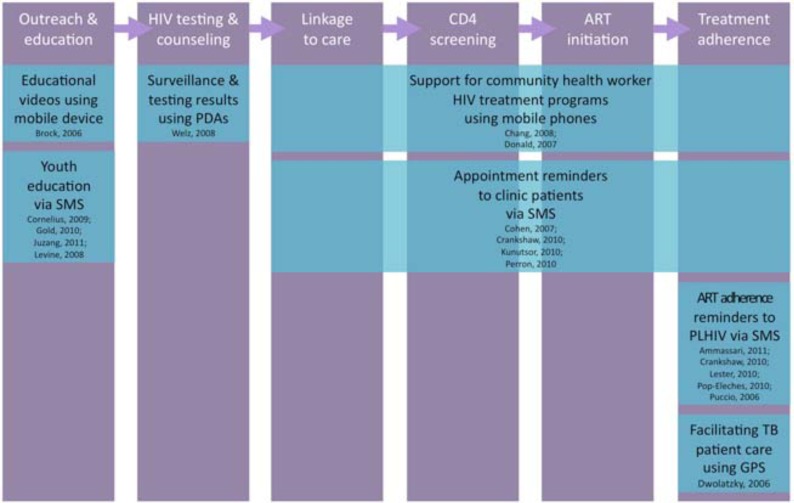
- ART adherence had the strongest evidence base: two Kenya RCTs found weekly SMS reminders significantly improved adherence, and Lester et al. also found improved viral suppression.
- Key populations were rarely addressed: projects focused on PLHIV (45%), pregnant women (3%), sex workers (5%), men who have sex with men (5%), and users of injection drugs (0%); no articles described mHealth for PMTCT.
Methods
- Systematic review searching health, engineering, technology, and social science databases, including Pubmed/Medline, Scopus, Embase, Cochrane, CABI Global Health, Compendex, Web of Science, INSPEC, Popline, WHO Technical Reports, and Google Scholar, limited to English articles from January 2001 to December 2011.
- Three independent reviewers coded articles for methods, design, implementation science category, rigor, purpose of technology, theoretical framework, location, population, community engagement, cascade stage, impact, findings, and conclusions; disagreements were resolved by a senior researcher.
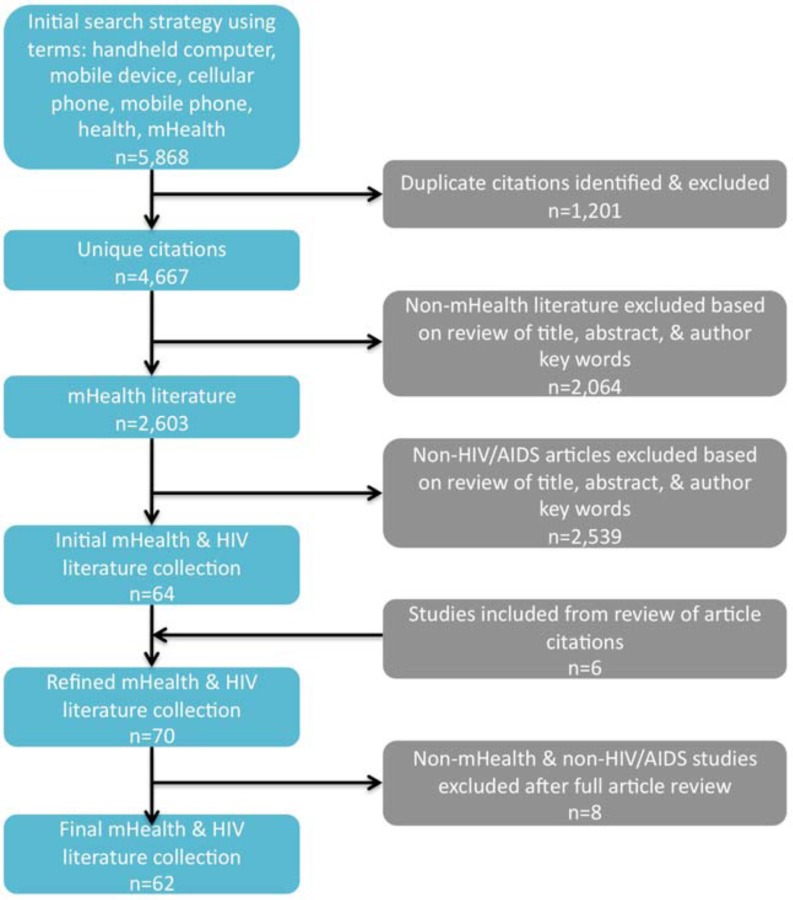
- From 2,603 mHealth articles, 64 were pertinent to HIV/AIDS, with additional reference-list articles yielding a final set of 62; articles were divided into research and non-research, and only research articles were used to assess evidence for HIV programmatic requirements.
Limitations
- Stated: mHealth is rapidly evolving and often led by commercial or small non-profit actors, so many initiatives may be unpublished; negative findings may be published less often, so the review may not reflect the full landscape.
- Stated: only articles explicitly reporting mobile information technology devices were included, excluding PC-, laptop-, and printer-based eHealth systems despite their potential relevance.
- Evident from the text: many studies were small pilots or descriptive, lacked comparison groups or multiple measurements, and only a few of 35 studies mentioned a theoretical or conceptual framework; none described an integrated mixed-methods approach.
Model-written summary. Check it against the paper before relying on it.
Integrity signals
Registry
Cites
Statistics
Figures
Verification
Claims the paper makes
4 Valid · 3 Not valid · 27 Not checked · 55 Own results and interpretations
Every source the paper cites for this claim was checked and supports it.
In the paper
“SMS was a feasible and acceptable way for vulnerable youth to receive information and referrals to clinical services [28].”
§ mHealth for HIV Treatment & Prevention: A Systematic Review of the Literature > FINDINGS > HIV Programmatic Objectives
What the sources say
- Supportedcites [28] Levine D McCright J Dobkin L Woodruff AJ Klausner JD SEXINFO: a sexual health text messaging service for San Francisco youth. Am J Public Health 2008 98 3 393 5 18235068 PMC2253571 source
The Conclusions section (p. 1 of our copy) states verbatim the substance of the claim: text messaging is 'a feasible and culturally acceptable way for at-risk youths to receive sexual health information and referrals to sexual and reproductive health services.' The Abstract and the DEVELOPMENT AND IMPLEMENTATION passage corroborate it (focus-group youths with unlimited texting 'considered SEXINFO a private and valuable service,' and the service delivers 'basic facts about sexual health and relationships, as well as referrals to youth-oriented clinical and social services'). 'Vulnerable youth' maps onto the paper's 'at-risk youths' (African American adolescents aged 15-19 in San Francisco), so the population qualifier holds. (LLM, conf=0.93)
plain- Asserted: passes — The authors put it forward as true.
- Checkable: passes — It can be checked against evidence.
- Load-bearing: unclear — It is unclear whether the paper’s conclusions depend on it.
- Based: passes — The paper gives a reason why it holds.
- Supported
The sources with a verdict support this claim; the rest weren’t checked yet, have no full text we could read, or their verdicts aren’t rated yet.
In the paper
“Among 35 studies, only a few [22-27] mentioned a theoretical basis or conceptual framework that guided their assumptions about why mHealth might facilitate or cause the intended change.”
§ mHealth for HIV Treatment & Prevention: A Systematic Review of the Literature > FINDINGS > Research & Evaluation Studies
What the sources say
- Not checked yetcites [22] Lester RT Ritvo P Mills EJ Effects of a mobile phone short message service on antiretroviral treatment adherence in Kenya (WelTel Kenya1): a randomised trial. Lancet 2010 376 9755 1838 45 21071074 source
- Supportedcites [23] Gold J Lim MSC Hellard ME Hocking JS Keogh L What's in a message?, delivering sexual health promotion to young people in Australia via text messaging. BMC Public Health 2010 10 792 21190584 PMC3022861 source
The citation identifies this paper as an example of a study that mentions a conceptual basis; it does not attribute the count of 35 studies to this paper. In the Background (page unavailable), the authors invoke Giddens’s concept of reflexivity to explain how incoming information can change practices and why that matters for health promotion through new communication channels. (LLM, conf=0.86)
- Could not verifycites [24] Samal L Hutton HE Erbelding EJ Brandon ES Finkelstein J Chander G Digital divide: variation in internet and cellular phone use among women attending an urban sexually transmitted infections clinic. Bull NY Acad Med J Urban Health 2010 87 1 122 8 PMC2821605 19941085 sourceExperimental — accuracy not yet measured
The Methods section describes a survey of internet and cellular-phone use among women attending an STI clinic, and the Discussion addresses the feasibility of future interventions. Our copy does not assess 35 studies or say which studies mentioned a theoretical basis or conceptual framework; searches for those terms found no relevant passage. (LLM, conf=0.72)
- Supportedcites [25] Swendeman D Rotheram-Borus MJ Innovation in sexually transmitted disease and HIV prevention: Internet and mobile phone delivery vehicles for global diffusion. Curr Opin Psychiatry 2010 23 2 139 44 20087189 PMC2881840 source
In “Evidence-based decision-making and practice” (page unavailable), the paper describes five common factors underlying effective HIV/STD prevention and applies them to adoption of information and communication technology. That supports citing it as an example of a paper that mentions a conceptual framework. The count of 35 studies is the citing authors’ framing, not a finding attributed to this individual source. (LLM, conf=0.84)
- Not checked yetcites [26] Tolly KDe Alexander H Town C Innovative use of cellphone technology for HIV / AIDS behaviour change communications?: 3 pilot projects Cellphones4 HIV project SMS ARV reminders?: TAC adherence clubs. Cell 2009 May 2008 1 13
- Not checked yetcites [27] Vidrine DJ Arduino RC Gritz ER Impact of a cell phone intervention on mediating mechanisms of smoking cessation in individuals living with HIV/AIDS. Nicotine Tobacco Res 2006 8 Suppl 1 S103 8 17491177 source
plain- Asserted: passes — The authors put it forward as true.
- Checkable: passes — It can be checked against evidence.
- Load-bearing: unclear — It is unclear whether the paper’s conclusions depend on it.
- Based: passes — The paper gives a reason why it holds.
The cited sources support only part of this claim — read each source’s verdict below.
In the paper
“Key populations -- such as pregnant mothers, sex workers, users of injection drugs, and men who have sex with men -- are not only at higher risk for HIV infection, but are also less likely to access standard treatment and the other related HIV health services due to stigma and discrimination they face from the general population as well as providers [64-70].”
§ mHealth for HIV Treatment & Prevention: A Systematic Review of the Literature > mHealth & HIV Treatment & Prevention Programmatic Needs
What the sources say
- Partly supportedcites [64] Mahajan AP Sayles JN Patel VA Stigma in the HIV/AIDS epidemic: a review of the literature and recommendations for the way forward. AIDS Lodon.England) 2008 22 Suppl 2 S67 79 PMC2835402 18641472 sourceExperimental — accuracy not yet measured
The Results section on defining stigma says that overlapping social disadvantages can predispose individuals to HIV infection. The Discussion identifies men who have sex with men, injecting drug users, and sex workers as groups facing stigma, but the paper does not state that all the listed groups—including pregnant mothers—are at higher risk of HIV infection. (LLM, conf=0.78)
- Not checked yetcites [65] Niang C Tapsoba P “It”s raining stones': Stigma. violence and HIV vulnerability among men who have sex with men in Dkar. Senegal. Culture. Health Sex 2003 5 6 499 512 source
- Not checked yetcites [66] PEPFAR Addressing gender and HIV/AIDS. Washington. D C PEPFAR 2010
- Not checked yetcites [67] Castronn A Farmern Pk Understanding and addressing AIDS-related stigma from anthropological theory to clinical practice in Haiti. J Inf. 2005 95 1 53 9 PMC1449851 15623859
- Not checked yetcites [68] Ogden J Nyblade L Common at its core HIV-related stigma across contexts. Washington DC ICRW. 2005
- Not checked yetcites [69] UNAIDS.HIV-related stigma discrimination and human rights violations: Case studies of successful programmes. Geneva UNAIDS. 2005
- Not checked yetcites [70] Farmer P Connors M Women poverty and AIDS sex drugs and structural violence 2nd ed. Monroe Common Courage Press. 2011
plainstates an association- Asserted: passes — The authors put it forward as true.
- Checkable: passes — It can be checked against evidence.
- Load-bearing: passes — The paper’s conclusions depend on it.
- Based: passes — The paper gives a reason why it holds.
- Partly supported
The cited sources support only part of this claim — read each source’s verdict below.
In the paper
“Key populations -- such as pregnant mothers, sex workers, users of injection drugs, and men who have sex with men -- are not only at higher risk for HIV infection, but are also less likely to access standard treatment and the other related HIV health services due to stigma and discrimination they face from the general population as well as providers [64-70].”
§ mHealth for HIV Treatment & Prevention: A Systematic Review of the Literature > mHealth & HIV Treatment & Prevention Programmatic Needs
What the sources say
- Partly supportedcites [64] Mahajan AP Sayles JN Patel VA Stigma in the HIV/AIDS epidemic: a review of the literature and recommendations for the way forward. AIDS Lodon.England) 2008 22 Suppl 2 S67 79 PMC2835402 18641472 sourceExperimental — accuracy not yet measured
The Results section (page not supplied) says HIV-related stigma impedes access to HIV care and treatment, and specifically describes pregnant women avoiding prevention-of-mother-to-child-transmission services for fear of stigma. The Recommendations section identifies sex workers, injecting drug users, and men who have sex with men as groups facing stigma, but does not establish that each of these groups is less likely to access treatment because of stigma from both the general population and providers. (LLM, conf=0.84)
- Not checked yetcites [65] Niang C Tapsoba P “It”s raining stones': Stigma. violence and HIV vulnerability among men who have sex with men in Dkar. Senegal. Culture. Health Sex 2003 5 6 499 512 source
- Not checked yetcites [66] PEPFAR Addressing gender and HIV/AIDS. Washington. D C PEPFAR 2010
- Not checked yetcites [67] Castronn A Farmern Pk Understanding and addressing AIDS-related stigma from anthropological theory to clinical practice in Haiti. J Inf. 2005 95 1 53 9 PMC1449851 15623859
- Not checked yetcites [68] Ogden J Nyblade L Common at its core HIV-related stigma across contexts. Washington DC ICRW. 2005
- Not checked yetcites [69] UNAIDS.HIV-related stigma discrimination and human rights violations: Case studies of successful programmes. Geneva UNAIDS. 2005
- Not checked yetcites [70] Farmer P Connors M Women poverty and AIDS sex drugs and structural violence 2nd ed. Monroe Common Courage Press. 2011
plainstates a cause- Asserted: passes — The authors put it forward as true.
- Checkable: passes — It can be checked against evidence.
- Load-bearing: passes — The paper’s conclusions depend on it.
- Based: passes — The paper gives a reason why it holds.
- Partly supported
A result the paper reports from its own data — it cites no other source for it, so there is none to check. The quote shows it is in the paper.
In the paper
“Nearly 80% of all articles were published between 2007 and 2011”
§ mHealth for HIV Treatment & Prevention: A Systematic Review of the Literature > FINDINGS > mHealth & HIV Landscape
plain- Asserted: passes — The authors put it forward as true.
- Checkable: passes — It can be checked against evidence.
- Load-bearing: unclear — It is unclear whether the paper’s conclusions depend on it.
- Based: passes — The paper gives a reason why it holds.
62 more claims
Create a free account to see all 89 claims and to verify the 55 references still open.
- It may state two separate claims as one. 11
- Probably not a substantial claim. 12
Claims other papers make about this one
Each is checked against this paper’s own text: does it say what the citing paper says it does?
The source backs part of the claim, not all of it — or backs it for a different population, condition or comparison.
In the citing paper
“Most reviews of use of digital communication with patients in sub-Saharan Africa, comment on the problems of implementation of the communication system, particularly technical and maintenance issues.26–28 54–58”
From mHealth text and voice communication for monitoring people with chronic diseases in low-resource settings: a realist review (2018) · cites this paper as [27]
Experimental — accuracy not yet measuredThe cited source says what the claim attributes to it.
In the citing paper
“Reviews have found variation in effect depending on how mechanisms were operationalised.”
From mHealth text and voice communication for monitoring people with chronic diseases in low-resource settings: a realist review (2018) · cites this paper as [27]
The cited source says what the claim attributes to it.
In the citing paper
“For example, weekly reminders worked better than daily reminders”
From mHealth text and voice communication for monitoring people with chronic diseases in low-resource settings: a realist review (2018) · cites this paper as [27]
In the citing paper
“A stronger theoretical understanding is likely to strengthen the mHealth evidence base.27”
From mHealth text and voice communication for monitoring people with chronic diseases in low-resource settings: a realist review (2018) · cites this paper as [27]
In the citing paper
“and messages had more impact when they were linked with patient–health worker interaction.17 27 49 51–53”
From mHealth text and voice communication for monitoring people with chronic diseases in low-resource settings: a realist review (2018) · cites this paper as [27]
Self-check
Percentages, sums and reported differences re-computed from the paper’s own numbers.
Each contradiction between two passages listed here was confirmed by an independent check.
Rated minor: it would not touch a result — a value no result rests on, a p-value that stays on the same side of the significance level, or a conflict that is clerical, resolved elsewhere in the paper, or outside its own findings.
In the paper
§ mHealth for HIV Treatment & Prevention: A Systematic Review of the Literature > mHealth & HIV Treatment & Prevention Programmatic Needs
“although one article on mHealth for improving efficiency of early infant diagnosis was published after the literature collection deadline [73].”
§ mHealth for HIV Treatment & Prevention: A Systematic Review of the Literature > References
“73. Rotheram-Borus M-J Richter L VanRooyen H Project masihambisane a cluster randomised controlled trial with peer mentors to improve outcomes for pregnant mothers living with HIV. Trials 2011 12 2 10.1186/1745-6215-12-2 PMC3022743 21205302”
Rated minor: it would not touch a result — a value no result rests on, a p-value that stays on the same side of the significance level, or a conflict that is clerical, resolved elsewhere in the paper, or outside its own findings.
In the paper
§ mHealth for HIV Treatment & Prevention: A Systematic Review of the Literature > FINDINGS > HIV Programmatic Objectives
“Pop-Eleches et al. found that treatment adherence improved significantly among patients randomized to receive weekly text message reminders during a 48-week intervention period in Kenya [20].”
§ mHealth for HIV Treatment & Prevention: A Systematic Review of the Literature > References
“20. Crankshaw T Corless IB Giddy J Nicholas PK Eichbaum Q Butler LM Exploring the patterns of use and the feasibility of using cellular phones for clinic appointment reminders and adherence messages in an antiretroviral treatment clinic.”
Rated minor: it would not touch a result — a value no result rests on, a p-value that stays on the same side of the significance level, or a conflict that is clerical, resolved elsewhere in the paper, or outside its own findings.
In the paper
“Four studies (20%) were monitoring reports, particularly descriptions of project activities, inputs, and outputs.”
§ mHealth for HIV Treatment & Prevention: A Systematic Review of the Literature > FINDINGS > Research & Evaluation Studies
Reported 20 · recomputed 11.428571
Rated minor: it would not touch a result — a value no result rests on, a p-value that stays on the same side of the significance level, or a conflict that is clerical, resolved elsewhere in the paper, or outside its own findings.
In the paper
§ mHealth for HIV Treatment & Prevention: A Systematic Review of the Literature > FINDINGS > mHealth & HIV Landscape
“Only one article, a brief news report, described the use of mobile technology for point-of-care diagnostics, specifically a mobile phone imaging tool that is currently in development to measure CD4 count from remote locations [17].”
§ mHealth for HIV Treatment & Prevention: A Systematic Review of the Literature > References
“17. Kho A Henderson LE Dressler DD Kripalani S Use of handheld computers in medical education.A systematic review.. J Gen Intern Med 2006 21 5 31 7 10.1111/j.1525-1497.2006.00444.x PMC1484794 16704405”
Rated minor: it would not touch a result — a value no result rests on, a p-value that stays on the same side of the significance level, or a conflict that is clerical, resolved elsewhere in the paper, or outside its own findings.
In the paper
§ mHealth for HIV Treatment & Prevention: A Systematic Review of the Literature > FINDINGS > Research & Evaluation Studies
“quantitative (71%) and qualitative (51%) methods”
§ mHealth for HIV Treatment & Prevention: A Systematic Review of the Literature > FINDINGS > Research & Evaluation Studies
“some (14%) used both qualitative/quantitative strategies”
Citations
Cites
(1998) · Sage eBooks · Cited by 38,631
Rogers, E. M., Singhal, A., & Quinlan, M. M. (2019) · An Integrated Approach to Communication Theory and Research · doi:10.4324/9780203710753-35 · Cited by 37,322
Social Cognitive Theory: An Agentic Perspective
Bandura, A. (2001) · Annual Review of Psychology · doi:10.1146/annurev.psych.52.1.1 · Cited by 15,510
Basics of Qualitative Research (3rd ed.): Techniques and Procedures for Developing Grounded Theory
Corbin, J., & Strauss, A. (2008) · SAGE · doi:10.4135/9781452230153 · Cited by 12,136 · cited 1×
“However, when RCTs are not feasible or ethical in practice-based contexts, implementers and researchers can push for more rigorous quasi-experimental studies [52-54] and further grounding [55] and analytical rigor [56] in qualitative studies.”
Qualitative research in health care: Analysing qualitative data
Pope, C. (2000) · BMJ · doi:10.1136/bmj.320.7227.114 · Cited by 8,131
(2008) · Cited by 7,674
Norman, D. (2016) · Vahlen eBooks · doi:10.15358/9783800648108 · Cited by 6,374
The Technology Acceptance Model: Past, Present, and Future
Lee, Y., Kozar, K. A., & Larsen, K. R. T. (2003) · Communications of the Association for Information Systems · doi:10.17705/1cais.01250 · Cited by 2,572 · cited 1×
“…review. mHealth interventions might benefit from the dozens if not hundreds of years of development of theories of individual, social, and institutional change, including social cognitive theory [48], unified theory of acceptance and use of technology [49], adoption of innovations [50], and others.”
BackgroundMale circumcision for HIV prevention in young men in Kisumu, Kenya: a randomised controlled trial.
Bailey, R. C., Moses, S., Parker, C. B., Agot, K., Maclean, I., Krieger, J. N., Williams, C. F., Campbell, R. T., & Ndinya-Achola, J. O. (2007) · The Lancet · doi:10.1016/s0140-6736(07)60312-2 · Cited by 2,292 · cited 1×
“For the first time since the dawn of the epidemic, major clinical trials have confirmed the effectiveness of several prevention strategies [2-5].”
BackgroundMale circumcision for HIV prevention in men in Rakai, Uganda: a randomised trial.
Gray, R. H., Kigozi, G., Serwadda, D., Makumbi, F., Watya, S., Nalugoda, F., Kiwanuka, N., Moulton, L. H., Chaudhary, M. A., Chen, M. Z., et al. (2007) · The Lancet · doi:10.1016/s0140-6736(07)60313-4 · Cited by 2,226 · cited 1×
“For the first time since the dawn of the epidemic, major clinical trials have confirmed the effectiveness of several prevention strategies [2-5].”
Background
Research works printed but not linked: 17
- WHO.WHO global observatory for e-health series - New horizons for health through mobile technologies. Observatory. Geneva: WHO 2011 3
- Baeten J Celum C Antiretroviral pre-exposure prophylaxis for HIV-1 prevention among heterosexual African men and women: the Partners PrEP study IAS Conference on HIV Pathogenesis. Treatment and Prevention. Rome 2011
- UNAIDS.Getting to zero: 2011-1015 Strategy. Development. Geneva: UNAIDS 2010
- Clinton HR Remarks on “Creating an AIDS-Free Generation”. Bethesda. National Institute of Health. 2011
- mHealth Alliance.What is mHealth?. Available at www.mhealthalliance.org 2012
- Torgan C The mHealth summit: local & global converge. Washingto D.C 2009, 00
- WHO M-Health Geneva. WHO 2013
- Marcus J Wong Kromhout W NIH recognizes engineering professor's innovative research with major award: pioneering work on cell-phone imaging could transform global health care. Los Angeles: UCLA Newsroom 2009
- Tolly KDe Alexander H Town C Innovative use of cellphone technology for HIV / AIDS behaviour change communications?: 3 pilot projects Cellphones4 HIV project SMS ARV reminders?: TAC adherence clubs. Cell 2009 May 2008 1 13
- Marcus J Wong Kromhout W NIH recognizes engineering professor's innovative research with major award: pioneering work on cell-phone imaging could transform global health care. Los Angeles. UCLA Newsroom 2009
- Micek M Gimbel-Sherr K João Baptista A Mozambique? Identifying obstacles to treatment. J Acquir Immune Defic Syndr. 2010 52 3 397 405 19550350 PMC2784145 · DOI
- Stansfield S Orobaton N Lubinski D Uggowitzer S Elec BE Mwanyika H The case for a national health information system architecture?a missing link to guiding Nat Dev Implementation. Belagio. 2009 1 9
- Rogers EM Diffusion of innovations. Glencoe Free Press 1962
- Swaminathan S Guay L How to conduct operational research and implementation science - definitions. de Methodology. 6th International AIDS Society Conference on HIV Pathogenesis. Treatment and Prevention. Rome 2011
- PEPFAR Addressing gender and HIV/AIDS. Washington. D C PEPFAR 2010
- Rotheram-Borus M-J Richter L VanRooyen H Project masihambisane a cluster randomised controlled trial with peer mentors to improve outcomes for pregnant mothers living with HIV. Trials 2011 12 2 PMC3022743 21205302
- World Health Organization (WHO).Antiretroviral drugs for treating pregnant women and preventing HIV infections in infants: Recommendations for a public health approach. Geneva WHO. 2010 26180894
Cited by
Items 201–255 of 255
Kiruthu-Kamamia, C., Klabbers, R. E., Tweya, H. M., Huwa, J. M., Thawani, A., Bisani, P., Chintedza, J., Chiwaya, G. D., Kudzala, A., Ndhlovu, D., et al. (2025) · PLOS Global Public Health · doi:10.1371/journal.pgph.0004598 · Cited by 2
“These findings align with previous research on SMS interventions with a positive impact on ART refill visit compliance [13,15,17,18,32].”
mHEALTH intervention to improve breast cancer prevention and early detection: A literature review
Fajriani, R. N., & Anggraeni, M. D. (2023) · Jurnal Aisyah Jurnal Ilmu Kesehatan · doi:10.30604/jika.v8i2.1774 · Cited by 2
“There has also been rising community enthusiasm for using mHealth, as it is used in high-income areas as well as low- and middle-income areas (Catalani et al., 2013).”
BackgroundTanner, A. E., Mann‐Jackson, L., Alonzo, J., Chaffin, J. W., Stafford, J. M., Kline, D. M., Aguilar-Palma, S. K., Goldenberg, T., Sucaldito, A. D., Jibriel, M. S. E., et al. (2025) · AIDS Education and Prevention · doi:10.1521/aeap.2025.37.5.379 · Cited by 2
Evidences on the effectiveness of text messages in the adherence to antiretroviral therapy in adults
Soares, Y. K. D. C., & de Araújo, T. M. E. (2020) · Revista gaúcha de enfermagem · doi:10.1590/1983-1447.2020.20190242 · Cited by 2
“It is a tool that can strengthen the health services in combination with regular care, improving care for people with HIV(11).”
MethodZambrano de León, K. K., & Cruzatty, F. A. M. (2023) · Polo del Conocimiento · doi:10.23857/pc.v8i8.5848 · Cited by 2
Deblonde, J. (2014) · Ghent University Academic Bibliography (Ghent University) · Cited by 2
Hyde, Z., Roura, R., Varanasi, K., McGinn, T., Evans, J., Verschoore, B., Yang, P., Labrique, A. B., Ricketts, E. P., Rothman, R. E., et al. (2022) · Digital Health · doi:10.1177/20552076221143238 · Cited by 1
“Mobile Health (mHealth), the practice of medical and public health via mobile communication devices, advances a new way of engaging with patients from vulnerable patient populations, by using the internet and text messages as means to promote better digital communication.(15,16) Studies have demonstrated thatmHealth i…”
BackgroundMulaudzi, M., Tshabalala, G., Hornschuh, S., Okyere-dede, K. E., Wu, M., Ariyo, O., & Dietrich, J. J. (2025) · PLOS Digital Health · doi:10.1371/journal.pdig.0000672 · Cited by 1
Agapito, J. A., Obmerga, K. Y., Pacheco, M. J., Ranin, C., Sophus, A. I., & Carandang, R. R. (2026) · Journal of the International Association of Providers of AIDS Care (JIAPAC) · doi:10.1177/23259582261431644 · Cited by 1
“39,51 The GRADE certainty for this outcome was moderate, supported by consistent evidence across diverse settings.”
Assessing the effect of an online HIV/AIDS course on 1st-year pharmacy students’ knowledge
Suleman, F. (2016) · African Journal of Health Professions Education · doi:10.7196/ajhpe.2016.v8i1.750 · Cited by 1
Spector, A. Y., Pavlicová, M., Hu, M. C., Nunes, E. V., Campbell, A. N. C., & Tross, S. (2020) · Journal of HIV/AIDS & Social Services · doi:10.1080/15381501.2020.1712290 · Cited by 1
Beck, E. J., Mandalia, S., Yfantopoulos, P., Jones, C. I., Bremner, S. A., Whetham, J., Wittevrongel, M., & Apers, L. (2021) · Acta Clinica Belgica · doi:10.1080/17843286.2021.2004697 · Cited by 1
“ventions, however, indicate the variable effectiveness of mHealth tools, for those that were HIV-specific [8,9,13] or mHealth tools for other chronic diseases”
BackgroundUnheard Voices: The Need for HIV Research and Prevention Priorities for YMSM in the Global Context
Hall, C. D. X., Murdock, D., Nehl, E. J., & Wong, F. Y. (2016) · AIDS Education and Prevention · doi:10.1521/aeap.2016.28.3.272 · Cited by 1
The Utility of Mobile Phones for Health Among Women Living with HIV in Urban Malawi
Dietrich, L. (2016) · UWM Digital Commons (University of Wisconsin–Milwaukee) · Cited by 1
Yah, C. S. (2017) · Ethiopian Journal of Health Sciences · doi:10.4314/ejhs.v27i6.7 · Cited by 1
“The use of ICT has improved partner perception of HIV knowledge in many settings (30,31).”
BackgroundKoegler, E., Thomson, T. J., Speno, A. G., & Teti, M. (2018) · Journal of HIV/AIDS & Social Services · doi:10.1080/15381501.2018.1519479 · Cited by 1
Experiences in Development and Support of a Multi-technology Skin Conditions Clinical Trial Platform
Sinnott, R., & Hu, W. T. (2022) · Proceedings - IEEE Symposium on Computer-Based Medical Systems · doi:10.1109/cbms55023.2022.00087 · Cited by 1
The efficiency of the EmERGE platform for medically stable people living with HIV in Portugal
Beck, E. J., Mandalia, S., Yfantopoulos, P., Jones, C. I., Bremner, S. A., Whetham, J., Cunha, A. S., Teófilo, E., Rodrigues, G., & Borges, M. (2022) · Porto Biomedical Journal · doi:10.1097/j.pbj.0000000000000191 · Cited by 1
Prata, N., Morris, N., Agbovi, K. K., & Hernandez, O. (2019) · MOJ Public Health · doi:10.15406/mojph.2019.08.00304 · Cited by 1
Suzuki, M., Yamanaka, K., Fukushima, S., Ogawa, M., Nagaiwa, Y., & Naito, T. (2023) · JMIR Formative Research · doi:10.2196/43527 · Cited by 1
“Mobile-based apps have been shown to promote the link between HIV care at home and ART adherence [3-5], but reports of physicians’ experiences and testimonies regarding patient-centric apps are scarce [6].”
BackgroundMcBain, H. B. (2014) · City Research Online (City University London) · Cited by 1
Jaffer, A. (2015) · ScholarWorks (Walden University) · Cited by 1
Goodman, K. S. (2014) · ODU Digital Commons (Old Dominion University) · doi:10.25777/z90b-g878 · Cited by 2
Mbuagbaw, L. C. E. (2014) · MacSphere (McMaster University) · doi:10.71548/21917 · Cited by 1
ANI Emerging Leaders Project: Point-of-Care Technology for HIV Prevention and Management
Schnall, R. (2016) · CIN Computers Informatics Nursing · doi:10.1097/cin.0000000000000246
“Mobile devices have the advantage of simple user interface, accessibility anywhere Internet or cellular service is available, and relative affordability and have been promoted specifically as a solution to reach stigmatized and disenfranchised populations.(1,2)”
BackgroundA mobile medical application design model in social perspective
Shi, G., Zhang, S., Liu, X., & Zhou, B. (2016) · IEEE International Conference on Software Engineering and Service Science (ICSESS) · doi:10.1109/icsess.2016.7883249
“But lack of meeting the needs of pregnant women, sex workers and other groups [15].”
BackgroundGlöckner, S. (2017) · University of Birmingham Institutional Research Archive (University of Birmingham)
Shepherd, J. G., Goodman, K. S., & Chandra, M.-S. (2017) · Journal of Patient Care · doi:10.4172/2573-4598.1000135
“Treatment modalities may include those that are offered in the patient’s primary medical home, technology based, practical, age specific, and those that are culturally sensitive with targeted audiences [2,7,27-29].”
BackgroundClarke, L. (2017) · University of Huddersfield Repository (University of Huddersfield)
Ochalek, T. A. (2018) · ScholarWorks -A service of University of Vermont Libraries (University of Vermont)
Pilot testing models of task shifting for the care of severe mental illness in South Africa
Sibeko, N. G. (2018) · Open University of Cape Town (University of Cape Town)
mHealth ELISA System for Point-of-care
Zhdanov, A. (2019) · Digital Commons - University of South Florida (University of South Florida)
Agaba, P. (2019) · Repository@Hull (Worktribe) (University of Hull)
Formation of HIV-infected models based on epidemiological monitoring data
Almukhametov, A. A., Akhmetshina, D. R., Petrov, I. V., Sidorova, I. V., & Galiakhmetov, A. I. (2021) · Zenodo (CERN European Organization for Nuclear Research) · doi:10.5281/zenodo.4425207
Study of e-Health nutritional interventions on disease patients based on meta-analysis
WIDJAJA, G., & Sijabat, H. H. (2021) · Food Science and Technology · doi:10.1590/fst.68921
Mahayani, G. A. K. D., Made Rini Damayanti, S., & Utami, P. A. S. (2022) · Journal of A Sustainable Global South · doi:10.24843/jsgs.2022.v06.i01.p02
“The number of HIV cases in Bali Province in 2016 was 14,583 people and the number of AIDS cases was 6,803 (Provincial Health Office of Bali, 2016) [3].”
BackgroundTelehealth for Adolescents in the Juvenile Justice System
Ghosh, R., Hsiao, V., & Pham, D.-Q. (2024) · Springer eBooks · doi:10.1007/978-3-031-55760-6_12
Solis, R. J. C., Labor, J. S., Samonte, C. J., & Cox, C. A. R. (2024) · Media Asia · doi:10.1080/01296612.2024.2429404
“Global evidence supports the use of mobile technologies for healthcare delivery among gay PLHIVs (Catalani et al., 2013; Mbuagbaw et al., 2015), but the agenda shows a limited exploration of social scientific research on mediated healthcare, especially in the local context.”
Mudogo, C. M., Mulwa, A. S., & Kyalo, D. N. (2025) · The Electronic Journal of Information Systems in Developing Countries · doi:10.1002/isd2.70019
“Moreover, EMRs increase adherence to treatment recommendations, leading to better management of chronic conditions, which frequently call for the longitudinal collecting of complicated data (Catalani 2013; Groves et al. 2013).”
Knowledge of the young population about post-exposure prophylaxis: an integrative review
Mota, E. R., Galvão, M. T. G., da Cunha, G. H., & Reis, R. K. (2025) · doi:10.22491/9786584884557/cap7
OVERVIEW OF HIGH RISE DEVELOPMENT IN SURABAYA CITY IN SEVERAL PERIODS OF YEARS
Kartowidjojo, R. I., & Dharmatanna, S. W. (2025) · ALUR Jurnal Arsitektur · doi:10.54367/alur.v8i1.4775
Flynn, G., Jia, H., Reynolds, N. R., Mohr, D. C., & Schnall, R. (2020) · Figshare · doi:10.6084/m9.figshare.13290584
Raeesi, A., Khajouei, R., & Ahmadian, L. (2021) · Figshare · doi:10.6084/m9.figshare.14478411
George, K. (2017) · UniSC Research Bank (University of the Sunshine Coast) · doi:10.25907/00616
Raeesi, A., Khajouei, R., & Ahmadian, L. (2022) · Figshare · doi:10.6084/m9.figshare.21435551
Schaab, B. L. (2019) · LA Referencia (Red Federada de Repositorios Institucionales de Publicaciones Científicas)
Interactieve technologie ter ondersteuning van HIV-management bij adolescenten in Ethiopië
Bezabih, A. M. (2023) · Lirias
Infeção por VIH: tratamento como prevenção
Patel, S. A. (2015) · Portuguese National Funding Agency for Science, Research and Technology (RCAAP Project by FCT)
A Space for Nepalese Male Migrant Workers to Co-Create Internet-Based HIV Prevention
Chhetri, T. B. (2022) · Tuwhera (Auckland University of Technology)
Caetani, R. (2024) · LA Referencia (Red Federada de Repositorios Institucionales de Publicaciones Científicas)
Swick, A., Peri, S. P., Hill, T. D., Datoo, M., Morra, D., Desai, M. G., & Rahman, O. (2026) · Frontiers in Digital Health · doi:10.3389/fdgth.2026.1684685
Moldokmatova, A. (2025) · Oxford University Research Archive (ORA) (University of Oxford) · doi:10.5287/ora-qmkqnvj04
Júnior, F. W. D., Dantas, M. B., Lima, F. E. T., Soares, P. R. A. L., Rebouças, C. B. D. A., Ribeiro, S. G., Coelho, M. D. M. F., Guedes, N. G., & da Cunha, G. H. (2026) · Journal of the Association of Nurses in AIDS Care · doi:10.1097/jnc.0000000000000652
Lodge, W., Chakrapani, V., Rawat, S. M., Singh, J., Mimiaga, M. J., & Biello, K. B. (2026) · SSM - Qualitative Research in Health · doi:10.1016/j.ssmqr.2026.100800
He, J., Chen, H., He, W., Chen, H., Pan, H., Lin, B., & Zhong, X. (2026) · Digital Health · doi:10.1177/20552076261478198
“Although mHealth interventions have garnered considerable attention in HIV prevention and control in recent years, related studies have provided substantial evidence in promoting testing behaviors, 10 increasing risk awareness, 9 and improving treatment compliance.”
Metadata
- Authors
- Catalani, C., Philbrick, W., Fraser, H., Mechael, & Israelski, D. M.
- Affiliations
- University of California, Berkeley (US)
- Brigham and Women's Hospital (US)
- Corresponding author
- Catalani, Caricia
- Venue
- The Open AIDS Journal
- Publisher
- Bentham Science Publishers Ltd.
- Published
- 2013-09-20
- Volume
- 7
- Issue
- 1
- Pages
- 17-41
- ISSN
- 1874-6136 (ISSN-L)
- PMC
- PMC3795408
- OpenAlex
- W2159560382
- Cited by
- 230
- References
- 65
- Citations by year
- 2026: 5 · 2025: 7 · 2024: 16 · 2023: 12 · 2022: 16 · 2021: 24 · 2020: 26 · 2019: 16 · 2018: 35 · 2017: 24 · 2016: 17 · 2015: 24 · 2014: 8
- FWCI
- 1.97
- Type
- journal article
- Language
- en
- Open access
- hybrid
- doi.org
- Locations
- The Open AIDS Journal (publishedVersion, cc-by)
- Europe PMC (PubMed Central) (publishedVersion, cc-by-nc)
- PubMed Central (publishedVersion, cc-by-nc)
- PubMed (publishedVersion)
- Funders
- United States Agency for International Development
- Centers for Disease Control and Prevention
- Topics
- Health Sciences › Health Professions › General Health Professions › Mobile Health and mHealth Applications
- Health Sciences › Medicine › Infectious Diseases › HIV/AIDS Research and Interventions
- Physical Sciences › Computer Science › Information Systems › Mobile Learning in Education
- Keywords
- mobile health, HIV/AIDS, HIV prevention, HIV care continuum, linkage to care, retention in care, antiretroviral therapy adherence, key populations, pregnant women, sex workers, people who inject drugs, men who have sex with men, resource-limited settings, digital health tools
About these checks
Registry, retraction, Cites and statistics results are computed, not judged, with one exception: a printed reference that no index lists is read once by a model before it counts as a citation error. Claims are extracted by a model and kept only when their quote appears verbatim in the text; each cited source is then checked, with a model’s help, for whether it says what the claim relies on. Those verdicts can be wrong — read the claim’s quote and the cited source before relying on one.
The claim verdicts this report counts are experimental: their accuracy is not yet measured.
A language model drew the claims from the paper on 2026-10-06, under version 3 of the claim definition (model deepseek-v4.1-flash, prompt extract-v3).
A second model labelled each claim on 2026-10-06 (model jev-1.13-20260917, definition revision gold-guideline-v0.2).
Cited sources are checked with a language model’s help (qwen3.8-omni-flash and gpt-6-sol).
Statistics and arithmetic are recomputed, not judged.
Confidence bands are shown only for fields calibrated on our annotated test set. None is calibrated yet, so no band is shown.
What counts as a claim ›How we measure confidence ›How we check this ›
Are you an author, or do you see a problem with this page? Request a review
Data sources
Bibliographic data: Semantic Scholar, OpenAlex, Crossref.
Contains information from the Semantic Scholar Academic Graph Datasets, made available under the ODC Attribution License (ODC-BY 1.0).
Semantic Scholar’s data is described in: Kinney, R., et al. (2023). The Semantic Scholar Open Data Platform. arXiv:2301.10140.
