

mHealth for HIV Treatment & Prevention: A Systematic Review of the Literature
Open accessThe DOI matches its Crossref record; 62 of the 65 references it cites were found in a registry or an index; 6 of the 61 sources its claims cite were checked for support.
Abstract
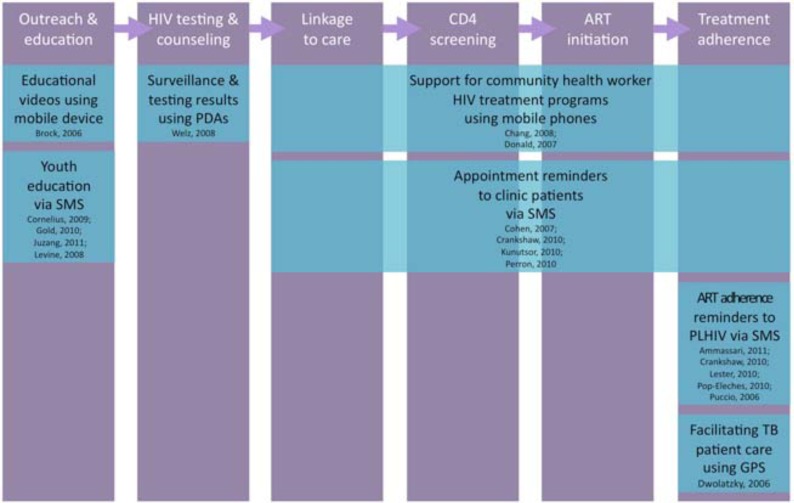
This systematic review assesses the published literature to describe the landscape of mobile health technology (mHealth) for HIV/AIDS and the evidence supporting the use of these tools to address the HIV prevention, care, and treatment cascade. The speed of innovation, broad range of initiatives and tools, and heterogeneity in reporting have made it difficult to uncover and synthesize knowledge on how mHealth tools might be effective in addressing the HIV pandemic. To do address this gap, a team of reviewers collected literature on the use of mobile technology for HIV/AIDS among health, engineering, and social science literature databases and analyzed a final set of 62 articles. Articles were systematically coded, assessed for scientific rigor, and sorted for HIV programmatic relevance. The review revealed evidence that mHealth tools support HIV programmatic priorities, including: linkage to care, retention in care, and adherence to antiretroviral treatment. In terms of technical features, mHealth tools facilitate alerts and reminders, data collection, direct voice communication, educational messaging, information on demand, and more. Studies were mostly descriptive with a growing number of quasi-experimental and experimental designs. There was a lack of evidence around the use of mHealth tools to address the needs of key populations, including pregnant mothers, sex workers, users of injection drugs, and men who have sex with men. The science and practice of mHealth for HIV are evolving rapidly, but still in their early stages. Small-scale efforts, pilot projects, and preliminary descriptive studies are advancing and there is a promising trend toward implementing mHealth innovation that is feasible and acceptable within low-resource settings, positive program outcomes, operational improvements, and rigorous study design
Overview
CoChat Summary
TL;DR
This systematic review of 62 articles describes the early mHealth for HIV landscape and finds the strongest evidence for mobile reminders improving ART adherence, with some evidence for linkage/retention in care. It reports major gaps in rigorous evaluation, theoretical grounding, and mHealth for key populations, especially PMTCT.
Key findings
- Among 62 articles, 56% were research/evaluation studies; most were monitoring/evaluation reports, with 34% evaluation reports, 29% operations research, and 14% impact evaluations.
- Technical features included alerts/reminders (60%), field-based data collection (24%), direct voice communication (24%), educational messaging (13%), information on demand (11%), and provider decision-support (5%).
- ART adherence had the strongest evidence base: two Kenya RCTs found weekly SMS reminders significantly improved adherence, and Lester et al. also found improved viral suppression.
- Key populations were rarely addressed: projects focused on PLHIV (45%), pregnant women (3%), sex workers (5%), men who have sex with men (5%), and users of injection drugs (0%); no articles described mHealth for PMTCT.
Methods
- Systematic review searching health, engineering, technology, and social science databases, including Pubmed/Medline, Scopus, Embase, Cochrane, CABI Global Health, Compendex, Web of Science, INSPEC, Popline, WHO Technical Reports, and Google Scholar, limited to English articles from January 2001 to December 2011.
- Three independent reviewers coded articles for methods, design, implementation science category, rigor, purpose of technology, theoretical framework, location, population, community engagement, cascade stage, impact, findings, and conclusions; disagreements were resolved by a senior researcher.
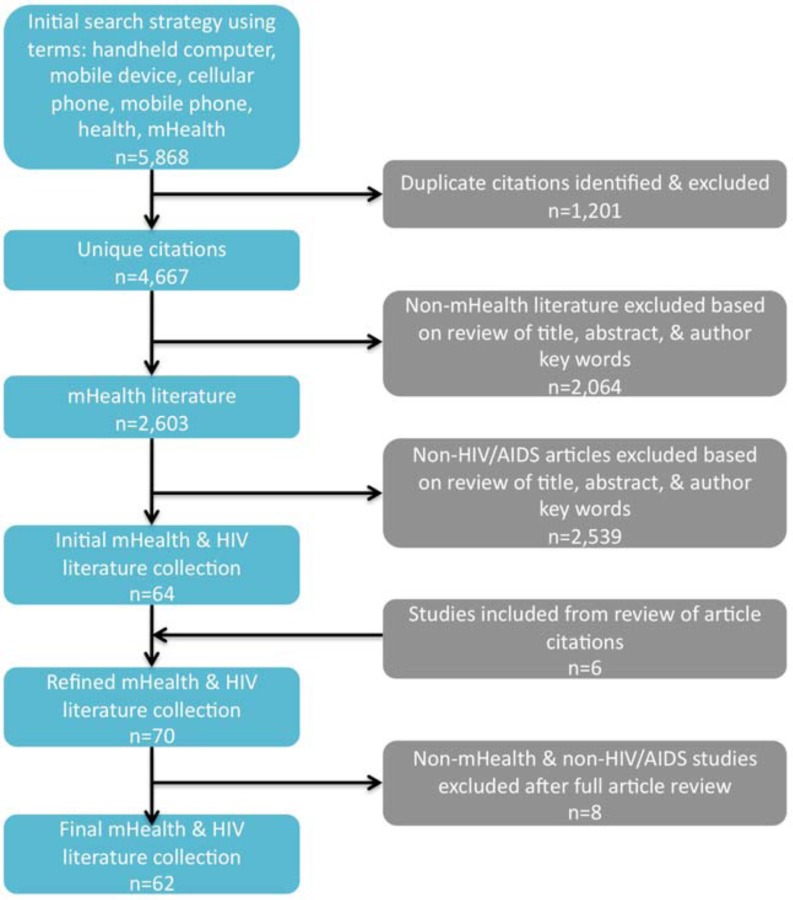
- From 2,603 mHealth articles, 64 were pertinent to HIV/AIDS, with additional reference-list articles yielding a final set of 62; articles were divided into research and non-research, and only research articles were used to assess evidence for HIV programmatic requirements.
Limitations
- Stated: mHealth is rapidly evolving and often led by commercial or small non-profit actors, so many initiatives may be unpublished; negative findings may be published less often, so the review may not reflect the full landscape.
- Stated: only articles explicitly reporting mobile information technology devices were included, excluding PC-, laptop-, and printer-based eHealth systems despite their potential relevance.
- Evident from the text: many studies were small pilots or descriptive, lacked comparison groups or multiple measurements, and only a few of 35 studies mentioned a theoretical or conceptual framework; none described an integrated mixed-methods approach.
Model-written summary. Check it against the paper before relying on it.
Integrity signals
Registry
Cites
Statistics
Figures
Verification
Claims the paper makes
4 Valid · 3 Not valid · 27 Not checked · 55 Own results and interpretations
Every source the paper cites for this claim was checked and supports it.
In the paper
“SMS was a feasible and acceptable way for vulnerable youth to receive information and referrals to clinical services [28].”
§ mHealth for HIV Treatment & Prevention: A Systematic Review of the Literature > FINDINGS > HIV Programmatic Objectives
What the sources say
- Supportedcites [28] Levine D McCright J Dobkin L Woodruff AJ Klausner JD SEXINFO: a sexual health text messaging service for San Francisco youth. Am J Public Health 2008 98 3 393 5 18235068 PMC2253571 source
The Conclusions section (p. 1 of our copy) states verbatim the substance of the claim: text messaging is 'a feasible and culturally acceptable way for at-risk youths to receive sexual health information and referrals to sexual and reproductive health services.' The Abstract and the DEVELOPMENT AND IMPLEMENTATION passage corroborate it (focus-group youths with unlimited texting 'considered SEXINFO a private and valuable service,' and the service delivers 'basic facts about sexual health and relationships, as well as referrals to youth-oriented clinical and social services'). 'Vulnerable youth' maps onto the paper's 'at-risk youths' (African American adolescents aged 15-19 in San Francisco), so the population qualifier holds. (LLM, conf=0.93)
plain- Asserted: passes — The authors put it forward as true.
- Checkable: passes — It can be checked against evidence.
- Load-bearing: unclear — It is unclear whether the paper’s conclusions depend on it.
- Based: passes — The paper gives a reason why it holds.
- Supported
The sources with a verdict support this claim; the rest weren’t checked yet, have no full text we could read, or their verdicts aren’t rated yet.
In the paper
“Among 35 studies, only a few [22-27] mentioned a theoretical basis or conceptual framework that guided their assumptions about why mHealth might facilitate or cause the intended change.”
§ mHealth for HIV Treatment & Prevention: A Systematic Review of the Literature > FINDINGS > Research & Evaluation Studies
What the sources say
- Not checked yetcites [22] Lester RT Ritvo P Mills EJ Effects of a mobile phone short message service on antiretroviral treatment adherence in Kenya (WelTel Kenya1): a randomised trial. Lancet 2010 376 9755 1838 45 21071074 source
- Supportedcites [23] Gold J Lim MSC Hellard ME Hocking JS Keogh L What's in a message?, delivering sexual health promotion to young people in Australia via text messaging. BMC Public Health 2010 10 792 21190584 PMC3022861 source
The citation identifies this paper as an example of a study that mentions a conceptual basis; it does not attribute the count of 35 studies to this paper. In the Background (page unavailable), the authors invoke Giddens’s concept of reflexivity to explain how incoming information can change practices and why that matters for health promotion through new communication channels. (LLM, conf=0.86)
- Could not verifycites [24] Samal L Hutton HE Erbelding EJ Brandon ES Finkelstein J Chander G Digital divide: variation in internet and cellular phone use among women attending an urban sexually transmitted infections clinic. Bull NY Acad Med J Urban Health 2010 87 1 122 8 PMC2821605 19941085 sourceExperimental — accuracy not yet measured
The Methods section describes a survey of internet and cellular-phone use among women attending an STI clinic, and the Discussion addresses the feasibility of future interventions. Our copy does not assess 35 studies or say which studies mentioned a theoretical basis or conceptual framework; searches for those terms found no relevant passage. (LLM, conf=0.72)
- Supportedcites [25] Swendeman D Rotheram-Borus MJ Innovation in sexually transmitted disease and HIV prevention: Internet and mobile phone delivery vehicles for global diffusion. Curr Opin Psychiatry 2010 23 2 139 44 20087189 PMC2881840 source
In “Evidence-based decision-making and practice” (page unavailable), the paper describes five common factors underlying effective HIV/STD prevention and applies them to adoption of information and communication technology. That supports citing it as an example of a paper that mentions a conceptual framework. The count of 35 studies is the citing authors’ framing, not a finding attributed to this individual source. (LLM, conf=0.84)
- Not checked yetcites [26] Tolly KDe Alexander H Town C Innovative use of cellphone technology for HIV / AIDS behaviour change communications?: 3 pilot projects Cellphones4 HIV project SMS ARV reminders?: TAC adherence clubs. Cell 2009 May 2008 1 13
- Not checked yetcites [27] Vidrine DJ Arduino RC Gritz ER Impact of a cell phone intervention on mediating mechanisms of smoking cessation in individuals living with HIV/AIDS. Nicotine Tobacco Res 2006 8 Suppl 1 S103 8 17491177 source
plain- Asserted: passes — The authors put it forward as true.
- Checkable: passes — It can be checked against evidence.
- Load-bearing: unclear — It is unclear whether the paper’s conclusions depend on it.
- Based: passes — The paper gives a reason why it holds.
The cited sources support only part of this claim — read each source’s verdict below.
In the paper
“Key populations -- such as pregnant mothers, sex workers, users of injection drugs, and men who have sex with men -- are not only at higher risk for HIV infection, but are also less likely to access standard treatment and the other related HIV health services due to stigma and discrimination they face from the general population as well as providers [64-70].”
§ mHealth for HIV Treatment & Prevention: A Systematic Review of the Literature > mHealth & HIV Treatment & Prevention Programmatic Needs
What the sources say
- Partly supportedcites [64] Mahajan AP Sayles JN Patel VA Stigma in the HIV/AIDS epidemic: a review of the literature and recommendations for the way forward. AIDS Lodon.England) 2008 22 Suppl 2 S67 79 PMC2835402 18641472 sourceExperimental — accuracy not yet measured
The Results section on defining stigma says that overlapping social disadvantages can predispose individuals to HIV infection. The Discussion identifies men who have sex with men, injecting drug users, and sex workers as groups facing stigma, but the paper does not state that all the listed groups—including pregnant mothers—are at higher risk of HIV infection. (LLM, conf=0.78)
- Not checked yetcites [65] Niang C Tapsoba P “It”s raining stones': Stigma. violence and HIV vulnerability among men who have sex with men in Dkar. Senegal. Culture. Health Sex 2003 5 6 499 512 source
- Not checked yetcites [66] PEPFAR Addressing gender and HIV/AIDS. Washington. D C PEPFAR 2010
- Not checked yetcites [67] Castronn A Farmern Pk Understanding and addressing AIDS-related stigma from anthropological theory to clinical practice in Haiti. J Inf. 2005 95 1 53 9 PMC1449851 15623859
- Not checked yetcites [68] Ogden J Nyblade L Common at its core HIV-related stigma across contexts. Washington DC ICRW. 2005
- Not checked yetcites [69] UNAIDS.HIV-related stigma discrimination and human rights violations: Case studies of successful programmes. Geneva UNAIDS. 2005
- Not checked yetcites [70] Farmer P Connors M Women poverty and AIDS sex drugs and structural violence 2nd ed. Monroe Common Courage Press. 2011
plainstates an association- Asserted: passes — The authors put it forward as true.
- Checkable: passes — It can be checked against evidence.
- Load-bearing: passes — The paper’s conclusions depend on it.
- Based: passes — The paper gives a reason why it holds.
- Partly supported
The cited sources support only part of this claim — read each source’s verdict below.
In the paper
“Key populations -- such as pregnant mothers, sex workers, users of injection drugs, and men who have sex with men -- are not only at higher risk for HIV infection, but are also less likely to access standard treatment and the other related HIV health services due to stigma and discrimination they face from the general population as well as providers [64-70].”
§ mHealth for HIV Treatment & Prevention: A Systematic Review of the Literature > mHealth & HIV Treatment & Prevention Programmatic Needs
What the sources say
- Partly supportedcites [64] Mahajan AP Sayles JN Patel VA Stigma in the HIV/AIDS epidemic: a review of the literature and recommendations for the way forward. AIDS Lodon.England) 2008 22 Suppl 2 S67 79 PMC2835402 18641472 sourceExperimental — accuracy not yet measured
The Results section (page not supplied) says HIV-related stigma impedes access to HIV care and treatment, and specifically describes pregnant women avoiding prevention-of-mother-to-child-transmission services for fear of stigma. The Recommendations section identifies sex workers, injecting drug users, and men who have sex with men as groups facing stigma, but does not establish that each of these groups is less likely to access treatment because of stigma from both the general population and providers. (LLM, conf=0.84)
- Not checked yetcites [65] Niang C Tapsoba P “It”s raining stones': Stigma. violence and HIV vulnerability among men who have sex with men in Dkar. Senegal. Culture. Health Sex 2003 5 6 499 512 source
- Not checked yetcites [66] PEPFAR Addressing gender and HIV/AIDS. Washington. D C PEPFAR 2010
- Not checked yetcites [67] Castronn A Farmern Pk Understanding and addressing AIDS-related stigma from anthropological theory to clinical practice in Haiti. J Inf. 2005 95 1 53 9 PMC1449851 15623859
- Not checked yetcites [68] Ogden J Nyblade L Common at its core HIV-related stigma across contexts. Washington DC ICRW. 2005
- Not checked yetcites [69] UNAIDS.HIV-related stigma discrimination and human rights violations: Case studies of successful programmes. Geneva UNAIDS. 2005
- Not checked yetcites [70] Farmer P Connors M Women poverty and AIDS sex drugs and structural violence 2nd ed. Monroe Common Courage Press. 2011
plainstates a cause- Asserted: passes — The authors put it forward as true.
- Checkable: passes — It can be checked against evidence.
- Load-bearing: passes — The paper’s conclusions depend on it.
- Based: passes — The paper gives a reason why it holds.
- Partly supported
A result the paper reports from its own data — it cites no other source for it, so there is none to check. The quote shows it is in the paper.
In the paper
“Nearly 80% of all articles were published between 2007 and 2011”
§ mHealth for HIV Treatment & Prevention: A Systematic Review of the Literature > FINDINGS > mHealth & HIV Landscape
plain- Asserted: passes — The authors put it forward as true.
- Checkable: passes — It can be checked against evidence.
- Load-bearing: unclear — It is unclear whether the paper’s conclusions depend on it.
- Based: passes — The paper gives a reason why it holds.
62 more claims
Create a free account to see all 89 claims and to verify the 55 references still open.
- It may state two separate claims as one. 11
- Probably not a substantial claim. 12
Claims other papers make about this one
Each is checked against this paper’s own text: does it say what the citing paper says it does?
The source backs part of the claim, not all of it — or backs it for a different population, condition or comparison.
In the citing paper
“Most reviews of use of digital communication with patients in sub-Saharan Africa, comment on the problems of implementation of the communication system, particularly technical and maintenance issues.26–28 54–58”
From mHealth text and voice communication for monitoring people with chronic diseases in low-resource settings: a realist review (2018) · cites this paper as [27]
Experimental — accuracy not yet measuredThe cited source says what the claim attributes to it.
In the citing paper
“Reviews have found variation in effect depending on how mechanisms were operationalised.”
From mHealth text and voice communication for monitoring people with chronic diseases in low-resource settings: a realist review (2018) · cites this paper as [27]
The cited source says what the claim attributes to it.
In the citing paper
“For example, weekly reminders worked better than daily reminders”
From mHealth text and voice communication for monitoring people with chronic diseases in low-resource settings: a realist review (2018) · cites this paper as [27]
In the citing paper
“A stronger theoretical understanding is likely to strengthen the mHealth evidence base.27”
From mHealth text and voice communication for monitoring people with chronic diseases in low-resource settings: a realist review (2018) · cites this paper as [27]
In the citing paper
“and messages had more impact when they were linked with patient–health worker interaction.17 27 49 51–53”
From mHealth text and voice communication for monitoring people with chronic diseases in low-resource settings: a realist review (2018) · cites this paper as [27]
Self-check
Percentages, sums and reported differences re-computed from the paper’s own numbers.
Each contradiction between two passages listed here was confirmed by an independent check.
Rated minor: it would not touch a result — a value no result rests on, a p-value that stays on the same side of the significance level, or a conflict that is clerical, resolved elsewhere in the paper, or outside its own findings.
In the paper
§ mHealth for HIV Treatment & Prevention: A Systematic Review of the Literature > mHealth & HIV Treatment & Prevention Programmatic Needs
“although one article on mHealth for improving efficiency of early infant diagnosis was published after the literature collection deadline [73].”
§ mHealth for HIV Treatment & Prevention: A Systematic Review of the Literature > References
“73. Rotheram-Borus M-J Richter L VanRooyen H Project masihambisane a cluster randomised controlled trial with peer mentors to improve outcomes for pregnant mothers living with HIV. Trials 2011 12 2 10.1186/1745-6215-12-2 PMC3022743 21205302”
Rated minor: it would not touch a result — a value no result rests on, a p-value that stays on the same side of the significance level, or a conflict that is clerical, resolved elsewhere in the paper, or outside its own findings.
In the paper
§ mHealth for HIV Treatment & Prevention: A Systematic Review of the Literature > FINDINGS > HIV Programmatic Objectives
“Pop-Eleches et al. found that treatment adherence improved significantly among patients randomized to receive weekly text message reminders during a 48-week intervention period in Kenya [20].”
§ mHealth for HIV Treatment & Prevention: A Systematic Review of the Literature > References
“20. Crankshaw T Corless IB Giddy J Nicholas PK Eichbaum Q Butler LM Exploring the patterns of use and the feasibility of using cellular phones for clinic appointment reminders and adherence messages in an antiretroviral treatment clinic.”
Rated minor: it would not touch a result — a value no result rests on, a p-value that stays on the same side of the significance level, or a conflict that is clerical, resolved elsewhere in the paper, or outside its own findings.
In the paper
“Four studies (20%) were monitoring reports, particularly descriptions of project activities, inputs, and outputs.”
§ mHealth for HIV Treatment & Prevention: A Systematic Review of the Literature > FINDINGS > Research & Evaluation Studies
Reported 20 · recomputed 11.428571
Rated minor: it would not touch a result — a value no result rests on, a p-value that stays on the same side of the significance level, or a conflict that is clerical, resolved elsewhere in the paper, or outside its own findings.
In the paper
§ mHealth for HIV Treatment & Prevention: A Systematic Review of the Literature > FINDINGS > mHealth & HIV Landscape
“Only one article, a brief news report, described the use of mobile technology for point-of-care diagnostics, specifically a mobile phone imaging tool that is currently in development to measure CD4 count from remote locations [17].”
§ mHealth for HIV Treatment & Prevention: A Systematic Review of the Literature > References
“17. Kho A Henderson LE Dressler DD Kripalani S Use of handheld computers in medical education.A systematic review.. J Gen Intern Med 2006 21 5 31 7 10.1111/j.1525-1497.2006.00444.x PMC1484794 16704405”
Rated minor: it would not touch a result — a value no result rests on, a p-value that stays on the same side of the significance level, or a conflict that is clerical, resolved elsewhere in the paper, or outside its own findings.
In the paper
§ mHealth for HIV Treatment & Prevention: A Systematic Review of the Literature > FINDINGS > Research & Evaluation Studies
“quantitative (71%) and qualitative (51%) methods”
§ mHealth for HIV Treatment & Prevention: A Systematic Review of the Literature > FINDINGS > Research & Evaluation Studies
“some (14%) used both qualitative/quantitative strategies”
Citations
Cites
(1998) · Sage eBooks · Cited by 38,631
Rogers, E. M., Singhal, A., & Quinlan, M. M. (2019) · An Integrated Approach to Communication Theory and Research · doi:10.4324/9780203710753-35 · Cited by 37,322
Social Cognitive Theory: An Agentic Perspective
Bandura, A. (2001) · Annual Review of Psychology · doi:10.1146/annurev.psych.52.1.1 · Cited by 15,510
Basics of Qualitative Research (3rd ed.): Techniques and Procedures for Developing Grounded Theory
Corbin, J., & Strauss, A. (2008) · SAGE · doi:10.4135/9781452230153 · Cited by 12,136 · cited 1×
“However, when RCTs are not feasible or ethical in practice-based contexts, implementers and researchers can push for more rigorous quasi-experimental studies [52-54] and further grounding [55] and analytical rigor [56] in qualitative studies.”
Qualitative research in health care: Analysing qualitative data
Pope, C. (2000) · BMJ · doi:10.1136/bmj.320.7227.114 · Cited by 8,131
(2008) · Cited by 7,674
Norman, D. (2016) · Vahlen eBooks · doi:10.15358/9783800648108 · Cited by 6,374
The Technology Acceptance Model: Past, Present, and Future
Lee, Y., Kozar, K. A., & Larsen, K. R. T. (2003) · Communications of the Association for Information Systems · doi:10.17705/1cais.01250 · Cited by 2,572 · cited 1×
“…review. mHealth interventions might benefit from the dozens if not hundreds of years of development of theories of individual, social, and institutional change, including social cognitive theory [48], unified theory of acceptance and use of technology [49], adoption of innovations [50], and others.”
BackgroundMale circumcision for HIV prevention in young men in Kisumu, Kenya: a randomised controlled trial.
Bailey, R. C., Moses, S., Parker, C. B., Agot, K., Maclean, I., Krieger, J. N., Williams, C. F., Campbell, R. T., & Ndinya-Achola, J. O. (2007) · The Lancet · doi:10.1016/s0140-6736(07)60312-2 · Cited by 2,292 · cited 1×
“For the first time since the dawn of the epidemic, major clinical trials have confirmed the effectiveness of several prevention strategies [2-5].”
BackgroundMale circumcision for HIV prevention in men in Rakai, Uganda: a randomised trial.
Gray, R. H., Kigozi, G., Serwadda, D., Makumbi, F., Watya, S., Nalugoda, F., Kiwanuka, N., Moulton, L. H., Chaudhary, M. A., Chen, M. Z., et al. (2007) · The Lancet · doi:10.1016/s0140-6736(07)60313-4 · Cited by 2,226 · cited 1×
“For the first time since the dawn of the epidemic, major clinical trials have confirmed the effectiveness of several prevention strategies [2-5].”
Background
Research works printed but not linked: 17
- WHO.WHO global observatory for e-health series - New horizons for health through mobile technologies. Observatory. Geneva: WHO 2011 3
- Baeten J Celum C Antiretroviral pre-exposure prophylaxis for HIV-1 prevention among heterosexual African men and women: the Partners PrEP study IAS Conference on HIV Pathogenesis. Treatment and Prevention. Rome 2011
- UNAIDS.Getting to zero: 2011-1015 Strategy. Development. Geneva: UNAIDS 2010
- Clinton HR Remarks on “Creating an AIDS-Free Generation”. Bethesda. National Institute of Health. 2011
- mHealth Alliance.What is mHealth?. Available at www.mhealthalliance.org 2012
- Torgan C The mHealth summit: local & global converge. Washingto D.C 2009, 00
- WHO M-Health Geneva. WHO 2013
- Marcus J Wong Kromhout W NIH recognizes engineering professor's innovative research with major award: pioneering work on cell-phone imaging could transform global health care. Los Angeles: UCLA Newsroom 2009
- Tolly KDe Alexander H Town C Innovative use of cellphone technology for HIV / AIDS behaviour change communications?: 3 pilot projects Cellphones4 HIV project SMS ARV reminders?: TAC adherence clubs. Cell 2009 May 2008 1 13
- Marcus J Wong Kromhout W NIH recognizes engineering professor's innovative research with major award: pioneering work on cell-phone imaging could transform global health care. Los Angeles. UCLA Newsroom 2009
- Micek M Gimbel-Sherr K João Baptista A Mozambique? Identifying obstacles to treatment. J Acquir Immune Defic Syndr. 2010 52 3 397 405 19550350 PMC2784145 · DOI
- Stansfield S Orobaton N Lubinski D Uggowitzer S Elec BE Mwanyika H The case for a national health information system architecture?a missing link to guiding Nat Dev Implementation. Belagio. 2009 1 9
- Rogers EM Diffusion of innovations. Glencoe Free Press 1962
- Swaminathan S Guay L How to conduct operational research and implementation science - definitions. de Methodology. 6th International AIDS Society Conference on HIV Pathogenesis. Treatment and Prevention. Rome 2011
- PEPFAR Addressing gender and HIV/AIDS. Washington. D C PEPFAR 2010
- Rotheram-Borus M-J Richter L VanRooyen H Project masihambisane a cluster randomised controlled trial with peer mentors to improve outcomes for pregnant mothers living with HIV. Trials 2011 12 2 PMC3022743 21205302
- World Health Organization (WHO).Antiretroviral drugs for treating pregnant women and preventing HIV infections in infants: Recommendations for a public health approach. Geneva WHO. 2010 26180894
Cited by
Items 101–200 of 255
Ochoa, A. M., Paneda, C., Wu, E. S. C., Maxwell, K. E., Garth, G., Smith, T., & Holloway, I. W. (2021) · JMIR Research Protocols · doi:10.2196/19770 · Cited by 22
“Technology created to address the needs of people living with HIV focuses specifically on HIV education, access to services (eg, HIV testing, linkage to care), maintaining communication between the patient and provider to support adherence and retention in care, and to support the work of providers [19].”
BackgroundMbotwa, C. H., Kazaura, M. R., Moen, K., Leshabari, M. T., Metta, E. O., Leyna, G. H., & Mmbaga, E. J. (2022) · BMC Health Services Research · doi:10.1186/s12913-022-08245-2 · Cited by 21
Thomas, B. E., Closson, E. F., Biello, K. B., Menon, S., Navakodi, P., Dhanalakshmi, A., Mayer, K. H., Safren, S. A., & Mimiaga, M. J. (2015) · Archives of Sexual Behavior · doi:10.1007/s10508-015-0665-3 · Cited by 21
Schnall, R., Kuhns, L. M., Hidalgo, M. A., Powell, D., Thai, J., Hirshfield, S., Pearson, C. R., Ignacio, M., Bruce, J., Batey, D. S., et al. (2018) · AIDS Education and Prevention · doi:10.1521/aeap.2018.30.6.449 · Cited by 20
Kolarić, B., Ambriović‐Ristov, A., Tabain, I., & Vilibić‐Čavlek, T. (2021) · Croatian Medical Journal · doi:10.3325/cmj.2021.62.630 · Cited by 19
Lucero, R. J., Frimpong, J. A., Fehlberg, E. A., Bjarnadóttir, R. I., Weaver, M. T., Cook, C. L., Modave, F. P., Rathore, M. H., Morano, J. P., Ibañez, G. E., et al. (2017) · JMIR mhealth and uhealth · doi:10.2196/mhealth.7853 · Cited by 19
“Mobile health technologies have shown promise in improving patient communication with their provider, providing education, and supporting management of various chronic conditions including diabetes, cardiovascular disease, and HIV [18-21].”
BackgroundStringer, K. L., Azuero, A., Ott, C., Psaros, C., Jagielski, C. H., Safren, S. A., Haberer, J. E., & Kempf, M.-C. (2018) · AIDS and Behavior · doi:10.1007/s10461-018-2322-z · Cited by 19
Clemenzi-Allen, A., Hickey, M. D., Conte, M., Das, D., Geng, E., Riley, E. D., Havlir, D. V., Gandhi, M., & Imbert, E. (2020) · Current HIV/AIDS Reports · doi:10.1007/s11904-020-00488-0 · Cited by 19
Kuhns, L. M., Johnson, A. K., Adetunji, A. A., Kuti, K. M., Garofalo, R., Omigbodun, O. O., Awolude, O. A., Oladeji, B. D., Berzins, B., Okonkwor, O., et al. (2021) · PLoS ONE · doi:10.1371/journal.pone.0258190 · Cited by 19
“Approaches using mHealth have had positive effects across the HIV care continuum and have the advantage of simple interfaces for users, accessibility anywhere cell signals and/or Wi-Fi are available, relative affordability, and have been promoted specifically to reach stigmatized and disenfranchised populations [30, 3…”
Mehta, K. G., Kumar, A. M. V., Chawla, S., Chavda, P., Selvaraj, K., Shringarpure, K. S., Solanki, D. M., Verma, P. B., & Rewari, B. B. (2018) · Global Health Action · doi:10.1080/16549716.2018.1438239 · Cited by 18
Brooks, R. A., Nieto, O., Swendeman, D. T., Myers, J. J., Lepe, R. M., Cabral, A., Kao, U. H., Donohoe, T., & Comulada, W. S. (2020) · Health Promotion Practice · doi:10.1177/1524839920938704 · Cited by 18
Medich, M., Swendeman, D. T., Comulada, W. S., Kao, U. H., Myers, J. J., Brooks, R. A., & Special Projects of National Significance Social Media Initiative Study Group (2019) · JMIR Research Protocols · doi:10.2196/10681 · Cited by 18
“A growing body of evidence suggests that mobile app interventions and social media can help in achieving HIV care program priorities, including linkage to care, engagement and retention in care, and adherence to HIV medications [23-26].”
Ngabireyimana, E., Mutaganzwa, C., Kirk, C. M., Miller, A. C., Wilson, K. A., Dushimimana, E., Bigirumwami, O., Mukakabano, E. S., Nkikabahizi, F., & Magge, H. (2017) · Maternal Health Neonatology and Perinatology · doi:10.1186/s40748-017-0052-2 · Cited by 18
“Automated calculation tools, such as job aids or mHealth tools, could facilitate the completion of these assessments, provide clinical reminders, and video teaching and counseling supports, as has been successfully done in other taskshifted programs [38, 39].”
MethodMartinez, P. R. S. (2015) · Digital Access to Scholarship at Harvard (DASH) (Harvard University) · Cited by 19
Drake, A. L., Rothschild, C. W., Jiang, W., Ronen, K., & Unger, J. A. (2020) · Current HIV/AIDS Reports · doi:10.1007/s11904-020-00534-x · Cited by 18
A mobile health intervention in HIV primary care: supporting patients at risk for ART non-adherence
Ventuneac, A., Kaplan‐Lewis, E., Buck, J., Roy, R., Aberg, C. E., Duah, B. A., Forcht, E., Cespedes, M., & Aberg, J. A. (2020) · HIV Research & Clinical Practice · doi:10.1080/25787489.2020.1862972 · Cited by 17
Krishnan, A., Weikum, D., Cravero, C., Kamarulzaman, A., & Altice, F. L. (2021) · PLoS ONE · doi:10.1371/journal.pone.0248705 · Cited by 17
“In response to criticism that mHealth is often implemented in the face of a lack of acceptability work [5, 21] and in recognizing the importance of examining mHealth among vulnerable populations [11], the purpose of this study is to ascertain at a micro level the following: (1) mobile technology access and use, (2) mH…”
BackgroundBrown, S.-E., Krishnan, A., Ranjit, Y. S., Marcus, R., & Altice, F. L. (2020) · mHealth · doi:10.21037/mhealth.2019.09.12 · Cited by 17
Chandra, P. S., Parameshwaran, S., Satyanarayana, V. A., Varghese, M., Liberti, L. S., Duggal, M., Singh, P., Jeon, S., & Reynolds, N. R. (2018) · Archives of Women s Mental Health · doi:10.1007/s00737-018-0827-0 · Cited by 16
McHenry, M. S., Apondi, E., McAteer, C. I., Nyandiko, W. M., Fischer, L. J., Ombitsa, A. R., Aluoch, J., Scanlon, M., & Vreeman, R. (2018) · African Journal of AIDS Research · doi:10.2989/16085906.2018.1509101 · Cited by 16
“For RLS, tablet computers are a particularly wellsuited resource, due to their low demands for electricity and functionality not requiring internet connectivity (Catalani et al., 2013; Dowshen, Kuhns, Johnson, Holoyda, & Garofalo, 2012; Finkelstein et al., 2012; Mackenzie et al., 2007).”
Nittas, V., Ameli, V., Little, M., & Humphreys, D. K. (2020) · DIGITAL HEALTH · doi:10.1177/2055207620942360 · Cited by 15
“Existing research highlights the value of mHealth tools for HIV treatment and prevention, with evidence suggesting reduced sexual risk, improved adherence to antiretroviral therapy,(1,2) stronger educational and community outreach, enhanced retention to care and better overall surveillance.(5) Considering the required…”
BackgroundGouse, H., Robbins, R. N., Mellins, C. A., Kingon, A., Rowe, J., Henry, M., Remien, R. H., Pearson, A., Victor, F., & Joska, J. A. (2018) · AIDS and Behavior · doi:10.1007/s10461-018-2145-y · Cited by 15
Pelaez, D., Weicker, N. P., Glick, J. L., Mesenburg, J. V., Wilson, A., Kirkpatrick, H., Clouse, E., & Sherman, S. G. (2021) · AIDS Care · doi:10.1080/09540121.2021.1889954 · Cited by 15
“mHealth is the use of mobile and wireless technologies to support health promotion and has been usedwith numerous populations, yet use with FSW is limited (Catalani et al., 2013; Cooper et al., 2017).”
BackgroundReback, C. J., Fletcher, J. B., & Mata, R. P. (2021) · JMIR Research Protocols · doi:10.2196/22572 · Cited by 15
Lambdin, B. H., Mbwambo, J. K. K., Josiah, R., & Bruce, R. D. (2015) · Journal of the International AIDS Society · doi:10.7448/ias.18.1.19936 · Cited by 15
“Alert and reminder systems make up the majority of health information technology interventions that address the HIV treatment cascade [23].”
BackgroundBaseline Evaluation of a Participatory Mobile Health Intervention for Dengue Prevention in Sri Lanka
Lwin, M. O., Vijaykumar, S., Lim, G., Fernando, O. N. N., Rathnayake, V. S., & Foo, S. S.-B. (2015) · Health Education & Behavior · doi:10.1177/1090198115604623 · Cited by 15
Bijou: Engaging Young MSM in HIV Care Using a Mobile Health Strategy
Chenneville, T., Drake, H., Gabbidon, K., Rodriguez, C. A., & Hightow‐Weidman, L. (2021) · Journal of the International Association of Providers of AIDS Care (JIAPAC) · doi:10.1177/23259582211030805 · Cited by 14
Sanabria, G., Scherr, T., Garofalo, R., Kuhns, L. M., Bushover, B. R., Nash, N., Davis, R., & Schnall, R. (2021) · AIDS Education and Prevention · doi:10.1521/aeap.2021.33.4.312 · Cited by 14
“In the past decade, there has been an increase in mHealth interventions targeting HIV prevention (Catalani et al., 2013; Forrest et al., 2015).”
BackgroundPasipanodya, E. C., Kohli, M., Fisher, C. B., Moore, D. J., & Curtis, B. L. (2020) · Harm Reduction Journal · doi:10.1186/s12954-020-00384-1 · Cited by 15
Nigenda, G., Torres, M., Jáuregui, A., Silverman-Retana, O., Casas, A., & Servan-Mori, E. E. (2016) · Journal of Public Health Policy · doi:10.1057/s41271-016-0014-3 · Cited by 14
“Use of mHealth tools supports the continuum of care for HIV/AIDS patients, including access to care, retention in care, and adherence to antiretroviral treatment.(8) Similarly, social media promote social connectivity and community engagement with institutional programs, transmitting useful information to promote heal…”
BackgroundWeiner, R., Fineberg, M., Dube, Z. B., Goswami, P., Mathew, S., Dallabetta, G., & Johnson, S. (2018) · BMC Public Health · doi:10.1186/s12889-018-5842-6 · Cited by 13
“While there is a lack of evidence for the use of mHealth tools to support FSW programs, digital devices have successfully collected behavioural data for other key populations [29].”
BackgroundApproaches to Mobile Health Evaluation: A Comparative Study
Dick, S., O’Connor, Y., & Heavin, C. (2019) · Information Systems Management · doi:10.1080/10580530.2020.1696550 · Cited by 13
“…and advice, test results, appointment scheduling and medication reminders (Catalani, Philbrick, Fraser, Mechael, & Israelski, 2013). mHealth interventions have shown successes in both the prevention and management of HIV in resource-poor settings (Catalani et al., 2013; Devi et al., 2015).”
BackgroundZhang, Y., Li, X., Qiao, S., Zhou, Y., & Shen, Z. (2017) · International Journal of Information Management · doi:10.1016/j.ijinfomgt.2017.09.003 · Cited by 13
Burrus, O., Gupta, C., Ortiz, A., Zulkiewicz, B. A., Furberg, R., Uhrig, J. D., Harshbarger, C. L., & Lewis, M. A. (2018) · Medical Care · doi:10.1097/mlr.0000000000000957 · Cited by 13
“These include (1) relative advantage, (2) compatibility, (3) complexity, (4) trial ability, and (5) observability.”
InfluentialRaeesi, A., Khajouei, R., & Ahmadian, L. (2021) · BMC Medical Informatics and Decision Making · doi:10.1186/s12911-021-01498-7 · Cited by 13
“Mobile applications have many benefits for the management and control of HIV/AIDS including collecting and communicating patient data to care providers, providing educational messages to patients and their families, and meeting the information needs of people to prevent HIV/ AIDS [1, 2].”
BackgroundMethodDemir, E., Yakutcan, U., Adeoti, A. O., Christian, I. O., & Adeyemi, S. (2024) · Health Policy and Technology · doi:10.1016/j.hlpt.2024.100937 · Cited by 12
“Studies suggest that these features have advanced the patient experience, created better health outcomes, increased the patient ’ s well-being, and improved treatment adherence through timely medication reminders [6 – 9].”
Kerrigan, A. R., Kaonga, N., Tang, A., Jordan, M. R., & Hong, S. Y. (2018) · AIDS Care · doi:10.1080/09540121.2018.1549723 · Cited by 12
“Previous reviews do not discuss the content of SMS or the content development process (Catalani et al., 2013; Free et al., 2013; Horvath et al., 2012).”
BackgroundStep, M. M., Smith, J. M., Kratz, J., Briggs, J., & Avery, A. (2019) · JMIR Formative Research · doi:10.2196/13495 · Cited by 12
“Although this app is currently being evaluated in the field, increasing demand to create digital tools for key populations motivated us to share our formative approach and lessons learned [17,27].”
BackgroundOnline HIV information seeking and pre-exposure prophylaxis awareness among people who use drugs
Ranjit, Y. S., Shrestha, R., Copenhaver, M., & Altice, F. L. (2019) · Journal of Substance Abuse Treatment · doi:10.1016/j.jsat.2019.12.010 · Cited by 12
“data show that PWUD now have greater access to mobile phones and use them for calling, texting, and accessing the internet (Catalani et al., 2013; Masson, Chen, Levine, Shopshire, & Sorensen, 2019; Redpath et al., 2006; Shrestha, Huedo-Medina, Altice, Krishnan, & Copenhaver, 2017).”
BackgroundBelay, E. G., & McCrickard, D. S. (2015) · International Conference on Collaboration Technologies and Systems (CTS) · doi:10.1109/cts.2015.7210460 · Cited by 11
Cordoba, E., Idnay, B., Garofalo, R., Kuhns, L. M., Pearson, C. R., Bruce, J., Batey, D. S., Radix, A., Belkind, U., Hidalgo, M. A., et al. (2021) · International Journal of Medical Informatics · doi:10.1016/j.ijmedinf.2021.104529 · Cited by 12
Bezabih, A. M., Gerling, K., Abebe, W., & Abeele, V. V. (2022) · CHI Conference on Human Factors in Computing Systems · doi:10.1145/3491102.3502132 · Cited by 11
“The potential of technology to support HIV treatment has been acknowledged widely in prior research [23, 27, 48, 65, 87].”
BackgroundDaniels, J., Lane, T., Struthers, H. E., Maleke, K., Moges, W., McIntyre, J. A., & Coates, T. J. (2017) · Journal of the International Association of Providers of AIDS Care (JIAPAC) · doi:10.1177/2325957417724207 · Cited by 11
“Mhealth tools have the potential to support HIV self-care and improve HIV health outcomes for MSM and transgender individuals in African settings.(16,17) There is expanded, low-cost access to mobile technology including smartphones in lowresource settings that provide the potential for mhealth use in”
BackgroundMedich, M., Swendeman, D. T., Comulada, W. S., Kao, U. H., Myers, J. J., Brooks, R. A., & Special Projects of National Significance Social Media Initiative Study Group (2019) · JMIR Research Protocols · doi:10.2196/15660 · Cited by 11
Predictors of willingness to use a smartphone for research in underserved persons living with HIV
Schnall, R., Cho, H., & Webel, A. R. (2017) · International Journal of Medical Informatics · doi:10.1016/j.ijmedinf.2017.01.002 · Cited by 10
“A growing body of research confirms the benefits of empowering PLWH consumers with information and decision-making support [30-36].”
BackgroundClaborn, K., Meier, E. M., Miller, M. B., Leavens, E. L. S., Brett, E. I., & Leffingwell, T. R. (2018) · Translational Behavioral Medicine · doi:10.1093/tbm/ibx025 · Cited by 10
Canan, C. E., Flickinger, T., Waselewski, M. E., Tabackman, A., Baker, L. S., Eger, S., Waldman, A. L., Ingersoll, K. S., & Dillingham, R. (2019) · Translational Behavioral Medicine · doi:10.1093/tbm/ibz180 · Cited by 10
Gautam, K., Shrestha, R., Dlamini, S., Razali, B., Paudel, K., Azwa, I., Saifi, R. A., Toh, Y., LIM, H., Sutherland, R., et al. (2024) · JMIR Formative Research · doi:10.2196/56250 · Cited by 9
“Mobile health (mHealth), specifically mHealth apps, may be particularly useful in overcoming barriers associated with accessing traditional clinic-based care in settings where antitransgender stigma persists [28-30].”
BackgroundAdebayo, E., Wang, D., Olaniyan, H. O., Olumide, A. O., Ogunniyi, A. O., & Fawzi, W. W. (2023) · BMJ Open · doi:10.1136/bmjopen-2022-069362 · Cited by 10
Daniels, J., Rosengren, L., Young, S. D., & Klausner, J. D. (2016) · Journal of the Association of Nurses in AIDS Care · doi:10.1016/j.jana.2016.05.002 · Cited by 9
Pilgrim, N. A., Okal, J., Matheka, J., Mukui, I., & Kalibala, S. (2018) · BMC Pediatrics · doi:10.1186/s12887-018-1209-5 · Cited by 9
Empowering patients to self-manage in the context of incontinence
Kelly, A. M., & Jordan, F. (2015) · British Journal of Nursing · doi:10.12968/bjon.2015.24.14.726 · Cited by 9
Løkke, K. F., Rasch, V., Mwaiselage, J. D., Gammeltoft, T. M., & Linde, D. S. (2022) · BMJ Open · doi:10.1136/bmjopen-2021-058450 · Cited by 8
Pitpitan, E. V., Horvath, K. J., Aldous, J. L., Stockman, J. K., Patterson, T. L., Liang, M., Barrozo, C., Moore, V., Penninga, K., & Smith, L. R. (2024) · Trials · doi:10.1186/s13063-024-08042-8 · Cited by 8
“In contrast, mobile health (mHealth) is a scalable approach that can be more feasibly implemented since it requires fewer staff resources [23, 24].”
BackgroundShi, H., Du, J. C., Jin, G., Yang, H., Guo, H., Yuan, G., Zhu, Z., Xu, W., Wang, S., Guo, H., et al. (2024) · International Journal of STD & AIDS · doi:10.1177/09564624241252457 · Cited by 8
Kiruthu-Kamamia, C., Berner-Rodoreda, A., O’Bryan, G., Sande, O., Huwa, J. M., Thawani, A., Tweya, H. M., Groot, W. N. J., Pavlova, M., & Feldacker, C. (2025) · PLoS ONE · doi:10.1371/journal.pone.0303416 · Cited by 9
Bhandari, A., & Burroway, R. (2023) · Social Science & Medicine · doi:10.1016/j.socscimed.2023.116217 · Cited by 8
Sucaldito, A. D., Tanner, A. E., Mann‐Jackson, L., Alonzo, J., Garcia, M., Chaffin, J. W., Faller, R., McGuire, T., Jibriel, M. S. E., Mertus, S., et al. (2023) · AIDS Education and Prevention · doi:10.1521/aeap.2023.35.6.495 · Cited by 8
Implementation of an e-pocket book to improve knowledge and perceive anemia in adolescents
Wijaya, L. R., Utami, S. B., Rialihanto, M. P., & Siswati, T. (2024) · Jurnal Gizi dan Dietetik Indonesia (Indonesian Journal of Nutrition and Dietetics) · doi:10.21927/ijnd.2024.1(1).10-18 · Cited by 8
A multipronged evidence-based approach to implement mHealth for underserved HIV-infected populations
Krishnan, A., & Cravero, C. (2017) · Mobile Media & Communication · doi:10.1177/2050157917692390 · Cited by 8
“This lack of theoretical framework was acknowledged in a systematic review of HIV-related mHealth studies (Catalani et al., 2013) where the authors note that mHealth researchers focus on user-centered design and health information systems over attempts to understand the health decision-making process.”
BackgroundGuinness, R. R., Volk, J. E., Hurley, L. B., Tobias, T. T., & Marcus, J. L. (2018) · AIDS and Behavior · doi:10.1007/s10461-018-2245-8 · Cited by 8
“Secure email messaging, in particular, has emerged as a key component of patient-centered care, and when leveraged effectively, leads to improvements in chronic disease management and increased patient retention rates [5].”
Liu, P. L. (2024) · Journal of Health Communication · doi:10.1080/10810730.2024.2303641 · Cited by 7
“…(Westergaard et al., 2017), facilitate patient-centered care (Kim, Tietsort, Posteher, Michaelides, & Toro-Ramos, 2020), and allow people to schedule visits and access their medical records with several clicks through their mobile phones (Catalani, Philbrick, Fraser, Mechael, & Israelski, 2013).”
BackgroundHealth information systems in extreme contexts: Using mobile phones to fight AIDS in Uganda
Njuba, L., Gómez, J. E., Herrera, A., & Camacho, S. (2024) · The Electronic Journal of Information Systems in Developing Countries · doi:10.1002/isd2.12314 · Cited by 7
“However, the need to analyze mobile technology interventions (henceforth to be referred to as m-health interventions) among specific communities has also been identified (Catalani et al., 2013; Cooper et al., 2017; Devi et al., 2015; Tufts et al., 2015).”
BackgroundKiruthu-Kamamia, C., Weldemariam, H., Chipanda, M., Huwa, J. M., Seyani, J., Chirwa, H., Kudzala, A., Thawani, A., Chintedza, J., Sande, O., et al. (2024) · Oxford Open Digital Health · doi:10.1093/oodh/oqae030 · Cited by 7
“The use of text messaging, like short messaging service (SMS), for clients and their health providers to communicate has been steadily increasing due convenience, accessibility and privacy advantages [17, 18].”
Quality of Care and Service Expansion for HIV Care and Treatment
Bolton‐Moore, C., & Ciaraldi, E. (2015) · Current HIV/AIDS Reports · doi:10.1007/s11904-015-0263-y · Cited by 7
Venkataraghavan, M., Rani, P., Ashok, L., Rao, C. R., Sekaran, V. C., & Krishnapriya, T. K. (2021) · Health Education · doi:10.1108/he-12-2020-0123 · Cited by 7
Prata, N., Weidert, K., & Soro, D. R. (2021) · mHealth · doi:10.21037/mhealth-20-125 · Cited by 7
Evaluation of Chinese HIV Mobile Apps by Researchers and Patients With HIV: Quality Evaluation Study
Liu, P., Wang, L., & Wang, F. (2024) · JMIR mhealth and uhealth · doi:10.2196/52573 · Cited by 6
Impact of Alternative Encounter Types on HIV Viral Suppression Rates in an Integrated Health System
Horberg, M. A., Blank, J., Rubenstein, K. B., Certa, J. M., Hurley, L. B., Kadlecik, P. M., Klein, D. B., & Silverberg, M. J. (2018) · AIDS Patient Care and STDs · doi:10.1089/apc.2018.0079 · Cited by 6
“33 Re-views of the literature on use of electronic and mobile communication devices as vehicles for HIV care, known as mobile health (mHealth), 26,30 found these alternative methods to be embraced among patients and efficacious in care delivery, contributing to retention in care.”
Fox, G., O’Connor, Y., Eze, E., Ndibuagu, E. O., & Heavin, C. (2020) · International Journal of E-Health and Medical Communications · doi:10.4018/ijehmc.2020100104 · Cited by 6
Lopez, K. D., Cravero, C., Krishnan, A., Freire, V. E. C. D. S., & Culbert, G. J. (2020) · Research in Nursing & Health · doi:10.1002/nur.22098 · Cited by 6
Kabukye, J. K., Namagembe, R., Nakku, J. E. M., Kiberu, V. M., Sjölinder, M., Nilsson, S., & Wamala-Larsson, C. (2024) · JMIR Human Factors · doi:10.2196/53976 · Cited by 6
The cost of care for people living with stable HIV in Croatia and the efficiency of EmERGE
Beck, E. J., Mandalia, S., Yfantopoulos, P., Jones, C. I., Bremner, S. A., Whetham, J., Benković, I., Zekan, Š., & Begovać, J. (2021) · Croatian Medical Journal · doi:10.3325/cmj.2021.62.542 · Cited by 7
Díaz, M. R., Varas‐Díaz, N., Reyes-Estrada, M., Coriano, D., Ortiz, N., & Padilla, M. (2019) · Revista Puertorriqueña de Psicología · Cited by 6
Bermon, A., Rodríguez, A. F. U., Rivero, P. F. P., Prieto‐Merino, D., Rivera, D. I. C., Guío, E., Atkins, L., Horne, R., Murray, E., Díaz, N. C. S., et al. (2019) · BMJ Open · doi:10.1136/bmjopen-2018-028017 · Cited by 6
Gamarel, K. E., Stephenson, R. B., & Hightow‐Weidman, L. (2021) · mHealth · doi:10.21037/mhealth-2020-5 · Cited by 6
Glick, J. L., Jivapong, B., Russo, R. G., Pelaez, D., Piser, R., Footer, K. H. A., & Sherman, S. G. (2022) · AIDS and Behavior · doi:10.1007/s10461-022-03600-0 · Cited by 5
“While literature regarding the use of mHealth technology with sex workers is rare [42], text message interventions have proven successful in supporting antiretroviral therapy (ART) and PrEP uptake and adherence [43–45], Additionally, many sex workers now use websites, social media, and applications to find clients and…”
BackgroundThe Dissociation Between Viral Load Suppression and Retention in Care
Feller, D. J., & Agins, B. (2016) · AIDS Patient Care and STDs · doi:10.1089/apc.2015.0209 · Cited by 5
“10 Several limitations should be considered.”
Management of mobile health projects in developing countries: An empirical study
Zalzala, A. M. S., & Roy, A. (2017) · IEEE International Forum on Research and Technology for Society and Industry (RTSI) · doi:10.1109/rtsi.2017.8065882 · Cited by 5
“[17] found that patient reminder systems were effective in enforcing system usage by patients.”
BackgroundCommentary: Innovations in Programming for HIV Among Adolescents Towards an AIDS-Free Generation
McClure, C., McFarland, M., & Legins, K. E. (2014) · JAIDS Journal of Acquired Immune Deficiency Syndromes · doi:10.1097/qai.0000000000000181 · Cited by 5
Tinsley, E. A., & Agapitova, N. (2018) · World Bank, Washington, DC eBooks · doi:10.1596/29544 · Cited by 5
Odukoya, O. O., Ohazurike, C., Akanbi, M. O., O’Dwyer, L., Isikekpei, B., Kuteyi, E., Ameh, I. O., Osadiaye, O., Adebayo, K., Usinoma, A., et al. (2021) · JMIR mhealth and uhealth · doi:10.2196/20330 · Cited by 4
“The improved access to mobile technology presents an immense opportunity for promoting the health of people living with HIV, and mobile technology is increasingly being used to provide support for people living with HIV and promote adherence to ART [23-25].”
BackgroundInfluentialTaiwo, B., Kuhns, L. M., Omigbodun, O. O., Awolude, O. A., Kuti, K. M., Adetunji, A. A., Berzins, B., Janulis, P. F., Akanmu, S. A., Agbaji, O. O., et al. (2023) · PLoS ONE · doi:10.1371/journal.pone.0274031 · Cited by 4
“Approaches using mHealth have the advantage of simple interfaces for users, accessibility anywhere mobile telephone signals and/ or Wi-Fi are available, relative affordability, and have been promoted specifically to reach stigmatized and disenfranchised populations [19, 20].”
BackgroundGlynn, T. R., Khanna, S., Hasdianda, M. A., O’Cleirigh, C. M., & Chai, P. R. (2024) · Psychology Health & Medicine · doi:10.1080/13548506.2024.2407450 · Cited by 4
“There are efficacious health behavior and psychological interventions via mHealth applications, including those that address HIV prevention (Catalani et al., 2013; Kazemi et al., 2021; Marcolino et al., 2018; Nelson et al., 2020; Rathbone & Prescott, 2017).”
Randomised controlled trials as a method of evaluating mobile health interventions
Dick, S., O’Connor, Y., & Heavin, C. (2017) · Cork Open Research Archive (University College Cork, Ireland) · Cited by 4
HIV screening and retention in care in people who use drugs in Madrid, Spain: a prospective study
Ryan, P., Valencia, J. A. S., Cuevas, G., Troya, J., Torres‐Macho, J., Muñoz‐Gómez, M. J., Muñoz‐Rivas, N., Canorea, I., Vázquez‐Morón, S., & Resino, S. (2021) · Infectious Diseases of Poverty · doi:10.1186/s40249-021-00894-5 · Cited by 4
Proposing an initial model for the heuristic evaluation of mHealth applications
Galavi, Z., & Khajouei, R. (2023) · Informatics in Medicine Unlocked · doi:10.1016/j.imu.2023.101322 · Cited by 4
Mngadi, K. T., Maharaj, B., Duki, Y., Grove, D. I., & Andriesen, J. G. (2018) · JMIR Research Protocols · doi:10.2196/resprot.9396 · Cited by 4
“Mobile health (mHealth) is the practice of medicine and public health supported by mobile devices, which have the potential to facilitate alerts, reminders, and data collection, substantially reducing the burden on health care systems [8-11].”
BackgroundZhang, Y., Li, X., Qiao, S., Zhou, Y., & Shen, Z. (2020) · Libri · doi:10.1515/libri-2019-0144 · Cited by 4
The Contribution of Digital Technologies to Service Delivery: An Evidence Review
Sharmin, S., Faith, B., Martín, P. P., & Ramalingam, B. (2017) · Figshare · Cited by 4
Palmer, L., Wickersham, J. A., Gautam, K., Maviglia, F., Bruno, B.-D., Azwa, I., Khati, A., Altice, F. L., Paudel, K., Pagoto, S., et al. (2024) · PLOS Digital Health · doi:10.1371/journal.pdig.0000643 · Cited by 3
Bengtson, A. M., Kumwenda, W., Lurie, M. N., Kutengule, A., Go, V. F.-L., Miller, W. C., Cui, E. R., Owino, M., & Hosseinipour, M. C. (2020) · AIDS Care · doi:10.1080/09540121.2020.1737639 · Cited by 3
“…such as mobile phones and biometric fingerprint scanning could provide a simple and reliable way to identify women transferring HIV clinics (Bengtson, Kumwenda, et al., 2019; Catalani et al., 2013; McNairy et al., 2017; Odei-Lartey et al., 2016; van der Kop et al., 2018; Wall et al., 2015).”
BackgroundCampbell, J. I., Aturinda, I., Mwesigwa, E., Basaza‐Ejiri, A. H., Kanyesigye, M., Holden, R. J., Siedner, M. J., & Kraemer, J. D. (2023) · JMIR Human Factors · doi:10.2196/42952 · Cited by 3
“Numerous interventions have attempted to leverage this widespread cellular phone coverage to address health gaps in the region, especially with respect to people living with HIV [2,3].”
The Infomóvel—An information system for managing HIV/AIDS patients in rural areas of Mozambique
Karajeanes, E., Bila, D., Luis, M., Tovela, M., Anjos, C., Ramanlal, N., Vaz, P., & Lapão, L. V. (2023) · BMC Medical Informatics and Decision Making · doi:10.1186/s12911-023-02281-6 · Cited by 3
“Other contexts also employed the same methodology [18].”
BackgroundMethodChibi, M., Wasswa, W., Ngongoni, C. N., & Lule, F. J. (2023) · Frontiers in Health Services · doi:10.3389/frhs.2023.1198008 · Cited by 3
“Notably, tracking and synthesizing technology tools such as mHealth innovations in HIV is a bit dif fi cult due to the broad range of tools and initiatives and speed of innovation (19).”
BackgroundMental Health in a Social Context
Bitanihirwe, B. K. Y. (2014) · African Journal of Psychiatry · doi:10.4172/psychiatry.1000169 · Cited by 3
“Notably, it has been reported that patients as well as therapists experience a positive relationship during e-Therapy, suggesting that it is possible to form a meaningful relationship based on written e-mail messages [119].”
BackgroundBeck, E. J., Mandalia, S., Yfantopoulos, P., Jones, C. I., Bremner, S. A., Whetham, J., Etcheverry, F., Moreno, L., González, E., Merino, M. J., et al. (2021) · Enfermedades Infecciosas y Microbiología Clínica · doi:10.1016/j.eimc.2020.11.018 · Cited by 3
Beck, E. J., Mandalia, S., Yfantopoulos, P., Jones, C. I., Bremner, S. A., Whetham, J., Etcheverry, F., Moreno, L., González, E., Merino, M. J., et al. (2022) · Enfermedades infecciosas y microbiologia clinica (English ed ) · doi:10.1016/j.eimce.2020.11.027 · Cited by 3
Watkins, J. A. (2026) · Warwick Research Archive Portal (University of Warwick) · doi:10.82444/warw.33732622 · Cited by 3
Crusto, C. A., Pittenger, S. L., Costeines, J., Amutah‐Onukagha, N., Kydd, A., Visser, M. J., Do, T., Dean, A. L., & Forsyth, B. W. C. (2025) · SAHARA-J Journal of Social Aspects of HIV/AIDS · doi:10.1080/17290376.2021.1989323 · Cited by 2
“…with adults in South Africa is widespread and largely focuses on reminders of appointments, alerts to take medication, educational messaging, monitoring of guideline compliance and data collection and direct voice communication (Aranda-Jan, Mohutsiwa-Dibe, & Loukanova, 2014; Catalani et al., 2013).”
Metadata
- Authors
- Catalani, C., Philbrick, W., Fraser, H., Mechael, & Israelski, D. M.
- Affiliations
- University of California, Berkeley (US)
- Brigham and Women's Hospital (US)
- Corresponding author
- Catalani, Caricia
- Venue
- The Open AIDS Journal
- Publisher
- Bentham Science Publishers Ltd.
- Published
- 2013-09-20
- Volume
- 7
- Issue
- 1
- Pages
- 17-41
- ISSN
- 1874-6136 (ISSN-L)
- PMC
- PMC3795408
- OpenAlex
- W2159560382
- Cited by
- 230
- References
- 65
- Citations by year
- 2026: 5 · 2025: 7 · 2024: 16 · 2023: 12 · 2022: 16 · 2021: 24 · 2020: 26 · 2019: 16 · 2018: 35 · 2017: 24 · 2016: 17 · 2015: 24 · 2014: 8
- FWCI
- 1.97
- Type
- journal article
- Language
- en
- Open access
- hybrid
- doi.org
- Locations
- The Open AIDS Journal (publishedVersion, cc-by)
- Europe PMC (PubMed Central) (publishedVersion, cc-by-nc)
- PubMed Central (publishedVersion, cc-by-nc)
- PubMed (publishedVersion)
- Funders
- United States Agency for International Development
- Centers for Disease Control and Prevention
- Topics
- Health Sciences › Health Professions › General Health Professions › Mobile Health and mHealth Applications
- Health Sciences › Medicine › Infectious Diseases › HIV/AIDS Research and Interventions
- Physical Sciences › Computer Science › Information Systems › Mobile Learning in Education
- Keywords
- mobile health, HIV/AIDS, HIV prevention, HIV care continuum, linkage to care, retention in care, antiretroviral therapy adherence, key populations, pregnant women, sex workers, people who inject drugs, men who have sex with men, resource-limited settings, digital health tools
About these checks
Registry, retraction, Cites and statistics results are computed, not judged, with one exception: a printed reference that no index lists is read once by a model before it counts as a citation error. Claims are extracted by a model and kept only when their quote appears verbatim in the text; each cited source is then checked, with a model’s help, for whether it says what the claim relies on. Those verdicts can be wrong — read the claim’s quote and the cited source before relying on one.
The claim verdicts this report counts are experimental: their accuracy is not yet measured.
A language model drew the claims from the paper on 2026-10-06, under version 3 of the claim definition (model deepseek-v4.1-flash, prompt extract-v3).
A second model labelled each claim on 2026-10-06 (model jev-1.13-20260917, definition revision gold-guideline-v0.2).
Cited sources are checked with a language model’s help (qwen3.8-omni-flash and gpt-6-sol).
Statistics and arithmetic are recomputed, not judged.
Confidence bands are shown only for fields calibrated on our annotated test set. None is calibrated yet, so no band is shown.
What counts as a claim ›How we measure confidence ›How we check this ›
Are you an author, or do you see a problem with this page? Request a review
Data sources
Bibliographic data: Semantic Scholar, OpenAlex, Crossref.
Contains information from the Semantic Scholar Academic Graph Datasets, made available under the ODC Attribution License (ODC-BY 1.0).
Semantic Scholar’s data is described in: Kinney, R., et al. (2023). The Semantic Scholar Open Data Platform. arXiv:2301.10140.
