

Public Attitudes Toward Guided Internet-Based Therapies: Web-Based Survey Study
Open accessPublished version of a preprint
The DOI matches its Crossref record; 86 of the 87 references it cites were found in a registry or an index.
Abstract
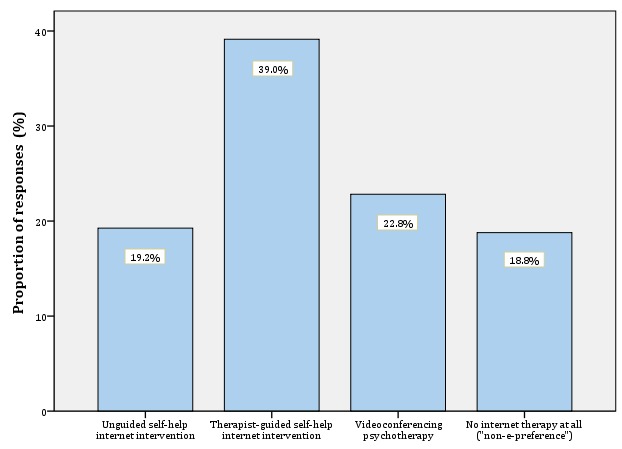
BACKGROUND Internet interventions have been proposed to improve the accessibility and use of evidence-based psychological treatments. However, little is known about attitudes toward such treatments, which can be an important barrier to their use. OBJECTIVE This study aimed to (1) determine attitudes toward guided internet interventions, (2) assess its acceptability compared with other internet-based formats, and (3) explore predictors of acceptance. METHODS A convenience-sample Web-based survey (N=646) assessed attitudes toward guided internet therapies (ie, perceived usefulness and helpfulness, and advantage relative to face-to-face therapy), preferences for delivery modes (ie, e-preference: guided internet interventions, unguided internet interventions, or videoconferencing psychotherapy), and potential predictors of attitudes and preferences: sociodemographics, help-seeking–related variables, attachment style, and perceived stress. RESULTS Although most participants perceived internet interventions as useful or helpful (426/646, 65.9%), a few indicated their advantage relative to face-to-face therapy (56/646, 8.7%). Most participants preferred guided internet interventions (252/646, 39.0%) over videoconferencing psychotherapy (147/646, 22.8%), unguided internet interventions (124/646, 19.2%), and not using internet interventions (121/646, 18.8%; missing data: 1/646, 0.2%). Attachment avoidance and stress were related to e-preference (all P<.05). Moreover, preference for therapist-guided internet interventions was higher for individuals who were aware of internet-based treatment (χ26=12.8; P=.046). CONCLUSIONS Participants assessed therapist-guided internet interventions as helpful, but not equivalent to face-to-face therapies. The vast majority (523/646, 81.0%) of the participants were potentially willing to use internet-based approaches. In lieu of providing patients with only one specific low-intensity treatment, implementation concepts should offer several options, including guided internet interventions, but not limited to them. Conversely, our results also indicate that efforts should focus on increasing public knowledge about internet interventions, including information about their effectiveness, to promote acceptance and uptake.
Overview
The claims and statistics of this paper haven’t been checked yet.
Free: it reads the open-access text and checks the first 5 claims that cite a source we can check. Create a free account to check every claim.
Integrity signals
Registry
Cites
Statistics
Figures
Verification
Claims the paper makes
The claims and statistics of this paper haven’t been checked yet.
Free: it reads the open-access text and checks the first 5 claims that cite a source we can check. Create a free account to check every claim.
Claims other papers make about this one
Each is checked against this paper’s own text: does it say what the citing paper says it does?
The source backs part of the claim, not all of it — or backs it for a different population, condition or comparison.
In the citing paper
“Similar to the findings in Apolinário-Hagen et al. (53), our study identified that having prior experience with a specific treatment mode positively predicted the preference for this mode among participants.”
From Mental health services for German university students: acceptance of intervention targets and preference for delivery modes (2024) · cites this paper as [53]
Experimental — accuracy not yet measuredThe cited source says what the claim attributes to it.
In the citing paper
“Public attitudes toward internet interventions are variable and acceptability of such interventions can be obscured by misinformation regarding their effectiveness (Apolinário-Hagen et al., 2018).”
From Internet-based cognitive behavioural therapy for tinnitus in Spanish: a global feasibility trial. (2022) · cites this paper as Apolinário-Hagen et al., 2018
The cited source says what the claim attributes to it.
In the citing paper
“This preference may be due partly to the common public view that online therapies are not as effective as face-to-face therapy [11].”
Self-check
Percentages, sums and reported differences re-computed from the paper’s own numbers.
The self-check needs the paper’s full text.
Citations
Cites
The theory of planned behavior
Ajzen, I. (1991) · Organizational Behavior and Human Decision Processes · doi:10.1016/0749-5978(91)90020-t · Cited by 134,657
User Acceptance of Information Technology: Toward A Unified View1
Venkatesh, V., Morris, M. G., Davis, G. B., & Davis, F. D. (2003) · MIS Quarterly · doi:10.2307/30036540 · Cited by 45,035 · cited 1×
“In accordance with the unified theory of acceptance and use of technology [38], performance expectancy (ie, how useful an individual perceives an intervention to be for reaching a specific goal) might thus play an important role in the adoption and acceptance of internet interventions [39,40] and provide a guideline i…”
Bundesgesundheitsblatt - Gesundheitsforschung - Gesundheitsschutz
(2013) · Bundesgesundheitsblatt - Gesundheitsforschung - Gesundheitsschutz · doi:10.1007/103.1437-1588 · Cited by 11,796
Whiteford, H. A., Degenhardt, L., Rehm, J., Baxter, A. J., Ferrari, A. J., Erskine, H. E., Charlson, F. J., Norman, R. E., Flaxman, A. D., Johns, N., et al. (2013) · The Lancet · doi:10.1016/s0140-6736(13)61611-6 · Cited by 6,006
Nature and Operation of Attitudes
Ajzen, I. (2001) · Annual Review of Psychology · doi:10.1146/annurev.psych.52.1.27 · Cited by 4,321 · cited 1×
“Generally, attitudes can be characterized as an aggregate of subjective assessments about an object, ranging, for example, from harmful to helpful [36].”
BackgroundClement, S., Schauman, O., Graham, T., Maggioni, F., Evans-Lacko, S., Bezborodovs, N., Morgan, C., Rüsch, N., Brown, J. S. L., & Thornicroft, G. (2015) · Psychological Medicine · doi:10.1017/s0033291714000129 · Cited by 3,152 · cited 1×
“Additionally, attitudinal barriers, such as personal stigma [9] or preferring to solve problems on one’s own, may be decisive in explaining insufficient treatment rates [10].”
BackgroundThe use of analogue scales in rating subjective feelings
BOND, A., & LADER, M. (1974) · British Journal of Medical Psychology · doi:10.1111/j.2044-8341.1974.tb02285.x · Cited by 1,972 · cited 1×
“Current Stress Level We used a visual analog scale [62] to assess current perceived stress level on a scale with 2 end points: 0 (“not at all”) and 10 (“maximum”).”
MethodThe global burden of mental disorders: An update from the WHO World Mental Health (WMH) surveys
Kessler, R. C., Aguilar-Gaxiola, S., Alonso, J., Chatterji, S., Lee, S., Ormel, J., Üstün, T. B., & Wang, P. S. (2009) · Epidemiologia e Psichiatria Sociale · doi:10.1017/s1121189x00001421 · Cited by 1,895 · cited 2×
“1% [1], mental health disorders are widespread.”
BackgroundTreatment gap in mental health care.
Abramowitz, M. Z., Greenberg, D., & Levav, I. (2008) · PubMed · Cited by 1,484
Computer-based psychological treatments for depression: A systematic review and meta-analysis
Richards, D., & Richardson, T. (2012) · Clinical Psychology Review · doi:10.1016/j.cpr.2012.02.004 · Cited by 1,442 · cited 1×
“In recent years, a large number of randomized controlled trials have shown that internet interventions can effectively treat various mental health disorders, such as depression [13,14], anxiety [15-17], insomnia [18], alcohol use disorder [19], comorbid mental health problems in chronic somatic diseases [20,21], and p…”
Background
Research works printed but not linked: 2
- Bowlby J Attachment and Loss 1980 New York, NY Basic Books
- Ebert D Van Daele T Nordgreen T Karekla M Compare T Zarbo C Brugnera A Oeverland S Trebbi G Jensen K Kaehlke F on behalf of the EFPA E-Health Taskforce Baumeister H Internet and mobile-based psychological interventions: applications, efficacy and potential for improving mental health: a report of the EFPA e-health taskforce Eur Psychol 2018 (forthcoming)
Cited by
Malhi, G. S., Bell, E., Bassett, D., Boyce, P., Bryant, R., Hazell, P., Hopwood, M., Lyndon, B., Mulder, R., Porter, R., et al. (2021) · Australian & New Zealand Journal of Psychiatry · doi:10.1177/0004867420979353 · Cited by 614
“In the treatment of major depression, online therapies (when delivered with some human support, such as emails with a coach) can be as effective as face-to-face management and are highly acceptable to patients (Apolinário-Hagen et al., 2018) (see Table 6).”
BackgroundBarriers to older adults’ uptake of mobile-based mental health interventions
Pywell, J., Vijaykumar, S., Dodd, A., & Coventry, L. (2020) · DIGITAL HEALTH · doi:10.1177/2055207620905422 · Cited by 152
Apolinário-Hagen, J., Drüge, M., & Fritsche, L. (2020) · Advances in Experimental Medicine and Biology · doi:10.1007/978-981-32-9705-0_17 · Cited by 100
Reins, J. A., Buntrock, C., Zimmermann, J., Grund, S., Harrer, M., Lehr, D., Baumeister, H., Weisel, K., Domhardt, M., Imamura, K., et al. (2021) · Psychotherapy and Psychosomatics · doi:10.1159/000507819 · Cited by 98
Preferences for e-mental health interventions in Germany: a discrete choice experiment
Phillips, E. A., Himmler, S. F., & Schreyögg, J. (2021) · Value in Health · doi:10.1016/j.jval.2020.09.018 · Cited by 88
“Our results are in concordance with those of previous research, in which participants disagreed that guided internet interventions were comparable to face-to-face psychotherapy in effectiveness and the ability to develop a good therapeutic relationship.(16,19) Musiat et al.”
Result
Metadata
- Authors
- Apolinário-Hagen, J., Harrer, M., Kählke, F., Fritsche, L., Salewski, C., & Ebert, D. D.
- Affiliations
- FernUniversität in Hagen (DE)
- Friedrich-Alexander-Universität Erlangen-Nürnberg (DE)
- Corresponding author
- Apolinário-Hagen, Jennifer
- ORCID
- Venue
- JMIR Mental Health
- Publisher
- JMIR Publications Inc.
- Published
- 2018-05-15
- Volume
- 5
- Issue
- 2
- Pages
- e10735
- ISSN
- 2368-7959 (ISSN-L)
- PMC
- PMC5974457
- OpenAlex
- W2802805333
- Cited by
- 123
- References
- 87
- Citations by year
- 2026: 10 · 2025: 13 · 2024: 13 · 2023: 17 · 2022: 14 · 2021: 23 · 2020: 20 · 2019: 13
- FWCI
- 17.66
- Type
- journal article
- Language
- en
- Open access
- gold
- doi.org
- Licence
- cc-by
- Locations
- JMIR Mental Health (publishedVersion, cc-by)
- PubMed Central (publishedVersion, cc-by)
- PubMed (publishedVersion)
- Topics
- Social Sciences › Psychology › Applied Psychology › Digital Mental Health Interventions
- Health Sciences › Medicine › Public Health, Environmental and Occupational Health › Telemedicine and Telehealth Implementation
- Health Sciences › Medicine › Psychiatry and Mental health › Mental Health Treatment and Access
- Keywords
- online therapy, public attitudes, acceptability, help-seeking, attachment avoidance, perceived stress, perceived usefulness, barriers to treatment uptake
About these checks
Registry, retraction, Cites and statistics results are computed, not judged, with one exception: a printed reference that no index lists is read once by a model before it counts as a citation error. Claims are extracted by a model and kept only when their quote appears verbatim in the text; each cited source is then checked, with a model’s help, for whether it says what the claim relies on. Those verdicts can be wrong — read the claim’s quote and the cited source before relying on one.
Statistics and arithmetic are recomputed, not judged.
Confidence bands are shown only for fields calibrated on our annotated test set. None is calibrated yet, so no band is shown.
What counts as a claim ›How we measure confidence ›How we check this ›
Are you an author, or do you see a problem with this page? Request a review
How to cite
Cite CoChat for the checks on this page, and the paper for its own findings.
- This page
- CoChat. (2026). Citation check: Public Attitudes Toward Guided Internet-Based Therapies: Web-Based Survey Study. https://app.cochat.ai/papers/10.2196/10735
- The paper
- Apolinário-Hagen, J., Harrer, M., Kählke, F., Fritsche, L., Salewski, C., & Ebert, D. D. (2018). Public Attitudes Toward Guided Internet-Based Therapies: Web-Based Survey Study. JMIR Mental Health. https://doi.org/10.2196/10735
Data sources
Bibliographic data: Semantic Scholar, OpenAlex, Crossref.
Contains information from the Semantic Scholar Academic Graph Datasets, made available under the ODC Attribution License (ODC-BY 1.0).
Semantic Scholar’s data is described in: Kinney, R., et al. (2023). The Semantic Scholar Open Data Platform. arXiv:2301.10140.
