

The DOI matches its Crossref record; 37 of the 37 references it cites were found in a registry or an index.
Review and Evaluation of Mindfulness-Based iPhone Apps
Open accessAbstract
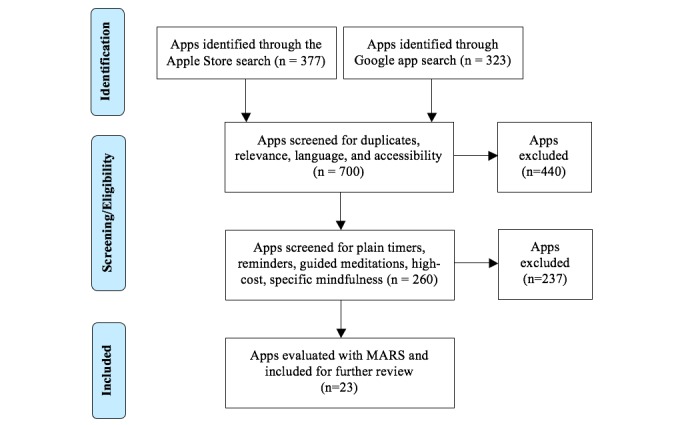
BACKGROUND: There is growing evidence for the positive impact of mindfulness on wellbeing. Mindfulness-based mobile apps may have potential as an alternative delivery medium for training. While there are hundreds of such apps, there is little information on their quality. OBJECTIVE: This study aimed to conduct a systematic review of mindfulness-based iPhone mobile apps and to evaluate their quality using a recently-developed expert rating scale, the Mobile Application Rating Scale (MARS). It also aimed to describe features of selected high-quality mindfulness apps. METHODS: A search for "mindfulness" was conducted in iTunes and Google Apps Marketplace. Apps that provided mindfulness training and education were included. Those containing only reminders, timers or guided meditation tracks were excluded. An expert rater reviewed and rated app quality using the MARS engagement, functionality, visual aesthetics, information quality and subjective quality subscales. A second rater provided MARS ratings on 30% of the apps for inter-rater reliability purposes. RESULTS: The "mindfulness" search identified 700 apps. However, 94 were duplicates, 6 were not accessible and 40 were not in English. Of the remaining 560, 23 apps met inclusion criteria and were reviewed. The median MARS score was 3.2 (out of 5.0), which exceeded the minimum acceptable score (3.0). The Headspace app had the highest average score (4.0), followed by Smiling Mind (3.7), iMindfulness (3.5) and Mindfulness Daily (3.5). There was a high level of inter-rater reliability between the two MARS raters. CONCLUSIONS: Though many apps claim to be mindfulness-related, most were guided meditation apps, timers, or reminders. Very few had high ratings on the MARS subscales of visual aesthetics, engagement, functionality or information quality. Little evidence is available on the efficacy of the apps in developing mindfulness.
Overview
The claims and statistics of this paper haven’t been checked yet.
Run the check — free, no account needed. It reads the open-access text and checks the sources it cites.
Integrity signals
Registry
Cites
Statistics
Figures
Verification
Claims the paper makes
The claims and statistics of this paper haven’t been checked yet.
Run the check — free, no account needed. It reads the open-access text and checks the sources it cites.
Claims other papers make about this one
Each is checked against this paper’s own text: does it say what the citing paper says it does?
The source backs part of the claim, not all of it — or backs it for a different population, condition or comparison.
In the citing paper
“First, at the commencement of the study it held the highest Mobile Application Rating Scale42 rating of all available mindfulness apps.26”
From Randomized, wait-list–controlled pilot study of app-delivered mindfulness for patients reporting chronic pain (2021) · cites this paper as [26]
Experimental — accuracy not yet measuredThe source backs part of the claim, not all of it — or backs it for a different population, condition or comparison.
In the citing paper
“Smartphone-based meditation interventions have almost exclusively focused on mindfulness training [30,62], although several studies have investigated internet-based interventions that include connection-related practices [63-65].”
From Testing the efficacy of a multicomponent, self-guided, smartphone-based meditation app: Three-armed randomized controlled trial (2020) · cites this paper as [62]
Experimental — accuracy not yet measured
Self-check
Percentages, sums and reported differences re-computed from the paper’s own numbers.
The self-check needs the paper’s full text.
Citations
Cites
Mindfulness-based interventions in context: Past, present, and future
Kabat-Zinn, J. (2003) · Clinical Psychology: Science and Practice · doi:10.1093/clipsy.bpg016 · Cited by 8,615
Mindfulness-based interventions in context: Past, present, and future.
Kabat-Zinn, J. (2003) · Clinical Psychology: Science and Practice · doi:10.1093/clipsy/bpg016 · Cited by 8,612
Mindfulness-based stress reduction and health benefits
Grossman, P., Niemann, L., Schmidt, S., & Walach, H. (2004) · Journal of Psychosomatic Research · doi:10.1016/s0022-3999(03)00573-7 · Cited by 3,958
Mindfulness: Theoretical Foundations and Evidence for its Salutary Effects
Brown, K. W., Ryan, R. M., & Creswell, J. D. (2007) · Psychological Inquiry · doi:10.1080/10478400701598298 · Cited by 3,654
Effects of mindfulness on psychological health: A review of empirical studies
Keng, S.-L., Smoski, M. J., & Robins, C. J. (2011) · Clinical Psychology Review · doi:10.1016/j.cpr.2011.04.006 · Cited by 2,687 · cited 1×
“Mindfulness has grown in popularity in the last two decades, and there is growing evidence for its positive impact on well-being [1,2].”
BackgroundMobile app rating scale: a new tool for assessing the quality of health mobile apps
Stoyanov, S. R., Hides, L., Kavanagh, D. J., Zelenko, O., Tjondronegoro, D., & Mani, M. (2015) · JMIR mHealth and uHealth · doi:10.2196/mhealth.3422 · Cited by 2,233
Self-citationMindfulness-based therapy: a comprehensive meta-analysis
Khoury, B., Lecomte, T., Fortin, G., Masse, M., Therien, P., Bouchard, V., Chapleau, M.-A., Paquin, K., & Hofmann, S. G. (2013) · Clinical Psychology Review · doi:10.1016/j.cpr.2013.05.005 · Cited by 2,003
Free, C., Phillips, G., Galli, L., Watson, L., Felix, L., Edwards, P., Patel, V., & Haines, A. (2013) · PLoS Medicine · doi:10.1371/journal.pmed.1001362 · Cited by 1,766 · cited 1×
“The majority of mHealth apps developed to date have focused on physical health and lifestyle domains rather than mental health [38,39].”
BackgroundMindfulness-based stress reduction and health benefits: A meta-analysis
Grossman, P., Niemann, L., Schmidt, S., & Walach, H. (2003) · Focus on Alternative and Complementary Therapies · doi:10.1111/j.2042-7166.2003.tb04008.x · Cited by 1,394
Free, C., Phillips, G., Watson, L., Galli, L., Felix, L., Edwards, P., Patel, V., & Haines, A. (2013) · PLoS Medicine · doi:10.1371/journal.pmed.1001363 · Cited by 1,187
Research works printed but not linked: 2
- Burns, Jane M, 2010, Med J Aust, 192, S22
- Christensen, H, 2010, Med J Aust, 192, S53
Cited by
Sorted by citations
Items 101–200 of 496
A standardized review of smartphone applications to promote balance for older adults
Reyes, A., Qin, P., & Brown, C. A. (2016) · Disability and Rehabilitation · doi:10.1080/09638288.2016.1250124 · Cited by 48
Avalos, L. A., Aghaee, S., Kurtovich, E., Quesenberry Jr, C., Nkemere, L., McGinnis, M. K., & Kubo, A. (2020) · JMIR Mental Health · doi:10.2196/17405 · Cited by 41
The Arabic Version of the Mobile App Rating Scale: Development and Validation Study
Bardus, M., Awada, N., Ghandour, L. A., Fares, E.-J., Gherbal, T., Al-Zanati, T., & Stoyanov, S. R. (2019) · JMIR mhealth and uhealth · doi:10.2196/16956 · Cited by 46
Self-citationRung, A. L., Oral, E., Berghammer, L., & Peters, E. S. (2020) · JMIR mHealth and uHealth · doi:10.2196/15943 · Cited by 39
Bardus, M., Ali, A., Demachkieh, F., & Hamadeh, G. (2019) · JMIR mHealth and uHealth · doi:10.2196/mhealth.9836 · Cited by 44
Understanding the evaluation of mHealth app features based on a cross-country Kano analysis
Gimpel, H., Manner-Romberg, T., Schmied, F., & Winkler, T. J. (2021) · Electronic Markets · doi:10.1007/s12525-020-00455-y · Cited by 46
Systematic evaluation of content and quality of English and German pain apps in European app stores
Terhorst, Y., Meßner, E.-M., Schultchen, D., Paganini, S., Portenhauser, A. A., Eder, A.-S., Bauer, M., Papenhoff, M. C., Baumeister, H., & Sander, L. (2021) · Internet Interventions · doi:10.1016/j.invent.2021.100376 · Cited by 42
Considering the therapeutic alliance in digital mental health interventions
Henson, P., Peck, P., & Torous, J. (2019) · Harvard Review of Psychiatry · doi:10.1097/hrp.0000000000000224 · Cited by 43
van Agteren, J. E., & Iasiello, M. P. (2019) · Australian Psychologist · doi:10.1111/ap.12440 · Cited by 44
Lau, N., O’Daffer, A., Yi‐Frazier, J. P., & Rosenberg, A. R. (2021) · JMIR mhealth and uhealth · doi:10.2196/29689 · Cited by 46
Effects of mobile mindfulness on emergency department work stress: A randomised controlled trial
Xu, H. (., Eley, R., Kynoch, K., & Tuckett, A. (2022) · Emergency Medicine Australasia · doi:10.1111/1742-6723.13836 · Cited by 42
Dichotomies in the Development and Implementation of Digital Mental Health Tools
Torous, J. B., & Haim, A. (2018) · Psychiatric Services · doi:10.1176/appi.ps.201800193 · Cited by 41
Donovan, E., Martin, S. R., Seidman, L. C., Zeltzer, L. K., Cousineau, T. M., Payne, L. A., Trant, M., Weiman, M., Knoll, M., & Federman, N. C. (2019) · JMIR mhealth and uhealth · doi:10.2196/10921 · Cited by 40
Sundquist, J., Palmér, K., Johansson, L. M., & Sundquist, K. (2017) · European Psychiatry · doi:10.1016/j.eurpsy.2017.01.328 · Cited by 40
App-Based Relaxation Exercises for Patients With Chronic Neck Pain: Pragmatic Randomized Trial
Pach, D., Blödt, S., Wang, J., Keller, T., Bergmann, B., Rogge, A. A., Barth, J., Icke, K., Roll, S., & Witt, C. M. (2022) · JMIR mhealth and uhealth · doi:10.2196/31482 · Cited by 43
Borjalilu, S., Mazaheri, M. A., & Talebpour, A. (2019) · Iranian Journal of Psychiatry and Behavioral Sciences · doi:10.5812/ijpbs.84726 · Cited by 41
Wasil, A. R., Patel, R., Cho, J. Y., Shingleton, R. M., Weisz, J. R., & DeRubeis, R. J. (2021) · International Journal of Eating Disorders · doi:10.1002/eat.23478 · Cited by 40
The technology specialist: a 21st century support role in clinical care
Noel, V. A., Carpenter-Song, E. A., Acquilano, S. C., Torous, J. B., & Drake, R. E. (2019) · npj Digital Medicine · doi:10.1038/s41746-019-0137-6 · Cited by 38
Militello, L. K., Sobolev, M., Okeke, F., Adler, D. A., & Nahum-Shani, I. B. (2021) · JMIR Formative Research · doi:10.2196/30606 · Cited by 39
Spears, C. A., Abroms, L. C., Glass, C. R., Hedeker, D., Eriksen, M. P., Cottrell-Daniels, C., Tran, B. Q., & Wetter, D. W. (2019) · JMIR mHealth and uHealth · doi:10.2196/13059 · Cited by 37
“However, low user engagement is a pervasive problem with mHealth programs [24,54], and efforts are needed to increase engagement with the ultimate goal of improving outcomes.”
From Ancient Contemplative Practice to the App Store
Lukoff, K., Lyngs, U., Gueorguieva, S., Dillman, E., Hiniker, A., & Munson, S. A. (2020) · Designing Interactive Systems Conference · doi:10.1145/3357236.3395444 · Cited by 53
Pizarro-Ruiz, J. P., Ordóñez-Camblor, N., Del-Líbano, M., & Escolar-LLamazares, M.-C. (2021) · International Journal of Environmental Research and Public Health · doi:10.3390/ijerph18020802 · Cited by 33
“Mobile health (mHealth) is an emerging field that has created new opportunities [33].”
BackgroundAn Effectiveness Study of a Digital Mindfulness-Based Program for Upper Secondary Education Students
Lahtinen, O., & Salmivalli, C. (2020) · Mindfulness · doi:10.1007/s12671-020-01462-y · Cited by 36
Crandall, A., Allsop, Y., & Hanson, C. L. (2018) · Journal of Adolescence · doi:10.1016/j.adolescence.2018.03.009 · Cited by 35
Theory-Based Predictors of Mindfulness Meditation Mobile App Usage: A Survey and Cohort Study
Crandall, A., Cheung, A., Young, A. M., & Hooper, A. P. (2018) · JMIR mhealth and uhealth · doi:10.2196/10794 · Cited by 36
Mindful Eating Mobile Health Apps: Review and Appraisal
Lyzwinski, L. N., Edirippulige, S., Caffery, L. J., & Bambling, M. (2019) · JMIR Mental Health · doi:10.2196/12820 · Cited by 36
Beshai, S., Bueno, C., Yu, M., Feeney, J. R., & Pitariu, A. (2020) · Behaviour Research and Therapy · doi:10.1016/j.brat.2020.103724 · Cited by 43
Design for mobile mental health: an exploratory review
Aryana, B., Brewster, L., & Abdelnour-Nocera, J. (2018) · Health and Technology · doi:10.1007/s12553-018-0271-1 · Cited by 36
Patient Perspectives on Self-Management Technologies for Chronic Fatigue Syndrome
Davies, T., Jones, S. L., & Kelly, R. (2019) · CHI Conference on Human Factors in Computing Systems · doi:10.1145/3290605.3300452 · Cited by 34
mHealth App Prescription in Australian General Practice: Pre-Post Study
Byambasuren, O., Beller, E., Hoffmann, T., & Glasziou, P. (2020) · JMIR mhealth and uhealth · doi:10.2196/16497 · Cited by 34
Kozlov, E., Bantum, E. O., Pagano, I., Walser, R. D., Ramsey, K. M., Taylor, K. L., Jaworski, B. K., & Owen, J. E. (2020) · JMIR Mental Health · doi:10.2196/23377 · Cited by 33
Clarke, F. J., Kotera, Y., & McEwan, K. (2021) · Sustainability · doi:10.3390/su13126761 · Cited by 43
Sun, L., Wang, Y., Greene, B., Xiao, Q., Jiao, C., Ji, M., & Wu, Y. (2017) · BMC Medical Informatics and Decision Making · doi:10.1186/s12911-017-0446-0 · Cited by 33
Patient focused oral hygiene apps: an assessment of quality (using MARS) and knowledge content
Sharif, M. O., & Alkadhimi, A. F. (2019) · BDJ · doi:10.1038/s41415-019-0665-0 · Cited by 33
Webb, C. A., Swords, C. M., Lawrence, H. R., & Hilt, L. M. (2022) · Journal of Consulting and Clinical Psychology · doi:10.1037/ccp0000763 · Cited by 42
Sharpe, J. D., & Kamara, M. T. B. (2018) · Sexual Health · doi:10.1071/sh18120 · Cited by 33
Pryss, R. C., John, D. T., Schlee, W., Schlotz, W., Schobel, J., Kraft, R., Spiliopoulou, M., Langguth, B., Reichert, M., O’Rourke, T., et al. (2019) · JMIR mhealth and uhealth · doi:10.2196/13978 · Cited by 32
Wu, J., Ma, Y., Zuo, Y., Zheng, K., Zhou, Z., Qin, Y., & Ren, Z. (2022) · Frontiers in Public Health · doi:10.3389/fpubh.2021.773296 · Cited by 32
PHIT for Duty, a Mobile Application for Stress Reduction, Sleep Improvement, and Alcohol Moderation
Kizakevich, P. N., Eckhoff, R., Brown, J. M., Tueller, S., Weimer, B., Bell, S. J., Weeks, A., Hourani, L. L., Spira, J. L., & King, L. A. (2018) · Military Medicine · doi:10.1093/milmed/usx157 · Cited by 31
Mahlo, L., & Windsor, T. D. (2020) · The Gerontologist · doi:10.1093/geront/gnaa093 · Cited by 37
Mobile apps for dementia awareness, support, and prevention – review and evaluation
Chelberg, G., Neuhaus, M., Mothershaw, A., Mahoney, R., & Caffery, L. J. (2021) · Disability and Rehabilitation · doi:10.1080/09638288.2021.1914755 · Cited by 31
Lippold, M. A., McDaniel, B. T., & Jensen, T. M. (2022) · Social Sciences · doi:10.3390/socsci11020043 · Cited by 41
Tozzi, F., Nicolaidou, I. A., Galani, A., & Antoniades, A. (2018) · JMIR Pediatrics and Parenting · doi:10.2196/pediatrics.7248 · Cited by 31
Tan, Z. Y. A., Wong, S. H., Cheng, L. J., & Lau, S. T. (2022) · Mindfulness · doi:10.1007/s12671-022-01962-z · Cited by 33
Review and Implementation of Self-Help and Automated Tools in Mental Health Care
Chan, S. R., Li, L., Torous, J. B., Gratzer, D., & Yellowlees, P. (2019) · Psychiatric Clinics of North America · doi:10.1016/j.psc.2019.07.001 · Cited by 29
Barton, A. C., Sheen, J. A., & Byrne, L. K. (2020) · Frontiers in Psychology · doi:10.3389/fpsyg.2020.02050 · Cited by 37
Pokémon GO Within the Context of Family Health: Retrospective Study
Militello, L. K., Hanna, N., & Nigg, C. R. (2018) · JMIR Pediatrics and Parenting · doi:10.2196/10679 · Cited by 30
Kwan, Y. H., Ong, W. J., Xiong, M., Leung, Y. Y., Phang, J. K., Wang, C. T. M., & Fong, W. W. S. (2019) · JMIR mhealth and uhealth · doi:10.2196/14753 · Cited by 29
A Review of Mindfulness-Based Apps for Children
Nunes, A., Castro, S. L., & Limpo, T. (2020) · Mindfulness · doi:10.1007/s12671-020-01410-w · Cited by 33
Acceptability and Preliminary Effects of a Mindfulness Mobile Application for Ruminative Adolescents
Hilt, L. M., & Swords, C. M. (2021) · Behavior Therapy · doi:10.1016/j.beth.2021.03.004 · Cited by 31
Stec, M. A., Arbour, M. W., & Hines, H. F. (2019) · Journal of Midwifery & Women s Health · doi:10.1111/jmwh.12941 · Cited by 29
Content and Usability Evaluation of Medication Adherence Mobile Applications for Use in Pediatrics
Carmody, J. K., Denson, L. A., & Hommel, K. A. (2018) · Journal of Pediatric Psychology · doi:10.1093/jpepsy/jsy086 · Cited by 28
Kalhori, S. R. N., Hemmat, M., Noori, T., Heydarian, S., & Katigari, M. R. (2020) · Current Diabetes Reviews · doi:10.2174/1573399816666200703181438 · Cited by 28
Kim, S., Park, J. Y., & Chung, K. (2022) · Journal of Medical Internet Research · doi:10.2196/39501 · Cited by 28
Specialized Smartphone Intervention Apps: Review of 2014 to 2018 NIH Funded Grants
Hansen, W. B., & Scheier, L. M. (2019) · JMIR mhealth and uhealth · doi:10.2196/14655 · Cited by 28
Bartlett, L., Martin, A. J., Kilpatrick, M., Otahal, P., Sanderson, K., & Neil, A. L. (2022) · JMIR mHealth and uHealth · doi:10.2196/30272 · Cited by 28
Darko, A. P., Antwi, C. O., Adjei, K., Zhang, B., & Ren, J. (2024) · Expert Systems with Applications · doi:10.1016/j.eswa.2024.123647 · Cited by 31
Weston, E., Raker, C., Huang, D., Parker, A. B., Robison, K. M., & Mathews, C. A. (2019) · Journal of Minimally Invasive Gynecology · doi:10.1016/j.jmig.2019.08.021 · Cited by 28
Kozlov, E., McDarby, M., Pagano, I., Llaneza, D. H., Owen, J., & Duberstein, P. (2021) · Aging & Mental Health · doi:10.1080/13607863.2021.1963949 · Cited by 26
Mobile App Tools for Identifying and Managing Mental Health Disorders in Primary Care
Magee, J. C., Adut, S., Brazill, K., & Warnick, S. (2018) · Current Treatment Options in Psychiatry · doi:10.1007/s40501-018-0154-0 · Cited by 25
Kizakevich, P. N., Eckhoff, R., Lewis, G. F., Davila, M. I., Hourani, L. L., Watkins, R. L., Weimer, B., Wills, T., Morgan, J. K., Morgan, T., et al. (2019) · JMIR mhealth and uhealth · doi:10.2196/12590 · Cited by 30
Saad, A., Magwood, O., Aubry, T., Alkhateeb, Q., Hashmi, S. S., Hakim, J. C.-E., Ford, L., Kassam, A., Tugwell, P., & Pottie, K. C. (2021) · PLoS ONE · doi:10.1371/journal.pone.0259474 · Cited by 26
Monitoring Symptoms of COVID-19: Review of Mobile Apps
Schmeelk, S., Davis, A., Li, Q., Shippey, C., Utah, M., Myers, A., Turchioe, M. R., & Creber, R. M. (2022) · JMIR mhealth and uhealth · doi:10.2196/36065 · Cited by 30
Raeesi, A., Khajouei, R., & Ahmadian, L. (2022) · BMC Medical Informatics and Decision Making · doi:10.1186/s12911-022-02029-8 · Cited by 26
Zainal, N. H., & Newman, M. G. (2023) · European Psychiatry · doi:10.1192/j.eurpsy.2023.2 · Cited by 28
Paganini, S., Meier, E. P., Terhorst, Y., Wurst, R., Hohberg, V., Schultchen, D., Strahler, J., Wursthorn, M., Baumeister, H., & Meßner, E.-M. (2023) · JMIR mhealth and uhealth · doi:10.2196/42415 · Cited by 29
Webb, C. A., Swords, C. M., Murray, L., & Hilt, L. M. (2021) · Mindfulness · doi:10.1007/s12671-021-01719-0 · Cited by 27
Plaza García, I., Sánchez, C. M., Espílez, Á. S., García-Magariño, I., Guillén, G. A., & García-Campayo, J. (2017) · International Journal of Medical Informatics · doi:10.1016/j.ijmedinf.2017.05.018 · Cited by 25
Draughon, J. E., Todd, A., Rose, L., Pollitt, E., & Anderson, J. (2022) · JMIR Formative Research · doi:10.2196/28959 · Cited by 25
Světlák, M., Linhartová, P., Knejzlíková, T., Knejzlík, J., Kóša, B., Horníčková, V., Jarolínová, K., Lučanská, K., Slezáčková, A., & Šumec, R. (2021) · Frontiers in Psychology · doi:10.3389/fpsyg.2020.581086 · Cited by 30
Ainsworth, B., Stanescu, S., Stuart, B. L., Russell, D., Liddiard, M., Djukanović, R., & Thomas, M. D. (2021) · Journal of Behavioral Medicine · doi:10.1007/s10865-021-00249-3 · Cited by 24
He, Y., Tang, Z., Sun, G., Cai, C., Wang, Y., Yang, G., & Bao, Z. (2023) · JMIR mhealth and uhealth · doi:10.2196/44855 · Cited by 24
Ball, E., Newton, S., Röhricht, F., Steed, L., Birch, J. V., Dodds, J. P., Calvete, C. C., Taylor, S. J., & Rivas, C. A. (2020) · BMJ Open · doi:10.1136/bmjopen-2019-030711 · Cited by 25
Evaluation of a mindfulness-based mobile application with college students: A pilot study
Moffitt-Carney, K. M., & Duncan, A. B. (2021) · Journal of American College Health · doi:10.1080/07448481.2019.1661420 · Cited by 23
Ma, Y., Kraemer, K. M., Lyu, J., & Yeh, G. Y. (2021) · The Journal of Alternative and Complementary Medicine · doi:10.1089/acm.2020.0548 · Cited by 22
Barzegari, S., Kia, A. S., Bardus, M., Stoyanov, S. R., Ghazisaeedi, M., & Rafizadeh, M. (2022) · JMIR Formative Research · doi:10.2196/42225 · Cited by 23
Self-citationThe role of mindfulness and occupational stress in the goal orientations of development and winning
Lee, Y. H. (2019) · Sport Management Review · doi:10.1016/j.smr.2019.08.004 · Cited by 25
Mrazek, A. J., Mrazek, M. D., Reese, J. V., Kirk, A. C., Gougis, L. J., Delegard, A. M., Cynman, D. J., Cherolini, C. M., Carr, P. C., & Schooler, J. W. (2019) · Education Sciences · doi:10.3390/educsci9030230 · Cited by 25
Nicolaidou, I. A., Stavrou, E., & Leonidou, G. (2021) · JMIR Pediatrics and Parenting · doi:10.2196/27958 · Cited by 25
Wolever, R. Q., Finn, M., & Shields, D. (2021) · Journal of Medical Internet Research · doi:10.2196/31935 · Cited by 13
University Students’ Perspectives on Mindfulness and mHealth: A Qualitative Exploratory Study
Lyzwinski, L. N., Caffery, L. J., Bambling, M., & Edirippulige, S. (2018) · American Journal of Health Education · doi:10.1080/19325037.2018.1502701 · Cited by 25
Church, D., Stapleton, P., & Sabot, D. (2020) · JMIR mhealth and uhealth · doi:10.2196/18545 · Cited by 20
An Overview of Smartphone Apps
Wells, C., & Spry, C. (2022) · Canadian Journal of Health Technologies · doi:10.51731/cjht.2022.269 · Cited by 21
Exploring the relationship between mindfulness and rock-climbing: a controlled study
Wheatley, K. (2021) · Current Psychology · doi:10.1007/s12144-021-01593-y · Cited by 20
The Effect of a Mindfulness Phone Application on NICU Nurses' Professional Quality of Life
Egami, S., & Highfield, M. E. F. (2023) · Advances in Neonatal Care · doi:10.1097/anc.0000000000001064 · Cited by 20
Sinclair, R., Nodi, S. S., & Kabir, M. A. (2023) · Computers and Electronics in Agriculture · doi:10.1016/j.compag.2023.108527 · Cited by 19
Daily Mindfulness Is Associated With Recovery Processes Among Coaches—A 4-Week Diary Study
Pawsey, F., Wong, J. H. K., Kenttä, G., & Näswall, K. (2021) · International Sport Coaching Journal · doi:10.1123/iscj.2020-0045 · Cited by 26
A Mixed-Method Assessment of a 10-Day Mobile Mindfulness Intervention
Haliwa, I., Ford, C. G., Wilson, J. M., & Shook, N. J. (2021) · Frontiers in Psychology · doi:10.3389/fpsyg.2021.722995 · Cited by 20
Psychometric evaluation of the Mobile Application Rating Scale (MARS) (Preprint)Preprint
Terhorst, Y., Philippi, P., Sander, L., Schultchen, D., Paganini, S., Bardus, M., Santo, K., Knitza, J., Machado, G. C., Schöeppe, S., et al. (2020) · doi:10.2196/preprints.17689 · Cited by 19
Cancer Patients’ and Survivors’ Perceptions of the Calm App: Cross-Sectional Descriptive Study
Huberty, J., Puzia, M., Eckert, R., & Larkey, L. (2020) · JMIR Cancer · doi:10.2196/16926 · Cited by 18
Meddar, J. M., Ponnapalli, A., Azhar, R., Turchioe, M. R., Duran, A. T., & Creber, R. M. (2022) · Journal of Cardiopulmonary Rehabilitation and Prevention · doi:10.1097/hcr.0000000000000667 · Cited by 20
Avasthi, S., Sanwal, T., Sareen, P., & Tripathi, S. L. (2022) · Advances in computational intelligence and robotics book series · doi:10.4018/978-1-7998-8786-7.ch005 · Cited by 18
Arenas-Escaso, J. F., Folgado-Fernández, J. A., & Palos‐Sánchez, P. R. (2024) · BMC Public Health · doi:10.1186/s12889-023-17584-6 · Cited by 18
Baptista, S. N., Oldenburg, B. F., & O'Neil, A. E. (2017) · JMIR mhealth and uhealth · doi:10.2196/mhealth.6419 · Cited by 18
Choo, C. C., Kuek, J. H. L., & Burton, A. A. D. (2018) · International Journal of Environmental Research and Public Health · doi:10.3390/ijerph15122810 · Cited by 17
Can Artificial Intelligence Chatbots Improve Mental Health?: A Scoping Review
Gallegos, C., Kausler, R., Alderden, J., Davis, M., & Wang, L. (2024) · CIN: Computers, Informatics, Nursing · doi:10.1097/cin.0000000000001155 · Cited by 18
Iribarren, S., Milligan, H., Goodwin, K., Vidrio, O. A. A., Chirico, C., Telles, H., Morelli, D., Lutz, B. R., Sprecher, J., & Rubinstein, F. (2021) · JMIR Research Protocols · doi:10.2196/28094 · Cited by 17
Wan, S. W., Chong, C. S., Toh, E., Lim, S. H., Loi, C. T., Lew, H. Y. F., Chua, M. C. H., Jee, X. P., Liu, G., Zhu, L., et al. (2021) · Journal of Medical Internet Research · doi:10.2196/31917 · Cited by 17
Ban, Y., Karasawa, H., Fukui, R., & Warisawa, S. (2022) · Frontiers in Computer Science · doi:10.3389/fcomp.2022.770701 · Cited by 18
Liebherr, M., Brandtner, A., Brand, M., & Tang, Y. (2024) · Annals of the New York Academy of Sciences · doi:10.1111/nyas.15095 · Cited by 31
Metadata
- Authors
- Mani, M., Kavanagh, D. J., Hides, L., & Stoyanov, S. R.
- Affiliations
- Queensland University of Technology (AU)
- Corresponding author
- Mani, Madhavan
- Venue
- JMIR mHealth and uHealth
- Publisher
- JMIR Publications Inc.
- Published
- 2015-08-19
- Volume
- 3
- Issue
- 3
- Pages
- e82
- ISSN
- 2291-5222 (ISSN-L)
- PMC
- PMC4705029
- OpenAlex
- W1748592323
- Cited by
- 495
- References
- 36
- Citations by year
- 2026: 19 · 2025: 25 · 2024: 32 · 2023: 60 · 2022: 65 · 2021: 65 · 2020: 58 · 2019: 59 · 2018: 64 · 2017: 30 · 2016: 16 · 2015: 1
- FWCI
- 45.88
- Type
- journal article
- Language
- en
- Open access
- gold
- doi.org
- Licence
- cc-by
- Locations
- JMIR mhealth and uhealth (publishedVersion, cc-by)
- PubMed Central (publishedVersion, cc-by)
- PubMed (publishedVersion)
- QUT ePrints (Queensland University of Technology) (submittedVersion)
- DOAJ (DOAJ: Directory of Open Access Journals) (submittedVersion, cc-by-sa)
- Faculty of Health; Institute of Health and Biomedical Innovation
- Funders
- Australian Government
- Young and Well Cooperative Research Centre
- Topics
- Social Sciences › Psychology › Clinical Psychology › Mindfulness and Compassion Interventions
- Social Sciences › Psychology › Applied Psychology › Digital Mental Health Interventions
- Health Sciences › Health Professions › General Health Professions › Mobile Health and mHealth Applications
- Keywords
- mindfulness, mobile application, iOS app, app quality, Mobile App Rating Scale, expert ratings, guided meditation, headspace, inter-rater reliability, digital mental health interventions
About these checks
Registry, retraction, Cites and statistics results are computed, not judged, with one exception: a printed reference that no index lists is read once by a model before it counts as a citation error. Claims are extracted by a model and kept only when their quote appears verbatim in the text; each cited source is then checked, with a model’s help, for whether it says what the claim relies on. Those verdicts can be wrong — read the claim’s quote and the cited source before relying on one.
Statistics and arithmetic are recomputed, not judged.
Confidence bands are shown only for fields calibrated on our annotated test set. None is calibrated yet, so no band is shown.
What counts as a claim ›How we measure confidence ›How we check this ›
Are you an author, or do you see a problem with this page? Request a review
