

The DOI matches its Crossref record; 37 of the 37 references it cites were found in a registry or an index.
Review and Evaluation of Mindfulness-Based iPhone Apps
Open accessAbstract
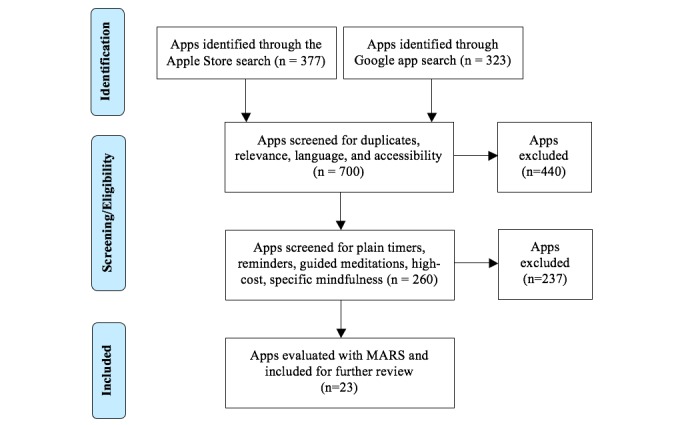
BACKGROUND: There is growing evidence for the positive impact of mindfulness on wellbeing. Mindfulness-based mobile apps may have potential as an alternative delivery medium for training. While there are hundreds of such apps, there is little information on their quality. OBJECTIVE: This study aimed to conduct a systematic review of mindfulness-based iPhone mobile apps and to evaluate their quality using a recently-developed expert rating scale, the Mobile Application Rating Scale (MARS). It also aimed to describe features of selected high-quality mindfulness apps. METHODS: A search for "mindfulness" was conducted in iTunes and Google Apps Marketplace. Apps that provided mindfulness training and education were included. Those containing only reminders, timers or guided meditation tracks were excluded. An expert rater reviewed and rated app quality using the MARS engagement, functionality, visual aesthetics, information quality and subjective quality subscales. A second rater provided MARS ratings on 30% of the apps for inter-rater reliability purposes. RESULTS: The "mindfulness" search identified 700 apps. However, 94 were duplicates, 6 were not accessible and 40 were not in English. Of the remaining 560, 23 apps met inclusion criteria and were reviewed. The median MARS score was 3.2 (out of 5.0), which exceeded the minimum acceptable score (3.0). The Headspace app had the highest average score (4.0), followed by Smiling Mind (3.7), iMindfulness (3.5) and Mindfulness Daily (3.5). There was a high level of inter-rater reliability between the two MARS raters. CONCLUSIONS: Though many apps claim to be mindfulness-related, most were guided meditation apps, timers, or reminders. Very few had high ratings on the MARS subscales of visual aesthetics, engagement, functionality or information quality. Little evidence is available on the efficacy of the apps in developing mindfulness.
Overview
The claims and statistics of this paper haven’t been checked yet.
Run the check — free, no account needed. It reads the open-access text and checks the sources it cites.
Integrity signals
Registry
Cites
Statistics
Figures
Verification
Claims the paper makes
The claims and statistics of this paper haven’t been checked yet.
Run the check — free, no account needed. It reads the open-access text and checks the sources it cites.
Claims other papers make about this one
Each is checked against this paper’s own text: does it say what the citing paper says it does?
The source backs part of the claim, not all of it — or backs it for a different population, condition or comparison.
In the citing paper
“First, at the commencement of the study it held the highest Mobile Application Rating Scale42 rating of all available mindfulness apps.26”
From Randomized, wait-list–controlled pilot study of app-delivered mindfulness for patients reporting chronic pain (2021) · cites this paper as [26]
Experimental — accuracy not yet measuredThe source backs part of the claim, not all of it — or backs it for a different population, condition or comparison.
In the citing paper
“Smartphone-based meditation interventions have almost exclusively focused on mindfulness training [30,62], although several studies have investigated internet-based interventions that include connection-related practices [63-65].”
From Testing the efficacy of a multicomponent, self-guided, smartphone-based meditation app: Three-armed randomized controlled trial (2020) · cites this paper as [62]
Experimental — accuracy not yet measured
Self-check
Percentages, sums and reported differences re-computed from the paper’s own numbers.
The self-check needs the paper’s full text.
Citations
Cites
Mindfulness-based interventions in context: Past, present, and future
Kabat-Zinn, J. (2003) · Clinical Psychology: Science and Practice · doi:10.1093/clipsy.bpg016 · Cited by 8,615
Mindfulness-based interventions in context: Past, present, and future.
Kabat-Zinn, J. (2003) · Clinical Psychology: Science and Practice · doi:10.1093/clipsy/bpg016 · Cited by 8,612
Mindfulness-based stress reduction and health benefits
Grossman, P., Niemann, L., Schmidt, S., & Walach, H. (2004) · Journal of Psychosomatic Research · doi:10.1016/s0022-3999(03)00573-7 · Cited by 3,958
Mindfulness: Theoretical Foundations and Evidence for its Salutary Effects
Brown, K. W., Ryan, R. M., & Creswell, J. D. (2007) · Psychological Inquiry · doi:10.1080/10478400701598298 · Cited by 3,654
Effects of mindfulness on psychological health: A review of empirical studies
Keng, S.-L., Smoski, M. J., & Robins, C. J. (2011) · Clinical Psychology Review · doi:10.1016/j.cpr.2011.04.006 · Cited by 2,687 · cited 1×
“Mindfulness has grown in popularity in the last two decades, and there is growing evidence for its positive impact on well-being [1,2].”
BackgroundMobile app rating scale: a new tool for assessing the quality of health mobile apps
Stoyanov, S. R., Hides, L., Kavanagh, D. J., Zelenko, O., Tjondronegoro, D., & Mani, M. (2015) · JMIR mHealth and uHealth · doi:10.2196/mhealth.3422 · Cited by 2,233
Self-citationMindfulness-based therapy: a comprehensive meta-analysis
Khoury, B., Lecomte, T., Fortin, G., Masse, M., Therien, P., Bouchard, V., Chapleau, M.-A., Paquin, K., & Hofmann, S. G. (2013) · Clinical Psychology Review · doi:10.1016/j.cpr.2013.05.005 · Cited by 2,003
Free, C., Phillips, G., Galli, L., Watson, L., Felix, L., Edwards, P., Patel, V., & Haines, A. (2013) · PLoS Medicine · doi:10.1371/journal.pmed.1001362 · Cited by 1,766 · cited 1×
“The majority of mHealth apps developed to date have focused on physical health and lifestyle domains rather than mental health [38,39].”
BackgroundMindfulness-based stress reduction and health benefits: A meta-analysis
Grossman, P., Niemann, L., Schmidt, S., & Walach, H. (2003) · Focus on Alternative and Complementary Therapies · doi:10.1111/j.2042-7166.2003.tb04008.x · Cited by 1,394
Free, C., Phillips, G., Watson, L., Galli, L., Felix, L., Edwards, P., Patel, V., & Haines, A. (2013) · PLoS Medicine · doi:10.1371/journal.pmed.1001363 · Cited by 1,187
Research works printed but not linked: 2
- Burns, Jane M, 2010, Med J Aust, 192, S22
- Christensen, H, 2010, Med J Aust, 192, S53
Cited by
Sorted by citations
Items 201–300 of 496
Chow, P. I., Showalter, S. L., Gerber, M. S., Kennedy, E. M., Brenin, D. R., Schroen, A. T., Mohr, D. C., Lattie, E. G., & Cohn, W. F. (2018) · JMIR Research Protocols · doi:10.2196/11452 · Cited by 16
Parsons, C. E., Jensen, K. L., Roepstorff, A., Fjorback, L. O., & Linehan, C. (2019) · Digital Health · doi:10.1177/2055207619868550 · Cited by 19
Azam, M. A., Latman, V. V., & Katz, J. D. (2019) · JMIR Research Protocols · doi:10.2196/14119 · Cited by 17
The Science of Mindfulness-Based Interventions and Learning: A Review for EducatorsPreprint
Laukkonen, R., Leggett, J. M. I., Gallagher, R., Biddell, H., Mrazek, A. J., Slagter, H. A., & Mrazek, M. D. (2020) · MindRxiv (OSF Preprints) · doi:10.31231/osf.io/6g9uq · Cited by 24
Boden, L. M., Rodriguez, C., Kelly, J. D., Khalsa, A. S., & Casper, D. S. (2023) · JBJS Open Access · doi:10.2106/jbjs.oa.22.00114 · Cited by 16
Mascaro, J. S., Singh, V., Wehrmeyer, K., Scott, B., Juan, J., McKenzie-Brown, A. M., Lane, O. P., & Haack, C. (2021) · PAIN Reports · doi:10.1097/pr9.0000000000000924 · Cited by 14
Sun, Z., Reani, M., Li, Q., & Ma, X. (2020) · International Journal of Human-Computer Studies · doi:10.1016/j.ijhcs.2020.102430 · Cited by 16
Shih, C. W., Pudipeddi, R., Uthayakumar, A., & Washington, P. Y. (2021) · JMIRx Med · doi:10.2196/24972 · Cited by 15
Na, H., Jo, M., Lee, C., & Kim, D. (2022) · Healthcare · doi:10.3390/healthcare10101880 · Cited by 16
Stifani, B. M., Peters, M., French, K., & Gill, R. K. (2023) · PLOS Digital Health · doi:10.1371/journal.pdig.0000277 · Cited by 16
Balsam, D., Bounds, D. T., Rahmani, A. M., & Nyamathi, A. (2023) · JMIR Pediatrics and Parenting · doi:10.2196/53933 · Cited by 18
Mental Health, New Technologies, and Wellbeing for Adolescents
Cangas, A. J., Silva, M. J. F., Morán, C., Gómez, N. N., & Moldes, P. (2019) · Springer eBooks · doi:10.1007/978-3-030-25513-8_15 · Cited by 17
Short-term Smartphone App–Based Focused Attention Meditation Diminishes Cognitive Flexibility
Wolff, N., & Beste, C. (2020) · Journal of Cognitive Neuroscience · doi:10.1162/jocn_a_01564 · Cited by 16
An Empirical Exploration of Mindfulness Design Using Solo Travel Domain
Chen, R., Orand, M., Choi, S. Y., & Choi, L. (2018) · CHI Conference on Human Factors in Computing Systems · doi:10.1145/3173574.3173671 · Cited by 16
Wagener, N., Duong, T. D., Schöning, J., Rogers, Y., & Niess, J. (2021) · Lecture notes in computer science · doi:10.1007/978-3-030-85610-6_16 · Cited by 17
At-Home use of App-Based Mindfulness for Children: A Randomized Active-Controlled Trial
Treves, I. N., Olson, H. A., Ozernov‐Palchik, O., Li, C. E., Wang, K. L., Arechiga, X. M., Goldberg, S. B., & Gabrieli, J. D. E. (2023) · Mindfulness · doi:10.1007/s12671-023-02231-3 · Cited by 22
Aldaweesh, S., AlAteeq, D. A., Kleek, M. G. V., & Shadbolt, N. (2024) · CHI Conference on Human Factors in Computing Systems · doi:10.1145/3613904.3642642 · Cited by 18
Ranjani, H., Sharma, N., Hariharan, R., Charumeena, H., Oliver, N. S., Pradeepa, R., Chambers, J. C., Ranjit Unnikrishnan, I., Mohan, V., Avari, P., et al. (2021) · Journal of Diabetology · doi:10.4103/jod.jod_68_21 · Cited by 15
ePSICONUT: An e-Health Programme to Improve Emotional Health and Lifestyle in University Students
Cantisano-Guzmán, L. M., González-Soltero, R., Fernández, A. B., & Belando‐Pedreño, N. (2022) · International Journal of Environmental Research and Public Health · doi:10.3390/ijerph19159253 · Cited by 15
Trub, L. R., & Starks, T. J. (2017) · Mindfulness · doi:10.1007/s12671-017-0697-y · Cited by 15
Sieverdes, J. C., Adams, Z. W., Nemeth, L. S., Brunner-Jackson, B. M., Mueller, M., Anderson, A., Patel, S. K., Sox, L. R., & Treiber, F. A. (2017) · mHealth · doi:10.21037/mhealth.2017.09.04 · Cited by 16
Policy, practice and regulatory issues in mobile technology treatment for forensic clients
Ross, S. (2018) · European Journal of Probation · doi:10.1177/2066220318761382 · Cited by 17
Burnett‐Zeigler, I., Waldron, E. M., Hong, S. H., Yang, A., Wisner, K. L., & Ciolino, J. D. (2018) · Complementary Therapies in Clinical Practice · doi:10.1016/j.ctcp.2018.09.001 · Cited by 16
Co-creating “Mindful” Holiday Resort Experience for Guests’ Digital Well-Being
Stankov, U., & Filimonau, V. (2018) · Springer eBooks · doi:10.1007/978-3-030-05940-8_16 · Cited by 15
Bordo, S., Costanzo, G., & Villani, D. (2025) · BMC Psychology · doi:10.1186/s40359-025-02824-8 · Cited by 21
The impact of a smartphone meditation application on anesthesia trainee well-being
Carullo, P. C., Ungerman, E. A., Metro, D. G., & Adams, P. S. (2021) · Journal of Clinical Anesthesia · doi:10.1016/j.jclinane.2021.110525 · Cited by 14
Hensley, C. P., Witte, M. M., Cai, J., Gruenke, A., Pecze, J., Mangefrida, A., & Chang, A. H. (2022) · JCR Journal of Clinical Rheumatology · doi:10.1097/rhu.0000000000001896 · Cited by 14
Stress-Mentor: Linking Gamification and Behavior Change Theory in a Stress Management Application
Christmann, C. A., Hoffmann, A., Zolynski, G., & Bleser, G. (2018) · Communications in computer and information science · doi:10.1007/978-3-319-92279-9_52 · Cited by 14
Technology-Assisted Mindfulness in the Co-creation of Tourist Experiences
Stankov, U., & Filimonau, V. (2020) · Springer eBooks · doi:10.1007/978-3-030-05324-6_128-1 · Cited by 14
Hwang, M. H., Bunt, L., & Warner, C. (2023) · International Journal of Environmental Research and Public Health · doi:10.3390/ijerph20237140 · Cited by 20
FAMAP: A Framework for Developing m-Health Apps
García‐Magariño, I., Bedía, M. G., & Palacios-Navarro, G. (2018) · Advances in intelligent systems and computing · doi:10.1007/978-3-319-77703-0_83 · Cited by 13
The Development of the Postpartum Depression Self-Management Mobile Application “Happy Mother”
Seo, J. M., Kim, S., Na, H., Kim, J. H., & Lee, H. (2021) · CIN Computers Informatics Nursing · doi:10.1097/cin.0000000000000738 · Cited by 12
Thinking about Inclusion: Designing a Digital App Catalog for People with Motor Disability
Larco, A., Peñafiel, P., Yanez, C., & Luján‐Mora, S. (2021) · Sustainability · doi:10.3390/su131910989 · Cited by 13
The Quality of Indian Obesity-Related mHealth Apps: PRECEDE-PROCEED Model–Based Content Analysis
Selvaraj, S. N., & Arulchelvan, S. (2022) · JMIR mhealth and uhealth · doi:10.2196/15719 · Cited by 13
García‐Magariño, I., & Plaza, I. (2017) · Journal of Computational Science · doi:10.1016/j.jocs.2016.12.011 · Cited by 13
Hunter, J. E., Jenkins, C. L., Grim, V., Leung, S., Charen, K. H., Hamilton, D. R., Allen, E. G., & Sherman, S. L. (2019) · Research in Developmental Disabilities · doi:10.1016/j.ridd.2019.03.008 · Cited by 12
A qualitative study exploring the digital therapeutic alliance with fully automated smartphone apps
Brotherdale, R., Berry, K., & Bucci, S. (2024) · Digital Health · doi:10.1177/20552076241277712 · Cited by 12
Consumer-Grade Neurofeedback With Mindfulness Meditation: Meta-Analysis
Treves, I. N., Bajwa, Z., Greene, K. D., Bloom, P. A., Kim, N., Wool, E., Goldberg, S. B., Whitfield, S., & Auerbach, R. P. (2025) · Journal of Medical Internet Research · doi:10.2196/68204 · Cited by 15
Frith, E., & Loprinzi, P. D. (2017) · JMIR Mental Health · doi:10.2196/mental.8086 · Cited by 13
Swainston, J., & Derakshan, N. (2021) · Mindfulness · doi:10.1007/s12671-021-01651-3 · Cited by 11
Merolli, M., Francis, J., Vallance, P., Bennell, K. L., Malliaras, P., & Hinman, R. S. (2021) · JMIR Research Protocols · doi:10.2196/29047 · Cited by 12
Does Using a Mindfulness App Reduce Anxiety and Worry? A Randomized-Controlled Trial
Abbott, D., Lack, C. W., & Anderson, P. L. (2023) · Journal of Cognitive Psychotherapy · doi:10.1891/jcpsy-d-20-00058 · Cited by 15
Eisenstadt, M., Liverpool, S., Metaxa, A.-M., Ciuvat, R. M., & Carlsson, C. (2021) · JMIR Formative Research · doi:10.2196/31064 · Cited by 12
Using a 10‐day mindfulness‐based app intervention to reduce burnout in special educators
Russell, A., & Smyth, S. (2023) · Journal of Research in Special Educational Needs · doi:10.1111/1471-3802.12599 · Cited by 14
Evaluation of Patient-Facing Mobile Apps to Support Physiotherapy Care: Systematic Review
Merolli, M., Francis, J., Vallance, P., Bennell, K. L., Malliaras, P., & Hinman, R. S. (2024) · JMIR mhealth and uhealth · doi:10.2196/55003 · Cited by 11
Potential treatments of technology addiction: insights for information systems scholars
Ning, W., Turel, O., & Davis, F. D. (2024) · Internet Research · doi:10.1108/intr-12-2023-1122 · Cited by 16
A neuroscience perspective on the plasticity of the social and relational brain
Singer, T. (2025) · Annals of the New York Academy of Sciences · doi:10.1111/nyas.15319 · Cited by 18
Areli, E., Godfrey, H. K., Perry, M., Hempel, D., Saipe, B., Grainger, R., Hale, L. A., & Devan, H. (2020) · British Journal of Pain · doi:10.1177/2049463720978264 · Cited by 12
Venkatesan, A., Krymis, H., Scharff, J., & Waber, A. (2021) · JMIR Formative Research · doi:10.2196/25078 · Cited by 10
Hartley, M., Dorstyn, D., & Due, C. (2022) · Research in Autism · doi:10.1016/j.rasd.2022.101991 · Cited by 11
Huberty, J., Bhuiyan, N., Neher, T. L., Joeman, L., Mesa, R. A., & Larkey, L. (2022) · JMIR Formative Research · doi:10.2196/32458 · Cited by 9
Review and Evaluation of Special Education iOS Apps Using MARS
Larco, A., Enríquez, F., & Luján‐Mora, S. (2018) · IEEE World Engineering Education Conference (EDUNINE) · doi:10.1109/edunine.2018.8450977 · Cited by 12
Use of a Mindfulness Smartphone App in an Advanced Psychiatry Elective for Pharmacy Students
McGuire, J., & Zhen, T. (2019) · INNOVATIONS in pharmacy · doi:10.24926/iip.v10i3.1346 · Cited by 11
Lee, Y. H., Chiu, W., Hwang, J., & Noh, S. (2024) · Scientific Reports · doi:10.1038/s41598-024-63637-0 · Cited by 16
Apolinário-Hagen, J., Drüge, M., Hennemann, S., & Breil, B. (2021) · Advances in experimental medicine and biology · doi:10.1007/978-981-33-6044-0_17 · Cited by 10
Torous, J. B., Powell, A. C., & Knable, M. B. (2016) · Psychiatric Annals · doi:10.3928/00485713-20160908-02 · Cited by 10
Cultivating Digital Well-Being and the Rise of Self-Care Apps
Dennis, M. (2020) · Philosophical studies series · doi:10.1007/978-3-030-50585-1_6 · Cited by 10
Adding Mindfulness to an Evidence-Based Reading Intervention for a Student with SLD: a Pilot Study
Benney, C. M., Cavender, S. C., McClain, M. B., Callan, G. L., & Pinkelman, S. E. (2021) · Contemporary School Psychology · doi:10.1007/s40688-021-00361-w · Cited by 12
Ullrich, S., Colzato, L. S., Wolff, N., & Beste, C. (2021) · Mindfulness · doi:10.1007/s12671-021-01599-4 · Cited by 10
Digitized thought records: a practitioner-focused review of cognitive restructuring apps
Erhardt, D., Bunyi, J., Dodge-Rice, Z., Neary, M., & Schueller, S. M. (2022) · The Cognitive Behaviour Therapist · doi:10.1017/s1754470x22000320 · Cited by 13
Hong, M., Liang, D., Lu, T., & Liu, S. (2023) · Frontiers in Psychology · doi:10.3389/fpsyg.2023.1213089 · Cited by 10
Feasibility of the Early Minds Program by Smiling Mind: a Pilot Cluster-Randomized-Controlled Trial
Sexton, E. T. S., Sheehan, J., Dam, N. T. V., Grobler, A. C., Phillips, L., Yaari, M., & Hiscock, H. (2022) · Mindfulness · doi:10.1007/s12671-021-01804-4 · Cited by 11
Larco, A., Yanez, C., Montenegro, C., & Luján‐Mora, S. (2018) · Advances in intelligent systems and computing · doi:10.1007/978-3-319-73450-7_61 · Cited by 9
Trauma-Informed Care: Helping the Healthcare Team Thrive
Barnhill, J. L., Fisher, J. W., Kimel-Scott, K., & Weil, A. (2019) · Springer eBooks · doi:10.1007/978-3-030-04342-1_11 · Cited by 9
Integrating Mindfulness into a Routine Schedule: The Role of Mobile-Health Mindfulness Applications
van Emmerik, A., Keijzer, R., & Schoenmakers, T. M. (2020) · Springer eBooks · doi:10.1007/978-3-030-30892-6_15 · Cited by 8
Mindfulness in Therapy: A Critical Analysis
Ștefan, S., & David, D. O. (2020) · International Journal of Clinical and Experimental Hypnosis · doi:10.1080/00207144.2020.1720514 · Cited by 13
Hurley-Wallace, A. L., Schoth, D. E., Lilley, S., Williams, G., & Liossi, C. (2020) · British Journal of Pain · doi:10.1177/2049463720940341 · Cited by 9
Reich, D., Evans, S., Nelson, B., Hickey, T., & O’Shea, M. (2021) · Mindfulness · doi:10.1007/s12671-021-01611-x · Cited by 10
Kabacińska, K., McLeod, K. E. R., MacKenzie, A., Vu, K., Cianfrone, M., Tugwell, A., & Robillard, J. M. (2022) · Digital Health · doi:10.1177/20552076221102775 · Cited by 11
Pierce, M. E., Mirabito, G., & Verhaeghen, P. (2024) · Cogent Mental Health · doi:10.1080/28324765.2024.2400878 · Cited by 11
Soriano, J. R., de, E. B. M., Karaiskou, A.-Ι., Vuyst, H.-J. D., Rodriguez‐Larios, J., Feng, N., Varon, C., & Alaerts, K. (2024) · NeuroRegulation · doi:10.15540/nr.11.3.230 · Cited by 8
Arabkermani, Z., Barzegari, S., Rouhani, A., Nahavandi, N., Gibreel, O., & Arpacı, İ. (2025) · Journal of Medical Internet Research · doi:10.2196/71118 · Cited by 10
Introduction to Special Issue “Parenting in the 21st Century”
Buchanan, C. M., & Glatz, T. (2022) · Social Sciences · doi:10.3390/socsci11100484 · Cited by 8
Tedder, M. L., Shi, L., Si, M., Franco, R., & Chen, L. (2015) · Medicines · doi:10.3390/medicines2040298 · Cited by 9
Mindfulness and its relevance for sports coaches adopting nonlinear pedagogy
Kee, Y. H. (2019) · International Journal of Sports Science & Coaching · doi:10.1177/1747954119830819 · Cited by 12
The Monetization Strategies of Apps for Anxiety Management: an International Comparison
Powell, A. C., Yue, Z., Shan, C., & Torous, J. B. (2019) · Journal of Technology in Behavioral Science · doi:10.1007/s41347-019-00093-y · Cited by 9
García‐Magariño, I., Plaza, I., & Neri, F. (2019) · Journal of Computational Science · doi:10.1016/j.jocs.2019.06.009 · Cited by 8
Tommasi, C. D., Richardson, E., Reale, M., & Jordan, J. (2020) · Journal of Neuro-Oncology · doi:10.1007/s11060-020-03638-x · Cited by 8
Menhart, S., & Cummings, J. J. (2022) · Technology Mind and Behavior · doi:10.1037/tmb0000089 · Cited by 10
Borjalilu, S. (2023) · International Journal of Islamic Educational Psychology · doi:10.18196/ijiep.v4i1.16513 · Cited by 10
Jones, P., Osborne, T., Sullivan-Drage, C., Keen, N., & Gadsby, E. (2022) · Policy Press eBooks · doi:10.56687/9781447360773 · Cited by 8
Eberhart, L. G., Seegan, P. L., Mcguire, J. F., Hu, H., Tripuraneni, B. R., & Miller, M. J. (2023) · Psychiatric Services · doi:10.1176/appi.ps.20220401 · Cited by 8
Min, Y., Choi, Y.-S., & Kim, B. (2023) · Current Psychology · doi:10.1007/s12144-023-05402-6 · Cited by 12
Mindful Scroll: An Infinite Scroll Abstract Colouring App for Mindfulness
Zassman, S., Kaplan, C. S., & Vogel, D. (2024) · CHI Conference on Human Factors in Computing Systems · doi:10.1145/3613904.3642729 · Cited by 10
Ghosal, S., Stanmore, E., Sturt, J. A., Bogosian, A., Woodcock, D., Zhang, M., Milne, N., Mubita, W., Robert, G., & O’Connor, S. (2024) · BMJ Open · doi:10.1136/bmjopen-2024-088576 · Cited by 8
Evaluating mobile mental health apps using the mobile application rating scale (MARS) in the U.S.
Ki, E., Jang, J., & Kang, D.-Y. (2024) · Advances in Mental Health · doi:10.1080/18387357.2024.2388680 · Cited by 8
Kittler, C., Stenzel, L., Jekauc, D., & Stoll, O. (2021) · Case Studies in Sport and Exercise Psychology · doi:10.1123/cssep.2021-0006 · Cited by 7
Liptáková, S., Světlák, M., Matis, J., Slezáčková, A., & Rastislav, R. (2022) · Ceskoslovenska psychologie · doi:10.51561/cspsych.66.3.233 · Cited by 8
Krisher, L. K., Boeldt, D. L., Sigmon, C. A. N., Rimel, S. E., & Newman, L. S. (2024) · American Journal of Public Health · doi:10.2105/ajph.2023.307505 · Cited by 7
ABSEM: An agent-based simulator of emotions in mindfulness programs
García‐Magariño, I., & Plaza, I. (2017) · Expert Systems with Applications · doi:10.1016/j.eswa.2017.05.011 · Cited by 7
Digital Therapeutics in the Management of Chronic Pain
Rogozinski, B., Greenleaf, W., Sackman, J., & Cahana, A. (2018) · Springer eBooks · doi:10.1007/978-3-319-95369-4_30 · Cited by 7
Loiacono, E. T., Fulwiler, C., Cohanim, R., & Davis, M. (2018) · AIS Transactions on Human-Computer Interaction · doi:10.17705/1thci.00109 · Cited by 8
Stanovsek, S. (2019) · Scholars' Bank (University of Oregon) · Cited by 7
Evaluating the Effectiveness of a Mindfulness App Among Academic Advisors
Hendricks, D. S., Lavery, M. R., Bouillon, L. E., & Gotfried, R. S. (2020) · Journal of Technology in Behavioral Science · doi:10.1007/s41347-019-00122-w · Cited by 6
A simple and accessible tool to improve student mental health wellbeing
Quatraro, M., Gallegos, C., & Walters, R. (2024) · Teaching and learning in nursing · doi:10.1016/j.teln.2024.01.011 · Cited by 6
Wepener, I., & Moen, M. C. (2025) · Pastoral Care in Education · doi:10.1080/02643944.2025.2502040 · Cited by 6
Dantes, G. R., Asril, N. M., Liem, A., Suwastini, N. K. A., Keng, S., & Mahayanti, N. W. S. (2024) · JMIR Research Protocols · doi:10.2196/56693 · Cited by 10
Trub, L. R., Doyle, K. M., Parker, V., & Starks, T. J. (2021) · Substance Use & Misuse · doi:10.1080/10826084.2021.1954027 · Cited by 6
Panatto, D., Domnich, A., Gasparini, R., Bonanni, P., Icardi, G., Amicizia, D., Arata, L., Carozzo, S., Signori, A., Bechini, A., et al. (2016) · Journal of Medical Internet Research · doi:10.2196/jmir.6205 · Cited by 6
Smartphone Apps for Mindfulness Interventions for Suicidality in Asian Youths: Literature Review
Choo, C. C., & Burton, A. A. D. (2018) · JMIR mhealth and uhealth · doi:10.2196/mhealth.8304 · Cited by 6
Metadata
- Authors
- Mani, M., Kavanagh, D. J., Hides, L., & Stoyanov, S. R.
- Affiliations
- Queensland University of Technology (AU)
- Corresponding author
- Mani, Madhavan
- Venue
- JMIR mHealth and uHealth
- Publisher
- JMIR Publications Inc.
- Published
- 2015-08-19
- Volume
- 3
- Issue
- 3
- Pages
- e82
- ISSN
- 2291-5222 (ISSN-L)
- PMC
- PMC4705029
- OpenAlex
- W1748592323
- Cited by
- 495
- References
- 36
- Citations by year
- 2026: 19 · 2025: 25 · 2024: 32 · 2023: 60 · 2022: 65 · 2021: 65 · 2020: 58 · 2019: 59 · 2018: 64 · 2017: 30 · 2016: 16 · 2015: 1
- FWCI
- 45.88
- Type
- journal article
- Language
- en
- Open access
- gold
- doi.org
- Licence
- cc-by
- Locations
- JMIR mhealth and uhealth (publishedVersion, cc-by)
- PubMed Central (publishedVersion, cc-by)
- PubMed (publishedVersion)
- QUT ePrints (Queensland University of Technology) (submittedVersion)
- DOAJ (DOAJ: Directory of Open Access Journals) (submittedVersion, cc-by-sa)
- Faculty of Health; Institute of Health and Biomedical Innovation
- Funders
- Australian Government
- Young and Well Cooperative Research Centre
- Topics
- Social Sciences › Psychology › Clinical Psychology › Mindfulness and Compassion Interventions
- Social Sciences › Psychology › Applied Psychology › Digital Mental Health Interventions
- Health Sciences › Health Professions › General Health Professions › Mobile Health and mHealth Applications
- Keywords
- mindfulness, mobile application, iOS app, app quality, Mobile App Rating Scale, expert ratings, guided meditation, headspace, inter-rater reliability, digital mental health interventions
About these checks
Registry, retraction, Cites and statistics results are computed, not judged, with one exception: a printed reference that no index lists is read once by a model before it counts as a citation error. Claims are extracted by a model and kept only when their quote appears verbatim in the text; each cited source is then checked, with a model’s help, for whether it says what the claim relies on. Those verdicts can be wrong — read the claim’s quote and the cited source before relying on one.
Statistics and arithmetic are recomputed, not judged.
Confidence bands are shown only for fields calibrated on our annotated test set. None is calibrated yet, so no band is shown.
What counts as a claim ›How we measure confidence ›How we check this ›
Are you an author, or do you see a problem with this page? Request a review
