

The DOI matches its Crossref record; 66 of the 66 references it cites were found in a registry or an index; 3 of the 78 sources its claims cite were checked for support.
Effectiveness Of Narrative Therapy In Addressing Psychological Challenges: A Systematic Review Of Randomised Controlled Trials
Open accessAbstract
Background: Evidence on the effectiveness of Narrative Therapy remains limited and varies across age groups, psychological conditions, and cultural contexts; therefore, a systematic review is needed to integrate findings across studies for a more comprehensive understanding. Objective: This review aims to evaluate the effectiveness of Narrative Therapy in reducing psychological problems across all age groups based on evidence from previously published studies. Methods: A systematic review was conducted on 20 articles with Randomized Controlled Trial (RCT) designs obtained from major academic databases. Study selection was performed using strict inclusion and exclusion criteria. Research participants included children (≤17 years), adolescents (18–25 years), adults (26–59 years), and older adults (≥60 years) from various clinical and community settings across different countries. Results: Of the 20 studies analyzed, 18 showed significant results (p < 0.05) with moderate to large effect sizes (Cohen’s d = 0.5–1.6), while 2 studies were not significant. The highest recorded p-value was 0.019 and the highest t-value was −9.46 (p < 0.001). The greatest effectiveness was observed among children with anxiety and trauma survivors, along with improvements in self-efficacy, self-image, social relationships, and quality of life. Conclusion: Narrative Therapy is effective in reducing psychological symptoms such as depression, anxiety, PTSD, and loneliness, while enhancing self-efficacy, self-image, and quality of life across ages and cultures. The therapy is flexible, adaptive, and relevant for psychiatric nursing practice, making it a recommended evidence-based intervention in both clinical and community settings.
Overview
AI snapshot
Written from the paper’s full text.
TL;DR
This systematic review of 20 RCTs concludes that Narrative Therapy is effective for reducing depression, anxiety, PTSD, and loneliness while improving self-efficacy, self-image, social relationships, and quality of life across ages and cultures. Eighteen of 20 studies reported significant results, though the authors note small samples, inconsistent durations, and contextual variation.
Key findings
- Of 20 included RCTs, 18 (90%) found statistically significant results (p < .05); 10 studies (50%) reported p < .001, and 8 (40%) reported significant t-values from 2.13 to 11.67.
- Effect sizes were moderate to large (Cohen’s d = .5–1.6). The strongest effects appeared in children with ADHD and anxiety in Rwanda (t = 6.7, p < .001, d = 1.6) and Syrian refugees with PTSD (t = -9.46, p < .001, d = .97).
- Narrative Therapy improved not only symptoms but also self-efficacy, self-esteem, social support, and quality of life; two studies—Fan et al. (2021) and Sackeim et al. (2022)—found no meaningful differences between intervention and control groups.
- The review reports that Narrative Therapy is flexible and adaptable across in-person, group, tele-narrative, and digital bibliotherapy formats, with cultural adaptation and social support described as enhancing outcomes.
Methods
- Systematic review of English-language RCTs published 2020–2025, searched in April 2025 across ScienceDirect, PubMed, and ProQuest using “Narrative Therapy,” “Psychological Distress,” and “Mental Health Problems,” excluding gray literature.
- Inclusion followed PICOS criteria: participants across children (≤17), adolescents (18–25), adults (26–59), and older adults (≥60); RCTs with sample size ≥10 per group; full-text availability; and narrative therapy for psychological issues.
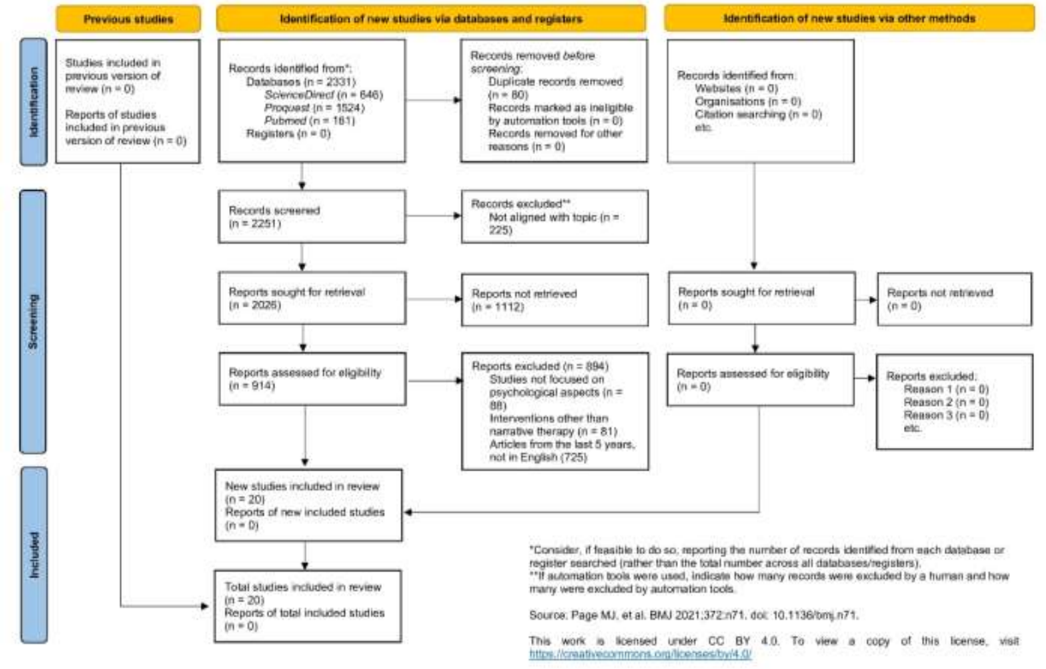
- From 2,331 records, 80 duplicates were removed, 2,251 remained, 2,026 were selected by title/abstract, 914 were available in full text, 814 were excluded after full-text evaluation, leaving 20 articles. Quality was assessed with the Joanna Briggs Institute Critical Appraisal Tool; 15 of 20 studies scored ≥60%, and 5 scored below this threshold.
Limitations
- The authors state limitations including small sample sizes, inconsistent therapy durations, and varying cultural and implementation settings; they also note that some studies did not consider external influences such as social support and socioeconomic status.
- The text makes evident that 5 of 20 studies scored below the 60% JBI quality threshold, and two included RCTs found non-significant results, limiting confidence in the overall consistency of findings.
- The review is restricted to English-language RCTs from 2020–2025 in three databases and excludes gray literature, which may limit generalizability; the included studies also vary widely in modality, duration, population, and outcome measures.
Model-written summary. Check it against the paper before relying on it.
Integrity signals
Registry
Cites
Statistics
Figures
Verification
Claims the paper makes
34 Not checked yet · 22 Own interpretation · 21 Sources not found · 13 Own result · 5 No basis given · 4 Own method · 3 No full text of the sources · 2 Partly supported · 1 Supported · accuracy not yet measured
Every source the paper cites for this claim was checked and supports it.
In the paper
“No significant change was observed in quality of life (t = .71,p = .487).”
§ Effectiveness of Narrative Therapy in Addressing Psychological Challenges: A Systematic Review of Randomised Controlled Trials > 84,6% Shakeri et al. (2020) Iran
What the sources say
- Supportedcites Shakeri et al. (2020) source
Table 3 in the Results reports a paired pre- versus post-intervention quality-of-life test in the experimental group of T=0.71, P=0.487. The Results text also says that this change was not statistically significant. (LLM, conf=0.95)
plain- Asserted: passes — The authors put it forward as true.
- Checkable: passes — It can be checked against evidence.
- Load-bearing: passes — The paper’s conclusions depend on it.
- Based: passes — The paper gives a reason why it holds.
- Supported
None of the sources cited for this claim have been checked yet.
In the paper
“However, no significant changes were observed in resilience.”
§ Effectiveness of Narrative Therapy in Addressing Psychological Challenges: A Systematic Review of Randomised Controlled Trials > 61,5%
What the sources say
- Not checked yetcites Lely et al. (2022) source
Checked before — its earlier verdict is held back until a new check runs.
plain- Asserted: passes — The authors put it forward as true.
- Checkable: passes — It can be checked against evidence.
- Load-bearing: unclear — It is unclear whether the paper’s conclusions depend on it.
- Based: passes — The paper gives a reason why it holds.
- Not checked yet
A result the paper reports from its own data — it cites no other source for it, so there is none to check. The quote shows it is in the paper.
In the paper
“Based on the mapping of 20 studies, Narrative Therapy has been extensively applied across diverse clinical and community groups in various countries.”
§ Effectiveness of Narrative Therapy in Addressing Psychological Challenges: A Systematic Review of Randomised Controlled Trials > 76,9%
plain- Asserted: passes — The authors put it forward as true.
- Checkable: passes — It can be checked against evidence.
- Load-bearing: unclear — It is unclear whether the paper’s conclusions depend on it.
- Based: passes — The paper gives a reason why it holds.
In the paper
“The intervention's effect on social anxiety was fully mediated by enhanced self-efficacy (B = .50,p < .01→ B = -.43,p < .001).”
§ Effectiveness of Narrative Therapy in Addressing Psychological Challenges: A Systematic Review of Randomised Controlled Trials > 76,9%
What the sources say
- Not matchedcites Chan & Lau (2025)
Couldn’t be matched to a paper in Crossref, so it can’t be checked.
plaindirectn = 38 ·- Asserted: passes — The authors put it forward as true.
- Checkable: passes — It can be checked against evidence.
- Load-bearing: unclear — It is unclear whether the paper’s conclusions depend on it.
- Based: passes — The paper gives a reason why it holds.
- Not matched
A result the paper reports from its own data — it cites no other source for it, so there is none to check. The quote shows it is in the paper.
In the paper
“After 12 weeks, the intervention group showed significantly lower depression scores (HAMD-17) compared to the control group (t = -3.666,p = .001).”
§ Effectiveness of Narrative Therapy in Addressing Psychological Challenges: A Systematic Review of Randomised Controlled Trials > 53,8% Appalasamy et al. (2020) Malaysia
plaindirect- Asserted: passes — The authors put it forward as true.
- Checkable: passes — It can be checked against evidence.
- Load-bearing: passes — The paper’s conclusions depend on it.
- Based: passes — The paper gives a reason why it holds.
The paper states this without a source or data behind it here, so there is nothing to check it against. The quote shows it is in the paper.
In the paper
“A review of twenty studies shows that Narrative Therapy is highly effective in reducing different psychological symptoms across all ages and settings.”
§ Effectiveness of Narrative Therapy in Addressing Psychological Challenges: A Systematic Review of Randomised Controlled Trials > 3.2. Discussion
boosteddirect- Asserted: passes — The authors put it forward as true.
- Checkable: passes — It can be checked against evidence.
- Load-bearing: passes — The paper’s conclusions depend on it.
- Based: unclear — It is unclear why the paper says it holds.
In the paper
“Multiple studies indicate that online formats produce outcomes similar to traditional face-to-face sessions and can improve participant engagement (Jiang et al., 2025).”
§ Effectiveness of Narrative Therapy in Addressing Psychological Challenges: A Systematic Review of Randomised Controlled Trials > 3.2. Discussion
What the sources say
- Not matchedcites Jiang et al., 2025
Couldn’t be matched to a paper in Crossref, so it can’t be checked.
hedged- Asserted: passes — The authors put it forward as true.
- Checkable: passes — It can be checked against evidence.
- Load-bearing: unclear — It is unclear whether the paper’s conclusions depend on it.
- Based: passes — The paper gives a reason why it holds.
- Not matched
In the paper
“Similarly, not using proper comparators or attention controls can obscure the true sources of clinical change (Crotty et al., 2024).”
§ Effectiveness of Narrative Therapy in Addressing Psychological Challenges: A Systematic Review of Randomised Controlled Trials > 1. Introduction
What the sources say
- Not matchedcites Crotty et al., 2024
Couldn’t be matched to a paper in Crossref, so it can’t be checked.
plainconditional- Asserted: passes — The authors put it forward as true.
- Checkable: passes — It can be checked against evidence.
- Load-bearing: passes — The paper’s conclusions depend on it.
- Based: passes — The paper gives a reason why it holds.
- Not matched
In the paper
“The use of video-based and screen-based interventions in hospital settings also improved self-reflection and communication between healthcare providers and patients (Jiang et al., 2025).”
§ Effectiveness of Narrative Therapy in Addressing Psychological Challenges: A Systematic Review of Randomised Controlled Trials > Methodological and Support Advantages
What the sources say
- Not matchedcites Jiang et al., 2025
Couldn’t be matched to a paper in Crossref, so it can’t be checked.
plaindirect- Asserted: passes — The authors put it forward as true.
- Checkable: passes — It can be checked against evidence.
- Load-bearing: unclear — It is unclear whether the paper’s conclusions depend on it.
- Based: passes — The paper gives a reason why it holds.
- Not matched
None of the sources cited for this claim have been checked yet.
In the paper
“Narrative Therapy is crucial in fostering identity change and redefining life purpose through reauthoring personal stories (Moreira et al., 2022;Zhu et al., 2025).”
§ Effectiveness of Narrative Therapy in Addressing Psychological Challenges: A Systematic Review of Randomised Controlled Trials > Main Advantages of the Intervention Media
What the sources say
- Not matchedcites Moreira et al., 2022
Couldn’t be matched to a paper in Crossref, so it can’t be checked.
- Not checked yetcites Zhu et al., 2025 source
Checked before — its earlier verdict is held back until a new check runs.
boosteddirect- Asserted: passes — The authors put it forward as true.
- Checkable: passes — It can be checked against evidence.
- Load-bearing: unclear — It is unclear whether the paper’s conclusions depend on it.
- Based: passes — The paper gives a reason why it holds.
- Not matched
- Probably not a substantial claim. 34
- It may state two separate claims as one. 69
- The quote only partly states this claim. 2
The cited sources support only part of this claim — read each source’s verdict below.
In the paper
“Children and adolescents faced a sharp increase in new psychiatric diagnoses, reflecting widespread impacts on psychosocial development (Bilu et al., 2023;Magson et al., 2021).”
§ Effectiveness of Narrative Therapy in Addressing Psychological Challenges: A Systematic Review of Randomised Controlled Trials > 1. Introduction
What the sources say
- Not checked yetcites Bilu et al., 2023 source
Checked before — its earlier verdict is held back until a new check runs.
- Partly supportedcites Magson et al., 2021 sourceExperimental — accuracy not yet measured
The Results (Overall Changes in Mental Health; page unavailable) report significant increases in depressive and anxiety symptoms among adolescents during the pandemic. The Methods (Measures; page unavailable) show these were self-reported symptom scores, not new psychiatric diagnoses. The study also does not establish an increase across children and adolescents generally. (LLM, conf=0.88)
plaindirect- Asserted: passes — The authors put it forward as true.
- Checkable: passes — It can be checked against evidence.
- Load-bearing: fails — The paper’s conclusions may not depend on it.
- Based: passes — The paper gives a reason why it holds.
Probably not a substantial claim. The paper’s conclusions may not depend on it.
- Not checked yet
The cited sources support only part of this claim — read each source’s verdict below.
In the paper
“However, two studies from Fan et al. (2021 andSackeim et al. (2022) found non-significant results, likely due to shorter intervention periods and the primarily educational approach of the therapy.”
§ Effectiveness of Narrative Therapy in Addressing Psychological Challenges: A Systematic Review of Randomised Controlled Trials > Main Advantages of the Intervention Media
What the sources say
- Partly supportedcites Fan et al. (2021) sourceExperimental — accuracy not yet measured
The Results section reports no significant between-group differences in depression, anxiety, or sleep quality, but it reports significantly better post-treatment post-traumatic stress symptom scores in the NET group. The Methods describe an eight-week intervention involving psychoeducation, life-event timelines, and trauma narration—not a primarily educational therapy. The Discussion suggests participant age, an active control group, and sample size as possible reasons for the nonsignificant secondary outcomes, rather than a shorter intervention period. (LLM, conf=0.88)
- Not matchedcites Sackeim et al. (2022)
Couldn’t be matched to a paper in Crossref, so it can’t be checked.
hedgedconditional- Asserted: passes — The authors put it forward as true.
- Checkable: passes — It can be checked against evidence.
- Load-bearing: unclear — It is unclear whether the paper’s conclusions depend on it.
- Based: passes — The paper gives a reason why it holds.
It may state two separate claims as one.
- Partly supported
None of the sources cited for this claim have been checked yet.
In the paper
“The intervention significantly improved medication self-efficacy (mean difference = 4.3, p = .002)and enhanced patients' psychological control (p < .05).”
§ Effectiveness of Narrative Therapy in Addressing Psychological Challenges: A Systematic Review of Randomised Controlled Trials > 53,8% Appalasamy et al. (2020) Malaysia
What the sources say
- Not checked yetcites Appalasamy et al. (2020) source
Checked before — its earlier verdict is held back until a new check runs.
plaindirect- Asserted: passes — The authors put it forward as true.
- Checkable: passes — It can be checked against evidence.
- Load-bearing: passes — The paper’s conclusions depend on it.
- Based: passes — The paper gives a reason why it holds.
It may state two separate claims as one.
- Not checked yet
A result the paper reports from its own data — it cites no other source for it, so there is none to check. The quote shows it is in the paper.
In the paper
“Of the 20 studies analyzed, 18 showed significant results (p < .05)with moderate to large effect sizes (Cohen's d = .5-1.6), while 2 studies were not significant.”
- Also stated in: § 61,5% · plain
“Quantitatively, 18 out of 20 studies (90%) found statistically significant results (p < .05),with 10 studies (50%) showing p < .001and 8 studies (40%) reporting significant t-values from 2.13 to 11.67.”
§ Effectiveness of Narrative Therapy in Addressing Psychological Challenges: A Systematic Review of Randomised Controlled Trials > Abstract
plain- Asserted: passes — The authors put it forward as true.
- Checkable: passes — It can be checked against evidence.
- Load-bearing: passes — The paper’s conclusions depend on it.
- Based: passes — The paper gives a reason why it holds.
It may state two separate claims as one.
- Also stated in: § 61,5% · plain
In the paper
“Increases in perceived shared experience fully mediated the Intervention effect (*b* = -.55,*p* < .001)and optimism (*b* = -.85,*p* < .001).”
§ Effectiveness of Narrative Therapy in Addressing Psychological Challenges: A Systematic Review of Randomised Controlled Trials > 76,9%
What the sources say
- Not checked — no full text of the sourcecites Franz et al. (2022) source
plaindirect- Asserted: passes — The authors put it forward as true.
- Checkable: passes — It can be checked against evidence.
- Load-bearing: unclear — It is unclear whether the paper’s conclusions depend on it.
- Based: passes — The paper gives a reason why it holds.
It may state two separate claims as one.
A result the paper reports from its own data — it cites no other source for it, so there is none to check. The quote shows it is in the paper.
In the paper
“Overall, the quality assessment showed that 15 of the 20 studies scored ≥60% on the JBI criteria, with the remaining 5 scoring below this mark (see Table 2).”
§ Effectiveness of Narrative Therapy in Addressing Psychological Challenges: A Systematic Review of Randomised Controlled Trials > Quality Assessment
plain- Asserted: passes — The authors put it forward as true.
- Checkable: passes — It can be checked against evidence.
- Load-bearing: unclear — It is unclear whether the paper’s conclusions depend on it.
- Based: passes — The paper gives a reason why it holds.
It may state two separate claims as one.
A result the paper reports from its own data — it cites no other source for it, so there is none to check. The quote shows it is in the paper.
In the paper
“Intervention durations ranged from 4 to 12 weeks, with sessions held 1-2 times weekly, each lasting 30-120 minutes.”
§ Effectiveness of Narrative Therapy in Addressing Psychological Challenges: A Systematic Review of Randomised Controlled Trials > 76,9%
plain- Asserted: passes — The authors put it forward as true.
- Checkable: passes — It can be checked against evidence.
- Load-bearing: fails — The paper’s conclusions may not depend on it.
- Based: passes — The paper gives a reason why it holds.
Probably not a substantial claim. The paper’s conclusions may not depend on it. It may state two separate claims as one.
A result the paper reports from its own data — it cites no other source for it, so there is none to check. The quote shows it is in the paper.
In the paper
“This process resulted in 20 articles fitting the criteria for analysis.”
§ Effectiveness of Narrative Therapy in Addressing Psychological Challenges: A Systematic Review of Randomised Controlled Trials > Literature Search Strategy
plain- Asserted: passes — The authors put it forward as true.
- Checkable: passes — It can be checked against evidence.
- Load-bearing: passes — The paper’s conclusions depend on it.
- Based: passes — The paper gives a reason why it holds.
Probably not a substantial claim.
A result the paper reports from its own data — it cites no other source for it, so there is none to check. The quote shows it is in the paper.
In the paper
“Mental state scores (MMSE) were significantly higher (t = 2.662, p = .011),and quality of life (SF-12) showed significant improvement (F = 8.863, p = .005).”
§ Effectiveness of Narrative Therapy in Addressing Psychological Challenges: A Systematic Review of Randomised Controlled Trials > 53,8% Appalasamy et al. (2020) Malaysia
plaindirect- Asserted: passes — The authors put it forward as true.
- Checkable: passes — It can be checked against evidence.
- Load-bearing: passes — The paper’s conclusions depend on it.
- Based: passes — The paper gives a reason why it holds.
It may state two separate claims as one.
In the paper
“Narrative Group Therapy significantly improved selfefficacy (F(1,36) = 7.92, p < .01,ηp² = .18;d = .81)and reduced social anxiety (F(1,36) = 6.67, p < .01,ηp² = .16;d = .54)compared to the control group.”
§ Effectiveness of Narrative Therapy in Addressing Psychological Challenges: A Systematic Review of Randomised Controlled Trials > 76,9%
What the sources say
- Not matchedcites Chan & Lau (2025)
Couldn’t be matched to a paper in Crossref, so it can’t be checked.
plaindirectn = 38 ·- Asserted: passes — The authors put it forward as true.
- Checkable: passes — It can be checked against evidence.
- Load-bearing: passes — The paper’s conclusions depend on it.
- Based: passes — The paper gives a reason why it holds.
It may state two separate claims as one.
- Not matched
In the paper
“Wisdom-Enhancement Narrative Therapy (Tele-NT) was shown to be effective in reducing loneliness among older adults compared to the control group (β = -.55;p = .019;d = .60),particularly in the domain of social loneliness.”
§ Effectiveness of Narrative Therapy in Addressing Psychological Challenges: A Systematic Review of Randomised Controlled Trials > 3.1. Results
What the sources say
- Not matchedcites Jiang et al. (2025)
Couldn’t be matched to a paper in Crossref, so it can’t be checked.
plaindirectn = 287 ·- Asserted: passes — The authors put it forward as true.
- Checkable: passes — It can be checked against evidence.
- Load-bearing: passes — The paper’s conclusions depend on it.
- Based: passes — The paper gives a reason why it holds.
It may state two separate claims as one.
- Not matched
A result the paper reports from its own data — it cites no other source for it, so there is none to check. The quote shows it is in the paper.
In the paper
“The highest recorded p-value was .019,and the highest t-value was -9.46 (p < .001).”
§ Effectiveness of Narrative Therapy in Addressing Psychological Challenges: A Systematic Review of Randomised Controlled Trials > Abstract
plain- Asserted: passes — The authors put it forward as true.
- Checkable: passes — It can be checked against evidence.
- Load-bearing: fails — The paper’s conclusions may not depend on it.
- Based: passes — The paper gives a reason why it holds.
Probably not a substantial claim. The paper’s conclusions may not depend on it. It may state two separate claims as one.
In the paper
“Black participants reported significantly lower levels of stigma and psychological distress (p = .001and p = .02,respectively).”
§ Effectiveness of Narrative Therapy in Addressing Psychological Challenges: A Systematic Review of Randomised Controlled Trials > 3.1. Results
What the sources say
- Not matchedcites Sackeim et al. (2022)
Couldn’t be matched to a paper in Crossref, so it can’t be checked.
plaincorrelational- Asserted: passes — The authors put it forward as true.
- Checkable: passes — It can be checked against evidence.
- Load-bearing: unclear — It is unclear whether the paper’s conclusions depend on it.
- Based: passes — The paper gives a reason why it holds.
It may state two separate claims as one.
- Not matched
In the paper
“Digital bibliotherapy significantly reduced the”
§ Effectiveness of Narrative Therapy in Addressing Psychological Challenges: A Systematic Review of Randomised Controlled Trials > 76,9%
What the sources say
- Not checked — no full text of the sourcecites Franz et al. (2022) source
plaindirect- Asserted: passes — The authors put it forward as true.
- Checkable: passes — It can be checked against evidence.
- Load-bearing: unclear — It is unclear whether the paper’s conclusions depend on it.
- Based: passes — The paper gives a reason why it holds.
It may state two separate claims as one. The quote only partly states this claim.
A result the paper reports from its own data — it cites no other source for it, so there is none to check. The quote shows it is in the paper.
In the paper
“A total of 2331 articles were collected from online databases: 646 from ScienceDirect, 1524 from ProQuest, and 161 from PubMed.”
§ Effectiveness of Narrative Therapy in Addressing Psychological Challenges: A Systematic Review of Randomised Controlled Trials > Literature Search Strategy
plain- Asserted: passes — The authors put it forward as true.
- Checkable: passes — It can be checked against evidence.
- Load-bearing: fails — The paper’s conclusions may not depend on it.
- Based: passes — The paper gives a reason why it holds.
Probably not a substantial claim. The paper’s conclusions may not depend on it. It may state two separate claims as one.
None of the sources cited for this claim have been checked yet.
In the paper
“Narrative Exposure Therapy (NET) significantly reduced PTSD symptoms (d = 0.54, p < .01),depression (d = .51,p = .03),and general psychopathology (d = .74,p = .001)among older adults with PTSD.”
§ Effectiveness of Narrative Therapy in Addressing Psychological Challenges: A Systematic Review of Randomised Controlled Trials > 61,5%
What the sources say
- Not checked yetcites Lely et al. (2022) source
Checked before — its earlier verdict is held back until a new check runs.
plaindirect- Asserted: passes — The authors put it forward as true.
- Checkable: passes — It can be checked against evidence.
- Load-bearing: passes — The paper’s conclusions depend on it.
- Based: passes — The paper gives a reason why it holds.
It may state two separate claims as one.
- Not checked yet
None of the sources cited for this claim have been checked yet.
In the paper
“No adverse effects or declines in treatment adherence were observed during the intervention period.”
§ Effectiveness of Narrative Therapy in Addressing Psychological Challenges: A Systematic Review of Randomised Controlled Trials > 53,8% Appalasamy et al. (2020) Malaysia
What the sources say
- Not checked yetcites Appalasamy et al. (2020) source
Checked before — its earlier verdict is held back until a new check runs.
plain- Asserted: passes — The authors put it forward as true.
- Checkable: passes — It can be checked against evidence.
- Load-bearing: unclear — It is unclear whether the paper’s conclusions depend on it.
- Based: passes — The paper gives a reason why it holds.
It may state two separate claims as one.
- Not checked yet
A result the paper reports from its own data — it cites no other source for it, so there is none to check. The quote shows it is in the paper.
In the paper
“Wisdom-Enhancement Narrative Therapy (WNT) resulted in a significant decrease in loneliness in 43% of participants, an increase in life satisfaction in 12%, and a slight decrease in 5%.Effect size: β = -.55;p = .019;Cohen's d = .60,indicating a moderate effect on reducing social loneliness.”
§ Effectiveness of Narrative Therapy in Addressing Psychological Challenges: A Systematic Review of Randomised Controlled Trials > 3.1. Results
plaindirect- Asserted: passes — The authors put it forward as true.
- Checkable: passes — It can be checked against evidence.
- Load-bearing: unclear — It is unclear whether the paper’s conclusions depend on it.
- Based: passes — The paper gives a reason why it holds.
It may state two separate claims as one.
None of the sources cited for this claim have been checked yet.
In the paper
“No significant differences were observed in depression, anxiety, or sleep quality (p > .05).”
§ Effectiveness of Narrative Therapy in Addressing Psychological Challenges: A Systematic Review of Randomised Controlled Trials > 61,5%
What the sources say
- Not checked yetcites Fan et al. (2021) source
Checked before — its earlier verdict is held back until a new check runs.
plain- Asserted: passes — The authors put it forward as true.
- Checkable: passes — It can be checked against evidence.
- Load-bearing: unclear — It is unclear whether the paper’s conclusions depend on it.
- Based: passes — The paper gives a reason why it holds.
It may state two separate claims as one.
- Not checked yet
None of the sources cited for this claim have been checked yet.
In the paper
“The NT group showed significant reductions in total PTSD scores (Z = -2.235,p = .025),stress (Z = -2.130,p = .033),anxiety (Z = -2.850,p = .004),and depression (Z = -2.434,p = .015)compared to the control group.”
§ Effectiveness of Narrative Therapy in Addressing Psychological Challenges: A Systematic Review of Randomised Controlled Trials > 61,5%
plaindirect- Asserted: passes — The authors put it forward as true.
- Checkable: passes — It can be checked against evidence.
- Load-bearing: passes — The paper’s conclusions depend on it.
- Based: passes — The paper gives a reason why it holds.
It may state two separate claims as one.
In the paper
“Results from the Actor-Partner Interdependence Model (APIM) indicated significant improvements in survivors' self-esteem (t = -2.146,p < .05)and reductions in depression (t = -1.841)following ToL-NT compared with the control group.”
§ Effectiveness of Narrative Therapy in Addressing Psychological Challenges: A Systematic Review of Randomised Controlled Trials > 61,5%
What the sources say
- Not matchedcites Chow et al. (2023)
Couldn’t be matched to a paper in Crossref, so it can’t be checked.
hedgeddirect- Asserted: passes — The authors put it forward as true.
- Checkable: passes — It can be checked against evidence.
- Load-bearing: passes — The paper’s conclusions depend on it.
- Based: passes — The paper gives a reason why it holds.
It may state two separate claims as one.
- Not matched
The paper states this without a source or data behind it here, so there is nothing to check it against. The quote shows it is in the paper.
In the paper
“The intervention proved to be feasible, culturally acceptable, and achieved 100% adherence and retention rates, indicating strong potential for largescale implementation.”
§ Effectiveness of Narrative Therapy in Addressing Psychological Challenges: A Systematic Review of Randomised Controlled Trials > 3.1. Results
plain- Asserted: passes — The authors put it forward as true.
- Checkable: passes — It can be checked against evidence.
- Load-bearing: unclear — It is unclear whether the paper’s conclusions depend on it.
- Based: passes — The paper gives a reason why it holds.
It may state two separate claims as one.
In the paper
“The intervention also significantly improved social support (p < .001)and sleep quality (p < .001).”
§ Effectiveness of Narrative Therapy in Addressing Psychological Challenges: A Systematic Review of Randomised Controlled Trials > 3.1. Results
What the sources say
- Not matchedcites Jiang et al. (2025)
Couldn’t be matched to a paper in Crossref, so it can’t be checked.
plaindirectn = 287 ·- Asserted: passes — The authors put it forward as true.
- Checkable: passes — It can be checked against evidence.
- Load-bearing: passes — The paper’s conclusions depend on it.
- Based: passes — The paper gives a reason why it holds.
It may state two separate claims as one.
- Not matched
None of the sources cited for this claim have been checked yet.
In the paper
“The GNT group showed significant reductions in depression (t = 5.47, p < .001)and anxiety (t = 5.30, p < .001)compared to the control group (t = 1.90, p = .08and t = 2.03, p = .06,respectively).”
§ Effectiveness of Narrative Therapy in Addressing Psychological Challenges: A Systematic Review of Randomised Controlled Trials > 84,6% Shakeri et al. (2020) Iran
What the sources say
- Not checked yetcites Shakeri et al. (2020) source
Checked before — its earlier verdict is held back until a new check runs.
plaindirect- Asserted: passes — The authors put it forward as true.
- Checkable: passes — It can be checked against evidence.
- Load-bearing: passes — The paper’s conclusions depend on it.
- Based: passes — The paper gives a reason why it holds.
It may state two separate claims as one.
- Not checked yet
A result the paper reports from its own data — it cites no other source for it, so there is none to check. The quote shows it is in the paper.
In the paper
“Prolonged Exposure (PE) produced greater reductions in PTSD symptoms compared to Schema Therapy for Negative Themes (SNT) (p = .016)and achieved a higher rate of loss of PTSD diagnosis (p = .007).”
§ Effectiveness of Narrative Therapy in Addressing Psychological Challenges: A Systematic Review of Randomised Controlled Trials > 3.1. Results
plaindirect- Asserted: passes — The authors put it forward as true.
- Checkable: passes — It can be checked against evidence.
- Load-bearing: unclear — It is unclear whether the paper’s conclusions depend on it.
- Based: passes — The paper gives a reason why it holds.
It may state two separate claims as one.
None of the sources cited for this claim have been checked yet.
In the paper
“The NET group showed significantly greater reductions in total PTSS compared to the control group (F(1,109) = 36.300,p < .001),including the dimensions of re-experiencing (F = 28.282,p < .001),avoidance/numbing (F = 8.470, p = .004),and hyperarousal (F = 9.643, p = .002).”
§ Effectiveness of Narrative Therapy in Addressing Psychological Challenges: A Systematic Review of Randomised Controlled Trials > 61,5%
What the sources say
- Not checked yetcites Fan et al. (2021) source
Checked before — its earlier verdict is held back until a new check runs.
plaindirect- Asserted: passes — The authors put it forward as true.
- Checkable: passes — It can be checked against evidence.
- Load-bearing: passes — The paper’s conclusions depend on it.
- Based: passes — The paper gives a reason why it holds.
It may state two separate claims as one.
- Not checked yet
None of the sources cited for this claim have been checked yet.
In the paper
“Multiple studies show high satisfaction among patients, caregivers, and healthcare providers with digital approaches, highlighting their broad acceptability across different age groups and clinical settings (Dutta et al., 2022).”
§ Effectiveness of Narrative Therapy in Addressing Psychological Challenges: A Systematic Review of Randomised Controlled Trials > Methodological and Support Advantages
What the sources say
- Not checked yetcites Dutta et al., 2022 source
Checked before — its earlier verdict is held back until a new check runs.
plain- Asserted: passes — The authors put it forward as true.
- Checkable: passes — It can be checked against evidence.
- Load-bearing: unclear — It is unclear whether the paper’s conclusions depend on it.
- Based: passes — The paper gives a reason why it holds.
It may state two separate claims as one.
- Not checked yet
None of the sources cited for this claim have been checked yet.
In the paper
“The therapy also significantly reduced anxiety, depression, social dysfunction, and loss of interest (all p < .001).”
§ Effectiveness of Narrative Therapy in Addressing Psychological Challenges: A Systematic Review of Randomised Controlled Trials > 69,2%
What the sources say
- Not checked yetcites Gong et al. (2022) source
Checked before — its earlier verdict is held back until a new check runs.
plaindirect- Asserted: passes — The authors put it forward as true.
- Checkable: passes — It can be checked against evidence.
- Load-bearing: passes — The paper’s conclusions depend on it.
- Based: passes — The paper gives a reason why it holds.
It may state two separate claims as one.
- Not checked yet
None of the sources cited for this claim have been checked yet.
In the paper
“The intervention group showed a significant reduction in internet addiction scores (t = -6.42;p < .001)and significant improvements in mental health (t = 9.64; p < .001)and positive affect (p < .001)compared to the control group.”
§ Effectiveness of Narrative Therapy in Addressing Psychological Challenges: A Systematic Review of Randomised Controlled Trials > 69,2%
What the sources say
- Not checked yetcites Gong et al. (2022) source
Checked before — its earlier verdict is held back until a new check runs.
plaindirect- Asserted: passes — The authors put it forward as true.
- Checkable: passes — It can be checked against evidence.
- Load-bearing: passes — The paper’s conclusions depend on it.
- Based: passes — The paper gives a reason why it holds.
It may state two separate claims as one.
- Not checked yet
None of the sources cited for this claim have been checked yet.
In the paper
“Beyond reducing symptoms, Narrative Therapy also supports social and cultural recovery, as seen in better social connectedness (p < .01)and less stigma (p = .002)among older adults and refugees (Sele et al., 2023;Smaik et al., 2023;Tang et al., 2025).”
§ Effectiveness of Narrative Therapy in Addressing Psychological Challenges: A Systematic Review of Randomised Controlled Trials > Main Advantages of the Intervention Media
What the sources say
- Not checked — no full text of the sourcecites Sele et al., 2023 source
- Not checked yetcites Smaik et al., 2023 source
Checked before — its earlier verdict is held back until a new check runs.
- Not checked yetcites Tang et al., 2025 source
Checked before — its earlier verdict is held back until a new check runs.
plaindirect- Asserted: passes — The authors put it forward as true.
- Checkable: passes — It can be checked against evidence.
- Load-bearing: passes — The paper’s conclusions depend on it.
- Based: passes — The paper gives a reason why it holds.
It may state two separate claims as one.
None of the sources cited for this claim have been checked yet.
In the paper
“The most substantial effect sizes appeared in children with ADHD and anxiety in Rwanda (t = 6.7; p < .001;d = 1.6) (Karibwende et al., 2023) and Syrian refugees with PTSD (t = 9.46; p < .001;d = .97)(Smaik et al., 2023), indicating that Narrative Therapy produces the strongest outcomes in populations experiencing high emotional distress.”
§ Effectiveness of Narrative Therapy in Addressing Psychological Challenges: A Systematic Review of Randomised Controlled Trials > 61,5%
What the sources say
hedgeddirect- Asserted: passes — The authors put it forward as true.
- Checkable: passes — It can be checked against evidence.
- Load-bearing: passes — The paper’s conclusions depend on it.
- Based: passes — The paper gives a reason why it holds.
It may state two separate claims as one.
A result the paper reports from its own data — it cites no other source for it, so there is none to check. The quote shows it is in the paper.
In the paper
“Narrative Exposure Therapy (NET) demonstrated statistically and clinically significant effectiveness, yielding a moderate effect on PTSD (t = -10.00,p < .001,Cohen's d = .73)and depression (t = -6.00,p < .001,d = .79),as well as a large effect on anxiety (t = -9.46,p < .001,d = .97).”
§ Effectiveness of Narrative Therapy in Addressing Psychological Challenges: A Systematic Review of Randomised Controlled Trials > 3.1. Results
boosteddirect- Asserted: passes — The authors put it forward as true.
- Checkable: passes — It can be checked against evidence.
- Load-bearing: passes — The paper’s conclusions depend on it.
- Based: passes — The paper gives a reason why it holds.
It may state two separate claims as one.
The paper states this without a source or data behind it here, so there is nothing to check it against. The quote shows it is in the paper.
In the paper
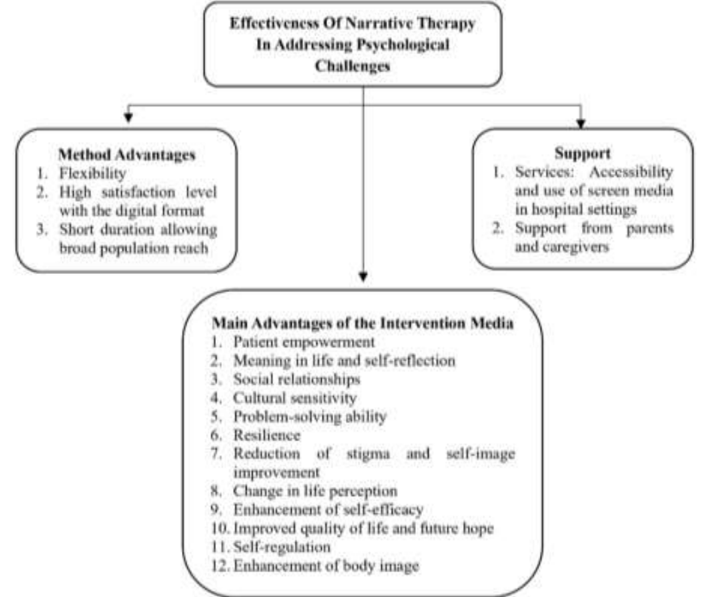
“Modalities included in-person sessions, tele-narrative therapy, group sessions, and digital bibliotherapy, reflecting high flexibility and adaptability to participants' needs and delivery platforms.”
§ Effectiveness of Narrative Therapy in Addressing Psychological Challenges: A Systematic Review of Randomised Controlled Trials > 76,9%
plain- Asserted: passes — The authors put it forward as true.
- Checkable: passes — It can be checked against evidence.
- Load-bearing: unclear — It is unclear whether the paper’s conclusions depend on it.
- Based: passes — The paper gives a reason why it holds.
It may state two separate claims as one.
A result the paper reports from its own data — it cites no other source for it, so there is none to check. The quote shows it is in the paper.
In the paper
“SNT showed limited effectiveness, with 11% of participants losing the PTSD diagnosis and 42% the CPTSD diagnosis, as well as relatively small symptom improvements (19% for PTSD; 22% for CPTSD), though it remained beneficial for some patients (Hedges' g = .34-.47 vs. .64-.81 for PE).”
§ Effectiveness of Narrative Therapy in Addressing Psychological Challenges: A Systematic Review of Randomised Controlled Trials > 3.1. Results
plaindirect- Asserted: passes — The authors put it forward as true.
- Checkable: passes — It can be checked against evidence.
- Load-bearing: unclear — It is unclear whether the paper’s conclusions depend on it.
- Based: passes — The paper gives a reason why it holds.
It may state two separate claims as one.
The paper states this without a source or data behind it here, so there is nothing to check it against. The quote shows it is in the paper.
In the paper
“It also boosts self-efficacy, self-image, and quality of life across ages and cultures.”
§ Effectiveness of Narrative Therapy in Addressing Psychological Challenges: A Systematic Review of Randomised Controlled Trials > 4. Conclusion
plaindirect- Asserted: passes — The authors put it forward as true.
- Checkable: passes — It can be checked against evidence.
- Load-bearing: passes — The paper’s conclusions depend on it.
- Based: unclear — It is unclear why the paper says it holds.
It may state two separate claims as one.
The paper states this without a source or data behind it here, so there is nothing to check it against. The quote shows it is in the paper.
In the paper
“This comprehensive review shows that Narrative Therapy effectively reduces psychological issues such as depression, anxiety, PTSD, and loneliness.”
§ Effectiveness of Narrative Therapy in Addressing Psychological Challenges: A Systematic Review of Randomised Controlled Trials > 4. Conclusion
boosteddirect- Asserted: passes — The authors put it forward as true.
- Checkable: passes — It can be checked against evidence.
- Load-bearing: passes — The paper’s conclusions depend on it.
- Based: passes — The paper gives a reason why it holds.
It may state two separate claims as one.
None of the sources cited for this claim have been checked yet.
In the paper
“Psychological trauma, including conditions like post-traumatic stress disorder (PTSD), is recognized as a major contributor to the global health burden.”
§ Effectiveness of Narrative Therapy in Addressing Psychological Challenges: A Systematic Review of Randomised Controlled Trials > 1. Introduction
plaindirect- Asserted: passes — The authors put it forward as true.
- Checkable: passes — It can be checked against evidence.
- Load-bearing: fails — The paper’s conclusions may not depend on it.
- Based: passes — The paper gives a reason why it holds.
Probably not a substantial claim. The paper’s conclusions may not depend on it.
None of the sources cited for this claim have been checked yet.
In the paper
“It can be delivered through various formats such as individual face-to-face sessions, small groups, and online methods like tele-narrative therapy and digital bibliotherapy”
§ Effectiveness of Narrative Therapy in Addressing Psychological Challenges: A Systematic Review of Randomised Controlled Trials > Methodological and Support Advantages
What the sources say
plain- Asserted: passes — The authors put it forward as true.
- Checkable: passes — It can be checked against evidence.
- Load-bearing: fails — The paper’s conclusions may not depend on it.
- Based: passes — The paper gives a reason why it holds.
Probably not a substantial claim. The paper’s conclusions may not depend on it. It may state two separate claims as one.
In the paper
“A meta-analysis by Hu et al. (2024) found that narrative therapy significantly lessened depressive symptoms (p < .001)”
§ Effectiveness of Narrative Therapy in Addressing Psychological Challenges: A Systematic Review of Randomised Controlled Trials > 3.2. Discussion
What the sources say
- Not matchedcites Hu et al. (2024)
Couldn’t be matched to a paper in Crossref, so it can’t be checked.
plaindirect- Asserted: passes — The authors put it forward as true.
- Checkable: passes — It can be checked against evidence.
- Load-bearing: passes — The paper’s conclusions depend on it.
- Based: passes — The paper gives a reason why it holds.
The quote only partly states this claim.
- Not matched
In the paper
“For example, in correctional environments, viewing oneself as a”
§ Effectiveness of Narrative Therapy in Addressing Psychological Challenges: A Systematic Review of Randomised Controlled Trials > 1. Introduction
What the sources say
- Not matchedcites Lerman & Sadin, 2023
Couldn’t be matched to a paper in Crossref, so it can’t be checked.
plaindirect- Asserted: passes — The authors put it forward as true.
- Checkable: passes — It can be checked against evidence.
- Load-bearing: fails — The paper’s conclusions may not depend on it.
- Based: passes — The paper gives a reason why it holds.
Probably not a substantial claim. The paper’s conclusions may not depend on it. It may state two separate claims as one.
- Not matched
A conclusion the paper draws from its own results — it cites no other source for it, so there is none to check. The quote shows it is in the paper.
In the paper
“The greatest effectiveness was observed among children with anxiety and trauma survivors, along with improvements in self-efficacy, self-image, social relationships, and quality of life.”
§ Effectiveness of Narrative Therapy in Addressing Psychological Challenges: A Systematic Review of Randomised Controlled Trials > Abstract
plaindirect- Asserted: passes — The authors put it forward as true.
- Checkable: passes — It can be checked against evidence.
- Load-bearing: passes — The paper’s conclusions depend on it.
- Based: passes — The paper gives a reason why it holds.
It may state two separate claims as one.
None of the sources cited for this claim have been checked yet.
In the paper
“Research in Indonesia confirms that during the pandemic, 20.8% of adults experienced depression and 25.4% stress, with young people at the highest risk (Izzatika et al., 2021).”
§ Effectiveness of Narrative Therapy in Addressing Psychological Challenges: A Systematic Review of Randomised Controlled Trials > 1. Introduction
What the sources say
- Not checked yetcites Izzatika et al., 2021 source
Checked before — its earlier verdict is held back until a new check runs.
plaincorrelational- Asserted: passes — The authors put it forward as true.
- Checkable: passes — It can be checked against evidence.
- Load-bearing: fails — The paper’s conclusions may not depend on it.
- Based: passes — The paper gives a reason why it holds.
Probably not a substantial claim. The paper’s conclusions may not depend on it. It may state two separate claims as one.
- Not checked yet
In the paper
“Trauma-informed training for healthcare workers has also been shown to improve self-efficacy (Haverkamp et al., 2023).”
§ Effectiveness of Narrative Therapy in Addressing Psychological Challenges: A Systematic Review of Randomised Controlled Trials > 1. Introduction
What the sources say
- Not matchedcites Haverkamp et al., 2023
Couldn’t be matched to a paper in Crossref, so it can’t be checked.
plaindirect- Asserted: passes — The authors put it forward as true.
- Checkable: passes — It can be checked against evidence.
- Load-bearing: fails — The paper’s conclusions may not depend on it.
- Based: passes — The paper gives a reason why it holds.
Probably not a substantial claim. The paper’s conclusions may not depend on it.
- Not matched
In the paper
“Digital adaptations like tele-narrative and video-based interventions have improved access to psychosocial services, especially in areas with limited resources (Lippke et al., 2021).”
§ Effectiveness of Narrative Therapy in Addressing Psychological Challenges: A Systematic Review of Randomised Controlled Trials > 3.2. Discussion
What the sources say
- Not checked yetcites Lippke et al., 2021 source
plaindirect- Asserted: passes — The authors put it forward as true.
- Checkable: passes — It can be checked against evidence.
- Load-bearing: fails — The paper’s conclusions may not depend on it.
- Based: passes — The paper gives a reason why it holds.
Probably not a substantial claim. The paper’s conclusions may not depend on it.
In the paper
“A systematic review and meta-analysis reported that during the pandemic, the prevalence of stress, anxiety, and depression reached 29.6%, 31.9%, and 33.7%, respectively (Salari et al., 2020).”
§ Effectiveness of Narrative Therapy in Addressing Psychological Challenges: A Systematic Review of Randomised Controlled Trials > 1. Introduction
What the sources say
- Not checked yetcites Salari et al., 2020 source
plain- Asserted: passes — The authors put it forward as true.
- Checkable: passes — It can be checked against evidence.
- Load-bearing: fails — The paper’s conclusions may not depend on it.
- Based: passes — The paper gives a reason why it holds.
Probably not a substantial claim. The paper’s conclusions may not depend on it. It may state two separate claims as one.
None of the sources cited for this claim have been checked yet.
In the paper
“Among elderly refugees, 68% reported COVID-19-related anxiety (Anwar et al., 2023).”
§ Effectiveness of Narrative Therapy in Addressing Psychological Challenges: A Systematic Review of Randomised Controlled Trials > 1. Introduction
What the sources say
- Not checked yetcites Anwar et al., 2023 source
Checked before — its earlier verdict is held back until a new check runs.
plain- Asserted: passes — The authors put it forward as true.
- Checkable: passes — It can be checked against evidence.
- Load-bearing: fails — The paper’s conclusions may not depend on it.
- Based: passes — The paper gives a reason why it holds.
Probably not a substantial claim. The paper’s conclusions may not depend on it.
- Not checked yet
A conclusion the paper draws from its own results — it cites no other source for it, so there is none to check. The quote shows it is in the paper.
In the paper
“This effectiveness stems from the therapy's focus on meaning reconstruction, self-reflection, and personal empowerment, leading to deeper psychological engagement than passive or educational methods like usual care or waitlist controls.”
§ Effectiveness of Narrative Therapy in Addressing Psychological Challenges: A Systematic Review of Randomised Controlled Trials > 61,5%
plaindirect- Asserted: passes — The authors put it forward as true.
- Checkable: fails — It may be too vague to check against evidence.
- Load-bearing: passes — The paper’s conclusions depend on it.
- Based: fails — The paper may give no reason why it holds.
Probably not a substantial claim. It may be too vague to check against evidence. The paper may give no reason why it holds. It may state two separate claims as one.
None of the sources cited for this claim have been checked yet.
In the paper
“For example, in Lithuania, no significant rise was observed in PTSD or adjustment disorder, possibly due to delayed diagnoses or service response differences (Kazlauskas et al., 2021).”
§ Effectiveness of Narrative Therapy in Addressing Psychological Challenges: A Systematic Review of Randomised Controlled Trials > 1. Introduction
What the sources say
- Not checked yetcites Kazlauskas et al., 2021 source
Checked before — its earlier verdict is held back until a new check runs.
hedgedconditional- Asserted: passes — The authors put it forward as true.
- Checkable: passes — It can be checked against evidence.
- Load-bearing: fails — The paper’s conclusions may not depend on it.
- Based: passes — The paper gives a reason why it holds.
Probably not a substantial claim. The paper’s conclusions may not depend on it. It may state two separate claims as one.
- Not checked yet
A conclusion the paper draws from its own results — it cites no other source for it, so there is none to check. The quote shows it is in the paper.
In the paper
“This approach reliably decreases psychological symptoms like depression, anxiety, and loneliness, while boosting self-esteem, self-efficacy, and social support.”
§ Effectiveness of Narrative Therapy in Addressing Psychological Challenges: A Systematic Review of Randomised Controlled Trials > 3.1. Results
boosteddirect- Asserted: passes — The authors put it forward as true.
- Checkable: passes — It can be checked against evidence.
- Load-bearing: passes — The paper’s conclusions depend on it.
- Based: passes — The paper gives a reason why it holds.
It may state two separate claims as one.
What the paper did — it cites no source for this, so there is none to check. The quote shows it is in the paper.
In the paper
“The selection and assessment were performed independently by two reviewers, and articles of questionable quality were re-evaluated to maintain consistency and methodological rigor.”
§ Effectiveness of Narrative Therapy in Addressing Psychological Challenges: A Systematic Review of Randomised Controlled Trials > Quality Assessment
plain- Asserted: passes — The authors put it forward as true.
- Checkable: passes — It can be checked against evidence.
- Load-bearing: fails — The paper’s conclusions may not depend on it.
- Based: passes — The paper gives a reason why it holds.
Probably not a substantial claim. The paper’s conclusions may not depend on it. It may state two separate claims as one.
A conclusion the paper draws from its own results — it cites no other source for it, so there is none to check. The quote shows it is in the paper.
In the paper
“These mechanisms support greater emotional resilience and overall mental health.”
§ Effectiveness of Narrative Therapy in Addressing Psychological Challenges: A Systematic Review of Randomised Controlled Trials > 3.2. Discussion
plaindirect- Asserted: passes — The authors put it forward as true.
- Checkable: passes — It can be checked against evidence.
- Load-bearing: passes — The paper’s conclusions depend on it.
- Based: fails — The paper may give no reason why it holds.
Probably not a substantial claim. The paper may give no reason why it holds. It may state two separate claims as one.
A conclusion the paper draws from its own results — it cites no other source for it, so there is none to check. The quote shows it is in the paper.
In the paper
“These flaws weaken the validity of results and hinder meta-analyses, underscoring the importance of assessing methodological quality.”
§ Effectiveness of Narrative Therapy in Addressing Psychological Challenges: A Systematic Review of Randomised Controlled Trials > 1. Introduction
plaindirect- Asserted: passes — The authors put it forward as true.
- Checkable: passes — It can be checked against evidence.
- Load-bearing: passes — The paper’s conclusions depend on it.
- Based: passes — The paper gives a reason why it holds.
It may state two separate claims as one.
A conclusion the paper draws from its own results — it cites no other source for it, so there is none to check. The quote shows it is in the paper.
In the paper
“Overall, integrating digital access, active social support, and culturally relevant adaptation makes Narrative Therapy a powerful, transformative, and sustainable method for enhancing psychological well-being across diverse populations and throughout different life stages.”
§ Effectiveness of Narrative Therapy in Addressing Psychological Challenges: A Systematic Review of Randomised Controlled Trials > Methodological and Support Advantages
plaindirect- Asserted: passes — The authors put it forward as true.
- Checkable: passes — It can be checked against evidence.
- Load-bearing: fails — The paper’s conclusions may not depend on it.
- Based: fails — The paper may give no reason why it holds.
Probably not a substantial claim. The paper’s conclusions may not depend on it. The paper may give no reason why it holds. It may state two separate claims as one.
- Rests on an assumption: The success of Narrative Therapy depends not only on the narrative process but also on how it is implemented, the intervention media used, and the social support provided.
- Rests on an assumption: Using flexible, adaptable, and culturally sensitive approaches improves therapeutic results across various populations.
None of the sources cited for this claim have been checked yet.
In the paper
“Compared to traditional treatments, narrative therapy tends to be more effective because it helps individuals rebuild meaning and self-identity by incorporating complex emotional experiences, such as trauma or chronic illnesses, into a coherent life story, which helps reduce depression and anxiety symptoms (Geng et al., 2024).”
§ Effectiveness of Narrative Therapy in Addressing Psychological Challenges: A Systematic Review of Randomised Controlled Trials > 3.2. Discussion
What the sources say
- Not checked yetcites Geng et al., 2024 source
Checked before — its earlier verdict is held back until a new check runs.
hedgeddirect- Asserted: passes — The authors put it forward as true.
- Checkable: passes — It can be checked against evidence.
- Load-bearing: passes — The paper’s conclusions depend on it.
- Based: passes — The paper gives a reason why it holds.
It may state two separate claims as one.
- Not checked yet
None of the sources cited for this claim have been checked yet.
In the paper
“which enhance accessibility and effectiveness, especially in settings with limited resources (Chow et al., 2023;Franz et al., 2022;Gong et al., 2022).”
§ Effectiveness of Narrative Therapy in Addressing Psychological Challenges: A Systematic Review of Randomised Controlled Trials > Methodological and Support Advantages
What the sources say
plaindirect- Asserted: passes — The authors put it forward as true.
- Checkable: passes — It can be checked against evidence.
- Load-bearing: unclear — It is unclear whether the paper’s conclusions depend on it.
- Based: passes — The paper gives a reason why it holds.
It may state two separate claims as one.
- Rests on an assumption: Using flexible, adaptable, and culturally sensitive approaches improves therapeutic results across various populations.
None of the sources cited for this claim have been checked yet.
In the paper
“Its effectiveness is evident across various groups, including older adults, individuals with chronic illnesses, and trauma survivors, who show gains in self-awareness, perceived control, and adaptability to life challenges (Chow et al., 2023;Jiang et al., 2025;Smaik et al., 2023).”
§ Effectiveness of Narrative Therapy in Addressing Psychological Challenges: A Systematic Review of Randomised Controlled Trials > Main Advantages of the Intervention Media
What the sources say
- Not matchedcites Chow et al., 2023
Couldn’t be matched to a paper in Crossref, so it can’t be checked.
- Not matchedcites Jiang et al., 2025
Couldn’t be matched to a paper in Crossref, so it can’t be checked.
- Not checked yetcites Smaik et al., 2023 source
Checked before — its earlier verdict is held back until a new check runs.
plaindirect- Asserted: passes — The authors put it forward as true.
- Checkable: passes — It can be checked against evidence.
- Load-bearing: passes — The paper’s conclusions depend on it.
- Based: passes — The paper gives a reason why it holds.
It may state two separate claims as one.
- Not matched
None of the sources cited for this claim have been checked yet.
In the paper
“Nevertheless, several methodological reviews highlight common issues in psychotherapy RCTs, such as poor controls, high dropout rates, inconsistent intervention fidelity, incomplete adverse effect reporting, and selection bias (Bertolín-Guillén, 2024;Crotty et al., 2024;Cuijpers et al., 2021;Melo-Carrillo et al., 2023).”
§ Effectiveness of Narrative Therapy in Addressing Psychological Challenges: A Systematic Review of Randomised Controlled Trials > 1. Introduction
What the sources say
- Not checked — no full text of the sourcecites Bertolín-Guillén, 2024 source
- Not matchedcites Crotty et al., 2024
Couldn’t be matched to a paper in Crossref, so it can’t be checked.
- Not checked yetcites Cuijpers et al., 2021 source
Checked before — its earlier verdict is held back until a new check runs.
plain- Asserted: passes — The authors put it forward as true.
- Checkable: passes — It can be checked against evidence.
- Load-bearing: passes — The paper’s conclusions depend on it.
- Based: passes — The paper gives a reason why it holds.
It may state two separate claims as one.
A conclusion the paper draws from its own results — it cites no other source for it, so there is none to check. The quote shows it is in the paper.
In the paper
“Narrative Therapy's strength also includes its adaptability and cultural sensitivity.”
§ Effectiveness of Narrative Therapy in Addressing Psychological Challenges: A Systematic Review of Randomised Controlled Trials > 3.2. Discussion
plain- Asserted: passes — The authors put it forward as true.
- Checkable: passes — It can be checked against evidence.
- Load-bearing: fails — The paper’s conclusions may not depend on it.
- Based: fails — The paper may give no reason why it holds.
Probably not a substantial claim. The paper’s conclusions may not depend on it. The paper may give no reason why it holds. It may state two separate claims as one.
None of the sources cited for this claim have been checked yet.
In the paper
“Ironically, mobility restrictions and social distancing reduced engagement with mental health services; many avoided healthcare facilities, causing reported cases of some disorders to appear artificially lower (Duden et al., 2022;Flodin et al., 2023).”
§ Effectiveness of Narrative Therapy in Addressing Psychological Challenges: A Systematic Review of Randomised Controlled Trials > 1. Introduction
What the sources say
hedgeddirect- Asserted: passes — The authors put it forward as true.
- Checkable: passes — It can be checked against evidence.
- Load-bearing: fails — The paper’s conclusions may not depend on it.
- Based: passes — The paper gives a reason why it holds.
Probably not a substantial claim. The paper’s conclusions may not depend on it. It may state two separate claims as one.
In the paper
“Supporting this, narrative reconstruction has demonstrated effectiveness in decreasing PTSD and depression symptoms both short and long term by aiding the integration of adaptive and coherent emotional memories (Siehl et al., 2021).”
§ Effectiveness of Narrative Therapy in Addressing Psychological Challenges: A Systematic Review of Randomised Controlled Trials > 3.2. Discussion
What the sources say
- Not matchedcites Siehl et al., 2021
Couldn’t be matched to a paper in Crossref, so it can’t be checked.
boosteddirect- Asserted: passes — The authors put it forward as true.
- Checkable: passes — It can be checked against evidence.
- Load-bearing: passes — The paper’s conclusions depend on it.
- Based: passes — The paper gives a reason why it holds.
It may state two separate claims as one.
- Not matched
In the paper
“The absence of adverse event reporting hampers risk-benefit analysis (Cuijpers et al., 2021), while weak randomization can introduce selection bias (Bertolín-Guillén, 2024).”
§ Effectiveness of Narrative Therapy in Addressing Psychological Challenges: A Systematic Review of Randomised Controlled Trials > 1. Introduction
What the sources say
- Not checked — no full text of the sourcecites Bertolín-Guillén, 2024 source
plaindirect- Asserted: passes — The authors put it forward as true.
- Checkable: passes — It can be checked against evidence.
- Load-bearing: fails — The paper’s conclusions may not depend on it.
- Based: passes — The paper gives a reason why it holds.
Probably not a substantial claim. The paper’s conclusions may not depend on it.
None of the sources cited for this claim could be matched to a paper in Crossref, so there is nothing to check it against.
In the paper
“For medical patients, Narrative Therapy helps improve self-image and body acceptance, especially in those with cancer or traumatic pasts (Sackeim et al., 2022;Sun et al., 2022).”
§ Effectiveness of Narrative Therapy in Addressing Psychological Challenges: A Systematic Review of Randomised Controlled Trials > Main Advantages of the Intervention Media
What the sources say
- Not matchedcites Sackeim et al., 2022
Couldn’t be matched to a paper in Crossref, so it can’t be checked.
- Not matchedcites Sun et al., 2022
Couldn’t be matched to a paper in Crossref, so it can’t be checked.
plaindirect- Asserted: passes — The authors put it forward as true.
- Checkable: passes — It can be checked against evidence.
- Load-bearing: unclear — It is unclear whether the paper’s conclusions depend on it.
- Based: passes — The paper gives a reason why it holds.
It may state two separate claims as one.
- Not matched
None of the sources cited for this claim have been checked yet.
In the paper
“It promotes psychological empowerment, self-reflection, and the restructuring of meaning, helping participants shift from stories of suffering to those of hope and healing (Appalasamy et al., 2020;Fan et al., 2021).”
§ Effectiveness of Narrative Therapy in Addressing Psychological Challenges: A Systematic Review of Randomised Controlled Trials > Main Advantages of the Intervention Media
What the sources say
plaindirect- Asserted: passes — The authors put it forward as true.
- Checkable: passes — It can be checked against evidence.
- Load-bearing: unclear — It is unclear whether the paper’s conclusions depend on it.
- Based: passes — The paper gives a reason why it holds.
It may state two separate claims as one.
A conclusion the paper draws from its own results — it cites no other source for it, so there is none to check. The quote shows it is in the paper.
In the paper
“It enhances personal empowerment, encourages self-reflection, and helps restructure life's meaning.”
§ Effectiveness of Narrative Therapy in Addressing Psychological Challenges: A Systematic Review of Randomised Controlled Trials > 3.2. Discussion
plaindirect- Asserted: passes — The authors put it forward as true.
- Checkable: passes — It can be checked against evidence.
- Load-bearing: passes — The paper’s conclusions depend on it.
- Based: passes — The paper gives a reason why it holds.
Probably not a substantial claim.
In the paper
“and improved self-efficacy and self-control in adults with somatic disorders”
§ Effectiveness of Narrative Therapy in Addressing Psychological Challenges: A Systematic Review of Randomised Controlled Trials > 3.2. Discussion
What the sources say
- Not matchedcites Hu et al. (2024)
Couldn’t be matched to a paper in Crossref, so it can’t be checked.
plaindirect- Asserted: passes — The authors put it forward as true.
- Checkable: passes — It can be checked against evidence.
- Load-bearing: passes — The paper’s conclusions depend on it.
- Based: passes — The paper gives a reason why it holds.
It may state two separate claims as one.
- Not matched
None of the sources cited for this claim have been checked yet.
In the paper
“Evidence indicates that self-efficacy plays a crucial role in developing professional identity among nursing students (Mei et al., 2022) and in linking professional identity with perceived competence (Yao et al., 2021).”
§ Effectiveness of Narrative Therapy in Addressing Psychological Challenges: A Systematic Review of Randomised Controlled Trials > 1. Introduction
What the sources say
hedgedcorrelational- Asserted: passes — The authors put it forward as true.
- Checkable: passes — It can be checked against evidence.
- Load-bearing: fails — The paper’s conclusions may not depend on it.
- Based: passes — The paper gives a reason why it holds.
Probably not a substantial claim. The paper’s conclusions may not depend on it. It may state two separate claims as one.
In the paper
“Among disaster volunteers, trauma centrality mediates the connection between coping self-efficacy and post-traumatic growth, suggesting that how individuals incorporate traumatic experiences into their identities affects their recovery potential (Arpaci et al., 2024).”
§ Effectiveness of Narrative Therapy in Addressing Psychological Challenges: A Systematic Review of Randomised Controlled Trials > 1. Introduction
What the sources say
- Not matchedcites Arpaci et al., 2024
Couldn’t be matched to a paper in Crossref, so it can’t be checked.
plaindirect- Asserted: passes — The authors put it forward as true.
- Checkable: passes — It can be checked against evidence.
- Load-bearing: fails — The paper’s conclusions may not depend on it.
- Based: passes — The paper gives a reason why it holds.
Probably not a substantial claim. The paper’s conclusions may not depend on it.
- Not matched
None of the sources cited for this claim have been checked yet.
In the paper
“Using symbols, language, and local values in culturally adapted approaches has been shown to increase participant engagement and boost the overall effectiveness of interventions (Appalasamy et al., 2020;Karibwende et al., 2023).”
§ Effectiveness of Narrative Therapy in Addressing Psychological Challenges: A Systematic Review of Randomised Controlled Trials > Main Advantages of the Intervention Media
What the sources say
plaindirect- Asserted: passes — The authors put it forward as true.
- Checkable: passes — It can be checked against evidence.
- Load-bearing: unclear — It is unclear whether the paper’s conclusions depend on it.
- Based: passes — The paper gives a reason why it holds.
It may state two separate claims as one.
A conclusion the paper draws from its own results — it cites no other source for it, so there is none to check. The quote shows it is in the paper.
In the paper
“Overall, Narrative Therapy consistently improves self-efficacy, self-esteem, emotion regulation, and quality of life across various age groups and populations, with the greatest success seen in trauma-focused and community-based interventions.”
§ Effectiveness of Narrative Therapy in Addressing Psychological Challenges: A Systematic Review of Randomised Controlled Trials > 61,5%
boosteddirect- Asserted: passes — The authors put it forward as true.
- Checkable: passes — It can be checked against evidence.
- Load-bearing: passes — The paper’s conclusions depend on it.
- Based: passes — The paper gives a reason why it holds.
It may state two separate claims as one.
A conclusion the paper draws from its own results — it cites no other source for it, so there is none to check. The quote shows it is in the paper.
In the paper
“Narrative Therapy is flexible and adaptable to different cultural and situational contexts.”
§ Effectiveness of Narrative Therapy in Addressing Psychological Challenges: A Systematic Review of Randomised Controlled Trials > Methodological and Support Advantages
plain- Asserted: passes — The authors put it forward as true.
- Checkable: passes — It can be checked against evidence.
- Load-bearing: unclear — It is unclear whether the paper’s conclusions depend on it.
- Based: passes — The paper gives a reason why it holds.
It may state two separate claims as one.
- Rests on an assumption: Using flexible, adaptable, and culturally sensitive approaches improves therapeutic results across various populations.
In the paper
“Family and caregiver participation, as shown in Chow et al. (2023), encouraged empathy, emotional resilience, and lowered depression levels among older adults with PTSD (p = .01).”
§ Effectiveness of Narrative Therapy in Addressing Psychological Challenges: A Systematic Review of Randomised Controlled Trials > Methodological and Support Advantages
What the sources say
- Not matchedcites Chow et al. (2023)
Couldn’t be matched to a paper in Crossref, so it can’t be checked.
plaindirect- Asserted: passes — The authors put it forward as true.
- Checkable: passes — It can be checked against evidence.
- Load-bearing: unclear — It is unclear whether the paper’s conclusions depend on it.
- Based: passes — The paper gives a reason why it holds.
It may state two separate claims as one.
- Not matched
A conclusion the paper draws from its own results — it cites no other source for it, so there is none to check. The quote shows it is in the paper.
In the paper
“This process allows participants to turn negative experiences into more positive and meaningful stories.”
§ Effectiveness of Narrative Therapy in Addressing Psychological Challenges: A Systematic Review of Randomised Controlled Trials > 3.2. Discussion
plaindirect- Asserted: passes — The authors put it forward as true.
- Checkable: passes — It can be checked against evidence.
- Load-bearing: passes — The paper’s conclusions depend on it.
- Based: passes — The paper gives a reason why it holds.
Probably not a substantial claim.
A conclusion the paper draws from its own results — it cites no other source for it, so there is none to check. The quote shows it is in the paper.
In the paper
“Narrative Therapy is effective in reducing psychological symptoms such as depression, anxiety, PTSD, and loneliness, while enhancing self-efficacy, self-image,”
- Also stated in: § Abstract · plain
“Therapy is effective in reducing psychological symptoms such as depression, anxiety, PTSD, and loneliness, while enhancing self-efficacy, self-image, and quality of life across ages and cultures.”
§ Effectiveness of Narrative Therapy in Addressing Psychological Challenges: A Systematic Review of Randomised Controlled Trials > Abstract
plaindirect- Asserted: passes — The authors put it forward as true.
- Checkable: passes — It can be checked against evidence.
- Load-bearing: passes — The paper’s conclusions depend on it.
- Based: passes — The paper gives a reason why it holds.
It may state two separate claims as one.
- Also stated in: § Abstract · plain
A conclusion the paper draws from its own results — it cites no other source for it, so there is none to check. The quote shows it is in the paper.
In the paper
“Modalities included in-person sessions, tele-narrative therapy, group sessions, and digital bibliotherapy, reflecting high flexibility and adaptability to participants' needs and delivery platforms.”
§ Effectiveness of Narrative Therapy in Addressing Psychological Challenges: A Systematic Review of Randomised Controlled Trials > 76,9%
boosted- Asserted: passes — The authors put it forward as true.
- Checkable: passes — It can be checked against evidence.
- Load-bearing: unclear — It is unclear whether the paper’s conclusions depend on it.
- Based: passes — The paper gives a reason why it holds.
It may state two separate claims as one.
A conclusion the paper draws from its own results — it cites no other source for it, so there is none to check. The quote shows it is in the paper.
In the paper
“Its overall success can be attributed to mechanisms like narrative reflection, cognitive restructuring, and enhanced self-efficacy, which foster emotional resilience and better emotional regulation in various psychological settings.”
§ Effectiveness of Narrative Therapy in Addressing Psychological Challenges: A Systematic Review of Randomised Controlled Trials > Main Advantages of the Intervention Media
plaindirect- Asserted: passes — The authors put it forward as true.
- Checkable: passes — It can be checked against evidence.
- Load-bearing: fails — The paper’s conclusions may not depend on it.
- Based: fails — The paper may give no reason why it holds.
Probably not a substantial claim. The paper’s conclusions may not depend on it. The paper may give no reason why it holds. It may state two separate claims as one.
None of the sources cited for this claim have been checked yet.
In the paper
“On the other hand, exposure to secondary trauma is linked to lower professional confidence (Syed Ali et al., 2023), and secondary traumatic self-efficacy predicts attitudes toward trauma-informed practice (Miller Itay & Turliuc, 2023).”
§ Effectiveness of Narrative Therapy in Addressing Psychological Challenges: A Systematic Review of Randomised Controlled Trials > 1. Introduction
What the sources say
- Not checked yetcites Miller Itay & Turliuc, 2023 source
Checked before — its earlier verdict is held back until a new check runs.
plaincorrelational- Asserted: passes — The authors put it forward as true.
- Checkable: passes — It can be checked against evidence.
- Load-bearing: fails — The paper’s conclusions may not depend on it.
- Based: passes — The paper gives a reason why it holds.
Probably not a substantial claim. The paper’s conclusions may not depend on it.
- Not checked yet
What the paper did — it cites no source for this, so there is none to check. The quote shows it is in the paper.
In the paper
“To evaluate the methodological quality of the selected articles, the Joanna Briggs Institute (JBI) Critical Appraisal Tool was employed, which is appropriate for the study types included in this systematic review.”
§ Effectiveness of Narrative Therapy in Addressing Psychological Challenges: A Systematic Review of Randomised Controlled Trials > Quality Assessment
plain- Asserted: passes — The authors put it forward as true.
- Checkable: passes — It can be checked against evidence.
- Load-bearing: fails — The paper’s conclusions may not depend on it.
- Based: passes — The paper gives a reason why it holds.
Probably not a substantial claim. The paper’s conclusions may not depend on it.
In the paper
“From 2010 to 2015, few RCTs focused specifically on NT, but since 2016, the number has grown along with increased interest in traumafocused therapies (summary of RCTs 2016-2020).”
§ Effectiveness of Narrative Therapy in Addressing Psychological Challenges: A Systematic Review of Randomised Controlled Trials > 1. Introduction
What the sources say
- Not matchedcites summary of RCTs 2016-2020
Couldn’t be matched to a paper in Crossref, so it can’t be checked.
plaincorrelational- Asserted: passes — The authors put it forward as true.
- Checkable: passes — It can be checked against evidence.
- Load-bearing: fails — The paper’s conclusions may not depend on it.
- Based: passes — The paper gives a reason why it holds.
Probably not a substantial claim. The paper’s conclusions may not depend on it. It may state two separate claims as one.
- Not matched
What the paper did — it cites no source for this, so there is none to check. The quote shows it is in the paper.
In the paper
“This review has some limitations, including small sample sizes, inconsistent therapy durations, and varying cultural and implementation settings.”
§ Effectiveness of Narrative Therapy in Addressing Psychological Challenges: A Systematic Review of Randomised Controlled Trials > 3.2. Discussion
plain- Asserted: passes — The authors put it forward as true.
- Checkable: passes — It can be checked against evidence.
- Load-bearing: passes — The paper’s conclusions depend on it.
- Based: passes — The paper gives a reason why it holds.
It may state two separate claims as one.
A conclusion the paper draws from its own results — it cites no other source for it, so there is none to check. The quote shows it is in the paper.
In the paper
“The change process involves narrative reflection, cognitive restructuring, and empowering individuals to find meaning in life, which helps build a positive identity and emotional resilience.”
§ Effectiveness of Narrative Therapy in Addressing Psychological Challenges: A Systematic Review of Randomised Controlled Trials > 4. Conclusion
plaindirect- Asserted: passes — The authors put it forward as true.
- Checkable: passes — It can be checked against evidence.
- Load-bearing: passes — The paper’s conclusions depend on it.
- Based: fails — The paper may give no reason why it holds.
Probably not a substantial claim. The paper may give no reason why it holds. It may state two separate claims as one.
In the paper
“Multiple studies indicate that online formats produce outcomes similar to traditional face-to-face sessions and can improve participant engagement (Jiang et al., 2025).”
§ Effectiveness of Narrative Therapy in Addressing Psychological Challenges: A Systematic Review of Randomised Controlled Trials > 3.2. Discussion
What the sources say
- Not matchedcites Jiang et al., 2025
Couldn’t be matched to a paper in Crossref, so it can’t be checked.
hedgeddirect- Asserted: passes — The authors put it forward as true.
- Checkable: passes — It can be checked against evidence.
- Load-bearing: fails — The paper’s conclusions may not depend on it.
- Based: passes — The paper gives a reason why it holds.
Probably not a substantial claim. The paper’s conclusions may not depend on it.
- Not matched
A conclusion the paper draws from its own results — it cites no other source for it, so there is none to check. The quote shows it is in the paper.
In the paper
“This therapy is adaptable, culturally appropriate, and highly relevant to mental health nursing because it promotes meaning-focused positive adaptation and recovery.”
§ Effectiveness of Narrative Therapy in Addressing Psychological Challenges: A Systematic Review of Randomised Controlled Trials > 4. Conclusion
plaindirect- Asserted: passes — The authors put it forward as true.
- Checkable: fails — It may be too vague to check against evidence.
- Load-bearing: passes — The paper’s conclusions depend on it.
- Based: passes — The paper gives a reason why it holds.
Probably not a substantial claim. It may be too vague to check against evidence. It may state two separate claims as one.
In the paper
“Additionally, social support from family, caregivers, and healthcare providers enhances therapy by promoting empathy, emotional bonds, and effective communication (Sun et al., 2022).”
§ Effectiveness of Narrative Therapy in Addressing Psychological Challenges: A Systematic Review of Randomised Controlled Trials > 3.2. Discussion
What the sources say
- Not matchedcites Sun et al., 2022
Couldn’t be matched to a paper in Crossref, so it can’t be checked.
plaindirect- Asserted: passes — The authors put it forward as true.
- Checkable: passes — It can be checked against evidence.
- Load-bearing: fails — The paper’s conclusions may not depend on it.
- Based: passes — The paper gives a reason why it holds.
Probably not a substantial claim. The paper’s conclusions may not depend on it.
- Not matched
A conclusion the paper draws from its own results — it cites no other source for it, so there is none to check. The quote shows it is in the paper.
In the paper
“Consequently, Narrative Therapy is recommended as an evidence-based approach suitable for both clinical and community nursing settings.”
§ Effectiveness of Narrative Therapy in Addressing Psychological Challenges: A Systematic Review of Randomised Controlled Trials > 4. Conclusion
plaindirect- Asserted: passes — The authors put it forward as true.
- Checkable: passes — It can be checked against evidence.
- Load-bearing: passes — The paper’s conclusions depend on it.
- Based: passes — The paper gives a reason why it holds.
Probably not a substantial claim. It may state two separate claims as one.
The paper relies on this without support.
Evidence on the effectiveness of Narrative Therapy remains limited and varies across age groups, psychological conditions, and cultural contexts.
“Evidence on the effectiveness of Narrative Therapy remains limited and varies across age groups, psychological conditions, and cultural contexts; therefore, a systematic review is needed to integrate findings across studies for a more comprehensive understanding.”
The paper relies on this without support.
Narrative Therapy's effectiveness has not been fully summarized for 2020-2025.
“However, its effectiveness has not been fully summarized for 2020-2025, a period characterized by increased post-pandemic research and digital mental health innovations.”
The paper relies on this without support.
No review explicitly connects identity shift and self-efficacy mechanisms to Narrative Therapy outcomes.
“Additionally, no review explicitly connects identity shift and self-efficacy mechanisms to NT outcomes, despite their potential role as key therapeutic mediators.”
The authors state this as an assumption.
Narrative transformation promotes identity change and enhances self-efficacy.
“Theoretically, narrative transformation promotes identity change and enhances self-efficacy.”
The paper relies on this without support.
Narrative Therapy emphasizes externalizing issues and reshaping meaning through personal narratives.
“In mental health interventions, NT emphasizes externalizing issues and reshaping meaning through personal narratives.”
The paper relies on this without support.
The success of Narrative Therapy depends not only on the narrative process but also on how it is implemented, the intervention media used, and the social support provided.
“The success of Narrative Therapy depends not only on the narrative process but also on how it is implemented, the intervention media used, and the social support provided.”
The paper relies on this without support.
Using flexible, adaptable, and culturally sensitive approaches improves therapeutic results across various populations.
“Using flexible, adaptable, and culturally sensitive approaches has been shown to improve therapeutic results across various populations significantly.”
Statistics that don’t add up
Each reported p-value recomputed from its test statistic and degrees of freedom.
Rated minor: it would not touch a result — a value no result rests on, a p-value that stays on the same side of the significance level, or a conflict that is clerical, resolved elsewhere in the paper, or outside its own findings.
In the paper
“F(1,36) = 6.67, p < .01”
§ Effectiveness of Narrative Therapy in Addressing Psychological Challenges: A Systematic Review of Randomised Controlled Trials > 76,9%
Reported p < .01 · recomputed p = .014
Statistics recomputed
Every reported test result, recomputed from its test statistic and degrees of freedom. A result shows as not adding up only once an independent check has confirmed it.
- Doesn’t add upF(1, 36) = 6.67reported p < .01 · recomputed p = .014
“F(1,36) = 6.67, p < .01”
- Not confirmedz = -3.32reported p = .005 · recomputed p < .001
“(z = -3.32,p = .005”
- Not confirmedz = 3.5reported p = .003 · recomputed p < .001
“(z = 3.50, p = .003”
- Not confirmedz = -2.78reported p = .034 · recomputed p = .005
“(z = -2.78,p = .034”
- Consistentz = -2.235reported p = .025 · recomputed p = .025
“(Z = -2.235,p = .025”
- Consistentz = -2.13reported p = .033 · recomputed p = .033
“(Z = -2.130,p = .033”
- Consistentz = -2.85reported p = .004 · recomputed p = .004
“(Z = -2.850,p = .004”
- Consistentz = -2.434reported p = .015 · recomputed p = .015
“(Z = -2.434,p = .015”
- ConsistentF(1, 109) = 36.3reported p < .001 · recomputed p < .001
“F(1,109) = 36.300,p < .001”
- Consistentz = -4.69reported p < .001 · recomputed p < .001
“(z = -4.69,p < .001”
- ConsistentF(1, 36) = 7.92reported p < .01 · recomputed p = .008
“F(1,36) = 7.92, p < .01”
Self-check
Percentages, sums and reported differences re-computed from the paper’s own numbers.
Each contradiction between two passages listed here was confirmed by an independent check.
Rated major: it would touch a result — a value a result rests on, reported and recomputed p-values on opposite sides of the significance level, two passages that conflict with no sign which is right, or a cited work retracted before this paper was published.
In the paper
“914 of these were available in full text.Following full-text evaluation, 814 articles that did not meet the research objectives were excluded.This process resulted in 20 articles fitting the criteria for analysis.”
§ Effectiveness of Narrative Therapy in Addressing Psychological Challenges: A Systematic Review of Randomised Controlled Trials > Literature Search Strategy
Reported 20 · recomputed 100
Rated major: it would touch a result — a value a result rests on, reported and recomputed p-values on opposite sides of the significance level, two passages that conflict with no sign which is right, or a cited work retracted before this paper was published.
In the paper
§ Effectiveness of Narrative Therapy in Addressing Psychological Challenges: A Systematic Review of Randomised Controlled Trials > 61,5%
“Two studies- Fan et al. (2021) and Sackeim et al. (2022)-found no meaningful differences between intervention and control groups.”
§ Effectiveness of Narrative Therapy in Addressing Psychological Challenges: A Systematic Review of Randomised Controlled Trials > 61,5%
“The NET group showed significantly greater reductions in total PTSS compared to the control group (F(1,109) = 36.300,p < .001)”
Rated minor: it would not touch a result — a value no result rests on, a p-value that stays on the same side of the significance level, or a conflict that is clerical, resolved elsewhere in the paper, or outside its own findings.
In the paper
§ Effectiveness of Narrative Therapy in Addressing Psychological Challenges: A Systematic Review of Randomised Controlled Trials > 76,9%
“Intervention durations ranged from 4 to 12 weeks, with sessions held 1-2 times weekly, each lasting 30-120 minutes.”
§ Effectiveness of Narrative Therapy in Addressing Psychological Challenges: A Systematic Review of Randomised Controlled Trials > 76,9%
“therapy duration of 14 days (one narrative per day, approximately 5-10 minutes of reading).”
Rated minor: it would not touch a result — a value no result rests on, a p-value that stays on the same side of the significance level, or a conflict that is clerical, resolved elsewhere in the paper, or outside its own findings.
In the paper
§ Effectiveness of Narrative Therapy in Addressing Psychological Challenges: A Systematic Review of Randomised Controlled Trials > Abstract
“The highest recorded p-value was .019,and the highest t-value was -9.46 (p < .001).”
§ Effectiveness of Narrative Therapy in Addressing Psychological Challenges: A Systematic Review of Randomised Controlled Trials > 61,5%
“depression (d = .51,p = .03),and general psychopathology (d = .74,p = .001)”
Rated minor: it would not touch a result — a value no result rests on, a p-value that stays on the same side of the significance level, or a conflict that is clerical, resolved elsewhere in the paper, or outside its own findings.
In the paper
§ Effectiveness of Narrative Therapy in Addressing Psychological Challenges: A Systematic Review of Randomised Controlled Trials > Abstract
“the highest t-value was -9.46 (p < .001).”
§ Effectiveness of Narrative Therapy in Addressing Psychological Challenges: A Systematic Review of Randomised Controlled Trials > 84,6% Shakeri et al. (2020) Iran
“with meaningful pre-to post-intervention improvements (t = 11.668,p < .001)”
Rated minor: it would not touch a result — a value no result rests on, a p-value that stays on the same side of the significance level, or a conflict that is clerical, resolved elsewhere in the paper, or outside its own findings.
In the paper
§ Effectiveness of Narrative Therapy in Addressing Psychological Challenges: A Systematic Review of Randomised Controlled Trials > CAPS-5; PCL-5; CRIES-8 for children; BDI-II; HAI.
“Randomized controlled trials (RCTs) in English, published between January 2020 and December 2025, with a sample size ≥ 10 per group.”
§ Effectiveness of Narrative Therapy in Addressing Psychological Challenges: A Systematic Review of Randomised Controlled Trials > 4. Conclusion
“8 vs. 11 adult female survivors of Intimate Partner Violence (IPV) residing in a shelter house; longitudinal RCT”
Rated minor: it would not touch a result — a value no result rests on, a p-value that stays on the same side of the significance level, or a conflict that is clerical, resolved elsewhere in the paper, or outside its own findings.
In the paper
§ Effectiveness of Narrative Therapy in Addressing Psychological Challenges: A Systematic Review of Randomised Controlled Trials > Abstract
“18 showed significant results (p < .05)with moderate to large effect sizes (Cohen's d = .5-1.6)”
§ Effectiveness of Narrative Therapy in Addressing Psychological Challenges: A Systematic Review of Randomised Controlled Trials > 76,9%
“remained significant at the 2-week follow-up (*t* = -2.82,*p* = .005,*d* = .33)”
Citations
Cites
The PRISMA 2020 statement: An updated guideline for reporting systematic reviews
Page, M. J., McKenzie, J. E., Bossuyt, P. M., Boutron, I., Hoffmann, T. C., Mulrow, C. D., Shamseer, L., Tetzlaff, J. M., Akl, E. A., Brennan, S. E., et al. (2021) · BMJ · doi:10.1136/bmj.n71 · Cited by 108,283
The psychological impact of quarantine and how to reduce it: Rapid review of the evidence
Brooks, S. K., Webster, R. K., Smith, L. E., Woodland, L., Wessely, S., Greenberg, N., & Rubin, G. J. (2020) · The Lancet · doi:10.1016/s0140-6736(20)30460-8 · Cited by 16,378
Ferrari, A. J., Santomauro, D. F., Aali, A., Abate, Y. H., Abbafati, C., Abbastabar, H., Abd ElHafeez, S., Abdelmasseh, M., Abd-Elsalam, S., Abdollahi, A., et al. (2024) · The Lancet · doi:10.1016/s0140-6736(24)00757-8 · Cited by 5,112
Salari, N., Hosseinian-Far, A., Jalali, R., Vaisi-Raygani, A., Rasoulpoor, S., Mohammadi, M., Rasoulpoor, S., & Khaledi-Paveh, B. (2020) · Globalization and Health · doi:10.1186/s12992-020-00589-w · Cited by 3,560
Magson, N. R., Freeman, J. Y. A., Rapee, R. M., Richardson, C. E., Oar, E. L., & Fardouly, J. (2021) · Journal of Youth and Adolescence · doi:10.1007/s10964-020-01332-9 · Cited by 1,498
Cuijpers, P., Karyotaki, E., Ciharova, M., Miguel, C., Noma, H., & Furukawa, T. A. (2021) · Acta Psychiatrica Scandinavica · doi:10.1111/acps.13335 · Cited by 336
Hoppen, T. H., Priebe, S., Vetter, I., & Nexhmedin Morina, B. (2021) · BMJ Global Health · doi:10.1136/bmjgh-2021-006303 · Cited by 271
Bohus, M., Kleindienst, N., Hahn, C., Müller-Engelmann, M., Ludäscher, P., Steil, R., Fydrich, T., Kuehner, C., Resick, P. A., Stiglmayr, C., et al. (2020) · JAMA Psychiatry · doi:10.1001/jamapsychiatry.2020.2148 · Cited by 265
Incidence and outcomes of eating disorders during the COVID-19 pandemic
Taquet, M., Geddes, J. R., Luciano, S., & Harrison, P. J. (2021) · The British Journal of Psychiatry · doi:10.1192/bjp.2021.105 · Cited by 246
Burden of Mental Disorders and Suicide Attributable to Childhood Maltreatment
Grummitt, L. R., Baldwin, J. R., Lafoa’i, J., Keyes, K. M., & Barrett, E. L. (2024) · JAMA Psychiatry · doi:10.1001/jamapsychiatry.2024.0804 · Cited by 149
Cited by
Still being checked.
Metadata
- Authors
- Permatasari, D. P., Windarwati, H. D., & Lestari, R.
- Affiliations
- University of Brawijaya (ID)
- Venue
- Indigenous: Jurnal Ilmiah Psikologi
- Publisher
- Universitas Muhammadiyah Surakarta
- Published
- 2026-02-28
- Volume
- 11
- Issue
- 1
- Pages
- 1-16
- ISSN
- 0854-2880 (ISSN-L)
- 2541-450X
- OpenAlex
- W7132826253
- Semantic Scholar
- f1375e7f6ee3c294c382d5341eec214ab99b5724
- Cited by
- 0
- References
- 66
- FWCI
- 0.00
- Type
- journal article
- Language
- en
- Open access
- gold
- doi.org
- Locations
- Indigenous Jurnal Ilmiah Psikologi (publishedVersion, cc-by)
- Topics
- Social Sciences › Psychology › Clinical Psychology › Counseling, Therapy, and Family Dynamics
- Social Sciences › Psychology › Clinical Psychology › Psychotherapy Techniques and Applications
- Social Sciences › Psychology › Clinical Psychology › Art Therapy and Mental Health
- Keywords
- narrative therapy, psychological intervention, depression, anxiety, post-traumatic stress disorder, loneliness, self-efficacy, self-image, quality of life, children and adolescents, older adults, psychiatric nursing, evidence-based practice
About these checks
Registry, retraction, Cites and statistics results are computed, not judged, with one exception: a printed reference that no index lists is read once by a model before it counts as a citation error. Claims are extracted by a model and kept only when their quote appears verbatim in the text; each cited source is then checked, with a model’s help, for whether it says what the claim relies on. Those verdicts can be wrong — read the claim’s quote and the cited source before relying on one.
A language model drew the claims from the paper on 2026-11-11, under version 3 of the claim definition (model deepseek-v4.1-flash, prompt extract-v3).
A second model labelled each claim on 2026-11-11 (model jev-1.13-20260917, definition revision gold-guideline-v0.2).
Cited sources are checked with a language model’s help (gpt-6-sol).
Statistics and arithmetic are recomputed, not judged.
Confidence bands are shown only for fields calibrated on our annotated test set. None is calibrated yet, so no band is shown.
What counts as a claim ›How we measure confidence ›How we check this ›
Are you an author, or do you see a problem with this page? Request a review
