

Pathways to Student Motivation: A Meta-Analysis of Antecedents of Autonomous and Controlled Motivations
Open accessThe DOI matches its Crossref record; 79 of the 80 references it cites were found in a registry or an index; 6 of the 38 sources its claims cite were checked for support.
Abstract
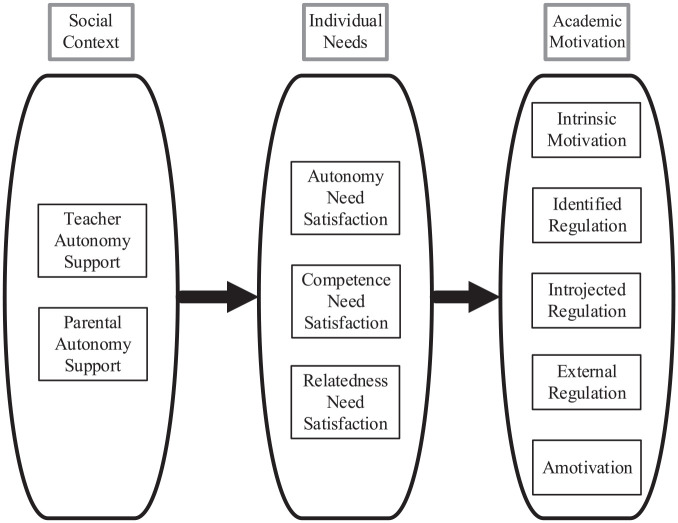
Students’ self-determined motivation (acting out of interest, curiosity, and abiding values) is associated with higher academic well-being, persistence, and achievement. Self-determination theory posits that self-determined motivation is dependent on the satisfaction of three psychological needs (relatedness, competence, and autonomy), which are in turn facilitated through need-supportive behaviors from notable others. In this meta-analysis, conducted over 144 studies and more than 79,000 students, we sought to overview pathways to student motivation in order to verify (1) how do psychological needs rank in the strength of their prediction of self-determined motivation and (2) which autonomy-support providers (parents or teachers) are the most relevant for psychological need satisfaction in students and self-determined motivation. Results show that teacher autonomy support predicts students’ need satisfaction and self-determined motivation more strongly than parental autonomy support. In addition, competence is the most positive predictor of self-determined motivation, followed by autonomy and then by relatedness.
Overview
CoChat Summary
TL;DR
This meta-analysis of 144 samples and 79,079 students tested self-determination theory pathways from teacher and parent autonomy support to psychological need satisfaction and student motivation. Teacher autonomy support was a stronger predictor than parental autonomy support, and competence was the strongest need predictor of self-determined motivation, followed by autonomy and relatedness.
Key findings
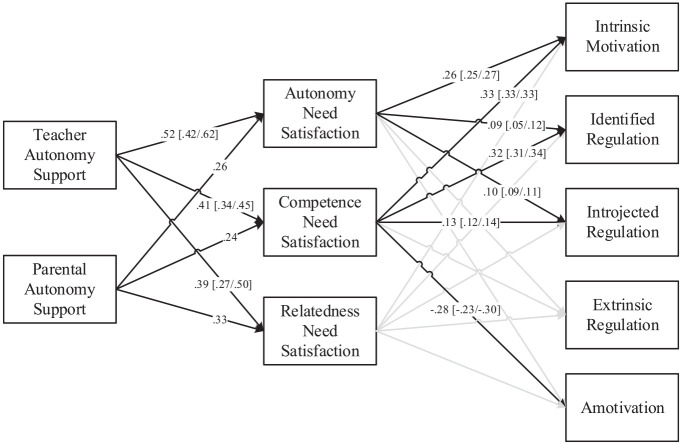
- Teacher autonomy support generally predicted need satisfaction and self-determined motivation more strongly than parental autonomy support. In the model including both sources, direct paths from parental autonomy support to motivation types were close to null; parental support showed only indirect prediction for identified and intrinsic motivation (βindirect = .13 and .16, respectively).
- Competence was the strongest positive predictor of self-determined motivation. Relative weight analysis showed competence accounted for 42.33% of unique variance in intrinsic motivation (R² = .38), 44.38% in identified regulation (R² = .30), and 46.90% in amotivation (R² = .15); autonomy followed, then relatedness. MASEM results similarly showed competence as the strongest predictor of amotivation (β = −.23 to −.30), identified regulation (β = .31 to .34), and intrinsic motivation (β = .33).
- Teacher autonomy support predicted autonomy (β = .42 to .62), competence (β = .34 to .45), and relatedness (β = .27 to .50). It also predicted amotivation (β = −.12 to −.18), identified regulation (β = .18 to .19 direct; βindirect = .17 to .24), and intrinsic motivation (β = .07 to .13 direct; βindirect = .24 to .32).
- External regulation was not predicted by needs or autonomy support (R² = .004 in relative weight analysis; R² = .01 in MASEM), and introjected regulation showed only minor associations (R² = .06 to .07).
Methods
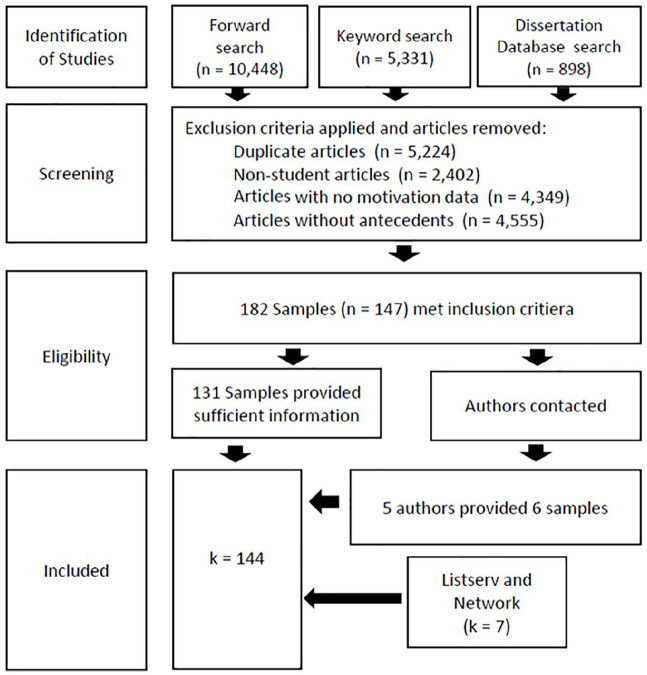
- Meta-analysis of 144 samples (98 published, 47 unpublished, as reported) with 79,079 participants, 1,718 correlation coefficients, mean age 16.55 years, and 45.46% male on average. Inclusion required students from primary school to university, at least one correlation between a motivation type and need satisfaction or autonomy support, and validated motivation scales.
- Literature search used forward citation searches, EBSCO/PsycINFO, ProQuest Dissertations and Theses Global, and mailing-list calls for unpublished data; gray literature was included. About 10% of data were double-coded (Cohen’s κ = .95).
- Analyses used random-effects models with robust variance estimation, reliability corrections, relative weight analysis, and weighted-covariance generalized least squares meta-analytic structural equation modeling with multiple imputation or pairwise deletion. Moderators included age, gender, educational context, scale used, and publication status/bias.
Limitations
- The paper states that the meta-analysis is based on correlations, limiting causal conclusions; future work should use longitudinal, experience-sampling, and quasi-experimental designs.
- The paper notes few studies on parental autonomy support and peer autonomy support, with peer autonomy support excluded from main analyses. Teacher/parent control, competence support, relatedness support, and need frustration variables were also too limited for inclusion.
- The paper reports possible publication bias, especially for teacher autonomy support: trim-and-fill and Egger’s test suggested missing studies for introjected, identified, and intrinsic motivation, with corrected estimates potentially closer to .09, .29, and .29 versus observed .17, .44, and .48. Evident from the text, many correlations showed high heterogeneity (I² often above 75%), and parental autonomy support analyses relied on small numbers of samples (e.g., k = 6 for amotivation, k = 12 for intrinsic motivation).
Model-written summary. Check it against the paper before relying on it.
Integrity signals
Registry
Cites
Statistics
Figures
Verification
Claims the paper makes
5 Valid · 1 Not valid · 23 Not checked · 86 Own results and interpretations
The cited sources support only part of this claim — read each source’s verdict below.
In the paper
“This finding also aligns with meta-analyses from other contexts which consistently find relatedness to be a positive antecedent of motivation types with smaller effect sizes compared with needs for autonomy and competence (Ng et al., 2012; Van den Broeck et al., 2016; Vasconcellos et al., 2020).”
§ Pathways to Student Motivation: A Meta-Analysis of Antecedents of Autonomous and Controlled Motivations > Discussion > The Role of Relatedness
What the sources say
- Not matchedcites Ng et al., 2012
This doesn’t read as a citation we can look up.
- Partly supportedcites Van den Broeck et al., 2016 matched to “A Review of Self-Determination Theory’s Basic Psychological Needs at Work” (2016) sourceExperimental — accuracy not yet measured
The meta-analysis reports positive associations between relatedness satisfaction and identified and intrinsic motivation (Relations Between Needs and Outcome Variables, p. 18). But the claim overstates their consistency across motivation types: external motivation is negatively associated with relatedness, and the comparison is not uniformly smaller than competence—for example, the reported intrinsic-motivation association is .39 for relatedness versus .35 for competence (p. 25). (LLM, conf=0.88)
- Not checked — no full text of the sourcecites Vasconcellos et al., 2020 matched to “Self-determination theory applied to physical education: A systematic review and meta-analysis.” (2020) source
plainstates an association- Asserted: passes — The authors put it forward as true.
- Checkable: passes — It can be checked against evidence.
- Load-bearing: unclear — It is unclear whether the paper’s conclusions depend on it.
- Based: passes — The paper gives a reason why it holds.
- Not matched
The cited sources that could be checked couldn’t confirm or dispute this claim.
In the paper
“the AMS shows eerily positive associations between external regulation and antecedents”
§ Pathways to Student Motivation: A Meta-Analysis of Antecedents of Autonomous and Controlled Motivations > Discussion > Moderating Influences
What the sources say
- Could not verifycites Howard et al., 2017 matched to “Testing a continuum structure of self-determined motivation: A meta-analysis.” (2017) sourceExperimental — accuracy not yet measured
The Results (section headed “Insert Table 2 here”; page unavailable) report an unexpectedly high correlation between identified and external regulation in AMS data, but identified regulation is not described as an antecedent. The Limitations section (page unavailable) says incorporating antecedent variables is a task for future research. A search for antecedents found no AMS-specific association between external regulation and antecedents. (LLM, conf=0.78)
plainstates an association- Asserted: passes — The authors put it forward as true.
- Checkable: passes — It can be checked against evidence.
- Load-bearing: unclear — It is unclear whether the paper’s conclusions depend on it.
- Based: passes — The paper gives a reason why it holds.
- Could not verify
The cited sources support only part of this claim — read each source’s verdict below.
In the paper
“This was also the case for need frustration variables (Vansteenkiste & Ryan, 2013).”
§ Pathways to Student Motivation: A Meta-Analysis of Antecedents of Autonomous and Controlled Motivations > Discussion > Limitations and Conclusion
What the sources say
- Partly supportedcites Vansteenkiste & Ryan, 2013 matched to “On psychological growth and vulnerability: Basic psychological need satisfaction and need frustration as a unifying principle.” (2013) sourceExperimental — accuracy not yet measured
The Ill-being section (page not supplied) says most studies assessed need satisfaction, while assessments of need frustration appeared in more recent research. This supports a comparatively smaller body of research on need frustration, but the paper does not say that this restricted the citing authors’ ability to include those variables in their analysis. (LLM, conf=0.83)
plainstates a cause- Asserted: passes — The authors put it forward as true.
- Checkable: passes — It can be checked against evidence.
- Load-bearing: passes — The paper’s conclusions depend on it.
- Based: passes — The paper gives a reason why it holds.
- Rests on an assumption not shown here.
- Partly supported
A result the paper reports from its own data — it cites no other source for it, so there is none to check. The quote shows it is in the paper.
In the paper
“First, it appeared that associations between autonomy support from parents and amotivation, identified regulation and intrinsic motivation diminished as students grew older.”
§ Pathways to Student Motivation: A Meta-Analysis of Antecedents of Autonomous and Controlled Motivations > Results
hedgedstates an association- Asserted: passes — The authors put it forward as true.
- Checkable: passes — It can be checked against evidence.
- Load-bearing: passes — The paper’s conclusions depend on it.
- Based: passes — The paper gives a reason why it holds.
A result the paper reports from its own data — it cites no other source for it, so there is none to check. The quote shows it is in the paper.
In the paper
“Regarding education context (i.e., classroom education vs. physical education), the correlations between amotivation and both autonomy and relatedness is substantially more negative in the classroom samples as compared to the physical education samples.”
§ Pathways to Student Motivation: A Meta-Analysis of Antecedents of Autonomous and Controlled Motivations > Results
plainstates an association- Asserted: passes — The authors put it forward as true.
- Checkable: passes — It can be checked against evidence.
- Load-bearing: unclear — It is unclear whether the paper’s conclusions depend on it.
- Based: passes — The paper gives a reason why it holds.
66 more claims
Create a free account to see all 115 claims and to verify the 4 references still open.
- Probably not a substantial claim. 12
- It may state two separate claims as one. 38
Claims other papers make about this one
Each is checked against this paper’s own text: does it say what the citing paper says it does?
The source backs part of the claim, not all of it — or backs it for a different population, condition or comparison.
In the citing paper
“Autonomy support and structure are both beneficial for students (Bureau et al., 2022;Hornstra et al., 2021;Howard et al., 2021;Mammadov & Schroeder, 2023) and teacher outcomes (Cheon et al., 2014;Ryan et al., 2022;Slemp et al., 2020).”
From Blending Teacher Autonomy Support and Provision of Structure in the Classroom for Optimal Motivation: A Systematic Review and Meta-Analysis (2025) · cites this paper as Bureau et al., 2022
Experimental — accuracy not yet measuredThe source backs part of the claim, not all of it — or backs it for a different population, condition or comparison.
In the citing paper
“Autonomy support and structure are both beneficial for students (Bureau et al., 2022;Hornstra et al., 2021;Howard et al., 2021;Mammadov & Schroeder, 2023) and teacher outcomes (Cheon et al., 2014;Ryan et al., 2022;Slemp et al., 2020).”
From Blending Teacher Autonomy Support and Provision of Structure in the Classroom for Optimal Motivation: A Systematic Review and Meta-Analysis (2025) · cites this paper as Bureau et al., 2022
Experimental — accuracy not yet measuredThe cited source says what the claim attributes to it.
In the citing paper
“Strong empirical evidence demonstrates the benefits of teachers' support of students' psychological needs for students' motivation (Bureau et al., 2022;Eakman et al., 2019;Filak & Sheldon, 2008;Vasconcellos et al., 2020), well-being (Ferguson et al., 2011;Stanley et al., 2021;Wang et al., 2021a, b), effort (Hardré & Sullivan, 2008;Hein et al., 2018), and engagement (Chen, 2005;Klem & Connell, 2004”
From Blending Teacher Autonomy Support and Provision of Structure in the Classroom for Optimal Motivation: A Systematic Review and Meta-Analysis (2025) · cites this paper as Bureau et al., 2022
Self-check
Percentages, sums and reported differences re-computed from the paper’s own numbers.
Each contradiction between two passages listed here was confirmed by an independent check.
Rated major: it would touch a result — a value a result rests on, reported and recomputed p-values on opposite sides of the significance level, two passages that conflict with no sign which is right, or a cited work retracted before this paper was published.
In the paper
§ Pathways to Student Motivation: A Meta-Analysis of Antecedents of Autonomous and Controlled Motivations > Results
“The need for relatedness was also found to demonstrate similar patterns (in the same ordering: ρ = −.38, −.02, .23, .53, and .58, respectively, k = 29, 45, 45, 44, 56)”
§ Pathways to Student Motivation: A Meta-Analysis of Antecedents of Autonomous and Controlled Motivations > Results
“| Amotivation | 29 | 13,885 | −.30 | −.38 | −.23 | .04 | .04 | 95.04 | | External | 45 | 20,175 | .01 | −.05 | .07 | .03 | .06 | 96.29 | | Introjected | 45 | 20,175 | .21 | .15 | .26 | .03 | .04 | 94.37 | | Identified | 44 | 20,338 | .44 | .39 | .49 | .02 | .02 | 91.73 | | Intrinsic | 56 | 27,209 | .44 | .39 | .48 | .02 | .03 | 93.15 |”
Rated minor: it would not touch a result — a value no result rests on, a p-value that stays on the same side of the significance level, or a conflict that is clerical, resolved elsewhere in the paper, or outside its own findings.
In the paper
§ Pathways to Student Motivation: A Meta-Analysis of Antecedents of Autonomous and Controlled Motivations > Results
“amotivation (β = −.12 to −.18; βindirect = −.10 to .14)”
§ Pathways to Student Motivation: A Meta-Analysis of Antecedents of Autonomous and Controlled Motivations > Results
“| 2 MI—No parent AS | Amotivation | .16 | −.18 (−.14) | — | .01 | −.23 | −.08 |”
Rated minor: it would not touch a result — a value no result rests on, a p-value that stays on the same side of the significance level, or a conflict that is clerical, resolved elsewhere in the paper, or outside its own findings.
In the paper
§ Pathways to Student Motivation: A Meta-Analysis of Antecedents of Autonomous and Controlled Motivations > Results
“Furthermore, correlations between autonomy and motivation types were all significantly different from each other as indicated by non-overlapping confidence intervals (Cumming & Finch, 2005).”
§ Pathways to Student Motivation: A Meta-Analysis of Antecedents of Autonomous and Controlled Motivations > Results
“| Identified | 42 | 18,395 | .48 | .41 | .56 | .04 | .04 | 94.50 | | Intrinsic | 52 | 23,759 | .57 | .50 | .63 | .03 | .04 | 94.88 |”
Rated minor: it would not touch a result — a value no result rests on, a p-value that stays on the same side of the significance level, or a conflict that is clerical, resolved elsewhere in the paper, or outside its own findings.
In the paper
§ Pathways to Student Motivation: A Meta-Analysis of Antecedents of Autonomous and Controlled Motivations > Results
“Confidence intervals of associations between competence and the various motivation types did not overlap, indicating significant differences throughout.”
§ Pathways to Student Motivation: A Meta-Analysis of Antecedents of Autonomous and Controlled Motivations > Results
“| Identified | 57 | 34,705 | .53 | .47 | .58 | .03 | .03 | 94.61 | | Intrinsic | 69 | 40,789 | .58 | .53 | .63 | .02 | .03 | 94.05 |”
Citations
Cites
Measuring inconsistency in meta-analyses
Higgins, J. P. T., Thompson, S. G., Deeks, J. J., & Altman, D. G. (2003) · BMJ · doi:10.1136/bmj.327.7414.557 · Cited by 63,139 · cited 3×
“An I2 score greater than 75% indicates a high likelihood of unaccounted moderating factors, whereas a score lower than 25% indicates a relatively low likelihood of meaningful moderating factors (Higgins et al., 2003).”
BackgroundInfluentialBias in meta-analysis detected by a simple, graphical test
Egger, M., Smith, G. D., Schneider, M., & Minder, C. (1997) · BMJ · doi:10.1136/bmj.315.7109.629 · Cited by 56,722 · cited 1×
“Egger’s test of the intercept was also applied (Egger et al., 1997).”
MethodRyan, R. M., & Deci, E. L. (2000) · American Psychologist · doi:10.1037//0003-066x.55.1.68 · Cited by 54,599 · cited 1×
“The specified needs are those of autonomy, competence, and relatedness (Ryan & Deci, 2000).”
BackgroundThe need to belong: Desire for interpersonal attachments as a fundamental human motivation.
Baumeister, R. F., & Leary, M. R. (1995) · Psychological Bulletin · doi:10.1037//0033-2909.117.3.497 · Cited by 23,245 · cited 1×
“Students experiencing relatedness feel connected with important others in their school (e.g., teachers, friends; Baumeister & Leary, 1995; Chen et al., 2015).”
BackgroundInterrater reliability: The kappa statistic
McHugh, M. L. (2012) · Biochemia Medica · doi:10.11613/bm.2012.031 · Cited by 19,877 · cited 1×
“Interrater agreement was very high (Cohen’s κ = .95; McHugh, 2012), and disagreements were discussed by the second and third authors.”
BackgroundBorenstein, M., Hedges, L. V., Higgins, J. P. T., & Rothstein, H. R. (2009) · doi:10.1002/9780470743386 · Cited by 14,225
mice: Multivariate Imputation by Chained Equations in R
Buuren, S. V., & Groothuis-Oudshoorn, K. (2011) · Journal of Statistical Software · doi:10.18637/jss.v045.i03 · Cited by 13,870
Hattie, J., & Timperley, H. (2007) · Review of Educational Research · doi:10.3102/003465430298487 · Cited by 12,905
(2008) · Cited by 6,939
Research works printed but not linked: 1
- Vallerand R. J. Ratelle C. (2002). Intrinsic and extrinsic motivation: A hierarchical model. In Deci E. L. Ryan R. M. (Eds.), Handbook of self-determination research (pp. 37– 63). University of Rochester Press.
Cited by
Items 301–397 of 397
Chavez, O. J. F., & Palaoag, T. D. (2026) · Artificial Intelligence in Education · doi:10.1108/aiie-06-2025-0131 · Cited by 2
Thiel, J. C., Grünert, A., & Neubauer, A. B. (2026) · SSRN Electronic Journal · doi:10.2139/ssrn.6442492
Johansen, M. O., Jeno, L. M., & Cotner, S. H. (2026) · Cogent Education · doi:10.1080/2331186x.2026.2644704
Jiang, J., Lu, H., Yao, G., Yang, Y., Xie, K., & Yang, Y. (2026) · BMC Psychology · doi:10.1186/s40359-026-04414-8 · Cited by 1
“While meta-analyses like those of [71] and [72] help to clarify these relationships, comprehensive empirical studies to validate such analyses are still urgently needed.”
Current issues of physical culture and sport in work with learners
Tymchyk, M. V., Masol, V., & Kasich, N. (2026) · Scientific Journal of National Pedagogical Dragomanov University Series 15 Scientific and pedagogical problems of physical culture (physical culture and sports) · doi:10.31392/udu-nc.series15.2026.03k(203).71
Shomotova, A. (2026) · Advances in computational intelligence and robotics book series · doi:10.4018/979-8-3373-4222-1.ch004 · Cited by 1
Bloem, J., Boer, I., Stroet, K., & Hornstra, L. (2026) · School Effectiveness and School Improvement · doi:10.1080/09243453.2026.2643232 · Cited by 2
Pansu, P., Núñez‐Regueiro, F., de Place, A., Bouffard, T., Bressoux, P., Mella, N., & Desrichard, O. (2026) · Emerald Group Publishing Limited eBooks · doi:10.1108/s0749-742320260000023007 · Cited by 1
Navigating the New Normal: The Effects of the COVID-19 Pandemic on Educators
Perry, A. H., Anderman, E. M., & Lee, Y. J. (2026) · Emerald Group Publishing Limited eBooks · doi:10.1108/s0749-742320260000023009
Global Crises and Distance Learning Through a Self-Determination Theory Lens
Lüftenegger, M., Daumiller, M., & Janke, S. (2026) · Emerald Group Publishing Limited eBooks · doi:10.1108/s0749-742320260000023001
Beyond averages: Situational lesson to lesson level interplay between relatedness and competence
Koivuhovi, S., Malmberg, L., Rawlings, A. M., Salonen, V., & Hotulainen, R. (2026) · Learning and Individual Differences · doi:10.1016/j.lindif.2026.102911 · Cited by 1
Salinas, L. E. C., Ballesteros, M. A. A., Lezama, M. T. F., & León, M. Y. O. (2026) · Societies · doi:10.3390/soc16040123
Duchesne, S., Châteauvert, G. B., Ratelle, C. F., & Gouin, J.-A. (2026) · Learning and Individual Differences · doi:10.1016/j.lindif.2026.102915
Fan, L., & Xu, R. (2026) · Smart innovation, systems and technologies · doi:10.1007/978-3-032-09601-2_23
Participatory learning environments : student and teacher perspectives on classroom decision-making
Kärner, T., Jüttler, M., Bottling, M., et al. (2026) · Zürcher Hochschule für Angewandte Wissenschaften digital collection (Zurich University of Applied Sciences) · doi:10.21256/zhaw-36328
Pösse, L., Rakoczy, K., Tallon, M., Weiß-Wittstadt, S., & Wagner, E. (2026) · SSRN Electronic Journal · doi:10.2139/ssrn.6478161
Wang, X., Li, X., Zhang, J., Bao, S., Bian, M., Sun, J., Cai, W., Xiao, Y., & An, H. (2026) · BMC Medical Education · doi:10.1186/s12909-026-09145-3 · Cited by 2
“…be directly captured by the entropy weight method, aligning with the entropy calculation principles for ordered data proposed by Tastle and Wierman [31]; the other hand, retaining the ordered nature of the Likert scale for entropy weight calculation enables more precise alignment with the relative…”
Kang, M., Bedard, A., Pyle, A., Guay, F., Martinussen, R., & Plamondon, A. (2026) · Journal of Attention Disorders · doi:10.1177/10870547261427102 · Cited by 1
Self-citationXu, C., Niu, G., & Sun, X. (2026) · Research Square · doi:10.21203/rs.3.rs-9257273/v1
Satisfaction with teachers’ attitude as a predictor of academic motivation in adolescents
Lanshchikov, D. N. (2026) · Pedagogy Theory & Practice · doi:10.30853/ped20260085
Avcı, S., Özgenel, M., Avcu, A., & Yapıcı, S. (2026) · Educational Studies · doi:10.1080/03055698.2026.2660683 · Cited by 1
Surmiyanti, Asfali, I., Zuhriyah, F., Fikri, A. H., Sumaryati, & Aziz, S. F. A. (2026) · JURNAL IQRA · doi:10.25217/ji.v11i1.7294 · Cited by 5
“Strengthening school communication with parents and promoting reading habits at home maintains continuity of practice and increases students’ readiness to receive corrections (Bureau et al., 2022; Sujarwo et al., 2022; Tanjung et al., 2022).”
InfluentialPrompt engineering in education: A systematic review of theory, applications, and future directions
Anowar, S., & Khatun, R. (2026) · Journal of Education Society & Sustainable Practice · doi:10.63697/jessp.2026.10093 · Cited by 6
“These findings are consistent with broader motivational meta-analyses demonstrating that perceived competence significantly predicts autonomous engagement with learning technologies (Bureau et al., 2022; Li et al., 2025).”
Zhang, Y., & Khairani, A. Z. (2026) · International Conference on Informatics Education and Computer Technology Applications (IECA) · doi:10.1145/3802133.3802165
“For instance, recent meta-analyses have examined the antecedents of autonomous motivation [6].”
Yermakova, T., Vypasniak, I., Zakharkevych, T., & Jagiełło, M. (2026) · Pedagogy of Health · doi:10.15561/health.2026.0203
215From Learned Helplessness to Authentic Dialogue: Rethinking AI, Consciousness, and Education
Lazic, M., Jun, J., & Woodruff, E. (2025) · De Gruyter eBooks · doi:10.1515/9783112206393-010
Zhao, J., & Liu, Q. (2026) · Frontiers in Psychology · doi:10.3389/fpsyg.2026.1836705
Развитие самодетерминации студентов посредством построения концептуальных карт: теоретический обзор
Матвеева, С. А. (2026) · Вестник педагогических наук. · doi:10.62257/2687-1661-2026-3-87-94
Cai, L., & Wu, H. (2026) · Frontiers in Psychology · doi:10.3389/fpsyg.2026.1858248
Li, Q. (2026) · The Asia-Pacific Education Researcher · doi:10.1007/s40299-026-01119-9 · Cited by 1
Gamificación y motivación académica en estudiantes de educación secundaria
Jimenez-Villares, A. M., García-Burgos, E. B., Chávez-Cabrera, F. C., Arreaga-Anzules, O. B., & Ibarra-Álvarez, J. V. (2026) · Revista Científica Ciencia y Método · doi:10.55813/gaea/rcym/v4/n2/208 · Cited by 2
Applying self-determination theory to workers’ motivation for self-directed learning
Hein, V., & Urban, K. (2026) · Journal of Workplace Learning · doi:10.1108/jwl-08-2025-0273 · Cited by 1
Exploring how executive function and motivation shape deep and surface learning
Pretorius, L., & Heyns, M. M. (2026) · Quarterly review of distance education · doi:10.1108/qrde-02-2026-0006
How teaching shapes motivations to learn across middle school subjects
Fryer, L. K., & Oga-Baldwin, W. L. Q. (2026) · Learning and Instruction · doi:10.1016/j.learninstruc.2026.102378
Gao, H., Cao, D., Ren, Y., Shi, H., Liang, Y., & Liu, Y. (2026) · Frontiers in Psychology · doi:10.3389/fpsyg.2026.1828839 · Cited by 1
“…evidence and systematic reviews have consistently documented positive associations between AST and learning motivation, classroom engagement, emotional experiences, psychological need satisfaction, and learning outcomes (Bureau et al., 2022; Reeve and Cheon, 2024; Patzak and Zhang, 2025).”
Bernholt, S., Lossjew, J., & Gombert, S. (2026) · Unterrichtswissenschaft · doi:10.1007/s42010-026-00244-0
“This could support learning in the zone of proximal development according to Vygotskij (1981), which—in turn—could promote the experience of competence and motivation to learn, as well as positive performance development (Bureau et al. 2022; Linnenbrink-Garcia et al. 2016).”
Krogh‐Jensen, O., Damsgaard, L., Rohde, R. A., Nielsen, G., Fosnaes, O., Hauge, J., & Wienecke, J. (2026) · Educational Psychology Review · doi:10.1007/s10648-026-10175-y
“According to Self-Determination-Theory based research increased experiences of autonomy and competence leads to higher intrinsic motivation and better school performance (Bureau et al., 2022; Ryan & Deci, 2020).”
Larsen, S. R., Mikkelsen, S., Müllertz, A. L. O., Aaskilde-Schneider, J., Nielsen, G., Mygind, L., Bentsen, P., Aadahl, M., Elsborg, P., & Bølling, M. (2026) · Social Sciences & Humanities Open · doi:10.1016/j.ssaho.2026.103028
Wang, C., Meng, N., Han, P., & Liu, C. (2026) · Acta Psychologica · doi:10.1016/j.actpsy.2026.107176
Ngu, P. N. H., Ha, P. N. T., Minh, N. T. H., Nguyen, T. P. T., & Phuong, T. T. T. (2026) · Asian Education and Development Studies · doi:10.1108/aeds-11-2025-0590 · Cited by 1
Association between school garden participation and pupils' school motivation
Stage, A., Bølling, M., Vermund, M. C., Otte, C. R., Bentsen, P., Elsborg, P., & Nielsen, G. (2026) · Scandinavian Journal of Educational Research · doi:10.1080/00313831.2026.2685706
Huang, T., & Tseng, H.-P. (2026) · European Journal of Education · doi:10.1111/ejed.70741
Anonymous, & Bentley, I. (2026) · Physical Review Physics Education Research · doi:10.1103/bdl1-6bn4 · Cited by 1
Bravo, G. (2026) · Teaching Mathematics and its Applications An International Journal of the IMA · doi:10.1093/teamat/hrag014
Collins, F., Moya, E., Rojas, M., Zuniga‐Hernandez, M., Arshad, F., Feng, R., Wang, E., Rodríguez, S., Jackson, C., & Caruso, T. J. (2026) · Clinical Pediatrics · doi:10.1177/00099228261460362
“14,27,28 In school-aged children, higher intrinsic motivation leads to stronger academic performance, greater classroom engagement, and improved self-regulation.”
Zou, Y. (2026) · SSRN Electronic Journal · doi:10.2139/ssrn.7076240
Sugiyem, S., Salmaa, & Halimah, E. (2026) · Jurnal Pedagogi dan Pembelajaran · doi:10.23887/jp2.v9i1.111083
Benjamin, L. S., Shanmugam, S. R., Dominguez, A. J., Alqarni, A. S., Mohammed, I. A. S., Ahmed, K. E., Mohsen, M. M., Zaki, R. A., & Krishnasamy, T. (2026) · BMC Nursing · doi:10.1186/s12912-026-05027-7
“…that deep encoding and spaced repetition consistently produce better long-term retention than rote rehearsal, the continued use of rote rehearsal in many settings demonstrates the necessity to develop context-specific pedagogical interventions designed to encourage meaningful learning [44, 45].”
Ferrer, M., Calvo, E., Garcia, V., & Ojeda, M. (2026) · Social Sciences & Humanities Open · doi:10.1016/j.ssaho.2026.103272
王詩涵, & Tang, L. (2026) · Frontiers in Psychology · doi:10.3389/fpsyg.2026.1872072 · Cited by 1
“Research has shown that more autonomous forms of motivation, particularly intrinsic motivation and identified regulation, are closely associated with higher levels of engagement, academic achievement, and positive learning experiences (Bureau et al., 2022).”
InfluentialBou, D., Hum, C., Soeung, S., & Sam, R. (2026) · Advances in computational intelligence and robotics book series · doi:10.4018/979-8-2600-3204-6.ch008
Compulsory Schooling as a Form of Captivity: A Polemic
Soling, C., & Burrows, K. (2026) · Educational Studies · doi:10.1080/00131946.2026.2705271
Happy, N., Zuhri, Z., & Saputra, H. (2026) · Integrated Science Education Journal · doi:10.37251/isej.v7i4.3583
Rêgo, R., Aires, A. P., Silva, R., & Bessa, M. (2026) · Education Sciences · doi:10.3390/educsci16081203
AI and student motivation: A scoping review
Li, J., King, R. B., Chai, C. S., Lee, V. W. Y., & Li, R. (2026) · Journal of Research on Technology in Education · doi:10.1080/15391523.2026.2672515 · Cited by 1
Multidimensional profiles of adolescent functioning: academic, emotional, and relational patterns
Aziku, M., Huang, X., & Djekourmane, D. (2026) · Frontiers in Psychology · doi:10.3389/fpsyg.2026.1907030 · Cited by 1
“…or being supported by their teachers, the higher their 10.3389/fpsyg.2026.1907030 likelihood of active academic engagement, motivation, persistence, and general educational adjustment (Ahn et al., 2021; Allen et al., 2021; Berger et al., 2021; Bureau et al., 2022; Montecillo et al., 2024).”
InfluentialBorongan, M. P., Acain, E., Villadores, S., Sacnan, M., & Malbas, W. (2026) · Journal of interdisciplinary perspectives · doi:10.69569/jip.2026.261
Pasturan, R. (2026) · Psychology and Education A Multidisciplinary Journal · doi:10.70838/pemj.600808
Do fathers’ and mothers’ parenting styles influence students’ emotional engagement in the same way?
Sánchez, J. A. A., Alonso, J. L. N., & Santana‐Monagas, E. (2026) · Anales de Psicología · doi:10.6018/analesps.659671
“In line with prior studies (e.g., Froiland & Worrell, 2017; Bureau et al., 2022), the present results reinforce the idea that psychological need satisfaction operates as a key explanatory mechanism linking contextual factors, such as parenting, to students’ motivation and engagement.”
Student-Centered Learning and Teaching (SCLT)
Alkandari, K. (2026) · Education and human development · doi:10.5772/intechopen.1014999
Thongpanit, P., Thongpanit, P., & Onkhum, P. (2026) · Eurasia Journal of Mathematics Science and Technology Education · doi:10.29333/ejmste/19139
“Howard et al. (2021) confirmed that satisfying these needs is the strongest predictor of deep learning, and the satisfaction of these needs predicts autonomous motivation (Bureau et al., 2022).”
Narong, D. K., & Hallinger, P. (2026) · European Journal of Engineering Education · doi:10.1080/03043797.2026.2708786
Guay, F., Gilbert, W., & Bureau, J. S. (2026) · Emerald Group Publishing Limited eBooks · doi:10.1108/978-1-80686-869-820261011 · Cited by 1
Self-citationMoè, A. (2026) · The Journal of Educational Research · doi:10.1080/00220671.2026.2714355
Cabezas, A. V. V., Andrade, D. M. C., Sanunga, H. G. P., et al. (2026) · Perspectivas Sociales y Administrativas. · doi:10.61347/psa.v4i2.172
IUSE: Merging Self-Paced Instruction with Real-Time Feedback for Enhanced Learning Engagement
Brown, J. D., & Reed, K. B. (2026) · ASEE Annual Conference & Exposition · doi:10.18260/1-2--59861
Liang, H. (2026) · SHS Web of Conferences · doi:10.1051/shsconf/202623601007
“The second one is authority based on respect, emotional support, and the opportunity to empower students’ autonomy and creativity [3, 4].”
InfluentialTeacher homework involvement and student learning outcomes: A three-level meta-analysis
Xu, J., Guo, S., Fan, H., & Sheng, J. (2026) · Educational Research Review · doi:10.1016/j.edurev.2026.100837
Lingua as an Asynchronous Learning Catalyst for EFL Reading Comprehension
Susanto, S., & Nanda, D. S. (2026) · Revista Electrónica de Investigación Educativa · doi:10.24320/redie.2026.28.e09.6958
Wang, C., & Zhao, Z. (2026) · European Journal of Education · doi:10.1111/ejed.70843
Ruan, X., Liu, Y., Zhang, W., Wang, J., Ye, L., Lin, Y., Song, X., Su, H., & Wang, X. (2026) · BMC Medical Education · doi:10.1186/s12909-026-10252-4
“Self-determination theory illustrates that intrinsic motivation is commonly correlated with sustained learning engagement [43].”
Flamant, N., Vansteenkiste, M., Haerens, L. L., Vrijders, B., Prinzie, P., & Soenens, B. (2026) · Motivation and Emotion · doi:10.1007/s11031-026-10277-8
Wang, K., & Mauhay, R. C. A. (2026) · International Journal of Research Studies in Management · doi:10.5861/ijrsm.2026.26112
Shi, J., Xi, M., Li, X., & Li, J. (2026) · Personnel Review · doi:10.1108/pr-05-2025-0486
Zou, Y. (2026) · SSRN Electronic Journal · doi:10.2139/ssrn.7387966
Dıaconıța, V., & Dinca, L.-G. (2026) · Service Business · doi:10.1007/s11628-026-00618-5
Cubillos, M., Zegers, M., & Siebert, J. M. (2026) · Journal of Research in Reading · doi:10.1111/1467-9817.70036 · Cited by 1
Zhang, Y., Shi, Y., & Lu, J. (2026) · Frontiers in Psychology · doi:10.3389/fpsyg.2026.1918525
“…and amotivation are differentially associated with academic performance, persistence, well-being and academic adjustment, and that the quality of motivation explains differences in learning outcomes more effectively than motivation intensity alone (Bureau et al., 2022; Howard et al., 2021).”
Chu, S., Lee, G., Yu, J., & Joo, W. (2026) · Frontiers in Psychology · doi:10.3389/fpsyg.2026.1868378
“By contrast, ego-involving peer climates are more self-centered and emphasize competition and social comparison, which are more likely to activate controlling regulatory mechanisms rather than directly undermine autonomous motivation (Bureau et al., 2022).”
Li, K., Abdullah, N. S. M., & Goh, P. S. C. (2026) · International Conference on Artificial Intelligence, Virtual Reality and Interaction Design · doi:10.1145/3820915.3821152
“…research has largely focused on the impact of basic psychological needs on the overall level of learning burnout, neglecting the differentiated mechanisms of the three sub-dimensions of emotional exhaustion, depersonalization, and reduced sense of accomplishment (Bureau et al., 2022) [ 3 ] .”
Yin, H., Hou, Y., Marshall-Smith, E., Remedios, R., & Holliman, A. J. (2026) · European Journal of Psychology of Education · doi:10.1007/s10212-026-01182-2
“A meta-analysis of 144 studies involving over 79,000 students also reported that parental autonomy support predicted students’ basic psychological need satisfaction, which in turn fostered self-determined motivation (Bureau et al., 2022).”
Dewi, F. I. R., Hutapea, B., Ernawati, E., Mulyawan, B., & Firmansyah, Y. (2026) · International Journal of Adolescence and Youth · doi:10.1080/02673843.2026.2727980
FinAIPhys: A Data Collection Platform for Future AI-Based Adaptive Learning in Mechanics
Burkovics, M., Kosztyó, P., Németh, T. Z., & Jenei, P. (2026) · Journal of Physics Conference Series · doi:10.1088/1742-6596/3280/1/012035
Buju, S. (2026) · Research and Education · doi:10.63467/red.14.2026.art3
Миколаївна, М. А. (2026) · Academic Visions · doi:10.66556/2786-586x.57.moskalenko-a
Campillay, M. D., & Fuentes, H. (2026) · Frontiers in Psychology · doi:10.3389/fpsyg.2026.1825932
“…to SDT. Meta-analytic evidence indicates that psychological need satisfaction and autonomy support from teachers and parents are associated with more self-determined forms of student motivation, with teacher autonomy support showing stronger associations than parental support (Bureau et al., 2022).”
Zhou, R., Ladin, C. A., & Razali, A. B. (2026) · Frontiers in Psychology · doi:10.3389/fpsyg.2026.1940043
“Students with a stronger sense of competence are more likely to engage in activities voluntarily and persistently (Singh and Aziz, 2025), and competence is closely associated with intrinsic motivation (Bureau et al., 2022).”
Harjana, S., Salahudin, Sholihin, Furkan, & Ardiansyah, A. (2026) · COMPETITOR Jurnal Pendidikan Kepelatihan Olahraga · doi:10.67322/cpjok.v18i3.1042
“Satisfaction of these psychological needs has consistently been associated with autonomous motivation and positive engagement in physical education (Vasconcellos et al., 2020; White et al., 2021; Bureau et al., 2022; Prado-Botana et al., 2023).”
Özbilen, F. M., & Aytaç, A. (2026) · Behavioral Sciences · doi:10.3390/bs16091707
“Autonomous forms of motivation are fostered when the basic psychological needs for autonomy, competence, and relatedness are satisfied and are related to adaptive learning, well-being, and academic persistence (Bureau et al., 2022; Niemiec & Ryan, 2009).”
Eviana, N., Yusrini, L., & Maeenuddin, M. (2026) · IJORER International Journal of Recent Educational Research · doi:10.46245/ijorer.v7i5.1495
“Students with strong motivation tend to participate more actively, persist when facing challenges, and achieve better academic outcomes (Bureau et al., 2022).”
Chen, Y., Zhang, S., Liu, X., Li, L., Si, M., & Xu, C. (2026) · Behavioral Sciences · doi:10.3390/bs16101715
Osman, A., Azhar, A. M., Rahman, N. S. A., & Mizher, H. A. A. (2026) · Currents in Pharmacy Teaching and Learning · doi:10.1016/j.cptl.2026.102795
Nguyen, P.-L., Hoang, T.-H. T., Cao, P.-T., Nguyen, H. D., Ingram, G., Rodam, B.-N. T., & Thi, L.-H. (2026) · Health Psychology Report · doi:10.5114/hpr/226272
From group climate to flow in ultimate frisbee: An indirect pathway through autonomous motivation
Li, P.-A., Lian, X.-L., Zhu, W.-H., Lin, Y.-H., Tai, W.-H., & Fang, B.-B. (2026) · Acta Psychologica · doi:10.1016/j.actpsy.2026.107928
André, A., Nicaud, C., & Tessier, D. P. (2026) · La nouvelle revue - Éducation et société inclusives · doi:10.3917/nresi.105.0185
Ce que les élèves disent de leurs besoins en classe : écarts entre élèves et personnel enseignant
Domine, S., Paré, M., & Vita, L. D. (2026) · La nouvelle revue - Éducation et société inclusives · doi:10.3917/nresi.105.0071
Metadata
- Authors
- Bureau, J. S., Howard, J. L., Chong, J. X. Y., & Guay, F.
- Affiliations
- Université Laval (CA)
- Monash University (AU)
- Curtin University (AU)
- Corresponding author
- Bureau, Julien S.
- Venue
- Review of Educational Research
- Published
- 2021-09-11
- Volume
- 92
- Issue
- 1
- Pages
- 46-72
- ISSN
- 0034-6543 (ISSN-L)
- 1935-1046
- PMC
- PMC8935530
- OpenAlex
- W3201580913
- Cited by
- 414
- References
- 80
- Citations by year
- 2026: 162 · 2025: 103 · 2024: 70 · 2023: 47 · 2022: 31 · 2021: 1
- FWCI
- 5.84
- Type
- journal article
- Language
- en
- Open access
- hybrid
- doi.org
- Licence
- Locations
- Review of Educational Research (publishedVersion, cc-by-nc)
- PubMed Central (publishedVersion, cc-by)
- PubMed (publishedVersion)
- Monash University Research Portal (Monash University) (submittedVersion, cc-by-nc)
- Funders
- Social Sciences and Humanities Research Council of Canada
- Fonds de Recherche du Québec-Société et Culture
- Topics
- Social Sciences › Psychology › Social Psychology › Motivation and Self-Concept in Sports
- Social Sciences › Psychology › Developmental and Educational Psychology › Education, Achievement, and Giftedness
- Social Sciences › Psychology › Developmental and Educational Psychology › Innovative Teaching and Learning Methods
- Keywords
- autonomous motivation, controlled motivation, self-determination theory, psychological need satisfaction, autonomy, competence, relatedness, teacher autonomy support, parental autonomy support, student motivation
About these checks
Registry, retraction, Cites and statistics results are computed, not judged, with one exception: a printed reference that no index lists is read once by a model before it counts as a citation error. Claims are extracted by a model and kept only when their quote appears verbatim in the text; each cited source is then checked, with a model’s help, for whether it says what the claim relies on. Those verdicts can be wrong — read the claim’s quote and the cited source before relying on one.
The claim verdicts this report counts are experimental: their accuracy is not yet measured.
A language model drew the claims from the paper on 2026-10-07, under version 3 of the claim definition (model deepseek-v4.1-flash, prompt extract-v3).
A second model labelled each claim on 2026-10-07 (model jev-1.13-20260917, definition revision gold-guideline-v0.2).
Cited sources are checked with a language model’s help (gpt-6-sol).
Statistics and arithmetic are recomputed, not judged.
Confidence bands are shown only for fields calibrated on our annotated test set. None is calibrated yet, so no band is shown.
What counts as a claim ›How we measure confidence ›How we check this ›
Are you an author, or do you see a problem with this page? Request a review
Data sources
Bibliographic data: Semantic Scholar, OpenAlex, Crossref.
Contains information from the Semantic Scholar Academic Graph Datasets, made available under the ODC Attribution License (ODC-BY 1.0).
Semantic Scholar’s data is described in: Kinney, R., et al. (2023). The Semantic Scholar Open Data Platform. arXiv:2301.10140.
