

The DOI matches its Crossref record; 74 of the 74 references it cites were found in a registry or an index; 65 of the 113 sources its claims cite were checked for support.
Epigenetics and depression
Open accessAbstract
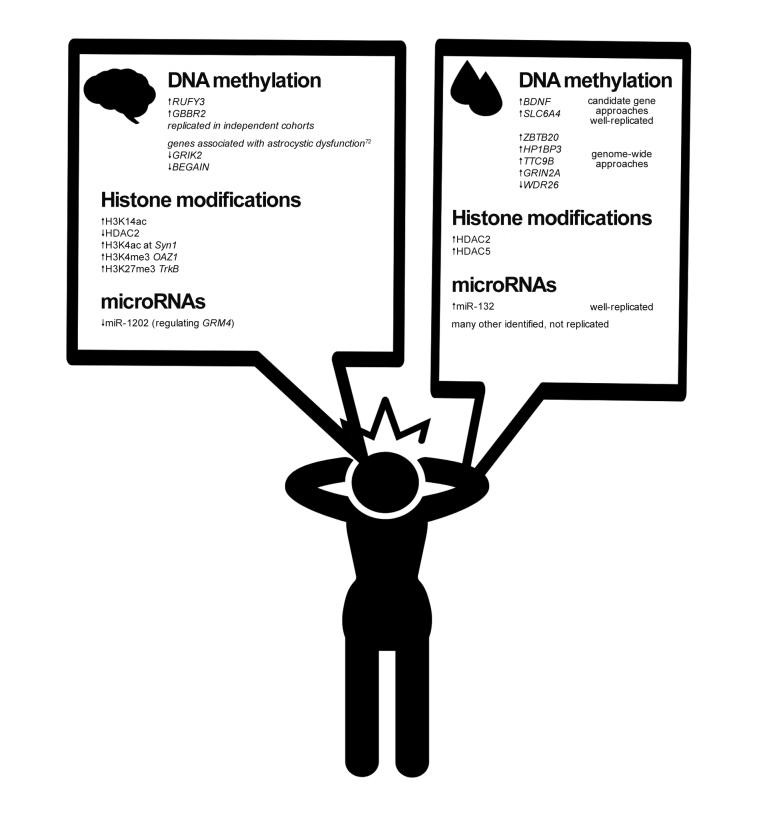
The risk for major depression is both genetically and environmentally determined. It has been proposed that epigenetic mechanisms could mediate the lasting increases in depression risk following exposure to adverse life events and provide a mechanistic framework within which genetic and environmental factors can be integrated. Epigenetics refers to processes affecting gene expression and translation that do not involve changes in the DNA sequence and include DNA methylation (DNAm) and microRNAs (miRNAs) as well as histone modifications. Here we review evidence for a role of epigenetics in the pathogenesis of depression from studies investigating DNAm, miRNAs, and histone modifications using different tissues and various experimental designs. From these studies, a model emerges where underlying genetic and environmental risk factors, and interactions between the two, could drive aberrant epigenetic mechanisms targeting stress response pathways, neuronal plasticity, and other behaviorally relevant pathways that have been implicated in major depression. .
Overview
CoChat Summary
TL;DR
This review synthesizes evidence that epigenetic mechanisms—DNA methylation, miRNAs, and histone modifications—may link genetic and environmental risk factors to major depressive disorder. It proposes that risk factors and their interactions drive aberrant epigenetic regulation of stress-response, neuronal plasticity, and other behaviorally relevant pathways.
Key findings
- Genetic risk for MDD is substantial but incomplete: first-degree relatives have an odds ratio of 2.84 (95% CI = 2.31–3.49), Swedish twin heritability is approximately 37%, and a GWAS meta-analysis of 807,553 individuals identified 102 loci.
- Environmental risk is also strong: a meta-analysis of 26 studies found childhood neglect associated with adult depression at OR 2.78 and emotional abuse at OR 2.75.
- DNA methylation findings are mixed: a systematic review of 67 publications (61 in peripheral tissue) found selected loci differences, most consistently hypermethylation in BDNF and SLC6A4, but no consistent genome-wide changes; a methylome-wide study found overlap between top MDD-associated DMRs in blood and Brodmann area 10 (P = 5.4×10⁻³), with three loci replicated across blood, BA10, and BA25.
- miRNA and histone findings remain less consistent: a review of 23 studies found 178 altered miRNAs in MDD cases versus controls, with only miRNA-132 replicated in four independent studies; miR-1202 was downregulated in PFC of MDD patients who died by suicide and increased in periphery after 8 weeks of antidepressant treatment.
Methods
- Narrative review of studies investigating DNA methylation, miRNAs, and histone modifications in MDD, using different tissues and experimental designs.
- Evidence includes human peripheral and postmortem brain case-control studies, animal stress models, human hippocampal progenitor cell models, and gene-by-environment/mQTL analyses.
- No new primary data or meta-analysis are reported; the paper synthesizes prior findings and proposes a mechanistic model.
Limitations
- Stated by the authors: most studies focus on DNAm, with fewer on histone modifications and long noncoding RNAs; most use peripheral tissue; postmortem brain studies are generally limited by smaller cohort sizes and tissue homogenates; validation across cohorts is difficult due to the polygenic architecture of depression, symptom-based diagnoses, and retrospective recall of environmental exposures.
- Stated by the authors: cross-tissue relevance of epigenetic findings remains unclear and is likely modification- and region-specific.
- Evident from the text: this is a narrative review rather than a systematic review or meta-analysis, so the strength of the summarized evidence is not quantitatively pooled.
Model-written summary. Check it against the paper before relying on it.
Integrity signals
Registry
Cites
Statistics
Figures
Verification
Claims the paper makes
53 Valid · 4 Not valid · 38 Not checked · 25 Own results and interpretations
At least one cited source doesn’t support this claim or points to a different paper, and none confirmed it — see the verdicts below.
In the paper
“Overall, there is very limited evidence for altered DNAm in peripheral blood in patients with MDD.”
§ Epigenetics and depression > DNAm in peripheral tissue
What the sources say
- Disputedcites [13] Li M, 2019, Transl Psychiatry sourceExperimental — accuracy not yet measured
The Results (Etiological studies: candidate-gene; page unavailable) say most studies associated BDNF and SLC6A4 hypermethylation with MDD or depression. The review also lists significant findings from whole-blood and peripheral-blood studies, so its account is contrary to the claim that evidence of altered methylation in peripheral blood is very limited, although it notes mixed findings for other genes. (LLM, conf=0.82)
Checked by a reasoning model — may be wrong.
plain- Asserted: passes — The authors put it forward as true.
- Checkable: passes — It can be checked against evidence.
- Load-bearing: passes — The paper’s conclusions depend on it.
- Based: passes — The paper gives a reason why it holds.
- Disputed
Every source the paper cites for this claim was checked and supports it.
In the paper
“a recent study performed genome-wide methylation assays on blood, brain, saliva, and buccal samples and found that cross-tissue correlation strength was highly region-specific, with the correlation coefficient varying widely for different CpGs.”
§ Epigenetics and depression > Challenges and solutions for overcoming cell-type specificity in epigenetic research in depression
What the sources say
- Supportedcites [33] Braun PR, 2019, Transl Psychiatry source
The Results sections “Impact of genomic and functional regions” and “Within-subject correlations at each CpG” report different cross-tissue correlations by genomic context and across individual CpGs. The paper also describes genome-wide comparisons of brain with blood, buccal tissue, and saliva. (LLM, conf=0.92)
plainstates an association- Asserted: passes — The authors put it forward as true.
- Checkable: passes — It can be checked against evidence.
- Load-bearing: passes — The paper’s conclusions depend on it.
- Based: passes — The paper gives a reason why it holds.
- Supported
Every source the paper cites for this claim was checked and supports it.
In the paper
“Studies from animal models demonstrate that stress, usually psychological stress via chronic social defeat paradigms, can induce changes in epigenetic marks.”
§ Epigenetics and depression > Drivers of aberrant epigenetic processes— environmental mechanisms
What the sources say
- Supportedcites [50] O’Toole N, 2019, bioRxiv source
The Introduction describes chronic social defeat stress as an animal model and identifies DNA methylation as the epigenetic mark studied. The Discussion reports widespread methylation differences between stress-susceptible mice and non-stressed controls, supporting the claim that this form of stress can change epigenetic marks. (LLM, conf=0.90)
boostedstates a cause- Asserted: passes — The authors put it forward as true.
- Checkable: passes — It can be checked against evidence.
- Load-bearing: passes — The paper’s conclusions depend on it.
- Based: passes — The paper gives a reason why it holds.
- Supported
Every source the paper cites for this claim was checked and supports it.
In the paper
“Correspondingly, mRNA levels of GRM4 increased in both cohorts.”
§ Epigenetics and depression > MicroRNAs
What the sources say
- Supportedcites [30] Lopez JP, 2014, Nat Med source
In the paper’s main text (indexed as Abstract; page unavailable), GRM4 mRNA was increased in the initial sample of depressed prefrontal cortex tissue. The same section reports GRM4 up-regulation in a larger, independent sample of depressed brains, supporting the claim for both cohorts. (LLM, conf=0.90)
plainstates a cause- Asserted: passes — The authors put it forward as true.
- Checkable: passes — It can be checked against evidence.
- Load-bearing: unclear — It is unclear whether the paper’s conclusions depend on it.
- Based: passes — The paper gives a reason why it holds.
- Supported
The cited sources support only part of this claim — read each source’s verdict below.
In the paper
“However, at the individual CpG level, correlations for all peripheral tissues were only nominally significantly correlated with brain tissue.”
§ Epigenetics and depression > Challenges and solutions for overcoming cell-type specificity in epigenetic research in depression
What the sources say
- Partly supportedcites [33] Braun PR, 2019, Transl Psychiatry sourceExperimental — accuracy not yet measured
The Results section (‘Within-subject correlations at each CpG’) reports nominally significant brain correlations in blood, buccal tissue, and saliva, but only for 20.8%, 17.4%, and 15.1% of CpGs, respectively. The claim overstates the finding: most CpGs were not nominally correlated, and some correlations survived Bonferroni correction rather than being only nominally significant. (LLM, conf=0.88)
plainstates an association- Asserted: passes — The authors put it forward as true.
- Checkable: passes — It can be checked against evidence.
- Load-bearing: unclear — It is unclear whether the paper’s conclusions depend on it.
- Based: passes — The paper gives a reason why it holds.
- Partly supported
81 more claims · 34 with their cited sources checked
Create a free account to see all 120 claims and to verify the 11 references still open.
- It may state two separate claims as one. 28
- Probably not a substantial claim. 7
- The quote only partly states this claim. 1
Claims other papers make about this one
Each is checked against this paper’s own text: does it say what the citing paper says it does?
The cited source says what the claim attributes to it.
In the citing paper
“Although studied far less frequently, some case-control differences in histone modifications and miRNA expression have also been associated with psychopathology.22”
From The role of epigenetics in psychological resilience (2021) · cites this paper as [22]
In the citing paper
“Epigenetic differences have been observed in presumably resilient individuals when comparing unaffected individuals to those with psychiatric disorders, including PTSD, depression, and anxiety disorders. This has been thoroughly examined elsewhere.16,17,21,22”
From The role of epigenetics in psychological resilience (2021) · cites this paper as [22]
Citations
Cites
MicroRNAs: Target Recognition and Regulatory Functions
Bartel, D. P. (2009) · Cell · doi:10.1016/j.cell.2009.01.002 · Cited by 20,068
The C. elegans heterochronic gene lin-4 encodes small RNAs with antisense complementarity to lin-14
Lee, R. C., Feinbaum, R. L., & Ambros, V. (1993) · Cell · doi:10.1016/0092-8674(93)90529-y · Cited by 12,948
Zhang, Q., Wang, C., Zheng, M., Li, Y., Li, J., Zhang, L., Shang, X., & Yan, C. (2015) · Cerebrovascular Diseases · doi:10.1159/000369778 · Cited by 11,533
Projections of Global Mortality and Burden of Disease from 2002 to 2030
Mathers, C. D., & Loncar, D. (2006) · PLoS Medicine · doi:10.1371/journal.pmed.0030442 · Cited by 11,386
Shrestha, S., & Offer, S. M. (2016) · Medical Epigenetics · doi:10.1159/000444713 · Cited by 8,914
Wnt/β-Catenin Signaling: Components, Mechanisms, and Diseases
MacDonald, B. T., Tamai, K., & He, X. (2009) · Developmental Cell · doi:10.1016/j.devcel.2009.06.016 · Cited by 5,583
Epigenetic regulation of the glucocorticoid receptor in human brain associates with childhood abuse
McGowan, P. O., Sasaki, A., D'Alessio, A. C., Dymov, S., Labonté, B., Szyf, M., Turecki, G., & Meaney, M. J. (2009) · Nature Neuroscience · doi:10.1038/nn.2270 · Cited by 3,531
Genetic Epidemiology of Major Depression: Review and Meta-Analysis
Sullivan, P. F., Neale, M. C., & Kendler, K. S. (2000) · American Journal of Psychiatry · doi:10.1176/appi.ajp.157.10.1552 · Cited by 3,431
eQTLGen, Wray, N. R., 23andMe, the Major Depressive Disorder Working Group of the Psychiatric Genomics Consortium, Ripke, S., Mattheisen, M., Trzaskowski, M., Byrne, E. M., Abdellaoui, A., Adams, M. J., et al. (2018) · Nature Genetics · doi:10.1038/s41588-018-0090-3 · Cited by 3,005
Self-citationCausal Relationship Between Stressful Life Events and the Onset of Major Depression
Kendler, K. S., Karkowski, L. M., & Prescott, C. A. (1999) · American Journal of Psychiatry · doi:10.1176/ajp.156.6.837 · Cited by 2,566
Research works printed but not linked: 7
- Friedrich MJ, 2017, JAMA, 317, 1517
- Aberg KA, Mol Psychiatry
- Nagy C, 2019, bioRxiv
- Lei Y, 2019, Mol Psychiatry
- O’Toole N, 2019, bioRxiv
- Provençal N, 2019, Proc Natl Acad Sci U S A
- Suderman M, 2014, BMC Med Genomics, 7
Cited by
Mikulska, J., Juszczyk, G., Gawrońska-Grzywacz, M., & Herbet, M. (2021) · Brain Sciences · doi:10.3390/brainsci11101298 · Cited by 450
Depression and Its Phytopharmacotherapy—A Narrative Review
Dobrek, Ł., & Głowacka, K. (2023) · International Journal of Molecular Sciences · doi:10.3390/ijms24054772 · Cited by 196
The cortisol switch between vulnerability and resilience
de Kloet, E. R., & Joëls, M. (2023) · Molecular Psychiatry · doi:10.1038/s41380-022-01934-8 · Cited by 174
“MR-GR imbalance predisposed by genetic background, sex, and/or developmental epigenetic imprints due to DNA methylation, histone acetylation, and miRNAs, is at the root of disorders that can be characterized by GR resistance or hypersensitivity and HPA-axis dysregulation [200].”
Chronic Stress-Induced Depression and Anxiety Priming Modulated by Gut-Brain-Axis Immunity
Westfall, S., Caracci, F., Estill, M. S., Frolinger, T., Shen, L., & Pasinetti, G. M. (2021) · Frontiers in Immunology · doi:10.3389/fimmu.2021.670500 · Cited by 165
“Epigenetic mechanisms are emerging as an important factor in immunological memory and depression (75, 76).”
BackgroundPotential Mechanisms and Clinical Effectiveness of Acupuncture in Depression
Yang, N.-N., Lin, L.-L., Li, Y.-J., Li, H.-P., Cao, Y., Tan, C.-X., Hao, X.-W., Ma, S.-M., Wang, L., & Liu, C.-Z. (2021) · Current Neuropharmacology · doi:10.2174/1570159x19666210609162809 · Cited by 173
Metadata
- Authors
- Penner-Goeke, S., & Binder, E. B.
- Affiliations
- Max Planck Institute of Psychiatry (DE)
- Corresponding author
- Binder, Elisabeth B.
- ORCID
- Binder, Elisabeth B.
- Venue
- Dialogues in Clinical Neuroscience
- Publisher
- Informa UK Limited
- Published
- 2019-12-31
- Volume
- 21
- Issue
- 4
- Pages
- 397-405
- ISSN
- 1294-8322 (ISSN-L)
- 1958-5969
- PMC
- PMC6952745
- OpenAlex
- W3009322768
- Cited by
- 254
- References
- 72
- Citations by year
- 2026: 27 · 2025: 43 · 2024: 58 · 2023: 56 · 2022: 41 · 2021: 22 · 2020: 5 · 2019: 1
- FWCI
- 1.52
- Type
- journal article
- Language
- en
- Open access
- diamond
- doi.org
- Licence
- Locations
- Dialogues in Clinical Neuroscience (publishedVersion, cc-by-nc-nd)
- Europe PMC (PubMed Central) (publishedVersion, cc-by-nc-nd)
- PubMed Central (publishedVersion, cc-by-nc-nd)
- PubMed (publishedVersion)
- MPG.PuRe (Max Planck Society) (submittedVersion)
- Topics
- Life Sciences › Biochemistry, Genetics and Molecular Biology › Molecular Biology › Epigenetics and DNA Methylation
- Life Sciences › Neuroscience › Behavioral Neuroscience › Stress Responses and Cortisol
- Health Sciences › Medicine › Pharmacology (medical) › Treatment of Major Depression
- Keywords
- epigenetics, major depressive disorder, DNA methylation, microRNA, histone modifications, gene-environment interaction, life events, stress response pathways, neuroplasticity, depression pathogenesis
- MeSH terms
- Animals, Depression, Major Depressive Disorder, Humans, Neuronal Plasticity, Gene Expression, MicroRNAs, Epigenesis, Genetic
About these checks
Registry, retraction, Cites and statistics results are computed, not judged, with one exception: a printed reference that no index lists is read once by a model before it counts as a citation error. Claims are extracted by a model and kept only when their quote appears verbatim in the text; each cited source is then checked, with a model’s help, for whether it says what the claim relies on. Those verdicts can be wrong — read the claim’s quote and the cited source before relying on one.
The claim verdicts this report counts are experimental: their accuracy is not yet measured.
A language model drew the claims from the paper on 2026-10-10, under version 3 of the claim definition (model deepseek-v4.1-flash, prompt extract-v3).
A second model labelled each claim on 2026-10-10 (model jev-1.13-20260917, definition revision gold-guideline-v0.2).
Cited sources are checked with a language model’s help (gpt-6-sol).
Statistics and arithmetic are recomputed, not judged.
Confidence bands are shown only for fields calibrated on our annotated test set. None is calibrated yet, so no band is shown.
What counts as a claim ›How we measure confidence ›How we check this ›
Are you an author, or do you see a problem with this page? Request a review
How to cite
Cite CoChat for the checks on this page, and the paper for its own findings.
- This page
- CoChat. (2026). Citation check: Epigenetics and depression. https://app.cochat.ai/papers/10.31887/dcns.2019.21.4/ebinder
- The paper
- Penner-Goeke, S., & Binder, E. B. (2019). Epigenetics and depression. Dialogues in Clinical Neuroscience. https://doi.org/10.31887/dcns.2019.21.4/ebinder
Data sources
Bibliographic data: Semantic Scholar, OpenAlex, Crossref.
Contains information from the Semantic Scholar Academic Graph Datasets, made available under the ODC Attribution License (ODC-BY 1.0).
Semantic Scholar’s data is described in: Kinney, R., et al. (2023). The Semantic Scholar Open Data Platform. arXiv:2301.10140.
