

Epigenetics and depression
Open accessThe DOI matches its Crossref record; 74 of the 74 references it cites were found in a registry or an index; 65 of the 113 sources its claims cite were checked for support.
Abstract
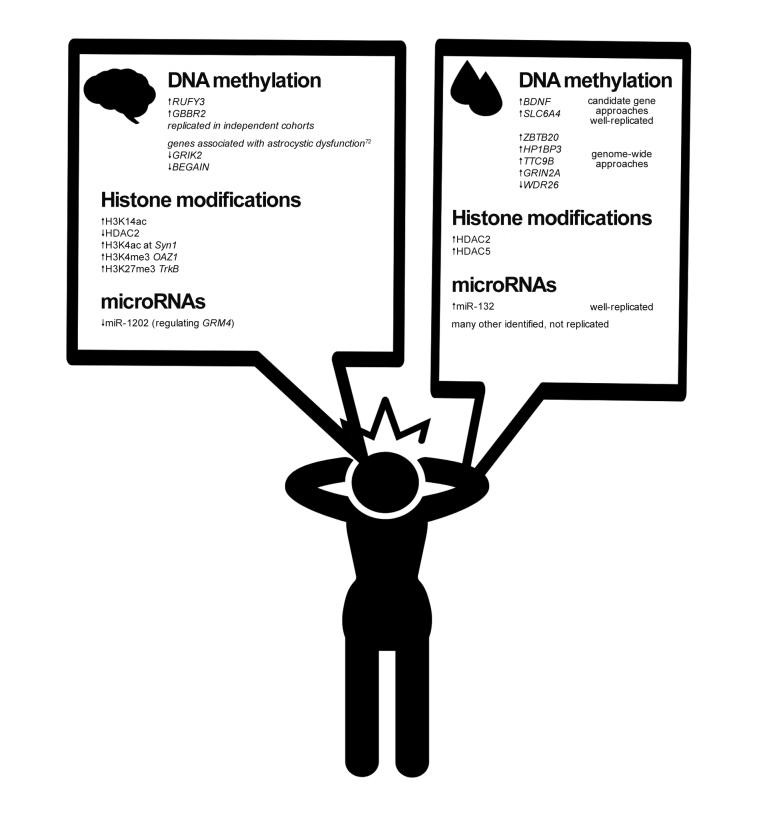
The risk for major depression is both genetically and environmentally determined. It has been proposed that epigenetic mechanisms could mediate the lasting increases in depression risk following exposure to adverse life events and provide a mechanistic framework within which genetic and environmental factors can be integrated. Epigenetics refers to processes affecting gene expression and translation that do not involve changes in the DNA sequence and include DNA methylation (DNAm) and microRNAs (miRNAs) as well as histone modifications. Here we review evidence for a role of epigenetics in the pathogenesis of depression from studies investigating DNAm, miRNAs, and histone modifications using different tissues and various experimental designs. From these studies, a model emerges where underlying genetic and environmental risk factors, and interactions between the two, could drive aberrant epigenetic mechanisms targeting stress response pathways, neuronal plasticity, and other behaviorally relevant pathways that have been implicated in major depression. .
Overview
CoChat Summary
TL;DR
This review synthesizes evidence that epigenetic mechanisms—DNA methylation, miRNAs, and histone modifications—may link genetic and environmental risk factors to major depressive disorder. It proposes that risk factors and their interactions drive aberrant epigenetic regulation of stress-response, neuronal plasticity, and other behaviorally relevant pathways.
Key findings
- Genetic risk for MDD is substantial but incomplete: first-degree relatives have an odds ratio of 2.84 (95% CI = 2.31–3.49), Swedish twin heritability is approximately 37%, and a GWAS meta-analysis of 807,553 individuals identified 102 loci.
- Environmental risk is also strong: a meta-analysis of 26 studies found childhood neglect associated with adult depression at OR 2.78 and emotional abuse at OR 2.75.
- DNA methylation findings are mixed: a systematic review of 67 publications (61 in peripheral tissue) found selected loci differences, most consistently hypermethylation in BDNF and SLC6A4, but no consistent genome-wide changes; a methylome-wide study found overlap between top MDD-associated DMRs in blood and Brodmann area 10 (P = 5.4×10⁻³), with three loci replicated across blood, BA10, and BA25.
- miRNA and histone findings remain less consistent: a review of 23 studies found 178 altered miRNAs in MDD cases versus controls, with only miRNA-132 replicated in four independent studies; miR-1202 was downregulated in PFC of MDD patients who died by suicide and increased in periphery after 8 weeks of antidepressant treatment.
Methods
- Narrative review of studies investigating DNA methylation, miRNAs, and histone modifications in MDD, using different tissues and experimental designs.
- Evidence includes human peripheral and postmortem brain case-control studies, animal stress models, human hippocampal progenitor cell models, and gene-by-environment/mQTL analyses.
- No new primary data or meta-analysis are reported; the paper synthesizes prior findings and proposes a mechanistic model.
Limitations
- Stated by the authors: most studies focus on DNAm, with fewer on histone modifications and long noncoding RNAs; most use peripheral tissue; postmortem brain studies are generally limited by smaller cohort sizes and tissue homogenates; validation across cohorts is difficult due to the polygenic architecture of depression, symptom-based diagnoses, and retrospective recall of environmental exposures.
- Stated by the authors: cross-tissue relevance of epigenetic findings remains unclear and is likely modification- and region-specific.
- Evident from the text: this is a narrative review rather than a systematic review or meta-analysis, so the strength of the summarized evidence is not quantitatively pooled.
Model-written summary. Check it against the paper before relying on it.
Integrity signals
Registry
Cites
Statistics
Figures
Verification
Claims the paper makes
53 Valid · 4 Not valid · 38 Not checked · 25 Own results and interpretations
At least one cited source doesn’t support this claim or points to a different paper, and none confirmed it — see the verdicts below.
In the paper
“Overall, there is very limited evidence for altered DNAm in peripheral blood in patients with MDD.”
§ Epigenetics and depression > DNAm in peripheral tissue
What the sources say
- Disputedcites [13] Li M D’Arcy C Li X Zhang T Joober R Meng X What do DNA methylation studies tell us about depression? A systematic review Transl Psychiatry 2019 9 1 e68 PMC6362194 30718449 sourceExperimental — accuracy not yet measured
The Results (Etiological studies: candidate-gene; page unavailable) say most studies associated BDNF and SLC6A4 hypermethylation with MDD or depression. The review also lists significant findings from whole-blood and peripheral-blood studies, so its account is contrary to the claim that evidence of altered methylation in peripheral blood is very limited, although it notes mixed findings for other genes. (LLM, conf=0.82)
Checked by a reasoning model — may be wrong.
plain- Asserted: passes — The authors put it forward as true.
- Checkable: passes — It can be checked against evidence.
- Load-bearing: passes — The paper’s conclusions depend on it.
- Based: passes — The paper gives a reason why it holds.
- Disputed
Every source the paper cites for this claim was checked and supports it.
In the paper
“a recent study performed genome-wide methylation assays on blood, brain, saliva, and buccal samples and found that cross-tissue correlation strength was highly region-specific, with the correlation coefficient varying widely for different CpGs.”
§ Epigenetics and depression > Challenges and solutions for overcoming cell-type specificity in epigenetic research in depression
What the sources say
- Supportedcites [33] Braun PR Han S Hing B et al Genome-wide DNA methylation comparison between live human brain and peripheral tissues within individuals Transl Psychiatry 2019 9 1 47 30705257 PMC6355837 source
The Results sections “Impact of genomic and functional regions” and “Within-subject correlations at each CpG” report different cross-tissue correlations by genomic context and across individual CpGs. The paper also describes genome-wide comparisons of brain with blood, buccal tissue, and saliva. (LLM, conf=0.92)
plainstates an association- Asserted: passes — The authors put it forward as true.
- Checkable: passes — It can be checked against evidence.
- Load-bearing: passes — The paper’s conclusions depend on it.
- Based: passes — The paper gives a reason why it holds.
- Supported
Every source the paper cites for this claim was checked and supports it.
In the paper
“Studies from animal models demonstrate that stress, usually psychological stress via chronic social defeat paradigms, can induce changes in epigenetic marks.”
§ Epigenetics and depression > Drivers of aberrant epigenetic processes— environmental mechanisms
What the sources say
- Supportedcites [50] O’Toole N Zhang T-Y Wen X et al Epigenetic signatures of chronic social stress in stress-susceptible animals bioRxiv 2019 10.1101/690826 source
The Introduction describes chronic social defeat stress as an animal model and identifies DNA methylation as the epigenetic mark studied. The Discussion reports widespread methylation differences between stress-susceptible mice and non-stressed controls, supporting the claim that this form of stress can change epigenetic marks. (LLM, conf=0.90)
boostedstates a cause- Asserted: passes — The authors put it forward as true.
- Checkable: passes — It can be checked against evidence.
- Load-bearing: passes — The paper’s conclusions depend on it.
- Based: passes — The paper gives a reason why it holds.
- Supported
Every source the paper cites for this claim was checked and supports it.
In the paper
“Correspondingly, mRNA levels of GRM4 increased in both cohorts.”
§ Epigenetics and depression > MicroRNAs
What the sources say
- Supportedcites [30] Lopez JP Lim R Cruceanu C et al MiR-1202 is a primate-specific and brain-enriched microRNA involved in major depression and antidepressant treatment Nat Med 2014 20 7 764 768 24908571 PMC4087015 source
In the paper’s main text (indexed as Abstract; page unavailable), GRM4 mRNA was increased in the initial sample of depressed prefrontal cortex tissue. The same section reports GRM4 up-regulation in a larger, independent sample of depressed brains, supporting the claim for both cohorts. (LLM, conf=0.90)
plainstates a cause- Asserted: passes — The authors put it forward as true.
- Checkable: passes — It can be checked against evidence.
- Load-bearing: unclear — It is unclear whether the paper’s conclusions depend on it.
- Based: passes — The paper gives a reason why it holds.
- Supported
The cited sources support only part of this claim — read each source’s verdict below.
In the paper
“However, at the individual CpG level, correlations for all peripheral tissues were only nominally significantly correlated with brain tissue.”
§ Epigenetics and depression > Challenges and solutions for overcoming cell-type specificity in epigenetic research in depression
What the sources say
- Partly supportedcites [33] Braun PR Han S Hing B et al Genome-wide DNA methylation comparison between live human brain and peripheral tissues within individuals Transl Psychiatry 2019 9 1 47 30705257 PMC6355837 sourceExperimental — accuracy not yet measured
The Results section (‘Within-subject correlations at each CpG’) reports nominally significant brain correlations in blood, buccal tissue, and saliva, but only for 20.8%, 17.4%, and 15.1% of CpGs, respectively. The claim overstates the finding: most CpGs were not nominally correlated, and some correlations survived Bonferroni correction rather than being only nominally significant. (LLM, conf=0.88)
plainstates an association- Asserted: passes — The authors put it forward as true.
- Checkable: passes — It can be checked against evidence.
- Load-bearing: unclear — It is unclear whether the paper’s conclusions depend on it.
- Based: passes — The paper gives a reason why it holds.
- Partly supported
81 more claims · 34 with their cited sources checked
Create a free account to see all 120 claims and to verify the 11 references still open.
- It may state two separate claims as one. 28
- Probably not a substantial claim. 7
- The quote only partly states this claim. 1
Claims other papers make about this one
Each is checked against this paper’s own text: does it say what the citing paper says it does?
The cited source says what the claim attributes to it.
In the citing paper
“Although studied far less frequently, some case-control differences in histone modifications and miRNA expression have also been associated with psychopathology.22”
From The role of epigenetics in psychological resilience (2021) · cites this paper as [22]
In the citing paper
“Epigenetic differences have been observed in presumably resilient individuals when comparing unaffected individuals to those with psychiatric disorders, including PTSD, depression, and anxiety disorders. This has been thoroughly examined elsewhere.16,17,21,22”
From The role of epigenetics in psychological resilience (2021) · cites this paper as [22]
Citations
Cites
MicroRNAs: Target Recognition and Regulatory Functions
Bartel, D. P. (2009) · Cell · doi:10.1016/j.cell.2009.01.002 · Cited by 20,068
The C. elegans heterochronic gene lin-4 encodes small RNAs with antisense complementarity to lin-14
Lee, R. C., Feinbaum, R. L., & Ambros, V. (1993) · Cell · doi:10.1016/0092-8674(93)90529-y · Cited by 12,948
Zhang, Q., Wang, C., Zheng, M., Li, Y., Li, J., Zhang, L., Shang, X., & Yan, C. (2015) · Cerebrovascular Diseases · doi:10.1159/000369778 · Cited by 11,533
Projections of Global Mortality and Burden of Disease from 2002 to 2030
Mathers, C. D., & Loncar, D. (2006) · PLoS Medicine · doi:10.1371/journal.pmed.0030442 · Cited by 11,386
Shrestha, S., & Offer, S. M. (2016) · Medical Epigenetics · doi:10.1159/000444713 · Cited by 8,914
Wnt/β-Catenin Signaling: Components, Mechanisms, and Diseases
MacDonald, B. T., Tamai, K., & He, X. (2009) · Developmental Cell · doi:10.1016/j.devcel.2009.06.016 · Cited by 5,583
Epigenetic regulation of the glucocorticoid receptor in human brain associates with childhood abuse
McGowan, P. O., Sasaki, A., D'Alessio, A. C., Dymov, S., Labonté, B., Szyf, M., Turecki, G., & Meaney, M. J. (2009) · Nature Neuroscience · doi:10.1038/nn.2270 · Cited by 3,531
Genetic Epidemiology of Major Depression: Review and Meta-Analysis
Sullivan, P. F., Neale, M. C., & Kendler, K. S. (2000) · American Journal of Psychiatry · doi:10.1176/appi.ajp.157.10.1552 · Cited by 3,431
eQTLGen, Wray, N. R., 23andMe, the Major Depressive Disorder Working Group of the Psychiatric Genomics Consortium, Ripke, S., Mattheisen, M., Trzaskowski, M., Byrne, E. M., Abdellaoui, A., Adams, M. J., et al. (2018) · Nature Genetics · doi:10.1038/s41588-018-0090-3 · Cited by 3,005
Self-citationCausal Relationship Between Stressful Life Events and the Onset of Major Depression
Kendler, K. S., Karkowski, L. M., & Prescott, C. A. (1999) · American Journal of Psychiatry · doi:10.1176/ajp.156.6.837 · Cited by 2,566
Cited by
Mikulska, J., Juszczyk, G., Gawrońska-Grzywacz, M., & Herbet, M. (2021) · Brain Sciences · doi:10.3390/brainsci11101298 · Cited by 450
Depression and Its Phytopharmacotherapy—A Narrative Review
Dobrek, Ł., & Głowacka, K. (2023) · International Journal of Molecular Sciences · doi:10.3390/ijms24054772 · Cited by 198
The cortisol switch between vulnerability and resilience
de Kloet, E. R., & Joëls, M. (2023) · Molecular Psychiatry · doi:10.1038/s41380-022-01934-8 · Cited by 175
“MR-GR imbalance predisposed by genetic background, sex, and/or developmental epigenetic imprints due to DNA methylation, histone acetylation, and miRNAs, is at the root of disorders that can be characterized by GR resistance or hypersensitivity and HPA-axis dysregulation [200].”
Chronic Stress-Induced Depression and Anxiety Priming Modulated by Gut-Brain-Axis Immunity
Westfall, S., Caracci, F., Estill, M., Frolinger, T., Shen, L., & Pasinetti, G. M. (2021) · Frontiers in Immunology · doi:10.3389/fimmu.2021.670500 · Cited by 139
“Epigenetic mechanisms are emerging as an important factor in immunological memory and depression (75, 76).”
BackgroundPotential Mechanisms and Clinical Effectiveness of Acupuncture in Depression
Yang, N.-N., Lin, L.-L., Li, Y.-J., Li, H.-P., Cao, Y., Tan, C.-X., Hao, X.-W., Ma, S.-M., Wang, L., & Liu, C.-Z. (2021) · Current Neuropharmacology · doi:10.2174/1570159x19666210609162809 · Cited by 175
What do DNA methylation studies tell us about depression? A systematic review
Li, M., D’Arcy, C., Li, X., Zhang, T., Joober, R., & Meng, X. (2019) · Translational Psychiatry · doi:10.1038/s41398-019-0412-y · Cited by 125
The role of epigenetics in psychological resilience
Smeeth, D., Beck, S., Karam, E. G., & Pluess, M. (2021) · The Lancet Psychiatry · doi:10.1016/s2215-0366(20)30515-0 · Cited by 108
Methyl Donors, Epigenetic Alterations, and Brain Health: Understanding the Connection
Bekdash, R. A. (2023) · International Journal of Molecular Sciences · doi:10.3390/ijms24032346 · Cited by 104
A sex-specific genome-wide association study of depression phenotypes in UK Biobank
Silveira, P. P., Pokhvisneva, I., Howard, D. M., & Meaney, M. J. (2023) · Molecular Psychiatry · doi:10.1038/s41380-023-01960-0 · Cited by 90
“Data are, however, available from the authors upon reasonable request and with permission of UK Biobank (http://www.ukbiobank.ac.uk/).”
BackgroundChang, J.-J., Ji, Y., Li, Y., Yuan, M., & Su, P. (2021) · Asian Journal of Psychiatry · doi:10.1016/j.ajp.2021.102824 · Cited by 99
Wang, W., Li, W., Wu, Y., Tian, X., Duan, H., Li, S., Tan, Q., & Zhang, D. (2021) · Translational Psychiatry · doi:10.1038/s41398-021-01536-y · Cited by 78
“It is suggested that epigenetic modification could mediate the lasting increasing depression risk resulting from exposure to adverse life events and provide a mechanistic framework, where genetic and environmental factors were integrated [3, 4].”
BackgroundPrecision Medicine and Public Health: New Challenges for Effective and Sustainable Health
Traversi, D., Pulliero, A., Izzotti, A., Franchitti, E., Iacoviello, L., Gianfagna, F., Gialluisi, A., Izzi, B., Agodi, A., Barchitta, M., et al. (2021) · Journal of Personalized Medicine · doi:10.3390/jpm11020135 · Cited by 88
“Epigenetics is known to play a role in both neurodegenerative and neuropsychiatric diseases, as DNA methylation changes have been described in Alzheimer’s disease [52], Parkinson’s disease [53], amyotrophic lateral sclerosis [54], schizophrenia [55], major depressive disorder [56], and post-traumatic stress disorder […”
BackgroundWu, Y., Song, J., Zhang, Q., Yan, S., Sun, X., Mei, L., Yi, W., Pan, R., Li, Y., Jin, X., et al. (2022) · Environmental Pollution · doi:10.1016/j.envpol.2022.120445 · Cited by 76
Johnson, D., Letchumanan, V., Thum, C. C., Thurairajasingam, S., & Lee, L. (2023) · Nutrients · doi:10.3390/nu15061382 · Cited by 78
The role of microRNAs in depression
Ding, R., Su, D., Zhao, Q., Wang, Y., Wang, J., Lv, S., & Ji, X. (2023) · Frontiers in Pharmacology · doi:10.3389/fphar.2023.1129186 · Cited by 74
“Epigenetics, the interaction of genes and the environment, plays a role in the alteration of brain neurobiology, and the effect of epigenetics can set the stage for the development of MDD (Penner-Goeke and Binder, 2019).”
BackgroundNutrition, Epigenetics, and Major Depressive Disorder: Understanding the Connection
Ortega, M. A., Fraile‐Μartinez, O., Montero, C. G., Álvarez-Mon, M. Á., Lahera, G., Monserrat, J., Llavero-Valero, M., Mora, F., Rodríguez–Jiménez, R., Fernández-Rojo, S., et al. (2022) · Frontiers in Nutrition · doi:10.3389/fnut.2022.867150 · Cited by 64
“Recent work reviews have denoted the lack of information regarding the validation of depression-associated epigenetic modifications due to the short age of this field of study, the small sample size of patients, and the difficulties to study functioning changes in alive brains instead of postmortem (23), although ther…”
BackgroundEpigenetics, Nutrition, and the Brain: Improving Mental Health through Diet
Bekdash, R. A. (2024) · International Journal of Molecular Sciences · doi:10.3390/ijms25074036 · Cited by 76
“In fact, the dysregulation of the brain epigenome by environmental factors during embryonic development can cause “fetal programming” with lasting effects on brain functioning and has been linked to many neurological disorders including mental health disorders [18,46–48].”
BackgroundBiological correlates of early life stressful events in major depressive disorder
Silva, R. C., Maffioletti, E., Gennarelli, M., Baune, B. T., & Minelli, A. (2021) · Psychoneuroendocrinology · doi:10.1016/j.psyneuen.2020.105103 · Cited by 52
Racial, Ethnic, and Cultural Resilience Factors in African American Youth Mental Health
Neblett, E. W. (2023) · Annual Review of Clinical Psychology · doi:10.1146/annurev-clinpsy-072720-015146 · Cited by 73
Depressive and Biopsychosocial Frailty Phenotypes: Impact on Late-life Cognitive Disorders
Panza, F., Solfrizzi, V., Sardone, R., Dibello, V., Castellana, F., Zupo, R., Stallone, R., Lampignano, L., Bortone, I., Mollica, A., et al. (2023) · Journal of Alzheimer s Disease · doi:10.3233/jad-230312 · Cited by 64
“Epigenetic mechanisms could also be the cause [40, 128].”
Kisku, A., Nishad, A., Agrawal, S., Paliwal, R., Datusalia, A. K., Gupta, G., Singh, S. K., Dua, K., & Sulakhiya, K. (2024) · Frontiers in Medicine · doi:10.3389/fmed.2024.1463976 · Cited by 57
“On the other hand, epigenetic pathways may mediate the long-term increases in depression risk associated with unfavorable life events, as well as provide a mechanistic foundation for integrating genetic and environmental components (29).”
BackgroundCanbeyli, R. (2022) · European Journal of Neuroscience · doi:10.1111/ejn.15507 · Cited by 48
“…Pulcu & Elliott, 2015), neurobiological functions (Chaudry et al., 2015; Duman et al., 2019; Han & Nestler, 2017; Pitsillou et al., 2020; Villas Boas et al., 2019) and genetic/epigenetic factors (Freeborough & Kimpton, 2011; Klengel & Binder, 2013; Penner-Goeke & Binder, 2019; Ramos et al., 2016).”
Overstreet, D. S., Pester, B., Wilson, J. M., Flowers, K. M., Kline, N. K., & Meints, S. M. (2022) · Current Pain and Headache Reports · doi:10.1007/s11916-022-01098-8 · Cited by 52
Higher-order adaptive dynamical system modeling of the role of epigenetics in anxiety disorders
Kathusing, S., Samhan, N., & Jan Treur, A. (2023) · Cognitive Systems Research · doi:10.1016/j.cogsys.2023.101177 · Cited by 43
Baj, J., Bargieł, J., Cabaj, J., Skierkowski, B., Hunek, G., Portincasa, P., Flieger, J., & Smoleń, A. (2023) · International Journal of Molecular Sciences · doi:10.3390/ijms242015071 · Cited by 53
Wei, Y., Li, H., Li, Y., Zeng, Y., Quan, T., Leng, Y.-E., Chang, E., Bai, Y., Bian, Y., & Hou, Y. (2024) · Frontiers in Pharmacology · doi:10.3389/fphar.2024.1496661 · Cited by 45
Jiang, Z., Wang, Z., Diao, Q., Chen, J., Tian, G., Cheng, X., Zhao, M., He, L., He, Q., Sun, J., et al. (2022) · Annals of General Psychiatry · doi:10.1186/s12991-022-00423-0 · Cited by 50
Role of estrogen in treatment of female depression
Sun, Q., Li, G., Zhao, F., Dong, M., Xie, W., Liu, Q., Yang, W., & Cui, R. (2024) · Aging · doi:10.18632/aging.205507 · Cited by 55
“Part of the risk of depression is mediated by environmental and genetic factors [11], and although its mechanism is currently unclear, the interaction of multiple factors, including early life events, social stress, health, and medication, seems to be the foundation of its development [12].”
BackgroundXu, Y. J., Li, R., Hu, C., He, Y., Zhang, X., & Li-na, J. (2024) · General Hospital Psychiatry · doi:10.1016/j.genhosppsych.2024.03.003 · Cited by 43
Hippocampal alpha-synuclein mediates depressive-like behaviors
Du, T., Li, G., Luo, H., Pan, Y., Xu, Q., & Ma, K. (2021) · Brain Behavior and Immunity · doi:10.1016/j.bbi.2021.03.020 · Cited by 34
Álvarez-Mon, M. Á., Ortega, M. A., Montero, C. G., Fraile‐Μartinez, O., Monserrat, J., Lahera, G., Mora, F., Rodríguez-Quiroga, A., Fernández-Rojo, S., Quintero, J., et al. (2021) · Pharmaceuticals · doi:10.3390/ph14080821 · Cited by 44
Early indicators of vulnerability to depression: The role of rumination and heart rate variability
Moretta, T., & Benvenuti, S. M. (2022) · Journal of Affective Disorders · doi:10.1016/j.jad.2022.06.049 · Cited by 39
Alberti, A., Coelho, D. R. A., Vieira, W. F., Iser, B. P. M., Lampert, R., Traebert, E., da Silva, B. B., de Oliveira, B. H., Leão, G. M., de Souza, G., et al. (2024) · Biomedicines · doi:10.3390/biomedicines12091994 · Cited by 55
Yu, X., Yao, H., Zhang, X., Liu, L., Liu, S., & Dong, Y. (2022) · BMC Psychiatry · doi:10.1186/s12888-022-04233-2 · Cited by 34
“Etiological hypotheses such as changes in HPA axis activity [3], neurogenesis and plasticity [4], aggravated neuroinflammation [5], abnormal DNA methylation [6] have been proposed.”
BackgroundStress, microRNAs, and stress-related psychiatric disorders: an overview
Musazzi, L., Mingardi, J., Ieraci, A., Barbon, A., & Popoli, M. (2023) · Molecular Psychiatry · doi:10.1038/s41380-023-02139-3 · Cited by 38
The Way to a Human’s Brain Goes Through Their Stomach: Dietary Factors in Major Depressive Disorder
Aly, J. S., & Engmann, O. (2020) · Frontiers in Neuroscience · doi:10.3389/fnins.2020.582853 · Cited by 39
“There is accumulating evidence that a variety of chromatin modifications is altered both, in peripheral tissue (typically blood), and postmortem in the brains of MDD patients (Penner-Goeke and Binder, 2019).”
BackgroundVorvolakos, T., Leontidou, E., Tsiptsios, D., Mueller, C., Serdari, A., Terzoudi, A., Nena, E., Tsamakis, K., Constantinidis, T. C., & Tripsianis, G. (2020) · Psychiatry Research · doi:10.1016/j.psychres.2020.113502 · Cited by 34
Kopf‐Beck, J., Zimmermann, P., Egli, S., Rein, M., Kappelmann, N., Fietz, J., Tamm, J., Rek, K., Lucae, S., Brem, A., et al. (2020) · BMC Psychiatry · doi:10.1186/s12888-020-02880-x · Cited by 55
Zhang, H., Xue, X., Pan, J., Song, X., Chang, X., Mao, Q., Lu, Y., Zhao, H., Wang, Y., Chi, X., et al. (2021) · Chinese Medicine · doi:10.1186/s13020-021-00519-x · Cited by 35
“Nowadays, epigenetics, defined as heritable and reversible ways of regulating expression, has become an important subject in biological and medical sciences [13].”
BackgroundSokolov, A. V., Manu, D.-M., Nordberg, D. O. T., Boström, A. E. D., Jokinen, J., & Schiöth, H. B. (2023) · Clinical Epigenetics · doi:10.1186/s13148-022-01394-5 · Cited by 34
“Many research groups have focused on investigating associations between DNA methylation and depression/suicide [7].”
BackgroundmiR-98-5p plays a critical role in depression and antidepressant effect of ketamine
Huang, C., Wang, Y. Y., Wu, Z., Xu, J., Zhou, L., Wang, D., Yang, L., Zhu, B., Chen, G., Liu, C., et al. (2021) · Translational Psychiatry · doi:10.1038/s41398-021-01588-0 · Cited by 30
“Clinical studies have identified altered expressions of many miRNAs in the peripheral tissues of patients with major depression or bipolar disorder [18, 19], and also have detected aberrant levels of several miRNAs in the brain of patients with major depressive symptoms who died by suicide [18].”
BackgroundSachdeva, B., Sachdeva, P., Ghosh, S., Ahmad, F., & Sinha, J. K. (2023) · Ibrain · doi:10.1002/ibra.12094 · Cited by 34
“These processes include histone modifications, microRNAs, and DNA methylation (DNAm).(20) Depression is multifactorial and it is still not clear as how it precipitates differentially in different individuals.”
BackgroundEpigenetic alterations in patients with anorexia nervosa—a systematic review
Käver, L., Hinney, A., Rajcsanyi, L. S., Maier, H. B., Frieling, H., Steiger, H., Voelz, C., Beyer, C., Trinh, S., & Seitz, J. (2024) · Molecular Psychiatry · doi:10.1038/s41380-024-02601-w · Cited by 36
“These include, most notably, major depressive disorder [21, 22], one of the most common comorbidities in AN, and autism spectrum disorder [23, 24].”
Current and Future Perspectives of Noncoding RNAs in Brain Function and Neuropsychiatric Disease
Kyzar, E. J., Bohnsack, J. P., & Pandey, S. C. (2021) · Biological Psychiatry · doi:10.1016/j.biopsych.2021.08.013 · Cited by 28
Miao, Y., Zhao, F., & Guan, W. (2024) · The International Journal of Neuropsychopharmacology · doi:10.1093/ijnp/pyae064 · Cited by 31
“8 Remarkably, research shows that only about 20% to 25% of individuals suffer from depression after experiencing major stressful events, 9 while large numbers of people successfully adapt to social stress and maintain healthy psychological and physiological functioning.”
Electrochemical biosensors for depression: Diagnosis and therapeutic monitoring
Asadi, A., Ferdosi, F., Anoosheh, S., Kaveh, M., Dadgostar, E., Ehtiati, S., Movahedpour, A., Khanifar, H., Haghighi, M. M., & Khatami, S. H. (2024) · Clinica Chimica Acta · doi:10.1016/j.cca.2024.120091 · Cited by 28
Zhao, T., Wu, D., Du, J., Liu, G., Ji, G., Wang, Z., Peng, F., Man, L., Zhou, W., & Hao, A. (2022) · Frontiers in Pharmacology · doi:10.3389/fphar.2022.818423 · Cited by 32
Cattarinussi, G., Aarabi, M. H., Moghaddam, H. S., Homayoun, M., Ashrafi, M., Soltanian-Zadeh, H., & Sambataro, F. (2021) · Neuroscience & Biobehavioral Reviews · doi:10.1016/j.neubiorev.2021.09.046 · Cited by 31
Cholinergic blockade of neuroinflammation: from tissue to RNA regulators
Zorbaz, T., Madrer, N., & Soreq, H. (2022) · Neuronal Signaling · doi:10.1042/ns20210035 · Cited by 30
Epigenetic Aberrations in Major Psychiatric Diseases Related to Diet and Gut Microbiome Alterations
Nohesara, S., Abdolmaleky, H. M., & Thiagalingam, S. (2023) · Genes · doi:10.3390/genes14071506 · Cited by 35
Molecular mechanisms underlying major depressive disorder and post-stroke affective disorders
Coliță, D., Burdusel, D., Glăvan, D., Hermann, D. M., Coliță, C.-I., Coliță, E., Udriștoiu, I., & Popa‐Wagner, A. (2023) · Journal of Affective Disorders · doi:10.1016/j.jad.2023.10.037 · Cited by 28
Ghaemi, S., Zeraattalab-Motlagh, S., Jayedi, A., & Shab‐Bidar, S. (2024) · Psychological Medicine · doi:10.1017/s0033291724001697 · Cited by 42
“…cognitive dysfunctions, stressful life events, interpersonal dysfunction, biological differences, and inherited traits are implicated in developing depression and anxiety (Altemus, Sarvaiya, & Neill Epperson, 2014; Hammen, 2018; Morssinkhof et al., 2020; Penner-Goeke & Binder, 2019).”
The microbiota-gut-brain axis in pathogenesis of depression: A narrative review
Yao, H., Zhang, D., Yu, H., Shen, H., Liu, H., Meng, F., Wu, X., Zhang, G., & Wang, X. (2022) · Physiology & Behavior · doi:10.1016/j.physbeh.2022.114056 · Cited by 35
Wang, Y., Li, O., Li, N., Sha, Z., Zhao, Z., & Xu, J. (2023) · Frontiers in Psychiatry · doi:10.3389/fpsyt.2023.1143833 · Cited by 38
“It is widely accepted thatMDD arises from a complex interplay between these factors, which ultimately contribute to alterations in brain structure and function, leading to the development of depressive symptoms (4, 5).”
BackgroundLiu, T., Du, D., Zhao, R., Xie, Q., & Dong, Z. (2023) · Microbiological Research · doi:10.1016/j.micres.2023.127440 · Cited by 25
Mechanism of METTL3 ‐mediated m6A modification in depression‐induced cognitive deficits
Niu, J., Wang, B., Wang, T., & Zhou, T. (2022) · American Journal of Medical Genetics Part B: Neuropsychiatric Genetics · doi:10.1002/ajmg.b.32892 · Cited by 23
“Without changes in DNA sequence, epigenetic mechanisms, including modifications to histone proteins, DNA, and noncoding RNAs, are implicated in the pathogenesis of DD (Pena & Nestler, 2018; Penner-Goeke & Binder, 2019).”
BackgroundDepressive disorder and antidepressants from an epigenetic point of view
Arčan, I. Š., Kouter, K., & Paska, A. V. (2022) · World Journal of Psychiatry · doi:10.5498/wjp.v12.i9.1150 · Cited by 30
Dionisio-García, D. M., Mendoza, A. D. G., González‐Castro, T. B., Tovilla‐Zárate, C. A., Juárez‐Rojop, I. E., López‐Narváez, M. L., Hernández‐Díaz, Y., Nicolini, H., & Olvera‐Hernández, V. (2023) · Brain Sciences · doi:10.3390/brainsci13040584 · Cited by 28
Deciphering Depression: Epigenetic Mechanisms and Treatment Strategies
Aljabali, A. A. A., Alkaraki, A. K., Gammoh, O., Tambuwala, M. M., Mishra, V. K., Mishra, Y., Hassan, S. S., & El‐Tanani, M. (2024) · Biology · doi:10.3390/biology13080638 · Cited by 33
Tseng, C., Wang, S.-C., Yang, Y.-C., Fu, H., Chou, C., Kang, H., & Hung, Y.-Y. (2023) · Molecular Neurobiology · doi:10.1007/s12035-023-03374-z · Cited by 23
Hicks, E. M., Seah, C., Cote, A. C., Marchese, S., Brennand, K., Nestler, E. J., Girgenti, M. J., & Huckins, L. M. (2023) · Translational Psychiatry · doi:10.1038/s41398-023-02412-7 · Cited by 30
“Because of its role in integrating environmental and genetic factors, epigenetic regulation has been investigated as a key molecular player in the pathogenesis of depression [112, 113].”
BackgroundAdvances in the Delivery and Development of Epigenetic Therapeutics for the Treatment of Cancer
Ghosh, A., Himaja, A., Biswas, S., Kulkarni, O. P., & Ghosh, B. (2023) · Molecular Pharmaceutics · doi:10.1021/acs.molpharmaceut.3c00610 · Cited by 26
Ceylan, D., Karaçiçek, B., Tüfekçi, K. U., Akşahin, İ. C., Şenol, Ş. H., & Genç, Ş. (2023) · Frontiers in Psychiatry · doi:10.3389/fpsyt.2023.1304660 · Cited by 28
“A growing number of reports indicates that epigenetic mechanisms, such as DNA methylation, histone modifications, and non-coding RNAs may exert critical roles in the pathogenesis of mood disorders, as well as in the response to pharmacological interventions (3, 5, 7, 8).”
BackgroundNi, X., Su, H., Lv, Y., Li, R., Chen, C., Zhang, D., Chen, Q., Zhang, S., Yang, Z., Sun, L., et al. (2022) · Frontiers in Psychiatry · doi:10.3389/fpsyt.2022.986389 · Cited by 27
“The major risk for depression is determined by both genes and environmental factors (5).”
BackgroundMoretta, T., & Benvenuti, S. M. (2023) · Scientific Reports · doi:10.1038/s41598-023-33534-z · Cited by 27
Luo, B., Yang, Y., Zhang, D., Zhang, Q., Liu, Z., Wang, S., Shi, Y., Xia, L., Wang, J., Liu, Z., et al. (2022) · Frontiers in Psychiatry · doi:10.3389/fpsyt.2022.993284 · Cited by 23
Palamarchuk, I. S., Slavich, G. M., Vaillancourt, T., & Rajji, T. K. (2023) · BMC Neuroscience · doi:10.1186/s12868-023-00831-2 · Cited by 32
“The polymorphism in fkbp5 has also been shown to predict individual differences in stress-related memory deficits [e.g., 162, 163] and functional activity/connectivity of the amygdala related to emotional (anxiety/depression) responses to threat [e.g., 164–168].”
BackgroundMokhtari, A., Porte, B., Belzeaux-R, R., Étain, B., Ibrahim, E. C., Marie-Claire, C., Lutz, P.-É., & Delahaye‐Duriez, A. (2022) · Progress in Neuro-Psychopharmacology and Biological Psychiatry · doi:10.1016/j.pnpbp.2022.110520 · Cited by 20
Research trend of epigenetics and depression: adolescents' research needs to strengthen
Yuan, D., Meng, Y., Ai, Z., & Zhou, S. (2024) · Frontiers in Neuroscience · doi:10.3389/fnins.2023.1289019 · Cited by 23
Sex Differences in Depression Caused by Early Life Stress and Related Mechanisms
An, X., Guo, W., Wu, H., Fu, X., Li, M., Zhang, Y., Li, Y., Cui, R., Yang, W., Zhang, Z., et al. (2022) · Frontiers in Neuroscience · doi:10.3389/fnins.2022.797755 · Cited by 24
Barbieri, S. S., Sandrini, L., Musazzi, L., Popoli, M., & Ieraci, A. (2021) · Biomolecules · doi:10.3390/biom11060885 · Cited by 19
“Chromatin remodeling, which is mainly attributed to histone posttranslational acetylation and methylation, is recognized as an important mechanism involved in the regulation of gene expression [9,10].”
BackgroundMaier, H. B., Moschny, N., Eberle, F. C., Jahn, K., Folsche, T., Schülke, R., Bleich, S., Frieling, H., & Neyazi, A. (2023) · Pharmacopsychiatry · doi:10.1055/a-2034-6536 · Cited by 19
“, DNA methylation (DNAm), might play a role in this phenomenon, as they likely regulate gene expression and thus, protein production [8].”
BackgroundZhou, Y., Xiong, L., Chen, J., & Wang, Q. (2023) · The International Journal of Neuropsychopharmacology · doi:10.1093/ijnp/pyad057 · Cited by 18
Sokolov, A. V., & Schiöth, H. B. (2024) · Translational Psychiatry · doi:10.1038/s41398-024-02992-y · Cited by 17
“Depression is a complex psychiatric condition in fl uenced by many factors, such as life experiences [1], interpersonal relationships [2], and biological determinants, such as genetics [3 – 7], epigenetics [8 – 12], and expression pro fi les [13, 14].”
Fu, C., Shuang, Q., Liu, Y., Zeng, L., & Su, W. (2022) · ACS Chemical Neuroscience · doi:10.1021/acschemneuro.1c00439 · Cited by 15
Dai, X., Chen, K., & Xie, Y. (2022) · Current Medicinal Chemistry · doi:10.2174/0929867329666220922102949 · Cited by 15
Castle, D. J., Feusner, J. D., Laposa, J. M., Richter, P. M. A., Hossain, R., Lusicic, A., & Drummond, L. M. (2022) · Comprehensive Psychiatry · doi:10.1016/j.comppsych.2022.152357 · Cited by 20
“However, there is now a considerable volume of research linking life events and the onset of depression [73].”
BackgroundEpigenetics in psychiatry: Beyond DNA methylation
Kouter, K., Arčan, I. Š., & Paska, A. V. (2023) · World Journal of Psychiatry · doi:10.5498/wjp.v13.i6.319 · Cited by 45
Flynn, L. T., & Gao, W. (2023) · Molecular Psychiatry · doi:10.1038/s41380-023-02235-4 · Cited by 19
“…with lasting effects on gene expression, the fi eld of epigenetics is particularly attractive to researchers studying diseases with environmental in fl uences, and in recent years, epigenetic mechanisms have been increasingly implicated in the pathophysiology of several psychiatric diseases [1, 2].”
Jin, S., Ma, Z., Zhang, H., Liang, T., & Zhang, J. (2023) · BMC Genomic Data · doi:10.1186/s12863-023-01120-x · Cited by 18
“The etiology of MDD is complex, and the interaction of intestinal microbes, immunity, neuroendocrine, genetics, psychosocial environment and other factors are associated with the pathogenesis of MDD [4, 5].”
BackgroundGonzales, E. L., Jeon, S. J., Han, K., Yang, S. J., Kim, Y., Remonde, C. G., Ahn, T. J., Ham, B., & Shin, C. Y. (2023) · Brain Behavior and Immunity · doi:10.1016/j.bbi.2023.06.017 · Cited by 14
Phytochemicals in the treatment of patients with depression: a systemic review
Picheta, N., Piekarz, J., Daniłowska, K., Mazur, K., Piecewicz‐Szczęsna, H., & Smoleń, A. (2024) · Frontiers in Psychiatry · doi:10.3389/fpsyt.2024.1509109 · Cited by 24
Ning, L., Zhou, Y., Chen, J., Hu, Z., Jiang, W., Guo, L., Xu, Y. H., Li, H., Xu, F., & Deng, D. (2022) · BMC Immunology · doi:10.1186/s12865-022-00479-3 · Cited by 15
“to genetics, gender, neuroendocrine, psychosocial environment, immunity, intestinal microbes and other factors [4, 5].”
BackgroundZhang, L., Cao, C., Luo, C., Ruan, H., Xu, C., Wang, Y., Jiang, X., & Mao, G. (2024) · Journal of Neurorestoratology · doi:10.1016/j.jnrt.2024.100130 · Cited by 21
Mokhtari, A., Ibrahim, E. C., Gloaguen, A., Barrot, C.-C., Cohen, D., Derouin, M., Vachon, H., Charbonnier, G., Loriod, B., Decraene, C., et al. (2025) · EBioMedicine · doi:10.1016/j.ebiom.2025.105569 · Cited by 26
“13 Therefore,”
New Insights into TETs in Psychiatric Disorders
Zhan, W., Li, Y., Yuan, J., Zhi, N., Huang, Y., Liu, Y., Zhang, M., Wu, S., & Zhao, X. (2022) · International Journal of Molecular Sciences · doi:10.3390/ijms23094909 · Cited by 14
“The epigenetic mechanism, which provides a basis for the integration of genetic and environmental factors, is suggested to explain gene–environment interactions in the pathogenesis of depression [76].”
BackgroundWang, H., Chen, Y., Zhao, A., Shen, Z., & Zhang, Y. (2026) · Frontiers in Pharmacology · doi:10.3389/fphar.2025.1709060 · Cited by 21
Research on Xiaoyao Powder in the treatment of depression based on epigenetics and quality markers
Wang, J., Wu, Q., Ou, C., Lu, G., & Yu, H. (2023) · Frontiers in Neuroscience · doi:10.3389/fnins.2023.1223451 · Cited by 12
“The abnormal expression of BDNF, SLC6A4, ZBTB20, HDAC2, and HDAC5 genes in the surrounding tissues increased, and the expression of GRIN2A and WDR26 decreased (Saavedra et al., 2016; Penner-Goeke and Binder, 2019).”
BackgroundBellver‐Sanchís, A., Ribalta‐Vilella, M., Irisarri, A., Gehlot, P., Choudhary, B. S., Jana, A., Vyas, V. K., Banerjee, D. R., Pallàs, M., Guerrero, A., et al. (2025) · Medicinal Research Reviews · doi:10.1002/med.22096 · Cited by 14
Preventive strategies for adolescent depression: What are we missing? A focus on biomarkers
Zonca, V. (2021) · Brain Behavior & Immunity - Health · doi:10.1016/j.bbih.2021.100385 · Cited by 14
Jiang, G., Ji, Y., Chen, C., Wang, X., Ye, T., Ling, Y., & Wang, H. (2022) · BMC Public Health · doi:10.1186/s12889-022-14085-w · Cited by 16
“As is known to all, the risks for depression are both genetically and environmentally determined [4].”
BackgroundPellowski, J. A., Wedderburn, C. J., Groenewold, N. A., Roos, A., Subramoney, S., Hoffman, N., Fouché, J., Joshi, S. H., Woods, R. P., Narr, K. L., et al. (2023) · Translational Psychiatry · doi:10.1038/s41398-023-02395-5 · Cited by 23
Bandeira, I. C., Giombelli, L., Werlang, I. C. R., Abujamra, A. L., Secchi, T. L., Brondani, R., Bragatti, J. A., Bizzi, J. W. J., Leistner‐Segal, S., & Bianchin, M. M. (2021) · Frontiers in Integrative Neuroscience · doi:10.3389/fnint.2021.764742 · Cited by 12
“Overall, the studies of DNA methylation in patients with depressive disorders frequently show significant associations, but no consistent changes have been reported, either for direction or position (Li et al., 2019; Penner-Goeke and Binder, 2019).”
BackgroundGenetics, epigenetics, and neurobiology of childhood-onset depression: an umbrella review
Singh, M. K., Gorelik, A. J., Stave, C. D., & Gotlib, I. H. (2023) · Molecular Psychiatry · doi:10.1038/s41380-023-02347-x · Cited by 18
“Finally, we are cautious about the generalizability of the fi ndings due to the variation across study context (sample and setting), diathesis exposure, variations in biomarker measurement, and complex ensuing neurodevelopmental trajectories leading to multiple outcomes.”
Discovering the Potential Value of Coenzyme Q10 as an Adjuvant Treatment in Patients With Depression
Majmasanaye, M., Mehrpooya, M., Amırı, H., & Eshraghi, A. (2024) · Journal of Clinical Psychopharmacology · doi:10.1097/jcp.0000000000001845 · Cited by 11
Asakura, S., Kaneko, K., Kawano, K., Shobako, M., Xu, C., Satô, M., Kurabayashi, A., Suzuki, H., Ito, A., Higuchi, Y., et al. (2024) · Peptides · doi:10.1016/j.peptides.2024.171184 · Cited by 12
“Depression is one of the most common and serious psychiatric diseases worldwide [30]; however, it is estimated that more than 50% of patients do not respond to first-line pharmacological treatment because the compatibility of the drugs varies.”
BackgroundMurthy, M. K. (2025) · Neuroscience · doi:10.1016/j.neuroscience.2025.08.009 · Cited by 13
Carneiro, B. A., Guerreiro‐Costa, L. N. F., Lins-Silva, D. H., Guimaraes, D. F., Souza, L. S., Leal, G. C.-G., Caliman‐Fontes, A. T., Beanes, G., Costa, R. D. S., & Quarantini, L. C. (2024) · Cureus · doi:10.7759/cureus.56910 · Cited by 18
Epigenetic aging in major depressive disorder: Clocks, mechanisms and therapeutic perspectives
Shaikh, M., & Doshi, G. (2024) · European Journal of Pharmacology · doi:10.1016/j.ejphar.2024.176757 · Cited by 13
Işık, M., Köse, F., Budak, Ö., Özbayer, C., KELEŞ, R., Aydın, S., Küçük, A. C., Demirci, M. A., Doğanay, S., & Bağcı, C. (2025) · Pflügers Archiv - European Journal of Physiology · doi:10.1007/s00424-025-03084-6 · Cited by 12
Metadata
- Authors
- Penner-Goeke, S., & Binder, E. B.
- Affiliations
- Max Planck Institute of Psychiatry (DE)
- Corresponding author
- Binder, Elisabeth B.
- ORCID
- Binder, Elisabeth B.
- Venue
- Dialogues in Clinical Neuroscience
- Publisher
- Informa UK Limited
- Published
- 2019-12-31
- Volume
- 21
- Issue
- 4
- Pages
- 397-405
- ISSN
- 1294-8322 (ISSN-L)
- 1958-5969
- PMC
- PMC6952745
- OpenAlex
- W3009322768
- Cited by
- 254
- References
- 72
- Citations by year
- 2026: 27 · 2025: 43 · 2024: 58 · 2023: 56 · 2022: 41 · 2021: 22 · 2020: 5 · 2019: 1
- FWCI
- 1.52
- Type
- journal article
- Language
- en
- Open access
- diamond
- doi.org
- Licence
- Locations
- Dialogues in Clinical Neuroscience (publishedVersion, cc-by-nc-nd)
- Europe PMC (PubMed Central) (publishedVersion, cc-by-nc-nd)
- PubMed Central (publishedVersion, cc-by-nc-nd)
- PubMed (publishedVersion)
- MPG.PuRe (Max Planck Society) (submittedVersion)
- Topics
- Life Sciences › Biochemistry, Genetics and Molecular Biology › Molecular Biology › Epigenetics and DNA Methylation
- Life Sciences › Neuroscience › Behavioral Neuroscience › Stress Responses and Cortisol
- Health Sciences › Medicine › Pharmacology (medical) › Treatment of Major Depression
- Keywords
- epigenetics, major depressive disorder, DNA methylation, microRNA, histone modifications, gene-environment interaction, life events, stress response pathways, neuroplasticity, depression pathogenesis
- MeSH terms
- Animals, Depression, Major Depressive Disorder, Humans, Neuronal Plasticity, Gene Expression, MicroRNAs, Epigenesis, Genetic
About these checks
Registry, retraction, Cites and statistics results are computed, not judged, with one exception: a printed reference that no index lists is read once by a model before it counts as a citation error. Claims are extracted by a model and kept only when their quote appears verbatim in the text; each cited source is then checked, with a model’s help, for whether it says what the claim relies on. Those verdicts can be wrong — read the claim’s quote and the cited source before relying on one.
The claim verdicts this report counts are experimental: their accuracy is not yet measured.
A language model drew the claims from the paper on 2026-10-10, under version 3 of the claim definition (model deepseek-v4.1-flash, prompt extract-v3).
A second model labelled each claim on 2026-10-10 (model jev-1.13-20260917, definition revision gold-guideline-v0.2).
Cited sources are checked with a language model’s help (gpt-6-sol).
Statistics and arithmetic are recomputed, not judged.
Confidence bands are shown only for fields calibrated on our annotated test set. None is calibrated yet, so no band is shown.
What counts as a claim ›How we measure confidence ›How we check this ›
Are you an author, or do you see a problem with this page? Request a review
Data sources
Bibliographic data: Semantic Scholar, OpenAlex, Crossref.
Contains information from the Semantic Scholar Academic Graph Datasets, made available under the ODC Attribution License (ODC-BY 1.0).
Semantic Scholar’s data is described in: Kinney, R., et al. (2023). The Semantic Scholar Open Data Platform. arXiv:2301.10140.
