

The DOI matches its Crossref record; 54 of the 54 references it cites were found in a registry or an index; none of the 27 sources its claims cite is checked for support yet.
Helpful or harmful? generative AI dependence, self-reported critical thinking disposition, and self-perceived employability among business students
Open accessAbstract
Generative artificial intelligence (GenAI) is reshaping higher education by offering new forms of learning support while also raising concerns about over-reliance, reduced verification, and the weakening of independent cognitive engagement. Drawing on cognitive load theory, cognitive offloading, habit formation, and the augmentation–automation distinction, this study examines the associations between GenAI use, GenAI dependence, self-reported critical-thinking disposition, and self-perceived employability among undergraduate business students in Oman. Cross-sectional survey data from 412 students were analysed using partial least squares structural equation modelling, with covariance-based SEM used as a robustness check. The findings show that GenAI use is positively associated with GenAI dependence and self-perceived employability. Its positive association with self-reported critical-thinking disposition emerges in the adjusted structural model after accounting for GenAI dependence and the interaction between GenAI use and GenAI dependence, rather than as a strong zero-order relationship. GenAI dependence is negatively associated with both student outcomes and reduces the strength of the positive associations between GenAI use and both outcomes. The results suggest that GenAI use may support students' perceived learning and career readiness when it functions as a reflective augmentation tool involving verification, comparison, and independent judgement, while higher dependence is associated with weaker perceived learning and employability-related outcomes.
Overview
CoChat Summary
TL;DR
This cross-sectional survey of 412 undergraduate business students in Oman finds that generative AI use is positively associated with self-perceived employability and with GenAI dependence, while dependence is negatively associated with both critical-thinking disposition and employability and weakens the positive use–outcome links. The authors conclude that GenAI use is neither uniformly helpful nor harmful, but conditional on how dependent students become on it.
Key findings
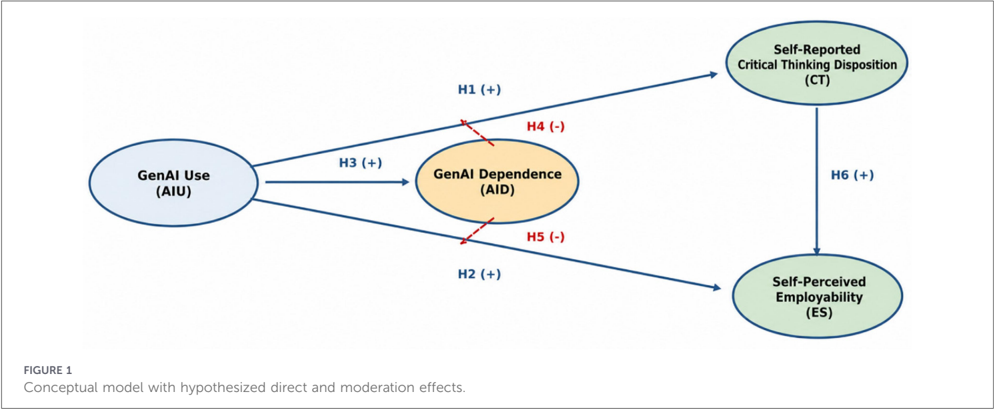
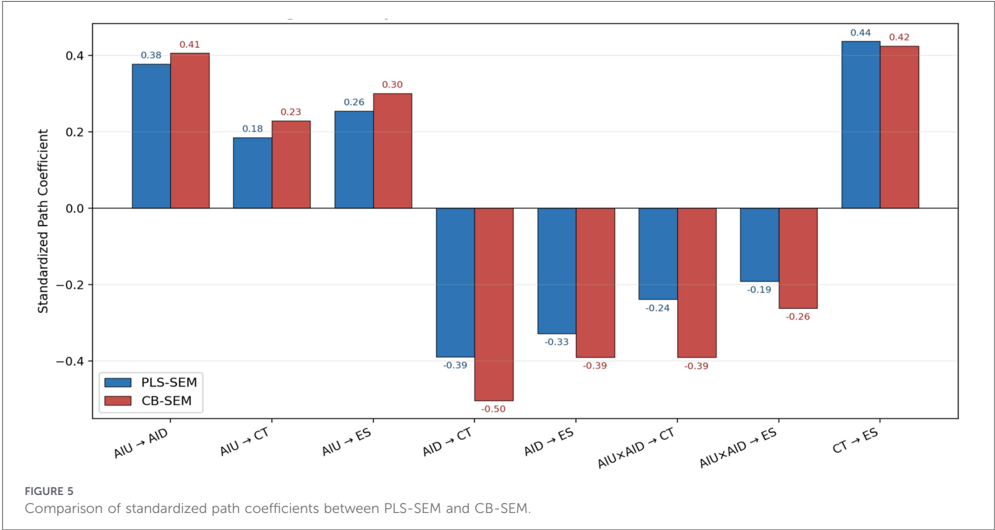
- GenAI use was positively associated with GenAI dependence (β = 0.378, p < 0.001) and with self-perceived employability (β = 0.255, p < 0.001); its positive association with self-reported critical-thinking disposition (β = 0.185, p < 0.001) emerged only in the adjusted structural model, since the zero-order correlation was very small (r = 0.050).
- GenAI dependence was negatively associated with self-reported critical-thinking disposition (β = −0.389, p < 0.001) and self-perceived employability (β = −0.328, p < 0.001).
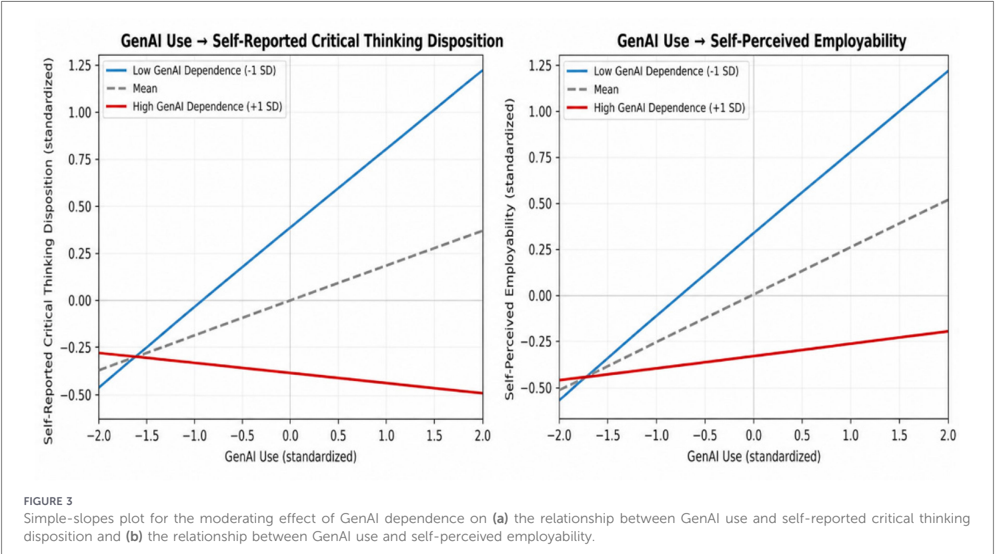
- The interaction of GenAI use × dependence was negative for critical-thinking disposition (β = −0.239, p < 0.001) and employability (β = −0.191, p < 0.001). Simple-slopes analysis showed the critical-thinking slope fell from 0.424 at low dependence to −0.054 (CI includes zero) at high dependence, and the employability slope from 0.446 to 0.064 (CI includes zero).
- Self-reported critical-thinking disposition was positively associated with self-perceived employability (β = 0.437, p < 0.001). Model R² was 0.143 for dependence, 0.186 for critical-thinking disposition, and 0.476 for employability; all six hypotheses were supported and converged in direction and significance under CB-SEM.
Methods
- Cross-sectional, quantitative questionnaire administered February–June 2025 to undergraduate business students with prior GenAI exposure at three Omani universities (one public, n = 118; two private, n = 211 and n = 83). From 587 returned questionnaires, 104 incomplete and 71 failing both attention checks were removed, leaving 412 valid responses.
- All constructs (GenAI use, GenAI dependence, self-reported critical-thinking disposition, self-perceived employability) were measured reflectively with multi-item scales on a uniform seven-point Likert agreement scale; items were reviewed by three subject-matter experts.
- PLS-SEM (SmartPLS 4, two-stage latent-score interaction, 5,000 bootstrap resamples) was the primary estimator; CB-SEM (Python semopy, maximum likelihood, matched-pair product-indicator interaction) served as a robustness check, interpreted for consistency in direction and significance rather than equal coefficients.
Limitations
- Stated: the cross-sectional design precludes causal or developmental inference, and reverse or reciprocal explanations are possible (e.g., students with lower confidence in independent problem-solving may report both greater dependence and weaker critical-thinking disposition).
- Stated: all focal constructs came from the same self-report questionnaire, so common method bias, social desirability, and consistency effects cannot be fully eliminated; self-reported critical-thinking disposition is not objectively assessed ability, and self-perceived employability is not employer-assessed competence or actual employment.
- Stated: non-probability convenience sampling among business students in Oman limits generalisability; GenAI dependence is an emerging construct whose indicators mix habitual reliance, limited verification, access-related discomfort, and perceived loss of cognitive autonomy (AID5 captures retrospective perceived change, not objective deterioration); and GenAI use captures self-reported frequency and breadth rather than behavioural logs or task-specific proficiency.
Model-written summary. Check it against the paper before relying on it.
Integrity signals
Registry
Cites
Statistics
Figures


Verification
Claims the paper makes
0 Valid · 0 Not valid · 21 Not checked · 79 Own results and interpretations
A result the paper reports from its own data — it cites no other source for it, so there is none to check. The quote shows it is in the paper.
In the paper
“The model explained modest variance in GenAI dependence (R 2 = 0.143) and self-reported critical-thinking disposition (R 2 = 0.186), while considerably more variance was explained in self-perceived employability (R 2 = 0.476) (Table 7).”
§ EDITED BY > 4.3.1 R 2 and Q 2 values
plainstates an association- Asserted: passes — The authors put it forward as true.
- Checkable: passes — It can be checked against evidence.
- Load-bearing: unclear — It is unclear whether the paper’s conclusions depend on it.
- Based: passes — The paper gives a reason why it holds.
- Rests on an assumption not shown here.
A result the paper reports from its own data — it cites no other source for it, so there is none to check. The quote shows it is in the paper.
In the paper
“The interaction between GenAI use and GenAI dependence also remained negative for both self-reported critical-thinking disposition [β = -0.222,95% bootstrap CI (-0.293, -0.148)] and self-perceived employability [β = -0.173,95% bootstrap CI (-0.237, -0.104)].”
§ EDITED BY > 4.3.4 Sensitivity analysis excluding AID5
plainstates an association- Asserted: passes — The authors put it forward as true.
- Checkable: passes — It can be checked against evidence.
- Load-bearing: unclear — It is unclear whether the paper’s conclusions depend on it.
- Based: passes — The paper gives a reason why it holds.
- Rests on an assumption not shown here.
A result the paper reports from its own data — it cites no other source for it, so there is none to check. The quote shows it is in the paper.
In the paper
“The interaction term GenAI use × GenAI dependence was negative and significant for self-reported critical thinking disposition (β = -0.239,p < 0.001; H4) and self-perceived employability (β = -0.191,p < 0.001; H5), indicating attenuation of the GenAI use-outcome association at higher dependence levels.”
§ EDITED BY > 4.3 Structural model
plainstates an association- Asserted: passes — The authors put it forward as true.
- Checkable: passes — It can be checked against evidence.
- Load-bearing: passes — The paper’s conclusions depend on it.
- Based: passes — The paper gives a reason why it holds.
- Rests on an assumption not shown here.
A result the paper reports from its own data — it cites no other source for it, so there is none to check. The quote shows it is in the paper.
In the paper
“Importantly, the zero-order correlation between GenAI use and self-reported critical thinking disposition was very small (r = 0.050), so the positive H1 coefficient should be interpreted as an adjusted association estimated in the presence of GenAI dependence and the interaction term, not as evidence of a strong simple bivariate relationship.”
§ EDITED BY > 4.3 Structural model
plainstates an association- Asserted: passes — The authors put it forward as true.
- Checkable: passes — It can be checked against evidence.
- Load-bearing: passes — The paper’s conclusions depend on it.
- Based: passes — The paper gives a reason why it holds.
- Rests on an assumption not shown here.
A result the paper reports from its own data — it cites no other source for it, so there is none to check. The quote shows it is in the paper.
In the paper
“Self-reported critical thinking disposition was positively associated with self-perceived employability (β = 0.437, p < 0.001; H6).”
§ EDITED BY > 4.3 Structural model
plainstates an association- Asserted: passes — The authors put it forward as true.
- Checkable: passes — It can be checked against evidence.
- Load-bearing: passes — The paper’s conclusions depend on it.
- Based: passes — The paper gives a reason why it holds.
- Rests on an assumption not shown here.
52 more claims
Create a free account to see all 100 claims and to verify the 25 references still open.
- It may state two separate claims as one. 25
- Probably not a substantial claim. 30
Statistics recomputed
Every reported test result, recomputed from its test statistic and degrees of freedom. A result shows as not adding up only once an independent check has confirmed it.
- Consistentχ²(1330) = 1256reported p = .926 · recomputed p = .926
“χ 2 (1330) = 1256.00,p = .926”
- Consistentz = -2.4reported p = .016 · recomputed p = .016
“z = -2.40,p = .016”
Self-check
Percentages, sums and reported differences re-computed from the paper’s own numbers.
Self-check results appear here once an independent check has confirmed them.
Citations
Cites
Hu, L., & Bentler, P. M. (1999) · Structural Equation Modeling A Multidisciplinary Journal · doi:10.1080/10705519909540118 · Cited by 108,788
Podsakoff, P. M., MacKenzie, S. B., Lee, J.-Y., & Podsakoff, N. P. (2003) · Journal of Applied Psychology · doi:10.1037/0021-9010.88.5.879 · Cited by 82,194
A new criterion for assessing discriminant validity in variance-based structural equation modeling
Henseler, J., Ringle, C. M., & Sarstedt, M. (2015) · Journal of the Academy of Marketing Science · doi:10.1007/s11747-014-0403-8 · Cited by 38,459
Cross validatory choice and assessment of statistical predictions
Stone, M. (1974) · Journal of the Royal Statistical Society Series B: Statistical Methodology · doi:10.1111/j.2517-6161.1974.tb00994.x · Cited by 10,881
Common Method Bias in PLS-SEM: A Full Collinearity Assessment Approach
Kock, N. (2015) · International Journal of e-Collaboration · doi:10.4018/ijec.2015100101 · Cited by 10,215
(1991) · Cited by 7,187
Sweller, J., Ayres, P., & Kalyuga, S. (2011) · doi:10.1007/978-1-4419-8126-4 · Cited by 5,531
Sweller, J. (2011) · Psychology of Learning and Motivation · doi:10.1016/b978-0-12-387691-1.00002-8 · Cited by 4,856
Predictive model assessment in PLS-SEM: guidelines for using PLSpredict
Shmueli, G., Sarstedt, M., Hair, J. F., Cheah, J.-H., Ting, H., Vaithilingam, S., & Ringle, C. M. (2019) · European Journal of Marketing · doi:10.1108/ejm-02-2019-0189 · Cited by 4,618
Identifying careless responses in survey data.
Meade, A. W., & Craig, S. B. (2012) · Psychological Methods · doi:10.1037/a0028085 · Cited by 3,865
A predictive approach to the random effect model
GEISSER, S. (1974) · Biometrika · doi:10.1093/biomet/61.1.101 · Cited by 2,961
Artificial Intelligence and Management: The Automation–Augmentation Paradox
Raisch, S., & Krakowski, S. (2021) · Academy of Management Review · doi:10.5465/amr.2018.0072 · Cited by 2,755
How Habit Limits the Predictive Power of Intention: The Case of Information Systems Continuance1
Limayem, M., Hirt, S. G., & Cheung, C. M. K. (2007) · MIS Quarterly · doi:10.2307/25148817 · Cited by 2,308
Students’ voices on generative AI: perceptions, benefits, and challenges in higher education
Chan, C. K. Y., & Hu, W. (2023) · International Journal of Educational Technology in Higher Education · doi:10.1186/s41239-023-00411-8 · Cited by 2,301
Employability: A psycho-social construct, its dimensions, and applications
Fugate, M., Kinicki, A. J., & Ashforth, B. E. (2004) · Journal of Vocational Behavior · doi:10.1016/j.jvb.2003.10.005 · Cited by 2,168
Risko, E. F., & Gilbert, S. J. (2016) · Trends in Cognitive Sciences · doi:10.1016/j.tics.2016.07.002 · Cited by 1,502
Partial Least Squares Structural Equation Modeling
Sarstedt, M., Ringle, C. M., & Hair, J. F. (2022) · Handbook of Market Research · doi:10.1007/978-3-319-57413-4_15 · Cited by 1,483
A Review of Artificial Intelligence (AI) in Education from 2010 to 2020
Zhai, X., Chu, X., Chai, C. S., Jong, M. S. Y., Istenic, A., Spector, M., Liu, J.-B., Yuan, J., & Li, Y. (2021) · Complexity · doi:10.1155/2021/8812542 · Cited by 1,364
Interventions to Break and Create Consumer Habits
Verplanken, B., & Wood, W. (2006) · Journal of Public Policy & Marketing · doi:10.1509/jppm.25.1.90 · Cited by 1,221
Marsh, H. W., Wen, Z., & Hau, K.-T. (2004) · Psychological Methods · doi:10.1037/1082-989x.9.3.275 · Cited by 1,205
Abrami, P. C., Bernard, R. M., Borokhovski, E., Wade, A., Surkes, M. A., Tamim, R., & Zhang, D. (2008) · Review of Educational Research · doi:10.3102/0034654308326084 · Cited by 977
Self‐perceived employability: development and validation of a scale
Rothwell, A., & Arnold, J. (2007) · Personnel Review · doi:10.1108/00483480710716704 · Cited by 922
Understanding the Model Size Effect on SEM Fit Indices
Shi, D., Lee, T., & Maydeu-Olivares, A. (2019) · Educational and Psychological Measurement · doi:10.1177/0013164418783530 · Cited by 919
The use of expert judges in scale development
Hardesty, D. M., & Bearden, W. O. (2004) · Journal of Business Research · doi:10.1016/s0148-2963(01)00295-8 · Cited by 778
An integrated critical thinking framework for the 21st century
Dwyer, C. P., Hogan, M. J., & Stewart, I. (2014) · Thinking Skills and Creativity · doi:10.1016/j.tsc.2013.12.004 · Cited by 765
Self-perceived employability: Construction and initial validation of a scale for university students
Rothwell, A., Herbert, I., & Rothwell, F. (2008) · Journal of Vocational Behavior · doi:10.1016/j.jvb.2007.12.001 · Cited by 529
Facione, P. A. (1990) · PhilPapers (PhilPapers Foundation) · Cited by 501
The development and psychometric validation of a Critical Thinking Disposition Scale
Sosu, E. M. (2013) · Thinking Skills and Creativity · doi:10.1016/j.tsc.2012.09.002 · Cited by 324
Morales-García, W. C., Sairitupa-Sanchez, L. Z., Morales-García, S. B., & Morales-García, M. (2024) · Frontiers in Education · doi:10.3389/feduc.2024.1323898 · Cited by 264
The Challenges and Opportunities of AI-Assisted Writing: Developing AI Literacy for the AI Age
Cardon, P., Fleischmann, C., Aritz, J., Logemann, M., & Heidewald, J. (2023) · Business and Professional Communication Quarterly · doi:10.1177/23294906231176517 · Cited by 234
Entrepreneurship education in the era of generative artificial intelligence
Bell, R., & Bell, H. (2023) · Entrepreneurship Education · doi:10.1007/s41959-023-00099-x · Cited by 215
ChatGPT: The cognitive effects on learning and memory
Bai, L., Liu, X., & Su, J. (2023) · Brain‐X · doi:10.1002/brx2.30 · Cited by 180
semopy: A Python Package for Structural Equation Modeling
Igolkina, A. A., & Meshcheryakov, G. (2020) · Structural Equation Modeling: A Multidisciplinary Journal · doi:10.1080/10705511.2019.1704289 · Cited by 168
Acosta-Enriquez, B. G., Arbulú Ballesteros, M. A., Huamaní Jordan, O., López Roca, C., & Saavedra Tirado, K. (2024) · BMC Psychology · doi:10.1186/s40359-024-01764-z · Cited by 164
Halpern, D. F. (2013) · doi:10.4324/9781315885278 · Cited by 140
The Investment Puzzle: Unveiling Behavioral Finance, Risk Perception, and Financial Literacy
Almansour, B. Y., Almansour, A. Y., Elkrghli, S., & Shojaei, S. A. (2024) · Economics · doi:10.2478/eoik-2025-0003 · Cited by 70
Self-citationChai, C. S., Yu, D., King, R. B., & Zhou, Y. (2024) · Sage Open · doi:10.1177/21582440241242188 · Cited by 69
Quinn, S., Hogan, M., Dwyer, C., Finn, P., & Fogarty, E. (2020) · Thinking Skills and Creativity · doi:10.1016/j.tsc.2020.100710 · Cited by 57
Rönkkö (2023) · doi:10.1002/joom.1232 · Cited by 40
Examining autonomous vehicle adoption: A media-based perception and adoption model
Zadeh, A. V., Yi, T. J., Hanifah, H. M., Nikbin, D., & Shojaei, S. A. (2025) · Travel Behaviour and Society · doi:10.1016/j.tbs.2025.101041 · Cited by 20
Self-citationShomotova, A., ElSayary, A., & Husain, S. (2026) · Education and Information Technologies · doi:10.1007/s10639-025-13832-x · Cited by 19
Empowering business research with ChatGPT: academic and student insights through the UTAUT lens
Al‐Hattami, H. M. (2025) · Discover Computing · doi:10.1007/s10791-025-09692-1 · Cited by 17
Teng, D., Zhou, X., Al‐Samarraie, H., & Fang, L. (2026) · Journal of Computer Assisted Learning · doi:10.1002/jcal.70176 · Cited by 10
Shojaei, S. A., Pakgohar, A., & Tran, D. Y. V. (2026) · Economics · doi:10.2478/eoik-2026-0026 · Cited by 10
Self-citationUnderstanding business students’ GenAI usage and perception and associated implications
Nakatani, K., & Jiang, Y. (2025) · Industry and Higher Education · doi:10.1177/09504222251388167 · Cited by 9
Shojaei, S. A. (2024) · Industrial Engineering & Management Systems · doi:10.7232/iems.2024.23.3.439 · Cited by 8
Self-citationBalancing Innovation and Profitability: Technological Diversification in Iran’s Insurance Industry
Shojaei, S. A., & Almansour, B. Y. (2024) · Asia-Pacific Journal of Risk and Insurance · doi:10.1515/apjri-2024-0011 · Cited by 8
Self-citationMa, Y., Zhang, Z., & Liu, C. (2025) · Education and Information Technologies · doi:10.1007/s10639-025-13850-9 · Cited by 8
Functional vs Ethical Drivers in Generative AI Adoption: A PLS-SEM Study in Business Education
Serrano, J. C., Vidal-Silva, C. L., von-Bichoffshausen, P., Gómez-López, R., & Campos-Núñez, F. (2025) · International Journal of Advanced Computer Science and Applications · doi:10.14569/ijacsa.2025.0160872 · Cited by 7
Mechanisms of employability development for applied talents in the artificial intelligence era
Wu, L., Wu, C., Geng, J., Zhao, H., & Liu, Z. (2026) · Scientific Reports · doi:10.1038/s41598-026-49248-x · Cited by 3
Shojaei, S. A., Almansour, B. Y., Pakgohar, A., & Orouji, M. (2026) · Risks · doi:10.3390/risks14070146 · Cited by 3
Self-citationProfessional competencies and graduates employability in Oman
Harrasi, G. F. A., Salmani, M. S. A., & Harrasi, M. G. A. (2025) · International Journal of Evaluation and Research in Education (IJERE) · doi:10.11591/ijere.v14i6.31524 · Cited by 1
Serrano, J. C., Vidal-Silva, C. L., Gómez-López, R., & Campos-Núñez, F. (2026) · Emerging Trends in Education · doi:10.19136/etie.v8n16.6349 · Cited by 1
Preparing Graduates for the Impact of Generative Artificial Intelligence in Future Work
Dean, B. A., Plumb, M., & Rook, L. (2026) · Springer eBooks · doi:10.1007/978-981-95-1875-3_4 · Cited by 1
Research works printed but not linked: 2
- Cohen, 1988, Statistical Power Analysis for the Behavioural Sciences
- Hair, 2022, A Primer on Partial Least Squares Structural Equation Modeling (PLS-SEM)
Cited by
Armosh, F., Shojaei, S. A., Labib, J., & Boateng, B. O. (2026) · Education Sciences · doi:10.3390/educsci16111876
Self-citationCarbone, D., Mattiassi, A. D. A., & Marcatto, F. (2026) · Education Sciences · doi:10.3390/educsci16111934
Metadata
- Authors
- Shojaei, S. A., Armosh, F., Lihe, R., Hamacha, R., & Labib, J.
- Affiliations
- School of Business, Coventry University, Kazakhstan Campus
- De Montfort University (GB)
- De Montfort University
- Mohammed V University (MA)
- Corresponding author
- Shojaei, Seyed Amirhossein
- Venue
- Frontiers in Education
- Publisher
- Frontiers Media SA
- Published
- 2026-09-17
- Volume
- 11
- ISSN
- 2504-284X (ISSN-L)
- OpenAlex
- W7213461661
- Cited by
- 2
- References
- 52
- Citations by year
- 2026: 2
- FWCI
- 7.19
- Type
- journal article
- Language
- en
- Open access
- gold
- doi.org
- Licence
- Locations
- Frontiers in Education (publishedVersion, cc-by)
- DOAJ (DOAJ: Directory of Open Access Journals) (submittedVersion)
- Topics
- Social Sciences › Education › Artificial Intelligence in Education
- Health Sciences › Medicine › Health Informatics › Artificial Intelligence in Healthcare and Education
- Social Sciences › Business, Management and Accounting › Organizational Behavior and Human Resource Management › AI and HR Technologies
- Keywords
- generative AI, AI dependency, critical thinking disposition, perceived employability, business students, cognitive offloading, habit formation, cognitive load theory, career readiness, overreliance on AI, Oman
About these checks
Registry, retraction, Cites and statistics results are computed, not judged, with one exception: a printed reference that no index lists is read once by a model before it counts as a citation error. Claims are extracted by a model and kept only when their quote appears verbatim in the text; each cited source is then checked, with a model’s help, for whether it says what the claim relies on. Those verdicts can be wrong — read the claim’s quote and the cited source before relying on one.
A language model drew the claims from the paper on 2026-11-18, under version 3 of the claim definition (model deepseek-v4.1-flash, prompt extract-v3).
A second model labelled each claim on 2026-11-18 (model jev-1.13-20260917, definition revision gold-guideline-v0.2).
Statistics and arithmetic are recomputed, not judged.
Confidence bands are shown only for fields calibrated on our annotated test set. None is calibrated yet, so no band is shown.
What counts as a claim ›How we measure confidence ›How we check this ›
Are you an author, or do you see a problem with this page? Request a review
Data sources
Bibliographic data: Semantic Scholar, OpenAlex, Crossref.
Contains information from the Semantic Scholar Academic Graph Datasets, made available under the ODC Attribution License (ODC-BY 1.0).
Semantic Scholar’s data is described in: Kinney, R., et al. (2023). The Semantic Scholar Open Data Platform. arXiv:2301.10140.
