

The DOI matches its Crossref record; 78 of the 78 references it cites were found in a registry or an index.
Androgen Action in the Ovary
Open accessAbstract
Androgen production by the ovary is an essential requirement for normal cyclical secretion of estradiol but its physiological role extends to important actions on both preantral and antral follicle development, including promotion of granulosa cell proliferation. It is likely only in mature antral follicles that androgens encourage apoptosis and consequent follicle atresia, and this may be an important mechanism to ensure mono-follicular ovulation in primates, including humans. Recent studies have provided new insight into the mechanism of androgen signaling in the ovary which involves both genomic and non-genomic effects that are complementary in effecting a cellular response. In polycystic ovary syndrome, a condition characterized by intra-ovarian androgen excess, aberrant development of both preantral and antral follicles is a salient feature. We present evidence that local action of androgens plays a part in such abnormalities. Finally, we review the role of androgens in follicle atresia and conclude that the effects are part of the normal physiology of follicle maturation.
Overview
The claims and statistics of this paper haven’t been checked yet.
Run the check — free, no account needed. It reads the open-access text and checks the sources it cites.
Integrity signals
Registry
Cites
Statistics
Figures
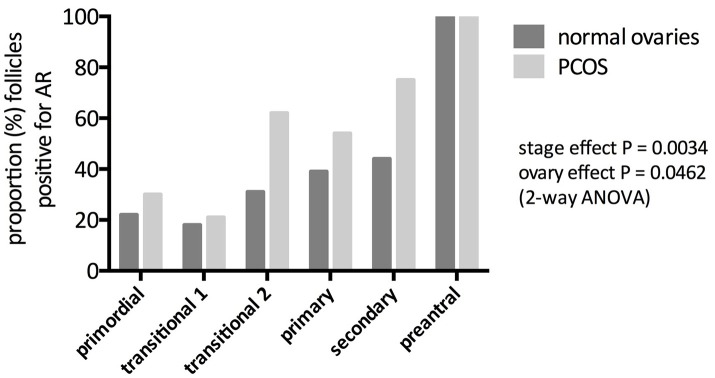
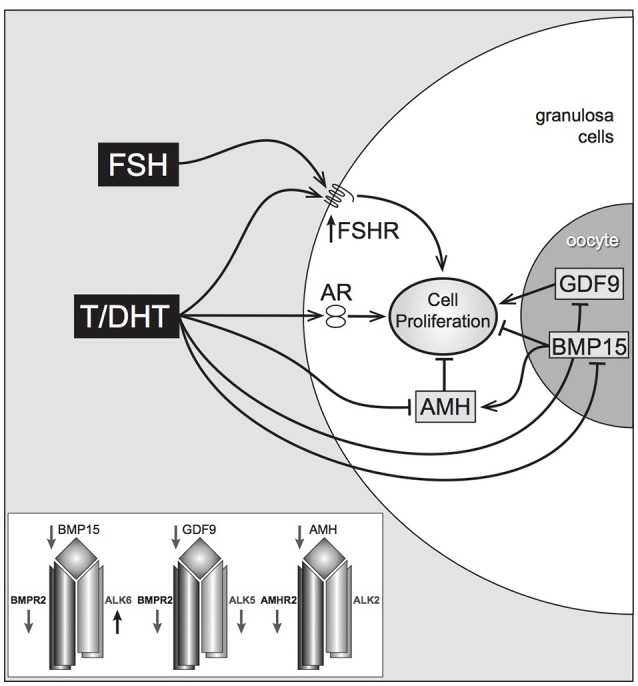
Verification
Claims the paper makes
The claims and statistics of this paper haven’t been checked yet.
Run the check — free, no account needed. It reads the open-access text and checks the sources it cites.
Claims other papers make about this one
Each is checked against this paper’s own text: does it say what the citing paper says it does?
In the citing paper
“Aberrant development during these earliest stages of follicular growth likely contributes to the ovarian aspects of PCOS [19].”
From Polycystic Ovary Syndrome: Pathophysiology, Presentation, and Treatment With Emphasis on Adolescent Girls (2019) · cites this paper as [19]
Self-check
Percentages, sums and reported differences re-computed from the paper’s own numbers.
The self-check needs the paper’s full text.
Citations
Cites
The Diagnosis of Polycystic Ovary Syndrome during Adolescence
Witchel, S. F., Oberfield, S., Rosenfield, R. L., Codner, E., Bonny, A., Ibáñez, L., Pena, A., Horikawa, R., Gomez-Lobo, V., Joel, D., et al. (2015) · Hormone Research in Paediatrics · doi:10.1159/000375530 · Cited by 3,113
Insulin Resistance and the Polycystic Ovary Syndrome: Mechanism and Implications for Pathogenesis
Dunaif, A. E. (1997) · Endocrine Reviews · doi:10.1210/edrv.18.6.0318 · Cited by 2,776
Franks, S. (1995) · New England Journal of Medicine · doi:10.1056/nejm199509283331307 · Cited by 2,463
Self-citationEhrmann, D. A. (2005) · New England Journal of Medicine · doi:10.1056/nejmra041536 · Cited by 1,920
Moran, L. J., Misso, M. L., Wild, R. A., & Norman, R. J. (2010) · Human Reproduction Update · doi:10.1093/humupd/dmq001 · Cited by 1,108
Chen, Z.-J., Zhao, H., He, L., Shi, Y., Qin, Y., Shi, Y., Li, Z., You, L., Zhao, J., Liu, J., et al. (2011) · Nature Genetics · doi:10.1038/ng.732 · Cited by 782
Androgens stimulate early stages of follicular growth in the primate ovary
Vendola, K. A., Zhou, J., Adesanya, O. O., Weil, S. J., & Bondy, C. A. (1998) · Journal of Clinical Investigation · doi:10.1172/jci2081 · Cited by 712
Transcriptional activation and nuclear targeting signals of the human androgen receptor.
Simental, J. A., Sar, M., Lane, M. V., French, F. S., & Wilson, E. M. (1991) · Journal of Biological Chemistry · doi:10.1016/s0021-9258(18)52466-2 · Cited by 631
Follicle dynamics and anovulation in polycystic ovary syndrome
Franks, S., Stark, J., & Hardy, K. (2008) · Human Reproduction Update · doi:10.1093/humupd/dmn015 · Cited by 581
Self-citationDunaif, A. E., GRAF, M., Mandeli, J., Laumas, V., & Dobrjansky, A. (1987) · The Journal of Clinical Endocrinology & Metabolism · doi:10.1210/jcem-65-3-499 · Cited by 577
Estrogens inhibit and androgens enhance ovarian granulosa cell apoptosis.
Billig, H., Furuta, I., & Hsueh, A. J. W. (1993) · Endocrinology · doi:10.1210/endo.133.5.8404672 · Cited by 556
Formation and early development of follicles in the polycystic ovary
Webber, L. J., Stubbs, S. A., Stark, J., Trew, G. H., Margara, R. A., Hardy, K., & Franks, S. (2003) · The Lancet · doi:10.1016/s0140-6736(03)14410-8 · Cited by 521
Self-citationDevelopmental origin of polycystic ovary syndrome—a hypothesis
Abbott, D., Dumesic, D., & Franks, S. (2002) · Journal of Endocrinology · doi:10.1677/joe.0.1740001 · Cited by 504
Self-citationA New Rat Model Exhibiting Both Ovarian and Metabolic Characteristics of Polycystic Ovary Syndrome
Mannerås, L., Cajander, S. B., Holmäng, A. B., Seleskovic, Z., Lystig, T., Lönn, M., & Stener‐Victorin, E. (2007) · Endocrinology · doi:10.1210/en.2007-0168 · Cited by 488
Hayes, M. G., Urbanek, M., Ehrmann, D. A., Armstrong, L. L., Lee, J. Y., Sisk, R., Karaderi, T., Barber, T. M., McCarthy, M. I., Franks, S., et al. (2015) · Nature Communications · doi:10.1038/ncomms8502 · Cited by 478
Self-citationDay, F. R., Hinds, D. A., Tung, J. Y., Stolk, L., Styrkarsdottir, U., Saxena, R., Bjonnes, A., Broer, L., Dunger, D. B., Halldorsson, B. V., et al. (2015) · Nature Communications · doi:10.1038/ncomms9464 · Cited by 459
Follicular oestrogen synthesis: the ‘two-cell, two-gonadotrophin’ model revisited
Hillier, S. G., Whitelaw, P. F., & Smyth, C. D. (1994) · Molecular and Cellular Endocrinology · doi:10.1016/0303-7207(94)90278-x · Cited by 456
Hillier, S. G. (1994) · Human Reproduction · doi:10.1093/oxfordjournals.humrep.a138480 · Cited by 456
Weil, S. J., Vendola, K., Zhou, J., Adesanya, O. O., Wang, J., Okafor, J., & Bondy, C. A. (1998) · The Journal of Clinical Endocrinology & Metabolism · doi:10.1210/jcem.83.7.4917 · Cited by 359
Premature ovarian failure in androgen receptor-deficient mice
Shiina, H., Μatsumoto, T., Sato, T., Igarashi, K., Miyamoto, J., Takemasa, S., Sakari, M., Takada, I., Nakamura, T., METZGER, D., et al. (2005) · Proceedings of the National Academy of Sciences · doi:10.1073/pnas.0506736102 · Cited by 332
Sen, A., & Hammes, S. R. (2010) · Molecular Endocrinology · doi:10.1210/me.2010-0006 · Cited by 313
Willis, D., Watson, H., Mason, H. D., Galea, R., Brincat, M., & Franks, S. (1998) · The Journal of Clinical Endocrinology & Metabolism · doi:10.1210/jcem.83.11.5232 · Cited by 312
Self-citationBarnes, R. B., Rosenfield, R. L., Ehrmann, D. A., Cara, J. F., Cuttler, L., Levitsky, L. L., & Rosenthal, I. M. (1994) · The Journal of Clinical Endocrinology & Metabolism · doi:10.1210/jcem.79.5.7962325 · Cited by 304
Evidence for a primary abnormality of thecal cell steroidogenesis in the polycystic ovary syndrome
Gilling‐Smith, C., Story, H., Rogers, V., & Franks, S. (1997) · Clinical Endocrinology · doi:10.1046/j.1365-2265.1997.2321049.x · Cited by 301 · cited 1×
“The biochemical hall mark of PCOS is excess androgen production, predominantly of ovarian origin (39, 41).”
BackgroundSelf-citationSen, A., Prizant, H., Light, A., Biswas, A., Hayes, E. T., Lee, H., Barad, D. H., Gleicher, N., & Hammes, S. R. (2014) · Proceedings of the National Academy of Sciences · doi:10.1073/pnas.1318978111 · Cited by 283
Erickson, G. F., Garzo, V. G., & Magoffin, D. A. (1989) · The Journal of Clinical Endocrinology & Metabolism · doi:10.1210/jcem-69-4-716 · Cited by 273
Overexpression of a DENND1A isoform produces a polycystic ovary syndrome theca phenotype
McAllister, J. M., Modi, B., Miller, B. A., Biegler, J., Bruggeman, R., Legro, R. S., & Strauss, J. F. (2014) · Proceedings of the National Academy of Sciences · doi:10.1073/pnas.1400574111 · Cited by 250
Jeppesen, J. V., Kristensen, S. G., Nielsen, M. E., Humaidan, P., Canto, M. D., Fadini, R., Schmidt, K. T., Ernst, E., & Andersen, C. Y. (2012) · The Journal of Clinical Endocrinology & Metabolism · doi:10.1210/jc.2012-1427 · Cited by 244
Maciel, G. A. R., Baracat, E. C., Bénda, J., Markham, S. M., Hensinger, K., Chang, R. J., & Erickson, G. F. (2004) · The Journal of Clinical Endocrinology & Metabolism · doi:10.1210/jc.2004-0643 · Cited by 228
Sheep models of polycystic ovary syndrome phenotype
Padmanabhan, V., & Veiga‐Lopez, A. (2012) · Molecular and Cellular Endocrinology · doi:10.1016/j.mce.2012.10.005 · Cited by 222
Willis, D. (1998) · The Journal of Clinical Endocrinology & Metabolism · doi:10.1210/jc.83.11.3984 · Cited by 207
Carmina, E., Dewailly, D., Escobar-Morreale, H. F., Keleştimur, F., Morán, C., Oberfield, S. E., Witchel, S. F., & Azziz, R. (2017) · Human Reproduction Update · doi:10.1093/humupd/dmx014 · Cited by 206
Effect of androgens on the development of mouse follicles growing in vitro
Murray, A. A., Gosden, R. G., Allison, V., & Spears, N. (1998) · Reproduction · doi:10.1530/jrf.0.1130027 · Cited by 205
Mason, H. D., Willis, D., Beard, R. W., Winston, R. M. L., Margara, R. A., & Franks, S. (1994) · The Journal of Clinical Endocrinology & Metabolism · doi:10.1210/jcem.79.5.7962330 · Cited by 201
Self-citationThe management of patients with polycystic ovary syndrome
Jayasena, C. N., & Franks, S. (2014) · Nature Reviews Endocrinology · doi:10.1038/nrendo.2014.102 · Cited by 196
Self-citationReproductive and Metabolic Phenotype of a Mouse Model of PCOS
van Houten, E. L. A. F., Kramer, P., McLuskey, A., Karels, B., Themmen, A. P. N., & Visser, J. A. (2012) · Endocrinology · doi:10.1210/en.2011-1754 · Cited by 190
Vendola, K., Zhou, J., Wang, J., & Bondy, C. A. (1999) · Human Reproduction · doi:10.1093/humrep/14.9.2328 · Cited by 185
Dyslipidaemia is associated with insulin resistance in women with polycystic ovaries
Robinson, S., Henderson, A. D., Gelding, S. V., Kiddy, D. S., Niththyananthan, R., Bush, A., Richmond, W., Johnston, D. G., & Franks, S. (1996) · Clinical Endocrinology · doi:10.1046/j.1365-2265.1996.674495.x · Cited by 181
Self-citationHAGUE, W. M., ADAMS, J., RODDA, C., BROOK, C. G. D., DE BRUYN, R., GRANT, D. B., & JACOBS, H. S. (1990) · Clinical Endocrinology · doi:10.1111/j.1365-2265.1990.tb03887.x · Cited by 175
Gestational Diabetes and Type 2 Diabetes in Reproductive-Aged Women With Polycystic Ovary Syndrome
Joham, A. E., Ranasinha, S., Zoungas, S., Moran, L., & Teede, H. J. (2013) · The Journal of Clinical Endocrinology & Metabolism · doi:10.1210/jc.2013-2007 · Cited by 155
Location and developmental regulation of androgen receptor in primate ovary
Hillier, S. G., TETSUKA, M., & Fraser, H. M. (1997) · Human Reproduction · doi:10.1093/humrep/12.1.107 · Cited by 149
Glister, C., Richards, S. L., & Knight, P. G. (2004) · Endocrinology · doi:10.1210/en.2004-1303 · Cited by 142
Robinson, S., Chan, S., Spacey, S., Anyaoku, V., Johnston, D. G., & Franks, S. (1992) · Clinical Endocrinology · doi:10.1111/j.1365-2265.1992.tb02262.x · Cited by 141
Self-citationNimrod, A., & Lindner, H. R. (1976) · Molecular and Cellular Endocrinology · doi:10.1016/0303-7207(76)90093-9 · Cited by 141
Testosterone Stimulates the Primary to Secondary Follicle Transition in Bovine Follicles In Vitro1
Yang, M. Y., & Fortune, J. E. (2006) · Biology of Reproduction · doi:10.1095/biolreprod.106.051813 · Cited by 141
Developmental regulation of androgen receptor in rat ovary
TETSUKA, M., Whitelaw, P. F., Bremner, W. J., Millar, M. R., Smyth, C. D., & Hillier, S. G. (1995) · Journal of Endocrinology · doi:10.1677/joe.0.1450535 · Cited by 138
Androgen actions in the ovary: balance is key
Prizant, H., Gleicher, N., & Sen, A. (2014) · Journal of Endocrinology · doi:10.1530/joe-14-0296 · Cited by 136
Stubbs, S. A., Stark, J., Dilworth, S. M., Franks, S., & Hardy, K. (2007) · The Journal of Clinical Endocrinology & Metabolism · doi:10.1210/jc.2007-0729 · Cited by 130
Self-citationJuengel, J. L., Heath, D. A., Quirke, L. D., & McNatty, K. P. (2005) · Reproduction · doi:10.1530/rep.1.00704 · Cited by 125
Walters, K. A., Middleton, L. J., Joseph, S. R., Hazra, R., Jimenez, M., Simanainen, U., Allan, C. M., & Handelsman, D. J. (2012) · Biology of Reproduction · doi:10.1095/biolreprod.112.102012 · Cited by 125
Rice, S., Ojha, K., Whitehead, S. A., & Mason, H. D. (2006) · The Journal of Clinical Endocrinology & Metabolism · doi:10.1210/jc.2006-1697 · Cited by 114
Fowler, P., Anderson, R. A., Saunders, P. T. K., Kinnell, H. L., Mason, J. I., Evans, D. B., Bhattacharya, S., Flannigan, S., Franks, S., Monteiro, A., et al. (2011) · The Journal of Clinical Endocrinology & Metabolism · doi:10.1210/jc.2010-2618 · Cited by 113
Self-citationHarlow, C. R., Shaw, H. J., Hillier, S. G., & Hodges, J. K. (1988) · Endocrinology · doi:10.1210/endo-122-6-2780 · Cited by 112
Nonhuman primate models of polycystic ovary syndrome
Abbott, D. H., Nicol, L. E., Levine, J. E., Xu, N., Goodarzi, M. O., & Dumesic, D. A. (2013) · Molecular and Cellular Endocrinology · doi:10.1016/j.mce.2013.01.013 · Cited by 111
Hillier, S. G., Knazek, R. A., & Ross, G. T. (1977) · Endocrinology · doi:10.1210/endo-100-6-1539 · Cited by 106
Paxillin mediates extranuclear and intranuclear signaling in prostate cancer proliferation
Sen, A., Castro, I. D., DeFranco, D. B., Deng, F.-M., Melamed, J., Kapur, P., Raj, G. V., Rossi, R. M., & Hammes, S. R. (2012) · Journal of Clinical Investigation · doi:10.1172/jci62044 · Cited by 103
Prolonged Survival in Culture of Preantral Follicles from Polycystic Ovaries
Webber, L. J., Stubbs, S. A., Stark, J., Margara, R. A., Trew, G. H., Lavery, S. A., Hardy, K., & Franks, S. (2007) · The Journal of Clinical Endocrinology & Metabolism · doi:10.1210/jc.2006-1422 · Cited by 99
Self-citationMetabolic profiling of polycystic ovary syndrome reveals interactions with abdominal obesity
Alves, A. C., Valcarcel, B., Mäkinen, V.-P., Morin-Papunen, L. C., Sebert, S. P., Kangas, A. J., Soininen, P., Das, S., Iorio, M. D., Coin, L., et al. (2017) · International Journal of Obesity · doi:10.1038/ijo.2017.126 · Cited by 99
Self-citationRole of androgens in the ovary
Walters, K. A., & Handelsman, D. J. (2017) · Molecular and Cellular Endocrinology · doi:10.1016/j.mce.2017.06.026 · Cited by 98
Infertility in Polycystic Ovary Syndrome: Focus on Low-Dose Gonadotropin Treatment
Gorry, A., White, D. M., & Franks, S. (2006) · Endocrine · doi:10.1385/endo:30:1:27 · Cited by 95
Self-citationSen, A., O’Malley, K. J., Wang, Z., Raj, G. V., DeFranco, D. B., & Hammes, S. R. (2010) · Journal of Biological Chemistry · doi:10.1074/jbc.m110.134064 · Cited by 89
Lenie, S., & Smitz, J. E. J. (2008) · Biology of Reproduction · doi:10.1095/biolreprod.107.067280 · Cited by 87
Perspectives in polycystic ovary syndrome: From hair to eternity
Dunaif, A. (2016) · The Journal of Clinical Endocrinology & Metabolism · doi:10.1210/jc.2015-3780 · Cited by 87
Disordered follicle development in ovaries of prenatally androgenized ewes
Forsdike, R. A., Hardy, K., Bull, L., Stark, J., Webber, L. J., Stubbs, S. A., Robinson, J. E., & Franks, S. (2007) · Journal of Endocrinology · doi:10.1677/joe.1.07097 · Cited by 85
Self-citationWestergaard, L. G., Christensen, I. J., & McNatty, K. P. (1986) · Human Reproduction · doi:10.1093/oxfordjournals.humrep.a136390 · Cited by 84
Laird, M., Thomson, K., Fenwick, M. A., Mora, J. M., Franks, S., & Hardy, K. (2017) · Endocrinology · doi:10.1210/en.2016-1538 · Cited by 79
Self-citationWang, X. N., & Greenwald, G. S. (1993) · Reproduction · doi:10.1530/jrf.0.0990403 · Cited by 76
Hogg, K., Young, J. M., Oliver, E. M., de Souza, C. J. H., McNeilly, A. S., & Duncan, W. C. (2011) · Endocrinology · doi:10.1210/en.2011-1607 · Cited by 64
Stubbs, S. A., Webber, L. J., Stark, J., Rice, S., Margara, R. A., Lavery, S. A., Trew, G. H., Hardy, K., & Franks, S. (2013) · The Journal of Clinical Endocrinology & Metabolism · doi:10.1210/jc.2013-1378 · Cited by 63
Self-citationFranks, S. (2012) · Endocrinology · doi:10.1210/en.2012-1366 · Cited by 62
Self-citationThe Role of Central Androgen Receptor Actions in Regulating the Hypothalamic-Pituitary-Ovarian Axis
Walters, K. A., Edwards, M. C., Tesic, D., Caldwell, A. S. L., Jimenez, M., Smith, J. T., & Handelsman, D. J. (2018) · Neuroendocrinology · doi:10.1159/000487762 · Cited by 58
Reproductive neuroendocrine dysfunction in polycystic ovary syndrome: Insight from animal models
Roland, A. V., & Moenter, S. M. (2014) · Frontiers in Neuroendocrinology · doi:10.1016/j.yfrne.2014.04.002 · Cited by 57
Fenwick, M. A., Mora, J. M., Mansour, Y. T., Baithun, C., Franks, S., & Hardy, K. (2013) · Endocrinology · doi:10.1210/en.2012-2251 · Cited by 50
Self-citationHormonal interactions in the control of granulosa cell differentiation
Dorrington, J. H., MCKERACHER, H. L., Chan, A. K., & Gore‐Langton, R. E. (1983) · Journal of Steroid Biochemistry · doi:10.1016/s0022-4731(83)80003-x · Cited by 41
Structural features discriminate androgen receptor N/C terminal and coactivator interactions
Askew, E. B., Minges, J. T., Hnat, A. T., & Wilson, E. M. (2011) · Molecular and Cellular Endocrinology · doi:10.1016/j.mce.2011.03.026 · Cited by 37
Qureshi, A. I., Nussey, S., Bano, G., Musonda, P., Whitehead, S. A., & Mason, H. D. (2008) · Reproduction · doi:10.1530/rep-07-0172 · Cited by 35
Androgens Regulate Ovarian Gene Expression Through Modulation of Ezh2 Expression and Activity
Ma, X., Hayes, E. T., Biswas, A., Seger, C., Prizant, H., Hammes, S. R., & Sen, A. (2017) · Endocrinology · doi:10.1210/en.2017-00145 · Cited by 28
Thomson, K., Mora, J. M., Laird, M., Franks, S., & Hardy, K. (2015) · doi:10.1530/repabs.2.o016 · Cited by 1
Self-citation
Cited by
Sorted by citations
Witchel, S. F., Oberfield, S. E., & Peña, A. S. (2019) · Journal of the Endocrine Society · doi:10.1210/js.2019-00078 · Cited by 653
Delbès, G., Blázquez, M., Fernandino, J. I., Grigorova, P., Hales, B. F., Metcalfe, C. D., Navarro‐Martín, L., Parent, L., Robaire, B., Rwigemera, A., et al. (2021) · Environmental Research · doi:10.1016/j.envres.2021.112040 · Cited by 152
Xiang, Y., Wang, H., Ding, H., Xu, T., Liu, X., Huang, Z., Wu, H., & Ge, H. (2023) · International Immunopharmacology · doi:10.1016/j.intimp.2023.111141 · Cited by 128
Coyle, C., & Campbell, R. E. (2019) · Molecular and Cellular Endocrinology · doi:10.1016/j.mce.2019.110561 · Cited by 89
Marouf, B. H., Dana, O. I., Hassan, A. H., & Ali, O. J. (2022) · Journal of Inflammation Research · doi:10.2147/jir.s379725 · Cited by 72
Metadata
- Authors
- Franks, S., & Hardy, K.
- Affiliations
- Hammersmith Hospital (GB)
- Corresponding author
- Franks, Stephen
- ORCID
- Franks, Stephen
- Venue
- Frontiers in Endocrinology
- Publisher
- Frontiers Media SA
- Published
- 2018-08-10
- Volume
- 9
- Pages
- 452-452
- ISSN
- 1664-2392 (ISSN-L)
- PMC
- PMC6097027
- OpenAlex
- W2886792139
- Cited by
- 109
- References
- 78
- Citations by year
- 2026: 10 · 2025: 8 · 2024: 17 · 2023: 19 · 2022: 21 · 2021: 18 · 2020: 9 · 2019: 6 · 2018: 1
- FWCI
- 1.28
- Type
- journal article
- Language
- en
- Open access
- gold
- doi.org
- Locations
- Frontiers in Endocrinology (publishedVersion, cc-by)
- Europe PMC (PubMed Central) (publishedVersion, cc-by)
- PubMed Central (publishedVersion, cc-by)
- PubMed (publishedVersion)
- DOAJ (DOAJ: Directory of Open Access Journals) (submittedVersion, cc-by-sa)
- Spiral (Imperial College London) (submittedVersion, other-oa)
- Topics
- Health Sciences › Medicine › Reproductive Medicine › Ovarian function and disorders
- Health Sciences › Medicine › Reproductive Medicine › Reproductive Biology and Fertility
- Life Sciences › Agricultural and Biological Sciences › Animal Science and Zoology › Reproductive Physiology in Livestock
- Keywords
- androgens, ovary, androgen signaling, folliculogenesis, granulosa cell proliferation, follicular atresia, apoptosis, polycystic ovary syndrome, estradiol secretion, follicle maturation
About these checks
Registry, retraction, Cites and statistics results are computed, not judged, with one exception: a printed reference that no index lists is read once by a model before it counts as a citation error. Claims are extracted by a model and kept only when their quote appears verbatim in the text; each cited source is then checked, with a model’s help, for whether it says what the claim relies on. Those verdicts can be wrong — read the claim’s quote and the cited source before relying on one.
Statistics and arithmetic are recomputed, not judged.
Confidence bands are shown only for fields calibrated on our annotated test set. None is calibrated yet, so no band is shown.
What counts as a claim ›How we measure confidence ›How we check this ›
Are you an author, or do you see a problem with this page? Request a review
