

Transforming body composition with semaglutide in adults with obesity and type 2 diabetes mellitus
Open accessThe DOI matches its Crossref record; 62 of the 70 references it cites were found in a registry or an index; 6 of the 27 sources its claims cite were checked for support.
Abstract
Background: Glucagon-like peptide-1 receptor-agonists (GLP-1ra), such as semaglutide, have emerged as promising treatments, demonstrating sustained weight reduction and metabolic benefits. This study aims to assess the impact of oral and subcutaneous semaglutide on body composition and metabolic parameters in patients with T2DM and obesity. Methods: A 24-week quasi-experimental retrospective study including adults with T2DM and obesity (BMI ≥ 30 kg/m²) who were treated with either daily-oral or weekly-subcutaneous semaglutide. Body composition was measured using bioelectrical impedance analysis, evaluating fat mass, fat-free mass, total body water, skeletal muscle mass, and whole-body phase angle. Analytical parameters included lipid profile and glycaemic control. Statistical analyses were performed using SPSS v.26. Results: Participants (n=88) experienced significant weight loss after treatment with semaglutide (9.5% in subcutaneous, 9.4% in oral, P<0.001). Weight reduction primarily resulted from fat mass reduction without substantial lean mass compromise. Visceral fat area decreased, whiles phase-angle remained stable. Improvements in lipid profiles and glycaemic control were observed, with a decrease in both HbA1c and insulin requirements. Multivariate analysis demonstrated comparable impacts of oral and subcutaneous semaglutide on body composition. Conclusion: Semaglutide, administered orally or subcutaneously, demonstrated positive effects on body composition, metabolic and glycaemic control in patients with T2DM and obesity. This real-world study highlights the potential of bioelectrical impedance analysis in assessing antidiabetic drugs' impact on body composition, providing valuable insights for future research and clinical applications.
Overview
CoChat Summary
## TL;DR
This 24-week retrospective quasi-experimental study in 88 adults with T2DM and obesity found that oral and subcutaneous semaglutide produced similar weight loss and improvements in body composition, with most weight loss coming from fat mass rather than lean mass. Glycaemic and lipid parameters also improved, and the authors report no meaningful difference between oral and subcutaneous administration in the multivariate analysis.
## Key findings
- Among 88 participants (55 subcutaneous, 33 oral), weight decreased by 9.5% with subcutaneous semaglutide and 9.4% with oral semaglutide (P < 0.001).
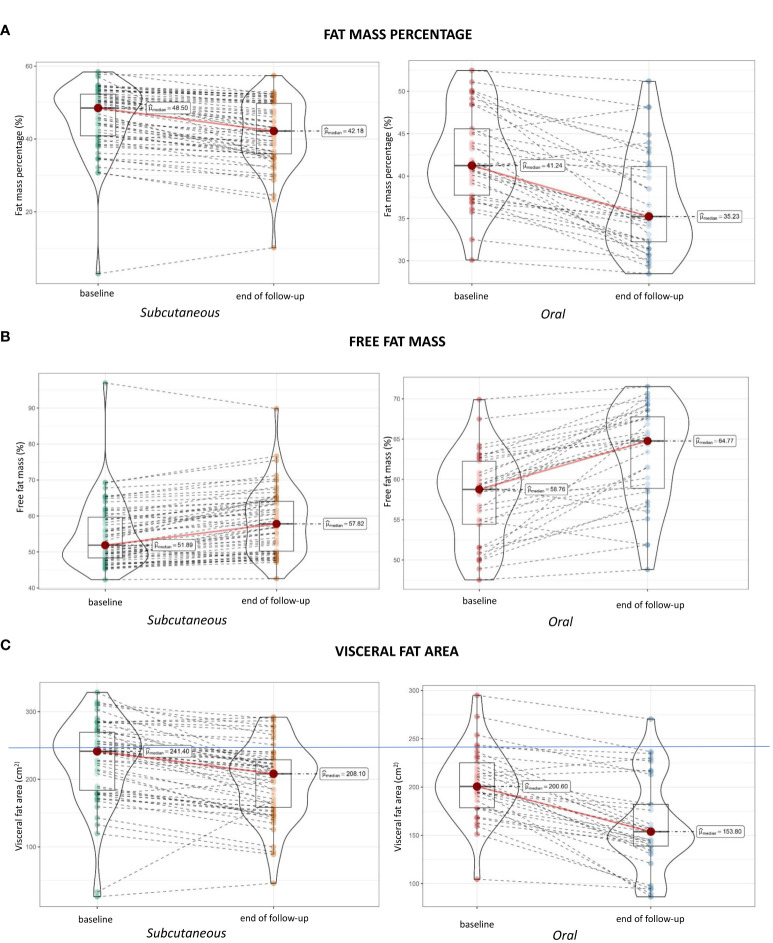
- Weight loss was driven mainly by fat loss: fat mass percentage fell by -4% in the subcutaneous group and -5.2% in the oral group, while fat-free mass percentage increased by 3.6% and 5.2%, respectively.
- Visceral fat area decreased by -30.2 cm² with subcutaneous semaglutide and -42.3 cm² with oral semaglutide; phase angle remained stable in both groups.
- Metabolic measures improved: total cholesterol fell by -30 mg/dl (subcutaneous) and -49.4 mg/dl (oral), HbA1c fell by -3.8% and -3%, and 92.3% of subcutaneous vs 75.8% of oral patients achieved HbA1c <7%.
- Multivariate analysis found that fat-mass loss was associated with baseline fat mass, baseline BMI, and concomitant iSGLT2/insulin treatment, but not with semaglutide route of administration.
## Methods
- Design: 24-week quasi-experimental retrospective real-world study, conducted in the Endocrinology and Nutrition Department of Virgen Macarena University Hospital (Seville) during 2020–2022.
- Sample: Adults ≥18 years with T2DM, HbA1c ≥7%, and BMI ≥30 kg/m² treated with oral or subcutaneous semaglutide; 88 patients were included after exclusions.
- Analysis: Body composition was assessed with multi-frequency bioelectrical impedance analysis (InBody 770) at baseline and week 24; laboratory outcomes included glycaemic control and lipid profile. Statistical analysis used SPSS v.26, with group comparisons and multiple linear regression for predictors of fat-mass loss.
## Limitations
- The paper states there was no control group, the follow-up was limited to 24 weeks, the sample size was narrow, and the study’s retrospective nature is a weakness.
- The authors also state they could not compare the treatment groups directly because of baseline differences.
- They note that bioelectrical impedance analysis is not the gold standard for body composition measurement.
- Evident from the text: because patients with intolerance/adverse effects were excluded, the results may underrepresent less-tolerant semaglutide users.
Model-written summary. Check it against the paper before relying on it.
Integrity signals
Registry
Cites
Statistics
Figures
Verification
Claims the paper makes
5 Valid · 1 Not valid · 16 Not checked · 43 Own results and interpretations
The cited sources support only part of this claim — read each source’s verdict below.
In the paper
“Several studies have indicated comparable outcomes between DXA and MF-BIA (26–29).”
§ Transforming body composition with semaglutide in adults with obesity and type 2 diabetes mellitus > Discussion
What the sources say
- Not checked — no full text of the sourcecites [26] Rosen CL Dunn BM Walker CD Downs RM Jones BA Danhoff GW. Validity: A study of the eight tactile point bioelectrical impedance using the DXA in body fat percentage assessment: 865 board# 261 may 27, 3:30 PM-5:00 PM. Med Sci Sports Exerc. (2015) 47: 237. source
- Not checked — no full text of the sourcecites [27] Kim M Shinkai S Murayama H Mori S. Comparison of segmental multifrequency bioelectrical impedance analysis with dual-energy X-ray absorptiometry for the assessment of body composition in a community-dwelling older population. Geriatrics Gerontology Int. (2014) 15: 1013–22. doi: 10.1111/ggi.12384 25345548 source
- Partly supportedcites [28] Jayanama K Putadechakun S Srisuwarn P Vallibhakara SAO Shantavasinkul PC Sritara C. Evaluation of body composition in hemodialysis thai patients: comparison between two models of bioelectrical impedance analyzer and dual-energy X-ray absorptiometry. J Of Nutr And Metab. (2018) 2018: 1– 11. doi: 10.1155/2018/4537623 PMC6098916 30174950 sourceExperimental — accuracy not yet measured
Materials and Methods §2.2 identifies both devices as multifrequency BIA analyzers. Results §3 reports strong correlations with DXA and no significant mean differences for InBody S10, supporting comparable outcomes for that model. But InBody 720 differed significantly on several measures, and both models had wide limits of agreement with DXA, so the unqualified claim needs qualification. (LLM, conf=0.85)
- Supportedcites [29] António J Kenyon M Ellerbroek A Carson C Burgess V Tyler-Palmer D. Comparison of Dual-Energy X-Ray Absorptiometry (DXA) versus a Multi-frequency Bioelectrical Impedance (InBody 770) Device for Body Composition Assessment after a 4-Week Hypoenergetic Diet. J Of Funct Morphology And Kinesiology. (2019) 4: 23. doi: 10.3390/jfmk4020023 PMC7739224 33467338 source
The Discussion reports that this study found MF-BIA and DXA comparable for changes in body composition and describes prior studies with similar findings. The Conclusions qualify that comparability as applying to group changes; MF-BIA showed more variability than DXA. (LLM, conf=0.90)
hedged- Asserted: passes — The authors put it forward as true.
- Checkable: passes — It can be checked against evidence.
- Load-bearing: passes — The paper’s conclusions depend on it.
- Based: passes — The paper gives a reason why it holds.
The cited sources support only part of this claim — read each source’s verdict below.
In the paper
“In particular, glucagon-like peptide-1 (GLP-1) receptor agonist (GLP-1ra) has demonstrated sustained, clinically significant body weight reductions in patients with T2DM and obesity (1–3).”
§ Transforming body composition with semaglutide in adults with obesity and type 2 diabetes mellitus > Introduction
What the sources say
- Partly supportedcites [1] Wilding J Batterham RL Calanna S Davies MJ Van Gaal LF Lingvay I. Once-Weekly semaglutide in adults with overweight or obesity. N Engl J Med. (2021) 384: 989– 1002. doi: 10.1056/nejmoa2032183 33567185 sourceExperimental — accuracy not yet measured
The Change in Body Weight and Discussion sections report substantial, clinically meaningful weight loss with semaglutide at week 68 in adults with overweight or obesity. But the Participants section says diabetes was an exclusion criterion, so this trial does not establish sustained, clinically significant reductions in patients with T2DM. (LLM, conf=0.90)
- Not checked — no full text of the sourcecites [2] Rubino D Abrahamsson N Davies MJ Hesse D Greenway FL Jensen C. Effect of continued weekly subcutaneous semaglutide vs placebo on weight loss maintenance in adults with overweight or obesity. JAMA. (2021) 325: 1414. doi: 10.1001/jama.2021.322 33755728 PMC7988425 doi:10.1001/jama.2021.322
- Not checked — no full text of the sourcecites [3] Rubino D Greenway FL Khalid U O’Neil PM Rosenstock J Sørrig R. Effect of weekly subcutaneous semaglutide vs daily liraglutide on body weight in adults with overweight or obesity without diabetes. JAMA. (2022) 327: 138. doi: 10.1001/jama.2021.236 35015037 PMC8753508 doi:10.1001/jama.2021.236
boostedstates a cause- Asserted: passes — The authors put it forward as true.
- Checkable: passes — It can be checked against evidence.
- Load-bearing: passes — The paper’s conclusions depend on it.
- Based: passes — The paper gives a reason why it holds.
- Partly supported
A result the paper reports from its own data — it cites no other source for it, so there is none to check. The quote shows it is in the paper.
In the paper
“Notably, no significant association was observed with the treatment administration route ( Table 4 ).”
§ Transforming body composition with semaglutide in adults with obesity and type 2 diabetes mellitus > Results > Multivariate analysis
plainn = 88- Asserted: passes — The authors put it forward as true.
- Checkable: passes — It can be checked against evidence.
- Load-bearing: unclear — It is unclear whether the paper’s conclusions depend on it.
- Based: passes — The paper gives a reason why it holds.
A result the paper reports from its own data — it cites no other source for it, so there is none to check. The quote shows it is in the paper.
In the paper
“Additionally, basal insulin requirements in our cohort decreased after follow-up”
§ Transforming body composition with semaglutide in adults with obesity and type 2 diabetes mellitus > Discussion
plainstates a cause- Asserted: passes — The authors put it forward as true.
- Checkable: passes — It can be checked against evidence.
- Load-bearing: passes — The paper’s conclusions depend on it.
- Based: passes — The paper gives a reason why it holds.
A result the paper reports from its own data — it cites no other source for it, so there is none to check. The quote shows it is in the paper.
In the paper
“With respect to analytical parameters, glycaemic control improved significantly as proven by HbA1c and fasting plasma glucose.”
§ Transforming body composition with semaglutide in adults with obesity and type 2 diabetes mellitus > Discussion
boostedstates a cause- Asserted: passes — The authors put it forward as true.
- Checkable: passes — It can be checked against evidence.
- Load-bearing: passes — The paper’s conclusions depend on it.
- Based: passes — The paper gives a reason why it holds.
19 more claims
Create a free account to see all 65 claims and every source verdict.
- Probably not a substantial claim. 24
- It may state two separate claims as one. 25
- The quote only partly states this claim. 2
Citations
Cites
10-year follow-up of intensive glucose control in type 2 diabetes
Holman, R. R., Paul, S. K., Bethel, M. A., Matthews, D. R., & Neil, H. A. W. (2008) · New England Journal of Medicine · doi:10.1056/nejmoa0806470 · Cited by 7,751 · cited 1×
“Attaining desired blood glucose levels is a key objective in diabetes management, since optimal glycaemic control reduces the risk of both microvascular and macrovascular complications (36, 55).”
BackgroundOnce-Weekly Semaglutide in Adults with Overweight or Obesity
Wilding, J. P. H., Batterham, R. L., Calanna, S., Davies, M., Van Gaal, L. F., Lingvay, I., McGowan, B. M., Rosenstock, J., Tran, M. T. D., Wadden, T. A., et al. (2021) · New England Journal of Medicine · doi:10.1056/nejmoa2032183 · Cited by 5,205
Cardiovascular effects of intensive lifestyle intervention in type 2 diabetes
The Look AHEAD Research Group (2013) · New England Journal of Medicine · doi:10.1056/nejmoa1212914 · Cited by 2,908 · cited 1×
“…stimulating weight loss and improving glycaemic control (5), as well as promoting physiological effects such as cardiovascular risk reduction (5, 11, 12), atherogenesis prevention through vascular in fl ammation modulation (13, 14) and renoprotective and neuroprotective effects (15 – 18), which…”
Background2. Classification and Diagnosis of Diabetes:Standards of Care in Diabetes—2023
ElSayed, N. A., Aleppo, G., Aroda, V. R., Bannuru, R. R., Brown, F. M., Bruemmer, D., Collins, B. S., Gaglia, J. L., Hilliard, M. E., Isaacs, D., et al. (2023) · Diabetes Care · doi:10.2337/dc23-s002 · Cited by 2,433
The biology of incretin hormones
Drucker, D. J. (2006) · Cell Metabolism · doi:10.1016/j.cmet.2006.01.004 · Cited by 2,210 · cited 13×
“However, considering our results and previous research (20), it would seem highly advisable to implement targeted physical exercise to preserve and potentially enhance muscle mass in patients receiving GLP-1 based therapies.”
BackgroundInfluentialTirzepatide versus Semaglutide Once Weekly in Patients with Type 2 Diabetes
Frías, J. P., Davies, M. J., Rosenstock, J., Pérez Manghi, F. C., Fernández Landó, L., Bergman, B. K., Liu, B., Cui, X., & Brown, K. (2021) · New England Journal of Medicine · doi:10.1056/nejmoa2107519 · Cited by 2,096
Garvey, W. T., Mechanick, J. I., Brett, E. M., Garber, A. J., Hurley, D. L., Jastreboff, A. M., Nadolsky, K., Pessah-Pollack, R., & Plodkowski, R. (2016) · Endocrine Practice · doi:10.4158/ep161365.gl · Cited by 1,914
Obesity in adults: a clinical practice guideline
Wharton, S., Lau, D. C. W., Vallis, M., Sharma, A. M., Biertho, L., Campbell-Scherer, D., Adamo, K., Alberga, A., Bell, R., Boulé, N., et al. (2020) · Canadian Medical Association Journal · doi:10.1503/cmaj.191707 · Cited by 1,506
Rubino, D., Abrahamsson, N., Davies, M., Hesse, D., Greenway, F. L., Jensen, C., Lingvay, I., Mosenzon, O., Rosenstock, J., Rubio, M. A., et al. (2021) · JAMA · doi:10.1001/jama.2021.3224 · Cited by 1,444
Self-citationBhaskaran, K., dos-Santos-Silva, I., Leon, D. A., Douglas, I. J., & Smeeth, L. (2018) · The Lancet Diabetes & Endocrinology · doi:10.1016/s2213-8587(18)30288-2 · Cited by 1,228
Discovery of the once-weekly glucagon-like peptide-1 (GLP-1) analogue semaglutide
Lau, J., Bloch, P., Schäffer, L., Pettersson, I., Spetzler, J., Kofoed, J., Madsen, K., Knudsen, L. B., McGuire, J., Steensgaard, D. B., et al. (2015) · Journal of Medicinal Chemistry · doi:10.1021/acs.jmedchem.5b00726 · Cited by 1,105
Rubino, D. M., Greenway, F. L., Khalid, U., O’Neil, P. M., Rosenstock, J., Sørrig, R., Wadden, T. A., Wizert, A., Garvey, W. T., STEP 8 Investigators, et al. (2022) · JAMA · doi:10.1001/jama.2021.23619 · Cited by 995
Why does obesity cause diabetes?
Klein, S., Gastaldelli, A., Yki-Järvinen, H., & Scherer, P. E. (2022) · Cell Metabolism · doi:10.1016/j.cmet.2021.12.012 · Cited by 939 · cited 2×
“Adiposity is an independent risk factor for glycometabolism disorder, since fat accumulation affects insulin ’ s action by different mechanisms including insulin resistance in organs such as the liver and muscle tissue (46, 48).”
BackgroundLong-term Drug Treatment for Obesity: A Systematic and Clinical Review
Yanovski, S. Z., & Yanovski, J. A. (2014) · JAMA · doi:10.1001/jama.2013.281361 · Cited by 876 · cited 1×
“…weight loss and improving glycaemic control (5), as well as promoting physiological effects such as cardiovascular risk reduction (5, 11, 12), atherogenesis prevention through vascular in fl ammation modulation (13, 14) and renoprotective and neuroprotective effects (15 – 18), which…”
BackgroundMcClean, P. L., Parthsarathy, V., Faivre, E., & Hölscher, C. (2011) · The Journal of Neuroscience · doi:10.1523/jneurosci.0529-11.2011 · Cited by 698
Bosy‐Westphal, A., Danielzik, S., Dörhöfer, R., Later, W., Wiese, S., & Müller, M. J. (2006) · Journal of Parenteral and Enteral Nutrition · doi:10.1177/0148607106030004309 · Cited by 595
Arakawa, M., Mita, T., Azuma, K., Ebato, C., Goto, H., Nomiyama, T., Fujitani, Y., Hirose, T., Kawamori, R., & Watada, H. (2010) · Diabetes · doi:10.2337/db09-1694 · Cited by 548
GLP-1 physiology informs the pharmacotherapy of obesity
Drucker, D. J. (2022) · Molecular Metabolism · doi:10.1016/j.molmet.2021.101351 · Cited by 510 · cited 1×
“GLP-1 receptors are widely expressed in tissues beyond the gastrointestinal tract, including the endocrine pancreas, kidneys, cardiovascular system, and various regions of the nervous system (4, 5, 7).”
BackgroundAhrén, B., Masmiquel, L., Kumar, H., Sargin, M., Karsbøl, J. D., Jacobsen, S. H., & Chow, F. (2017) · The Lancet Diabetes & Endocrinology · doi:10.1016/s2213-8587(17)30092-x · Cited by 495
Marx, N., Husain, M., Lehrke, M., Verma, S., & Sattar, N. (2022) · Circulation · doi:10.1161/circulationaha.122.059595 · Cited by 483
Aroda, V. R., Bain, S. C., Cariou, B., Piletič, M., Rose, L., Axelsen, M., Rowe, E., & DeVries, J. H. (2017) · The Lancet Diabetes & Endocrinology · doi:10.1016/s2213-8587(17)30085-2 · Cited by 464
Fat-free and fat mass percentiles in 5225 healthy subjects aged 15 to 98 years
Kyle, U. G., Genton, L., Slosman, D. O., & Pichard, C. (2001) · Nutrition · doi:10.1016/s0899-9007(01)00555-x · Cited by 440 · cited 1×
“Several investigations have been carried out around the world, based on large population samples in Germany (51), the United States (52) and Switzerland (53), obtaining notable differences (35).”
BackgroundSemaglutide added to basal insulin in type 2 diabetes (SUSTAIN 5): a randomized, controlled trial.
Rodbard, H. W., Lingvay, I., Reed, J., de la Rosa, R., Rose, L., Sugimoto, D., Araki, E., Chu, P.-L., Wijayasinghe, N., & Norwood, P. (2018) · The Journal of Clinical Endocrinology & Metabolism · doi:10.1210/jc.2018-00070 · Cited by 412
Signaling pathways in obesity: mechanisms and therapeutic interventions
Wen, X., Zhang, B., Wu, B., Xiao, H., Li, Z., Li, R., Xu, X., & Li, T. (2022) · Signal Transduction and Targeted Therapy · doi:10.1038/s41392-022-01149-x · Cited by 410 · cited 13×
“However, considering our results and previous research (20), it would seem highly advisable to implement targeted physical exercise to preserve and potentially enhance muscle mass in patients receiving GLP-1 based therapies.”
BackgroundInfluentialBarbosa-Silva, M. C. G., & Barros, A. J. (2005) · Current Opinion in Clinical Nutrition & Metabolic Care · doi:10.1097/01.mco.0000165011.69943.39 · Cited by 400 · cited 1×
“Several investigations have been carried out around the world, based on large population samples in Germany (51), the United States (52) and Switzerland (53), obtaining notable differences (35).”
BackgroundZinman, B., Bhosekar, V., Busch, R., Holst, I., Ludvik, B., Thielke, D., Thrasher, J., Woo, V., & Philis-Tsimikas, A. (2019) · The Lancet Diabetes & Endocrinology · doi:10.1016/s2213-8587(19)30066-x · Cited by 376 · cited 1×
“This is consistent with SUSTAIN 9 ’ s trial, where both parameters signi fi cantly decreased in the same proportion (58).”
ResultBioimpedance at the Bedside: Current Applications, Limitations, and Opportunities
Mulasi, U., Kuchnia, A. J., Cole, A. J., & Earthman, C. P. (2015) · Nutrition in Clinical Practice · doi:10.1177/0884533614568155 · Cited by 337 · cited 3×
“Several investigations have been carried out around the world, based on large population samples in Germany (51), the United States (52) and Switzerland (53), obtaining notable differences (35).”
BackgroundLi, Y., Duffy, K. B., Ottinger, M. A., Ray, B., Bailey, J. A., Holloway, H. W., Tweedie, D., Perry, T., Mattson, M. P., Kapogiannis, D., et al. (2010) · Journal of Alzheimer's Disease · doi:10.3233/jad-2010-1314 · Cited by 321
Review of head‐to‐head comparisons of glucagon‐like peptide‐1 receptor agonists
Madsbad, S. (2016) · Diabetes, Obesity and Metabolism · doi:10.1111/dom.12596 · Cited by 305
Obesity and diabetes—Not only a simple link between two epidemics
Chobot, A., Górowska‐Kowolik, K., Sokołowska, M., & Jarosz‐Chobot, P. (2018) · Diabetes/Metabolism Research and Reviews · doi:10.1002/dmrr.3042 · Cited by 281
Phase angle and mortality: a systematic review
Garlini, L. M., Alves, F. D., Ceretta, L. B., Perry, I. S., Souza, G. C., & Clausell, N. O. (2019) · European Journal of Clinical Nutrition · doi:10.1038/s41430-018-0159-1 · Cited by 277 · cited 1×
“PhA is a raw bioelectrical parameter with a demonstrated prognostic utility (50).”
BackgroundHypothesis Concerning the U-shaped Relation between Body Mass Index and Mortality
Allison, D. B., Faith, M. S., Heo, M., & Kotler, D. P. (1997) · American Journal of Epidemiology · doi:10.1093/oxfordjournals.aje.a009275 · Cited by 228 · cited 1×
“Traditionally, the association between BMI and long-term all-cause mortality was described as a U-shape (41), as a result of different underlying risk functions of opposite directions associated with fat and fat-free body compartments (42).”
BackgroundFineman, M. S., Shen, L. Z., Taylor, K., Kim, D. D., & Baron, A. D. (2004) · Diabetes/Metabolism Research and Reviews · doi:10.1002/dmrr.499 · Cited by 227
Kim, M., Shinkai, S., Murayama, H., & Mori, S. (2015) · Geriatrics & Gerontology International · doi:10.1111/ggi.12384 · Cited by 221
Future lines of research on phase angle: Strengths and limitations
Bellido, D., García-García, C., Talluri, A., Lukaski, H. C., & García-Almeida, J. M. (2023) · Reviews in Endocrine and Metabolic Disorders · doi:10.1007/s11154-023-09803-7 · Cited by 209
The gut–renal axis: do incretin-based agents confer renoprotection in diabetes?
Muskiet, M. H. A., Smits, M. M., Morsink, L. M., & Diamant, M. (2014) · Nature Reviews Nephrology · doi:10.1038/nrneph.2013.272 · Cited by 181
Gaspari, T., Welungoda, I., Widdop, R. E., Simpson, R. W., & Dear, A. E. (2013) · Diabetes and Vascular Disease Research · doi:10.1177/1479164113481817 · Cited by 148
Safety and tolerability of once‐weekly GLP‐1 receptor agonists in type 2 diabetes
Trujillo, J. (2020) · Journal of Clinical Pharmacy and Therapeutics · doi:10.1111/jcpt.13225 · Cited by 130
Esco, M. R., Snarr, R. L., Leatherwood, M. D., Chamberlain, N. A., Redding, M. L., Flatt, A. A., Moon, J. R., & Williford, H. N. (2015) · Journal of Strength and Conditioning Research · doi:10.1519/jsc.0000000000000732 · Cited by 122
GLP ‐1 receptor agonists: Nonglycemic clinical effects in weight loss and beyond
Ryan, D., & Acosta, A. (2015) · Obesity · doi:10.1002/oby.21107 · Cited by 112 · cited 5×
“Additionally, glucagon secretion is suppressed by GLP-1 (4), leading to a glucose-dependent reduction of hepatic glucose production (5).”
BackgroundInfluentialWilding, J. P. H., Batterham, R. L., Calanna, S., Van Gaal, L. F., McGowan, B. M., Rosenstock, J., Tran, M. T. D., Wharton, S., Yokote, K., Zeuthen, N., et al. (2021) · Journal of the Endocrine Society · doi:10.1210/jendso/bvab048.030 · Cited by 107
Antonio, J., Kenyon, M., Ellerbroek, A., Carson, C., Burgess, V., Tyler-Palmer, D., Mike, J., Roberts, J., Angeli, G., & Peacock, C. (2019) · Journal of Functional Morphology and Kinesiology · doi:10.3390/jfmk4020023 · Cited by 106
MR-based assessment of body fat distribution and characteristics
Baum, T. H., Cordes, C., Dieckmeyer, M., Ruschke, S., Franz, D., Hauner, H., Kirschke, J. S., & Karampinos, D. C. (2016) · European Journal of Radiology · doi:10.1016/j.ejrad.2016.02.013 · Cited by 98
Effects of glucagon-like peptide-1 receptor agonists on renal function
Filippatos, T. D., & Elisaf, M. S. (2013) · World Journal of Diabetes · doi:10.4239/wjd.v4.i5.190 · Cited by 97
Schlögl, H., Kabisch, S., Horstmann, A., Lohmann, G., Müller, K., Lepsien, J., Busse-Voigt, F., Kratzsch, J., Pleger, B., Villringer, A., et al. (2013) · Diabetes Care · doi:10.2337/dc12-1925 · Cited by 88
Body composition and mortality in the general population: A review of epidemiologic studies
Lee, D. H., & Giovannucci, E. L. (2018) · Experimental Biology and Medicine · doi:10.1177/1535370218818161 · Cited by 88 · cited 1×
“Recent investigation has shown an inverse association between FFM and mortality, whereas FM was directly associated with mortality (43).”
BackgroundBioimpedance phase angle indicates catabolism in Type 2 diabetes
Dittmar, M., Reber, H., & Kahaly, G. J. (2015) · Diabetic Medicine · doi:10.1111/dme.12710 · Cited by 85 · cited 2×
“PhA acts as a marker of the amount of electrical charge that a cell membrane can hold, related to membrane integrity, permeability, overall size and hydration (35); therefore, indicating cellular health and function (49).”
BackgroundVolpe, S., Lisco, G., Fanelli, M., Racaniello, D., Colaianni, V., Lavarra, V., Triggiani, D., Crudele, L., Triggiani, V., Sabbà, C., et al. (2023) · Frontiers in Endocrinology · doi:10.3389/fendo.2023.1240263 · Cited by 73 · cited 1×
“One study (60), assessed the impact of OS in 32 patients with a mean BMI of 28.2 kg/m2.”
BackgroundInfluentialAlmeida, J. M. G., García, C. G., Bellido, V., et al. (2018) · Nutrición Hospitalaria · doi:10.20960/nh.2027 · Cited by 68
Volpe, S., Lisco, G., Racaniello, D., Fanelli, M., Colaianni, V., Vozza, A., Triggiani, V., Sabbà, C., Tortorella, C., De Pergola, G., et al. (2022) · Nutrients · doi:10.3390/nu14122414 · Cited by 67 · cited 2×
“In the other study (37), involving subcutaneous administration of semaglutide in a population of 40 patients with a mean BMI of 38.8 kg/m2, a weight loss of 9.89kg was observed after 6 months.”
BackgroundInfluentialEffect of GLP-1 Based Therapies on Diabetic Dyslipidemia
Patel, V., Joharapurkar, A., Shah, G., & Jain, M. (2014) · Current Diabetes Reviews · doi:10.2174/1573399810666140707092506 · Cited by 67 · cited 1×
“It is suggested that such improvement could come alongside with reductions in body weight and glucose levels; GLP-1ra have also been shown to regulate cholesterol and triglyceride concentrations via several different pathways (59).”
BackgroundSchoenfeld, B. J., Nickerson, B. S., Wilborn, C. D., Urbina, S. L., Hayward, S. B., Krieger, J., Aragon, A. A., & Tinsley, G. M. (2020) · Journal of Strength and Conditioning Research · doi:10.1519/jsc.0000000000002708 · Cited by 59
Jayanama, K., Putadechakun, S., Srisuwarn, P., Vallibhakara, S. A.-O., Chattranukulchai Shantavasinkul, P., Sritara, C., Kantachuvesiri, S., & Komindr, S. (2018) · Journal of Nutrition and Metabolism · doi:10.1155/2018/4537623 · Cited by 48
(1997) · National Academies Press eBooks · doi:10.17226/5827 · Cited by 42
Østergaard, J. N., Grønbæk, M., Schnohr, P., Sørensen, T. I. A., & Heitmann, B. L. (2010) · International Journal of Obesity · doi:10.1038/ijo.2009.274 · Cited by 40
(2023) · doi:10.26355/eurrev_202310_34169 · Cited by 36
Impact of body composition changes on risk of all-cause mortality in older adults
Graf, C. E., Herrmann, F. R., Spoerri, A., Makhlouf, A., Sørensen, T. I. A., Ho, S., Karsegard, V. L., & Genton, L. (2016) · Clinical Nutrition · doi:10.1016/j.clnu.2016.04.003 · Cited by 34 · cited 7×
“Parameters including fat mass (FM), fat free mass (FFM), total body water, skeletal muscle mass and phase angle (PhA) where registered.”
BackgroundInfluentialBioelectrical Impedance: A History, Research Issues, and Recent Consensus
Carlson-Newberry, S. J., & Costello, R. B. (1997) · Cited by 19
Carvalho, J. B., de Andrade, G. K. P., do Nascimento, L. A., Golin, N., Rodrigues, A. L. C. C., Suíter, E., Soprani, M. V. O., & Severine, A. N. (2023) · BMC Infectious Diseases · doi:10.1186/s12879-023-08833-5 · Cited by 8
Kamalinia, S., Josse, R. G., Donio, P. J., Leduc, L., Shah, B. R., & Tobe, S. W. (2019) · Endocrinology Diabetes & Metabolism · doi:10.1002/edm2.100 · Cited by 7
Gómez, J. C., Arévalo‐Lorido, J. C., & Martínez, L. G. (2022) · Diabetes · doi:10.2337/db22-1493-pub · Cited by 2
Rosen (2015) · doi:10.1249/01.mss.0000477071.37233.5b · Cited by 1
Carvalho, J. B., de Andrade, G. K. P., do Nascimento, L. A., et al. (2023) · Research Square · doi:10.21203/rs.3.rs-2406253/v1 · Cited by 1
Research works printed but not linked: 1
- Carreira J Cornejo I Vegas I García CG Almeida JMG Bellido D. Aplicaciones del ángulo de fase de la bioimpedancia en la nutrición clínica. Nutr Clín Med. (2022) XVI: 33– 46. doi: 10.7400/NCM.2022.16.1.5107 · doi:10.7400/ncm.2022.16.1.5107
Cited by
Spotlight on the Mechanism of Action of Semaglutide
Papakonstantinou, I. P., Tsioufis, K. P., & Katsi, V. K. (2024) · Current Issues in Molecular Biology · doi:10.3390/cimb46120872 · Cited by 102
Glucagon-like peptide-1 receptor agonists and muscle mass effects
Ceasovschih, A., Asaftei, A., Lupo, M. G., Kotlyarov, S., Bartušková, H., Balta, A., Sorodoc, V., Sorodoc, L., & Banach, M. (2025) · Pharmacological Research · doi:10.1016/j.phrs.2025.107927 · Cited by 64
Packer, M., Zile, M. R., Kramer, C. M., Murakami, M., Ou, Y., & Borlaug, B. A. (2025) · Journal of the American College of Cardiology · doi:10.1016/j.jacc.2025.03.009 · Cited by 49
GLP-1 receptor agonists and sarcopenia: Weight loss at a cost? A brief narrative review
Pantazopoulos, D., Gouveri, E., Papazoglou, D., & Παπάνας, Ν. (2025) · Diabetes Research and Clinical Practice · doi:10.1016/j.diabres.2025.112924 · Cited by 55
Scheen, A. J. (2025) · Diabetes & Metabolism · doi:10.1016/j.diabet.2025.101681 · Cited by 30
Metadata
- Authors
- Rodríguez Jiménez, B., Rodríguez de Vera Gómez, P., Belmonte Lomas, S., Mesa Díaz, Á. M., Caballero Mateos, I., Galán, I., Morales Portillo, C., & Martínez-Brocca, M. A.
- Affiliations
- Hospital Universitario Virgen Macarena (ES)
- Venue
- Frontiers in Endocrinology
- Publisher
- Frontiers Media SA
- Published
- 2024-06-04
- Volume
- 15
- Pages
- 1386542-1386542
- ISSN
- 1664-2392 (ISSN-L)
- PMC
- PMC11182984
- OpenAlex
- W4399330051
- Cited by
- 39
- References
- 70
- Citations by year
- 2026: 19 · 2025: 18 · 2024: 2
- FWCI
- 12.76
- Type
- journal article
- Language
- en
- Open access
- gold
- doi.org
- Licence
- Locations
- Frontiers in Endocrinology (publishedVersion, cc-by)
- PubMed Central (publishedVersion, cc-by)
- PubMed (publishedVersion)
- DOAJ (DOAJ: Directory of Open Access Journals) (submittedVersion)
- Topics
- Health Sciences › Medicine › Endocrinology, Diabetes and Metabolism › Diabetes Treatment and Management
- Health Sciences › Medicine › Pharmacology (medical) › Pharmacology and Obesity Treatment
- Health Sciences › Medicine › Endocrinology, Diabetes and Metabolism › Diabetes, Cardiovascular Risks, and Lipoproteins
- Keywords
- semaglutide, body composition, obesity, type 2 diabetes, GLP-1 receptor agonists, oral semaglutide, fat mass reduction, visceral fat, fat-free mass, phase angle, lipid profile, glycemic control, HbA1c, insulin requirement, weight loss
- MeSH terms
- Semaglutide, Adult, Aged, Blood Glucose, Body Composition, Diabetes Mellitus, Type 2, Glucagon-Like Peptides, Female, Humans, Hypoglycemic Agents, Male, Middle Aged, Obesity, Retrospective Studies, Weight Loss
About these checks
Registry, retraction, Cites and statistics results are computed, not judged, with one exception: a printed reference that no index lists is read once by a model before it counts as a citation error. Claims are extracted by a model and kept only when their quote appears verbatim in the text; each cited source is then checked, with a model’s help, for whether it says what the claim relies on. Those verdicts can be wrong — read the claim’s quote and the cited source before relying on one.
The claim verdicts this report counts are experimental: their accuracy is not yet measured.
A language model drew the claims from the paper on 2026-10-10, under version 3 of the claim definition (model deepseek-v4.1-flash, prompt extract-v3).
A second model labelled each claim on 2026-10-10 (model jev-1.13-20260917, definition revision gold-guideline-v0.2).
Cited sources are checked with a language model’s help (gpt-6-sol).
Statistics and arithmetic are recomputed, not judged.
Confidence bands are shown only for fields calibrated on our annotated test set. None is calibrated yet, so no band is shown.
What counts as a claim ›How we measure confidence ›How we check this ›
Are you an author, or do you see a problem with this page? Request a review
Data sources
Bibliographic data: Semantic Scholar, OpenAlex, Crossref.
Contains information from the Semantic Scholar Academic Graph Datasets, made available under the ODC Attribution License (ODC-BY 1.0).
Semantic Scholar’s data is described in: Kinney, R., et al. (2023). The Semantic Scholar Open Data Platform. arXiv:2301.10140.
