

The DOI matches its Crossref record; 11 of the 11 references it cites were found in a registry or an index.
Genetic Relationship Among the Kazakh People Based on Y-STR Markers Reveals Evidence of Genetic Variation Among Tribes and Zhuz.
Abstract
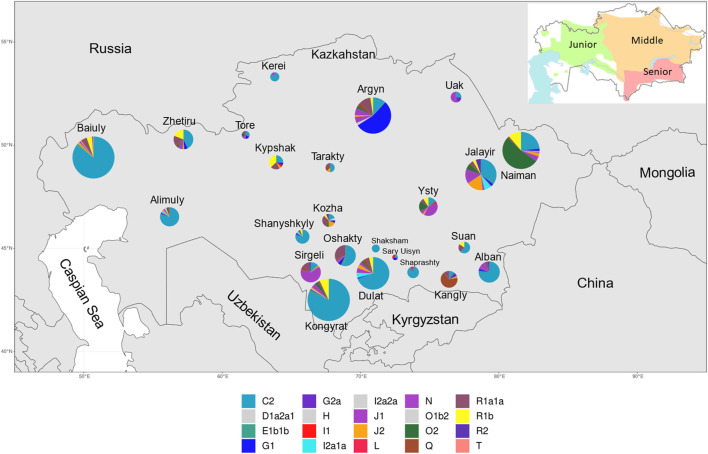
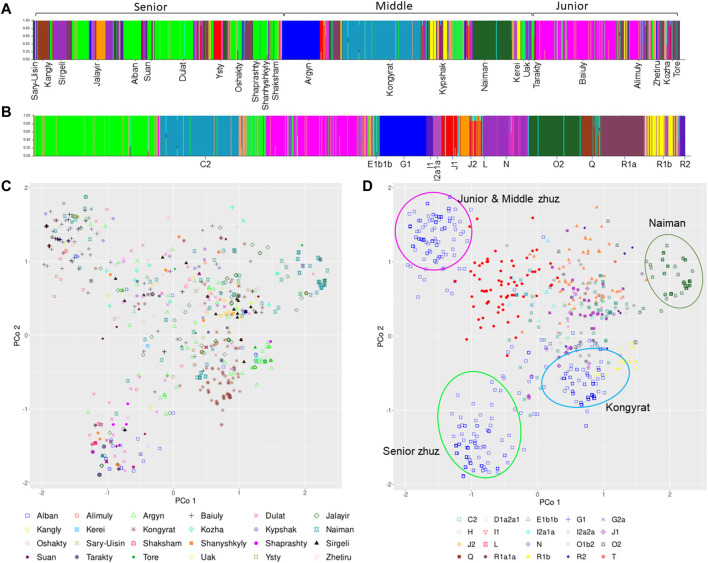
Ethnogenesis of Kazakhs took place in Central Asia, a region of high genetic and cultural diversity. Even though archaeological and historical studies have shed some light on the formation of modern Kazakhs, the process of establishment of hierarchical socioeconomic structure in the Steppe remains contentious. In this study, we analyzed haplotype variation at 15 Y-chromosomal short-tandem-repeats obtained from 1171 individuals from 24 tribes representing the three socio-territorial subdivisions (Senior, Middle and Junior zhuz) in Kazakhstan to comprehensively characterize the patrilineal genetic architecture of the Kazakh Steppe. In total, 577 distinct haplotypes were identified belonging to one of 20 haplogroups; 16 predominant haplogroups were confirmed by SNP-genotyping. The haplogroup distribution was skewed towards C2-M217, present in all tribes at a global frequency of 51.9%. Despite signatures of spatial differences in haplotype frequencies, a Mantel test failed to detect a statistically significant correlation between genetic and geographic distance between individuals. An analysis of molecular variance found that ∼8.9% of the genetic variance among individuals was attributable to differences among zhuzes and ∼20% to differences among tribes within zhuzes. The STRUCTURE analysis of the 1164 individuals indicated the presence of 20 ancestral groups and a complex three-subclade organization of the C2-M217 haplogroup in Kazakhs, a result supported by the multidimensional scaling analysis. Additionally, while the majority of the haplotypes and tribes overlapped, a distinct cluster of the O2 haplogroup, mostly of the Naiman tribe, was observed. Thus, firstly, our analysis indicated that the majority of Kazakh tribes share deep heterogeneous patrilineal ancestries, while a smaller fraction of them are descendants of a founder paternal ancestor. Secondly, we observed a high frequency of the C2-M217 haplogroups along the southern border of Kazakhstan, broadly corresponding to both the path of the Mongolian invasion and the ancient Silk Road. Interestingly, we detected three subclades of the C2-M217 haplogroup that broadly exhibits zhuz-specific clustering. Further study of Kazakh haplotypes variation within a Central Asian context is required to untwist this complex process of ethnogenesis.
Overview
The claims and statistics of this paper haven’t been checked yet.
Run the check — free, no account needed. It reads the open-access text and checks the sources it cites.
Integrity signals
Registry
Cites
Statistics
Figures
Verification
Claims the paper makes
The claims and statistics of this paper haven’t been checked yet.
Run the check — free, no account needed. It reads the open-access text and checks the sources it cites.
Claims other papers make about this one
Each is checked against this paper’s own text: does it say what the citing paper says it does?
In the citing paper
“These variants include E-M35, N-M231, and C2-M48.”
From Y-Chromosomal insights into the paternal genealogy of the Kerey tribe have called into question their descent from the Stepfather of Genghis Khan (2024) · cites this paper as [9]
In the citing paper
“This haplogroup is also observed in the Karakerey clan, with a frequency of 70% [9].”
From Y-Chromosomal insights into the paternal genealogy of the Kerey tribe have called into question their descent from the Stepfather of Genghis Khan (2024) · cites this paper as [9]
In the citing paper
“Specifically, four individuals have been identified with such variants, [9,35,39].”
From Y-Chromosomal insights into the paternal genealogy of the Kerey tribe have called into question their descent from the Stepfather of Genghis Khan (2024) · cites this paper as [9]
In the citing paper
“The Sirgeli tribe exhibits a high prevalence (71%) of the N-M231 Y-chromosome haplogroup [9,38].”
From Y-Chromosomal insights into the paternal genealogy of the Kerey tribe have called into question their descent from the Stepfather of Genghis Khan (2024) · cites this paper as [9]
Self-check
Percentages, sums and reported differences re-computed from the paper’s own numbers.
The self-check needs the paper’s full text.
Citations
Cites
Population genomics of Bronze Age Eurasia
Allentoft, M. E., Sikora, M., Sjögren, K.-G., Rasmussen, S., Rasmussen, M., Stenderup, J., Damgaard, P. B., Schroeder, H., Ahlström, T., Vinner, L., et al. (2015) · Nature · doi:10.1038/nature14507 · Cited by 1,550
The Genetic Legacy of the Mongols
Zerjal, T., Xue, Y., Bertorelle, G., Wells, R. S., Bao, W., Zhu, S., Qamar, R., Ayub, Q., Mohyuddin, A., Fu, S., et al. (2003) · The American Journal of Human Genetics · doi:10.1086/367774 · Cited by 563
Distribution of the male lineages of Genghis Khan’s descendants in northern Eurasian populations
Derenko, M. V., Malyarchuk, B. A., Wozniak, M., Denisova, G. A., Dambueva, I. K., Dorzhu, C. M., Grzybowski, T., & Zakharov, I. A. (2007) · Russian Journal of Genetics · doi:10.1134/s1022795407030179 · Cited by 109
Dulik, M. C., Osipova, L. P., & Schurr, T. G. (2011) · PLoS ONE · doi:10.1371/journal.pone.0017548 · Cited by 76
Abilev, S., Malyarchuk, B., Derenko, M., Wozniak, M., Grzybowski, T., & Zakharov, I. (2012) · Human Biology · doi:10.3378/027.084.0106 · Cited by 56
The Connection of the Genetic, Cultural and Geographic Landscapes of Transoxiana
Zhabagin, M., Balanovska, E., Sabitov, Z., Kuznetsova, M., Agdzhoyan, A., Balaganskaya, O., Chukhryaeva, M., Markina, N., Romanov, A., Skhalyakho, R., et al. (2017) · Scientific Reports · doi:10.1038/s41598-017-03176-z · Cited by 39
Dispersals of the Siberian Y-chromosome haplogroup Q in Eurasia
Huang, Y.-Z., Pamjav, H., Flegontov, P., Stenzl, V., Wen, S.-Q., Tong, X.-Z., Wang, C.-C., Wang, L.-X., Wei, L.-H., Gao, J.-Y., et al. (2018) · Molecular Genetics and Genomics · doi:10.1007/s00438-017-1363-8 · Cited by 34
The medieval Mongolian roots of Y-chromosomal lineages from South Kazakhstan
Zhabagin, M., Sabitov, Z., Tarlykov, P., Tazhigulova, I., Junissova, Z., Yerezhepov, D., Akilzhanov, R., Zholdybayeva, E., Wei, L.-H., Akilzhanova, A., et al. (2020) · BMC Genetics · doi:10.1186/s12863-020-00897-5 · Cited by 21
Medieval Super-Grandfather founder of Western Kazakh Clans from Haplogroup C2a1a2-M48
Zhabagin, M., Sabitov, Z., Tazhigulova, I., Alborova, I., Agdzhoyan, A., Wei, L.-H., Urasin, V., Koshel, S., Mustafin, K., Akilzhanova, A., et al. (2021) · Journal of Human Genetics · doi:10.1038/s10038-021-00901-5 · Cited by 16
Estimating the impact of the Mongol expansion upon the gene pool of Tuvans
Damba, L. D., Balanovskaya, Е. V., Zhabagin, M. K., Yusupov, Y. М., Bogunov, Y. V., Sabitov, Z. M., Agdzhoyan, A. T., Korotkova, N. A., Lavryashina, M. B., Mongush, B. B., et al. (2018) · Vavilov Journal of Genetics and Breeding · doi:10.18699/vj18.402 · Cited by 15
Research works printed but not linked: 67
- Akerov, 2016, On the Origin of the Naiman, J. Sib. Fed. Univ. Humanit. Soc. Sci., 9, 2071, 10.17516/1997-1370-2016-9-9-2071-2081 · DOI
- Akishev, 1996, History of Kazakhstan in 4 Volumes
- Artykbaev, 2020, O Kazahskom Plemeni Sirgeli: Problemy Proishozhdenija [Kazakh Tribe Sirgeli: Problems of Origin], North-Eastern humanitarian Bull., 2, 34, 10.25693/SVGV.2020.31.2.004 · DOI
- Ashirbekov, 2017, Raspredelenie Gaplogrupp Y-Hromosomy Kazahov Juzhno-Kazahstanskoj, Zhambylskoj I Almatinskoj Oblasti [Distribution of Y-Chromosome Haplogroups of Kazakhs in South Kazakhstan, Zhambyl and Almaty Regions], 25
- Ashirbekov, 2018, Molecular Genetic Analysis of Population Structure of the Great Zhuz Kazakh Tribal Union Based on Y-Chromosome Polymorphism, Mol. Genet. Microbiol. Virol., 33, 91, 10.3103/S0891416818020040 · DOI · Paper page
- Bai, 2013, Haplotype Diversity of 17 Y-STR Loci in a Chinese Han Population Sample from Shanxi Province, Northern China, Forensic Sci. Int. Genet., 7, 214, 10.1016/j.fsigen.2012.10.004 · DOI
- Balaganskaya, 2011, Gene Pool of the Altay Ethnic Groups (From Russia, Kazakhstan, and Mongolia) Analyzed by the Y Chromosomal Markers, 25
- Balanovsky, 2015, Deep Phylogenetic Analysis of Haplogroup G1 Provides Estimates of SNP and STR Mutation Rates on the Human Y-Chromosome and Reveals Migrations of Iranic Speakers, PLoS ONE, 10, e0122968, 10.1371/journal.pone.0122968 · DOI · Paper page
- Balmukhanov, 2013, Investigation of Y-Chromosome Microsatellite STR Loci in Kazakh Population, Proc. Natl. Acad. Sci. Republic Kazakhstan, 4, 91
- Barinova, 2016, Some Aspects of Forming the Population of East and Central Asia in Ancient Times, RUDN J. World Hist., 3, 40
- Beisenov, 2015, Naselenie Central’nogo Kazahstana V I Tys. Do n.Je. Almaty [The Population of Central Kazakhstan in the 1st Millennium BC]
- Cai, 2011, Human Migration Through Bottlenecks from Southeast Asia into East Asia During Last Glacial Maximum Revealed by Y Chromosomes, PLoS ONE, 6, e24282, 10.1371/journal.pone.0024282 · DOI
- Comas, 2004, Admixture, Migrations, and Dispersals in Central Asia: Evidence from Maternal DNA Lineages, Eur. J. Hum. Genet., 12, 495, 10.1038/sj.ejhg.5201160 · DOI · Paper page
- Damgaard, 2018, 137 Ancient Human Genomes from Across the Eurasian Steppes, Nature, 557, 369, 10.1038/s41586-018-0094-2 · DOI · Paper page
- Ding, 2020, Genetic Polymorphisms and Phylogenetic Analyses of the Ü-Tsang Tibetan from Lhasa Based on 30 Slowly and Moderately Mutated Y-STR Loci, Forensic Sci. Res., 1, 10.1080/20961790.2020.1810882 · DOI
- Earl, 2012, STRUCTURE HARVESTER: A Website and Program for Visualizing STRUCTURE Output and Implementing the Evanno Method, Conservation Genet. Resour., 4, 359, 10.1007/s12686-011-9548-7 · DOI
- Excoffier, 1992, Analysis of Molecular Variance Inferred from Metric Distances Among DNA Haplotypes: Application to Human Mitochondrial DNA Restriction Data, Genetics, 131, 479, 10.1093/genetics/131.2.479 · DOI · Paper page
- Gnecchi-Ruscone, 2021, Ancient Genomic Time Transect from the Central Asian Steppe Unravels the History of the Scythians, Sci. Adv., 7, eabe4414, 10.1126/sciadv.abe4414 · DOI · Paper page
- Gokcumen, 2008, Genetic Variation in the Enigmatic Altaian Kazakhs of South-Central Russia: Insights into Turkic Population History, Am. J. Phys. Anthropol., 136, 278, 10.1002/ajpa.20802 · DOI · Paper page
- Herrera, 2018, Ancestral DNA, Human Origins, and Migrations
- Hollard, 2014, Strong Genetic Admixture in the Altai at the Middle Bronze Age Revealed by Uniparental and Ancestry Informative Markers, Forensic Sci. Int. Genet., 12, 199, 10.1016/j.fsigen.2014.05.012 · DOI
- Ilumäe, 2016, Human Y Chromosome Haplogroup N: A Non-trivial Time-Resolved Phylogeography that Cuts Across Language Families, Am. J. Hum. Genet., 99, 163, 10.1016/j.ajhg.2016.05.025 · DOI · Paper page
- Ismagulov, 1982, Jetnicheskaja Antropologija Kazahstana: Somatologicheskoe Issledovanie [Ethnic Anthropology of Kazakhstan: Somatological Study]
- Ismagulov, 1970, Naselenie Kazahstana Ot Jepohi Bronzy Do Sovremennosti: (Paleoantropologicheskoe Issledovanie) [ Population of Kazakhstan from the Bronze Age to the Present: (Paleoanthropological Study)]
- Jeong, 2019, The Genetic History of Admixture Across Inner Eurasia, Nat. Ecol. Evol., 3, 966, 10.1038/s41559-019-0878-2 · DOI · Paper page
- Karafet, 2008, New Binary Polymorphisms Reshape and Increase Resolution of the Human Y Chromosomal Haplogroup Tree, Genome Res., 18, 830, 10.1101/gr.7172008 · DOI · Paper page
- Karafet, 2002, High Levels of Y-Chromosome Differentiation Among Native Siberian Populations and the Genetic Signature of a Boreal Hunter-Gatherer Way of Life, Hum. Biol., 74, 761, 10.1353/hub.2003.0006 · DOI · Paper page
- Keyser, 2009, Ancient DNA Provides New Insights into the History of South Siberian Kurgan People, Hum. Genet., 126, 395, 10.1007/s00439-009-0683-0 · DOI · Paper page
- Kharkov, 2012, Structure and Phylogeography of Gene Pools of Aboriginal Peoples of Siberia Based on Y-Chromosomal Markers
- Khubrani, 2018, Extensive Geographical and Social Structure in the Paternal Lineages of Saudi Arabia Revealed by Analysis of 27 Y-STRs, Forensic Sci. Int. Genet., 33, 98, 10.1016/j.fsigen.2017.11.015 · DOI
- Kozhanuly, 2018, Nekotorye Drevnie Jetnotoponimy Mangistauskogo Regiona [Some Ancient Ethnotonyms of the Mangystau Region], Int. Res. J., 6, 106, 10.23670/IRJ.2018.72.6.044 · DOI
- Lacau, 2011, Y-STR Profiling in Two Afghanistan Populations, Leg. Med., 13, 103, 10.1016/j.legalmed.2010.11.004 · DOI
- Lalueza-Fox, 2004, Unravelling Migrations in the Steppe: Mitochondrial DNA Sequences from Ancient Central Asians, Proc. R. Soc. Lond. B, 271, 941, 10.1098/rspb.2004.2698 · DOI
- Liu, 2020, The Construction and Application of a New 17-Plex Y-STR System Using Universal Fluorescent PCR, Int. J. Leg. Med, 134, 2015, 10.1007/s00414-020-02291-3 · DOI
- Malyarchuk, 2010, Phylogeography of the Y-Chromosome Haplogroup C in Northern Eurasia, Ann. Hum. Genet., 74, 539, 10.1111/j.1469-1809.2010.00601.x · DOI · Paper page
- Meirmans, 2006, Using the Amova Framework to Estimate a Standardized Genetic Differentiation Measure, Evolution, 60, 2399, 10.1111/j.0014-3820.2006.tb01874.x · DOI
- Myres, 2011, A Major Y-Chromosome Haplogroup R1b Holocene Era Founder Effect in Central and Western Europe, Eur. J. Hum. Genet., 19, 95, 10.1038/ejhg.2010.146 · DOI · Paper page
- Narasimhan, 2019, The Formation of Human Populations in South and Central Asia, Science, 365, eaat7487, 10.1126/science.aat7487 · DOI · Paper page
- Paradis, 2004, APE: Analyses of Phylogenetics and Evolution in R Language, Bioinformatics, 20, 289, 10.1093/bioinformatics/btg412 · DOI · Paper page
- Paradis, 2010, Pegas: An R Package for Population Genetics with an Integrated-Modular Approach, Bioinformatics, 26, 419, 10.1093/bioinformatics/btp696 · DOI
- Pritchard, 2000, Inference of Population Structure Using Multilocus Genotype Data, Genetics, 155, 945, 10.1093/genetics/155.2.945 · DOI
- Purps, 2014, A Global Analysis of Y-Chromosomal Haplotype Diversity for 23 STR Loci, Forensic Sci. Int. Genet., 12, 12, 10.1016/j.fsigen.2014.04.008 · DOI
- Robino, 2008, Analysis of Y-Chromosomal SNP Haplogroups and STR Haplotypes in an Algerian Population Sample, Int. J. Leg. Med., 122, 251, 10.1007/s00414-007-0203-5 · DOI
- Roewer, 2007, Y-chromosomal STR Haplotypes in Kalmyk Population Samples, Forensic Sci. Int., 173, 204, 10.1016/j.forsciint.2006.11.013 · DOI · Paper page
- Roewer, 2013, Continent-Wide Decoupling of Y-Chromosomal Genetic Variation from Language and Geography in Native South Americans, Plos Genet., 9, e1003460, 10.1371/journal.pgen.1003460 · DOI
- Sabitov, 2013, Jetnogenez Kazahov S Tochki Zrenija Populjacionnoj Genetiki [Ethogenesis of Kazakhs: Population Genetics Perspective], The Russ. J. Genet. Genealogy, 5, 29
- Shan, Genetic Polymorphism of 17 Y Chromosomal STRs in Kazakh and Uighur Populations from Xinjiang, China, Int. J. Leg. Med., 128, 743, 10.1007/s00414-013-0948-y · DOI
- Shan, Maternal and Paternal Diversity in Xinjiang Kazakh Population from China, Russ. J. Genet., 50, 1218, 10.1134/S1022795414110143 · DOI
- Shi, 2005, Y-chromosome Evidence of Southern Origin of the East Asian-specific Haplogroup O3-M122, Am. J. Hum. Genet., 77, 408, 10.1086/444436 · DOI
- Shi, 2013, Genetic Evidence of an East Asian Origin and Paleolithic Northward Migration of Y-Chromosome Haplogroup N, PLoS ONE, 8, e66102, 10.1371/journal.pone.0066102 · DOI
- Shou, 2010, Y-chromosome Distributions Among Populations in Northwest China Identify Significant Contribution from Central Asian Pastoralists and Lesser Influence of Western Eurasians, J. Hum. Genet., 55, 314, 10.1038/jhg.2010.30 · DOI
- Tarlykov, 2013, Mitochondrial and Y-Chromosomal Profile of the Kazakh Population from East Kazakhstan, Croat. Med. J., 54, 17, 10.3325/cmj.2013.54.17 · DOI
- Turrina, 2006, Y-chromosomal STR Haplotypes in a Northeast Italian Population Sample Using 17plex Loci PCR Assay, Int. J. Leg. Med, 120, 56, 10.1007/s00414-005-0054-x · DOI
- Underhill, 1997, Detection of Numerous Y Chromosome Biallelic Polymorphisms by Denaturing High-Performance Liquid Chromatography, Genome Res., 7, 996, 10.1101/gr.7.10.996 · DOI
- Underhill, 2010, Separating the Post-Glacial Coancestry of European and Asian Y Chromosomes within Haplogroup R1a, Eur. J. Hum. Genet., 18, 479, 10.1038/ejhg.2009.194 · DOI · Paper page
- Underhill, 2015, The Phylogenetic and Geographic Structure of Y-Chromosome Haplogroup R1a, Eur. J. Hum. Genet., 23, 124, 10.1038/ejhg.2014.50 · DOI · Paper page
- Unterländer, 2017, Ancestry and Demography and Descendants of Iron Age Nomads of the Eurasian Steppe, Nat. Commun., 8, 14615, 10.1038/ncomms14615 · DOI · Paper page
- Wassily, 2014, Approximate Areas Occupied by the Three Kazakh Zhuzes in the Early 20th century. Image
- Wei, 2018, A Novel Multiplex Assay of SNP-STR Markers for Forensic Purpose, PLoS ONE, 13, e0200700, 10.1371/journal.pone.0200700 · DOI
- Weir, 1984, Estimating F-Statistics for the Analysis of Population Structure, Evolution, 38, 1358, 10.2307/2408641 · DOI
- Wells, 2001, The Eurasian Heartland: A Continental Perspective on Y-Chromosome Diversity, Proc. Natl. Acad. Sci., 98, 10244, 10.1073/pnas.171305098 · DOI · Paper page
- Zegura, 2004, High-Resolution SNPs and Microsatellite Haplotypes Point to a Single, Recent Entry of Native American Y Chromosomes into the Americas, Mol. Biol. Evol., 21, 164, 10.1093/molbev/msh009 · DOI
- Zhabagin, 2014, The Relation between the Y-Chromosomal Variation and the Clan Structure: The Gene Pool of the Steppe Aristocracy and the Steppe Clergy of the Kazakhs, Mosc. Univ. Anthropol. Bull., 1, 96
- Zhabagin, 2018, Reconstructing the Genetic Structure of the Kazakh from Clan Distribution Data, Vestn. Vogis, 22, 895, 10.18699/VJ18.431 · DOI
- Zhabagin, 2016, Genezis Krupnejshej Rodoplemennoj Gruppy Kazahov – Argynov – V Kontkste Populjacionnoj Genetiki [Genesis of the Largest Tribal Group of Kazakhs - the Argyns - in the Context of Population Genetics], 59
- Zhabagin, 2019, Development of the Kazakhstan Y-Chromosome Haplotype Reference Database: Analysis of 27 Y-STR in Kazakh Population, Int. J. Leg. Med, 133, 1029, 10.1007/s00414-018-1859-8 · DOI · Paper page
- Zhong, 2010, Global Distribution of Y-Chromosome Haplogroup C Reveals the Prehistoric Migration Routes of African Exodus and Early Settlement in East Asia, J. Hum. Genet., 55, 428, 10.1038/jhg.2010.40 · DOI · Paper page
Cited by
Genetic polymorphism of Y-chromosome in Kazakh populations from Southern Kazakhstan
Ashirbekov, Y., Seidualy, M., Abaildayev, A., Maxutova, A., Zhunussova, A., Akilzhanova, A., Sharipov, K., Sabitov, Z., & Zhabagin, M. (2023) · BMC Genomics · doi:10.1186/s12864-023-09753-z · Cited by 12
Genomes of the Golden Horde elites and their implications for the rulers of the Mongol Empire
Askapuli, A., Kanzawa-Kiriyama, H., Kakuda, T., Kassenali, A., Yessen, S., Schamiloglu, U., Schrodi, S. J., Hawks, J., & Saitou, N. (2026) · Proceedings of the National Academy of Sciences · doi:10.1073/pnas.2531003123 · Cited by 5
Zhabagin, M., Bukayev, A., Dyussenova, Z., Zhuraliyeva, A., Tashkarayeva, A., Zhunussova, A., Aidarov, B., Darmenov, A., Akilzhanova, A., Schamiloglu, U., et al. (2024) · PLOS ONE · doi:10.1371/journal.pone.0309080 · Cited by 5
Wang, B., Liang, J., Allen, E., Chang, X., Jiang, Z., Yu, Y., Shi, M., & Wen, S. (2023) · Frontiers in Ecology and Evolution · doi:10.3389/fevo.2023.1264718 · Cited by 1
Metadata
- Authors
- Khussainova, E., Kisselev, I., Iksan, O., Bekmanov, B., Skvortsova, L., Garshin, A., Kuzovleva, E., Zhaniyazov, Z., Zhunussova, G., Musralina, L., Kahbatkyzy, N., Amirgaliyeva, A., Begmanova, M., Seisenbayeva, A., Bespalova, K., Perfilyeva, A., Abylkassymova, G., Farkhatuly, A., Good, S. V., & Djansugurova, L.
- Venue
- Frontiers in Genetics
- Publisher
- Frontiers Media SA
- Published
- 2022-01-07
- Volume
- 12
- ISSN
- 1664-8021
- PMC
- PMC8777105
- Cited by
- 12
- References
- 11
About these checks
Registry, retraction, Cites and statistics results are computed, not judged, with one exception: a printed reference that no index lists is read once by a model before it counts as a citation error. Claims are extracted by a model and kept only when their quote appears verbatim in the text; each cited source is then checked, with a model’s help, for whether it says what the claim relies on. Those verdicts can be wrong — read the claim’s quote and the cited source before relying on one.
Statistics and arithmetic are recomputed, not judged.
Confidence bands are shown only for fields calibrated on our annotated test set. None is calibrated yet, so no band is shown.
What counts as a claim ›How we measure confidence ›How we check this ›
Are you an author, or do you see a problem with this page? Request a review
