

The DOI matches its Crossref record; 97 of the 97 references it cites were found in a registry or an index.
Revisiting Mouse Peritoneal Macrophages: Heterogeneity, Development, and Function
Open accessAbstract
Tissue macrophages play a crucial role in the maintenance of tissue homeostasis and also contribute to inflammatory and reparatory responses during pathogenic infection and tissue injury. The high heterogeneity of these macrophages is consistent with their adaptation to distinct tissue environments and specialization to develop niche-specific functions. Although peritoneal macrophages are one of the best-studied macrophage populations, recently it was demonstrated the co-existence of two subsets in mouse peritoneal cavity (PerC), which exhibit distinct phenotypes, functions, and origins. These macrophage subsets have been classified, according to their morphology, as large peritoneal macrophages (LPMs) and small peritoneal macrophages (SPMs). LPMs, the most abundant subset under steady state conditions, express high levels of F4/80 and low levels of class II molecules of the major histocompatibility complex (MHC). LPMs appear to be originated from embryogenic precursors, and their maintenance in PerC is regulated by expression of specific transcription factors and tissue-derived signals. Conversely, SPMs, a minor subset in unstimulated PerC, have a F4/80(low)MHC-II(high) phenotype and are generated from bone-marrow-derived myeloid precursors. In response to infectious or inflammatory stimuli, the cellular composition of PerC is dramatically altered, where LPMs disappear and SPMs become the prevalent population together with their precursor, the inflammatory monocyte. SPMs appear to be the major source of inflammatory mediators in PerC during infection, whereas LPMs contribute for gut-associated lymphoid tissue-independent and retinoic acid-dependent IgA production by peritoneal B-1 cells. In the previous years, considerable efforts have been made to broaden our understanding of LPM and SPM origin, transcriptional regulation, and functional profile. This review addresses these issues, focusing on the impact of tissue-derived signals and external stimulation in the complex dynamics of peritoneal macrophage populations.
Overview
The claims and statistics of this paper haven’t been checked yet.
Run the check — free, no account needed. It reads the open-access text and checks the sources it cites.
Integrity signals
Registry
Cites
Statistics
Figures
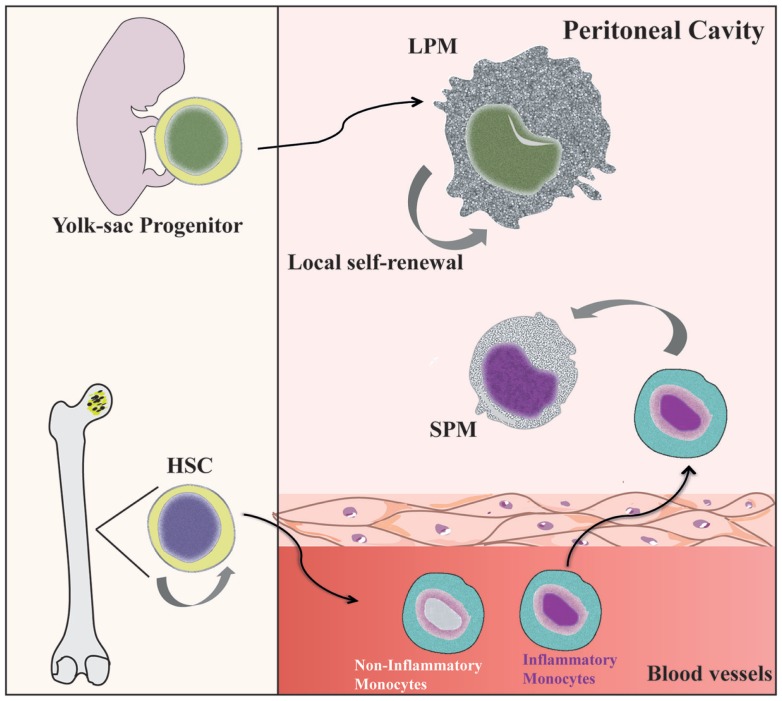
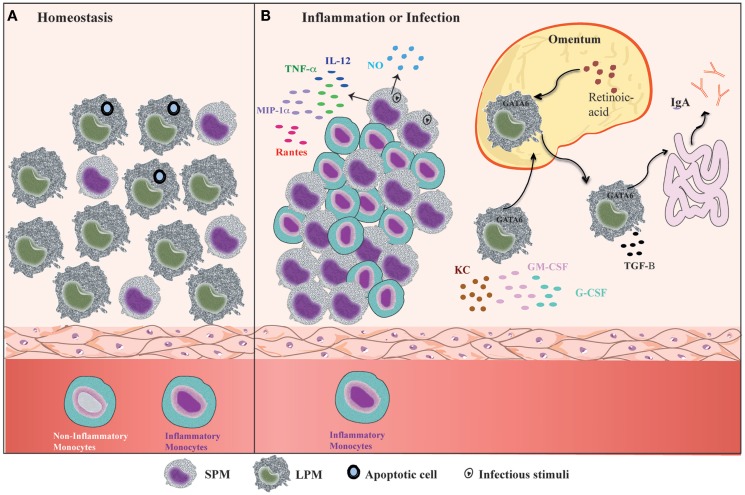
Verification
Claims the paper makes
The claims and statistics of this paper haven’t been checked yet.
Run the check — free, no account needed. It reads the open-access text and checks the sources it cites.
Claims other papers make about this one
Each is checked against this paper’s own text: does it say what the citing paper says it does?
The source backs part of the claim, not all of it — or backs it for a different population, condition or comparison.
In the citing paper
“This population was selected over bone-marrow derived macrophages as peritoneal macrophages differentiate within the tissue, which allows them to mold to their environment and experience hormonal changes throughout the animal’s lifespan [29, 31, 32].”
From Alzheimer’s disease-associated protective variant Plcg2-P522R modulates peripheral macrophage function in a sex-dimorphic manner (2024) · cites this paper as [29]
Experimental — accuracy not yet measuredThe cited source says what the claim attributes to it.
In the citing paper
“In broad terms, LPMs are known to be resident to the peritoneal cavity, and SPMs are derived from blood-monocytes, which travel to the peritoneal cavity upon infection or other inflammatory events [29].”
From Alzheimer’s disease-associated protective variant Plcg2-P522R modulates peripheral macrophage function in a sex-dimorphic manner (2024) · cites this paper as [29]
The cited source says what the claim attributes to it.
In the citing paper
“Although the canonical sub-populations known as LPMs and SPMs are recognized as separate groups [29]”
From Alzheimer’s disease-associated protective variant Plcg2-P522R modulates peripheral macrophage function in a sex-dimorphic manner (2024) · cites this paper as [29]
Self-check
Percentages, sums and reported differences re-computed from the paper’s own numbers.
The self-check needs the paper’s full text.
Citations
Cites
Exploring the full spectrum of macrophage activation
Mosser, D. M., & Edwards, J. P. (2008) · Nature Reviews Immunology · doi:10.1038/nri2448 · Cited by 9,144
A biomarker that identifies senescent human cells in culture and in aging skin in vivo.
Dimri, G. P., Lee, X., Basile, G., Acosta, M., Scott, G., Roskelley, C., Medrano, E. E., Linskens, M., Rubelj, I., & Pereira-Smith, O. (1995) · Proceedings of the National Academy of Sciences · doi:10.1073/pnas.92.20.9363 · Cited by 7,477
The chemokine system in diverse forms of macrophage activation and polarization
MANTOVANI, A., SICA, A., SOZZANI, S., ALLAVENA, P., VECCHI, A., & LOCATI, M. (2004) · Trends in Immunology · doi:10.1016/j.it.2004.09.015 · Cited by 6,534
Alternative activation of macrophages
Gordon, S. (2003) · Nature Reviews Immunology · doi:10.1038/nri978 · Cited by 6,189
MANTOVANI, A., SOZZANI, S., LOCATI, M., ALLAVENA, P., & SICA, A. (2002) · Trends in Immunology · doi:10.1016/s1471-4906(02)02302-5 · Cited by 5,528
Monocyte and macrophage heterogeneity
Gordon, S., & Taylor, P. R. (2005) · Nature Reviews Immunology · doi:10.1038/nri1733 · Cited by 5,190
Fate Mapping Analysis Reveals That Adult Microglia Derive from Primitive Macrophages
Ginhoux, F., Greter, M., Leboeuf, M., Nandi, S., See, P., Gokhan, S., Mehler, M. F., Conway, S. J., Ng, L. G., Stanley, E. R., et al. (2010) · Science · doi:10.1126/science.1194637 · Cited by 5,175
Macrophage biology in development, homeostasis and disease
Wynn, T. A., Chawla, A., & Pollard, J. W. (2013) · Nature · doi:10.1038/nature12034 · Cited by 4,684 · cited 2×
“Currently, it is accepted that inflammatory macrophages and tissue-resident macrophages comprise developmentally and functionally distinct populations (3, 14, 17, 18, 29).”
BackgroundBlood Monocytes Consist of Two Principal Subsets with Distinct Migratory Properties
Geissmann, F., Jung, S., & Littman, D. R. (2003) · Immunity · doi:10.1016/s1074-7613(03)00174-2 · Cited by 3,504
M-1/M-2 Macrophages and the Th1/Th2 Paradigm
Mills, C. D., Kincaid, K., Alt, J. M., Heilman, M. J., & Hill, A. M. (2000) · The Journal of Immunology · doi:10.4049/jimmunol.164.12.6166 · Cited by 3,287
Research works printed but not linked: 3
- Metchnikoff, 1892, Leçons sur la Pathologie Comparée de I’inflammation faites à l’Institut Pasteur en 1891
- Aschoff, 1924, Das reticuloendotheliale system, Ergeb Inn Med Kinderheilkd, 26, 1
- Ghosn, 2008, CD11b expression distinguishes sequential stages of peritoneal B-1 development, Proc Natl Acad Sci U S A, 105, 5195, 10.1073/pnas.0712350105 · DOI
Cited by
Sorted by citations
Targeting macrophages in cancer immunotherapy
Duan, Z., & Luo, Y. (2021) · Signal Transduction and Targeted Therapy · doi:10.1038/s41392-021-00506-6 · Cited by 656
Metabolism of tissue macrophages in homeostasis and pathology
Wculek, S. K., Dunphy, G., Heras-Murillo, I., Mastrangelo, A., & Sancho, D. (2022) · Cellular & Molecular Immunology · doi:10.1038/s41423-021-00791-9 · Cited by 501
Macrophages During the Fibrotic Process: M2 as Friend and Foe
Braga, T. T., Agudelo, J. S. H., & Câmara, N. O. S. (2015) · Frontiers in Immunology · doi:10.3389/fimmu.2015.00602 · Cited by 481
Macrophages: An Inflammatory Link Between Angiogenesis and Lymphangiogenesis
Corliss, B. A., Azimi, M. S., Munson, J. M., Peirce, S. M., & Murfee, W. L. (2016) · Microcirculation · doi:10.1111/micc.12259 · Cited by 356
Metal Drugs and the Anticancer Immune Response
Englinger, B., Pirker, C., Heffeter, P., Terenzi, A., Kowol, C. R., Keppler, B. K., & Berger, W. (2019) · Chemical Reviews · doi:10.1021/acs.chemrev.8b00396 · Cited by 355
Metadata
- Authors
- Cassado, A. D. A., D’Império Lima, M. R., & Bortoluci, K. R.
- Affiliations
- Universidade de São Paulo (BR)
- Universidade Federal de São Paulo (BR)
- Corresponding author
- Cassado, Alexandra dos Anjos
- Venue
- Frontiers in Immunology
- Publisher
- Frontiers Media SA
- Published
- 2015-05-19
- Volume
- 6
- Pages
- 225-225
- ISSN
- 1664-3224 (ISSN-L)
- PMC
- PMC4437037
- OpenAlex
- W1553047467
- Cited by
- 315
- References
- 97
- Citations by year
- 2026: 18 · 2025: 24 · 2024: 31 · 2023: 38 · 2022: 25 · 2021: 48 · 2020: 36 · 2019: 27 · 2018: 23 · 2017: 24 · 2016: 17 · 2015: 4
- FWCI
- 2.13
- Type
- journal article
- Language
- en
- Open access
- gold
- dx.doi.org
- Licence
- cc-by
- Locations
- Frontiers in Immunology (publishedVersion, cc-by)
- Europe PMC (PubMed Central) (publishedVersion, cc-by)
- PubMed Central (publishedVersion, cc-by)
- PubMed (publishedVersion)
- DOAJ (DOAJ: Directory of Open Access Journals) (submittedVersion, cc-by-sa)
- LA Referencia (Red Federada de Repositorios Institucionales de Publicaciones Científicas) (submittedVersion, other-oa)
- Funders
- Fundação de Amparo à Pesquisa do Estado de São Paulo (13/16010-5, 13/07140-2)
- Coordenação de Aperfeiçoamento de Pessoal de Nível Superior
- Conselho Nacional de Desenvolvimento Científico e Tecnológico (2013/07140-2)
- Topics
- Life Sciences › Immunology and Microbiology › Immunology › Immune cells in cancer
- Life Sciences › Immunology and Microbiology › Immunology › Phagocytosis and Immune Regulation
- Life Sciences › Immunology and Microbiology › Immunology › Immune Response and Inflammation
- Keywords
- peritoneal macrophages, macrophage heterogeneity, macrophage development, macrophage origin, inflammatory monocytes, MHC class II expression, F4/80, transcriptional regulation, IgA production, gut-associated lymphoid tissue, retinoic acid, infection, inflammation, tissue homeostasis
About these checks
Registry, retraction, Cites and statistics results are computed, not judged, with one exception: a printed reference that no index lists is read once by a model before it counts as a citation error. Claims are extracted by a model and kept only when their quote appears verbatim in the text; each cited source is then checked, with a model’s help, for whether it says what the claim relies on. Those verdicts can be wrong — read the claim’s quote and the cited source before relying on one.
Statistics and arithmetic are recomputed, not judged.
Confidence bands are shown only for fields calibrated on our annotated test set. None is calibrated yet, so no band is shown.
What counts as a claim ›How we measure confidence ›How we check this ›
Are you an author, or do you see a problem with this page? Request a review
