

The DOI matches its Crossref record; 82 of the 83 references it cites were found in a registry or an index.
Exopolysaccharides as Antimicrobial Agents: Mechanism and Spectrum of Activity
Open accessAbstract
Exopolysaccharides (EPSs) are metabolites synthesized and excreted by a variety of microorganisms, including lactic acid bacteria (LAB). EPS serve several biological functions such as interactions between bacteria and their environments, protection against hostile conditions including dehydration, the alleviation of the action of toxic compounds (bile salts, hydrolyzing enzymes, lysozyme, gastric, and pancreatic enzymes, metal ions, antibiotics), and stresses (changing pH, osmolarity), and evasion of the immune response and phage attack. Bacterial EPSs are considered valuable by the food, pharmaceutical, and nutraceutical industries, owing to their health-promoting benefits and rheological impacts. Numerous studies have reported the unusual antimicrobial activities of various EPS against a wide variety of pathogenic microbes (bacteria, virus, and fungi). This review aims to provide a comprehensive examination of the in vitro and in vivo antimicrobial activities of different EPSs, mainly against foodborne bacterial, fungal, and viral pathogens. The mechanism of EPS action against these pathogens as well as the methods used to measure antimicrobial activities are critically reviewed.
Overview
The claims and statistics of this paper haven’t been checked yet.
Run the check — free, no account needed. It reads the open-access text and checks the sources it cites.
Integrity signals
Registry
Cites
Statistics
Figures
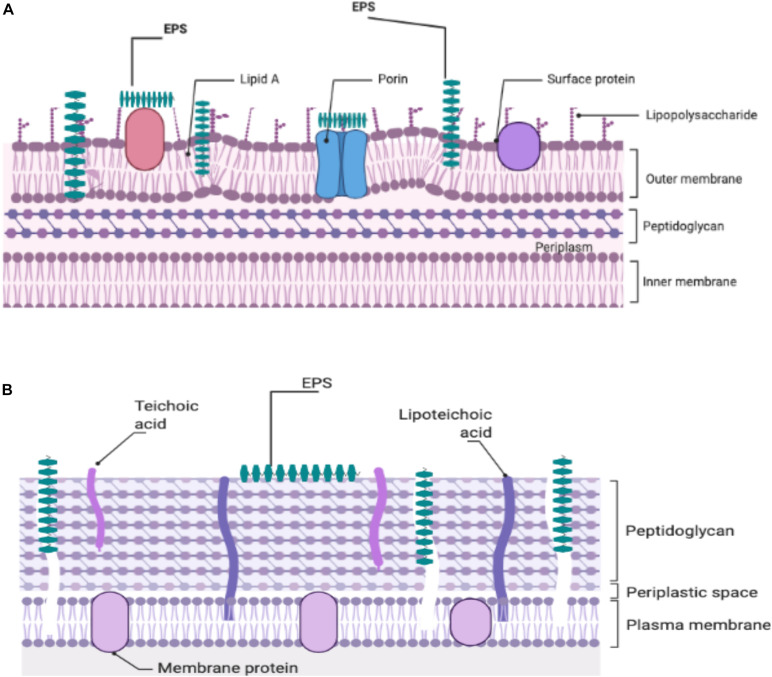
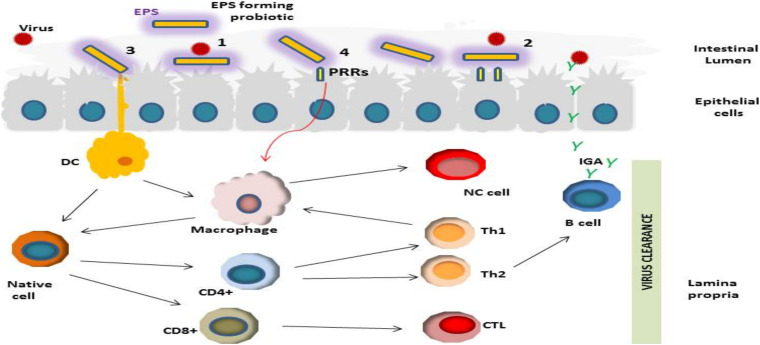
Verification
Claims the paper makes
The claims and statistics of this paper haven’t been checked yet.
Run the check — free, no account needed. It reads the open-access text and checks the sources it cites.
Claims other papers make about this one
Each is checked against this paper’s own text: does it say what the citing paper says it does?
The cited source says what the claim attributes to it.
In the citing paper
“Several LAB species, particularly those of the genus Lactobacillus, are capable of producing EPSs, and some of the EPSs identified to date by LAB have been shown to have biological functions, such as free radical scavenging, free cholesterol binding, gut microbiota modulation, antitumor, antimicrobial, and antibiofilm properties [8,15,16].”
From Analysis of Chemical Structure and Antibiofilm Properties of Exopolysaccharides from Lactiplantibacillus plantarum EIR/IF-1 Postbiotics (2022) · cites this paper as [15]
The cited source says what the claim attributes to it.
In the citing paper
“Several LAB species, particularly those of the genus Lactobacillus, are capable of producing EPSs, and some of the EPSs identified to date by LAB have been shown to have biological functions”
From Analysis of Chemical Structure and Antibiofilm Properties of Exopolysaccharides from Lactiplantibacillus plantarum EIR/IF-1 Postbiotics (2022) · cites this paper as [15]
Self-check
Percentages, sums and reported differences re-computed from the paper’s own numbers.
The self-check needs the paper’s full text.
Citations
Cites
Methods for in vitro evaluating antimicrobial activity: A review
Balouiri, M., Sadiki, M., & Ibnsouda, S. K. (2016) · Journal of Pharmaceutical Analysis · doi:10.1016/j.jpha.2015.11.005 · Cited by 8,044
Structural basis for the recognition of SARS-CoV-2 by full-length human ACE2
Yan, R., Zhang, Y., Li, Y., Xia, L., Guo, Y., & Zhou, Q. (2020) · Science · doi:10.1126/science.abb2762 · Cited by 5,036
The Toll-like receptor 2 pathway establishes colonization by a commensal of the human microbiota
Round, J. L., Lee, S. M., Li, J., Tran, G., Jabri, B., Chatila, T. A., & Mazmanian, S. K. (2011) · Science · doi:10.1126/science.1206095 · Cited by 1,604
Progress in and promise of bacterial quorum sensing research
Whiteley, M., Diggle, S. P., & Greenberg, E. P. (2017) · Nature · doi:10.1038/nature24624 · Cited by 1,306
A review of current and emergent biofilm control strategies
Simões, M. V., Simões, L. C., & Vieira, M. J. (2010) · LWT · doi:10.1016/j.lwt.2009.12.008 · Cited by 1,276
Bacterial Extracellular Polysaccharides Involved in Biofilm Formation
Vu, B., Chen, M., Crawford, R. J., & Ivanova, E. P. (2009) · Molecules · doi:10.3390/molecules14072535 · Cited by 1,125
Host interactions of probiotic bacterial surface molecules: comparison with commensals and pathogens
Lebeer, S., Vanderleyden, J., & De Keersmaecker, S. C. J. (2010) · Nature Reviews Microbiology · doi:10.1038/nrmicro2297 · Cited by 1,062
Exploiting Quorum Sensing To Confuse Bacterial Pathogens
LaSarre, B., & Federle, M. J. (2013) · Microbiology and Molecular Biology Reviews · doi:10.1128/mmbr.00046-12 · Cited by 829
Postbiotics-Parabiotics: The New Horizons in Microbial Biotherapy and Functional Foods
Nataraj, B. H., Ali, S. A., Behare, P. V., & Yadav, H. (2020) · Microbial Cell Factories · doi:10.1186/s12934-020-01426-w · Cited by 737
Bacterial Quorum Sensing and Microbial Community Interactions
Abisado, R. G., Benomar, S., Klaus, J. R., Dandekar, A. A., & Chandler, J. R. (2018) · mBio · doi:10.1128/mbio.02331-17 · Cited by 707
Cited by
Sorted by citations
The Many Faces of Enterococcus spp.—Commensal, Probiotic and Opportunistic Pathogen
Krawczyk, B., Wityk, P., Gałęcka, M., & Michalik, M. (2021) · Microorganisms · doi:10.3390/microorganisms9091900 · Cited by 432
How plants recruit their microbiome? New insights into beneficial interactions
Santoyo, G. (2021) · Journal of Advanced Research · doi:10.1016/j.jare.2021.11.020 · Cited by 428
Jurášková, D., Ribeiro, S. C., & Silva, C. C. G. (2022) · Foods · doi:10.3390/foods11020156 · Cited by 342
Bacterial exopolysaccharides as emerging bioactive macromolecules: from fundamentals to applications
Kaur, N., & Dey, P. (2022) · Research in Microbiology · doi:10.1016/j.resmic.2022.104024 · Cited by 285
Fermented foods: An update on evidence-based health benefits and future perspectives
Diez‐Ozaeta, I., & Astiazaran, O. J. (2022) · Food Research International · doi:10.1016/j.foodres.2022.111133 · Cited by 176
Metadata
- Authors
- Abdalla, A. K., Ayyash, M. M., Olaimat, A. N., Osaili, T. M., Al-Nabulsi, A. A., Shah, N. P., & Holley, R.
- Affiliations
- South Valley University (EG)
- United Arab Emirates University (AE)
- Hashemite University (JO)
- Jordan University of Science and Technology (JO)
- University of Hong Kong (HK)
- University of Manitoba (CA)
- Corresponding author
- Ayyash, Mutamed M.
- ORCID
- Venue
- Frontiers in Microbiology
- Publisher
- Frontiers Media SA
- Published
- 2021-05-19
- Volume
- 12
- Pages
- 664395-664395
- ISSN
- 1664-302X (ISSN-L)
- PMC
- PMC8170130
- OpenAlex
- W3162369158
- Cited by
- 268
- References
- 83
- Citations by year
- 2026: 50 · 2025: 61 · 2024: 57 · 2023: 54 · 2022: 38 · 2021: 8
- FWCI
- 3.56
- Type
- journal article
- Language
- en
- Open access
- gold
- doi.org
- Licence
- Locations
- Frontiers in Microbiology (publishedVersion, cc-by)
- PubMed Central (publishedVersion, cc-by)
- PubMed (publishedVersion)
- DOAJ (DOAJ: Directory of Open Access Journals) (submittedVersion, cc-by-sa)
- Greater South Information System
- Funders
- United Arab Emirates University
- Topics
- Life Sciences › Agricultural and Biological Sciences › Food Science › Polysaccharides Composition and Applications
- Life Sciences › Agricultural and Biological Sciences › Food Science › Probiotics and Fermented Foods
- Life Sciences › Biochemistry, Genetics and Molecular Biology › Molecular Biology › Bacterial biofilms and quorum sensing
- Keywords
- exopolysaccharides, antimicrobial activity, lactic acid bacteria, mechanism of action, foodborne pathogens, fungal pathogens, viral pathogens, stress tolerance, immune evasion, phage resistance, rheological properties, nutraceuticals
About these checks
Registry, retraction, Cites and statistics results are computed, not judged, with one exception: a printed reference that no index lists is read once by a model before it counts as a citation error. Claims are extracted by a model and kept only when their quote appears verbatim in the text; each cited source is then checked, with a model’s help, for whether it says what the claim relies on. Those verdicts can be wrong — read the claim’s quote and the cited source before relying on one.
Statistics and arithmetic are recomputed, not judged.
Confidence bands are shown only for fields calibrated on our annotated test set. None is calibrated yet, so no band is shown.
What counts as a claim ›How we measure confidence ›How we check this ›
Are you an author, or do you see a problem with this page? Request a review
