

Comparing technology and regulatory landscape of probiotics as food, dietary supplements and live biotherapeutics
Open accessThe DOI matches its Crossref record; 51 of the 51 references it cites were found in a registry or an index.
Abstract
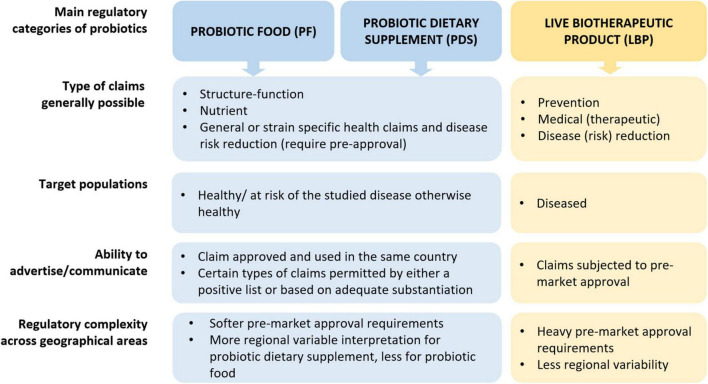
Application of beneficial microorganisms as probiotics targets a broad range of intended uses, from maintaining health and supporting normal bodily functions to curing and preventing diseases. Currently, three main regulatory fields of probiotic products can be defined depending on their intended use: the more similar probiotic foods and probiotic dietary supplements, and live biotherapeutic products. However, it is not always straightforward to classify a probiotic product into one of these categories. The regulatory nuances of developing, manufacturing, investigating and applying each category of probiotic products are not universal, and not always apparent to those unfamiliar with the various global probiotic regulatory guidelines. Various global markets can be significantly different regarding legislation, possible claims, market value and quality requirements for the development and commercialization of probiotic products. Furthermore, different probiotic product categories are also linked with variable costs at different stages of product development. This review outlines the current landscape comparing probiotic foods, probiotic dietary supplements, and live biotherapeutics as probiotic products from a regulatory lens, focusing on product development, manufacturing and production, and clinical research agenda. The aim is to inform and promote a better understanding among stakeholders by outlining the expectations and performance for each probiotic product category, depending on their intended use and targeted geographical region.
Overview
The claims and statistics of this paper haven’t been checked yet.
Free: it reads the open-access text and checks the first 5 claims that cite a source we can check. Create a free account to check every claim.
Integrity signals
Registry
Cites
Statistics
Figures
Verification
Claims the paper makes
The claims and statistics of this paper haven’t been checked yet.
Free: it reads the open-access text and checks the first 5 claims that cite a source we can check. Create a free account to check every claim.
Claims other papers make about this one
Each is checked against this paper’s own text: does it say what the citing paper says it does?
The source backs part of the claim, not all of it — or backs it for a different population, condition or comparison.
In the citing paper
“The European Union lacks dedicated probiotic legislation, though health claims are regulated. Japan, Brazil, and Canada offer more structured frameworks that mandate safety and efficacy evidence.39”
From Safety and efficacy concerns in Indian probiotics: Insights from whole-genome sequencing and in vitro assessment (2026) · cites this paper as [39]
Experimental — accuracy not yet measuredThe cited source says what the claim attributes to it.
In the citing paper
“Probiotics marketed as foods or dietary supplements are subject to food and consumer product safety legislation. In contrast, live biotherapeutic products, intended to treat or prevent diseases, are regulated as biological medicinal products. This means that they must undergo rigorous safety, efficacy, and quality testing similar to that applied to pharmaceuticals [29,30].”
From Current Concepts in Probiotic Safety and Efficacy (2026) · cites this paper as [29]
The cited source says what the claim attributes to it.
In the citing paper
“Regulatory challenges affecting the commercialization of probiotics include the lack of harmonization of regulatory requirements, which can vary by region (e.g., as with drugs or dietary supplements), leading to confusion in interpreting requirements. Efficacy and safety standards also vary, increasing costs and complicating worldwide regulatory compliance, which in turn leads to differences in”
From Current Concepts in Probiotic Safety and Efficacy (2026) · cites this paper as [29]
Self-check
Percentages, sums and reported differences re-computed from the paper’s own numbers.
The self-check needs the paper’s full text.
Citations
Cites
Hill (2014) · doi:10.1038/nrgastro.2014.66 · Cited by 9,592
Innovation in the pharmaceutical industry: New estimates of R&D costs
DiMasi, J. A., Grabowski, H. G., & Hansen, R. W. (2016) · Journal of Health Economics · doi:10.1016/j.jhealeco.2016.01.012 · Cited by 3,359 · cited 1×
“…from synthesis to clinical testing) for drugs is expensive and time-consuming, as it has been reported to average a considerable 31.7 months with inferred out-of-pocket costs of 430 million USD based on 1990– 2013 data on 106 new drugs from 10 biopharmaceutical companies (DiMasi et al., 2016).”
BackgroundInfluentialZheng, J., Wittouck, S., Salvetti, E., Franz, C. M. A. P., Harris, H. M. B., Mattarelli, P., O’Toole, P. W., Pot, B., Vandamme, P., Walter, J., et al. (2020) · International Journal of Systematic and Evolutionary Microbiology · doi:10.1099/ijsem.0.004107 · Cited by 3,313
Clinical development success rates for investigational drugs
Hay, M., Thomas, D. W., Craighead, J. L., Economides, C., & Rosenthal, J. (2014) · Nature Biotechnology · doi:10.1038/nbt.2786 · Cited by 2,536
Better Reporting of Harms in Randomized Trials: An Extension of the CONSORT Statement
Ioannidis, J. P. A., Evans, S. J. W., Gøtzsche, P. C., O'Neill, R. T., Altman, D. G., Schulz, K., Moher, D., & for the CONSORT Group* (2004) · Annals of Internal Medicine · doi:10.7326/0003-4819-141-10-200411160-00009 · Cited by 1,593
Marco, M. L., Sanders, M. E., Gänzle, M., Arrieta, M. C., Cotter, P. D., De Vuyst, L., Hill, C., Holzapfel, W., Lebeer, S., Merenstein, D., et al. (2021) · Nature Reviews Gastroenterology & Hepatology · doi:10.1038/s41575-020-00390-5 · Cited by 937
Probiotics for preventing acute upper respiratory tract infections
Hao, Q., Dong, B. R., & Wu, T. (2015) · Cochrane Database of Systematic Reviews · doi:10.1002/14651858.cd006895.pub3 · Cited by 569
Criteria to Qualify Microorganisms as “Probiotic” in Foods and Dietary Supplements
Binda, S., Hill, C., Johansen, E., Obis, D., Pot, B., Sanders, M. E., Tremblay, A., & Ouwehand, A. C. (2020) · Frontiers in Microbiology · doi:10.3389/fmicb.2020.01662 · Cited by 519
Self-citationEmerging issues in probiotic safety: 2023 perspectives
Merenstein, D., Pot, B., Leyer, G., Ouwehand, A. C., Preidis, G. A., Elkins, C. A., Hill, C., Lewis, Z. T., Shane, A. L., Zmora, N., et al. (2023) · Gut Microbes · doi:10.1080/19490976.2023.2185034 · Cited by 481
Self-citationThe Production and Delivery of Probiotics: A Review of a Practical Approach
Fenster, K., Freeburg, B., Hollard, C., Wong, C., Rønhave Laursen, R., & Ouwehand, A. C. (2019) · Microorganisms · doi:10.3390/microorganisms7030083 · Cited by 405
Self-citation
Research works printed but not linked: 14
- CFI Team (2023). Current Good Manufacturing Practices (CGMPs). Available online at: https://corporatefinanceinstitute.com/resources/valuation/current-good-manufacturing-practices-cgmps/ (accessed October 15, 2023).
- Chieffi D. Fanelli F. Fusco V. (2022). Legislation of probiotic foods and supplements. Probiotics for human nutrition in health and disease. Amsterdam: Elsevier.
- European Commission [EC] (2007). Corrigendum to Regulation (EC) No 1924/2006 of the European Parliament and of the Council of 20 December 2006 on nutrition and health claims made on foods. Official J. Eur. Union 12: 16.
- HealthEcon (2023). Reimbursement of Pharmaceuticals. Available online at: https://www.healthecon.com/reimbursement/index_eng.html (accessed August 04, 2023).
- Health Canada. (2023). Probiotics. Available online at: https://webprod.hc-sc.gc.ca/nhpid-bdipsn/atReq.do?atid=probio (accessed December 01, 2023).
- IPA Europe (2023). Do you know what probiotics are? Available online at: https://www.ipaeurope.org/wp-content/uploads/2023/01/202211Survey-report-1.pdf
- Lumina Intelligence (2021). Explained: The US E-commerce probiotic supplements market. Available online at: https://www.lumina-intelligence.com/probiotics-reports/explained-the-us-e-commerce-probiotics-market/ (accessed December 01, 2023).
- Markel Services Inc (2023). Hazard Analysis and Critical Control Points (HACCP) understanding HACCP food safety standards. Available online at: https://www.markelinsurance.com/resources/hazard-analysis-and-critical-control-points (accessed October 15, 2023).
- Paraskevakos G. (2020). Global overview for probiotics: trends, markets, and harmonization. Regulatory Focus. Available online at: https://www.raps.org/news-and-articles/news-articles/2022/9/global-overview-for-probiotics-trends-markets-and#citation (accessed October 15, 2023).
- The European Directorate for the Quality of Medicines and HealthCare [EDQM] (2019). Live biotherapeutic products for human use 3053 monograph. Eur. Pharmacopoeia 9 6522– 6523.
- United States Food and Drug Administration [FDA] (2016). Early clinical trials with live biotherapeutic products: chemistry, manufacturing, and control information. Guidance for Industry. Silver Spring, MD: FDA.
- United States Food and Drug Administration [FDA] (2021). Facts About the Current Good Manufacturing Practices (CGMPs). Silver Spring, MD: FDA.
- United States Food and Drug Administration [FDA] (2022a). Authorized health claims that meet the Significant Scientific Agreement (SSA) Standard. Silver Spring, MD: FDA.
- United States Food and Drug Administration [FDA] (2022b). Investigational New Drug (IND) application. Silver Spring, MD: FDA.
Cited by
Items 101–130 of 130
Development strategies for engineered live biotherapeutic products for metabolic diseases
Yun, S., Choi, K.-S., Min, H., Jo, Y. K., & Jang, S. (2026) · Critical Reviews in Biotechnology · doi:10.1080/07388551.2026.2653692 · Cited by 1
“However, unlike purified biologics, eLBPs require stringent control of microbial viability, genetic stability, and batch-to-batch consistency under GMP conditions, which may offset potential savings from reduced downstream protein purification [146,154].”
InfluentialEngineered bacteria in disease diagnosis and therapy: A synthetic biology perspective
Shen, Y., Lu, S.-M., Yang, L., Li, Y., Zhang, Y., & Liang, L. (2026) · Synthetic and Systems Biotechnology · doi:10.1016/j.synbio.2026.04.028 · Cited by 1
“There are significant disparities across global markets legislation, permissible claims, market value, and quality requirements, and different probiotic product categories incur varying costs at different stages of development [99].”
AI Technologies for Advancing Probiotic Applications
Ogidi, O. I., Timi-Johnson, E., Alagha, E. W., & Gupta, R. K. (2026) · Advances in computational intelligence and robotics book series · doi:10.4018/979-8-3373-8172-5.ch007
Spore-Forming Probiotic-Embedded Biomaterials for Targeted Gut Microplastic Biodegradation
Nicolas, G. M., Yuan, T., Rukmana, A., Zhang, Z., Qiao, R., & Ma, S. (2026) · ACS Pharmacology & Translational Science · doi:10.1021/acsptsci.6c00183 · Cited by 1
Biotics as targeted microbial alternatives to antibiotics in One Health
Dewan, A. (2026) · Discover Molecules · doi:10.1007/s44345-026-00055-x
“…and maintaining high-quality, stable Live Biotherapeutic Products (LBPs), which are live organisms administered for a therapeutic effect and regulated as drugs, requires stringent Good Manufacturing Practices (GMP) and can be significantly more expensive than producing food supplements [152].”
Challenges and Considerations in Probiotic Therapy
Raman, M., Mishra, R., Gupta, S. K., Nishtala, S., & Jacob, S. (2026) · Springer eBooks · doi:10.1007/978-981-92-0002-3_21
Price, C. D., Lunn, B., Knight, C., Wells, B., & Witts, L. (2026) · Springer eBooks · doi:10.1007/978-981-92-0002-3_20
Bridging the Policy-practice Gap
Shah, S., & Lou, L. (2026) · Clinics in Perinatology · doi:10.1016/j.clp.2026.07.008
Verma, V., Pandey, V. K., Sharma, R., & Verma, P. (2026) · Food Bioscience · doi:10.1016/j.fbio.2026.109846
Alkalbani, N. S., Osaili, T. M. I., Obaid, R. S., Hasan, H., Ismail, L. C., Karu, S., Nasser, A., Hameed, A. A., Mohamed, E., Nasrin, M., et al. (2026) · Frontiers in Nutrition · doi:10.3389/fnut.2026.1929193
葛燕子, Hu, J., Liu, S., Yang, G., Hua, Q., Gu, Q., Mao, T., Xue, X., Yu, B., & Fang, Y. (2026) · International Journal of Food Science · doi:10.1155/ijfo/1979133
Jung, S., Noh, S., 이현승, & Park, S. (2026) · Gels · doi:10.3390/gels12100861
“In practice, the most sophisticated responsive system is not necessarily the most translatable; the preferred design is the simplest formulation that reproducibly meets the required protection, release, storage, and safety criteria for the intended product category [114].”
C, A. O., Narayanan, A., Vijayashree, R., Gurav, V. U., Menon, G., & Kottarath, S. K. (2026) · Next Materials · doi:10.1016/j.nxmate.2026.103643
Wang, R., Li, Z., Zhang, L., Pan, Y., & He, Z. (2026) · Comprehensive Reviews in Food Science and Food Safety · doi:10.1111/1541-4337.70655
“∙ If intended for therapeutic use as a live biotherapeutic product (LBP), an investigational new drug (IND) application and Phases I–III clinical trials are required (Spacova et al. 2023 ).”
Functional Food Microecology: An integrated strategy from gut modulation to systemic health
Sun, J., & Lun, Y. (2026) · MicroBiome and One Health · doi:10.1016/j.micoh.2026.100006
From toxicity to therapy: Probiotics and novel adsorbents in aflatoxin detoxification
Huang, Z., Xie, C., Yang, G., Li, S., Wu, H., Nie, Y., Li, H., Liu, B., Du, M., Zhang, L., et al. (2026) · Pharmacological Research · doi:10.1016/j.phrs.2026.109661
Kaur, M., & Mishra, A. K. (2026) · World Journal of Microbiology and Biotechnology · doi:10.1007/s11274-026-05300-6
“In Europe, the regulatory system for probiotics has faced criticism for not adequately serving both consumers and the industry by limiting access to essential information about scientifically supported prod - ucts and hindering market expansion (Spacova et al. 2023 ).”
Shao, T., Li, M., Li, S., Pu, J., Li, C., & Guo, C. (2026) · Frontiers in Immunology · doi:10.3389/fimmu.2026.1945287
Jeyavelkumaran, R., Saravanan, M. D., & Keerthivasan, N. (2026) · Folia Microbiologica · doi:10.1007/s12223-026-01602-2
Александрович, Ч. А., Sokolyanskaya, L. O., Lukina, A. P., & Karnachuk, O. V. (2026) · Frontiers in Nutrition · doi:10.3389/fnut.2026.1964473
“Progress in engineered live therapeutics will also depend on harmonized regulatory expectations and proportionate biosafety requirements (6).”
Microbiome-directed therapies in oncology: from animal models to clinical implementation
Skonieczna‐Żydecka, K., Marlicz, M., Kaczmarczyk, M., Łoniewski, I., Boluk, P., Ekstedt, N., Kutrzuba, K., & Marlicz, W. M. (2026) · Best Practice & Research Clinical Gastroenterology · doi:10.1016/j.bpg.2026.102148
Bains, A., Janghu, S., & Chawla, P. (2026) · Food Bioscience · doi:10.1016/j.fbio.2026.110220
Khawlah, A., Zheng, X., Jia, Y., Wang, Z., & Yang, Z. (2026) · Foods · doi:10.3390/foods15203580
“These nanoscale systems can be engineered to respond to specific physiological triggers, such as pH or enzymatic activity [10,44].”
InfluentialPostbiotics Unveiled: The Next Emerging Trend in Functional Foods
Wahid, Z., Ahmad, A. M. R., Zulfiqar, F., Shah, S. H. B. U., & Mohammadi, N. (2026) · Food Science & Nutrition · doi:10.1002/fsn3.72485
Chapman, K., & Ballal, S. A. (2026) · Global Advances in Integrative Medicine and Health · doi:10.1177/27536130261490586
Wang, M., Bu, G., Liu, J., Liu, X., Li, Y., & Rashid, M. T. (2026) · Food Bioscience · doi:10.1016/j.fbio.2026.110261
Shidhaye, S. S., Chaudhary, A. A., Gautam, Y., Chafle, V., Patil, H., Umekar, M. J., Rudayni, H. A., & Trivedi, R. (2026) · Future Microbiology · doi:10.1080/17460913.2026.2749225
The potential impact of probiotics on human health
Mishra, S., Dagariya, S., Tiwari, S., & Dakal, T. C. (2026) · Elsevier eBooks · doi:10.1016/b978-0-443-45154-6.00034-9
Jaglan, P., Buttar, H. S., & Sobti, R. C. (2026) · Elsevier eBooks · doi:10.1016/b978-0-443-45154-6.00022-2
Probiotics and the human immune system: Mechanisms and applications
Kumar, S., Thakur, M., Das, P., Kaur, T., & Sobti, R. C. (2026) · Elsevier eBooks · doi:10.1016/b978-0-443-45154-6.00020-9
Metadata
- Authors
- Spacova, I., Binda, S., ter Haar, J. A., Henoud, S., Legrain-Raspaud, S., Dekker, J., Espadaler-Mazo, J., Langella, P., Martín, R., Pane, M., & Ouwehand, A. C.
- Affiliations
- University of Antwerp (BE)
- Fonterra (New Zealand) (NZ)
- AgroParisTech (FR)
- Probiotical (Italy) (IT)
- Corresponding author
- Spacova, Irina
- Ouwehand, Arthur C.
- Venue
- Frontiers in Microbiology
- Publisher
- Frontiers Media SA
- Published
- 2023-12-19
- Volume
- 14
- Issue
- 3
- Pages
- 1272754-1272754
- ISSN
- 1664-302X (ISSN-L)
- PMC
- PMC10770255
- OpenAlex
- W4389938247
- Cited by
- 129
- References
- 50
- Citations by year
- 2026: 68 · 2025: 47 · 2024: 14
- FWCI
- 2.98
- Type
- journal article
- Language
- en
- Open access
- gold
- doi.org
- Licence
- Locations
- Frontiers in Microbiology (publishedVersion, cc-by)
- PubMed Central (publishedVersion, cc-by)
- PubMed (publishedVersion)
- HAL (submittedVersion, cc-by-nd)
- DOAJ (DOAJ: Directory of Open Access Journals) (submittedVersion, cc-by-sa)
- Funders
- Fonds Wetenschappelijk Onderzoek (1277222N)
- Vlaamse regering
- Topics
- Life Sciences › Agricultural and Biological Sciences › Food Science › Probiotics and Fermented Foods
- Life Sciences › Agricultural and Biological Sciences › Food Science › Agricultural safety and regulations
- Health Sciences › Medicine › Public Health, Environmental and Occupational Health › Consumer Attitudes and Food Labeling
- Keywords
- probiotics, probiotic foods, live biotherapeutic products, probiotic regulation, regulatory guidelines, product development, clinical research, health claims, commercialization
About these checks
Registry, retraction, Cites and statistics results are computed, not judged, with one exception: a printed reference that no index lists is read once by a model before it counts as a citation error. Claims are extracted by a model and kept only when their quote appears verbatim in the text; each cited source is then checked, with a model’s help, for whether it says what the claim relies on. Those verdicts can be wrong — read the claim’s quote and the cited source before relying on one.
Statistics and arithmetic are recomputed, not judged.
Confidence bands are shown only for fields calibrated on our annotated test set. None is calibrated yet, so no band is shown.
What counts as a claim ›How we measure confidence ›How we check this ›
Are you an author, or do you see a problem with this page? Request a review
Data sources
Bibliographic data: Semantic Scholar, OpenAlex, Crossref.
Contains information from the Semantic Scholar Academic Graph Datasets, made available under the ODC Attribution License (ODC-BY 1.0).
Semantic Scholar’s data is described in: Kinney, R., et al. (2023). The Semantic Scholar Open Data Platform. arXiv:2301.10140.
