

Malvidin alleviates mitochondrial dysfunction and ROS accumulation through activating AMPK-α/UCP2 axis, thereby resisting inflammation and apoptosis in SAE mice
Open accessThe DOI matches its Crossref record; 92 of the 93 references it cites were found in a registry or an index.
Abstract
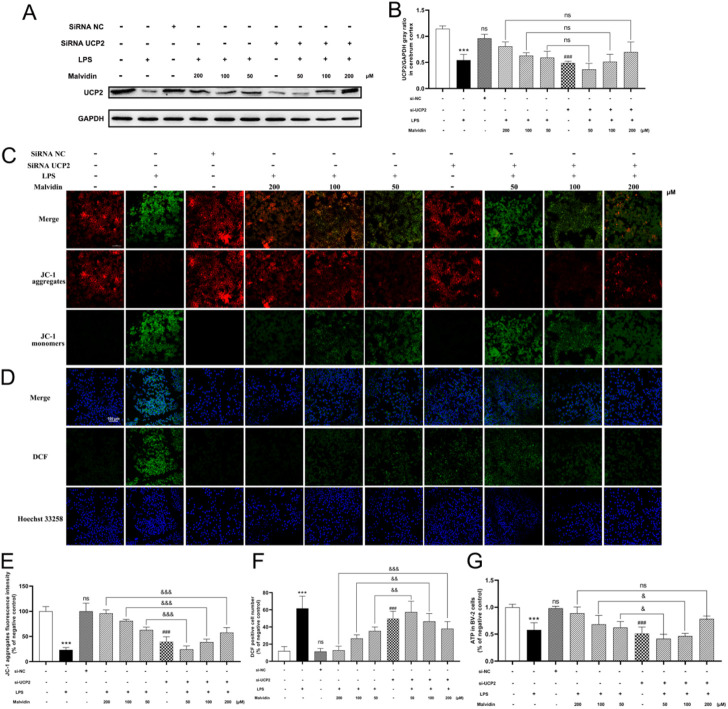
This study aimed to explore the protective roles of malvidin in life-threatened sepsis-associated encephalopathy (SAE) and illustrate the underlying mechanism. SAE mice models were developed and treated with malvidin for subsequently protective effects evaluation. Malvidin restored neurobehavioral retardation, declined serum S100β and NSE levels, sustained cerebrum morphological structure, improved blood-brain barrier integrity with elevated tight junction proteins, and decreased evans blue leakage, and finally protect SAE mice from brain injury. Mechanistically, malvidin prevented cerebrum from mitochondrial dysfunction with enhanced JC-1 aggregates and ATP levels, and ROS accumulation with decreased lipid peroxidation and increased antioxidant enzymes. UCP2 protein levels were found to be decreased after LPS stimulation in the cerebrum and BV-2 cells, and malvidin recovered its levels in a ROS dependent manner. In vivo inhibition of UCP2 with genipin or in vitro interference with siRNA UCP2 both disrupted the mitochondrial membrane potential, decreased ATP levels and intensified DCF signals, being a key target for malvidin. Moreover, dorsomorphin block assays verified that malvidin upregulated UCP2 expression through phosphorylating AMPK in SAE models. Also, malvidin alleviated SAE progression through inhibition of ROS-dependent NLRP3 inflammasome activation mediated serum pro-inflammatory cytokines secretion and mitochondrial pathway mediated apoptosis with weakened apoptosis body formation and tunel positive signals, and decreased Bax, cytochrome C, caspase-3 and increased Bcl-2 protein levels. Overall, this study illustrated that malvidin targeted AMPK-α/UCP2 axis to restore LPS-induced mitochondrial dysfunction and alleviate ROS accumulation, which further inhibits NLRP3 inflammasome activation and mitochondrial apoptosis in a ROS dependent way, and ultimately protected SAE mice, providing a reference for the targeted development of SAE prophylactic approach.
Overview
The claims and statistics of this paper haven’t been checked yet.
Free: it reads the open-access text and checks the first 5 claims that cite a source we can check. Create a free account to check every claim.
Integrity signals
Registry
Cites
Statistics
Figures




Verification
Claims the paper makes
The claims and statistics of this paper haven’t been checked yet.
Free: it reads the open-access text and checks the first 5 claims that cite a source we can check. Create a free account to check every claim.
Claims other papers make about this one
Each is checked against this paper’s own text: does it say what the citing paper says it does?
The source backs part of the claim, not all of it — or backs it for a different population, condition or comparison.
In the citing paper
“echinomycin improves mitochondrial structure and reduces inflammatory factors via the HIF-1α/BNIP3L axis [85]; ② Natural compounds (preclinical): Puerarin enhances BBB stability by blocking GSDMD cleavage; myricitrin alleviates neuroinflammation by modulating the Bax/Bcl-2 balance [86]; malvidin dually inhibits pyroptosis and apoptosis via the AMPKα/UCP2 axis [87].”
From Research Advances in the Pathogenesis of Sepsis-Associated Encephalopathy (2026) · cites this paper as [87]
Experimental — accuracy not yet measuredThe source backs part of the claim, not all of it — or backs it for a different population, condition or comparison.
In the citing paper
“echinomycin improves mitochondrial structure and reduces inflammatory factors via the HIF-1α/BNIP3L axis [85]; ② Natural compounds (preclinical): Puerarin enhances BBB stability by blocking GSDMD cleavage; myricitrin alleviates neuroinflammation by modulating the Bax/Bcl-2 balance [86]; malvidin dually inhibits pyroptosis and apoptosis via the AMPKα/UCP2 axis [87].”
From Research Advances in the Pathogenesis of Sepsis-Associated Encephalopathy (2026) · cites this paper as [87]
Experimental — accuracy not yet measured
Self-check
Percentages, sums and reported differences re-computed from the paper’s own numbers.
The self-check needs the paper’s full text.
Citations
Cites
The third international consensus definitions for sepsis and septic shock (Sepsis-3).
Singer, M., Deutschman, C. S., Seymour, C. W., Shankar-Hari, M., Annane, D., Bauer, M., Bellomo, R., Bernard, G. R., Chiche, J.-D., Coopersmith, C. M., et al. (2016) · JAMA · doi:10.1001/jama.2016.0287 · Cited by 28,250 · cited 2×
“Sepsis, a serious clinical syndrome in the field of critical care, is a life-threatening multi-organ dysfunction caused by an uncontrolled acute systemic inflammatory response of the host to bacterial toxins and has become a major public health problem worldwide (Singer et al., 2016).”
BackgroundThe NLRP3 Inflammasome: an overview of mechanisms of activation and regulation
Kelley, N., Jeltema, D., Duan, Y., & He, Y. (2019) · International Journal of Molecular Sciences · doi:10.3390/ijms20133328 · Cited by 3,539 · cited 1×
“ROS stimulation mediates NLRP3 oligomerization with ASC, recruitment of inflammatory caspases, assembly of inflammasomes to produce activated caspases, cleavage of IL1β precursors into mature IL-1β, and mediation of inflammatory responses (Kelley et al., 2019).”
BackgroundReactive oxygen species, cellular redox systems, and apoptosis
Circu, M. L., & Aw, T. Y. (2010) · Free Radical Biology and Medicine · doi:10.1016/j.freeradbiomed.2009.12.022 · Cited by 3,340 · cited 1×
“ROS accumulation promotes apoptosis and causes mitochondrial membrane potential changes, leading to the translocation of Bax and Bad across the mitochondrial membrane, and release of cytochrome c (Circu and Aw, 2010).”
BackgroundThe blood-brain barrier/neurovascular unit in health and disease
Hawkins, B. T., & Davis, T. P. (2005) · Pharmacological Reviews · doi:10.1124/pr.57.2.4 · Cited by 2,661 · cited 1×
“circulating blood into the CNS to maintain the dynamic balance of the internal environment (Hawkins and Davis, 2005).”
BackgroundOxidative Stress and Inflammation: What Polyphenols Can Do for Us?
Hussain, T., Tan, B., Yin, Y., Blachier, F., Tossou, M. C. B., & Rahu, N. (2016) · Oxidative Medicine and Cellular Longevity · doi:10.1155/2016/7432797 · Cited by 2,082 · cited 1×
“…are the most common active polyphenols, widely distributed in plants, with a variety of pharmacological effects, including anti-inflammatory (Hussain et al., 2016), anti-cancer (Kopustinskiene et al., 2020), anti-proliferative (Fernández et al., 2021), antioxidant, and inhibition of free…”
BackgroundEndonuclease G is an apoptotic DNase when released from mitochondria
Li, L. Y., Luo, X., & Wang, X. (2001) · Nature · doi:10.1038/35083620 · Cited by 1,787 · cited 1×
“Caspase-3 is downstream of the apoptotic cascade and is a common executor of several apoptotic pathways, which can directly cause apoptosis by shearing the structural proteins of the cell (Li et al., 2001).”
BackgroundMicroglia as a source and target of cytokines
Hanisch, U. (2002) · Glia · doi:10.1002/glia.10161 · Cited by 1,645 · cited 1×
“Microglia BV-2, an important line of defense for the CNS, are part of the mononuclear phagocyte system and are involved in innate defense mechanisms of the CNS, contributing to tissue repair and recovery (Hanisch, 2002).”
BackgroundNitric oxide in the central nervous system: neuroprotection versus neurotoxicity
Calabrese, V., Mancuso, C., Calvani, M., Rizzarelli, E., Butterfield, D. A., & Giuffrida Stella, A. M. (2007) · Nature Reviews Neuroscience · doi:10.1038/nrn2214 · Cited by 1,543
Molecular mechanisms regulating NLRP3 inflammasome activation
Jo, E.-K., Kim, J. K., Shin, D.-M., & Sasakawa, C. (2016) · Cellular & Molecular Immunology · doi:10.1038/cmi.2015.95 · Cited by 1,378 · cited 1×
“Activation of NLRP3 inflammasome will secrete pro-inflammatory factors IL-1β and IL-18, which regulate the inflammatory response, and ROS accumulation is thought to be an important pathway for NLRP3 inflammasome activation (Jo et al., 2016).”
BackgroundFlavonoids as Anticancer Agents
Kopustinskiene, D. M., Jakstas, V., Savickas, A., & Bernatoniene, J. (2020) · Nutrients · doi:10.3390/nu12020457 · Cited by 1,295 · cited 2×
“The mammalian genome encodes five UCP homologues, UCP1-5 (Krauss et al., 2005).”
Background
Cited by
Merecz-Sadowska, A., Sitarek, P., Kowalczyk, T., Zajdel, K., Jęcek, M., Nowak, P. A., & Zajdel, R. (2023) · Nutrients · doi:10.3390/nu15133016 · Cited by 142
“, the effects of malvidin on a murine microglial cell line were investigated, showing that it prevented mitochondrial dysfunction and accumulation of ROS, decreased lipid peroxidation, and increased antioxidant enzyme activity in the cerebrum [81].”
BackgroundInfluentialPlant anthocyanins: Classification, biosynthesis, regulation, bioactivity, and health benefits
Lu, Z., Wang, X., Lin, X., Mostafa, S., Zou, H., Wang, L., & Jin, B. (2024) · Plant Physiology and Biochemistry · doi:10.1016/j.plaphy.2024.109268 · Cited by 127
Masyita, A., Hardinasinta, G., Astuti, A. D., Firdayani, F., Mayasari, D., Hori, A., Nisha, I. N. A., Nainu, F., & Kuraishi, T. (2025) · Frontiers in Pharmacology · doi:10.3389/fphar.2024.1507108 · Cited by 74
Microglial Activation: Key Players in Sepsis-Associated Encephalopathy
Hu, J., Xie, S., Zhang, H., Wang, X., Meng, B., & Zhang, L. (2023) · Brain Sciences · doi:10.3390/brainsci13101453 · Cited by 49
Self-citationConvergence of sepsis-associated encephalopathy pathogenesis onto microglia
Xiao, D., Wang, X., Liang, W., Yang, Y., Du, Y., Liu, C., Xu, F., Yang, Y., Wei, M., & Yang, G. (2025) · Journal of Translational Medicine · doi:10.1186/s12967-025-06635-8 · Cited by 35
Metadata
- Authors
- Zhao, P., Li, X., Yang, Q., Lu, Y., Wang, G., Yang, H., Dong, J., & Zhang, H.
- Affiliations
- The First People’s Hospital of Lianyungang (CN)
- Jiangsu Ocean University (CN)
- Corresponding author
- Zhang, Honggang
- Venue
- Frontiers in Pharmacology
- Publisher
- Frontiers Media SA
- Published
- 2023-01-09
- Volume
- 13
- Pages
- 1038802-1038802
- ISSN
- 1663-9812 (ISSN-L)
- PMC
- PMC9868257
- OpenAlex
- W4313891039
- Cited by
- 43
- References
- 93
- Citations by year
- 2026: 7 · 2025: 15 · 2024: 17 · 2023: 4
- FWCI
- 3.83
- Type
- journal article
- Language
- en
- Open access
- gold
- doi.org
- Licence
- Locations
- Frontiers in Pharmacology (publishedVersion, cc-by)
- PubMed Central (publishedVersion, cc-by)
- PubMed (publishedVersion)
- DOAJ (DOAJ: Directory of Open Access Journals) (submittedVersion, cc-by-sa)
- Funders
- Government of Jiangsu Province
- Priority Academic Program Development of Jiangsu Higher Education Institutions
- Topics
- Life Sciences › Biochemistry, Genetics and Molecular Biology › Molecular Biology › Mitochondrial Function and Pathology
- Life Sciences › Neuroscience › Neurology › Neuroprotection in Cerebral Ischemia
- Health Sciences › Medicine › Pharmacology (medical) › Flavonoids in Medical Research
- Keywords
- malvidin, sepsis-associated encephalopathy, mitochondrial dysfunction, reactive oxygen species, NLRP3 inflammasome, neuroinflammation, mitochondrial apoptosis, blood-brain barrier integrity, lipopolysaccharide, genipin, flavonoids, neuroprotection
About these checks
Registry, retraction, Cites and statistics results are computed, not judged, with one exception: a printed reference that no index lists is read once by a model before it counts as a citation error. Claims are extracted by a model and kept only when their quote appears verbatim in the text; each cited source is then checked, with a model’s help, for whether it says what the claim relies on. Those verdicts can be wrong — read the claim’s quote and the cited source before relying on one.
Statistics and arithmetic are recomputed, not judged.
Confidence bands are shown only for fields calibrated on our annotated test set. None is calibrated yet, so no band is shown.
What counts as a claim ›How we measure confidence ›How we check this ›
Are you an author, or do you see a problem with this page? Request a review
How to cite
Cite CoChat for the checks on this page, and the paper for its own findings.
- This page
- CoChat. (2026). Citation check: Malvidin alleviates mitochondrial dysfunction and ROS accumulation through activating AMPK-α/UCP2 axis, thereby resisting inflammation and apoptosis in SAE mice. https://app.cochat.ai/papers/10.3389/fphar.2022.1038802
- The paper
- Zhao, P., Li, X., Yang, Q., Lu, Y., Wang, G., Yang, H., Dong, J., & Zhang, H. (2023). Malvidin alleviates mitochondrial dysfunction and ROS accumulation through activating AMPK-α/UCP2 axis, thereby resisting inflammation and apoptosis in SAE mice. Frontiers in Pharmacology. https://doi.org/10.3389/fphar.2022.1038802
Data sources
Bibliographic data: Semantic Scholar, OpenAlex, Crossref.
Contains information from the Semantic Scholar Academic Graph Datasets, made available under the ODC Attribution License (ODC-BY 1.0).
Semantic Scholar’s data is described in: Kinney, R., et al. (2023). The Semantic Scholar Open Data Platform. arXiv:2301.10140.
