

The DOI matches its Crossref record; 54 of the 55 references it cites were found in a registry or an index, and 1 are not checked yet; none of the 46 sources its claims cite is checked for support yet.
Dual conception of risk in the Iowa Gambling Task: effects of sleep deprivation and test-retest gap
Open accessAbstract
Risk in the Iowa Gambling Task (IGT) is often understood in terms of intertemporal choices, i.e., preference for immediate outcomes in favor of delayed outcomes is considered risky decision making. According to behavioral economics, healthy decision makers are expected to refrain from choosing the short-sighted immediate gain because, over time (10 trials of the IGT), the immediate gains result in a long term loss (net loss). Instead decision makers are expected to maximize their gains by choosing options that, over time (10 trials), result in delayed or long term gains (net gain). However, task choices are sometimes made on the basis of the frequency of reward and punishment such that frequent rewards/infrequent punishments are favored over infrequent rewards/frequent punishments. The presence of these two attributes (intertemporality and frequency of reward) in IGT decision making may correspond to the emotion-cognition dichotomy and reflect a dual conception of risk. Decision making on the basis of the two attributes was tested under two conditions: delay in retest and sleep deprivation. An interaction between sleep deprivation and time delay was expected to attenuate the difference between the two attributes. Participants were 40 male university students. Analysis of the effects of IGT attribute type (intertemporal vs. frequency of reinforcement), sleep deprivation (sleep deprivation vs. no sleep deprivation), and test-retest gap (short vs. long delay) showed a significant within-subjects effect of IGT attribute type thus confirming the difference between the two attributes. Sleep deprivation had no effect on the attributes, but test-retest gap and the three-way interaction between attribute type, test-retest gap, and sleep deprivation were significantly different. Post-hoc tests revealed that sleep deprivation and short test-retest gap attenuated the difference between the two attributes. Furthermore, the results showed an expected trend of increase in intertemporal decision making at retest suggesting that intertemporal decision making benefited from repeated task exposure. The present findings add to understanding of the emotion-cognition dichotomy. Further, they show an important time-dependent effect of a universally experienced constraint (sleep deprivation) on decision making. It is concluded that risky decision making in the IGT is contingent on the attribute under consideration and is affected by factors such as time elapsed and constraint experienced before the retest.
Checked 2026-11-11 · 1 reference not checked yet
Overview
AI snapshot
Written from the paper’s full text.
TL;DR
This study tested whether Iowa Gambling Task (IGT) risk reflects two separable attributes—intertemporal choice and frequency of reinforcement—and whether sleep deprivation and test-retest gap alter them. It found a significant difference between the two attributes, a significant attribute × test-retest gap interaction, and a significant three-way interaction with sleep deprivation, while sleep deprivation alone had no independent effect.
Key findings
- IGT decision making differed significantly by attribute type, F(1, 36) = 7.51, p < 0.01, η²p = 0.17, supporting a dual conception of risk.
- Attribute type interacted significantly with test-retest gap, F(1, 36) = 5.01, p < 0.05, η²p = 0.12, and the three-way interaction of attribute type × sleep deprivation × test-retest gap was significant, F(1, 36) = 5.16, p < 0.05, η²p = 0.12.
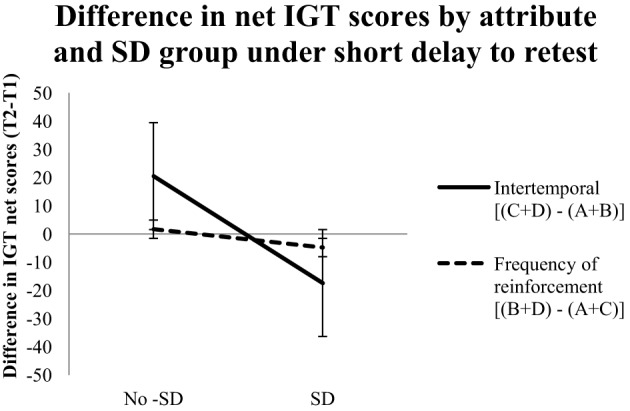
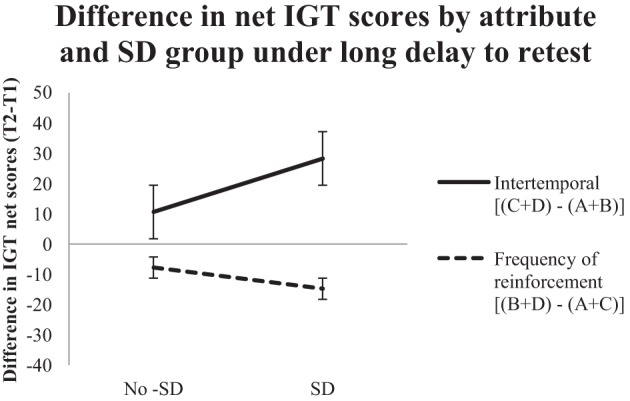
- For the short test-retest gap, the attribute-type effect was not significant, but sleep deprivation × attribute type was significant, F(1, 18) = 4.55, p < 0.05, η²p = 0.20; for the long gap, attribute type was significant, F(1, 18) = 9.61, p < 0.01, η²p = 0.35, while sleep deprivation × attribute type was not.
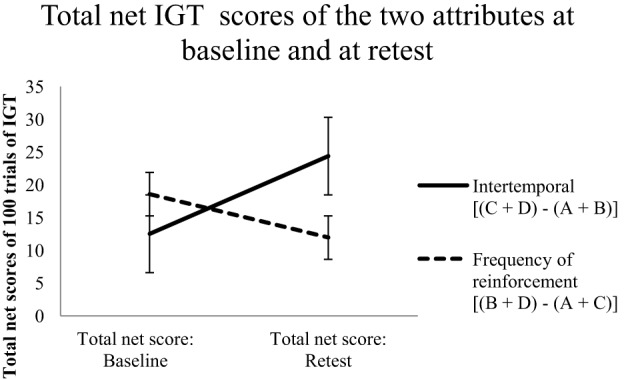
- Intertemporal scores improved from baseline (M = 12.53, SD = 33.05) to retest (M = 24.38, SD = 24.09), t(39) = −2.32, p < 0.05; frequency-attribute scores declined from baseline (M = 18.58, SD = 19.38) to retest (M = 11.95, SD = 26.12), but this difference was not significant.
Methods
- Forty healthy, non-smoking, right-handed Indian male students (mean age = 24.92 years, SD = 1.99) completed a computerized IGT (A′B′C′D′) with 60 cards per deck and payoffs matching Bechara et al. (2000).
- A 2 × 2 × 2 mixed repeated-measures design was used: scoring type (intertemporal vs. frequency of reinforcement), sleep deprivation (sleep deprived vs. not sleep deprived), and test-retest gap (short 24 h vs. long 12 weeks).
- Baseline (T1) and retest (T2) each consisted of 100 trials; analyses used repeated-measures ANOVA and paired t-tests on difference scores between T2 and T1.
Limitations
- The paper states limitations including small sample size, an all-male sample, lack of physiological monitoring to ascertain sleep deprivation effects, and lack of accounting for individual disposition and mood.
- The paper also notes that varying the test-retest gap made it impossible to equate affective and motivational states between groups across sessions, and that providing no incentives has advantages but may make motivation difficult to infer.
- Evident from the text: the sample was restricted to Indian male PhD students, limiting generalizability; the all-male design was chosen partly because female students were reluctant to stay overnight due to the sociocultural environment.
Model-written summary. Check it against the paper before relying on it.
Integrity signals
Registry
Cites
Statistics
Figures
Verification
Claims the paper makes
22 Own interpretation · 16 No full text of the sources · 14 Check pending · 13 Own result · 11 Own method · 5 Not checked yet · 2 No basis given · 1 Sources not found
A result the paper reports from its own data — it cites no other source for it, so there is none to check. The quote shows it is in the paper.
In the paper
“In support of a hypothesized distinction between the attributes, sleep deprivation in conjunction with the test-retest gap had a significant effect on the two attributes.”
§ Dual conception of risk in the Iowa Gambling Task: effects of sleep deprivation and test-retest gap > Discussion
plaindirect- Asserted: passes — The authors put it forward as true.
- Checkable: passes — It can be checked against evidence.
- Load-bearing: passes — The paper’s conclusions depend on it.
- Based: passes — The paper gives a reason why it holds.
A result the paper reports from its own data — it cites no other source for it, so there is none to check. The quote shows it is in the paper.
In the paper
“Contrary to expectations, sleep deprivation did not have an effect on IGT decision making analyzed via the two attributes.”
§ Dual conception of risk in the Iowa Gambling Task: effects of sleep deprivation and test-retest gap > Results
plain- Asserted: passes — The authors put it forward as true.
- Checkable: passes — It can be checked against evidence.
- Load-bearing: passes — The paper’s conclusions depend on it.
- Based: passes — The paper gives a reason why it holds.
The paper states this without a source or data behind it here, so there is nothing to check it against. The quote shows it is in the paper.
In the paper
“Contrary to expectations, sleep deprivation had no independent effect on the two attributes.”
§ Dual conception of risk in the Iowa Gambling Task: effects of sleep deprivation and test-retest gap > Discussion
plain- Asserted: passes — The authors put it forward as true.
- Checkable: passes — It can be checked against evidence.
- Load-bearing: passes — The paper’s conclusions depend on it.
- Based: passes — The paper gives a reason why it holds.
A result the paper reports from its own data — it cites no other source for it, so there is none to check. The quote shows it is in the paper.
In the paper
“Post-hoc tests revealed that sleep deprivation and short test-retest gap attenuated the difference between the two attributes.”
§ Dual conception of risk in the Iowa Gambling Task: effects of sleep deprivation and test-retest gap > Abstract
plaindirect- Asserted: passes — The authors put it forward as true.
- Checkable: passes — It can be checked against evidence.
- Load-bearing: passes — The paper’s conclusions depend on it.
- Based: passes — The paper gives a reason why it holds.
A result the paper reports from its own data — it cites no other source for it, so there is none to check. The quote shows it is in the paper.
In the paper
“Furthermore, the results showed an expected trend of increase in intertemporal decision making at retest”
§ Dual conception of risk in the Iowa Gambling Task: effects of sleep deprivation and test-retest gap > Abstract
plaindirect- Asserted: passes — The authors put it forward as true.
- Checkable: passes — It can be checked against evidence.
- Load-bearing: unclear — It is unclear whether the paper’s conclusions depend on it.
- Based: passes — The paper gives a reason why it holds.
A result the paper reports from its own data — it cites no other source for it, so there is none to check. The quote shows it is in the paper.
In the paper
“There was a significant improvement in total net IGT scores between baseline (M = 12.53, SD = 33.05) and retest (M = 24.38, SD = 24.09) when scored on the basis of intertemporal attribute [i.e., (C + D) – (A + C)], t(39) = −2.32, p < 0.05.”
- Also stated in: § Discussion · plain
“At retest, there was a marked increase in choices made on the basis of the intertemporal attribute.”
§ Dual conception of risk in the Iowa Gambling Task: effects of sleep deprivation and test-retest gap > Results
plain- Asserted: passes — The authors put it forward as true.
- Checkable: passes — It can be checked against evidence.
- Load-bearing: passes — The paper’s conclusions depend on it.
- Based: passes — The paper gives a reason why it holds.
- Also stated in: § Discussion · plain
A result the paper reports from its own data — it cites no other source for it, so there is none to check. The quote shows it is in the paper.
In the paper
“There was a significant main effect of attribute type, F(1, 36) = 7.51, p < 0.01, η2p = 0.17.”
§ Dual conception of risk in the Iowa Gambling Task: effects of sleep deprivation and test-retest gap > Results
plaincorrelational- Asserted: passes — The authors put it forward as true.
- Checkable: passes — It can be checked against evidence.
- Load-bearing: passes — The paper’s conclusions depend on it.
- Based: passes — The paper gives a reason why it holds.
A result the paper reports from its own data — it cites no other source for it, so there is none to check. The quote shows it is in the paper.
In the paper
“As expected, The ANOVA showed a difference between the two total net IGT scores derived from the two attribute types (intertemporality and frequency).”
§ Dual conception of risk in the Iowa Gambling Task: effects of sleep deprivation and test-retest gap > Discussion
plaincorrelational- Asserted: passes — The authors put it forward as true.
- Checkable: passes — It can be checked against evidence.
- Load-bearing: passes — The paper’s conclusions depend on it.
- Based: passes — The paper gives a reason why it holds.
A result the paper reports from its own data — it cites no other source for it, so there is none to check. The quote shows it is in the paper.
In the paper
“The was a significant interaction effect between attribute type and test-retest gap, F(1, 36) = 5.01, p < 0.05, η2p = 0.12.”
§ Dual conception of risk in the Iowa Gambling Task: effects of sleep deprivation and test-retest gap > Results
plaincorrelational- Asserted: passes — The authors put it forward as true.
- Checkable: passes — It can be checked against evidence.
- Load-bearing: passes — The paper’s conclusions depend on it.
- Based: passes — The paper gives a reason why it holds.
A result the paper reports from its own data — it cites no other source for it, so there is none to check. The quote shows it is in the paper.
In the paper
“There was also a significant three-way interaction among attribute type, sleep deprivation, and test-retest gap, F(1, 36) = 5.16, p < 0.05, η2p = 0.12.”
§ Dual conception of risk in the Iowa Gambling Task: effects of sleep deprivation and test-retest gap > Results
plaincorrelational- Asserted: passes — The authors put it forward as true.
- Checkable: passes — It can be checked against evidence.
- Load-bearing: passes — The paper’s conclusions depend on it.
- Based: passes — The paper gives a reason why it holds.
- It may state two separate claims as one. 23
- Probably not a substantial claim. 24
A result the paper reports from its own data — it cites no other source for it, so there is none to check. The quote shows it is in the paper.
In the paper
“However, when total net IGT scores were calculated according to preference for immediate reinforcement, they showed a slight decline from baseline (M = 18.58, SD = 19.38) to retest (M = 11.95, SD = 26.12); however, this difference was not significant”
§ Dual conception of risk in the Iowa Gambling Task: effects of sleep deprivation and test-retest gap > Results
plain- Asserted: passes — The authors put it forward as true.
- Checkable: passes — It can be checked against evidence.
- Load-bearing: unclear — It is unclear whether the paper’s conclusions depend on it.
- Based: passes — The paper gives a reason why it holds.
It may state two separate claims as one.
A result the paper reports from its own data — it cites no other source for it, so there is none to check. The quote shows it is in the paper.
In the paper
“In contrast, for the long test-retest gap, there was a significant effect of attribute type, F(1, 18) = 9.61, p < 0.01, η2p = 0.35, whereas the interaction of sleep deprivation with attribute type was not significant.”
§ Dual conception of risk in the Iowa Gambling Task: effects of sleep deprivation and test-retest gap > Results
plain- Asserted: passes — The authors put it forward as true.
- Checkable: passes — It can be checked against evidence.
- Load-bearing: passes — The paper’s conclusions depend on it.
- Based: passes — The paper gives a reason why it holds.
It may state two separate claims as one.
A result the paper reports from its own data — it cites no other source for it, so there is none to check. The quote shows it is in the paper.
In the paper
“Larger standard deviations (suggesting greater variability) have been observed for intertemporal decision making in the IGT (Bowman and Turnbull, 2003; Newman et al., 2008) and were also observed in the present study.”
§ Dual conception of risk in the Iowa Gambling Task: effects of sleep deprivation and test-retest gap > Results
plainn = 40- Asserted: passes — The authors put it forward as true.
- Checkable: passes — It can be checked against evidence.
- Load-bearing: fails — The paper’s conclusions may not depend on it.
- Based: passes — The paper gives a reason why it holds.
Probably not a substantial claim. The paper’s conclusions may not depend on it.
A result the paper reports from its own data — it cites no other source for it, so there is none to check. The quote shows it is in the paper.
In the paper
“For the short test-retest gap, the effect of attribute type was not significant, but the interaction between sleep deprivation and attribute type was significant, F(1, 18) = 4.55, p < 0.05, η2p = 0.20.”
§ Dual conception of risk in the Iowa Gambling Task: effects of sleep deprivation and test-retest gap > Results
plain- Asserted: passes — The authors put it forward as true.
- Checkable: passes — It can be checked against evidence.
- Load-bearing: passes — The paper’s conclusions depend on it.
- Based: passes — The paper gives a reason why it holds.
It may state two separate claims as one.
In the paper
“dispositional risk seekers who were assessed using a modified risk-taking scale (Domain-Specific Risk-Taking; Weber et al., 2002) preferred decks A′ and C′ and avoided decks B′ and D′ (Singh and Khan, 2008).”
§ Dual conception of risk in the Iowa Gambling Task: effects of sleep deprivation and test-retest gap > Introduction
What the sources say
- Not checked — no full text of the sourcecites Singh and Khan, 2008 source
plaincorrelational- Asserted: passes — The authors put it forward as true.
- Checkable: passes — It can be checked against evidence.
- Load-bearing: passes — The paper’s conclusions depend on it.
- Based: passes — The paper gives a reason why it holds.
Probably not a substantial claim.
In the paper
“Contrary to their expectation, absence of a secondary task (working memory load) was associated with greater decision making on the basis of the frequency attribute.”
§ Dual conception of risk in the Iowa Gambling Task: effects of sleep deprivation and test-retest gap > Introduction
What the sources say
- Check pendingcites Stocco et al., 2009 source
plaincorrelational- Asserted: passes — The authors put it forward as true.
- Checkable: passes — It can be checked against evidence.
- Load-bearing: fails — The paper’s conclusions may not depend on it.
- Based: passes — The paper gives a reason why it holds.
Probably not a substantial claim. The paper’s conclusions may not depend on it.
In the paper
“Decks C′ and D′ have small immediate rewards (50 points per card-pick) with 50% of cards drawn from deck C′ giving a loss of 25–75 points and 10% of cards drawn from deck D′ giving a loss of 250 points, such that 10 cards drawn from decks C′ and D′ result in a net gain of 250 points.”
§ Dual conception of risk in the Iowa Gambling Task: effects of sleep deprivation and test-retest gap > Introduction
What the sources say
- Not checked — no full text of the sourcecites Bechara et al., 2000 source
plain- Asserted: passes — The authors put it forward as true.
- Checkable: passes — It can be checked against evidence.
- Load-bearing: fails — The paper’s conclusions may not depend on it.
- Based: passes — The paper gives a reason why it holds.
Probably not a substantial claim. The paper’s conclusions may not depend on it. It may state two separate claims as one.
What the paper did — it cites no source for this, so there is none to check. The quote shows it is in the paper.
In the paper
“Apart from the small sample size and the use of an all-male sample, the present study had other limitations, such as the lack of physiological monitoring to ascertain the effects of sleep deprivation and a lack of accounting for individual disposition (Franken and Muris, 2005) and mood (Suhr and Tsanadis, 2007).”
§ Dual conception of risk in the Iowa Gambling Task: effects of sleep deprivation and test-retest gap > Discussion
plain- Asserted: passes — The authors put it forward as true.
- Checkable: passes — It can be checked against evidence.
- Load-bearing: fails — The paper’s conclusions may not depend on it.
- Based: passes — The paper gives a reason why it holds.
Probably not a substantial claim. The paper’s conclusions may not depend on it.
In the paper
“decks A′ and B′ have high immediate rewards (100 points per card-pick) with 50% of cards drawn from deck A′ giving a loss of 35–100 points and 10% of cards drawn from deck B′ giving a loss of 1250 points, such that 10 cards drawn from decks A′ and B′ result in a net loss of 250 points.”
§ Dual conception of risk in the Iowa Gambling Task: effects of sleep deprivation and test-retest gap > Introduction
What the sources say
- Not checked — no full text of the sourcecites Bechara et al., 2000 source
plaindirect- Asserted: passes — The authors put it forward as true.
- Checkable: passes — It can be checked against evidence.
- Load-bearing: passes — The paper’s conclusions depend on it.
- Based: passes — The paper gives a reason why it holds.
Probably not a substantial claim. It may state two separate claims as one.
A claim is checked only against the cited paper’s full text, never its abstract, and none is available for its sources.
In the paper
“Few studies have investigated the effects of sleep deprivation on the IGT (e.g., Killgore et al., 2006, 2007), however none have compared decision making on the basis of both the attributes.”
§ Dual conception of risk in the Iowa Gambling Task: effects of sleep deprivation and test-retest gap > Introduction
What the sources say
plain- Asserted: passes — The authors put it forward as true.
- Checkable: passes — It can be checked against evidence.
- Load-bearing: passes — The paper’s conclusions depend on it.
- Based: passes — The paper gives a reason why it holds.
It may state two separate claims as one.
In the paper
“and that choices on the basis of the frequency attribute have no long-term advantage (Dunn et al., 2006).”
§ Dual conception of risk in the Iowa Gambling Task: effects of sleep deprivation and test-retest gap > Introduction
What the sources say
- Not checked — no full text of the sourcecites Dunn et al., 2006 source
plain- Asserted: passes — The authors put it forward as true.
- Checkable: passes — It can be checked against evidence.
- Load-bearing: passes — The paper’s conclusions depend on it.
- Based: passes — The paper gives a reason why it holds.
Probably not a substantial claim.
In the paper
“At least one animal study has shown that sleep deprivation and a short test-retest gap disrupt learning of a hippocampus-dependent task, whereas sleep deprivation fails to cause a disruption with a longer delay (Graves et al., 2003)”
§ Dual conception of risk in the Iowa Gambling Task: effects of sleep deprivation and test-retest gap > Introduction
What the sources say
- Not checked yetcites Graves et al., 2003 source
hedgeddirect- Asserted: passes — The authors put it forward as true.
- Checkable: passes — It can be checked against evidence.
- Load-bearing: passes — The paper’s conclusions depend on it.
- Based: passes — The paper gives a reason why it holds.
It may state two separate claims as one.
A conclusion the paper draws from its own results — it cites no other source for it, so there is none to check. The quote shows it is in the paper.
In the paper
“It is concluded that risky decision making in the IGT is contingent on the attribute under consideration and is affected by factors such as time elapsed and constraint experienced before the retest.”
§ Dual conception of risk in the Iowa Gambling Task: effects of sleep deprivation and test-retest gap > Abstract
plaindirect- Asserted: passes — The authors put it forward as true.
- Checkable: passes — It can be checked against evidence.
- Load-bearing: passes — The paper’s conclusions depend on it.
- Based: passes — The paper gives a reason why it holds.
It may state two separate claims as one.
A conclusion the paper draws from its own results — it cites no other source for it, so there is none to check. The quote shows it is in the paper.
In the paper
“the frequency attribute may be the “default attribute” and decision making on the basis of the intertemporal attribute may require inhibition or overriding of this “default” mode.”
§ Dual conception of risk in the Iowa Gambling Task: effects of sleep deprivation and test-retest gap > Discussion
hedgedconditional- Asserted: passes — The authors put it forward as true.
- Checkable: passes — It can be checked against evidence.
- Load-bearing: passes — The paper’s conclusions depend on it.
- Based: passes — The paper gives a reason why it holds.
It may state two separate claims as one.
What the paper did — it cites no source for this, so there is none to check. The quote shows it is in the paper.
In the paper
“Apart from the small sample size and the use of an all-male sample, the present study had other limitations, such as the lack of physiological monitoring to ascertain the effects of sleep deprivation and a lack of accounting for individual disposition (Franken and Muris, 2005) and mood (Suhr and Tsanadis, 2007).”
§ Dual conception of risk in the Iowa Gambling Task: effects of sleep deprivation and test-retest gap > Discussion
plain- Asserted: passes — The authors put it forward as true.
- Checkable: passes — It can be checked against evidence.
- Load-bearing: fails — The paper’s conclusions may not depend on it.
- Based: passes — The paper gives a reason why it holds.
Probably not a substantial claim. The paper’s conclusions may not depend on it.
In the paper
“It is commonly understood that risk perception and decision making in the IGT is governed by the intertemporal attribute (Bechara et al., 2005)”
§ Dual conception of risk in the Iowa Gambling Task: effects of sleep deprivation and test-retest gap > Introduction
What the sources say
- Not checked — no full text of the sourcecites Bechara et al., 2005 source
boosteddirect- Asserted: passes — The authors put it forward as true.
- Checkable: passes — It can be checked against evidence.
- Load-bearing: passes — The paper’s conclusions depend on it.
- Based: passes — The paper gives a reason why it holds.
Probably not a substantial claim.
A conclusion the paper draws from its own results — it cites no other source for it, so there is none to check. The quote shows it is in the paper.
In the paper
“Together, these findings suggest that, in the IGT, risk might be perceived in two ways, either by the intertemporal attribute or by frequency of reward and punishment.”
§ Dual conception of risk in the Iowa Gambling Task: effects of sleep deprivation and test-retest gap > Introduction
hedged- Asserted: passes — The authors put it forward as true.
- Checkable: passes — It can be checked against evidence.
- Load-bearing: passes — The paper’s conclusions depend on it.
- Based: passes — The paper gives a reason why it holds.
It may state two separate claims as one.
In the paper
“Therefore the four decks differ in two ways: (a) net outcome across time (i.e., inter temporal attribute) by which decks A′ and B′ could be considered risky in the long term, whereas decks C′ and D′ could be considered safe in the long term”
§ Dual conception of risk in the Iowa Gambling Task: effects of sleep deprivation and test-retest gap > Introduction
What the sources say
- Not checked — no full text of the sourcecites Bechara et al., 2000 source
hedgedcorrelational- Asserted: passes — The authors put it forward as true.
- Checkable: passes — It can be checked against evidence.
- Load-bearing: passes — The paper’s conclusions depend on it.
- Based: passes — The paper gives a reason why it holds.
It may state two separate claims as one.
In the paper
“deck B′ was considered “risky” on the basis of the intertemporal attribute and is preferred to other “safe” decks (Lin et al., 2007)”
§ Dual conception of risk in the Iowa Gambling Task: effects of sleep deprivation and test-retest gap > Introduction
What the sources say
- Check pendingcites Lin et al., 2007 source
plain- Asserted: passes — The authors put it forward as true.
- Checkable: passes — It can be checked against evidence.
- Load-bearing: passes — The paper’s conclusions depend on it.
- Based: passes — The paper gives a reason why it holds.
Probably not a substantial claim.
In the paper
“The main assumption in the SMH–IGT framework is that risk is perceived in terms of its intertemporal attribute, i.e., choice of immediate as opposed to delayed reward and punishment is considered risky (Bechara et al., 2005).”
§ Dual conception of risk in the Iowa Gambling Task: effects of sleep deprivation and test-retest gap > Introduction
What the sources say
- Not checked — no full text of the sourcecites Bechara et al., 2005 source
plain- Asserted: passes — The authors put it forward as true.
- Checkable: passes — It can be checked against evidence.
- Load-bearing: passes — The paper’s conclusions depend on it.
- Based: passes — The paper gives a reason why it holds.
Probably not a substantial claim.
A conclusion the paper draws from its own results — it cites no other source for it, so there is none to check. The quote shows it is in the paper.
In the paper
“The current results imply that temporal stability of the two attributes is different and that learning of the two attributes might be differentially vulnerable to the effects of test-retest gap and sleep deprivation.”
§ Dual conception of risk in the Iowa Gambling Task: effects of sleep deprivation and test-retest gap > Discussion
hedgedconditional- Asserted: passes — The authors put it forward as true.
- Checkable: passes — It can be checked against evidence.
- Load-bearing: passes — The paper’s conclusions depend on it.
- Based: passes — The paper gives a reason why it holds.
It may state two separate claims as one.
A conclusion the paper draws from its own results — it cites no other source for it, so there is none to check. The quote shows it is in the paper.
In the paper
“As expected, differences in the two attributes were affected by the length of test-retest gap suggesting that temporal stability in risk taking is contingent both on the attribute under consideration and on the time gap between test and retest.”
§ Dual conception of risk in the Iowa Gambling Task: effects of sleep deprivation and test-retest gap > Discussion
hedgedconditional- Asserted: passes — The authors put it forward as true.
- Checkable: passes — It can be checked against evidence.
- Load-bearing: passes — The paper’s conclusions depend on it.
- Based: passes — The paper gives a reason why it holds.
It may state two separate claims as one.
What the paper did — it cites no source for this, so there is none to check. The quote shows it is in the paper.
In the paper
“Participants were then randomly assigned to one of four groups (short-test-retest gap/sleep deprivation, long test-retest gap/sleep deprivation, short test-retest gap/no sleep deprivation, or long test-re-test delay/no sleep deprivation).”
§ Dual conception of risk in the Iowa Gambling Task: effects of sleep deprivation and test-retest gap > Materials and methods > Procedure
plain- Asserted: passes — The authors put it forward as true.
- Checkable: passes — It can be checked against evidence.
- Load-bearing: passes — The paper’s conclusions depend on it.
- Based: passes — The paper gives a reason why it holds.
Probably not a substantial claim.
A conclusion the paper draws from its own results — it cites no other source for it, so there is none to check. The quote shows it is in the paper.
In the paper
“suggesting that the effects of sleep deprivation might be time-dependent.”
§ Dual conception of risk in the Iowa Gambling Task: effects of sleep deprivation and test-retest gap > Introduction
hedgedconditional- Asserted: passes — The authors put it forward as true.
- Checkable: passes — It can be checked against evidence.
- Load-bearing: passes — The paper’s conclusions depend on it.
- Based: passes — The paper gives a reason why it holds.
Probably not a substantial claim.
A conclusion the paper draws from its own results — it cites no other source for it, so there is none to check. The quote shows it is in the paper.
In the paper
“Thus, the data support the hypothesis that there is a distinction between the two conceptualizations of risk in the IGT indicating that decision making of cognition-based system differs from that of emotion-based system at the retest.”
§ Dual conception of risk in the Iowa Gambling Task: effects of sleep deprivation and test-retest gap > Discussion
hedgedcorrelational- Asserted: passes — The authors put it forward as true.
- Checkable: passes — It can be checked against evidence.
- Load-bearing: passes — The paper’s conclusions depend on it.
- Based: passes — The paper gives a reason why it holds.
It may state two separate claims as one.
What the paper did — it cites no source for this, so there is none to check. The quote shows it is in the paper.
In the paper
“All participants spent the night before the retest session in a dormitory in the presence of a male research assistant who observed no tossing and turning or other discomfort among the participants as they slept.”
§ Dual conception of risk in the Iowa Gambling Task: effects of sleep deprivation and test-retest gap > Materials and methods > Procedure
plain- Asserted: passes — The authors put it forward as true.
- Checkable: passes — It can be checked against evidence.
- Load-bearing: fails — The paper’s conclusions may not depend on it.
- Based: passes — The paper gives a reason why it holds.
Probably not a substantial claim. The paper’s conclusions may not depend on it. It may state two separate claims as one.
What the paper did — it cites no source for this, so there is none to check. The quote shows it is in the paper.
In the paper
“Participants in the no–sleep-deprivation group were asked to sleep (in presence of a male research assistant who observed no discomfort among participants, and who woke participants in time for the retest session).”
§ Dual conception of risk in the Iowa Gambling Task: effects of sleep deprivation and test-retest gap > Materials and methods > Procedure
plain- Asserted: passes — The authors put it forward as true.
- Checkable: passes — It can be checked against evidence.
- Load-bearing: fails — The paper’s conclusions may not depend on it.
- Based: passes — The paper gives a reason why it holds.
Probably not a substantial claim. The paper’s conclusions may not depend on it. It may state two separate claims as one.
In the paper
“dispositional risk seekers who were assessed using a modified risk-taking scale (Domain-Specific Risk-Taking; Weber et al., 2002) preferred decks A′ and C′ and avoided decks B′ and D′ (Singh and Khan, 2008).”
§ Dual conception of risk in the Iowa Gambling Task: effects of sleep deprivation and test-retest gap > Introduction
What the sources say
- Not checked — no full text of the sourcecites Singh and Khan, 2008 source
plaincorrelational- Asserted: passes — The authors put it forward as true.
- Checkable: passes — It can be checked against evidence.
- Load-bearing: passes — The paper’s conclusions depend on it.
- Based: passes — The paper gives a reason why it holds.
Probably not a substantial claim.
In the paper
“These results are consistent with those of Killgore et al. (2006, 2007) in which sleep deprivation and short test-retest gaps (49, 51, 72 h) impaired intertemporal decision making.”
§ Dual conception of risk in the Iowa Gambling Task: effects of sleep deprivation and test-retest gap > Discussion
What the sources say
- Not matchedcites Killgore et al. (2006, 2007)
Couldn’t be matched to a paper in Crossref, so it can’t be checked.
plaindirect- Asserted: passes — The authors put it forward as true.
- Checkable: passes — It can be checked against evidence.
- Load-bearing: passes — The paper’s conclusions depend on it.
- Based: passes — The paper gives a reason why it holds.
Probably not a substantial claim. It may state two separate claims as one.
- Not matched
What the paper did — it cites no source for this, so there is none to check. The quote shows it is in the paper.
In the paper
“All participants were discouraged from taking afternoon naps the day before the retest and were reminded not to discuss the study with others.”
§ Dual conception of risk in the Iowa Gambling Task: effects of sleep deprivation and test-retest gap > Materials and methods > Procedure
plain- Asserted: passes — The authors put it forward as true.
- Checkable: passes — It can be checked against evidence.
- Load-bearing: fails — The paper’s conclusions may not depend on it.
- Based: passes — The paper gives a reason why it holds.
Probably not a substantial claim. The paper’s conclusions may not depend on it. It may state two separate claims as one.
In the paper
“the impairment caused by sleep deprivation has been explained as a failure of integration of both cognitive and affective processes (Killgore et al., 2007).”
§ Dual conception of risk in the Iowa Gambling Task: effects of sleep deprivation and test-retest gap > Introduction
What the sources say
- Not checked — no full text of the sourcecites Killgore et al., 2007 source
plaindirect- Asserted: passes — The authors put it forward as true.
- Checkable: passes — It can be checked against evidence.
- Load-bearing: passes — The paper’s conclusions depend on it.
- Based: passes — The paper gives a reason why it holds.
Probably not a substantial claim.
What the paper did — it cites no source for this, so there is none to check. The quote shows it is in the paper.
In the paper
“Participants in the sleep-deprivation group were in the company of a male research assistant and refrained from drinking caffeinated beverages (e.g., tea, coffee) throughout the night.”
§ Dual conception of risk in the Iowa Gambling Task: effects of sleep deprivation and test-retest gap > Materials and methods > Procedure
plain- Asserted: passes — The authors put it forward as true.
- Checkable: passes — It can be checked against evidence.
- Load-bearing: fails — The paper’s conclusions may not depend on it.
- Based: passes — The paper gives a reason why it holds.
Probably not a substantial claim. The paper’s conclusions may not depend on it. It may state two separate claims as one.
What the paper did — it cites no source for this, so there is none to check. The quote shows it is in the paper.
In the paper
“All IGT testing was done between 7:00 a.m. and 9:00 a.m., and in each retest half of participants were sleep-deprived and half were not.”
§ Dual conception of risk in the Iowa Gambling Task: effects of sleep deprivation and test-retest gap > Materials and methods > Procedure
plain- Asserted: passes — The authors put it forward as true.
- Checkable: passes — It can be checked against evidence.
- Load-bearing: fails — The paper’s conclusions may not depend on it.
- Based: passes — The paper gives a reason why it holds.
Probably not a substantial claim. The paper’s conclusions may not depend on it. It may state two separate claims as one.
What the paper did — it cites no source for this, so there is none to check. The quote shows it is in the paper.
In the paper
“Baseline and retest times were matched for all participants; for example, if a participant underwent the baseline session at 8.00 a.m., his or her retest session was also at 8.00 a.m.”
§ Dual conception of risk in the Iowa Gambling Task: effects of sleep deprivation and test-retest gap > Materials and methods > Procedure
plain- Asserted: passes — The authors put it forward as true.
- Checkable: passes — It can be checked against evidence.
- Load-bearing: passes — The paper’s conclusions depend on it.
- Based: passes — The paper gives a reason why it holds.
Probably not a substantial claim.
What the paper did — it cites no source for this, so there is none to check. The quote shows it is in the paper.
In the paper
“One disadvantage of varying the test-retest gap (short and long test-retest gap) is the inability to equate the affective and motivational states of the two groups between the two testing sessions.”
§ Dual conception of risk in the Iowa Gambling Task: effects of sleep deprivation and test-retest gap > Discussion
plaindirect- Asserted: passes — The authors put it forward as true.
- Checkable: passes — It can be checked against evidence.
- Load-bearing: fails — The paper’s conclusions may not depend on it.
- Based: passes — The paper gives a reason why it holds.
Probably not a substantial claim. The paper’s conclusions may not depend on it.
In the paper
“(b) frequency of immediate reward and punishment notwithstanding net or long-term outcomes (i.e., frequency attribute) by which decks A′ and C′ could be perceived as risky due to frequent punishments/infrequent rewards and decks B′ and D′ could be perceived as safe due to infrequent punishments/frequent rewards.”
§ Dual conception of risk in the Iowa Gambling Task: effects of sleep deprivation and test-retest gap > Introduction
What the sources say
- Not checked — no full text of the sourcecites Bechara et al., 2000 source
hedgedcorrelational- Asserted: passes — The authors put it forward as true.
- Checkable: passes — It can be checked against evidence.
- Load-bearing: passes — The paper’s conclusions depend on it.
- Based: passes — The paper gives a reason why it holds.
It may state two separate claims as one.
A conclusion the paper draws from its own results — it cites no other source for it, so there is none to check. The quote shows it is in the paper.
In the paper
“These findings suggest that decision making on the basis of the intertemporal attribute is the result of activity in the cognition-based system whereas decision making on the basis of the frequency attribute may reflect activity in the emotion-based system.”
§ Dual conception of risk in the Iowa Gambling Task: effects of sleep deprivation and test-retest gap > Introduction
hedgedconditional- Asserted: passes — The authors put it forward as true.
- Checkable: passes — It can be checked against evidence.
- Load-bearing: passes — The paper’s conclusions depend on it.
- Based: passes — The paper gives a reason why it holds.
It may state two separate claims as one.
What the paper did — it cites no source for this, so there is none to check. The quote shows it is in the paper.
In the paper
“Apart from the small sample size and the use of an all-male sample, the present study had other limitations, such as the lack of physiological monitoring to ascertain the effects of sleep deprivation and a lack of accounting for individual disposition (Franken and Muris, 2005) and mood (Suhr and Tsanadis, 2007).”
§ Dual conception of risk in the Iowa Gambling Task: effects of sleep deprivation and test-retest gap > Discussion
plain- Asserted: passes — The authors put it forward as true.
- Checkable: passes — It can be checked against evidence.
- Load-bearing: fails — The paper’s conclusions may not depend on it.
- Based: passes — The paper gives a reason why it holds.
Probably not a substantial claim. The paper’s conclusions may not depend on it.
In the paper
“Killgore et al. (2006) found that a short (1 day) test-retest gap, when combined with sleep deprivation, impaired decision making and increased risky choices in the IGT (greater number of choices made from the short-term advantageous decks).”
§ Dual conception of risk in the Iowa Gambling Task: effects of sleep deprivation and test-retest gap > Introduction
What the sources say
- Not checked — no full text of the sourcecites Killgore et al., 2006 source
plaindirect- Asserted: passes — The authors put it forward as true.
- Checkable: passes — It can be checked against evidence.
- Load-bearing: passes — The paper’s conclusions depend on it.
- Based: passes — The paper gives a reason why it holds.
It may state two separate claims as one.
The paper relies on this without support.
Task familiarity at retest is conducive to activity of the cognition-based system rather than to activity of the emotion-based system.
“The dual process theory suggests that task-familiarity (e.g., at retest) is conducive to activity of cognition-based system (rather than to activity of emotion-based system).”
Statistics recomputed
Every reported test result, recomputed from its test statistic and degrees of freedom. A result shows as not adding up only once an independent check has confirmed it.
- ConsistentF(1, 36) = 7.51reported p < .01 · recomputed p = .009
“F(1, 36) = 7.51, p < .01”
- ConsistentF(1, 36) = 5.01reported p < .05 · recomputed p = .031
“F(1, 36) = 5.01, p < .05”
- ConsistentF(1, 36) = 5.16reported p < .05 · recomputed p = .029
“F(1, 36) = 5.16, p < .05”
- ConsistentF(1, 18) = 4.55reported p < .05 · recomputed p = .047
“F(1, 18) = 4.55, p < .05”
- ConsistentF(1, 18) = 9.61reported p < .01 · recomputed p = .006
“F(1, 18) = 9.61, p < .01”
- Consistentt(39) = -2.32reported p < .05 · recomputed p = .026
“t(39) = −2.32, p < .05”
Self-check
Percentages, sums and reported differences re-computed from the paper’s own numbers.
Each contradiction between two passages listed here was confirmed by an independent check.
Rated major: it would touch a result — a value a result rests on, reported and recomputed p-values on opposite sides of the significance level, two passages that conflict with no sign which is right, or a cited work retracted before this paper was published.
In the paper
§ Dual conception of risk in the Iowa Gambling Task: effects of sleep deprivation and test-retest gap > Results
“sleep deprivation introduced with a short test-retest gap attenuates the difference between the two attributes.”
§ Dual conception of risk in the Iowa Gambling Task: effects of sleep deprivation and test-retest gap > Discussion
“introducing sleep deprivation with a short test-retest gap enhanced the difference between the two attributes.”
Rated minor: it would not touch a result — a value no result rests on, a p-value that stays on the same side of the significance level, or a conflict that is clerical, resolved elsewhere in the paper, or outside its own findings.
In the paper
§ Dual conception of risk in the Iowa Gambling Task: effects of sleep deprivation and test-retest gap > Results
“Intertemporal attribute [(C′ + D′) − (A′ + B′)] | 28.30 (40.22) | −17.40 (17.61) | 20.50 (27.83) | 10.60 (19.10)”
§ Dual conception of risk in the Iowa Gambling Task: effects of sleep deprivation and test-retest gap > Results
“There was a significant improvement in total net IGT scores between baseline (M = 12.53, SD = 33.05) and retest (M = 24.38, SD = 24.09)”
Rated minor: it would not touch a result — a value no result rests on, a p-value that stays on the same side of the significance level, or a conflict that is clerical, resolved elsewhere in the paper, or outside its own findings.
In the paper
§ Dual conception of risk in the Iowa Gambling Task: effects of sleep deprivation and test-retest gap > Results
“scored on the basis of intertemporal attribute [i.e., (C + D) – (A + C)]”
§ Dual conception of risk in the Iowa Gambling Task: effects of sleep deprivation and test-retest gap > Materials and methods > Design and analysis
“scored according to the intertemporal attribute [T2 ((C′ + D′) − (A′ + B′)) − T1 ((C′ + D′) − (A′ + B′))]”
Rated minor: it would not touch a result — a value no result rests on, a p-value that stays on the same side of the significance level, or a conflict that is clerical, resolved elsewhere in the paper, or outside its own findings.
In the paper
§ Dual conception of risk in the Iowa Gambling Task: effects of sleep deprivation and test-retest gap > Introduction
“such that 10 cards drawn from decks A′ and B′ result in a net loss of 250 points.”
§ Dual conception of risk in the Iowa Gambling Task: effects of sleep deprivation and test-retest gap > Introduction
“decks A′ and B′ have high immediate rewards (100 points per card-pick) with 50% of cards drawn from deck A′ giving a loss of 35–100 points”
Citations
Cites
Yaşlı Kadınlarda Üreme Sağlığı
Kokanalı, D., & Üstün, Y. E. (2019) · DergiPark (Istanbul University) · Cited by 169,621
(1994) · DigitalGeorgetown (Georgetown University Library) · Cited by 10,542
DESCARTES' ERROR: Emotion, Reason, and the Human Brain
Marg, E. (1995) · Optometry and Vision Science · doi:10.1002/j.1538-9235.1995.tb03988.x · Cited by 8,178
Loewenstein, G. F., Weber, E. U., Hsee, C. K., & Welch, N. (2001) · Psychological Bulletin · doi:10.1037//0033-2909.127.2.267 · Cited by 6,500
Insensitivity to future consequences following damage to human prefrontal cortex
Bechara, A., Damasio, A. R., Damasio, H., & Anderson, S. W. (1994) · Cognition · doi:10.1016/0010-0277(94)90018-3 · Cited by 6,128
Loewenstein, G. F., Weber, E. U., Hsee, C. K., & Welch, N. (2001) · Psychological Bulletin · doi:10.1037/0033-2909.127.2.267 · Cited by 5,955
Risk as Analysis and Risk as Feelings: Some Thoughts about Affect, Reason, Risk, and Rationality
Slovic, P., Finucane, M. L., Peters, E., & MacGregor, D. G. (2004) · Risk Analysis · doi:10.1111/j.0272-4332.2004.00433.x · Cited by 3,885
Emotion, Decision Making and the Orbitofrontal Cortex
Bechara, A. (2000) · Cerebral Cortex · doi:10.1093/cercor/10.3.295 · Cited by 3,589
Belief in the law of small numbers.
Tversky, A., & Kahneman, D. (1971) · Psychological Bulletin · doi:10.1037/h0031322 · Cited by 3,246
A domain‐specific risk‐attitude scale: measuring risk perceptions and risk behaviors
Weber, E. U., Blais, A., & Betz, N. E. (2002) · Journal of Behavioral Decision Making · doi:10.1002/bdm.414 · Cited by 2,936
Research works printed but not linked: 1
- Newman L. I. Polk T. A. Preston S. D. (2008). “Revealing individual differences in the Iowa Gambling Task,” in Proceedings of the 30th Annual Conference of the Cognitive Science Society, eds Love B. C. McRae K. Sloutsky V. M. (Austin, TX: Cognitive Science Society), 1067– 1072
Cited by
Sorted by citations
Singh, V. (2021) · Frontiers in Neuroscience · doi:10.3389/fnins.2021.631195 · Cited by 19
Self-citationThe impact of sleep loss on decision making: Opening the cognitive black box
Lim, J. Y. L., Killgore, W. D. S., Bennett, D., & Drummond, S. P. A. (2025) · Sleep Medicine Reviews · doi:10.1016/j.smrv.2025.102114 · Cited by 16
Effect of 72 h of Sleep Deprivation on the Iowa Gambling Task
Liu, L., & Zhou, R. (2016) · Nöro Psikiyatri Arşivi · doi:10.5152/npa.2016.12505 · Cited by 16
Oberdörfer, S., Heidrich, D., Birnstiel, S., & Latoschik, M. E. (2021) · Frontiers in Virtual Reality · doi:10.3389/frvir.2021.679277 · Cited by 12
Zhang, Z., Tian, Y., & Liu, Y. (2023) · Brain Topography · doi:10.1007/s10548-023-00948-x · Cited by 7
Singh, V. (2024) · Frontiers in Neuroscience · doi:10.3389/fnins.2023.1214271 · Cited by 6
Self-citationOberdörfer, S., Birnstiel, S., Steinhaeusser, S. C., & Latoschik, M. E. (2023) · Lecture notes in computer science · doi:10.1007/978-3-031-35634-6_47 · Cited by 2
Xiaoting, L. I. U., ZHANG, L., & Zhang, N. (2019) · Advances in Psychological Science · doi:10.3724/sp.j.1042.2019.01875 · Cited by 1
Pérez, Y. B., Figueredo, C. A. D., & Dosina, A. R. (2015) · Revista cubana de neurología y neurocirugía
(2020) · Elsevier eBooks · doi:10.1016/b978-0-12-815002-3.00020-6
Li, Y., Yang, L., Hao, D., & Li, G. (2023) · International Symposium on Artificial Intelligence for Medicine Sciences (ISAIMS) · doi:10.1145/3644116.3644219
Research on sleep disorders in patients with mental illness: A review of Indian studies
Pal, A., Saini, L. K., Basu, A., Kachhawaha, G., Kundu, K., & Gupta, R. (2025) · Indian Journal of Psychiatry · doi:10.4103/indianjpsychiatry.indianjpsychiatry_110_25
Elaboration et normalisation d'un test clinique visant à évaluer les troubles émotionnels
Gros, A. (2015) · theses.fr (ABES) · doi:10.70675/60ac7413z9c30z480cz9e65z4bd2b28fcfcd
Metadata
- Authors
- Singh, V.
- Affiliations
- Indian Institute of Technology Delhi (IN)
- Corresponding author
- Singh, Varsha
- ORCID
- Singh, Varsha
- Venue
- Frontiers in Psychology
- Publisher
- Frontiers Media SA
- Published
- 2013
- Volume
- 4
- Pages
- 628-628
- ISSN
- 1664-1078 (ISSN-L)
- PMC
- PMC3776933
- OpenAlex
- W2141087742
- Cited by
- 13
- References
- 54
- Citations by year
- 2025: 2 · 2024: 1 · 2023: 3 · 2021: 2 · 2020: 1 · 2019: 1 · 2016: 1 · 2015: 2
- FWCI
- 0.62
- Type
- journal article
- Language
- en
- Open access
- gold
- doi.org
- Licence
- cc-by
- Locations
- Frontiers in Psychology (publishedVersion, cc-by)
- Europe PMC (PubMed Central) (publishedVersion, cc-by)
- PubMed (publishedVersion)
- PubMed Central (publishedVersion, cc-by)
- DOAJ (DOAJ: Directory of Open Access Journals) (submittedVersion, cc-by-sa)
- Topics
- Social Sciences › Decision Sciences › General Decision Sciences › Decision-Making and Behavioral Economics
- Life Sciences › Neuroscience › Cognitive Neuroscience › Neural and Behavioral Psychology Studies
- Social Sciences › Psychology › Clinical Psychology › Gambling Behavior and Treatments
- Keywords
- Iowa Gambling Task, risk perception, intertemporal choice, sleep deprivation, risky decision making, time-dependent effects
About these checks
Registry, retraction, Cites and statistics results are computed, not judged, with one exception: a printed reference that no index lists is read once by a model before it counts as a citation error. Claims are extracted by a model and kept only when their quote appears verbatim in the text; each cited source is then checked, with a model’s help, for whether it says what the claim relies on. Those verdicts can be wrong — read the claim’s quote and the cited source before relying on one.
A language model drew the claims from the paper on 2026-11-11, under version 3 of the claim definition (model deepseek-v4.1-flash, prompt extract-v3).
A second model labelled each claim on 2026-11-11 (model jev-1.13-20260917, definition revision gold-guideline-v0.2).
Statistics and arithmetic are recomputed, not judged.
Confidence bands are shown only for fields calibrated on our annotated test set. None is calibrated yet, so no band is shown.
What counts as a claim ›How we measure confidence ›How we check this ›
Are you an author, or do you see a problem with this page? Request a review
