

The DOI matches its Crossref record; 55 of the 58 references it cites were found in a registry or an index.
The importance of protesters' morals: moral obligation as a key variable to understand collective action
Open accessAbstract
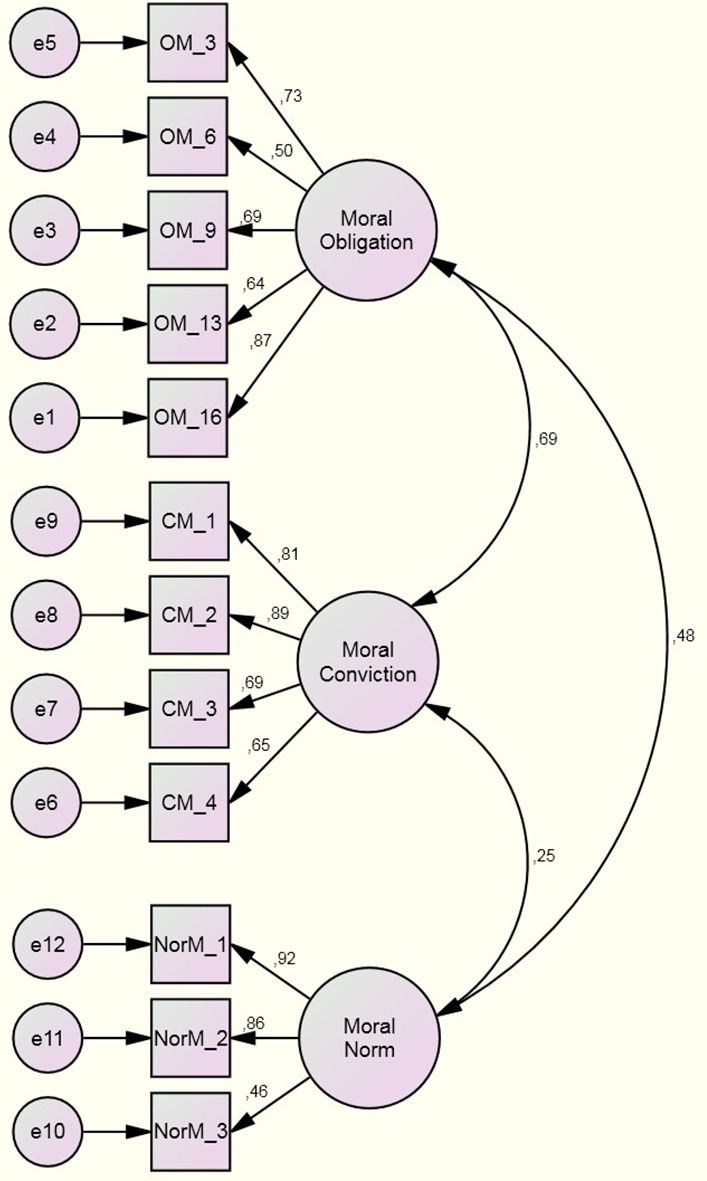
Collective action and protest have become a normalised political behaviour that in many cases defines the political agenda. The reasons why people take to the streets constitutes a central subject within the study of Social Psychology. In the literature, three precedents of protest that have been established as central to the study of this phenomenon are: injustice, efficacy and identity. But political action is also deeply related to moral values. This explains why in recent years some moral constructs have also been pointed out as predictors of collective action. Moral variables have been introduced into the literature with little consideration to how they relate to each other. Thus, work in this direction is needed. The general aim of this research is to differentiate moral obligation from moral norms and moral conviction, as well as to compare their ability to predict collective action. In order to do so, the research objectives are: a) conceptualise and operationalise moral obligation (Study 1, N= 171); b) test its predictive power for intention to participate in protests (Study 2, N= 622); and c) test moral obligation in a real context (Study 3, N= 407). Results are encouraging, showing not only that moral obligation is different to moral conviction and moral norm, but also that it is a more effective predictor working both for intention and real participation. This work therefore presents moral obligation as a key precedent of protest participation, prompting its future use as a variable that can enhance existing predictive models of collective action. Results regarding other variables are also discussed.
Overview
The claims and statistics of this paper haven’t been checked yet.
Run the check — free, no account needed. It reads the open-access text and checks the sources it cites.
Integrity signals
Registry
Cites
Statistics
Figures
Verification
Claims the paper makes
The claims and statistics of this paper haven’t been checked yet.
Run the check — free, no account needed. It reads the open-access text and checks the sources it cites.
Claims other papers make about this one
Each is checked against this paper’s own text: does it say what the citing paper says it does?
The source backs part of the claim, not all of it — or backs it for a different population, condition or comparison.
In the citing paper
“agreement with self-trascendence values, that could reinforce moral conviction supportive of collective action (Sabucedo et al., 2018; Agostini and van Zomeren, 2021)”
From Emotional processes, collective behavior, and social movements: A meta-analytic review of collective effervescence outcomes during collective gatherings and demonstrations (2022) · cites this paper as Sabucedo et al., 2018
Experimental — accuracy not yet measured
Self-check
Percentages, sums and reported differences re-computed from the paper’s own numbers.
The self-check needs the paper’s full text.
Citations
Cites
The theory of planned behavior
Ajzen, I. (1991) · Organizational Behavior and Human Decision Processes · doi:10.1016/0749-5978(91)90020-t · Cited by 90,587
A Theory of Cognitive Dissonance
Festinger, L. (1957) · doi:10.1515/9781503620766 · Cited by 24,241
A Theory of Cognitive Dissonance
Morvan, C., & O’Connor, A. (2017) · Macat Library eBooks · doi:10.4324/9781912282432 · Cited by 18,284 · cited 1×
“The theory of self-discrepancy (Higgins, 1987) posits, following the classical concept of cognitive dissonance (Festinger, 1957) that discrepancy between beliefs and actions produces psychological distress.”
BackgroundSelf-discrepancy: A theory relating self and affect.
Higgins, E. T. (1987) · Psychological Review · doi:10.1037/0033-295x.94.3.319 · Cited by 7,219 · cited 3×
“The theory of self-discrepancy (Higgins, 1987) posits, following the classical concept of cognitive dissonance (Festinger, 1957) that discrepancy between beliefs and actions produces psychological distress.”
BackgroundMethodImplicit social cognition: Attitudes, self-esteem, and stereotypes
Greenwald, A. G., & Banaji, M. R. (1995) · Psychological Review · doi:10.1037/0033-295x.102.1.4 · Cited by 6,682 · cited 1×
“This devaluation is not likely to happen however, as people will resort to cognitive strategies in order to reduce cognitive dissonance and self-discrepancy, such as looking for external causes for non-compliance (Greenwald and Banaji, 1995).”
BackgroundStatistical mediation analysis with a multicategorical independent variable
Hayes, A. F., & Preacher, K. J. (2014) · British Journal of Mathematical and Statistical Psychology · doi:10.1111/bmsp.12028 · Cited by 3,403 · cited 2×
“0; for additional information on the software, see (Hayes and Preacher, 2014)].”
BackgroundMethodInfluentialvan Zomeren, M., Postmes, T., & Spears, R. (2008) · Psychological Bulletin · doi:10.1037/0033-2909.134.4.504 · Cited by 2,714 · cited 5×
“…as a predictor of intention to participate in collective action along with the most used predictive variables in the literature, those of the SIMCA (van Zomeren et al., 2008; Study 2); and (3) to test moral obligation’s predictive power in the context of real participation in a demonstration.”
BackgroundMethodResultInfluentialSpencer, S. J., Zanna, M. P., & Fong, G. T. (2005) · Journal of Personality and Social Psychology · doi:10.1037/0022-3514.89.6.845 · Cited by 2,452 · cited 1×
“Despite this, it has to be noted that causal assumptions derived from mediational analysis should be addressed with caution (Spencer et al., 2005).”
BackgroundCross-Cultural Correlates of Life Satisfaction and Self-Esteem
Diener, E., & Diener, M. (1995) · Journal of Personality and Social Psychology · doi:10.1037/0022-3514.68.4.653 · Cited by 1,722
The Lucifer effect: understanding how good people turn evil
(2007) · Choice Reviews Online · doi:10.5860/choice.45-1153 · Cited by 1,558
Research works printed but not linked: 4
- Blackburn, 2008, Oxford Dictionary of Philosophyq.
- Gamson, 1992, Talking Politics.
- 2017, Población y Edad Media por nacionalidad y sexo.
- Zimbardo, 2007, The Lucifer Effect.
Cited by
Sorted by citations
The Psychology of Moral Conviction
Skitka, L. J., Hanson, B. E., Morgan, G. S., & Wisneski, D. C. (2020) · Annual Review of Psychology · doi:10.1146/annurev-psych-063020-030612 · Cited by 525
Agostini, M., & van Zomeren, M. (2021) · Psychological Bulletin · doi:10.1037/bul0000256 · Cited by 301
“…2007, 2012; Skitka, 2010) inspired scientific interest in moral motivations for collective action (e.g., Jost et al., 2017; Milesi & Alberici, 2018; Sabucedo et al., 2018; van Stekelenburg et al., 2009; van Stekelenburg & Klandermans, 2009), which includes motivations based in values, moral…”
BackgroundInfluentialvan Zomeren, M., Kutlaca, M., & Turner-Zwinkels, F. M. (2018) · European Review of Social Psychology · doi:10.1080/10463283.2018.1479347 · Cited by 282
Resistance in repressive contexts: A comprehensive test of psychological predictors.
Ayanian, A. H., Tausch, N., Acar, Y. G., Chayinska, M., Cheung, W.-Y., & Lukyanova, Y. (2021) · Journal of Personality and Social Psychology · doi:10.1037/pspi0000285 · Cited by 137
The Volatility of Collective Action: Theoretical Analysis and Empirical Data
Louis, W. R., Thomas, E. F., McGarty, C., Lizzio‐Wilson, M., Amiot, C. E., & Moghaddam, F. M. (2020) · Political Psychology · doi:10.1111/pops.12671 · Cited by 125
Metadata
- Authors
- Sabucedo, J.-M., Dono, M., Alzate, M., & Seoane, G.
- Affiliations
- Universidade de Santiago de Compostela (ES)
- Corresponding author
- Dono, Marcos
- ORCID
- Dono, Marcos
- Venue
- Frontiers in Psychology
- Publisher
- Frontiers Media SA
- Published
- 2018-03-27
- Volume
- 9
- Pages
- 418-418
- ISSN
- 1664-1078 (ISSN-L)
- PMC
- PMC5881521
- OpenAlex
- W2795179140
- Cited by
- 149
- References
- 58
- Citations by year
- 2026: 21 · 2025: 31 · 2024: 24 · 2023: 20 · 2022: 19 · 2021: 17 · 2020: 12 · 2019: 3 · 2018: 2
- FWCI
- 19.34
- Type
- journal article
- Language
- en
- Open access
- gold
- doi.org
- Locations
- Frontiers in Psychology (publishedVersion, cc-by)
- PubMed Central (publishedVersion, cc-by)
- PubMed (publishedVersion)
- LA Referencia (Red Federada de Repositorios Institucionales de Publicaciones Científicas) (publishedVersion, other-oa)
- DOAJ (DOAJ: Directory of Open Access Journals) (submittedVersion, cc-by-sa)
- Hispana (submittedVersion, cc-by-sa)
- Repositorio institucional da Universidade de Santiago de Compostela (University of Santiago de Compostela) (submittedVersion, cc-by-sa)
- Funders
- Ministerio de Economía y Competitividad (BDNS (Identif.): 316231, PSI2015-66608- P)
- Consellería de Cultura, Educación e Ordenación Universitaria, Xunta de Galicia (2016-PG055)
- Topics
- Social Sciences › Sociology and Political Science › Social and Intergroup Psychology
- Life Sciences › Neuroscience › Cognitive Neuroscience › Psychology of Moral and Emotional Judgment
- Social Sciences › Political Science and International Relations › Electoral Systems and Political Participation
- Keywords
- moral obligation, collective action, protest participation, moral conviction, moral norms, moral values, injustice, perceived efficacy, political identity
About these checks
Registry, retraction, Cites and statistics results are computed, not judged, with one exception: a printed reference that no index lists is read once by a model before it counts as a citation error. Claims are extracted by a model and kept only when their quote appears verbatim in the text; each cited source is then checked, with a model’s help, for whether it says what the claim relies on. Those verdicts can be wrong — read the claim’s quote and the cited source before relying on one.
Statistics and arithmetic are recomputed, not judged.
Confidence bands are shown only for fields calibrated on our annotated test set. None is calibrated yet, so no band is shown.
What counts as a claim ›How we measure confidence ›How we check this ›
Are you an author, or do you see a problem with this page? Request a review
