

The DOI matches its Crossref record; 48 of the 62 references it cites were found in a registry or an index.
Buying Organic Food Products: The Role of Trust in the Theory of Planned Behavior
Open accessAbstract
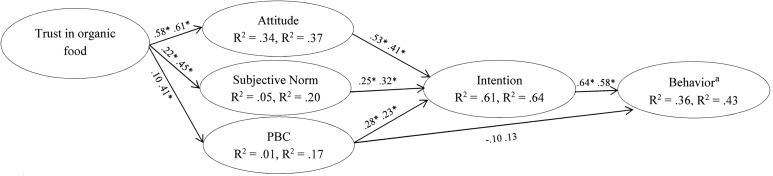
When someone decides to buy organic food products trust plays a role. Consumers, in fact, are neither supposed to have the appropriate knowledge to evaluate the characteristics of these products, nor can they control that the food was actually manufactured following the procedures prescribed by organic production. Therefore, trust may contribute to the explanation of both purchasing intention and behavior since it represents a heuristic or shortcut that people adopt in order to reduce the large amount of information that consumers need to take into account. The present research aimed to analyze the role of trust in organic products on buying behavior adopting the Theory of Planned Behavior (TPB) as theoretical framework. A relational model was tested in which this variable was supposed to act as a background factor associated with all the classical constructs foreseen by the theory and the buying behavior. Also, indirect effects of trust on both intention and behavior were assessed. Two studies were conducted targeting the purchase of organic food products in general (Study 1) and of fresh organic fruit and vegetables (Study 2). In both studies, the data collection was organized in two waves, with a time lag of 1 month. At Time 1, the questionnaires included measures of intention, its antecedents and trust, while at Time 2 self-reported buying behavior was collected. Data were supplied by two convenience samples of Italian adults (237 and 227 participants) and analyzed via structural equation modeling. Results turned out to be overlapping in both studies, since trust was positively associated with attitude and subjective norm, and it was indirectly associated with intention and behavior, thanks to the mediation of the TPB constructs. The outcomes highlighted the importance of people's trust in organic products as a meaningful antecedent that boosts the TPB-based psychosocial processes that are supposed to stand behind both purchasing intentions and behaviors.
Overview
The claims and statistics of this paper haven’t been checked yet.
Run the check — free, no account needed. It reads the open-access text and checks the sources it cites.
Integrity signals
Registry
Cites
Statistics
Figures

Verification
Claims the paper makes
The claims and statistics of this paper haven’t been checked yet.
Run the check — free, no account needed. It reads the open-access text and checks the sources it cites.
Claims other papers make about this one
Each is checked against this paper’s own text: does it say what the citing paper says it does?
The check wasn’t confident either way, so it gives no verdict — never disputed.
In the citing paper
“Multiple studies across different geographical and cultural contexts have consistently demonstrated that health consciousness strongly predicts positive attitudes toward health-oriented food products [15,66,68].”
From Psychological Determinants of Healthy Food Purchase Intention: An Integrative Model Based on Health Consciousness (2025) · cites this paper as [68]
Experimental — accuracy not yet measured
Self-check
Percentages, sums and reported differences re-computed from the paper’s own numbers.
The self-check needs the paper’s full text.
Citations
Cites
Hu, L., & Bentler, P. M. (1999) · Structural Equation Modeling A Multidisciplinary Journal · doi:10.1080/10705519909540118 · Cited by 108,788
The theory of planned behavior
Ajzen, I. (1991) · Organizational Behavior and Human Decision Processes · doi:10.1016/0749-5978(91)90020-t · Cited by 90,587 · cited 3×
“Many studies within the food consumption literature have assumed the Theory of Planned Behavior (TPB) (Ajzen, 1991) as their theoretical reference for investigating the psychosocial factors that explain consumers’ intentions and behaviors.”
BackgroundMethodStructural equation models with unobservable variables and measurement error: Algebra and statistics
Fornell, C., & Larcker, D. F. (1981) · Journal of Marketing Research · doi:10.1177/002224378101800313 · Cited by 13,287 · cited 1×
“50 (Fornell and Larcker, 1981); furthermore, the AVE of each construct was higher than the squared correlations among the constructs, indicating good convergent and discriminant validity.”
BackgroundEfficacy of the Theory of Planned Behaviour: A meta‐analytic review
Armitage, C. J., & Conner, M. (2001) · British Journal of Social Psychology · doi:10.1348/014466601164939 · Cited by 9,970
TRUST AND DISTRUST IN ORGANIZATIONS: Emerging Perspectives, Enduring Questions
Kramer, R. M. (1999) · Annual Review of Psychology · doi:10.1146/annurev.psych.50.1.569 · Cited by 3,415 · cited 1×
“Additionally, marketers should design marketing campaigns focused on the personal advantages of organic food consumption, such as health benefits (Kushwah et al., 2019), and on facilitating the perception of control, thus supporting individuals in overcoming obstacles and barriers (e.g., the cost…”
BackgroundA comprehensive model of the psychology of environmental behaviour—A meta-analysis
Klöckner, C. A. (2013) · Global Environmental Change · doi:10.1016/j.gloenvcha.2013.05.014 · Cited by 1,773 · cited 2×
“…of fields, such as those concerning health behaviors (McEachan et al., 2016), healthy eating (Riebl et al., 2015), pro-environmental behaviors (Klöckner, 2013), and organic food consumption (Scalco et al., 2017), and its predictive power has been demonstrated in a number of meta-analyses like…”
BackgroundAgency and Trust Mechanisms in Consumer Satisfaction and Loyalty Judgments
Singh, J., & Sirdeshmukh, D. (2000) · Journal of the Academy of Marketing Science · doi:10.1177/0092070300281014 · Cited by 1,635 · cited 1×
“…of the concept of trust: (a) the expectation that the counterpart will act in a reliable and not harmful manner and (b) the intention to rely on the counterpart, at the same time as accepting some degree of vulnerability (e.g., uncertainty, risk of being frustrated) (Singh and Sirdeshmukh, 2000).”
BackgroundFactors affecting green purchase behaviour and future research directions
Joshi, Y., & Rahman, Z. (2015) · International Strategic Management Review · doi:10.1016/j.ism.2015.04.001 · Cited by 1,518 · cited 1×
“The lack of consumer trust in green products can act as a barrier to green consumption (Joshi and Rahman, 2015); vice versa, uncritical trust in the “organic food” category or label may leave consumers”
BackgroundYadav, R., & Pathak, G. S. (2016) · Journal of Cleaner Production · doi:10.1016/j.jclepro.2016.06.120 · Cited by 1,463
Yadav, R., & Pathak, G. S. (2017) · Ecological Economics · doi:10.1016/j.ecolecon.2016.12.019 · Cited by 1,318
de Leeuw, A., Valois, P., Ajzen, I., & Schmidt, P. (2015) · Journal of Environmental Psychology · doi:10.1016/j.jenvp.2015.03.005 · Cited by 1,236
Personal determinants of organic food consumption: a review
Aertsens, J., Verbeke, W., Mondelaers, K., & Huylenbroeck, G. V. (2009) · British Food Journal · doi:10.1108/00070700910992961 · Cited by 1,097
Arvola, A., Vassallo, M., Dean, M., Lampila, P., Saba, A., Lähteenmäki, L., & Shepherd, R. (2007) · Appetite · doi:10.1016/j.appet.2007.09.010 · Cited by 1,019
Wu, I.-L., & Chen, J.-L. (2005) · International Journal of Human-Computer Studies · doi:10.1016/j.ijhcs.2005.03.003 · Cited by 879 · cited 2×
“This confidence in significant others and their beliefs can be expected to play a role in determining the subjective norms; in fact individuals will be more willing to comply with the important referents (Wu and Chen, 2005).”
BackgroundMaichum, K., Parichatnon, S., & Peng, K.-C. (2016) · Sustainability · doi:10.3390/su8101077 · Cited by 877 · cited 1×
“In fact, trust is a behavioral determinant whose nature may be relevant for all the TPB constructs: attitude, subjective norm and PBC (Mazzocchi et al., 2008).”
BackgroundNuttavuthisit, K., & Thøgersen, J. (2017) · Journal of Business Ethics · doi:10.1007/s10551-015-2690-5 · Cited by 722
Meta-Analysis of the Reasoned Action Approach (RAA) to Understanding Health Behaviors
McEachan, R., Taylor, N. J., Harrison, R., Lawton, R., Gardner, P. H., & Conner, M. T. (2016) · Annals of Behavioral Medicine · doi:10.1007/s12160-016-9798-4 · Cited by 706 · cited 1×
“Some studies considered trust as an additional predictor of the intention to buy eco-friendly food (e.g., Menozzi et al., 2015; Giampietri et al., 2018; Carfora et al., 2019) and found that trust was a significant antecedent of intention, explaining additional quotas of intention variance with…”
BackgroundIntention to purchase organic food among young consumers: Evidences from a developing nation
Yadav, R., & Pathak, G. S. (2015) · Appetite · doi:10.1016/j.appet.2015.09.017 · Cited by 704 · cited 1×
“Indeed, most recent claims in the literature have advocated the need to focus on actual choice behavior along with behavioral intentions because behavioral intentions alone may not represent actual purchase behavior accurately (Yadav and Pathak, 2016a).”
BackgroundYazdanpanah, M., & Forouzani, M. (2015) · Journal of Cleaner Production · doi:10.1016/j.jclepro.2015.02.071 · Cited by 649
Hansen, J. M., Saridakis, G., & Benson, V. (2017) · Computers in Human Behavior · doi:10.1016/j.chb.2017.11.010 · Cited by 629
Al‐Swidi, A. K., Huque, S. M. R., Hafeez, M. H., & Shariff, M. N. M. (2014) · British Food Journal · doi:10.1108/bfj-05-2013-0105 · Cited by 621
Attitudes towards organic foods and risk/benefit perception associated with pesticides
Saba, A., & Messina, F. (2003) · Food Quality and Preference · doi:10.1016/s0950-3293(02)00188-x · Cited by 440 · cited 2×
“On the other hand, in the second study, fruit and vegetables were chosen because they represent, since 2000, the largest portion of the Italian organic food market, and the demand for them is growing rapidly (Saba and Messina, 2003; Ricci et al., 2018).”
BackgroundScalco, A. R., Noventa, S., Sartori, R., & Ceschi, A. (2017) · Appetite · doi:10.1016/j.appet.2017.02.007 · Cited by 410
Decisional factors driving organic food consumption: Generation of consumer purchase intentions
Teng, C.-C., & Wang, Y.-M. (2015) · British Food Journal · doi:10.1108/bfj-12-2013-0361 · Cited by 391 · cited 3×
“…a growing interest has also emerged in recent years among scholars from other geographical areas, such as the Far East, Iran, China, and India (e.g., Teng and Wang, 2015; Yazdanpanah and Forouzani, 2015; Yadav and Pathak, 2016a,b, 2017; Nuttavuthisit and Thøgersen, 2017; Qi and Ploeger, 2019).”
BackgroundResultCarfora, V., Cavallo, C., Caso, D., Giudice, T. D., Devitiis, B. D., Viscecchia, R., Nardone, G., & Cicia, G. (2019) · Food Quality and Preference · doi:10.1016/j.foodqual.2019.03.006 · Cited by 382 · cited 5×
“Some studies considered trust as an additional predictor of the intention to buy eco-friendly food (e.g., Menozzi et al., 2015; Giampietri et al., 2018; Carfora et al., 2019) and found that trust was a significant antecedent of intention, explaining additional quotas of intention variance with respect to the classical…”
BackgroundResultInfluentialGiampietri, E., Verneau, F., Giudice, T. D., Carfora, V., & Finco, A. (2017) · Food Quality and Preference · doi:10.1016/j.foodqual.2017.09.012 · Cited by 337 · cited 2×
“Trust in Organic Food Three items derived from the literature were adopted (Giampietri et al., 2018): “I perceive organic food to be reliable,” “I trust in organic food products,” and “I trust in purchasing organic food products.”
BackgroundMethodRiebl, S. K., Estabrooks, P. A., Dunsmore, J. C., Savla, J., Frisard, M. I., Dietrich, A. M., Peng, Y., Zhang, X., & Davy, B. M. (2015) · Eating Behaviors · doi:10.1016/j.eatbeh.2015.05.016 · Cited by 326
Kushwah, S., Dhir, A., & Sagar, M. (2019) · Food Quality and Preference · doi:10.1016/j.foodqual.2019.04.003 · Cited by 267 · cited 1×
“…has analyzed the relationships between trust, subjective norm, and PBC, but some studies in the transport literature (e.g., Hsiao and Yang, 2010; Madha et al., 2016; Borhan et al., 2017; Ibrahim et al., 2020) and on on-line transactions (e.g., Wu and Chen, 2005) highlighted that trust via…”
ResultQi, X., & Ploeger, A. (2018) · Appetite · doi:10.1016/j.appet.2018.12.004 · Cited by 262 · cited 2×
“These quotas are similar to those reported by Carfora et al. (2019) and slightly lower than that published by Qi and Ploeger (2019).”
BackgroundResultZagata, L. (2012) · Appetite · doi:10.1016/j.appet.2012.03.023 · Cited by 258 · cited 2×
“In some cases, PBC had a significant impact on the intention to buy organic food (e.g., Zagata, 2012; Maichum et al., 2016; Yadav and Pathak, 2016a,b; Carfora et al., 2019; Wang et al., 2019; Fleşeriu et al., 2020); in others, the effect was not significant (e.g., Al-Swidi et al., 2014;…”
BackgroundFood purchases: Impacts from the consumers’ point of view investigated with a modular LCA
Jungbluth, N., Tietje, O., & Scholz, R. (2000) · The International Journal of Life Cycle Assessment · doi:10.1007/bf02978609 · Cited by 247 · cited 1×
“The most effective ways to reduce the environmental impact of food consumption from the consumer perspective are the refusal of air-transported food, the preference for organic food, and the reduction in meat consumption (Jungbluth et al., 2000).”
BackgroundWang, X.-H., Pacho, F., Liu, J., & Kajungiro, R. (2019) · Sustainability · doi:10.3390/su11010209 · Cited by 246 · cited 1×
“…a significant impact on the intention to buy organic food (e.g., Zagata, 2012; Maichum et al., 2016; Yadav and Pathak, 2016a,b; Carfora et al., 2019; Wang et al., 2019; Fleşeriu et al., 2020); in others, the effect was not significant (e.g., Al-Swidi et al., 2014; Yazdanpanah and Forouzani, 2015).”
BackgroundTrust to Go Green: An Exploration of Consumer Intentions for Eco-friendly Convenience Food
Ricci, E. C., Banterle, A., & Stranieri, S. (2018) · Ecological Economics · doi:10.1016/j.ecolecon.2018.02.010 · Cited by 240 · cited 3×
“On the other hand, in the second study, fruit and vegetables were chosen because they represent, since 2000, the largest portion of the Italian organic food market, and the demand for them is growing rapidly (Saba and Messina, 2003; Ricci et al., 2018).”
BackgroundResultOrganic as a Heuristic Cue: What Spanish Consumers Mean by Organic Foods
Vega‐Zamora, M., Ruíz, F. J. T., Murgado‐Armenteros, E. M., & Rosa, M. P. (2014) · Psychology and Marketing · doi:10.1002/mar.20699 · Cited by 141
Motives towards traceable food choice: A comparison between French and Italian consumers
Menozzi, D., Halawany-Darson, R., Mora, C., & Giraud, G. (2013) · Food Control · doi:10.1016/j.foodcont.2013.09.006 · Cited by 137
Hobbs, J. E., & Goddard, E. W. (2015) · Food Policy · doi:10.1016/j.foodpol.2014.10.017 · Cited by 133
Food Scares and Trust: A European Study
Mazzocchi, M., Lobb, A., Traill, W., & Cavicchi, A. (2008) · Journal of Agricultural Economics · doi:10.1111/j.1477-9552.2007.00142.x · Cited by 131 · cited 1×
“The TPB has been applied successfully in a wide range of fields, such as those concerning health behaviors (McEachan et al., 2016), healthy eating (Riebl et al., 2015), pro-environmental behaviors (Klöckner, 2013), and organic food consumption (Scalco et al., 2017), and its predictive power has…”
BackgroundValues and Planned Behaviour of the Romanian Organic Food Consumer
Fleșeriu, C., COSMA, S. A., & Bocăneț, V. (2020) · Sustainability · doi:10.3390/su12051722 · Cited by 120 · cited 1×
“In some cases, PBC had a significant impact on the intention to buy organic food (e.g., Zagata, 2012; Maichum et al., 2016; Yadav and Pathak, 2016a,b; Carfora et al., 2019; Wang et al., 2019; Fleşeriu et al., 2020); in others, the effect was not significant (e.”
BackgroundPredicting the travel intention to take High Speed Rail among college students
Hsiao, C., & Yang, C. (2010) · Transportation Research Part F Traffic Psychology and Behaviour · doi:10.1016/j.trf.2010.04.011 · Cited by 93
Hagger, M., & Hamilton, K. (2020) · Psychology and Health · doi:10.31234/osf.io/rfx9d · Cited by 93 · cited 1×
“, age, sex, ethnicity, socioeconomic status, education, personality, past experiences) to act as sources of potential influence on the beliefs people hold (de Leeuw et al., 2015; Hagger and Hamilton, 2020).”
BackgroundCause related marketing in the German retail sector: Exploring the role of consumers’ trust
Hartmann, M., Klink, J., & Simons, J. (2015) · Food Policy · doi:10.1016/j.foodpol.2014.06.012 · Cited by 81 · cited 1×
“As we stated in the Introduction, it is important to remember that trust may serve as a “shortcut” when, as in the case of organic food, consumers have limited information about and exposure to the production or preparation of these products, and when direct relationships with food producers are rare (Hartmann et al.,…”
BackgroundIbrahim, A. N. H., Borhan, M. N., & Rahmat, R. (2020) · Sustainability · doi:10.3390/su12062484 · Cited by 59 · cited 1×
“To the best of our knowledge, no study in the field of organic food choice has analyzed the relationships between trust, subjective norm, and PBC, but some studies in the transport literature (e.g., Hsiao and Yang, 2010; Madha et al., 2016; Borhan et al., 2017; Ibrahim et al., 2020) and on on-line transactions (e.”
ResultPredicting fruit consumption: A multi-group application of the Theory of Planned Behavior
Canova, L., Bobbio, A., & Manganelli, A. M. (2019) · Appetite · doi:10.1016/j.appet.2019.104490 · Cited by 57 · cited 1×
“Measures The questionnaires presented measures of TPB constructs adapted from those already used in previous studies in the Italian context (Canova and Manganelli, 2016; Canova et al., 2020).”
MethodSelf-citationPredicting car drivers’ intention to use low cost airlines for intercity travel in Libya
Borhan, M. N., Ibrahim, A. N. H., Miskeen, M. A. A., Rahmat, R., & Alhodairi, A. M. (2017) · Journal of Air Transport Management · doi:10.1016/j.jairtraman.2017.09.004 · Cited by 53 · cited 1×
“To the best of our knowledge, no study in the field of organic food choice has analyzed the relationships between trust, subjective norm, and PBC, but some studies in the transport literature (e.g., Hsiao and Yang, 2010; Madha et al., 2016; Borhan et al., 2017; Ibrahim et al., 2020) and on on-line transactions (e.”
ResultAntecedents of Trust in Organic Foods: The Mediating Role of Food Related Personality Traits
Ayyub, S., Wang, X., Asif, M., & Ayyub, R. M. (2018) · Sustainability · doi:10.3390/su10103597 · Cited by 42 · cited 1×
“Since any kind of organic food can be seen as reliable, consumers’ trust in organic food may be largely based only on the intrinsic value of the “organic” label (Ayyub et al., 2018).”
BackgroundMadha, A., Salman, A., Hussain, H., Borhan, M. N., & Rahmat, R. (2016) · Archives of Transport · doi:10.5604/08669546.1218791 · Cited by 20 · cited 1×
“In some cases, PBC had a significant impact on the intention to buy organic food (e.g., Zagata, 2012; Maichum et al., 2016; Yadav and Pathak, 2016a,b; Carfora et al., 2019; Wang et al., 2019; Fleşeriu et al., 2020); in others, the effect was not significant (e.g., Al-Swidi et al., 2014;…”
BackgroundCanova, L., & Manganelli, A. (2016) · Padua Research Archive (University of Padova) · doi:10.4473/tpm23.1.6 · Cited by 17
Self-citation(2019) · Encyclopedia of Food and Agricultural Ethics · doi:10.1007/978-94-024-1179-9_301652 · Cited by 1 · cited 1×
“In fact, trust is a behavioral determinant whose nature may be relevant for all the TPB constructs: attitude, subjective norm and PBC (Mazzocchi et al., 2008).”
Background
Research works printed but not linked: 11
- 2020, L’alimentare biologico premiato dai consumatori alla ricerca di qualità e sicurezza, Forte crescita per il biologico anche in tempo di Covid-19
- Bagozzi, 1994, Principles of Marketing Research.
- 2014, Action Plan for the Future of Organic Production in the European Union.
- 2016, A Strategic Approach to EU Agricultural Research & Innovation.
- Fishbein, 2010, Predicting and Changing Behavior: The Reasoned Action Approach.
- 2018, Tutti i Numeri del bio. I Driver del Consumatore e le Novità del Canale Specializzato
- 2019, Il Posizionamento Competitivo del Bio Made in ITALY sui Mercati esteri, ed Zucconi S. (Osservatorio Sana 2019). (In Italian).
- Viganò, 2019, Il mercato, Bioreport 2017-2018, L’agricoltura biologica in Italia, (Rete Rurale Nazionale 2014-2020, Roma 2019). (In Italian)
- Willer, Organic in Europe: Recent Developments, The World of Organic Agriculture. Statistics and Emerging Trends 2020
- Willer, Organic farming and market development in Europe and the European Union, The World of Organic Agriculture. Statistics and Emerging Trends 2020
- Willer, Organic agriculture in europe: current statistics, Proceedings of BIOFACH Congress 2020. Session: The European Market for Organic Food, Messezentrum Nürnberg, Germany
Cited by
Sorted by citations
Su, Y., Zhu, Z., Chen, J., Jin, Y., Wang, T., Lin, C., & Xu, D. (2021) · Sustainability · doi:10.3390/su13084519 · Cited by 277
“[27] Buying organic food products Trust in organic food, attitude, subjective norm, perceived behavior control Behavior, intention”
BackgroundGansser, O. A., & Reich, C. S. (2022) · Journal of Cleaner Production · doi:10.1016/j.jclepro.2022.134629 · Cited by 287
Parashar, S., Singh, S., & Sood, G. (2022) · Journal of Cleaner Production · doi:10.1016/j.jclepro.2022.135553 · Cited by 182
“Intention considers both stimuli and cognitive planning and is the predecessor of behaviour (Canova et al., 2020).”
García-Salirrosas, E. E., Escobar-Farfán, M., Gómez-Bayona, L., Moreno-López, G., Valencia-Arias, A., & Gallardo-Canales, R. (2024) · Frontiers in Psychology · doi:10.3389/fpsyg.2023.1282383 · Cited by 94
“The potential for an enhanced inclination toward acquiring environmentally friendly items has been suggested as a factor that might contribute to an increase in the adoption of such products (Canova et al., 2020; Chen et al., 2022; Wang and Li, 2022).”
BackgroundRandall, T., Cousins, A. L., Neilson, L., Price, M. J., Hardman, C. A., & Wilkinson, L. L. (2024) · Food Quality and Preference · doi:10.1016/j.foodqual.2023.105086 · Cited by 103
Metadata
- Authors
- Canova, L., Bobbio, A., & Manganelli, A. M.
- Affiliations
- University of Padua (IT)
- Corresponding author
- Canova, Luigina
- Venue
- Frontiers in Psychology
- Publisher
- Frontiers Media SA
- Published
- 2020-10-23
- Volume
- 11
- Pages
- 575820-575820
- ISSN
- 1664-1078 (ISSN-L)
- PMC
- PMC7644777
- OpenAlex
- W3093490496
- Cited by
- 141
- References
- 62
- Citations by year
- 2026: 23 · 2025: 24 · 2024: 34 · 2023: 23 · 2022: 27 · 2021: 10
- FWCI
- 9.69
- Type
- journal article
- Language
- en
- Open access
- gold
- doi.org
- Licence
- Locations
- Frontiers in Psychology (publishedVersion, cc-by)
- PubMed Central (publishedVersion, cc-by)
- PubMed (publishedVersion)
- DOAJ (DOAJ: Directory of Open Access Journals) (submittedVersion, cc-by-sa)
- Padua Research Archive (University of Padova) (submittedVersion, cc-by)
- Funders
- Università degli Studi di Padova (DOR1837181/18)
- Topics
- Life Sciences › Agricultural and Biological Sciences › Plant Science › Organic Food and Agriculture
- Health Sciences › Medicine › Public Health, Environmental and Occupational Health › Consumer Attitudes and Food Labeling
- Social Sciences › Sociology and Political Science › Consumer behavior in food and health
- Keywords
- organic food, consumer trust, theory of planned behavior, purchase intention, consumer behavior, attitudes, subjective norms, heuristic processing
About these checks
Registry, retraction, Cites and statistics results are computed, not judged, with one exception: a printed reference that no index lists is read once by a model before it counts as a citation error. Claims are extracted by a model and kept only when their quote appears verbatim in the text; each cited source is then checked, with a model’s help, for whether it says what the claim relies on. Those verdicts can be wrong — read the claim’s quote and the cited source before relying on one.
Statistics and arithmetic are recomputed, not judged.
Confidence bands are shown only for fields calibrated on our annotated test set. None is calibrated yet, so no band is shown.
What counts as a claim ›How we measure confidence ›How we check this ›
Are you an author, or do you see a problem with this page? Request a review
