

The DOI matches its Crossref record; 5 of the 5 references it cites were found in a registry or an index.
The Feasibility and Effectiveness of a Novel, On-Line Social Skills Intervention for Individuals With Prader-Willi Syndrome
Abstract
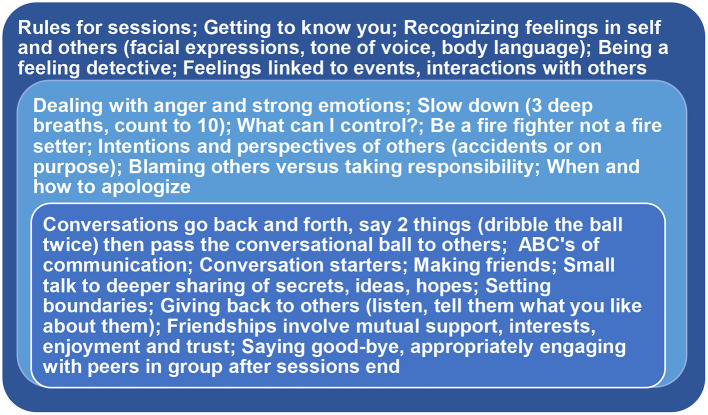
Introduction: People with neurodevelopmental disabilities, including Prader-Willi syndrome (PWS), are at heightened risk for the negative sequalae of loneliness, including depression and anxiety. While societal factors such as stigma or limited social opportunities contribute to loneliness, so too do deficits in social cognition and social skills. People with PWS have specific difficulties recognizing affect in others, accurately interpreting social interactions, and taking the perspectives of others. These features, combined with hyperphagia, rigidity, and insistence on sameness conspire to impede the abilities of people with PWS to make and sustain friendships and reduce feelings of loneliness. Methods: We developed and administered an intervention, Building Our Social Skills (BOSS), that aimed to improve social skill deficits in PWS. The 10-week intervention was administered on-line via Zoom to 51 young people with PWS in the U.S. (M age = 20.8, SD = 6.42). Two clinicians co-led groups of 6–8 participants in 30-min sessions, 3 times per week, and also trained 4 graduate students to co-lead groups with high fidelity. We used a pre-post intervention and 3-month follow-up design, with no control group, and mitigated this design limitation by triangulating across informants and methodologies. Specifically, parents completed the widely used Social Responsiveness Scale (SRS) and Child Behavior Checklist (CBCL), and participants were individually interviewed about their friendships and loneliness. Interview responses were reliably coded by independent raters. Results: Repeated measure multivariate analyses, with baseline values entered as covariates, revealed significant pre-to post-test improvements in the SRS's social cognition, motivation and communication subscales (p's < 0.001), with large effect sizes (np2 = 0.920, 0.270, and 0.204, respectively). Participant and parental reports of loneliness were correlated with the CBCL's Internalizing domain, specifically the Anxiety/Depressed subdomain. Over time, parents reported getting along better with peers, increased contact with friends, more friends and less loneliness. Participants also reported significantly less loneliness and more friends. Conclusions: This mixed method, proof-of-concept study demonstrated the feasibility of delivering an on-line social skills intervention to young people with PWS. As no differences were found between clinician vs. graduate student outcomes, the BOSS curriculum holds considerable promise for wider dissemination and implementation in the PWS community.
Overview
The claims and statistics of this paper haven’t been checked yet.
Run the check — free, no account needed. It reads the open-access text and checks the sources it cites.
Integrity signals
Registry
Cites
Statistics
Figures
Verification
Claims the paper makes
The claims and statistics of this paper haven’t been checked yet.
Run the check — free, no account needed. It reads the open-access text and checks the sources it cites.
Claims other papers make about this one
Each is checked against this paper’s own text: does it say what the citing paper says it does?
The cited source says what the claim attributes to it.
In the citing paper
“The results showed an interesting effect of the program on socialization (friendly relations and quality of interactions with peers).”
Self-check
Percentages, sums and reported differences re-computed from the paper’s own numbers.
The self-check needs the paper’s full text.
Citations
Cites
Loneliness matters: a theoretical and empirical review of consequences and mechanisms
Hawkley, L. C., & Cacioppo, J. T. (2010) · Annals of Behavioral Medicine · doi:10.1007/s12160-010-9210-8 · Cited by 4,782
The psychological impact of COVID-19 on the mental health in the general population
Serafini, G., Parmigiani, B., Amerio, A., Aguglia, A., Sher, L., & Amore, M. (2020) · QJM: An International Journal of Medicine · doi:10.1093/qjmed/hcaa201 · Cited by 1,187 · cited 1×
“It is well-documented that people across the globe have experienced COVID-19 related spikes in such mental health problems as depression, anxiety, distress, loneliness and anxiety (67, 68).”
BackgroundPrader-Willi syndrome: Intellectual abilities and behavioural features by genetic subtype
Milner, K. M., Craig, E. E., Thompson, R. J., Veltman, M. W. M., Simon Thomas, N., Roberts, S., Bellamy, M., Curran, S. R., Sporikou, C. M. J., & Bolton, P. F. (2005) · Journal of Child Psychology and Psychiatry · doi:10.1111/j.1469-7610.2005.01520.x · Cited by 177
Dimitropoulos, A., Ho, A., & Feldman, B. (2013) · Journal of Autism and Developmental Disorders · doi:10.1007/s10803-012-1547-3 · Cited by 77
Telemedicine for Mental Health in the United States: Making Progress, Still a Long Way to Go
Barnett, M. L., & Huskamp, H. A. (2020) · Psychiatric Services · doi:10.1176/appi.ps.201900555 · Cited by 56
Research works printed but not linked: 70
- Stanley, 2013, Toward a neural basis for social behavior, Neuron., 80, 816, 10.1016/j.neuron.2013.10.038 · DOI
- Seligman, 2011, Flourish: A Visionary New Understanding of Happiness and Well-Being, 368
- Gilmore, 2014, Vulnerability to loneliness in people with intellectual disability: an explanatory model, J Ment Health Res Intellect Disabil., 11, 192, 10.1111/jppi.12089 · DOI
- Fisher, 2012, Vulnerability and experiences related to social victimization among individuals with intellectual and developmental disabilities, J Ment Health Res Intellect Disabil., 5, 32, 10.1080/19315864.2011.592239 · DOI
- 2013, Diagnostic and Statistical Manual of Mental Disorders-5, 947
- Hronis, 2017, A review of cognitive impairments in children with intellectual disabilities: implications for cognitive behaviour therapy, Br J Clin Psychol, 56, 189, 10.1111/bjc.12133 · DOI
- Su, 2008, Neuropsychological predictors of everyday functioning in adults with intellectual disabilities, J Intellect Disabil Res., 52, 18, 10.1111/j.1365-2788.2007.00969.x · DOI
- Tanskanen, 2016, Prospective study of social isolation, loneliness, and mortality in Finland, Am J Public Health., 106, 2042, 10.2105/AJPH.2016.303431 · DOI · Paper page
- Macdonald, 2018, ‘The invisible enemy': disability, loneliness and isolation, Disabil Soc, 33, 1138, 10.1080/09687599.2018.1476224 · DOI
- Alexandra, 2018, Loneliness in people with intellectual and developmental disorders across the lifespan: a systematic review of prevalence and interventions, J Appl Res Intellect Disabil., 31, 643, 10.1111/jar.12432 · DOI
- Emerson, 2021, Loneliness, social support, social isolation and wellbeing among working age adults with and without disability: Cross-sectional study, Disabil Health J, 14, 1, 10.1016/j.dhjo.2020.100965 · DOI
- Heiman, 2011, Depressive mood in students with mild intellectual disability: Students' reports and teachers' evaluations, J Intellect Disabil Res, 45, 526, 10.1046/j.1365-2788.2001.00363.x · DOI
- Duvdevany, 2004, Leisure activities, friendships and quality of life of persons with intellectual disability: foster homes vs, community residential settings Int J Rehabil Res., 27, 289, 10.1097/00004356-200412000-00006 · DOI
- Reinders, 2002, The good life for citizens with intellectual disability, J Intellect Disabil Res., 46, 1, 10.1046/j.1365-2788.2002.00386.x · DOI
- Lippold, 2009, Social support and intellectual disabilities: a comparison between social networks of adults with intellectual disability and those with physical disability, J Intellect Disabil Res, 53, 463, 10.1111/j.1365-2788.2009.01170.x · DOI
- Robertson, 2001, Social networks of people with mental retardation in residential settings, Ment Retard, 39, 201, 10.1352/0047-6765(2001)039<0201:SNOPWM>2.0.CO;2 · DOI
- Asselt-Goverts, 2015, Social networks of people with mild intellectual disabilities: characteristics, satisfaction, wishes and quality of life, J Intellect Disabil Res., 59, 450, 10.1111/jir.12143 · DOI
- Cassidy, 2010, Prader-Willi syndrome, 628, 10.1002/9780470893159.ch42 · DOI
- Dykens, 2007, Assessment of hyperphagia in Prader-Willi syndrome, Obesity., 15, 1816, 10.1038/oby.2007.216 · DOI
- Dykens, 2021, ‘The cure for us is a lot of things': how young people with Prader-Willi syndrome view themselves and future clinical trials, J Appl Res Intellect Disabil, 35, 460, 10.1111/jar.12950 · DOI
- Manning, 2015, Holland AJ. Puzzle pieces: neural structure and function in Prader-Willi syndrome, Dis., 3, 382, 10.3390/diseases3040382 · DOI
- Dykens, 2008, Behavior in Prader-Willi syndrome: relationship to genetic subtypes and age, J Child Psychol Psychiatry, 49, 1001, 10.1111/j.1469-7610.2008.01913.x · DOI
- Dykens, 2017, Diagnoses and characteristics of autism spectrum disorders in children with Prader-Willi syndrome, J Neurodev Disord., 9, 1, 10.1186/s11689-017-9200-2 · DOI
- Whittington, 2018, review of psychiatric conceptions of mental and behavioural disorders in Prader-Willi syndrome, Neurosci Biobehav Rev., 95, 396, 10.1016/j.neubiorev.2018.10.006 · DOI
- Woodcock, 2009, Associations between repetitive questioning, resistance to change, temper outbursts and anxiety in Prader-Willi and Fragile-X syndromes, J Intellect Disabil Res., 53, 265, 10.1111/j.1365-2788.2008.01122.x · DOI
- Rosner, 2004, Social competence in persons with Prader-Willi, Williams, and Down syndromes, J Appl Res Intellect Disabil., 17, 209, 10.1111/j.1468-3148.2004.00200.x · DOI
- Penn, 2008, Social Cognition in Schizophrenia: An Overview, Schizophr Bull., 34, 408, 10.1093/schbul/sbn014 · DOI · Paper page
- Whittington, 2011, Recognition of emotion in facial expression by people with Prader–Willi syndrome, J Intellect Disabil Res, 55, 75, 10.1111/j.1365-2788.2010.01348.x · DOI
- Dykens, 2019, Profiles and trajectories of impaired social cognition in people with Prader-Willi syndrome, PLoS ONE., 10.1371/journal.pone.0223162 · DOI · Paper page
- Lo, 2013, Impaired theory of mind and symptoms of autism spectrum disorder in children with Prader–Willi syndrome, Res Dev Disabil, 34, 2764, 10.1016/j.ridd.2013.05.024 · DOI
- Tager-Flusberg, 2000, A componential view of theory of mind: evidence from Williams syndrome, Cogn., 76, 59, 10.1016/S0010-0277(00)00069-X · DOI
- Phoebe, 2018, Research evidence of social cognitive intervention: Implications for people with autism, 31
- Reichow, 2010, Social skills interventions for individuals with Autism: Evaluation for evidence-based practices within a best evidence synthesis framework, J Autism Dev Disord., 40, 49, 10.1007/s10803-009-0842-0 · DOI
- Watkins, 2017, Evidence-based social communication interventions for children with autism spectrum disorder, Indian J Pediatr., 84, 68, 10.1007/s12098-015-1938-5 · DOI
- Grant, 2017, Social cognition interventions for people with schizophrenia: a systematic review focusing on methodological quality and intervention modality, Clin Psychol Rev., 56, 55, 10.1016/j.cpr.2017.06.001 · DOI
- Denzin, 1970, The Research Act: A Theoretical Introduction to Sociological Methods
- Mathison, 1988, Why triangulate?, Educ Res., 17, 13, 10.3102/0013189X017002013 · DOI · Paper page
- Noble, 2019, Triangulation in research, Evid Based Nurs., 22, 67, 10.1136/ebnurs-2019-103145 · DOI · Paper page
- De Los Reyes, 2011, Introduction to the special section: more than measurement error: discovering meaning behind informant discrepancies in clinical assessments of children and adolescents, J Clin Child Adolesc Psychol., 40, 1, 10.1080/15374416.2011.533405 · DOI
- Hill, 2017, Therapist effects: integration and conclusions, 325, 10.1037/0000034-018 · DOI
- Bellg, 2004, Treatment fidelity workgroup of the NIH behavior change consortium. Enhancing treatment fidelity in health behavior change studies: best practices and recommendations from the NIH behavior change consortium, Health Psychol, 23, 443, 10.1037/0278-6133.23.5.443 · DOI · Paper page
- Constantino, 2012, The Social Responsiveness Scale Manual, Second Edition (SRS-2)
- Tavakol, 2011, Making sense of Cronbach's alpha, Int J Med Educ., 2, 53, 10.5116/ijme.4dfb.8dfd · DOI · Paper page
- Achenbach, 2001, Manual for the ASEBA School-Age Forms & Profiles: An Integrated System of Multi-Informant Assessment
- Neuendorf, 2019, Content analysis and thematic analysis, 21
- Armijo-Olivo, 2009, Intention to treat analysis, compliance, drop-outs and how to deal with missing data in clinical research: a review, Phys Ther Rev., 14, 36, 10.1179/174328809X405928 · DOI · Paper page
- Richardson, 2011, Eta squared and partial eta squared as measures of effect size in educational research, Educ Res Rev., 6, 135, 10.1016/j.edurev.2010.12.001 · DOI
- Fulford, 2016, Friendships and intimate relationships among people with intellectual disabilities: a thematic synthesis, J Appl Res Intellect Disabil., 31, 18, 10.1111/jar.12312 · DOI
- Mason, 2013, How do people described as having a learning disability make sense of friendship?, J Appl Res Intellect Disabil., 26, 108, 10.1111/jar.12001 · DOI
- Lunsky, 2001, Association between perceived social support and strain, and positive and negative outcome for adults with mild intellectual disability, J Intellect Disabil Res., 45, 106, 10.1046/j.1365-2788.2001.00334.x · DOI
- Bagwell, 2011, Friendships in Childhood and Adolescence
- Selman, 1980, The growth of interpersonal understanding: Developmental and Clinical Analyses.
- Gordon, 2005, Helping children with disabilities develop and maintain Ffiendships, Teach Educ Spec Educ., 28, 1, 10.1177/088840640502800101 · DOI
- Amichai-Hamburger, 2013, & Schneider BH. Friendship: An old concept with a new meaning?, Comput Human Behav., 29, 33, 10.1016/j.chb.2012.05.025 · DOI
- Hartup, 1999, Friendships and Adaptation Across the Life Span, Curr Dir Psychol Sci., 8, 76, 10.1111/1467-8721.00018 · DOI
- Marglit, 1994, Loneliness Among Children With Special Needs: Theory, Research, Coping and Interventions, 10.1007/978-1-4612-2622-2 · DOI
- Weiss, 1987, Reflections on the present state of loneliness research, J Soc Behav Pers., 2, 2
- Cacioppo, 2015, Loneliness: Clinical import and interventions, Perspect Psychol Sci., 10, 238, 10.1177/1745691615570616 · DOI · Paper page
- Holt-Lunstad, 2017, The potential public health relevance of social isolation and loneliness: prevalence, epidemiology, and risk factors, Public Policy Aging Rep, 27, 127, 10.1093/ppar/prx030 · DOI · Paper page
- Sticklet, 2016, Loneliness, common mental disorders and suicidal behavior: Findings from a general population survey, J Affect Disord, 197, 81, 10.1016/j.jad.2016.02.054 · DOI
- Dykens, 2016, Psychiatric disorders in people with intellectual disabilities: Steps toward eliminating research and clinical care disparities, 277
- Ailey, 2006, Evaluating an interpersonal model of depression among adults with Down syndrome, Res Theory Nurs Pract, 20, 229, 10.1891/rtnp.20.3.229 · DOI
- Lunsky, 2004, Suicidality in a clinical and community sample of adults with mental retardation, Res Dev Disabil, 25, 231, 10.1016/j.ridd.2003.06.004 · DOI
- Xiong, 2020, Impact of COVID-19 pandemic on mental health in the general population: a systematic review, J Affect Disord, 277, 55, 10.1016/j.jad.2020.08.001 · DOI · Paper page
- Constantino, 2020, The impact of COVID-19 on individuals with intellectual and developmental disabilities: clinical and scientific priorities, Am J Psychiatry, 177, 1091, 10.1176/appi.ajp.2020.20060780 · DOI
- Lake, 2021, The wellbeing and mental health care experiences of adults with intellectual and developmental disabilities during COVID-19, J Ment Health Res Intellect Disabil., 1, 10.1080/19315864.2021.1892890 · DOI
- Yeo, 2022, A meta-analysis of the effects of social-cognitive training in schizophrenia: the role of treatment characteristics and study quality, Br J Clin Psychol, 61, 37, 10.1111/bjc.12320 · DOI
- Selick, 2021, Virtual health care for adult patients with intellectual and developmental disabilities: a scoping review, Disabil Health J, 14, 1, 10.1016/j.dhjo.2021.101132 · DOI
- Mund, 2020, The stability and change of loneliness across the lifespan: a meta-analysis of longitudinal studies, Pers Soc Psychol Rev., 24, 24, 10.1177/1088868319850738 · DOI · Paper page
- Mund, 2021, Would the Real loneliness please stand up?, 10.31234/osf.io/64bt2 · DOI
Cited by
Sorted by citations
Famelart, N., Diene, G., Çabal-Berthoumieu, S., Glattard, M., Molinas, C., Tauber, M., & Guidetti, M. (2022) · Frontiers in Psychiatry · doi:10.3389/fpsyt.2022.1038223 · Cited by 5
Metadata
- Authors
- Dykens, E. M., Roof, E., Hunt-Hawkins, H., & McDonald, C.
- Venue
- Frontiers in Psychiatry
- Publisher
- Frontiers Media SA
- Published
- 2022-05-24
- Volume
- 13
- ISSN
- 1664-0640
- PMC
- PMC9175568
- Cited by
- 9
- References
- 5
- Funders
- Foundation for Prader-Willi Research (NA)
About these checks
Registry, retraction, Cites and statistics results are computed, not judged, with one exception: a printed reference that no index lists is read once by a model before it counts as a citation error. Claims are extracted by a model and kept only when their quote appears verbatim in the text; each cited source is then checked, with a model’s help, for whether it says what the claim relies on. Those verdicts can be wrong — read the claim’s quote and the cited source before relying on one.
Statistics and arithmetic are recomputed, not judged.
Confidence bands are shown only for fields calibrated on our annotated test set. None is calibrated yet, so no band is shown.
What counts as a claim ›How we measure confidence ›How we check this ›
Are you an author, or do you see a problem with this page? Request a review
