

Comparing the reliability of muscle oxygen saturation with common performance and physiological markers across cycling exercise intensity
Open accessThe DOI matches its Crossref record; 60 of the 63 references it cites were found in a registry or an index; 22 of the 62 sources its claims cite were checked for support.
Abstract
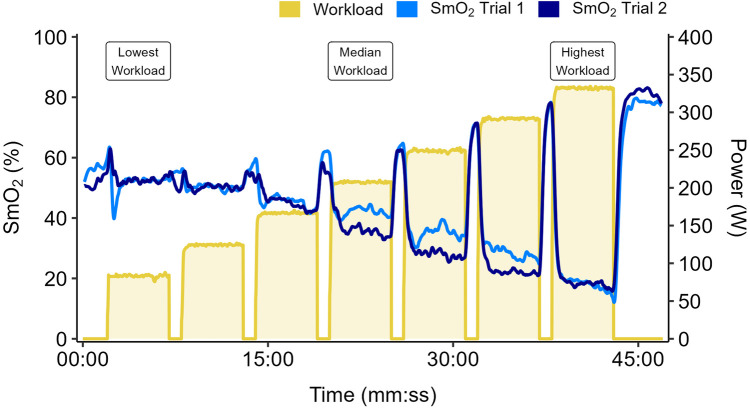
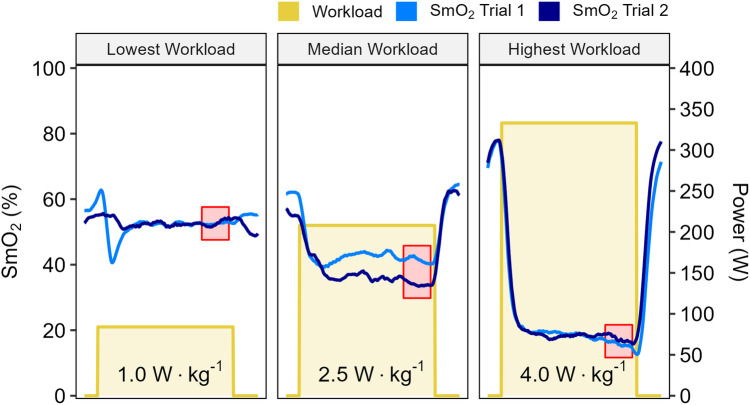
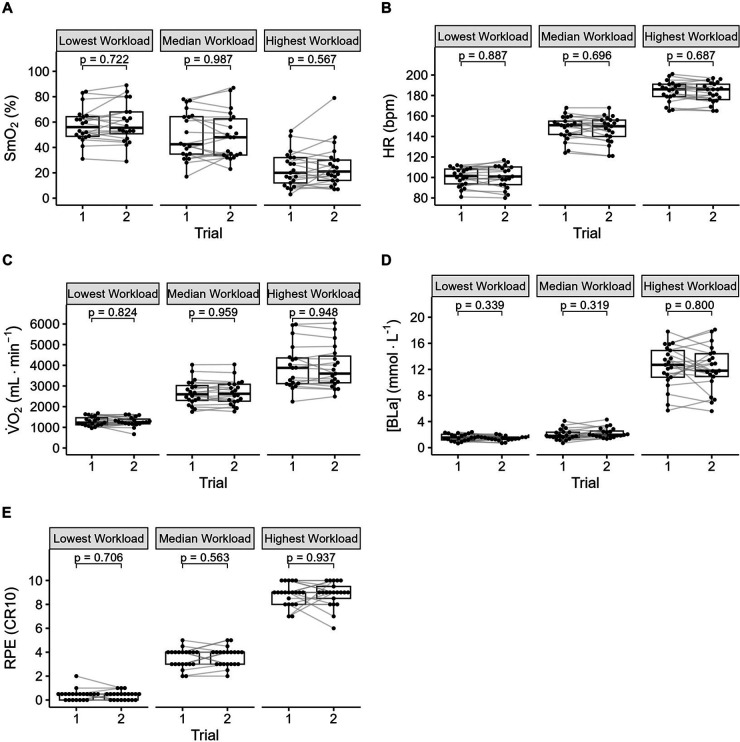
Introduction: Wearable near-infrared spectroscopy (NIRS) measurements of muscle oxygen saturation (SmO 2) demonstrated good test–retest reliability at rest. We hypothesized SmO 2 measured with the Moxy monitor at the vastus lateralis (VL) would demonstrate good reliability across intensities. For relative reliability, SmO 2 will be lower than volume of oxygen consumption (V̇O 2) and heart rate (HR), higher than concentration of blood lactate accumulation ([BLa]) and rating of perceived exertion (RPE). We aimed to estimate the reliability of SmO 2 and common physiological measures across exercise intensities, as well as to quantify within-participant agreement between sessions. Methods: Twenty-one trained cyclists completed two trials of an incremental multi-stage cycling test with 5 min constant workload steps starting at 1.0 watt per kg bodyweight (W·kg−1) and increasing by 0.5 W kg−1 per step, separated by 1 min passive recovery intervals until maximal task tolerance. SmO 2, HR, V̇O 2, [BLa], and RPE were recorded for each stage. Continuous measures were averaged over the final 60 s of each stage. Relative reliability at the lowest, median, and highest work stages was quantified as intraclass correlation coefficient (ICC). Absolute reliability and within-subject agreement were quantified as standard error of the measurement (SEM) and minimum detectable change (MDC). Results: Comparisons between trials showed no significant differences within each exercise intensity for all outcome variables. ICC for SmO 2 was 0.81–0.90 across exercise intensity. ICC for HR, V̇O 2, [BLa], and RPE were 0.87–0.92, 0.73–0.97, 0.44–0.74, 0.29–0.70, respectively. SEM (95% CI) for SmO 2 was 5 (3–7), 6 (4–9), and 7 (5–10)%, and MDC was 12%, 16%, and 18%. Discussion: Our results demonstrate good-to-excellent test-retest reliability for SmO 2 across intensity during an incremental multi-stage cycling test. V̇O 2 and HR had excellent reliability, higher than SmO 2. [BLa] and RPE had lower reliability than SmO 2. Muscle oxygen saturation measured by wearable NIRS was found to have similar reliability to V̇O 2 and HR, and higher than [BLa] and RPE across exercise intensity, suggesting that it is appropriate for everyday use as a non-invasive method of monitoring internal load alongside other metrics.
Overview
CoChat Summary
TL;DR
In 21 trained cyclists, wearable NIRS SmO2 at the vastus lateralis showed good-to-excellent test–retest reliability across an incremental multi-stage cycling test. SmO2 reliability was similar to V̇O2 and HR and higher than [BLa] and RPE, with no significant between-trial differences within each exercise intensity.
Key findings
- Between-trial comparisons showed no significant differences within each workload for all outcome variables.
- ICC for SmO2 was 0.81–0.90 across exercise intensity; ICC for HR, V̇O2, [BLa], and RPE were 0.87–0.92, 0.73–0.97, 0.44–0.74, and 0.29–0.70, respectively.
- SEM (95% CI) for SmO2 was 5 (3–7), 6 (4–9), and 7 (5–10)%, and MDC was 12%, 16%, and 18% at the lowest, median, and highest workloads.
- SmO2 had good-to-excellent reliability across intensity, with reliability highest for V̇O2 and HR, followed by SmO2, and lower reliability for [BLa] and RPE.
Methods
- Twenty-one trained cyclists (10 females, 11 males; 29.1 ± 7.8 years; V̇O2peak 58.6 ± 7.9 ml·kg−1·min−1) completed two trials 1–2 weeks apart of an incremental multi-stage cycling test: 5-min constant-workload stages starting at 1.0 W·kg−1, increasing by 0.5 W·kg−1 per stage, with 1-min passive recovery intervals until maximal task tolerance.
- SmO2 was measured at the right vastus lateralis with a wearable Moxy NIRS sensor; HR, V̇O2, [BLa], and RPE were also recorded. Continuous measures were averaged over the final 60 s of each stage, omitting the final 10 s.
- Relative reliability was quantified with ICC2,1; absolute reliability and within-subject agreement with SEM, CV, and MDC. Analyses used the first, median, and last work stages, with two-way repeated measures ANOVA and Bonferroni-adjusted post hoc comparisons.
Limitations
- The paper states: no familiarization trial was included, which may have negatively affected test–retest reliability, especially for RPE; the Moxy sensor may be more sensitive to blood flow, tissue properties, and small positioning inconsistencies than more advanced stationary NIRS; no participants were excluded for skinfold thickness despite possible signal effects above 12.5 mm; and NIRS responses are specific to exercise location and modality.
- The text also makes evident: some data were excluded due to measurement error or methodological inconsistencies, including gas exchange data for two participants, ergometer resistance issues for two participants, and one missing HR signal.
- The text notes that [BLa] and RPE were single measurements taken at the end of each stage, unlike the continuous measures, and are more prone to subjective interpretation or investigator error.
Model-written summary. Check it against the paper before relying on it.
Integrity signals
Registry
Cites
Statistics
Figures
Verification
Claims the paper makes
17 Valid · 2 Not valid · 10 Not checked · 41 Own results and interpretations
The sources with a verdict support this claim; the rest weren’t checked yet, have no full text we could read, or their verdicts aren’t rated yet.
In the paper
“Wearable near-infrared spectroscopy (NIRS) measurements of muscle oxygen saturation (SmO2) demonstrated good test–retest reliability at rest.”
- Also stated in: § Background · plain
“Both relative and absolute test–retest reliability of muscle oxygenation signals measured by the Moxy muscle oxygen monitor (Fortiori Design LLC., Hutchinson, MN, USA), in particular muscle oxygen saturation, has been investigated in the conditions of rest, vascular occlusion, and exercise (3–5).”
§ Comparing the reliability of muscle oxygen saturation with common performance and physiological markers across cycling exercise intensity > Abstract > Introduction
What the sources say
- Supportedcites [3] McManus CJ Collison J Cooper CE. Performance comparison of the MOXY and PortaMon near-infrared spectroscopy muscle oximeters at rest and during exercise. J Biomed Opt. (2018) 23(01): 1. 10.1117/1.JBO.23.1.015007 29368457 source
Section 3.3 (p. 6) reports that both portable NIRS devices had resting test–retest coefficients of variation below the study’s 10% acceptability threshold. Section 2.4 (p. 4) specifies that these were repeated resting measurements of the vastus lateralis in five male participants. (LLM, conf=0.93)
- Not checked — no full text of the sourcecites [4] Feldmann A Schmitz R Erlacher D. Near-infrared spectroscopy-derived muscle oxygen saturation on a 0% to 100% scale: reliability and validity of the moxy monitor. J Biomed Opt. (2019) 24(11): 1. 10.1117/1.JBO.24.11.115001.full 31741352 PMC7003144 doi:10.1117/1.jbo.24.11.115001.full
- Not checked — no full text of the sourcecites [5] Crum EM O’Connor WJ Van Loo L Valckx M Stannard SR. Validity and reliability of the moxy oxygen monitor during incremental cycling exercise. Eur J Sport Sci. (2017) 17(8): 1037– 43. 10.1080/17461391.2017.1330899 28557670 source
boosted- Asserted: passes — The authors put it forward as true.
- Checkable: passes — It can be checked against evidence.
- Load-bearing: passes — The paper’s conclusions depend on it.
- Based: passes — The paper gives a reason why it holds.
- Also stated in: § Background · plain
The cited sources that could be checked couldn’t confirm or dispute this claim.
In the paper
“During CW cycling exercise, SmO2 at the VL will rapidly deoxygenate before reaching a quasi-steady state within 60–120 s, similar to the primary onset phase of systemic V̇O2 kinetics (21, 22).”
§ Comparing the reliability of muscle oxygen saturation with common performance and physiological markers across cycling exercise intensity > Background
What the sources say
- Not checked — no full text of the sourcecites [21] Grassi B Pogliaghi S Rampichini S Quaresima V Ferrari M Marconi C Muscle oxygenation and pulmonary gas exchange kinetics during cycling exercise on-transitions in humans. J Appl Physiol. (2003) 95(1): 149– 58. 10.1152/japplphysiol.00695.2002 12611769 source
- Could not verifycites [22] Bellotti C Calabria E Capelli C Pogliaghi S. Determination of maximal lactate steady state in healthy adults: can NIRS help? Med Sci Sports Exerc. (2013) 45(6): 1208– 16. 10.1249/MSS.0b013e3182828ab2 23274611 sourceExperimental — accuracy not yet measured
The available indexed passages are an unpaginated repository record and do not contain the paper’s findings. Searches for VL SmO2 during constant-workload cycling, a quasi-steady state at 60–120 s, and its comparison with systemic V̇O2 onset kinetics returned no relevant passage. The claim therefore cannot be checked against our available copy. (LLM, conf=0.74)
plainstates an association- Asserted: passes — The authors put it forward as true.
- Checkable: passes — It can be checked against evidence.
- Load-bearing: passes — The paper’s conclusions depend on it.
- Based: passes — The paper gives a reason why it holds.
The cited sources that could be checked couldn’t confirm or dispute this claim.
In the paper
“Multiple studies have validated various stationary NIRS sensors with each of the physiological and performance markers outlined above, during various modes of exercise (12, 17, 22, 29–31).”
§ Comparing the reliability of muscle oxygen saturation with common performance and physiological markers across cycling exercise intensity > Background
What the sources say
- Not checked — no full text of the sourcecites [12] Keir DA Pogliaghi S Murias JM. The respiratory compensation point and the deoxygenation break point are valid surrogates for critical power and maximum lactate steady state. Med Sci Sports Exerc. (2018) 50(11): 2375– 8. 10.1249/MSS.0000000000001698 30134366 source
- Not checked — no full text of the sourcecites [17] Keir DA Fontana FY Robertson TC Murias JM Paterson DH Kowalchuk JM Exercise intensity thresholds: identifying the boundaries of sustainable performance. Med Sci Sports Exerc. (2015) 47(9): 1932– 40. 10.1249/MSS.0000000000000613 25606817 source
- Could not verifycites [22] Bellotti C Calabria E Capelli C Pogliaghi S. Determination of maximal lactate steady state in healthy adults: can NIRS help? Med Sci Sports Exerc. (2013) 45(6): 1208– 16. 10.1249/MSS.0b013e3182828ab2 23274611 sourceExperimental — accuracy not yet measured
The retrieved copy contains a bibliographic listing (no section or page) identifying a paper about NIRS and maximal lactate steady state, but no substantive passage about sensor validation. Searches for stationary NIRS sensors and physiological or performance markers returned no text that establishes the attributed claim. (LLM, conf=0.72)
- Not checked — no full text of the sourcecites [29] Caen K Vermeire K Bourgois JG Boone J. Exercise thresholds on trial: are they really equivalent? Med Sci Sports Exerc. (2018) 50(6): 1277– 84. 10.1249/MSS.0000000000001547 29315165 source
- Not checked — no full text of the sourcecites [30] Inglis EC Iannetta D Keir DA Murias JM. Training-Induced changes in the RCP, [HHb]BP and MLSS: evidence of equivalence. Int J Sports Physiol Perform. (2019) 6: 1– 7. 10.1123/ijspp.2019-0046 31034305 source
- Not checked — no full text of the sourcecites [31] Snyder AC Parmenter MA. Using near-infrared spectroscopy to determine maximal steady state exercise intensity. J Strength Cond Res. (2009) 23(6): 1833– 40. 10.1519/JSC.0b013e3181ad3362 19675475 source
plainstates an association- Asserted: passes — The authors put it forward as true.
- Checkable: passes — It can be checked against evidence.
- Load-bearing: passes — The paper’s conclusions depend on it.
- Based: passes — The paper gives a reason why it holds.
The cited sources support only part of this claim — read each source’s verdict below.
In the paper
“In their report, within-subject reliability for both thresholds was found to have slightly lower CV (3.6% and 2.1%, respectively) than those found in our study at the median and highest workload (6.4% and 6.5%) (37).”
§ Comparing the reliability of muscle oxygen saturation with common performance and physiological markers across cycling exercise intensity > Discussion > SmO2 compared to V̇O2 and HR
What the sources say
- Partly supportedcites [37] Pallarés JG Morán-Navarro R Ortega JF Fernández-Elías VE Mora-Rodriguez R. Validity and reliability of ventilatory and blood lactate thresholds in well-trained cyclists. PLoS One. (2016) 11: e0163389. 10.1371/journal.pone.0163389 27657502 PMC5033582 sourceExperimental — accuracy not yet measured
Table 2 in Results > Reliability reports CVs of 3.5% for VT1 and 2.1% for VT2, supporting the comparison’s general point but not its stated 3.6% for the first threshold. The 6.4% and 6.5% figures are identified as results of the citing authors’ own study, not findings attributed to Pallarés et al. (LLM, conf=0.88)
plain- Asserted: passes — The authors put it forward as true.
- Checkable: passes — It can be checked against evidence.
- Load-bearing: unclear — It is unclear whether the paper’s conclusions depend on it.
- Based: passes — The paper gives a reason why it holds.
- Partly supported
The cited sources support only part of this claim — read each source’s verdict below.
In the paper
“Second, the SmO2 signal of the wearable, self-contained Moxy sensor may be more sensitive to changes in blood flow, and changes in tissue properties with small positioning inconsistencies compared to NIRS signals measured with more advanced stationary technologies (21, 47, 54, 55).”
§ Comparing the reliability of muscle oxygen saturation with common performance and physiological markers across cycling exercise intensity > Study limitations
What the sources say
- Not checked — no full text of the sourcecites [21] Grassi B Pogliaghi S Rampichini S Quaresima V Ferrari M Marconi C Muscle oxygenation and pulmonary gas exchange kinetics during cycling exercise on-transitions in humans. J Appl Physiol. (2003) 95(1): 149– 58. 10.1152/japplphysiol.00695.2002 12611769 source
- Not checked — no full text of the sourcecites [47] Barstow TJ. Understanding near infrared spectroscopy and its application to skeletal muscle research. J Appl Physiol. (2019) 126: 1360– 76. 10.1152/japplphysiol.00166.2018 30844336 source
- Partly supportedcites [54] Messere A Roatta S. Influence of cutaneous and muscular circulation on spatially resolved versus standard beer-Lambert near-infrared spectroscopy. Physiol Rep. (2013) 1(7): e00179. 10.1002/phy2.179 24744858 PMC3970749 sourceExperimental — accuracy not yet measured
Split into 2 atoms — 0 confirmed, 2 partially supported, 0 disputed, 0 misattributed, 0 unverifiable. Expand the claim to see per-atom verdicts.
- Not checked — no full text of the sourcecites [55] Koga S Poole DC Kondo N Oue A Ohmae E Barstow TJ. Effects of increased skin blood flow on muscle oxygenation/deoxygenation: comparison of time-resolved and continuous-wave near-infrared spectroscopy signals. Eur J Appl Physiol. (2015) 115(2): 335– 43. 10.1007/s00421-014-3019-2 25311753 source
hedgedstates a possible cause- Asserted: passes — The authors put it forward as true.
- Checkable: passes — It can be checked against evidence.
- Load-bearing: unclear — It is unclear whether the paper’s conclusions depend on it.
- Based: passes — The paper gives a reason why it holds.
27 more claims · 5 with their cited sources checked
Create a free account to see all 70 claims and to verify the 2 references still open.
- Probably not a substantial claim. 21
- It may state two separate claims as one. 22
- The quote only partly states this claim. 1
Self-check
Percentages, sums and reported differences re-computed from the paper’s own numbers.
Each contradiction between two passages listed here was confirmed by an independent check.
Rated minor: it would not touch a result — a value no result rests on, a p-value that stays on the same side of the significance level, or a conflict that is clerical, resolved elsewhere in the paper, or outside its own findings.
In the paper
§ Comparing the reliability of muscle oxygen saturation with common performance and physiological markers across cycling exercise intensity > Abstract > Discussion
“V̇O2 and HR had excellent reliability, higher than SmO2.”
§ Comparing the reliability of muscle oxygen saturation with common performance and physiological markers across cycling exercise intensity > Discussion
“SmO2 provided similar ICC values to both HR and V̇O2, scoring higher than V̇O2 at the lowest workload, but not as high as both of these variables at the highest workload.”
Rated minor: it would not touch a result — a value no result rests on, a p-value that stays on the same side of the significance level, or a conflict that is clerical, resolved elsewhere in the paper, or outside its own findings.
In the paper
§ Comparing the reliability of muscle oxygen saturation with common performance and physiological markers across cycling exercise intensity > Discussion
“our results demonstrated higher absolute agreement compared to the studies that examined the reliability of wearable NIRS at rest.”
§ Comparing the reliability of muscle oxygen saturation with common performance and physiological markers across cycling exercise intensity > Discussion
“Like our CV results, they found higher CV values (lower absolute reliability) as workload increased.”
Citations
Cites
A guideline of selecting and reporting intraclass correlation coefficients for reliability research
Koo, T. K., & Li, M. Y. (2016) · Journal of Chiropractic Medicine · doi:10.1016/j.jcm.2016.02.012 · Cited by 31,709
Psychophysical bases of perceived exertion
BORG, G. A. V. (1982) · Medicine & Science in Sports & Exercise · doi:10.1249/00005768-198205000-00012 · Cited by 16,580 · cited 1×
“RPE was reported at the same time using the Borg category-ratio 0–10 scale (46).”
MethodQUANTIFYING TEST-RETEST RELIABILITY USING THE INTRACLASS CORRELATION COEFFICIENT AND THE SEM
WEIR, J. P. (2005) · Journal of Strength and Conditioning Research · doi:10.1519/00124278-200502000-00038 · Cited by 4,842
Measures of Reliability in Sports Medicine and Science
Hopkins, W. G. (2000) · Sports Medicine · doi:10.2165/00007256-200030010-00001 · Cited by 4,635
Atkinson, G., & Nevill, A. M. (1998) · Sports Medicine · doi:10.2165/00007256-199826040-00002 · Cited by 3,779
Defining Training and Performance Caliber: A Participant Classification Framework
McKay, A. K. A., Stellingwerff, T., Smith, E. S., Martin, D. T., Mujika, I., Goosey-Tolfrey, V. L., Sheppard, J., & Burke, L. M. (2022) · International Journal of Sports Physiology and Performance · doi:10.1123/ijspp.2021-0451 · Cited by 3,093
Bartlett, J. W., & Frost, C. (2008) · Ultrasound in Obstetrics & Gynecology · doi:10.1002/uog.5256 · Cited by 936
Guidelines to classify subject groups in sport-science research
Pauw, K. D., Roelands, B., Cheung, S. S., de Geus, B., Rietjens, G., & Meeusen, R. (2013) · International Journal of Sports Physiology and Performance · doi:10.1123/ijspp.8.2.111 · Cited by 680
Understanding near infrared spectroscopy and its application to skeletal muscle research
Barstow, T. J. (2019) · Journal of Applied Physiology · doi:10.1152/japplphysiol.00166.2018 · Cited by 470 · cited 2×
“It is recommended that participant skinfold thickness (SF) be less than the maximum penetration depth (SF < 1⁄2 the maximum inter-optode distance); however, to better represent real-world use of NIRS with competitive athletes, no exclusion was made on the basis of skinfold measurements, nor was a correction performed…”
BackgroundMethodGrassi, B., Pogliaghi, S., Rampichini, S., Quaresima, V., Ferrari, M., Marconi, C., & Cerretelli, P. (2003) · Journal of Applied Physiology · doi:10.1152/japplphysiol.00695.2002 · Cited by 429 · cited 2×
“Second, the SmO2 signal of the wearable, self-contained Moxy sensor may be more sensitive to changes in blood flow, and changes in tissue properties with small positioning inconsistencies compared to NIRS signals measured with more advanced stationary technologies (21, 47, 54, 55).”
BackgroundMethod
Cited by
Muscle Oximetry in Sports Science: An Updated Systematic Review
Perrey, S., Quaresima, V., & Ferrari, M. (2024) · Sports Medicine · doi:10.1007/s40279-023-01987-x · Cited by 100
“…2 saturation measured by wearable NIRS was found to have similar reliability to O 2 uptake and heart rate, across exercise intensities, suggesting that it is suitable for daily use as a non-invasive method of monitoring internal burden alongside other regular systemic physiological variables [216].”
MethodStellingwerff, T., Burke, L. M., Caldwell, H. G., Gathercole, R. J., McNeil, C. J., Napier, C., Purcell, S. A., Boegman, S., Johnson, E. A., Hoar, S., et al. (2025) · Sports Medicine · doi:10.1007/s40279-025-02227-0 · Cited by 38
“As exercise intensity increases, reliability issues arise, possibly owing to tissue ischemia or an increase in movement artifacts associated with higher frequency of muscle contraction [68, 69].”
Side differences and reproducibility of the Moxy muscle oximeter during cycling in trained men
Skotzke, P., Schwindling, S., & Meyer, T. (2024) · European Journal of Applied Physiology · doi:10.1007/s00421-024-05514-2 · Cited by 25
“Yogev et al. (2023a) also concluded that the SEM is more suited for homoscedastic SmO 2 data.”
BackgroundResultInfluentialRosenblat, M. A., Watt, J. A., Arnold, J. I., Treff, G., Sandbakk, Ø. B., Esteve-Lanao, J., Festa, L., Filipas, L., Galloway, S. D., Muñoz, I., et al. (2025) · Sports Medicine · doi:10.1007/s40279-024-02149-3 · Cited by 18
“This is well within the typical error often reported for ̇ V O 2peak of approximately 1–5% (~ 50–250 mL/min or ~ 1–5 mL/kg/ min) [62–65].”
Self-citationStuer, L., Teso, M., Colosio, A. L., Loi, M., Mucci, P., Pogliaghi, S., Boone, J., & Caen, K. (2024) · European Journal of Applied Physiology · doi:10.1007/s00421-024-05654-5 · Cited by 13
“Although numerous studies have examined the reliability of the NIRS measurements, data on the VL during cycling at a constant intensity or step incremental exercise is rather scarce (Yogev et al. 2023a, b; Crum et al. 2017; Nimmer-ichter et al. 2020; Austin et al. 2005).”
Metadata
- Authors
- Yogev, A., Arnold, J., Nelson, H., Clarke, D. C., Guenette, J. A., Sporer, B. C., & Koehle, M. S.
- Affiliations
- University of British Columbia (CA)
- Simon Fraser University (CA)
- Corresponding author
- Yogev, Assaf
- Venue
- Frontiers in Sports and Active Living
- Publisher
- Frontiers Media SA
- Published
- 2023-08-04
- Volume
- 5
- Pages
- 1143393-1143393
- ISSN
- 2624-9367 (ISSN-L)
- PMC
- PMC10436610
- OpenAlex
- W4385578644
- Semantic Scholar
- 9635d4a47287fe536ce80582670aeada9224da9b
- Cited by
- 49
- References
- 63
- Citations by year
- 2026: 21 · 2025: 15 · 2024: 12 · 2023: 1
- FWCI
- 7.16
- Type
- journal article
- Language
- en
- Open access
- gold
- doi.org
- Licence
- Locations
- Frontiers in Sports and Active Living (publishedVersion, cc-by)
- PubMed Central (publishedVersion, cc-by)
- PubMed (publishedVersion)
- DOAJ (DOAJ: Directory of Open Access Journals) (submittedVersion, cc-by-sa)
- Topics
- Health Sciences › Medicine › Physiology (medical) › Cardiovascular and exercise physiology
- Health Sciences › Medicine › Orthopedics and Sports Medicine › Sports Performance and Training
- Health Sciences › Medicine › Physiology (medical) › Exercise and Physiological Responses
- Keywords
- muscle oxygen saturation, test-retest reliability, near-infrared spectroscopy, vastus lateralis, incremental cycling test, exercise intensity, oxygen consumption, heart rate, blood lactate, rating of perceived exertion, minimal detectable change, standard error of measurement, intraclass correlation coefficient, cyclists, wearable sensors
About these checks
Registry, retraction, Cites and statistics results are computed, not judged, with one exception: a printed reference that no index lists is read once by a model before it counts as a citation error. Claims are extracted by a model and kept only when their quote appears verbatim in the text; each cited source is then checked, with a model’s help, for whether it says what the claim relies on. Those verdicts can be wrong — read the claim’s quote and the cited source before relying on one.
The claim verdicts this report counts are experimental: their accuracy is not yet measured.
A language model drew the claims from the paper on 2026-10-13, under version 3 of the claim definition (model deepseek-v4.1-flash, prompt extract-v3).
A second model labelled each claim on 2026-10-13 (model jev-1.13-20260917, definition revision gold-guideline-v0.2).
Cited sources are checked with a language model’s help (gpt-6-sol).
Statistics and arithmetic are recomputed, not judged.
Confidence bands are shown only for fields calibrated on our annotated test set. None is calibrated yet, so no band is shown.
What counts as a claim ›How we measure confidence ›How we check this ›
Are you an author, or do you see a problem with this page? Request a review
Data sources
Bibliographic data: Semantic Scholar, OpenAlex, Crossref.
Contains information from the Semantic Scholar Academic Graph Datasets, made available under the ODC Attribution License (ODC-BY 1.0).
Semantic Scholar’s data is described in: Kinney, R., et al. (2023). The Semantic Scholar Open Data Platform. arXiv:2301.10140.
