

The DOI matches its Crossref record; 201 of the 203 references it cites were found in a registry or an index.
Cholesterol Dysmetabolism in Alzheimer’s Disease: A Starring Role for Astrocytes?
Open accessAbstract
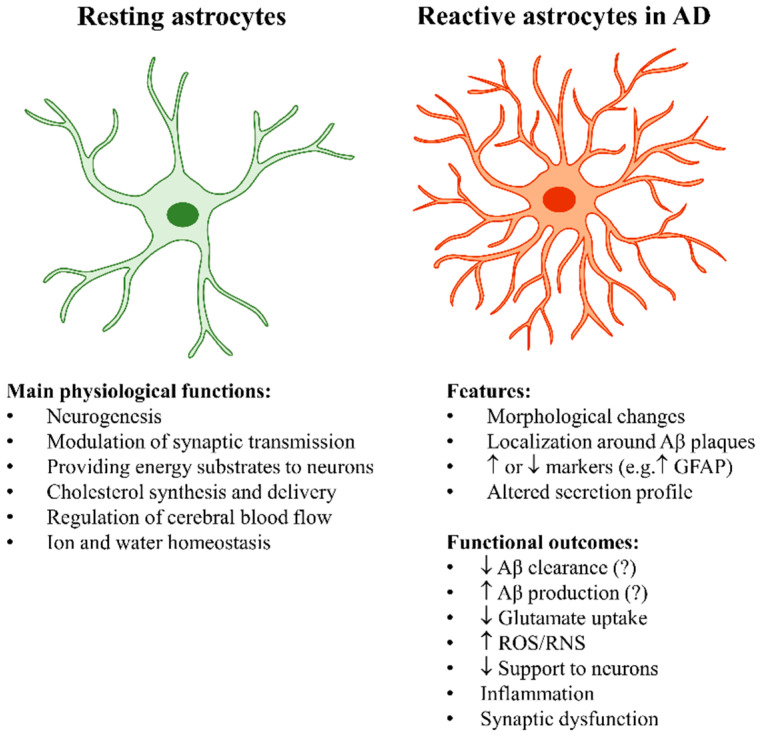
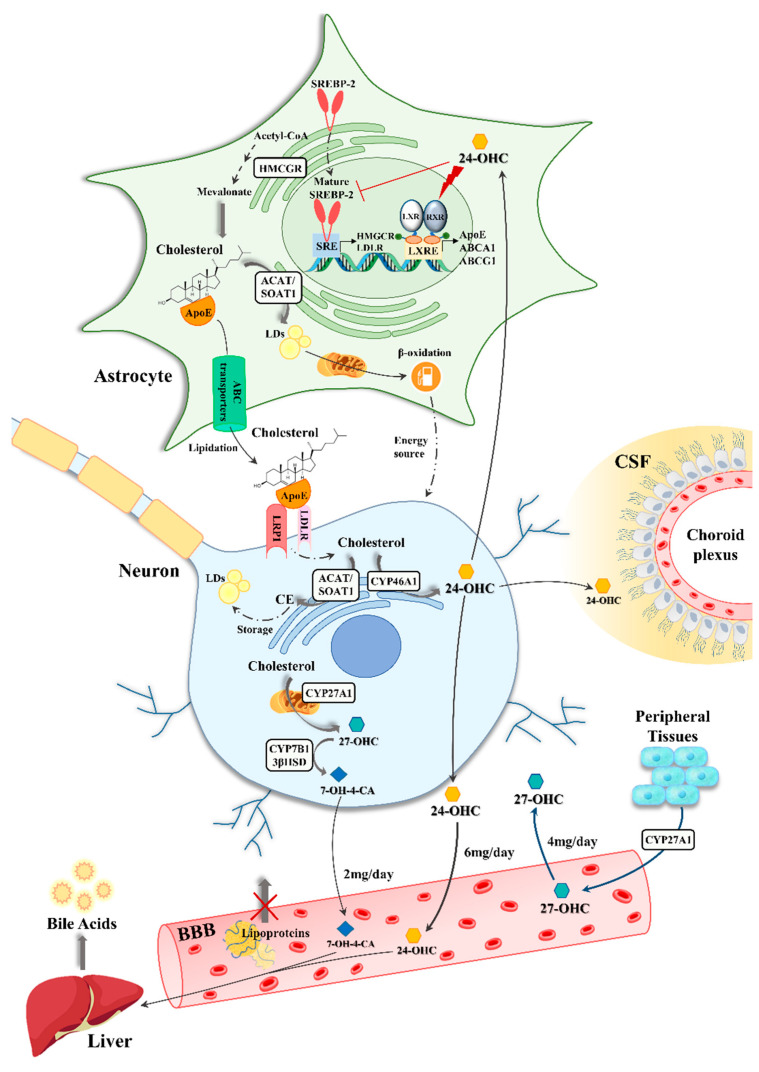
In recent decades, the impairment of cholesterol metabolism in the pathogenesis of Alzheimer’s disease (AD) has been intensively investigated, and it has been recognized to affect amyloid β (Aβ) production and clearance, tau phosphorylation, neuroinflammation and degeneration. In particular, the key role of cholesterol oxidation products, named oxysterols, has emerged. Brain cholesterol metabolism is independent from that of peripheral tissues and it must be preserved in order to guarantee cerebral functions. Among the cells that help maintain brain cholesterol homeostasis, astrocytes play a starring role since they deliver de novo synthesized cholesterol to neurons. In addition, other physiological roles of astrocytes are to modulate synaptic transmission and plasticity and support neurons providing energy. In the AD brain, astrocytes undergo significant morphological and functional changes that contribute to AD onset and development. However, the extent of this contribution and the role played by oxysterols are still unclear. Here we review the current understanding of the physiological role exerted by astrocytes in the brain and their contribution to AD pathogenesis. In particular, we focus on the impact of cholesterol dysmetabolism on astrocyte functions suggesting new potential approaches to develop therapeutic strategies aimed at counteracting AD development.
Overview
The claims and statistics of this paper haven’t been checked yet.
Run the check — free, no account needed. It reads the open-access text and checks the sources it cites.
Integrity signals
Registry
Cites
Statistics
Figures
Verification
Claims the paper makes
The claims and statistics of this paper haven’t been checked yet.
Run the check — free, no account needed. It reads the open-access text and checks the sources it cites.
Claims other papers make about this one
Each is checked against this paper’s own text: does it say what the citing paper says it does?
The cited source says what the claim attributes to it.
In the citing paper
“As astrocytes are important for cholesterol synthesis in brain and are a major source of ApoE-containing lipoprotein particles central to cholesterol transport between astrocytes, neurons, and other cells (17)”
From Regulation of astrocyte lipid metabolism and ApoE secretion by the microglial oxysterol, 25-hydroxycholesterol (2023) · cites this paper as [17]
In the citing paper
“In the brain most cholesterol is produced de novo by astrocytes, and then transported to neurons and other cells by combining with ApoE, mainly synthesized by astrocytes, to form lipoproteins that are secreted through the ATP-binding cassette (ABC) transporters [9,10].”
From ApoE3 vs. ApoE4 Astrocytes: A Detailed Analysis Provides New Insights into Differences in Cholesterol Homeostasis (2022) · cites this paper as [10]
In the citing paper
“it is recognized that HMGCR is negatively regulated by side-chain oxidized oxysterols such as 25-OHC and 27-OHC [10]”
From ApoE3 vs. ApoE4 Astrocytes: A Detailed Analysis Provides New Insights into Differences in Cholesterol Homeostasis (2022) · cites this paper as [10]
Self-check
Percentages, sums and reported differences re-computed from the paper’s own numbers.
The self-check needs the paper’s full text.
Citations
Cites
Corder, E. H., Saunders, A. M., Strittmatter, W. J., Schmechel, D. E., Gaskell, P. C., Small, G. W., Roses, A. D., Haines, J. L., & Pericak-Vance, M. A. (1993) · Science · doi:10.1126/science.8346443 · Cited by 9,429
Neurotoxic reactive astrocytes are induced by activated microglia
Liddelow, S. A., Guttenplan, K. A., Clarke, L. E., Bennett, F. C., Bohlen, C. J., Schirmer, L., Bennett, M. L., Münch, A. E., Chung, W.-S., Peterson, T. C., et al. (2017) · Nature · doi:10.1038/nature21029 · Cited by 7,971
Reactive astrocyte nomenclature, definitions, and future directions
Escartin, C., Galea, E., Lakatos, A., O’Callaghan, J. P., Petzold, G. C., Serrano-Pozo, A., Steinhäuser, C., Volterra, A., Carmignoto, G., Agarwal, A., et al. (2021) · Nature Neuroscience · doi:10.1038/s41593-020-00783-4 · Cited by 2,513 · cited 1×
“The authors recommended the evaluation of various potential markers of astrocyte reactivity in addition to GFAP and the assessment of key astrocytic functions (glutamate uptake, metabolic functions, and production of neurotrophic factors or cytokines) in order to determine whether astrocytes are actually reactive and…”
BackgroundGenomic analysis of reactive astrogliosis
Zamanian, J. L., Xu, L., Foo, L. C., Nouri, N., Zhou, L., Giffard, R. G., & Barres, B. A. (2012) · The Journal of Neuroscience · doi:10.1523/jneurosci.6221-11.2012 · Cited by 2,404
Zhang, Y., Sloan, S. A., Clarke, L. E., Caneda, C., Plaza, C. A., Blumenthal, P. D., Vogel, H., Steinberg, G. K., Edwards, M. S. B., Li, G., et al. (2016) · Neuron · doi:10.1016/j.neuron.2015.11.013 · Cited by 2,295
Mechanisms and regulation of cholesterol homeostasis
Luo, J., Yang, H., & Song, B.-L. (2020) · Nature Reviews Molecular Cell Biology · doi:10.1038/s41580-019-0190-7 · Cited by 1,980
Oxidative stress, dysfunctional glucose metabolism and Alzheimer disease
Butterfield, D. A., & Halliwell, B. (2019) · Nature Reviews Neuroscience · doi:10.1038/s41583-019-0132-6 · Cited by 1,954
Astrocyte scar formation aids central nervous system axon regeneration
Anderson, M. A., Burda, J. E., Ren, Y., Ao, Y., O’Shea, T. M., Kawaguchi, R., Coppola, G., Khakh, B. S., Deming, T. J., & Sofroniew, M. V. (2016) · Nature · doi:10.1038/nature17623 · Cited by 1,851
Uniquely Hominid Features of Adult Human Astrocytes
Oberheim, N. A., Takano, T., Han, X., He, W., Lin, J. H. C., Wang, F., Xu, Q., Wyatt, J. D., Pilcher, W., Ojemann, J. G., et al. (2009) · The Journal of Neuroscience · doi:10.1523/jneurosci.4707-08.2009 · Cited by 1,488
An english translation of alzheimer’s 1907 paper, “über eine eigenartige erkankung der hirnrinde”
Stelzmann, R. A., Norman Schnitzlein, H., & Reed Murtagh, F. (1995) · Clinical Anatomy · doi:10.1002/ca.980080612 · Cited by 1,455
Cited by
Sorted by citations
Cashikar, A. G., Toral-Rios, D., Timm, D., Romero, J., Strickland, M., Long, J. M., Han, X., Holtzman, D. M., & Paul, S. M. (2023) · Journal of Lipid Research · doi:10.1016/j.jlr.2023.100350 · Cited by 72
He, S., Xu, Z., & Han, X. (2025) · Molecular Neurodegeneration · doi:10.1186/s13024-025-00803-6 · Cited by 62
Functions of Stress-Induced Lipid Droplets in the Nervous System
Islimye, E., Girard, V., & Gould, A. P. (2022) · Frontiers in Cell and Developmental Biology · doi:10.3389/fcell.2022.863907 · Cited by 57
The translational potential of cholesterol-based therapies for neurological disease
Valenza, M., Birolini, G., & Cattaneo, E. F. (2023) · Nature Reviews Neurology · doi:10.1038/s41582-023-00864-5 · Cited by 48
Borràs, C., Mercer, A., Sirisi, S., Alcolea, D., Escolà-Gil, J. C., Blanco-Vaca, F., & Tondo, M. (2022) · International Journal of Molecular Sciences · doi:10.3390/ijms23169356 · Cited by 39
Metadata
- Authors
- Staurenghi, E., Giannelli, S., Testa, G., Sottero, B., Leonarduzzi, G., & Gamba, P.
- Affiliations
- University of Turin (IT)
- Corresponding author
- Gamba, Paola
- Venue
- Antioxidants
- Publisher
- MDPI AG
- Published
- 2021-11-26
- Volume
- 10
- Issue
- 12
- Pages
- 1890
- ISSN
- 2076-3921 (ISSN-L)
- PMC
- PMC8750262
- OpenAlex
- W3215444088
- Cited by
- 44
- References
- 203
- Citations by year
- 2026: 5 · 2025: 10 · 2024: 12 · 2023: 10 · 2022: 7
- FWCI
- 0.97
- Type
- journal article
- Language
- en
- Open access
- gold
- doi.org
- Licence
- Locations
- Antioxidants (publishedVersion, cc-by)
- PubMed Central (publishedVersion, cc-by)
- PubMed (publishedVersion)
- Institutional Research Information System University of Turin (University of Turin) (submittedVersion, other-oa)
- DOAJ (DOAJ: Directory of Open Access Journals) (submittedVersion, cc-by-sa)
- Funders
- Università degli Studi di Torino
- Topics
- Life Sciences › Neuroscience › Cellular and Molecular Neuroscience › Alzheimer's disease research and treatments
- Life Sciences › Biochemistry, Genetics and Molecular Biology › Biochemistry › Cholesterol and Lipid Metabolism
- Life Sciences › Neuroscience › Neurology › Neuroinflammation and Neurodegeneration Mechanisms
- Keywords
- Alzheimer's disease, cholesterol metabolism, astrocytes, oxysterols, cholesterol homeostasis, amyloid-beta, tau phosphorylation, neuroinflammation, astrocyte-neuron interaction, synaptic transmission, treatment options
About these checks
Registry, retraction, Cites and statistics results are computed, not judged, with one exception: a printed reference that no index lists is read once by a model before it counts as a citation error. Claims are extracted by a model and kept only when their quote appears verbatim in the text; each cited source is then checked, with a model’s help, for whether it says what the claim relies on. Those verdicts can be wrong — read the claim’s quote and the cited source before relying on one.
Statistics and arithmetic are recomputed, not judged.
Confidence bands are shown only for fields calibrated on our annotated test set. None is calibrated yet, so no band is shown.
What counts as a claim ›How we measure confidence ›How we check this ›
Are you an author, or do you see a problem with this page? Request a review
