

Immune Cell Ratios Are Higher in Bipolar Affective than Unipolar Depressive Disorder and Modulated by Mood Episode: A Retrospective, Cross-Sectional Study
Open accessThe DOI matches its Crossref record; 65 of the 71 references it cites were found in a registry or an index; 12 of the 31 sources its claims cite were checked for support.
Abstract
Immune dysregulation is implicated in the pathophysiology of both bipolar and major depressive disorder, while immune cell ratios (IRCs) have recently been proposed as clinically applicable immune biomarkers. We investigated IRCs differences in affective disorders and their association with current mood episodes and clinical features. This retrospective cohort study analyzed neutrophil–lymphocyte (NLR), monocyte–lymphocyte (MLR), and platelet–lymphocyte (PLR) ratios upon admission in 135 affective disorder in-patients with mania (MA, n = 36), bipolar depression (BiD, n = 38), and unipolar depression (MDD, n = 61). Demographic, clinical, and immune data were extracted from medical records. Monocyte count was significantly higher in BiD compared to MDD (p < 0.001). Multivariable regression models suggested higher NLR in MA compared to MDD (p = 0.039), higher MLR in both MA and BiD compared to MDD (p < 0.001 and p = 0.004 respectively), while we found neither group differences in PLR nor an effect of type and duration of hospitalization, current psychotic, or suicidal features and psychiatric history on IRCs. Here, we show that IRCs are elevated in bipolar disorder versus MDD and affected by mood episode, while MLR could be especially valuable in the differential diagnosis between bipolar and unipolar depression. IRCs represent inexpensive, routinely accessible and clinically applicable biomarkers with diagnostic validity in affective disorders that could be easily implemented as illness activity indicators, to better follow the course of illness and eventually predict relapse or treatment response and, thus, guide therapeutic targeting.
Overview
CoChat Summary
TL;DR
In 135 inpatients with affective disorders, immune cell ratios differed by diagnosis and mood episode: MLR was higher in mania and bipolar depression than unipolar depression, and NLR was higher in mania than unipolar depression. PLR showed no mood-episode differences, and MLR may be especially useful for differentiating bipolar from unipolar depression.
Key findings
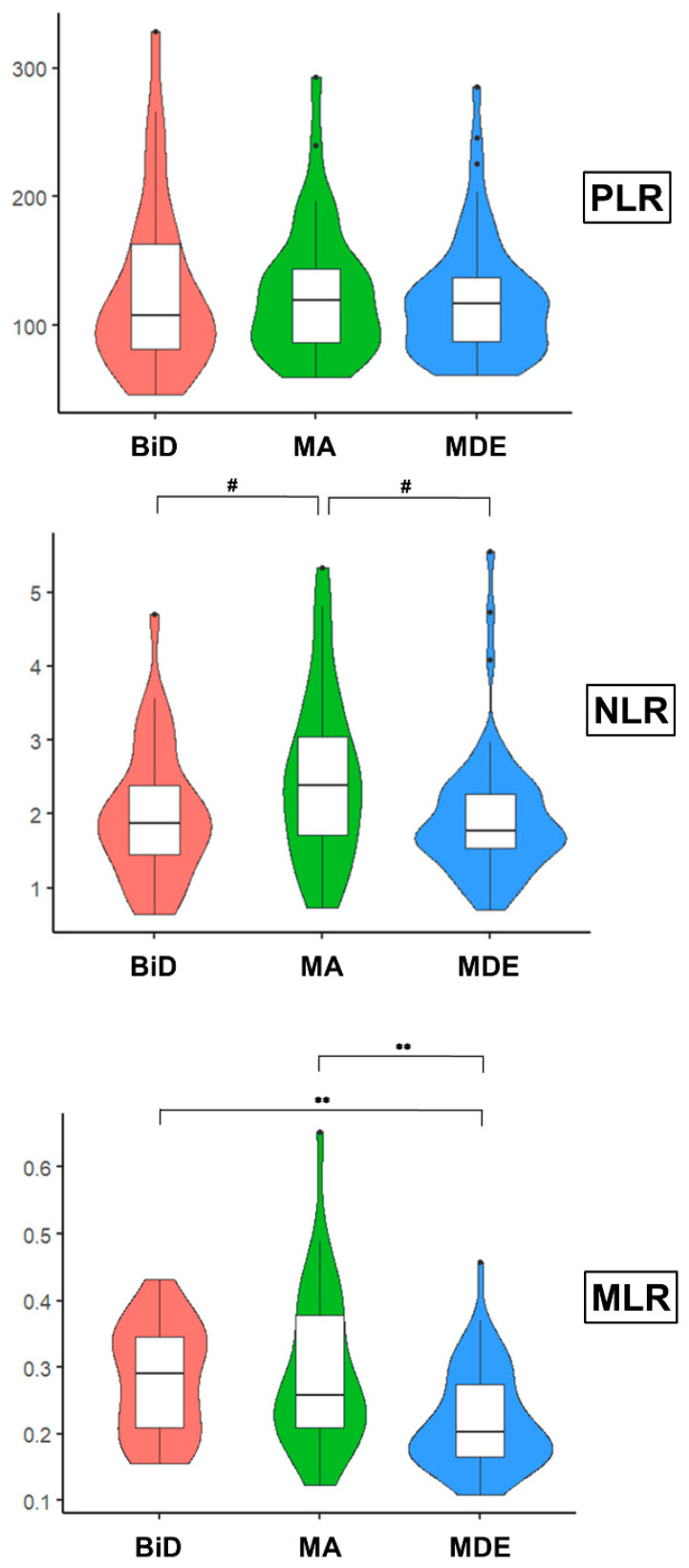
- Monocyte count was significantly higher in bipolar depression (BiD) compared with unipolar major depressive episode (MDE) (p < 0.001), with no difference between mania (MA) and BiD or MDE.
- MLR differed significantly across groups (p < 0.001); post hoc tests showed MLR was higher in MA vs MDE (p = 0.005) and BiD vs MDE (p = 0.002), but not MA vs BiD (p = 0.916). In multivariable models, MLR remained lower in MDE vs MA (95% CI: −0.12 to −0.04, p < 0.001) and vs BiD (95% CI: −0.1 to −0.02, p = 0.004).
- NLR was higher in MA than BiD or MDE only at a trend level in group comparisons (p = 0.056); in multivariable analysis, NLR was lower in MDE vs MA adjusted for psychotic symptoms (95% CI: −0.93 to −0.02, p = 0.039), but not vs BiD.
- PLR showed no statistically relevant group differences (p = 0.785); PLR decreased with age in univariable analysis (0.84 units per 1-year increase, 95% CI: −1.53 to −1.49, p = 0.018) and remained negatively associated with age in multivariable analysis (95% CI: −1.50 to −0.08, p = 0.029). MLR was higher in men than women, and no effect of hospitalization type/duration, current psychotic or suicidal features, or psychiatric history on ICRs was found.
Methods
- Retrospective cohort/cross-sectional study at the Department of Psychiatry, General Hospital of Katerini, Greece. From 503 admissions between January 2013 and December 2019, 135 met inclusion criteria: MA n = 36, BiD n = 38, MDE n = 61; mean (SD) age 47.4 (13.6) years, 30% male (n = 40).
- Routine blood samples were collected on the first morning after admission; NLR, MLR, and PLR were calculated. Diagnoses were based on ICD-10 criteria; exclusions included chronic/acute psychotic disorders, mixed episodes, physical comorbidities, relevant medications, substance use disorder, and social admissions.
- Analyses used Shapiro-Wilk and Levene’s tests, ANOVA/Kruskal–Wallis with post hoc t-test or Wilcoxon–Mann–Whitney and Bonferroni correction, linear regression with diagnostic groups as fixed factors and confounders, and multivariable backward elimination with AIC, forcing mood episode into the final model.
Limitations
- Paper-stated: BMI, smoking, medication prior to admission, and clinical rating scales were not considered because of missing information in most medical records; other immune/inflammatory biomarkers (e.g., cytokines, CRP) were not evaluated; and patients were not compared with a matched healthy control group.
- Evident from the text: the study is retrospective and single-center, with a modest sample size, so causal inferences cannot be drawn and residual confounding or limited generalizability may remain.
Model-written summary. Check it against the paper before relying on it.
Integrity signals
Registry
Cites
Statistics
Figures
Verification
Claims the paper makes
5 Valid · 0 Not valid · 6 Not checked · 52 Own results and interpretations
A result the paper reports from its own data — it cites no other source for it, so there is none to check. The quote shows it is in the paper.
In the paper
“Between PLR and age, there was an expected decrease of 0.84 units of PLR for every 1-year increase in age (95% CI: −1.53 to −1.49, p = 0.018).”
§ Immune Cell Ratios Are Higher in Bipolar Affective than Unipolar Depressive Disorder and Modulated by Mood Episode: A Retrospective, Cross-Sectional Study > 3. Results > 3.3. Univariate Analyses
plainstates an association- Asserted: passes — The authors put it forward as true.
- Checkable: passes — It can be checked against evidence.
- Load-bearing: unclear — It is unclear whether the paper’s conclusions depend on it.
- Based: passes — The paper gives a reason why it holds.
A result the paper reports from its own data — it cites no other source for it, so there is none to check. The quote shows it is in the paper.
In the paper
“PLR showed no statistically relevant differences between the groups (p = 0.785; cf. Table 2, Figure 1).”
- Also stated in: § Abstract · plain
“we found neither group differences in PLR”
§ Immune Cell Ratios Are Higher in Bipolar Affective than Unipolar Depressive Disorder and Modulated by Mood Episode: A Retrospective, Cross-Sectional Study > 3. Results > 3.2. Group Differences
plain- Asserted: passes — The authors put it forward as true.
- Checkable: passes — It can be checked against evidence.
- Load-bearing: unclear — It is unclear whether the paper’s conclusions depend on it.
- Based: passes — The paper gives a reason why it holds.
- Also stated in: § Abstract · plain
A result the paper reports from its own data — it cites no other source for it, so there is none to check. The quote shows it is in the paper.
In the paper
“we found neither group differences in PLR nor an effect of type and duration of hospitalization, current psychotic, or suicidal features and psychiatric history on IRCs.”
- Also stated in: § 3.5. Synopsis of Main Findings · hedged
“our results suggested no effect of type and duration of hospitalization, current psychotic or suicidal features, and psychiatric history on ICRs.”
§ Immune Cell Ratios Are Higher in Bipolar Affective than Unipolar Depressive Disorder and Modulated by Mood Episode: A Retrospective, Cross-Sectional Study > Abstract
plain- Asserted: passes — The authors put it forward as true.
- Checkable: passes — It can be checked against evidence.
- Load-bearing: unclear — It is unclear whether the paper’s conclusions depend on it.
- Based: passes — The paper gives a reason why it holds.
- Also stated in: § 3.5. Synopsis of Main Findings · hedged
A result the paper reports from its own data — it cites no other source for it, so there is none to check. The quote shows it is in the paper.
In the paper
“the negative association between PLR and age remained significant adjusted for current mood episode and suicide attempt upon admission (95% CI: −1.50 to −0.08, p = 0.029)”
§ Immune Cell Ratios Are Higher in Bipolar Affective than Unipolar Depressive Disorder and Modulated by Mood Episode: A Retrospective, Cross-Sectional Study > 3. Results > 3.4. Multivariate Regression Models
plainstates an association- Asserted: passes — The authors put it forward as true.
- Checkable: passes — It can be checked against evidence.
- Load-bearing: unclear — It is unclear whether the paper’s conclusions depend on it.
- Based: passes — The paper gives a reason why it holds.
A result the paper reports from its own data — it cites no other source for it, so there is none to check. The quote shows it is in the paper.
In the paper
“we found neither group differences in PLR nor an effect of type and duration of hospitalization, current psychotic, or suicidal features and psychiatric history on IRCs.”
- Also stated in: § 3.5. Synopsis of Main Findings · hedged
“our results suggested no effect of type and duration of hospitalization, current psychotic or suicidal features, and psychiatric history on ICRs.”
§ Immune Cell Ratios Are Higher in Bipolar Affective than Unipolar Depressive Disorder and Modulated by Mood Episode: A Retrospective, Cross-Sectional Study > Abstract
plain- Asserted: passes — The authors put it forward as true.
- Checkable: passes — It can be checked against evidence.
- Load-bearing: unclear — It is unclear whether the paper’s conclusions depend on it.
- Based: passes — The paper gives a reason why it holds.
- Also stated in: § 3.5. Synopsis of Main Findings · hedged
31 more claims
Create a free account to see all 63 claims and every source verdict.
- Probably not a substantial claim. 22
- It may state two separate claims as one. 12
Claims other papers make about this one
Each is checked against this paper’s own text: does it say what the citing paper says it does?
The source backs part of the claim, not all of it — or backs it for a different population, condition or comparison.
In the citing paper
“Although a few studies found significantly higher NLR or MLR values in bipolar depression than in unipolar depression, most studies observed no significant difference, which is consistent with previous findings.20,21”
From Association Between Mood Disorder Severity, Treatment Response and Systemic Inflammatory Markers: Exploring the Role of NLR, PLR, MLR, and SII (2024) · cites this paper as [20]
Experimental — accuracy not yet measured
Self-check
Percentages, sums and reported differences re-computed from the paper’s own numbers.
Each contradiction between two passages listed here was confirmed by an independent check.
Rated minor: it would not touch a result — a value no result rests on, a p-value that stays on the same side of the significance level, or a conflict that is clerical, resolved elsewhere in the paper, or outside its own findings.
In the paper
§ Immune Cell Ratios Are Higher in Bipolar Affective than Unipolar Depressive Disorder and Modulated by Mood Episode: A Retrospective, Cross-Sectional Study > 3. Results > 3.3. Univariate Analyses
“there was an expected decrease of 0.84 units of PLR for every 1-year increase in age”
§ Immune Cell Ratios Are Higher in Bipolar Affective than Unipolar Depressive Disorder and Modulated by Mood Episode: A Retrospective, Cross-Sectional Study > 3. Results > 3.3. Univariate Analyses
“(95% CI: −1.53 to −1.49, p = 0.018)”
Citations
Cites
Origin and physiological roles of inflammation
Medzhitov, R. (2008) · Nature · doi:10.1038/nature07201 · Cited by 6,618 · cited 1×
“, para-inflammation) at the other end of the spectrum [5].”
BackgroundThe Hypothalamic–Pituitary–Adrenal Axis and Immune-Mediated Inflammation
Chrousos, G. P. (1995) · New England Journal of Medicine · doi:10.1056/nejm199505183322008 · Cited by 2,579
Stress-induced immune dysfunction: implications for health
Glaser, R., & Kiecolt-Glaser, J. K. (2005) · Nature Reviews Immunology · doi:10.1038/nri1571 · Cited by 2,190
Nathan, C., & Ding, A. (2010) · Cell · doi:10.1016/j.cell.2010.02.029 · Cited by 2,183
Zahorec, R. (2001) · Bratislava Medical Journal · doi:10.1007/bf03656390 · Cited by 1,601 · cited 2×
“concluded that ICRs “indicate the balance between innate and adaptive immune responses and are an excellent indicator of inflammation and stress together” [26].”
BackgroundEffects of stress on immune function: The good, the bad, and the beautiful
Dhabhar, F. S. (2014) · Immunologic Research · doi:10.1007/s12026-014-8517-0 · Cited by 1,343
Buonacera, A., Stancanelli, B., Colaci, M., & Malatino, L. (2022) · International Journal of Molecular Sciences · doi:10.3390/ijms23073636 · Cited by 1,083
Neuroendocrine Regulation of Immunity
Webster, J. I., Tonelli, L., & Sternberg, E. M. (2002) · Annual Review of Immunology · doi:10.1146/annurev.immunol.20.082401.104914 · Cited by 957 · cited 1×
“The timely regulation of this immune continuum is mediated by intertwined immune, endocrine, and neural regulatory pathways that safeguard against undue tissue and cell damage [6,7].”
BackgroundMarsland, A. L., Walsh, C., Lockwood, K., & John-Henderson, N. A. (2017) · Brain, Behavior, and Immunity · doi:10.1016/j.bbi.2017.01.011 · Cited by 691 · cited 1×
“Indeed, both acute and chronic psychosocial stressors in humans have been reliably associated with systemic inflammatory responses [15,16].”
BackgroundThe Platelet-to-Lymphocyte Ratio as an Inflammatory Marker in Rheumatic Diseases
Gasparyan, A. Y., Ayvazyan, L., Mukanova, U., Yessirkepov, M., & Kitas, G. D. (2019) · Annals of Laboratory Medicine · doi:10.3343/alm.2019.39.4.345 · Cited by 607
Systemic inflammation markers and cancer incidence in the UK Biobank
Nøst, T. H., Alcala, K., Urbarova, I., Byrne, K. S., Guida, F., Sandanger, T. M., & Johansson, M. (2021) · European Journal of Epidemiology · doi:10.1007/s10654-021-00752-6 · Cited by 526
Stimulation of systemic low-grade inflammation by psychosocial stress.
Rohleder, N. (2014) · Psychosomatic Medicine · doi:10.1097/psy.0000000000000049 · Cited by 497 · cited 1×
“Indeed, both acute and chronic psychosocial stressors in humans have been reliably associated with systemic inflammatory responses [15,16].”
BackgroundThe neuroendocrinology of stress: the stress-related continuum of chronic disease development
Agorastos, A., & Chrousos, G. P. (2022) · Molecular Psychiatry · doi:10.1038/s41380-021-01224-9 · Cited by 462
Self-citationKauer-Sant'Anna, M., Kapczinski, F., Andreazza, A. C., Bond, D. J., Lam, R. W., Young, L. T., & Yatham, L. N. (2009) · The International Journal of Neuropsychopharmacology · doi:10.1017/s1461145708009310 · Cited by 435
Immune and neuroendocrine mechanisms of stress vulnerability and resilience
Ménard, C., Pfau, M. L., Hodes, G. E., & Russo, S. J. (2017) · Neuropsychopharmacology · doi:10.1038/npp.2016.90 · Cited by 374
Tissue homeostasis and inflammation
Meizlish, M. L., Franklin, R. A., Zhou, X., & Medzhitov, R. (2021) · Annual Review of Immunology · doi:10.1146/annurev-immunol-061020-053734 · Cited by 364
Tryptophan-kynurenine pathway is dysregulated in inflammation and immune activation
Zou, M.-H. (2015) · Frontiers in Bioscience · doi:10.2741/4363 · Cited by 361 · cited 1×
“In addition, inflammation influences the redox equilibrium through the tryptophan-kynurenine pathway [20,21], resulting in elevated glutamate, NMDA receptor overactivation, and excitotoxicity, culminating in reactive nitrogen species generation and lipid peroxidation in neurons, thereby affecting neural function [22].”
BackgroundNeutrophil/lymphocyte ratio and platelet/lymphocyte ratio in mood disorders: A meta-analysis
Mazza, M. G., Lucchi, S., Tringali, A. G. M., Rossetti, A., Botti, E. R., & Clerici, M. (2018) · Progress in Neuro-Psychopharmacology and Biological Psychiatry · doi:10.1016/j.pnpbp.2018.03.012 · Cited by 326 · cited 1×
“Then, 3 years later, a meta-analysis of 11 studies solidly confirmed that NLR and PLR were increased in patients with MDD and BD compared to healthy controls [49].”
BackgroundCzarny, P., Wigner, P., Galecki, P., & Sliwinski, T. (2018) · Progress in Neuro-Psychopharmacology and Biological Psychiatry · doi:10.1016/j.pnpbp.2017.06.036 · Cited by 310
Dantzer, R., Cohen, S., Russo, S. J., & Dinan, T. G. (2018) · Brain, Behavior, and Immunity · doi:10.1016/j.bbi.2018.08.010 · Cited by 309
Neurobiology of Resilience: Interface Between Mind and Body
Cathomas, F., Murrough, J. W., Nestler, E. J., Han, M.-H., & Russo, S. J. (2019) · Biological Psychiatry · doi:10.1016/j.biopsych.2019.04.011 · Cited by 296
Beyond Host Defense: Emerging Functions of the Immune System in Regulating Complex Tissue Physiology
Rankin, L. C., & Artis, D. (2018) · Cell · doi:10.1016/j.cell.2018.03.013 · Cited by 269 · cited 1×
“The immune system consists of tissues, cell populations, and soluble factors that function to regulate tissue and whole-body homeostasis [1].”
BackgroundDjordjevic, D., Rondovic, G., Surbatovic, M., Stanojevic, I., Udovicic, I., Andjelic, T., Zeba, S., Milosavljevic, S., Stankovic, N., Abazovic, D., et al. (2018) · Mediators of Inflammation · doi:10.1155/2018/3758068 · Cited by 268
Steullet, P., Cabungcal, J. H., Monin, A., Dwir, D., O'Donnell, P., Cuenod, M., & Do, K. Q. (2016) · Schizophrenia Research · doi:10.1016/j.schres.2014.06.021 · Cited by 262
Immune Influencers in Action: Metabolites and Enzymes of the Tryptophan-Kynurenine Metabolic Pathway
Tanaka, M., Tóth, F., Polyák, H., Szabó, Á., Mándi, Y., & Vécsei, L. (2021) · Biomedicines · doi:10.3390/biomedicines9070734 · Cited by 248 · cited 1×
“In addition, inflammation influences the redox equilibrium through the tryptophan-kynurenine pathway [20,21], resulting in elevated glutamate, NMDA receptor overactivation, and excitotoxicity, culminating in reactive nitrogen species generation and lipid peroxidation in neurons, thereby affecting neural function [22].”
BackgroundOxidative Stress, Inflammation, and Neuroprogression in Chronic PTSD
Miller, M. W., Lin, A. P., Wolf, E. J., & Miller, D. R. (2018) · Harvard Review of Psychiatry · doi:10.1097/hrp.0000000000000167 · Cited by 237
Bai, S., Guo, W., Feng, Y., Deng, H., Li, G., Nie, H., Guo, G., Yu, H., Ma, Y., Wang, J., et al. (2020) · Journal of Neurology, Neurosurgery & Psychiatry · doi:10.1136/jnnp-2019-320912 · Cited by 235 · cited 1×
“So far, systematic reviews and meta-analyses support the potential therapeutic effects of anti-inflammatory drugs as adjunctive agents to both bipolar disorder and major depression [62,63].”
BackgroundRosenblat, J. D., Kakar, R., Berk, M., Kessing, L. V., Vinberg, M., Baune, B. T., Mansur, R. B., Brietzke, E., Goldstein, B. I., & McIntyre, R. S. (2016) · Bipolar Disorders · doi:10.1111/bdi.12373 · Cited by 199 · cited 1×
“So far, systematic reviews and meta-analyses support the potential therapeutic effects of anti-inflammatory drugs as adjunctive agents to both bipolar disorder and major depression [62,63].”
BackgroundNeuroendocrine regulation of inflammation
Padro, C. J., & Sanders, V. M. (2014) · Seminars in Immunology · doi:10.1016/j.smim.2014.01.003 · Cited by 188 · cited 1×
“The timely regulation of this immune continuum is mediated by intertwined immune, endocrine, and neural regulatory pathways that safeguard against undue tissue and cell damage [6,7].”
BackgroundImmunopsychiatry: important facts
Khandaker, G. M., Dantzer, R., & Jones, P. B. (2017) · Psychological Medicine · doi:10.1017/s0033291717000745 · Cited by 183 · cited 1×
“Thus, the immune system involvement in the pathophysiology of psychiatric and, more specifically, affective disorders has increasingly become a central research focus in the field of immunopsychiatry [23].”
BackgroundNovel Systemic Inflammation Markers to Predict COVID-19 Prognosis
Karimi, A., Shobeiri, P., Kulasinghe, A., & Rezaei, N. (2021) · Frontiers in Immunology · doi:10.3389/fimmu.2021.741061 · Cited by 171
Atli, A., Demir, S., Bulut, M., Okan İbiloğlu, A., Güneş, M., Kaya, M., Demirpençe, Ö., & Sır, A. (2015) · Neuropsychiatric Disease and Treatment · doi:10.2147/ndt.s89470 · Cited by 156 · cited 2×
“first investigated NLR in MDD and BD respectively, and both reported higher levels of NLR in MDD and BD patients compared to healthy controls [47,48].”
ResultHwang, M., Canzoniero, J. V., Rosner, S., Zhang, G., White, J. R., Belcaid, Z., Cherry, C., Balan, A., Pereira, G., Curry, A., et al. (2022) · Journal for ImmunoTherapy of Cancer · doi:10.1136/jitc-2022-004688 · Cited by 150
Role of neuro-immunological factors in the pathophysiology of mood disorders
Bhattacharya, A., Derecki, N. C., Lovenberg, T. W., & Drevets, W. C. (2016) · Psychopharmacology · doi:10.1007/s00213-016-4214-0 · Cited by 149 · cited 1×
“Solid research of the past two decades suggests a distinct crosstalk between the central nervous and the peripheral immune system, and has offered mounting evidence of immune dysregulation in affective disorders through several molecular pathways [24].”
BackgroundYang, Z., Zhang, Z., Lin, F., Ren, Y., Liu, D., Zhong, R., & Liang, Y. (2017) · APMIS · doi:10.1111/apm.12722 · Cited by 145
Özdin, S., & Böke, Ö. (2019) · Psychiatry Research · doi:10.1016/j.psychres.2018.11.043 · Cited by 129 · cited 1×
“, response to treatment indicator) of affective disorders [46,59,60].”
BackgroundThe neuroimmune response during stress: A physiological perspective
Haykin, H., & Rolls, A. (2021) · Immunity · doi:10.1016/j.immuni.2021.08.023 · Cited by 121 · cited 1×
“Accordingly, adverse psychological conditions such as psychiatric disorders have the potential to function as inducers of a wide range of immune responses, as they chronically influence the human homeostatic stress system [14].”
BackgroundA systemic toxicity index developed to assess peripheral changes in mood episodes
Kapczinski, F., Dal-Pizzol, F., Teixeira, A. L., Magalhaes, P. V. S., Kauer-Sant'Anna, M., Klamt, F., de Bittencourt Pasquali, M. A., Quevedo, J., Gama, C. S., & Post, R. (2010) · Molecular Psychiatry · doi:10.1038/mp.2009.112 · Cited by 117 · cited 1×
“Last but not least, a potential combination of several immune biomarkers into a systematic index to assess dynamic immune and inflammatory states as in prior studies [61] could be of particular interest in future studies.”
BackgroundZhang, N., Jiang, J., Tang, S., & Sun, G. (2020) · International Immunopharmacology · doi:10.1016/j.intimp.2020.106677 · Cited by 109
Neutrophil-to-lymphocyte ratio is a novel predictor of venous thrombosis in polycythemia vera
Carobbio, A., Vannucchi, A. M., Stefano, V. D., Masciulli, A., Guglielmelli, P., Loscocco, G. G., Ramundo, F., Rossi, E., Kanthi, Y. M., Tefferi, A., et al. (2022) · Blood Cancer Journal · doi:10.1038/s41408-022-00625-5 · Cited by 100
Neutrophil-to-lymphocyte ratio: A potential new peripheral biomarker of suicidal behavior
Velasco, Á., Rodríguez-Revuelta, J., Olié, E., Abad, I., Fernández-Peláez, A., Cazals, A., Guillaume, S., de la Fuente-Tomás, L., Jiménez-Treviño, L., Gutiérrez, L., et al. (2020) · European Psychiatry · doi:10.1192/j.eurpsy.2019.20 · Cited by 100
Sayed, A., Bahbah, E. I., Kamel, S., Barreto, G. E., Ashraf, G. M., & Elfil, M. (2020) · Journal of Neuroimmunology · doi:10.1016/j.jneuroim.2020.577398 · Cited by 97
Fusar-Poli, L., Natale, A., Amerio, A., Cimpoesu, P., Grimaldi Filioli, P., Aguglia, E., Amore, M., Serafini, G., & Aguglia, A. (2021) · Brain Sciences · doi:10.3390/brainsci11010058 · Cited by 93 · cited 1×
“found higher immune ratios in mania compared to depression in individuals with BD [52], while Dadouli et al.”
ResultNLR-Dependent Regulation of Inflammation in Multiple Sclerosis
Gharagozloo, M., Gris, K. V., Mahvelati, T., Amrani, A., Lukens, J. R., & Gris, D. (2018) · Frontiers in Immunology · doi:10.3389/fimmu.2017.02012 · Cited by 91
Mazza, M. G., Tringali, A. G. M., Rossetti, A., Botti, R. E., & Clerici, M. (2019) · General Hospital Psychiatry · doi:10.1016/j.genhosppsych.2019.02.003 · Cited by 89
Ghaffari, S., Nadiri, M., Pourafkari, L., Sepehrvand, N., Movasagpoor, A., Rahmatvand, N., Saatloo, M. R., Ahmadi, M., & Nader, N. D. (2014) · Europe PMC (PubMed Central) · doi:10.5681/jcvtr.2014.007 · Cited by 87
Dionisie, V., Filip, G. A., Manea, M. C., Movileanu, R. C., Moisa, E., Manea, M., Riga, S., & Ciobanu, A. M. (2021) · Journal of Clinical Medicine · doi:10.3390/jcm10091924 · Cited by 82 · cited 2×
“In particular, our study aimed to replicate and extend previously reported findings [50,51] that compared ICRs in mania, bipolar depression, and unipolar depression.”
ResultKaranikas, E., Daskalakis, N. P., & Agorastos, A. (2021) · Brain Sciences · doi:10.3390/brainsci11060723 · Cited by 78 · cited 1×
“Inflammation is additionally involved in oxidative pathways and is a vital mechanism of oxidative stress generation and neurodegeneration in the periphery and the central nervous system, in particular in stress-related disorders [17].”
BackgroundSelf-citationInanli, I., Aydin, M., Çaliskan, A. M., & Eren, I. (2019) · Nordic Journal of Psychiatry · doi:10.1080/08039488.2019.1640789 · Cited by 69 · cited 1×
“reported higher NLR and MLR in manic state compared to depressive state in BD patients, while depressed patients showed higher ratios compared to healthy controls [53].”
ResultIncreased neutrophil/lymphoctye ratio in patients with bipolar disorder: a preliminary study.
Çakır, U., Tuman, T. C., & Yıldırım, O. (2015) · PubMed · Cited by 69
Neurotrophins, inflammation and oxidative stress as illness activity biomarkers in bipolar disorder
Pfaffenseller, B., Fries, G. R., Wollenhaupt-Aguiar, B., Colpo, G. D., Stertz, L., Panizzutti, B., Magalhães, P. V., & Kapczinski, F. (2013) · Expert Review of Neurotherapeutics · doi:10.1586/14737175.2013.811981 · Cited by 68 · cited 1×
“, response to treatment indicator) of affective disorders [46,59,60].”
BackgroundMirna, M., Schmutzler, L., Topf, A., Hoppe, U. C., & Lichtenauer, M. (2021) · Scientific Reports · doi:10.1038/s41598-021-97678-6 · Cited by 58
Dadouli, K., Janho, M. B., Hatziefthimiou, A., Voulgaridi, I., Piaha, K., Anagnostopoulos, L., Ntellas, P., Mouchtouri, V. A., Bonotis, K., Christodoulou, N., et al. (2022) · Brain Sciences · doi:10.3390/brainsci12081034 · Cited by 57 · cited 3×
“reported higher immune ratios in patients with BD than in controls when experiencing a depressive or manic episode, while MLR was higher only in BD patients with a manic episode [56].”
BackgroundResult(2019) · PubMed Central · doi:10.22088/cjim.10.3.320 · Cited by 57 · cited 2×
“that showed similar sex differences in MLR [57], but were not found elsewhere [56].”
BackgroundResultWei, Y., Feng, J., Ma, J., Chen, D., & Chen, J. (2022) · Journal of Affective Disorders · doi:10.1016/j.jad.2022.04.092 · Cited by 56 · cited 1×
“[55], which reported elevated NLR in MDD patients in comparison to healthy controls, higher NLR and MLR and lower PLR in BD patients in comparison to MDD, and elevated NLR and MLR in BD patients with manic episode compared to BD patients with depression or MDD patients.”
ResultMathur, K., Kurbanova, N., & Qayyum, R. (2019) · Platelets · doi:10.1080/09537104.2019.1571188 · Cited by 55 · cited 1×
“Further research suggested that platelet– lymphocyte ratio (PLR) may represent an additional very sensitive marker of inflammation, as in the absence of absolute thrombocytosis, higher PLR has been interrelated with higher thrombosis and inflammation [27].”
BackgroundLi, L.-H., Chen, C.-T., Chang, Y.-C., Chen, Y.-J., Lee, I.-H., & How, C.-K. (2021) · Medicine · doi:10.1097/md.0000000000026354 · Cited by 51
The correlation between PLR-NLR and prognosis in acute myocardial infarction.
Liu, J., Ao, W., Zhou, J., et al. (2021) · PubMed · Cited by 50
Chen, J., Ji, X., & Xing, H. (2022) · World Journal of Surgical Oncology · doi:10.1186/s12957-022-02793-x · Cited by 41
A comparison of inflammatory markers in manic and euthymic states of bipolar disorder
Özdin, S., & Usta, M. B. (2021) · Nordic Journal of Psychiatry · doi:10.1080/08039488.2020.1807048 · Cited by 30
Pasqui, E., de DONATO, G., Lazzeri, E., Molino, C., Galzerano, G., Giubbolini, M., & Palasciano, G. (2022) · Biomedicines · doi:10.3390/biomedicines10092218 · Cited by 29
Dommershuijsen, L. J., Ruiter, R., Erler, N. S., Rizopoulos, D., Ikram, M. A., & Ikram, M. K. (2021) · Journal of Parkinson s Disease · doi:10.3233/jpd-212914 · Cited by 29
Rapoport, S. I., & Hibbeln, J. R. (2020) · Prostaglandins, Leukotrienes and Essential Fatty Acids · doi:10.1016/j.plefa.2020.102118 · Cited by 11
The dilemma of immune stimulation and suppression during depression: One step closer to a solution?
Shattuck, E. C. (2016) · Brain Behavior and Immunity · doi:10.1016/j.bbi.2016.02.004 · Cited by 2 · cited 1×
“, immunosuppression versus low-grade inflammation) [25].”
Cited by
Daray, F. M., Chiapella, L. C., Grendas, L. N., Casiani, R. I. Á., Olaviaga, A., Robetto, J., Prokopez, C. R., Silva, E. A. C., Errasti, A. E., & Neupane, S. P. (2024) · Molecular Psychiatry · doi:10.1038/s41380-024-02587-5 · Cited by 40
Ghafori, S. S., Yousefi, Z., Bakhtiari, E., hasani, M. H. M. M., & Hassanzadeh, G. (2024) · Brain Behavior & Immunity - Health · doi:10.1016/j.bbih.2024.100734 · Cited by 28
“Additionally, it has been reported that the manic phase in BD was characterized by a higher inflammation activation, reflected by the NLR index, than the depression phase (Dionisie et al., 2021; Koureta et al., 2023).”
BackgroundDepartment of Psychiatry, G. U., Kucukkarapinar, M., Erbil, D., Department of Psychiatry, G. U., Keles, İ., Department of Psychiatry, G. U., Karadag, F., & Department of Psychiatry, G. U. (2024) · Psychiatry and Clinical Psychopharmacology · doi:10.5152/pcp.2024.23760 · Cited by 14
“Since Koureta et al 20 found that NLR values were significantly higher only in bipolar manic episodes and MLR values were significantly higher in both stages of bipolar disorder compared to MDD, Mazza et al 8 found that manic patients had higher NLR and MLR compared to patients with unipolar and bipolar depression, wi…”
ResultCavaleri, D., Cucchi, G., Citton, M., Monti, M., Crocamo, C., Bartoli, F., & Carrà, G. (2026) · European Psychiatry · doi:10.1192/j.eurpsy.2026.10174 · Cited by 7
“The 23 articles excluded after full-text review, with reasons for exclusion, are listed in Supplementary Table 3 .”
Metadata
- Authors
- Koureta, A., Asimakopoulos, L. O., Bozikas, V. P., & Agorastos, A.
- Affiliations
- Department of Psychiatry, General Hospital of Katerini, GR 60100 Katerini, Greece
- Democritus University of Thrace (GR)
- Aristotle University of Thessaloniki (GR)
- Corresponding author
- Agorastos, Agorastos
- Venue
- Brain Sciences
- Publisher
- MDPI AG
- Published
- 2023-03-05
- Volume
- 13
- Issue
- 3
- Pages
- 448
- ISSN
- 2076-3425 (ISSN-L)
- PMC
- PMC10046831
- OpenAlex
- W4323318011
- Cited by
- 12
- References
- 71
- Citations by year
- 2026: 2 · 2025: 4 · 2024: 5 · 2023: 1
- FWCI
- 2.43
- Type
- journal article
- Language
- en
- Open access
- gold
- doi.org
- Licence
- Locations
- Brain Sciences (publishedVersion, cc-by)
- PubMed Central (publishedVersion, cc-by)
- PubMed (publishedVersion)
- DOAJ (DOAJ: Directory of Open Access Journals) (submittedVersion, cc-by-sa)
- Topics
- Health Sciences › Medicine › Psychiatry and Mental health › Bipolar Disorder and Treatment
- Life Sciences › Neuroscience › Biological Psychiatry › Tryptophan and brain disorders
- Health Sciences › Medicine › Pharmacology (medical) › Treatment of Major Depression
- Keywords
- bipolar disorder, major depressive disorder, mania, bipolar depression, neutrophil-to-lymphocyte ratio, monocyte-to-lymphocyte ratio, platelet-to-lymphocyte ratio, immunological markers, differential diagnosis, immune dysregulation, monocyte count
About these checks
Registry, retraction, Cites and statistics results are computed, not judged, with one exception: a printed reference that no index lists is read once by a model before it counts as a citation error. Claims are extracted by a model and kept only when their quote appears verbatim in the text; each cited source is then checked, with a model’s help, for whether it says what the claim relies on. Those verdicts can be wrong — read the claim’s quote and the cited source before relying on one.
The claim verdicts this report counts are experimental: their accuracy is not yet measured.
A language model drew the claims from the paper on 2026-10-10, under version 3 of the claim definition (model deepseek-v4.1-flash, prompt extract-v3).
A second model labelled each claim on 2026-10-10 (model jev-1.13-20260917, definition revision gold-guideline-v0.2).
Statistics and arithmetic are recomputed, not judged.
Confidence bands are shown only for fields calibrated on our annotated test set. None is calibrated yet, so no band is shown.
What counts as a claim ›How we measure confidence ›How we check this ›
Are you an author, or do you see a problem with this page? Request a review
Data sources
Bibliographic data: Semantic Scholar, OpenAlex, Crossref.
Contains information from the Semantic Scholar Academic Graph Datasets, made available under the ODC Attribution License (ODC-BY 1.0).
Semantic Scholar’s data is described in: Kinney, R., et al. (2023). The Semantic Scholar Open Data Platform. arXiv:2301.10140.
