

Sex: A Significant Risk Factor for Neurodevelopmental and Neurodegenerative Disorders
Open accessThe DOI matches its Crossref record; 336 of the 336 references it cites were found in a registry or an index.
Abstract
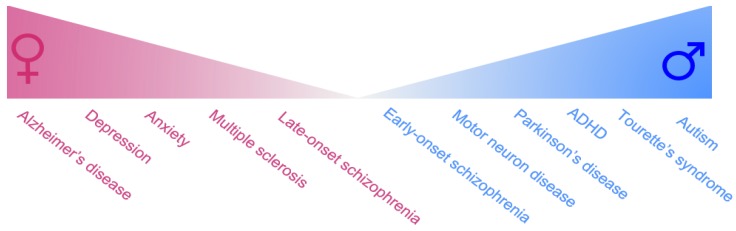
Males and females sometimes significantly differ in their propensity to develop neurological disorders. Females suffer more from mood disorders such as depression and anxiety, whereas males are more susceptible to deficits in the dopamine system including Parkinson’s disease (PD), attention-deficit hyperactivity disorder (ADHD) and autism. Despite this, biological sex is rarely considered when making treatment decisions in neurological disorders. A better understanding of the molecular mechanism(s) underlying sex differences in the healthy and diseased brain will help to devise diagnostic and therapeutic strategies optimal for each sex. Thus, the aim of this review is to discuss the available evidence on sex differences in neuropsychiatric and neurodegenerative disorders regarding prevalence, progression, symptoms and response to therapy. We also discuss the sex-related factors such as gonadal sex hormones and sex chromosome genes and how these might help to explain some of the clinically observed sex differences in these disorders. In particular, we highlight the emerging role of the Y-chromosome gene, SRY, in the male brain and its potential role as a male-specific risk factor for disorders such as PD, autism, and ADHD in many individuals.
Overview
The claims and statistics of this paper haven’t been checked yet.
Free: it reads the open-access text and checks the first 5 claims that cite a source we can check. Create a free account to check every claim.
Integrity signals
Registry
Cites
Statistics
Figures
Verification
Claims the paper makes
The claims and statistics of this paper haven’t been checked yet.
Free: it reads the open-access text and checks the first 5 claims that cite a source we can check. Create a free account to check every claim.
Claims other papers make about this one
Each is checked against this paper’s own text: does it say what the citing paper says it does?
In the citing paper
“Preliminary findings indicate that, compared with neurotypical children, male children with Tourette syndrome have alterations in cortical and callosal thickness and basal ganglia volume; these alterations were not observed in female children with Tourette syndrome149,216.”
From Sex and gender in neurodevelopmental conditions (2023) · cites this paper as [216]
Self-check
Percentages, sums and reported differences re-computed from the paper’s own numbers.
The self-check needs the paper’s full text.
Citations
Cites
Neuropathological stageing of Alzheimer-related changes.
Braak, H., & Braak, E. (1991) · Acta Neuropathologica · doi:10.1007/bf00308809 · Cited by 16,123 · cited 1×
“The propagation of neuropathological changes in AD is highly characterized, beginning in the entorhinal cortex, before spreading to the hippocampus, basal forebrain, temporal and parietal lobes, and eventually the neocortex [85,86].”
BackgroundUbiquitinated TDP-43 in Frontotemporal Lobar Degeneration and Amyotrophic Lateral Sclerosis
Neumann, M., Sampathu, D. M., Kwong, L. K., Truax, A. C., Micsenyi, M. C., Chou, T. T., Bruce, J., Schuck, T., Grossman, M., Clark, C. M., et al. (2006) · Science · doi:10.1126/science.1134108 · Cited by 6,576
Kalia, L. V., & Lang, A. E. (2015) · The Lancet · doi:10.1016/s0140-6736(14)61393-3 · Cited by 6,184
Baio, J., Wiggins, L., Christensen, D. L., Maenner, M. J., Daniels, J., Warren, Z., Kurzius-Spencer, M., Zahorodny, W., Robinson, C., Rosenberg, et al. (2018) · MMWR. Surveillance Summaries · doi:10.15585/mmwr.ss6706a1 · Cited by 6,078
Dauer, W., & Przedborski, S. (2003) · Neuron · doi:10.1016/s0896-6273(03)00568-3 · Cited by 5,469 · cited 1×
“Motor symptoms of PD are associated with the loss of midbrain dopamine neurons [191].”
BackgroundGlenner, G. G., & Wong, C. W. (1984) · Biochemical and Biophysical Research Communications · doi:10.1016/s0006-291x(84)80190-4 · Cited by 5,404
The worldwide prevalence of ADHD: a systematic review and metaregression analysis
Polanczyk, G., de Lima, M. S., Horta, B. L., Biederman, J., & Rohde, L. A. (2007) · American Journal of Psychiatry · doi:10.1176/ajp.2007.164.6.942 · Cited by 5,346 · cited 1×
“Attention-deficit hyperactivity disorder (ADHD) is the most commonly diagnosed psychiatric disorder in children, affecting approximately 5% of children worldwide, particularly boys [145].”
BackgroundGlobal mortality, disability, and the contribution of risk factors: Global Burden of Disease Study
Murray, C. J., & Lopez, A. D. (1997) · The Lancet · doi:10.1016/s0140-6736(96)07495-8 · Cited by 4,492 · cited 1×
“Depression is a leading cause of suicide [49] characterized by symptoms of depressed mood, lack of drive, anhedonia, changes in appetite, sleep disturbances, feelings of guilt and concentration problems [50–52].”
BackgroundEpidemiology of Parkinson's disease
de Lau, L. M., & Breteler, M. M. (2006) · The Lancet Neurology · doi:10.1016/s1474-4422(06)70471-9 · Cited by 4,110
Gene Action in the X-chromosome of the Mouse (Mus musculus L.)
LYON, M. F. (1961) · Nature · doi:10.1038/190372a0 · Cited by 3,978 · cited 6×
“X-Linked Dosage Effects As females have two X chromosomes, one of the copies of the X chromosome present in females is inactivated in process known as X-inactivation [283], equalizing the gene products of sex chromosomes between the sexes.”
BackgroundInfluential
Cited by
Items 201–209 of 209
Sayeed, M. S. H., Meeli, S. M. K. A., Masum, D. I., Das, J., Sarkar, P. C., Alam, S., & Sumon, S. M. (2026) · Journal of Brahmanbaria Medical College · doi:10.3329/jbrmc.v8i2.91019
Liu, S.-Y., Tsai, S., & Liu, M. (2026) · Neurocase · doi:10.1080/13554794.2026.2704842
“Distinct sex-hormone environments may further modulate microglial activation, glutamate handling, and frontolimbic network vulnerability, thereby influencing whether the predominant early phenotype is seizures or psychosis (Pinares-Garcia et al., 2018).”
InfluentialThe multisystem impact of perimenopausal hormonal fluctuations on chronic disease risk
Luo, L., Li, L., Wang, X., & Bai, W. (2026) · Frontiers in Endocrinology · doi:10.3389/fendo.2026.1894588
Tsiarli, M. A., & Larschan, E. (2026) · Frontiers in Behavioral Neuroscience · doi:10.3389/fnbeh.2026.1888207
Predictors of Preschool Neurodevelopmental Outcomes and Trajectories in a South African Birth CohortPreprint
Donald, K. A., Lake, M. T., Williams, S. R., Wedderburn, C. J., Malcolm‐Smith, S., Rehman, A. M., Hoffman, N., Burd, T., Zar, H. J., & Stein, D. J. (2026) · Research Square · doi:10.21203/rs.3.rs-10971095/v1
Nolan, E., Wang, L., Georgiades, S., Szatmári, P., Duncan, L., MacMillian, H., & Georgiades, K. (2026) · medRxiv · doi:10.64898/2026.09.26.26364070
Membrane progesterone receptors in the female rat brain.
Buynack, L. M. (2026) · Spectrum Research Repository (Concordia University)
Limited sex‐specific structural alterations across common epilepsies: A worldwide ENIGMA study
Wen, H., Wan, B., Gholipour, T., Xie, K., Chen, J., Serio, B., Hettwer, M. D., Alvim, M. K. M., Arienzo, D., João, R. B., et al. (2026) · Epilepsia · doi:10.1002/epi.70515
Sex-related multivariate organization of glymphatic MRI markers in healthy adults
Wang, R., Wu, S., Xu, J., Huang, X., Zhang, S., Gong, Q., & Sun, H. (2026) · NeuroImage · doi:10.1016/j.neuroimage.2026.122319
Metadata
- Authors
- Pinares-Garcia, P., Stratikopoulos, M., Zagato, A., Loke, H., & Lee, J.
- Affiliations
- Hudson Institute of Medical Research (AU)
- Deakin University (AU)
- Corresponding author
- Lee, Joohyung
- Venue
- Brain Sciences
- Publisher
- MDPI AG
- Published
- 2018-08-13
- Volume
- 8
- Issue
- 8
- Pages
- 154
- ISSN
- 2076-3425 (ISSN-L)
- PMC
- PMC6120011
- OpenAlex
- W2887447243
- Cited by
- 200
- References
- 336
- Citations by year
- 2026: 17 · 2025: 25 · 2024: 25 · 2023: 28 · 2022: 22 · 2021: 32 · 2020: 27 · 2019: 20 · 2018: 4
- FWCI
- 3.77
- Type
- journal article
- Language
- en
- Open access
- gold
- dx.doi.org
- Licence
- Locations
- Brain Sciences (publishedVersion, cc-by)
- Europe PMC (PubMed Central) (publishedVersion, cc-by)
- PubMed Central (publishedVersion, cc-by)
- PubMed (publishedVersion)
- Monash University Research Portal (Monash University) (submittedVersion, other-oa)
- DOAJ (DOAJ: Directory of Open Access Journals) (submittedVersion, cc-by-sa)
- Funders
- State Government of Victoria
- Topics
- Health Sciences › Medicine › Public Health, Environmental and Occupational Health › Sex and Gender in Healthcare
- Health Sciences › Medicine › Endocrinology, Diabetes and Metabolism › Sexual Differentiation and Disorders
- Life Sciences › Biochemistry, Genetics and Molecular Biology › Genetics › Genetic and Clinical Aspects of Sex Determination and Chromosomal Abnormalities
- Keywords
- sex differences, neurodevelopmental disorders, neurodegenerative diseases, Parkinson's disease, attention deficit hyperactivity disorder, autism spectrum disorder, depression, anxiety, dopaminergic system, sex hormones, sex chromosome genes, SRY gene, male brain, treatment response, sex-specific treatment
About these checks
Registry, retraction, Cites and statistics results are computed, not judged, with one exception: a printed reference that no index lists is read once by a model before it counts as a citation error. Claims are extracted by a model and kept only when their quote appears verbatim in the text; each cited source is then checked, with a model’s help, for whether it says what the claim relies on. Those verdicts can be wrong — read the claim’s quote and the cited source before relying on one.
Statistics and arithmetic are recomputed, not judged.
Confidence bands are shown only for fields calibrated on our annotated test set. None is calibrated yet, so no band is shown.
What counts as a claim ›How we measure confidence ›How we check this ›
Are you an author, or do you see a problem with this page? Request a review
Data sources
Bibliographic data: Semantic Scholar, OpenAlex, Crossref.
Contains information from the Semantic Scholar Academic Graph Datasets, made available under the ODC Attribution License (ODC-BY 1.0).
Semantic Scholar’s data is described in: Kinney, R., et al. (2023). The Semantic Scholar Open Data Platform. arXiv:2301.10140.
