

The DOI matches its Crossref record; 11 of the 11 references it cites were found in a registry or an index.
Insulin Resistance and NAFLD: A Dangerous Liaison beyond the Genetics
Abstract
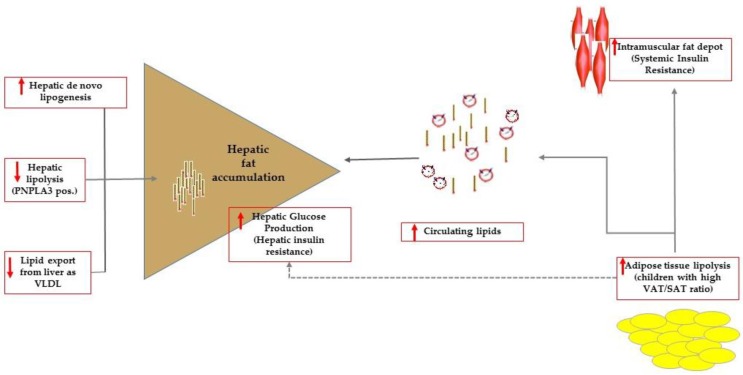
Over the last decade, the understanding of the association between insulin resistance (IR) and non-alcoholic fatty liver disease (NAFLD) has dramatically evolved. There is clear understanding that carriers of some common genetic variants, i.e., the patatin-like phospholipase domain-containing 3 (PNPLA3) or the transmembrane 6 superfamily member 2 (TM6SF2) are at risk of developing severe forms of NAFLD even in the presence of reduced or absent IR. In contrast, there are obese patients with “metabolic” (non-genetically driven) NAFLD who present severe IR. Owing to the epidemic obesity and the high prevalence of these genetic variants in the general population, the number of pediatric cases with combination of genetic and metabolic NAFLD is expected to be very high. Gut dysbiosis, excessive dietary intake of saturated fats/fructose-enriched foods and exposure to some chemicals contribute all to both IR and NAFLD, adding further complexity to the understanding of their relationship. Once NAFLD is established, IR can accelerate the progression to the more severe form of liver derangement that is the non-alcoholic steatohepatitis.
Overview
The claims and statistics of this paper haven’t been checked yet.
Run the check — free, no account needed. It reads the open-access text and checks the sources it cites.
Integrity signals
Registry
Cites
Statistics
Figures
Verification
Claims the paper makes
The claims and statistics of this paper haven’t been checked yet.
Run the check — free, no account needed. It reads the open-access text and checks the sources it cites.
Claims other papers make about this one
Each is checked against this paper’s own text: does it say what the citing paper says it does?
The check wasn’t confident either way, so it gives no verdict — never disputed.
In the citing paper
“Elevated circulating levels of bile acids have been associated with major risk factors for non-alcoholic fatty liver disease (NAFLD), including insulin resistance and type 2 diabetes mellitus [43,44]. In addition, metabolomic studies conducted in the adult population have revealed global alterations in bile acid composition in individuals with simple steatosis compared with healthy controls [45,46”
From Metabolomic Analysis of Pediatric Patients with Idiosyncratic Drug-Induced Liver Injury According to the Updated RUCAM (2023) · cites this paper as [44]
Experimental — accuracy not yet measured
Self-check
Percentages, sums and reported differences re-computed from the paper’s own numbers.
The self-check needs the paper’s full text.
Citations
Cites
Matthews, D. R., Hosker, J. P., Rudenski, A. S., Naylor, B. A., Treacher, D. F., & Turner, R. C. (1985) · Diabetologia · doi:10.1007/bf00280883 · Cited by 31,502
Katz, A., Nambi, S. S., Mather, K., Baron, A. D., Follmann, D. A., Sullivan, G., & Quon, M. J. (2000) · The Journal of Clinical Endocrinology & Metabolism · doi:10.1210/jcem.85.7.6661 · Cited by 3,931 · cited 2×
“The HOMA-IR [9] is the most frequently used index of IR among those based on fasting value of glucose and insulin, while the QUICKI [10] corresponds to 1/HOMA-IR and such as is an index of insulin sensitivity.”
MethodMolecular mediators of hepatic steatosis and liver injury
Browning, J. D., & Horton, J. D. (2004) · Journal of Clinical Investigation · doi:10.1172/jci200422422 · Cited by 1,772
Kozlitina, J., Smagris, E., Stender, S., Nordestgaard, B. G., Zhou, H. H., Tybjærg-Hansen, A., Vogt, T. F., Hobbs, H. H., & Cohen, J. C. (2014) · Nature Genetics · doi:10.1038/ng.2901 · Cited by 1,234
Ectopic Fat in Insulin Resistance, Dyslipidemia, and Cardiometabolic Disease
Shulman, G. I. (2014) · New England Journal of Medicine · doi:10.1056/nejmra1011035 · Cited by 1,126
Adipose tissue expandability, lipotoxicity and the Metabolic Syndrome — An allostatic perspective
Virtue, S., & Vidal-Puig, A. (2010) · Biochimica et Biophysica Acta (BBA) - Molecular and Cell Biology of Lipids · doi:10.1016/j.bbalip.2009.12.006 · Cited by 1,013
A possible role for malonyl-CoA in the regulation of hepatic fatty acid oxidation and ketogenesis.
McGarry, J. D., Mannaerts, G. P., & Foster, D. W. (1977) · Journal of Clinical Investigation · doi:10.1172/jci108764 · Cited by 736
Del Chierico, F., Nobili, V., Vernocchi, P., Russo, A., De Stefanis, C., Gnani, D., Furlanello, C., Zandonà, A., Paci, P., Capuani, G., et al. (2017) · Hepatology · doi:10.1002/hep.28572 · Cited by 696
Failure of adipocyte differentiation causes type II diabetes mellitus?
Danforth, E. (2000) · Nature Genetics · doi:10.1038/79111 · Cited by 487
Roles of diacylglycerols and ceramides in hepatic insulin resistance
Petersen, M. C., & Shulman, G. I. (2017) · Trends in Pharmacological Sciences · doi:10.1016/j.tips.2017.04.004 · Cited by 373
Research works printed but not linked: 42
- Manco, 2011, Metabolic syndrome in childhood from impaired carbohydrate metabolism to nonalcoholic fatty liver disease, J. Am. Coll. Nutr., 30, 295, 10.1080/07315724.2011.10719972 · DOI
- Buzzetti, 2016, The multiple-hit pathogenesis of non-alcoholic fatty liver disease (NAFLD), Metabolism, 65, 1038, 10.1016/j.metabol.2015.12.012 · DOI · Paper page
- Marchesini, 1999, Association of non-alcoholic fatty liver disease to insulin resistance, Am. J. Med., 107, 450, 10.1016/S0002-9343(99)00271-5 · DOI
- Marchesini, 2001, Nonalcoholic fatty liver disease: A feature of the metabolic syndrome, Diabetes, 50, 1844, 10.2337/diabetes.50.8.1844 · DOI · Paper page
- Schwimmer, 2003, Obesity, insulin resistance, and other clinicopathological correlates of pediatric nonalcoholic fattyliver disease, J. Pediatr., 143, 500, 10.1067/S0022-3476(03)00325-1 · DOI
- Shashaj, 2016, Reference ranges of HOMA-IR in normal-weight and obese young Caucasians, Acta Diabetol., 53, 251, 10.1007/s00592-015-0782-4 · DOI
- DeFronzo, 1979, Glucose clamp technique: A method for quantifying insulin secretion and resistance, Am. J. Physiol., 237, G214
- Matsuda, 1999, Insulin sensitivity indices obtained from oral glucose tolerance testing: Comparison with the euglycemic insulin clamp, Diabetes Care, 22, 1462, 10.2337/diacare.22.9.1462 · DOI · Paper page
- Mari, 2001, A model-based method for assessing insulin sensitivity from the oral glucose tolerance test, Diabetes Care, 24, 539, 10.2337/diacare.24.3.539 · DOI
- Tripathy, 2004, Contribution of insulin-stimulated glucose uptake and basal hepatic insulin sensitivity to surrogate measures of insulin sensitivity, Diabetes Care, 27, 2204, 10.2337/diacare.27.9.2204 · DOI
- Petta, S., Gastaldelli, A., Rebelos, E., Bugianesi, E., Messa, P., Miele, L., Svegliati-Baroni, G., Valenti, L., and Bonino, F. (2016). Pathophysiology of non alcoholic fatty liver disease. Int. J. Mol. Sci., 17. · DOI
- Manco, 2008, Metabolic syndrome and liver histology in paediatric non-alcoholic steatohepatitis, Int. J. Obes. (Lond.), 32, 381, 10.1038/sj.ijo.0803711 · DOI
- Shashaj, 2014, Origin of cardiovascular risk in overweight preschool children: A cohort study of cardiometabolic risk factors at the onset of obesity, JAMA Pediatr., 168, 917, 10.1001/jamapediatrics.2014.900 · DOI
- Hooper, 2011, Genetic determinants of hepatic steatosis in man, J. Lipid Res., 52, 593, 10.1194/jlr.R008896 · DOI
- Caprio, 2017, Adolescent obesity and insulin resistance: Roles of ectopic fat accumulation and adipose inflammation, Gastroenterology, 152, 1638, 10.1053/j.gastro.2016.12.051 · DOI
- Cali, 2010, Central role of fatty liver in the pathogenesis of insulin resistance in obese adolescents, Diabetes Care, 33, 1817, 10.2337/dc10-0284 · DOI
- Kursawe, 2010, Cellularity and adipogenic profile of the abdominal subcutaneous adipose tissue from obese adolescents: Association with insulin resistance and hepatic steatosis, Diabetes, 59, 2288, 10.2337/db10-0113 · DOI
- Rebrin, 1996, Causal linkage between insulin suppression of lipolysis and suppression of liver glucose output in dogs, J. Clin. Investig., 98, 741, 10.1172/JCI118846 · DOI
- Umano, G.R., Martino, M., and Santoro, N. (2017). The association between pediatric NAFLD and common genetic variants. Children, 4. · DOI
- Petäjä, E.M., and Yki-Järvinen, H. (2016). Definitions of normal liver fat and the association of insulin sensitivity with acquired and genetic NAFLD—A systematic review. Int. J. Mol. Sci., 17. · DOI
- Goffredo, 2016, Role of TM6SF2 rs58542926 in the pathogenesis of nonalcoholic pediatric fatty liver disease: A multiethnic study, Hepatology, 63, 117, 10.1002/hep.28283 · DOI
- Grandone, 2016, TM6SF2 Glu167Lys polymorphism is associated with low levels of LDL-cholesterol and increased liver injury in obese children, Pediatr. Obes., 11, 115, 10.1111/ijpo.12032 · DOI
- Sookoian, 2011, Meta-analysis of the influence of I148M variant of patatin-like phospholipase domain containing 3 gene (PNPLA3) on the susceptibility and histological severity of nonalcoholic fatty liver disease, Hepatology, 53, 1883, 10.1002/hep.24283 · DOI
- He, 2010, A sequence variation (I148M) in PNPLA3 associated with nonalcoholic fatty liver disease disrupts triglyceride hydrolysis, J. Biol. Chem., 285, 6706, 10.1074/jbc.M109.064501 · DOI
- Huang, 2011, Expression and characterization of a PNPLA3 protein isoform (I148M) associated with nonalcoholic fatty liver disease, J. Biol. Chem., 286, 37085, 10.1074/jbc.M111.290114 · DOI
- Kumari, 2012, Adiponutrin functions as a nutritionally regulated lysophosphatidic acid acyltransferase, Cell Metab., 15, 691, 10.1016/j.cmet.2012.04.008 · DOI
- Luukkonen, 2016, Hepatic ceramides dissociate steatosis and insulin resistance in patients with non-alcoholic fatty liver disease, J. Hepatol., 64, 1167, 10.1016/j.jhep.2016.01.002 · DOI · Paper page
- Pirola, 2015, The dual and opposite role of the TM6SF2-rs58542926 variant in protecting against cardiovascular disease and conferring risk for nonalcoholic fatty liver: A meta-analysis, Hepatology, 62, 1742, 10.1002/hep.28142 · DOI
- Marzuillo, 2014, Pediatric fatty liver disease: Role of ethnicity and genetics, World J. Gastroenterol., 20, 7347, 10.3748/wjg.v20.i23.7347 · DOI
- Becard, 2000, Insulin effects on sterol regulatory-element-binding protein-1c (SREBP-1c) transcriptional activity in rat hepatocytes, Biochem. J., 350, 389, 10.1042/bj3500389 · DOI
- Akkaoui, 2009, Modulation of the hepatic malonyl-CoA-carnitine palmitoyltransferase 1A partnership creates a metabolic switch allowing oxidation of de novo fatty acids, Biochem. J., 420, 429, 10.1042/BJ20081932 · DOI
- Neel, 1962, Diabetes mellitus: A “thrifty” genotype rendered detrimental by “progress”?, Am. J. Hum. Genet., 14, 353
- Romeo, 2008, Genetic variation in PNPLA3 confers susceptibility to nonalcoholic fatty liver disease, Nat. Genet., 40, 1461, 10.1038/ng.257 · DOI · Paper page
- 2016, Diagnosis of non-alcoholic fatty liver disease (NAFLD), Diabetologia, 59, 1104, 10.1007/s00125-016-3944-1 · DOI
- Manco, 2010, Gut microbiota, lipopolysaccharides, and innate immunity in the pathogenesis of obesity and cardiovascular risk, Endocr. Rev., 31, 817, 10.1210/er.2009-0030 · DOI
- Stanhope, 2016, Sugar consumption, metabolic disease and obesity: The state of the controversy, Crit. Rev. Clin. Lab. Sci., 53, 52, 10.3109/10408363.2015.1084990 · DOI · Paper page
- Macdonald, 2016, A review of recent evidence relating to sugars, insulin resistance and diabetes, Eur. J. Nutr., 55, 17, 10.1007/s00394-016-1340-8 · DOI
- 2015, Nutritional modulation of non-alcoholic fatty liver disease and insulin resistance, Nutrients, 7, 9127, 10.3390/nu7115454 · DOI
- Mosca, 2017, Serum uric acid concentrations and fructose consumption are independently associated with NASH in children and adolescents, J. Hepatol., 66, 1031, 10.1016/j.jhep.2016.12.025 · DOI · Paper page
- Polyzos, 2012, The emerging role of endocrine disruptors in pathogenesis of insulin resistance: A concept implicating nonalcoholic fatty liver disease, Curr. Mol. Med., 12, 68, 10.2174/156652412798376161 · DOI
- Sampey, 2011, Cafeteria diet is a robust model of human metabolic syndrome with liver and adipose inflammation: Comparison to high-fat diet, Obesity, 19, 1109, 10.1038/oby.2011.18 · DOI
- Petta, 2016, A “systems medicine” approach to the study of non-alcoholic fatty liver disease, Dig. Liver Dis., 48, 333, 10.1016/j.dld.2015.10.027 · DOI
Cited by
Sorted by citations
Lipotoxicity and Diabetic Nephropathy: Novel Mechanistic Insights and Therapeutic Opportunities
Opazo-Ríos, L., Mas, S., Marín-Royo, G., Mezzano, S., Gómez-Guerrero, C., Moreno, J. A., & Egido, J. (2020) · International Journal of Molecular Sciences · doi:10.3390/ijms21072632 · Cited by 363
Errafii, K., Khalifa, O., Al-Akl, N. S., & Arredouani, A. (2022) · Biomedicines · doi:10.3390/biomedicines10051020 · Cited by 17
Andújar-Vera, F., Alés-Palmer, M. L., Muñoz-de-Rueda, P., Iglesias-Baena, I., & Ocete-Hita, E. (2023) · International Journal of Molecular Sciences · doi:10.3390/ijms241713562 · Cited by 10
Metadata
- Authors
- Manco, M.
- Venue
- Children
- Publisher
- MDPI AG
- Published
- 2017-08-14
- Volume
- 4
- Issue
- 8
- Pages
- 74
- ISSN
- 2227-9067
- PMC
- PMC5575596
- Cited by
- 45
- References
- 11
- Language
- en
About these checks
Registry, retraction, Cites and statistics results are computed, not judged, with one exception: a printed reference that no index lists is read once by a model before it counts as a citation error. Claims are extracted by a model and kept only when their quote appears verbatim in the text; each cited source is then checked, with a model’s help, for whether it says what the claim relies on. Those verdicts can be wrong — read the claim’s quote and the cited source before relying on one.
Statistics and arithmetic are recomputed, not judged.
Confidence bands are shown only for fields calibrated on our annotated test set. None is calibrated yet, so no band is shown.
What counts as a claim ›How we measure confidence ›How we check this ›
Are you an author, or do you see a problem with this page? Request a review
