

Social Engineering Attacks: A Survey
Open accessThe DOI matches its Crossref record; 65 of the 71 references it cites were found in a registry or an index; 16 of the 79 sources its claims cite were checked for support.
Abstract
The advancements in digital communication technology have made communication between humans more accessible and instant. However, personal and sensitive information may be available online through social networks and online services that lack the security measures to protect this information. Communication systems are vulnerable and can easily be penetrated by malicious users through social engineering attacks. These attacks aim at tricking individuals or enterprises into accomplishing actions that benefit attackers or providing them with sensitive data such as social security number, health records, and passwords. Social engineering is one of the biggest challenges facing network security because it exploits the natural human tendency to trust. This paper provides an in-depth survey about the social engineering attacks, their classifications, detection strategies, and prevention procedures.
Overview
CoChat Summary
TL;DR
This survey reviews social engineering attacks, their classifications, detection, prevention, and mitigation techniques, arguing they exploit human trust and cannot be stopped by technology alone. It concludes that AI-based defenses and combined countermeasures are most effective, while training and cybersecurity education are needed.
Key findings
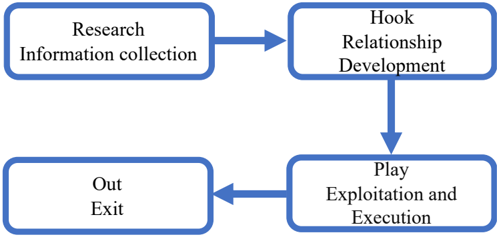
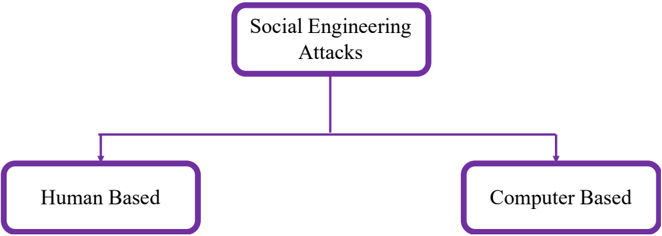
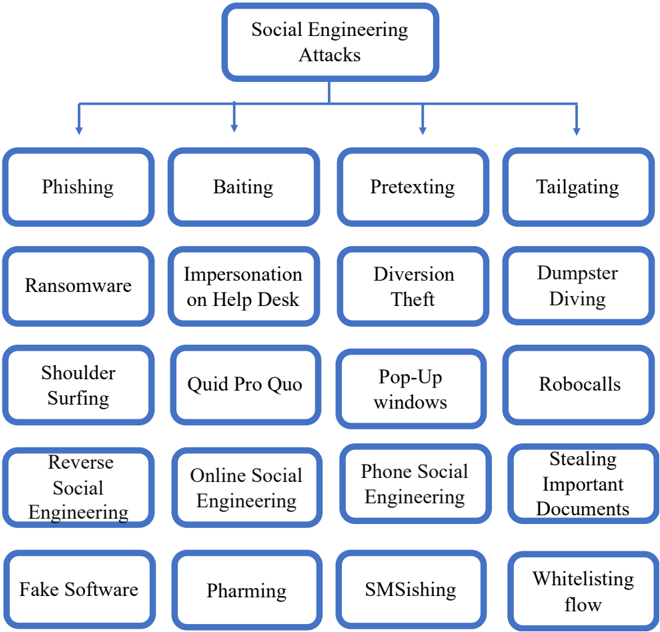
- Social engineering attacks share a common four-phase pattern: collect information about the target, develop a relationship, exploit the information and execute the attack, and exit without traces. They are classified as human-based or computer-based, and as social, technical, or physical-based; the paper also proposes direct and indirect categories.
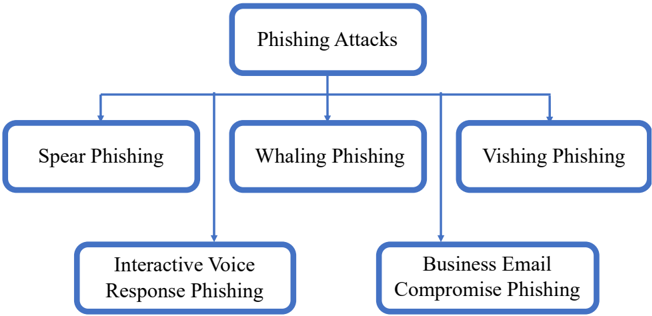
- Phishing is described as the most common social engineering attack and is divided into five categories: spear phishing, whaling phishing, vishing phishing, interactive voice response phishing, and business email compromise phishing. Ransomware is described as involving six stages: malware creation, deployment, installation, command and control, destruction, and extortion.
- Reported impacts include an estimated US social engineering attack cost of $121.22 billion; the Equifax breach exposing personal information of 145.5 million American consumers; over $80 million stolen from Central Bank using a remote access trojan; more than $2.3 billion lost by companies to FBI-reported CEO fraud and email scams; 84% of cyber-attacks conducted by social engineers; and about $1 billion in ransomware losses in 2016.
- In comparing countermeasures, the paper concludes that artificial intelligence-based defense mechanisms are the most effective techniques to reduce social engineering risk, and that combining two or more defense techniques can ensure better protection.
Methods
- The paper is an in-depth survey/overview of social engineering attacks, existing detection methods, prevention procedures, and mitigation techniques; it does not collect primary data or conduct an empirical experiment.
- It synthesizes prior literature and classifications, describes attack types, and compares human-based versus computer-based countermeasures and computer-based mitigation techniques in Tables 1 and 2.
- It discusses challenges and future directions, including training employees and K-12 students and investing in cybersecurity education.
Limitations
- Stated in the paper: existing detection methods have fundamental limitations, countermeasures are inefficient against the ever-growing number of social engineering attacks, human-based techniques are limited by subjective human decisions, and technology-based techniques can be limited because technological vulnerabilities may be exploited.
- Stated in the paper: human-based mitigation depends on relative and subjective human judgment, while technology-based mitigation can be mimicked, complex, expensive, or limited by human unawareness and ignored alerts.
- Evident from the text: as a survey, it does not report a systematic review protocol, primary data, or empirical validation; its comparative conclusions about effectiveness rely on qualitative synthesis of cited works rather than original testing.
Model-written summary. Check it against the paper before relying on it.
Integrity signals
Registry
Cites
Statistics
Figures

Verification
Claims the paper makes
11 Valid · 10 Not valid · 61 Not checked · 35 Own results and interpretations
The cited sources support only part of this claim — read each source’s verdict below.
In the paper
“The common pattern involves four phases: (1) collect information about the target; (2) develop relationship with the target; (3) exploit the available information and execute the attack; and (4) exit with no traces [12].”
§ Social Engineering Attacks: A Survey > 2. Social Engineering Attacks
What the sources say
- Partly supportedcites [12] 12. Mouton, F.; Leenen, L.; Venter, H. Social engineering attack examples, templates and scenarios. Comput. Secur. 2016, 59, 186-209. [CrossRef] sourceExperimental — accuracy not yet measured
Section 2, “Defining Social Engineering Attacks” (page unavailable), describes a commonly known four-phase model involving research, rapport, exploitation of trust, and use of information. But it does not give “exit with no traces” as the fourth phase; the paper’s own six-phase framework ends with debriefing, in which the attacker reassures the target and checks whether the goal was met. (LLM, conf=0.88)
plain- Asserted: passes — The authors put it forward as true.
- Checkable: passes — It can be checked against evidence.
- Load-bearing: unclear — It is unclear whether the paper’s conclusions depend on it.
- Based: passes — The paper gives a reason why it holds.
- Partly supported
The cited sources that could be checked couldn’t confirm or dispute this claim.
In the paper
“Currently, social engineering attacks are the biggest threats facing cybersecurity [4][5][6][7][8][9].”
§ Social Engineering Attacks: A Survey > 2. Social Engineering Attacks
What the sources say
- Not matchedcites [4] 4. Arana, M. How much does a cyberattack cost companies? Open Data Security 2017, 1-4.
We searched by its title and found no matching paper.
- Could not verifycites [5] 5. Chargo, M. You've been hacked: How to better incentivize corporations to protect consumers' data. Trans. Tenn. J. Bus. Law 2018, 20, 115-143. doi:10.70658/4486-1457.1452Experimental — accuracy not yet measured
The Introduction discusses breaches involving weak or stolen passwords, and the Target section describes access through a third-party vendor. Neither passage identifies social engineering attacks as the biggest cybersecurity threat. Searches for social engineering, phishing, and related threats found no passage in our copy making that comparison. (LLM, conf=0.72)
- Not checked — no full text of the sourcecites [6] 6. Libicki, M. Could the issue of DPRK hacking benefit from benign neglect? Georg. J. Int. Aff. 2018, 19, 83-89. [CrossRef] source
plain- Asserted: passes — The authors put it forward as true.
- Checkable: passes — It can be checked against evidence.
- Load-bearing: unclear — It is unclear whether the paper’s conclusions depend on it.
- Based: passes — The paper gives a reason why it holds.
- Not matched
The cited sources support only part of this claim — read each source’s verdict below.
In the paper
“They can also be fake alerts stating that the computer storage is full and that it needs to be scanned and cleaned to save more space [35].”
§ Social Engineering Attacks: A Survey > 2.2.8. Pop-Up Windows
What the sources say
- Partly supportedcites [35] 35. Ivaturi, K.; Janczewski, L. A taxonomy for social engineering attacks. In Proceedings of the International Conference on Information Resources Management, Centre for Information Technology, Organizations, and People, Ontario, Canada, 18-20 June 2011; pp. 1-12.Experimental — accuracy not yet measured
The “Popups” section describes fake alerts that prompt users to take action, supporting the general point. Its example warns of a virus and urges an antivirus download; it does not describe a full-storage alert or scanning and cleaning to free space. No page number is available in our copy. (LLM, conf=0.87)
plain- Asserted: passes — The authors put it forward as true.
- Checkable: passes — It can be checked against evidence.
- Load-bearing: unclear — It is unclear whether the paper’s conclusions depend on it.
- Based: passes — The paper gives a reason why it holds.
- Partly supported
The cited sources support only part of this claim — read each source’s verdict below.
In the paper
“For attacks related to emails or link clicks, software vendors become more aware of the social engineering treats by building strong products with security measures [54].”
§ Social Engineering Attacks: A Survey > 4. Mitigation Techniques
What the sources say
- Partly supportedcites [54] 54. Ali, B.; Awad, A. Cyber and physical security vulnerability assessment for IoT-based smart homes. Sensors 2018, 18, 817. [CrossRef] sourceExperimental — accuracy not yet measured
The Discussion recommends that device manufacturers and application programmers provide devices with stronger security capabilities and applications with secure interfaces. The Results discuss social engineering, but our copy does not connect that recommendation to email or link-click attacks, or say that building secure products makes vendors more aware of social engineering threats. (LLM, conf=0.86)
plainstates a cause- Asserted: passes — The authors put it forward as true.
- Checkable: passes — It can be checked against evidence.
- Load-bearing: unclear — It is unclear whether the paper’s conclusions depend on it.
- Based: passes — The paper gives a reason why it holds.
- Partly supported
None of the sources cited for this claim have been checked yet.
In the paper
“Phishing attacks are the most common attacks conducted by social engineers [19,20].”
§ Social Engineering Attacks: A Survey > 2.2.1. Phishing Attacks
What the sources say
- Not checked — no full text of the sourcecites [19] 19. Gupta, S.; Singhal, A.; Kapoor, A. A literature survey on social engineering attacks: Phishing attack. In Proceedings of the International Conference on Computing, Communication, and Automation, Noida, India, 29-30 April 2016; pp. 537-540. [CrossRef] source
- Not matchedcites [20] 20. Yeboah-Boateng, E.O.; Amanor, P.M. Phishing, SMiShing & Vishing: An assessment of threats against mobile devices. J. Emerg. Trends Comput. Inf. Sci. 2014, 5, 297-307.
We searched by its title and found no matching paper.
- Asserted: passes — The authors put it forward as true.
- Checkable: passes — It can be checked against evidence.
- Load-bearing: unclear — It is unclear whether the paper’s conclusions depend on it.
- Based: passes — The paper gives a reason why it holds.
17 more claims
Create a free account to see all 117 claims and to verify the 2 references still open.
- Probably not a substantial claim. 89
- It may state two separate claims as one. 26
Claims other papers make about this one
Each is checked against this paper’s own text: does it say what the citing paper says it does?
The source backs part of the claim, not all of it — or backs it for a different population, condition or comparison.
In the citing paper
“With the Big Data advent, attackers use the vast amount of collected data for businesses purposes, selling it in bulk as goods within black markets (Salahdine and Kaabouch 2019).”
From Deepfakes: current and future trends (2024) · cites this paper as Salahdine and Kaabouch 2019
Experimental — accuracy not yet measuredThe cited source says what the claim attributes to it.
In the citing paper
“These attacks use psychological tricks and dishonest tactics with the goal of obtaining sensitive data, such as passwords, private information, incriminating evidence, and bank card numbers, among others, by deceiving people or businesses into taking actions that are advantageous to the attackers.”
From Deepfakes: current and future trends (2024) · cites this paper as Salahdine and Kaabouch 2019
The cited source says what the claim attributes to it.
In the citing paper
“Social engineering attacks can be used by hostile persons to access communication networks (Salahdine and Kaabouch 2019).”
From Deepfakes: current and future trends (2024) · cites this paper as Salahdine and Kaabouch 2019
Self-check
Percentages, sums and reported differences re-computed from the paper’s own numbers.
Each contradiction between two passages listed here was confirmed by an independent check.
Rated minor: it would not touch a result — a value no result rests on, a p-value that stays on the same side of the significance level, or a conflict that is clerical, resolved elsewhere in the paper, or outside its own findings.
In the paper
§ Social Engineering Attacks: A Survey > 4. Mitigation Techniques
“In [60], the authors focused on mobile ransomware by proposing a new detection technique called HelDroid.”
§ Social Engineering Attacks: A Survey > References
“62. Andronio, N.; Zanero, S.; Maggi, F. Heldroid: Dissecting and detecting mobile ransomware.”
Rated minor: it would not touch a result — a value no result rests on, a p-value that stays on the same side of the significance level, or a conflict that is clerical, resolved elsewhere in the paper, or outside its own findings.
In the paper
§ Social Engineering Attacks: A Survey > 3. Prevention Techniques
“The authors compared the performance of six machine learning algorithms for detecting phishing attacks in terms of speed, reliability, and accuracy: support vector machine, biased support vector machine, artificial neural networks, scaled conjugate gradient, and self-organizing map.”
§ Social Engineering Attacks: A Survey > 3. Prevention Techniques
“support vector machine, biased support vector machine, artificial neural networks, scaled conjugate gradient, and self-organizing map.”
Rated minor: it would not touch a result — a value no result rests on, a p-value that stays on the same side of the significance level, or a conflict that is clerical, resolved elsewhere in the paper, or outside its own findings.
In the paper
§ Social Engineering Attacks: A Survey > 3. Prevention Techniques
“In [51], a social engineering awareness program (SEAP) was developed for schools aiming at increasing students' awareness by providing significant education and training in early age.”
§ Social Engineering Attacks: A Survey > References
“51. Algarni, A.; Xu, Y.; Chan, T. Measuring source credibility of social engineering attackers on Facebook. In Proceedings of the IEEE Hawaii International Conference on System Sciences, Koloa, HI, USA, 5-8 January 2016; pp. 3686-3695. [CrossRef]”
Rated minor: it would not touch a result — a value no result rests on, a p-value that stays on the same side of the significance level, or a conflict that is clerical, resolved elsewhere in the paper, or outside its own findings.
In the paper
§ Social Engineering Attacks: A Survey > 3. Prevention Techniques
“In [34], the authors proposed a new approach called TabShots to distinguish between legitimate pages from malicious pages.”
§ Social Engineering Attacks: A Survey > References
“33. De Ryck, P.; Nikiforakis, N.; Desmet, L.; Joosen, W. Tabshots: Client-side detection of tabnabbing attacks.”
Rated minor: it would not touch a result — a value no result rests on, a p-value that stays on the same side of the significance level, or a conflict that is clerical, resolved elsewhere in the paper, or outside its own findings.
In the paper
§ Social Engineering Attacks: A Survey > 3. Prevention Techniques
“The authors compared the performance of six machine learning algorithms for detecting phishing attacks in terms of speed, reliability, and accuracy:”
§ Social Engineering Attacks: A Survey > 3. Prevention Techniques
“support vector machine, biased support vector machine, artificial neural networks, scaled conjugate gradient, and self-organizing map.”
1 more finding
Create a free account to see every finding of this check.
Citations
Cites
Advanced social engineering attacks
Krombholz, K., Hobel, H., Huber, M., & Weippl, E. (2015) · Journal of Information Security and Applications · doi:10.1016/j.jisa.2014.09.005 · Cited by 575 · cited 2×
“Diversion Theft attacks: consist of misdirecting a transport company to deliver a courier or package to the desired location.”
BackgroundCutting the Gordian Knot: A Look Under the Hood of Ransomware Attacks
Kharraz, A., Robertson, W., Balzarotti, D., Bilge, L., & Kirda, E. (2015) · Lecture Notes in Computer Science · doi:10.1007/978-3-319-20550-2_1 · Cited by 458 · cited 2×
“Getting back the files after the victim’s payment is not guaranteed [30,31].”
BackgroundCryptoLock (and Drop It): Stopping Ransomware Attacks on User Data
Scaife, N., Carter, H., Traynor, P., & Butler, K. R. B. (2016) · 2016 IEEE 36th International Conference on Distributed Computing Systems (ICDCS) · doi:10.1109/icdcs.2016.46 · Cited by 437 · cited 1×
“In [64], the authors proposed an early warning detection system called CryptoDrop that is able to alert the employee in case of suspicious activity on the user data.”
BackgroundSecurity and privacy challenges in smart cities
Braun, T., Fung, B. C. M., Iqbal, F., & Shah, B. (2018) · Sustainable Cities and Society · doi:10.1016/j.scs.2018.02.039 · Cited by 352 · cited 1×
“26”
Cyber and Physical Security Vulnerability Assessment for IoT-Based Smart Homes
Ali, B., & Awad, A. (2018) · Sensors · doi:10.3390/s18030817 · Cited by 344 · cited 1×
“Thus, there are numerous jobs in this cyber-security field that are not filled because of the lack of graduates.”
BackgroundMalicious PDF detection using metadata and structural features
Smutz, C., & Stavrou, A. (2012) · Proceedings of the 28th Annual Computer Security Applications Conference · doi:10.1145/2420950.2420987 · Cited by 271 · cited 1×
“In [45], the authors proposed a detection technique based on machine learning algorithms.”
MethodHelDroid: Dissecting and Detecting Mobile Ransomware
Andronio, N., Zanero, S., & Maggi, F. (2015) · Lecture Notes in Computer Science · doi:10.1007/978-3-319-26362-5_18 · Cited by 246 · cited 1×
“In [62], the authors proposed a neuro-fuzzy-based technique to mitigate phishing attacks in real time and protect online transactions.”
BackgroundRansomware attacks: detection, prevention and cure
Brewer, R. (2016) · Network Security · doi:10.1016/s1353-4858(16)30086-1 · Cited by 214 · cited 1×
“In [65], the authors proposed several steps to follow to mitigate and handle ransomware attacks.”
BackgroundA literature survey on social engineering attacks: Phishing attack
Gupta, S., Singhal, A., & Kapoor, A. (2016) · 2016 International Conference on Computing, Communication and Automation (ICCCA) · doi:10.1109/ccaa.2016.7813778 · Cited by 208 · cited 2×
“Phishing attacks are the most common attacks conducted by social engineers [19,20].”
BackgroundA Taxonomy of Attacks and a Survey of Defence Mechanisms for Semantic Social Engineering Attacks
Heartfield, R., & Loukas, G. (2016) · ACM Computing Surveys · doi:10.1145/2835375 · Cited by 202
Research works printed but not linked: 5
- 16. Patil, P.; Devale, P. A literature survey of phishing attack technique. Int. J. Adv. Res. Comput. Commun. Eng. 2016, 5, 198-200.
- 23. Hofbauer, S.; Beckers, K.; Quirchmayr, G. Defense Methods against VoIP and Video Hacking Attacks in Enterprise Networks. In Proceedings of the 10th International Conference on e-Business, Bangkok, Thailand, 23-24 November 2015; pp. 1-10.
- 40. Foozy, C.F.M.; Ahmad, R.; Abdollah, M.F.; Yusof, R.; Mas'ud, M.Z. Generic taxonomy of social engineering attack and defence mechanism for handheld computer study. In Proceedings of the Malaysian Technical Universities International Conference on Engineering and Technology, Batu Pahat, Malaysia, 13-15 November 2011; pp. 1-6.
- 59. Zulkurnain, A.U.; Hamidy, A.K.B.; Husain, A.B.; Chizari, H. Social engineering attack mitigation. Int. J. Math. Comput. Sci. 2015, 1, 188-198.
- 66. Kharaz, A.; Arshad, S.; Mulliner, C.; Robertson, W.; Kirda, E. A large-scale, automated approach to detecting ransomware. In Proceedings of the 25th USENIX Security Symposium, Austin, TX, USA, 10-12 August 2016; pp. 757-772.
Cited by
Items 301–400 of 506
Kim, J. (2024) · Electronics · doi:10.3390/electronics13193954 · Cited by 2
Case Studies on disproportionate Impact of Cyberattacks in the Healthcare Sector
Rai, A. (2024) · Journal of High School Research · doi:10.70671/gad6q058 · Cited by 2
Social Engineering Threats in Cybersecurity: Risk Mitigation through Behavioral Insights
Tsanov, I. (2024) · International Conference Automatics and Informatics (ICAI) · doi:10.1109/icai63388.2024.10851536 · Cited by 5
“Salahdine and Kaabouch [11] underline that vishing attacks, when fraudsters pose as official institutions over the phone, play on the natural confidence people have in authoritative figures, sometimes resulting in compromised personal or financial information.”
URL-Based Phishing Attacks Detection Using Machine Learning
Kalikiri, J., Policepatel, P. R., Kancharla, S., et al. (2025) · doi:10.1109/netcrypt65877.2025.11102732 · Cited by 2
Hybrid Evolutionary Approach in Feature Vector for Ransomware Detection
Aljubory, N., & Khammas, B. M. (2021) · International Conference on Intelligent Technology, System and Service for Internet of Everything (ITSS-IoE) · doi:10.1109/itss-ioe53029.2021.9615344 · Cited by 6
Cyber Security Threat, it’s Risks and Susceptibilities, in the Global Perspective
Gupta, R. M., Mathur, P., & Nanda, R. (2022) · Lecture notes in networks and systems · doi:10.1007/978-981-19-1122-4_63 · Cited by 2
Analysis of Social Engineering Attacks Using Exploit Kits
Mokoena, T., Zuva, T., & Appiah, M. (2020) · Advances in intelligent systems and computing · doi:10.1007/978-3-030-51965-0_16 · Cited by 2
Design of Face Recognition Security System on Public Spaces
Dirgantara, F. M., & Wicaksa, D. P. (2022) · Journal of Electrical Electronic Information and Communication Technology · doi:10.20961/jeeict.4.1.60409 · Cited by 2
“Threats to data centers, data processing facilities, and staff will be prevented by combining physical security with specified functionality [10] [11].”
BackgroundAtaques Automatizados de Engenharia Social com o uso de Bots em Redes Sociais Profissionais
Ariza, M., de Azambuja, A. J. G., Nobre, J. C., & Granville, L. Z. (2022) · Simpósio Brasileiro de Cibersegurança (SBSeg) · doi:10.5753/sbseg.2022.225334 · Cited by 3
“Os ataques têm explorado a interação humana em conjunto com as brechas tecnológicas, enfraquecendo a cadeia de segurança [Salahdine and Kaabouch 2019] [Klimburg-Witjes and Wentland 2021].”
BackgroundAwareness of Mobile Operating System Privacy Among Computer Science Students
Alghamdi, F., AlAnazi, W. S., & Snoussi, S. (2023) · International Conference on Advanced Innovations in Smart Cities (ICAISC) · doi:10.1109/icaisc56366.2023.10085581 · Cited by 2
Slamet, S. (2023) · SPIRIT · doi:10.53567/spirit.v14i2.260 · Cited by 2
“HarperCollins ebooks [15] Salahdine, F.”
BackgroundExploring Social Engineering Attacks Using Spear Phishing in a Universtiy
Trust Tshepo Mapoka, Zuva, K., KUKUMARA, G., Seipone, T., & Zuva, T. (2023) · The Eurasia Proceedings of Science Technology Engineering and Mathematics · doi:10.55549/epstem.1406262 · Cited by 2
FreeEM: Uncovering Parallel Memory EMR Covert Communication in Volatile Environments
Yu, S., Fu, J., Jiang, C., et al. (2024) · International Conference on Mobile Systems, Applications, and Services · doi:10.1145/3643832.3661870 · Cited by 2
“This is a common assumption in conventional EMR covert channels [19, 25, 28], which can be done by various methods as introduced in [22].”
MethodOlla, R., Houmanfar, R. A., Sengupta, S., Hand, E., & Louis, S. J. (2024) · Behavior and Social Issues · doi:10.1007/s42822-024-00174-5 · Cited by 2
Tulupieva, T. V. (2022) · Administrative Consulting · doi:10.22394/1726-1139-2022-2-123-138 · Cited by 3
Development of a secure multi-factor authentication algorithm for mobile money applications
Guma, A. (2022) · doi:10.58694/1782 · Cited by 3
STClass: A Method for Determining the Sensitivity of Documents
Escobar, S. J. M., Shulcloper, J. R., Landín, C. J., et al. (2021) · Lecture notes in computer science · doi:10.1007/978-3-030-89820-5_11 · Cited by 1
Escobar, S. J. M., Shulcloper, J. R., Landín, C. J., Pérez-García, O. A., & Castilla, J. S. R. (2021) · Lecture notes in computer science · doi:10.1007/978-3-030-89691-1_28 · Cited by 1
Evaluation of the security level of Aruba wireless networks in an educational center
Paola, D. L. C. D. L. C., & Domínguez-Domínguez, R. (2021) · International Conference on Computational Science and Computational Intelligence (CSCI) · doi:10.1109/csci54926.2021.00275 · Cited by 3
Multilayers Physical Authentication and NoSQL PRESENT algorithm for Data Center
Chuldun, Z. N., Marlena, D., Priambodo, D. F., & Arizal, A. (2022) · FORTEI-International Conference on Electrical Engineering (FORTEI-ICEE) · doi:10.1109/fortei-icee57243.2022.9972986 · Cited by 1
“These weaknesses can be in the form of sharing passwords or dictionary attacks [8], rainbow table [9], or social engineering [10].”
BackgroundMuzigura, G., & Casmir, R. O. (2023) · European Journal of Theoretical and Applied Sciences · doi:10.59324/ejtas.2023.1(4).114 · Cited by 1
Ransomware-as-a-Weapon (RaaW): A Futuristic Approach for Understanding Malware as a Social Weapon
Mohanty, K., Bopche, G. S., Brahnam, S., & Dash, S. R. (2023) · Advances in information security, privacy, and ethics book series · doi:10.4018/979-8-3693-1528-6.ch013 · Cited by 8
Student's Cybersecurity Awareness in Post Covid-19 Pandemic
Setiawan, A., Wirawan, S., Djajakerta, H., & Haryanto, H. (2023) · Journal of Economics Finance and Management Studies · doi:10.47191/jefms/v6-i10-38 · Cited by 7
Representasi Rekayasa Sosial dalam Film Unlocked (Analisis Semiotika Roland Barthes)
Azwar, A., & Auliana, I. (2024) · Ekspresi dan Persepsi Jurnal Ilmu Komunikasi · doi:10.33822/jep.v7i1.7186 · Cited by 1
Social engineering awareness and resilience in Egypt: a quantitative exploration
Shehata, A. M. K., & Eldakar, M. A. M. (2024) · Library Hi Tech · doi:10.1108/lht-10-2023-0480 · Cited by 3
Emoti-Shing: Detecting Vishing Attacks by Learning Emotion Dynamics through Hidden Markov Models
Nyassi, V. S., Tchakounté, F., Yenké, B. O., Danga, D. E. H., Ngoran, M. D., & Fendji, J. L. E. K. (2024) · Journal of Intelligent Learning Systems and Applications · doi:10.4236/jilsa.2024.163015 · Cited by 4
Social Engineering Attacks Detection and Mitigation by Analyzing Human Interaction Patterns
Siddiqua, A., Ramesh, B., Chandrika, J., & Khan, A. (2024) · Lecture notes in networks and systems · doi:10.1007/978-981-97-4228-8_40 · Cited by 1
Zimba, A., Mukupa, G. M., & Chama, V. (2024) · African Journal of Science Technology Innovation and Development · doi:10.1080/20421338.2024.2387886 · Cited by 3
Al-Hamad, E. A., Alshakhsi, S. A. A., Babiker, A., Erbad, A., & Ali, R. (2024) · Lecture notes in computer science · doi:10.1007/978-981-96-0570-5_28 · Cited by 1
Risk Modelling of Cyber Threats Against MIS and ERP Applications
Efe, A. (2024) · Pamukkale Üniversitesi İşletme Araştırmaları Dergisi · doi:10.47097/piar.1550812 · Cited by 1
Research on the Credulity of Spear-Phishing Attacks for Lithuanian Education Institutions’ Employees
Rastenis, J., Ramanauskaitė, S., Čenys, A., et al. (2025) · Applied Sciences · doi:10.3390/app15073431 · Cited by 1
AI-Powered Social Engineering and Impersonation Attacks
Arafah, M. E., Karadsheh, L., Aburub, F. A. F., & Alhariri, S. (2025) · Advances in computational intelligence and robotics book series · doi:10.4018/979-8-3373-0832-6.ch006 · Cited by 3
Paswan, R., & Dusi, P. (2025) · International Journal for Research in Applied Science and Engineering Technology · doi:10.22214/ijraset.2025.70136 · Cited by 1
AI-Driven Phishing: Techniques, Threats, and Defence Strategies
Shrestha, L., Balogun, H., & Khan, S. (2025) · Advanced sciences and technologies for security applications · doi:10.1007/978-3-031-82031-1_7 · Cited by 1
Vulnerability to Social Engineering Across Digital User Generations: A Dual-Theory Approach
Viana, J. A. L., Bellini, C. G. P., Oguz, A., & Pereira, R. D. C. D. F. (2025) · Security Journal · doi:10.1057/s41284-025-00498-w · Cited by 4
“Since software-based attacks allow social engineers to manipulate many people at once and thus increase the likelihood of success, this is the most common practice (Salahdine & Kaabouch 2019).”
Hey, do you wanna trade? An interactional typology of virtual items trading scams
Jensen, A. V., Kristiansen, S., Larsen, M. N., Ludvigsen, E., & Rand, S. H. (2025) · Crime Media Culture An International Journal · doi:10.1177/17416590251345720 · Cited by 2
“However, key factors in virtual items trade scams may not be related to technical skills, since social engineering seeks to manipulate people to perform specific actions and to go beyond the safety of technical security (Salahdine and Kaabouch, 2019).”
Security Challenges in Smart Manufacturing
Hammad, M., Panaousis, M., Ali, H. M., & Khan, W. A. (2025) · Springer series in advanced manufacturing · doi:10.1007/978-3-032-00214-3_11 · Cited by 1
Fool Me Twice, Shame on Me: Being Deceived by a Robot Does Not Make People More Cautious
Kimura, Y., Anzai, E., Saiwaki, N., & Shiomi, M. (2025) · IEEE RO-MAN · doi:10.1109/ro-man63969.2025.11217809 · Cited by 3
“Even as security technologies become more robust, the "human factor" often constitutes a major weakness in the system [7, 8].”
Sharing passwords with strangers – A laboratory study
Fehlhaber, A. L. (2026) · Information and Computer Security · doi:10.1108/ics-10-2025-0422 · Cited by 1
Development of Organizational Cybersecurity Awareness Scale (OCAS)
Ünsal, N. Ö., & Ocak, M. A. (2026) · Hacettepe University Journal of Education · doi:10.16986/hunefd.1739282 · Cited by 1
Security Risks in Responsive Web Design Frameworks
Almeida, F., & Sousa, C. (2026) · Digital · doi:10.3390/digital6010026 · Cited by 1
SBCSE: Emulation platform for smart building control system security testing
Weng, X., Beuran, R., & Tan, Y. (2026) · International Journal of Critical Infrastructure Protection · doi:10.1016/j.ijcip.2026.100852 · Cited by 2
A Comprehensive Review of Cybersecurity Attack Vectors and Mitigation Strategies
Chatterjee, S., Mukherjee, A., Hazra, S., Bhattacharyya, R., Karmakar, C., & Chakraborty, T. (2026) · International Journal of Engineering and Information Management · doi:10.52756/ijeim.2026.v02.i02.003 · Cited by 1
Cartwright, A., & Cartwright, E. J. (2026) · Computers & Security · doi:10.1016/j.cose.2026.105004 · Cited by 1
Privacy in Online Social Networks: Threat Analysis and Countermeasures
Kaur, R., Klobučar, T., & Gabrijelčič, D. (2020) · Advances in information security, privacy, and ethics book series · doi:10.4018/978-1-7998-5728-0.ch027 · Cited by 1
Proposed Solution for HID Fileless Ransomware Using Machine Learning
Kerrich, M. A., Addaim, A., & Damej, L. (2020) · Communications in computer and information science · doi:10.1007/978-3-030-61143-9_15 · Cited by 1
Pristopi k transformaciji modela poslovnega procesa v pametne pogodbe
Баггиа, А., Hriberšek, J., & Leskovar, R. (2021) · University of Maribor, University Press eBooks · doi:10.18690/978-961-286-509-2.5 · Cited by 1
Challenges of implementation of data protection legislation in a South African context
Theys, M. W. (2021) · doi:10.33422/11th.rstconf.2021.05.105 · Cited by 1
Amelioration of Security Protocols from the outset of technology to present moment
Thapa, R., Goyal, A., Goyal, A., et al. (2022) · International Conference on Advance Computing and Innovative Technologies in Engineering (ICACITE) · doi:10.1109/icacite53722.2022.9823517 · Cited by 1
UNDERSTANDING CYBERCRIME: A THREE-GENERATION APPROACH
(2022) · Issues in Information Systems · doi:10.48009/3_iis_2022_103 · Cited by 1
Security and Performance of Knowledge-Based User Authentication for Smart Devices
Wells, A., & Usman, A. B. (2023) · Advances in information security, privacy, and ethics book series · doi:10.4018/978-1-6684-5991-1.ch002 · Cited by 1
Kobis, P. (2023) · European Conference on Knowledge Management · doi:10.34190/eckm.24.1.1494 · Cited by 1
Enerji Sektörünün Dijital Dönüşümünde Yapay Zekâ
Göde, A., Doğan, A., & Özköse, H. (2023) · Özgür Yayınları eBooks · doi:10.58830/ozgur.pub137.c1389 · Cited by 3
Yönetim Bilişim Sistemleri: İşletmelerde Dijital Dönüşüm Yönetimi
Akbulut, M., Aka, S., Tekin, İ. Ç., Erdoğan, P., Emül, Y., Çerasi, C. Ç., Seymen, T., Sözüer, A., KORKMAZ, E. V., Başar, R., et al. (2023) · Özgür Yayınları eBooks · doi:10.58830/ozgur.pub137 · Cited by 1
Stratejik Yönetim Perspektifinde Lojistik Teknolojileri
KORKMAZ, E. V. (2023) · Özgür Yayınları eBooks · doi:10.58830/ozgur.pub137.c1387 · Cited by 2
Content Disarm and Reconstruction of Microsoft Office OLE files
Dubin, R. (2023) · Computers & Security · doi:10.1016/j.cose.2023.103647 · Cited by 6
Spear-phishing and Its Specifics Within Social Engineering
Tomsů, M., Rosíková, V., Vojtek, P., et al. (2023) · Annals of DAAAM for ... & proceedings of the ... International DAAAM Symposium · doi:10.2507/34th.daaam.proceedings.052 · Cited by 1
Survey of E-Mail Phishing Preparedness Within a Selected Group
Madleňák, M., Kampová, K., & Skýpalová, E. (2023) · Transportation research procedia · doi:10.1016/j.trpro.2023.11.286 · Cited by 1
Detecting Targeted Phishing Websites for Brand Protection and Cyber Defence Using Computer Vision
Pires, C., & Borges, J. (2023) · IEEE International Workshop on Technologies for Defense and Security (TechDefense) · doi:10.1109/techdefense59795.2023.10380893 · Cited by 4
“Spearphishing, a more refined and sophisticated variant of the conventional phishing attack targeted at a single individual or group, and whaling, a spearphishing attack aimed at those working in high positions, are two subcategories of phishing attacks [6], [7].”
BackgroundSocial Engineering as the Art of Deception in Cyber-Attacks: A Mapping Review
Guaña–Moya, J., & Ávila-Pesantez, D. (2024) · Lecture notes in networks and systems · doi:10.1007/978-3-031-45642-8_15 · Cited by 1
Kesadaran Keamanan Informasi atas Phising, Smishing, dan Vishing pada Warga Kota Cimahi
Ladayya, U., Prayitno, D., Syani, M., Hikmawan, R., & Abdulmajid, N. W. (2024) · NUANSA INFORMATIKA · doi:10.25134/ilkom.v18i2.201 · Cited by 5
An Evaluation of the Security of Bare Machine Computing (BMC) Systems against Cybersecurity Attacks
Alotaibi, F., Karne, R. K., Wijesinha, A. L., Soundararajan, N., & Rangi, A. (2024) · Journal of Cybersecurity and Privacy · doi:10.3390/jcp4030033 · Cited by 4
Navigating the Cybersecurity Terrain
Shetty, A. P., Prajwal, B., & Kumar, E. S. (2024) · Advances in information security, privacy, and ethics book series · doi:10.4018/979-8-3693-5961-7.ch010 · Cited by 1
Navigating Cybersecurity Challenges in FinTech: Strategic Approaches for SMEs in the GCC Region
Webb, H. C., & Sallos, M. P. (2024) · Springer eBooks · doi:10.1007/978-981-97-1998-3_22-1 · Cited by 1
The Impact of Social Engineering Attacks on the Metaverse Platform
Jafar, A., Yeboah-Ofori, A., Abisogun, T., et al. (2024) · International Conference on Future Internet of Things and Cloud (FiCloud) · doi:10.1109/ficloud62933.2024.00038 · Cited by 1
“[14, 15].”
BackgroundA Review of Research on the Security of Train Control Networks
Chaoyuan, S., Zhang, W., Wang, H., & Sun, P. (2024) · International Conference on System Reliability and Safety Engineering (SRSE) · doi:10.1109/srse63568.2024.10772416 · Cited by 2
Pant, V. K., Pant, J., Singh, R. K., & Srivastava, S. (2024) · Advances in information security, privacy, and ethics book series · doi:10.4018/979-8-3693-6665-3.ch003 · Cited by 1
The Use of Deep Fakes in Social Engineering Attacks: A Case Study on Social Media Engagements
Saxena, A., & Grewal, H. (2024) · Advances in information security, privacy, and ethics book series · doi:10.4018/979-8-3693-6665-3.ch013 · Cited by 2
Security threats affecting user-data on transit in mobile banking applications: A review
Orucho, D. O., Fredrick, M. A., Cyprian, R., & Collins, O. (2023) · International Journal of Computer Engineering Research · doi:10.5897/ijcer2023.0304 · Cited by 7
“These efforts are geared towards mining important confidential bank details that could be used to access private accounts by utilizing mobile banking channel (Salahdine and Kaabouch, 2019).”
Cloud Computing Authentication Attack and Mitigation Survey
Abusaimeh, H. (2020) · International Journal of Advanced Trends in Computer Science and Engineering · doi:10.30534/ijatcse/2020/197942020 · Cited by 1
“There are three main steps to mitigate the social engineering attacks as below [3] [19]: 1.”
BackgroundCyber Security with AI–Part II
Singh, M., Lall, H., & Shaurya (2020) · Lecture notes in networks and systems · doi:10.1007/978-981-15-9317-8_7 · Cited by 1
Останина, Е. А. (2021) · Revista Amazonia Investiga · doi:10.34069/ai/2021.38.02.11 · Cited by 1
“As any process of training (professional development) of adults at the initial stage, the preparation of specialists to counter the methods of social engineering should include incoming control (Salahdine & Kaabouch, 2019).”
BackgroundV-CRYPT: A Secure Visual Cryptography System
Nashrudin, M. R. B., Nasser, A. B., & Abdul-Qawy, A. S. H. (2021) · doi:10.1109/icsecs52883.2021.00110 · Cited by 1
“There is only 5% of companies’ folders on average that are properly protected [3].”
BackgroundUnderstanding the Landscape of Online Deception
Hage, H., Aïmeur, E., & Guedidi, A. (2020) · IGI Global eBooks · doi:10.4018/978-1-7998-7291-7.ch003 · Cited by 4
Lopes, A., Reis, L., Mamede, H. S., & dos Santos, A. M. P. (2022) · Lecture notes in networks and systems · doi:10.1007/978-3-031-04819-7_24 · Cited by 3
Saini, Y. S., Sharma, L., Chawla, P., et al. (2022) · Lecture notes in networks and systems · doi:10.1007/978-981-19-4193-1_49 · Cited by 1
Leading K-12 Community Responsiveness to Cyber Threats via Education of School Community
Kielty, M. L., & Staton, A. R. (2023) · Journal of Cybersecurity Education Research and Practice · doi:10.32727/8.2023.28 · Cited by 1
Review of Cyber-Attack Detection Methods in Smart Grid SCADA Systems
Palanga, E. T. G., Kpegouni, A., Mikemina, D., & Salami, A. A. (2023) · International Conference on High Technology for Sustainable Development (HiTech) · doi:10.1109/hitech60680.2023.10759111 · Cited by 1
“This method has shortcomings, so [26] adopted a hybrid approach that consists of using multi-level techniques with Bloom filters to spot anomalies in SCADA systems; • Intrusion Detection Systems (IDS): Their main role is to audit and analyze security information in order to detect possible…”
IŠŠŪKIAI KIBERNETINIAM SAUGUMUI: SOCIALINĖ INŽINERIJA INSTITUCINIO IZOMORFIZMO KONTEKSTE
Šidlauskas, A., & Ungurytė-Ragauskienė, S. (2020) · Visuomenes saugumas ir viesoji tvarka/Visuomenės saugumas ir viešoji tvarka · doi:10.13165/pspo-20-25-26 · Cited by 3
Morgan, G. (2021) · Dublin City University Open Access Institutional Repository (Dublin City University) · Cited by 1
Social Engineering: Concepts, Techniques, and Security CountermeasuresPreprint
Aziz, M. U. (2022) · Preprints.org · doi:10.20944/preprints202207.0054.v1 · Cited by 1
Social Engineering as a Driving Force for Innovation in CybersecurityPreprint
Dabke, V., Dabke, Y., Gadgil, D. G., & Gadgil, G. (2023) · doi:10.36227/techrxiv.24226411.v3 · Cited by 1
Galadima, I. B., Ithnin, N., Abdulwahab, H., Zamri, M., & Gabi, D. (2025) · Research Square · doi:10.21203/rs.3.rs-7734139/v1 · Cited by 1
Сотрудник организации как субъект управления её информационной безопасностью
Астахова, Л. В., & Астахова, Л. В. (2020) · Научно- техническая информация Серия 1 Организация и методика информационной работы · doi:10.36535/0548-0019-2020-05-2
RCAP Solutions Breach Management - Case Study
Adu-Gyamfi, E., Muarrawi, G. A., & Ofori, K. S. (2020) · Clark Digital Commons (Clark University)
Shaurya, & Singh, M. (2021) · Lecture notes on data engineering and communications technologies · doi:10.1007/978-981-33-4968-1_51
Vpliv pandemije COVID-19 na kibernetsko varnost: analiza stanja s priporočili za mala podjetja
Brezavšček, A. (2021) · University of Maribor, University Press eBooks · doi:10.18690/978-961-286-509-2.6 · Cited by 2
Sistemi za podporo odločanju: metodologija razvoja
Rajkovič, U. (2021) · University of Maribor, University Press eBooks · doi:10.18690/978-961-286-509-2.3
Realizing a Multi-Layered Mobile Strategy for Underserved Areas for Cybersecurity Leadership
Burton, S. L. (2022) · Advances in information security, privacy, and ethics book series · doi:10.4018/978-1-7998-8693-8.ch009
Информационное средство повышения устойчивости сотрудников организации к социоинженерным атакам
Астахова, Л. В., & Medvedev, I. A. (2021) · Научно- техническая информация Серия 1 Организация и методика информационной работы · doi:10.36535/0548-0019-2021-01-2
Privacy in Online Social Networks: Threat Analysis and Countermeasures
Kaur, R., Klobučar, T., & Gabrijelčič, D. (2021) · IGI Global eBooks · doi:10.4018/978-1-7998-8954-0.ch102
Simulation Model of Social Engineering Attacks in Business Enterprises
Lowu, F. (2012) · Journal of information engineering and applications · doi:10.7176/jiea/11-2-10
Credit Cards Theft Using Social Engineering over WhatsApp: A Survey Study
Qabalin, M. K., Odeh, D., Almahaireh, A. S., & Qusef, A. D. (2021) · International Arab Conference on Information Technology (ACIT) · doi:10.1109/acit53391.2021.9677454
Reliability-Disguised Attacks on Social Network to Accelerate Fake News Dissemination
Yoshikawa, K., Awa, T., Kusano, R., Ichino, M., & Yoshiura, H. (2021) · IEEE International Conference on Software Quality, Reliability and Security Companion (QRS-C) · doi:10.1109/qrs-c55045.2021.00127
Online Social Networks Misuse, Cyber Crimes, and Counter Mechanisms
Rao, S., Verma, A. K., & Bhatia, T. (2022) · IGI Global eBooks · doi:10.4018/978-1-6684-5594-4.ch023
A Survey of Social Engineers that did not Collect Enough Data
Austin, A. D. (2022) · Engineering and Technology Journal · doi:10.47191/etj/v7i6.03
Hierarchikus fuzzy alapú kiberbiztonsági kockázatértékelő modell
Gózon, F. Z., Váczi, D., & Tóth-Laufer, E. (2022) · Hadmérnök · doi:10.32567/hm.2022.1.8
Information Security and Privacy in Smart Devices: Tools, Methods, and Applications
Usman, A. B. (2023) · Advances in information security, privacy, and ethics book series · doi:10.4018/978-1-6684-5991-1 · Cited by 1
Metadata
- Authors
- Salahdine, F., & Kaabouch, N.
- Affiliations
- University of North Dakota (US)
- Corresponding author
- Salahdine, Fatima
- ORCID
- Salahdine, Fatima
- Venue
- Future Internet
- Publisher
- MDPI AG
- Published
- 2019-04-02
- Volume
- 11
- Issue
- 4
- Pages
- 89
- ISSN
- 1999-5903 (ISSN-L)
- OpenAlex
- W2933127114
- Cited by
- 509
- References
- 71
- Citations by year
- 2026: 48 · 2025: 69 · 2024: 98 · 2023: 110 · 2022: 69 · 2021: 68 · 2020: 41 · 2019: 4
- FWCI
- 27.70
- Type
- journal article
- Language
- en
- Open access
- gold
- doi.org
- Licence
- Locations
- Future Internet (publishedVersion, cc-by)
- RePEc: Research Papers in Economics (submittedVersion)
- DOAJ (DOAJ: Directory of Open Access Journals) (submittedVersion, cc-by-sa)
- Topics
- Physical Sciences › Computer Science › Software › Advanced Malware Detection Techniques
- Physical Sciences › Computer Science › Information Systems › User Authentication and Security Systems
- Physical Sciences › Computer Science › Information Systems › Information and Cyber Security
- Keywords
- social engineering attacks, human factors in security, sensitive information disclosure, password theft, social networks, attack classification, attack detection, attack prevention
About these checks
Registry, retraction, Cites and statistics results are computed, not judged, with one exception: a printed reference that no index lists is read once by a model before it counts as a citation error. Claims are extracted by a model and kept only when their quote appears verbatim in the text; each cited source is then checked, with a model’s help, for whether it says what the claim relies on. Those verdicts can be wrong — read the claim’s quote and the cited source before relying on one.
The claim verdicts this report counts are experimental: their accuracy is not yet measured.
A language model drew the claims from the paper on 2026-09-28, under version 3 of the claim definition (prompt extract-v3).
A second model labelled each claim on 2026-09-28 (model jev-1.13-20260917, definition revision gold-guideline-v0.2).
Cited sources are checked with a language model’s help (gpt-6-sol).
Statistics and arithmetic are recomputed, not judged.
Confidence bands are shown only for fields calibrated on our annotated test set. None is calibrated yet, so no band is shown.
What counts as a claim ›How we measure confidence ›How we check this ›
Are you an author, or do you see a problem with this page? Request a review
Data sources
Bibliographic data: Semantic Scholar, OpenAlex, Crossref.
Contains information from the Semantic Scholar Academic Graph Datasets, made available under the ODC Attribution License (ODC-BY 1.0).
Semantic Scholar’s data is described in: Kinney, R., et al. (2023). The Semantic Scholar Open Data Platform. arXiv:2301.10140.
