

The Application of Single-Cell Ingredients in Aquaculture Feeds—A Review
Open accessThe DOI matches its Crossref record; 229 of the 230 references it cites were found in a registry or an index.
Abstract
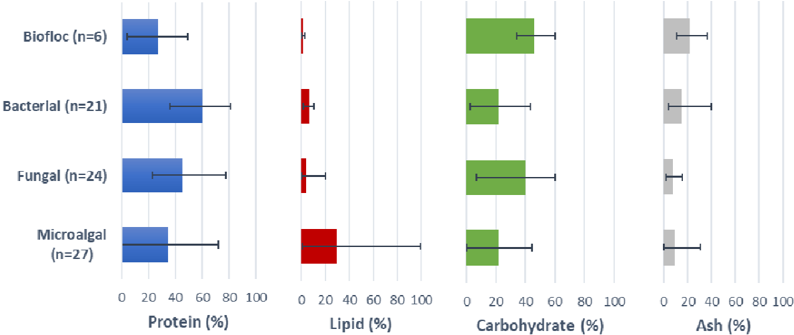
Single-cell ingredients (SCI) are a relatively broad class of materials that encompasses bacterial, fungal (yeast), microalgal-derived products or the combination of all three microbial groups into microbial bioflocs and aggregates. In this review we focus on those dried and processed single-cell organisms used as potential ingredients for aqua-feeds where the microorganisms are considered non-viable and are used primarily to provide protein, lipids or specific nutritional components. Among the SCI, there is a generalised dichotomy in terms of their use as either single-cell protein (SCP) resources or single-cell oil (SCO) resources, with SCO products being those oleaginous products containing 200 g/kg or more of lipids, whereas those products considered as SCP resources tend to contain more than 300 g/kg of protein (on a dry basis). Both SCP and SCO are now widely being used as protein/amino acid sources, omega-3 sources and sources of bioactive molecules in the diets of several species, with the current range of both these ingredient groups being considerable and growing. However, the different array of products becoming available in the market, how they are produced and processed has also resulted in different nutritional qualities in those products. In assessing this variation among the products and the application of the various types of SCI, we have taken the approach of evaluating their use against a set of standardised evaluation criteria based around key nutritional response parameters and how these criteria have been applied against salmonids, shrimp, tilapia and marine fish species.
Overview
The claims and statistics of this paper haven’t been checked yet.
Free: it reads the open-access text and checks the first 5 claims that cite a source we can check. Create a free account to check every claim.
Integrity signals
Registry
Cites
Statistics
Figures
Verification
Claims the paper makes
The claims and statistics of this paper haven’t been checked yet.
Free: it reads the open-access text and checks the first 5 claims that cite a source we can check. Create a free account to check every claim.
Claims other papers make about this one
Each is checked against this paper’s own text: does it say what the citing paper says it does?
The source backs part of the claim, not all of it — or backs it for a different population, condition or comparison.
In the citing paper
“In recent decades, some current investigations have reported the feasibility of sustainable microalgae production, both whole-cell and processed form used as feed ingredients formulating industrially compounded aquafeeds for salmonids, shrimp, tilapia, and many other marine species [9,19,20].”
From Overview and Challenges of Large-Scale Cultivation of Photosynthetic Microalgae and Cyanobacteria (2023) · cites this paper as [9]
Experimental — accuracy not yet measuredThe cited source says what the claim attributes to it.
In the citing paper
“In this regard, microalgae are mainly used for their nutritional value [8], and the current potential utility of these ingredients is considerable and growing [9].”
From Overview and Challenges of Large-Scale Cultivation of Photosynthetic Microalgae and Cyanobacteria (2023) · cites this paper as [9]
Self-check
Percentages, sums and reported differences re-computed from the paper’s own numbers.
The self-check needs the paper’s full text.
Citations
Cites
Carbon/nitrogen ratio as a control element in aquaculture systems
Avnimelech, Y. (1999) · Aquaculture · doi:10.1016/s0044-8486(99)00085-x · Cited by 1,301 · cited 2×
“Although the characteristics of these SCI are highly diverse depending on the various production parameters employed, most such studies have focused on protein production utilising in situ nitrogenous inputs with added carbon inputs to fuel the microbial productivity [66,72,73].”
BackgroundFish oil replacement in finfish nutrition
Turchini, G. M., Torstensen, B. E., & Ng, W. (2009) · Reviews in Aquaculture · doi:10.1111/j.1753-5131.2008.01001.x · Cited by 1,241 · cited 1×
“They are also important sources of long-chain omega-3 PUFA, and accordingly are being eagerly sought as a much-needed alternatives to fishoil use in aquaculture feeds [120].”
BackgroundCommercial potential for Haematococcus microalgae as a natural source of astaxanthin
Lorenz, R. T., & Cysewski, G. R. (2000) · Trends in Biotechnology · doi:10.1016/s0167-7799(00)01433-5 · Cited by 1,189 · cited 1×
“For example, there are varieties of microalgae, such as Haematococcus pluvialis (NaturRoseTM) that have been developed and are being used as natural sources of the carotenoid astaxanthin [92,93].”
BackgroundShah, M. M. R., Liang, Y., Cheng, J. J., & Daroch, M. (2016) · Frontiers in Plant Science · doi:10.3389/fpls.2016.00531 · Cited by 931
Biofloc technology in aquaculture: Beneficial effects and future challenges
Crab, R., Defoirdt, T., Bossier, P., & Verstraete, W. (2012) · Aquaculture · doi:10.1016/j.aquaculture.2012.04.046 · Cited by 903 · cited 2×
“Although the characteristics of these SCI are highly diverse depending on the various production parameters employed, most such studies have focused on protein production utilising in situ nitrogenous inputs with added carbon inputs to fuel the microbial productivity [66,72,73].”
BackgroundGLENCROSS, B. D., BOOTH, M., & ALLAN, G. L. (2007) · Aquaculture Nutrition · doi:10.1111/j.1365-2095.2007.00450.x · Cited by 808
Self-citationAzim, M. E., & Little, D. C. (2008) · Aquaculture · doi:10.1016/j.aquaculture.2008.06.036 · Cited by 795 · cited 2×
“Azim and Little [208] demonstrated that Nile tilapia (O. niloticus) production was enhanced if the fish were cultured in situ with a microbial biofloc.”
BackgroundFeeding with microbial flocs by tilapia in minimal discharge bio-flocs technology ponds
Avnimelech, Y. (2007) · Aquaculture · doi:10.1016/j.aquaculture.2006.11.025 · Cited by 688
Anupama, & Ravindra, P. (2000) · Biotechnology Advances · doi:10.1016/s0734-9750(00)00045-8 · Cited by 632
Hoseinifar, S. H., Sun, Y.-Z., Wang, A., & Zhou, Z. (2018) · Frontiers in Microbiology · doi:10.3389/fmicb.2018.02429 · Cited by 601 · cited 1×
“We focused on studies that used yeast as a protein source above 10 g/kg in the diet, although there are several reviews that focus on the use of yeast and fungal polysaccharides (beta-glucans and MOS) as a probiotics and immunostimulant for shrimp [161,162].”
Method
Research works printed but not linked: 3
- 7. Cohen, Z.; Ratledge, C. (Eds.) Single Cell Oils: Microbial and Algal Oils , 2nd ed.; AOCS Press: Urbana, IL, USA, 2010; p. 516.
- 19. Glencross, B.D.; Booth, M.; Allan, G.L. A feed is only as good as its ingredients-A review of ingredient evaluation for aquaculture feeds. Aquac. Nutr. 2007 , 13 , 17-34. [CrossRef] · DOI · Paper page
- 16. 1993 , 5 , 71-83. [CrossRef]
Cited by
Items 201–233 of 233
Chen, Q., Ren, T., Mao, Q., Yu, W., wang, C., Chen, X., xu, J., Dong, F., Chen, Y., Wang, J., et al. (2026) · Frontiers in Physiology · doi:10.3389/fphys.2026.1987412
Mi, R., Wang, X., Xiao, Y., Zhao, D., Gao, S., Chen, B., Jiang, J., & Zhou, Z. (2026) · SSRN Electronic Journal · doi:10.2139/ssrn.6500102
Javourez, U. (2023) · theses.fr (ABES) · doi:10.70675/e4785e88z0a1bz4f14zb777zc3d4ea620dcc
Chu, Y.-T., Chen, C.-T., Hung, W.-E., Yang, Z.-L., Tan, S. H., & Hung, S. L. (2026) · Animal Feed Science and Technology · doi:10.1016/j.anifeedsci.2026.116805
Mi, R., Wang, X., Xiao, Y., Zhao, D., Gao, S., Chen, B., Jiang, J., & Zhou, Z. (2026) · SSRN Electronic Journal · doi:10.2139/ssrn.6852551
Park, J. H., Park, C., Park, E., & Kim, I. H. (2026) · Journal of Animal and Feed Sciences · doi:10.22358/jafs/219415/2026
“…alternative protein source in poultry production. microorganisms and characterized by high crude protein content, a balanced profile of essential amino acids, and functional properties that may improve nu - trient utilisation and gut health ( Øverland et al., 2010; Glencross et al., 2020).”
Wang, X., Mi, R., Dong, Y., Ye, B., Jiang, J., (552532), P. L., Wang, X., Zhao, Z., Liu, D., Yang, B., et al. (2026) · SSRN Electronic Journal · doi:10.2139/ssrn.6886843
Mukherjee, S., Mohanty, A. K., Chakraborty, S., Rao, U., Rao, S. B., Chinnadurai, R. K., & Poddar, A. (2026) · Bioresource Technology Reports · doi:10.1016/j.biteb.2026.102870
Swamy, S., Dhanalakshmi, M., Amirtha Kayalvizhi, A., Selvarani, B., Raman, S., Vinod, M. S., Sharma, S., Prashanth, B. R., Kaushik, V., & Rao, A. C. S. (2026) · Frontiers in Aquaculture · doi:10.3389/faquc.2026.1820213
Liu, Y. (2026) · ORBi (University of Liège)
Hidayati, B. P., Fitri, B. A. L., & Arista, Y. L. V. (2026) · Jurnal Penelitian Pendidikan IPA · doi:10.29303/jppipa.v12i5.15418
“Furthermore, differences in natural feed availability and composition, including microalgae and plankton communities, may also contribute to the observed variation in PUFA profiles between the two species (Glencross et al., 2020).”
InfluentialFernandes, B., Teixeira, I., Barros, J., Pinto, C. A., & Saraiva, J. A. (2026) · Applied Sciences · doi:10.3390/app16157392
Cortes, J. R., Lastra, D. P., & Amero, M. (2026) · Frontiers in Sustainable Food Systems · doi:10.3389/fsufs.2026.1899651
Dash, M., Subudhi, L., Das, A., Rath, P., Panda, A. K., & Mohapatra, S. (2026) · Elsevier eBooks · doi:10.1016/b978-0-443-41728-3.00004-6
Incorporating oilseed cakes and meals in aquafeeds
Barwant, M. M., Singh, B., Sil, D. C., Lodh, D., Parra-Cota, F. I., Apaarna, Sağlam, K., Boyno, G., Danesh, Y. R., Ganguly, A., et al. (2026) · Elsevier eBooks · doi:10.1016/b978-0-443-41728-3.00006-x
Bezner, S. (2026) · The Atrium (University of Guelph)
Bušelić, I., Pleić, I. L., Hrabar, J., Žuvić, L., Talijančić, I., Žužul, I., Messina, M., Matas, R. F., Grubišić, L., Cardinaletti, G., et al. (2026) · Research Square · doi:10.21203/rs.3.rs-10139852/v1
Zhang, J., Fu, S., Li, R., Li, M., Cheng, Z., Fan, X., Guo, R., & Wang, H. (2026) · Animal Feed Science and Technology · doi:10.1016/j.anifeedsci.2026.117017
Davies, S. J., Adel, M., Jyoti, D., Sinha, R., & El‐Haroun, E. (2026) · Aquaculture Journal · doi:10.3390/aquacj6030037
Boucher, R. L., Wu, C., Chung, W., Sapri, T. A. B., Koon, M., Tan, L. S. E., Ng, J. K. L., & Lee, C. S. (2026) · Aquaculture Reports · doi:10.1016/j.aqrep.2026.103829
Fungal proteins as eco-friendly alternate proteins
Vijayaraj, R., Altaff, K., Vijayalakshmi, P., Sundari, T. M., & Desai, D. (2026) · Advances in protein chemistry and structural biology · doi:10.1016/bs.apcsb.2026.08.016
Jensen, H. M., Kumaş, K., Kania, P. W., Buchmann, K., Ntokou, E., & Thorringer, N. W. (2026) · Fishes · doi:10.3390/fishes11090526
Dietary Components Modulate the Gut Microbiota of Farmed Fish: Advances from the past Decade
Teame, T., Ringø, E., Yang, H., Zhang, R., Yang, Y., Ran, C., Yao, Y., Ding, Q., Zhang, M., Nie, G., et al. (2026) · Reviews in Aquaculture · doi:10.1111/raq.70204
Izzah, H. S., Karim, M., Yong, A. S., Xu, Q., Rossi, W., & de Cruz, C. R. (2026) · Italian Journal of Animal Science · doi:10.1080/1828051x.2026.2721969
Những thách thức và cơ hội mới trong sản xuất và cung cấp protein cho thức ăn chăn nuôi
Văn, Q. N. (2024) · Tạp chí khoa học Chăn nuôi và Thú y
Response Surface-Based Optimization of Single-Cell Protein Production in Phaffia rhodozyma
Kušnere, Z., Raita, S., Kuzmika, I., Palcevska, J., Geiba, Z., Mika, T., & Valters, K. (2026) · Environmental and Climate Technologies · doi:10.2478/rtuect-2026-0034
“Several studies indicate that the acceptable threshold concentration of nucleic acids is close to 5–10 % in finished fish feed [10], [11].”
Herrera-Perez, M., de Lima, H. G., Cereser, N. D., Nascente, P. D. S., Cardozo, C. D. S., Marco, I. D., & Rombaldi, C. V. (2026) · Marine and Fishery Sciences (MAFIS) · doi:10.47193/mafis.4012027010108
Pilmer, L. W. (n.d.) · Murdoch University Research Portal
Yeter, G., Dolfi, E., Marrocco, E. S., Masi, M., Themistoklis, A., Vecchio, Y., & Adinolfi, F. (2026) · Ams Acta Institutional Research Repository (University of Bologna) · doi:10.6092/unibo/amsacta/9191
Hilirisasi Teknologi Pakan Berbasis Daun Talas bagi Pembudidaya Ikan Air Tawar
Febriyanti, T. L., Utami, E. S., & Qulubi, M. H. (2026) · Jurnal Pengabdian Masyarakat (abdira) · doi:10.31004/abdira.v6i4.2323
Vasilaki, A., Mente, E., Fountoulaki, E., Henry, M., Nikoloudaki, C., Berillis, P., Kousoulaki, K., & Nengas, I. (2023) · doi:10.3389/fphys.2023.1199497.s001
Metadata
- Authors
- Glencross, B. D., Huyben, D., & Schrama, J. W.
- Affiliations
- University of Stirling (GB)
- Wageningen University & Research (NL)
- Corresponding author
- Glencross, Brett D.
- Venue
- Fishes
- Publisher
- MDPI AG
- Published
- 2020-07-16
- Volume
- 5
- Issue
- 3
- Pages
- 22
- ISSN
- 2410-3888 (ISSN-L)
- OpenAlex
- W3043009614
- Cited by
- 203
- References
- 230
- Citations by year
- 2026: 29 · 2025: 45 · 2024: 31 · 2023: 31 · 2022: 36 · 2021: 28 · 2020: 3
- FWCI
- 17.68
- Type
- journal article
- Language
- en
- Open access
- gold
- doi.org
- Licence
- Locations
- Fishes (publishedVersion, cc-by)
- Socio-Environmental Systems Modeling (acceptedVersion, cc-by)
- DOAJ (DOAJ: Directory of Open Access Journals) (submittedVersion, cc-by-sa)
- Stirling Online Research Repository (University of Stirling) (submittedVersion, cc-by)
- Data Archiving and Networked Services (DANS) (submittedVersion, cc-by)
- Topics
- Life Sciences › Agricultural and Biological Sciences › Aquatic Science › Aquaculture Nutrition and Growth
- Life Sciences › Immunology and Microbiology › Immunology › Aquaculture disease management and microbiota
- Physical Sciences › Energy › Renewable Energy, Sustainability and the Environment › Algal biology and biofuel production
- Keywords
- aquaculture feed, microbial protein, single cell oil, oleaginous microorganisms, yeast, microalgae, omega-3 fatty acids, bioactive compounds, amino acid sources, salmonids, shrimp, tilapia, marine fish, feed quality
About these checks
Registry, retraction, Cites and statistics results are computed, not judged, with one exception: a printed reference that no index lists is read once by a model before it counts as a citation error. Claims are extracted by a model and kept only when their quote appears verbatim in the text; each cited source is then checked, with a model’s help, for whether it says what the claim relies on. Those verdicts can be wrong — read the claim’s quote and the cited source before relying on one.
Statistics and arithmetic are recomputed, not judged.
Confidence bands are shown only for fields calibrated on our annotated test set. None is calibrated yet, so no band is shown.
What counts as a claim ›How we measure confidence ›How we check this ›
Are you an author, or do you see a problem with this page? Request a review
Data sources
Bibliographic data: Semantic Scholar, OpenAlex, Crossref.
Contains information from the Semantic Scholar Academic Graph Datasets, made available under the ODC Attribution License (ODC-BY 1.0).
Semantic Scholar’s data is described in: Kinney, R., et al. (2023). The Semantic Scholar Open Data Platform. arXiv:2301.10140.
