

Bioactive Candy: Effects of Licorice on the Cardiovascular System
The DOI matches its Crossref record; 8 of the 8 references it cites were found in a registry or an index.
Abstract
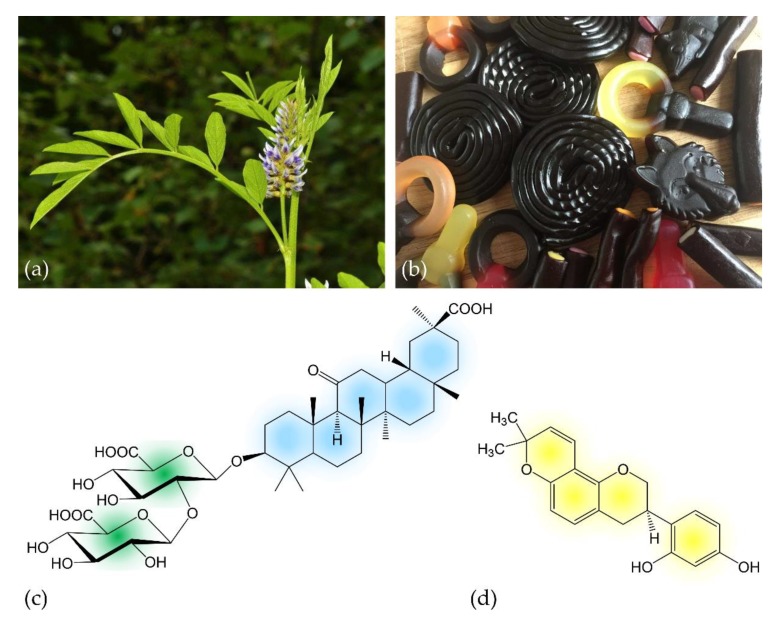
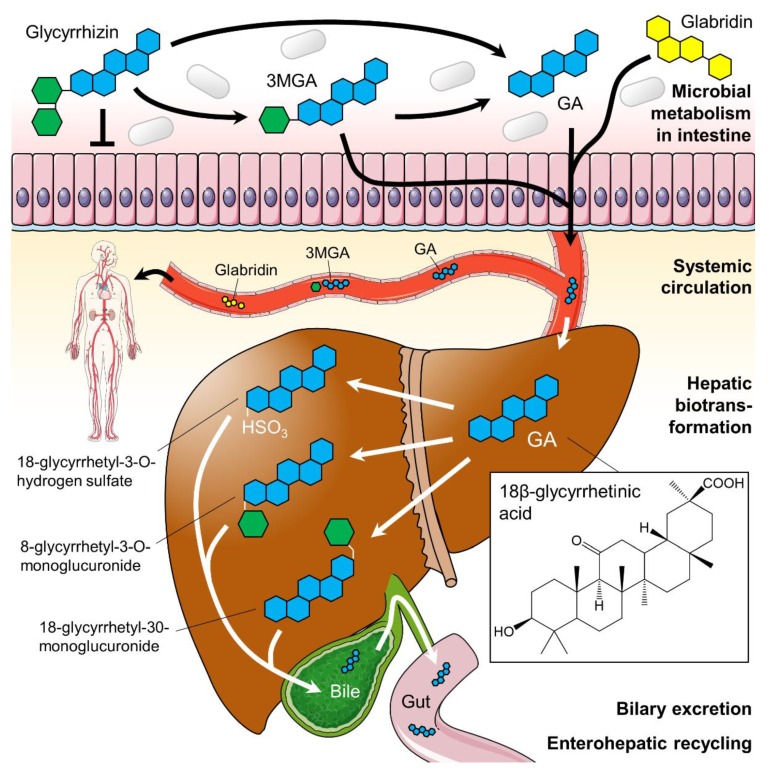
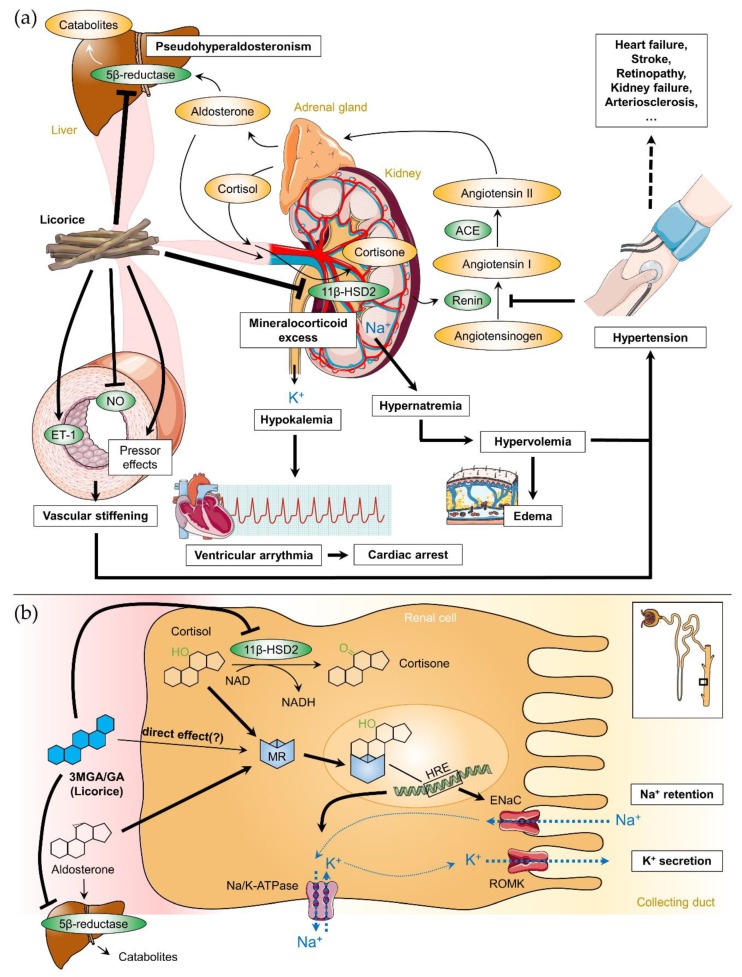
Licorice, today chiefly utilized as a flavoring additive in tea, tobacco and candy, is one of the oldest used herbs for medicinal purposes and consists of up to 300 active compounds. The main active constituent of licorice is the prodrug glycyrrhizin, which is successively converted to 3β-monoglucuronyl-18β-glycyrrhetinic acid (3MGA) and 18β-glycyrrhetinic acid (GA) in the intestines. Despite many reported health benefits, 3MGA and GA inhibit the 11-β-hydrogenase type II enzyme (11β-HSD2) oxidizing cortisol to cortisone. Through activation of mineralocorticoid receptors, high cortisol levels induce a mild form of apparent mineralocorticoid excess in the kidney and increase systemic vascular resistance. Continuous inhibition of 11β-HSD2 related to excess licorice consumption will create a state of hypernatremia, hypokalemia and increased fluid volume, which can cause serious life-threatening complications especially in patients already suffering from cardiovascular diseases. Two recent meta-analyses of 18 and 26 studies investigating the correlation between licorice intake and blood pressure revealed statistically significant increases both in systolic (5.45 mmHg) and in diastolic blood pressure (3.19/1.74 mmHg). This review summarizes and evaluates current literature about the acute and chronic effects of licorice ingestion on the cardiovascular system with special focus on blood pressure. Starting from the molecular actions of licorice (metabolites) inside the cells, it describes how licorice intake is affecting the human body and shows the boundaries between the health benefits of licorice and possible harmful effects.
Overview
The claims and statistics of this paper haven’t been checked yet.
Free: it reads the open-access text and checks the first 5 claims that cite a source we can check. Create a free account to check every claim.
Integrity signals
Registry
Cites
Statistics
Figures
Verification
Claims the paper makes
The claims and statistics of this paper haven’t been checked yet.
Free: it reads the open-access text and checks the first 5 claims that cite a source we can check. Create a free account to check every claim.
Claims other papers make about this one
Each is checked against this paper’s own text: does it say what the citing paper says it does?
The cited source says what the claim attributes to it.
In the citing paper
“In the kidney, glycyrrhetinic acid inhibits 11β-hydroxysteroid dehydrogenase type 2, which, otherwise, inactivates cortisol by conversion to cortisone [1,3].”
From A low dose of daily licorice intake affects renin, aldosterone, and home blood pressure in a randomized crossover trial (2024) · cites this paper as [1]
In the citing paper
“Despite suggested health benefits, ingestion can also raise blood pressure (BP), mainly through the effects of glycyrrhizic acid (GA) and its metabolite glycyrrhetinic acid [1].”
From A low dose of daily licorice intake affects renin, aldosterone, and home blood pressure in a randomized crossover trial (2024) · cites this paper as [1]
In the citing paper
“The bioavailability of GA is higher when ingested in an isolated form, suggesting interactions with other compounds of licorice [1].”
From A low dose of daily licorice intake affects renin, aldosterone, and home blood pressure in a randomized crossover trial (2024) · cites this paper as [1]
In the citing paper
“Drawing ballots were used for stratified block randomization to 2 groups with a 1:1 allocation ratio, with 1 block of 14 participants for males and 1 block of 14 participants for females because sex differences have been seen in previous studies [1].”
From A low dose of daily licorice intake affects renin, aldosterone, and home blood pressure in a randomized crossover trial (2024) · cites this paper as [1]
In the citing paper
“Thus, increased concentrations of cortisol, which has a much higher affinity to mineralocorticoid receptors than cortisone, causes pseudohyperaldosteronism with hypokalemia, hypernatremia, and water retention, resulting in elevated BP [1,3].”
From A low dose of daily licorice intake affects renin, aldosterone, and home blood pressure in a randomized crossover trial (2024) · cites this paper as [1]
Self-check
Percentages, sums and reported differences re-computed from the paper’s own numbers.
The self-check needs the paper’s full text.
Citations
Cites
2018 ESC/ESH Guidelines for the management of arterial hypertension
Williams, B., Mancia, G., Spiering, W., Agabiti Rosei, E., Azizi, M., Burnier, M., Clement, D. L., Coca, A., de Simone, G., Dominiczak, A., et al. (2018) · European Heart Journal · doi:10.1093/eurheartj/ehy339 · Cited by 10,286
Global Burden of Hypertension and Systolic Blood Pressure of at Least 110 to 115 mm Hg, 1990-2015
Forouzanfar, M. H., Liu, P., Roth, G. A., Ng, M., Biryukov, S., Marczak, L., Alexander, L., Estep, K., Hassen Abate, K., Akinyemiju, T. F., et al. (2017) · JAMA · doi:10.1001/jama.2016.19043 · Cited by 2,381 · cited 1×
“Hypertension is one of the major concerns for our healthcare system and was the leading contributor to premature death in 2015 [31].”
Phytochemistry and biological properties of glabridin
Simmler, C., Pauli, G. F., & Chen, S.-N. (2013) · Fitoterapia · doi:10.1016/j.fitote.2013.07.003 · Cited by 281
Toxicological Effects of Glycyrrhiza glabra (Licorice): A Review
Nazari, S., Rameshrad, M., & Hosseinzadeh, H. (2017) · Phytotherapy Research · doi:10.1002/ptr.5893 · Cited by 266
Licorice abuse: time to send a warning message
Omar, H. R., Komarova, I., El-Ghonemi, M., Fathy, A., Rashad, R., Abdelmalak, H. D., Yerramadha, M. R., Ali, Y., Helal, E., & Camporesi, E. M. (2012) · Therapeutic Advances in Endocrinology and Metabolism · doi:10.1177/2042018812454322 · Cited by 246
Liquorice-induced rise in blood pressure: a linear dose-response relationship
Sigurjónsdóttir, H. Á., Franzson, L., Manhem, K., Ragnarsson, J., Sigurdsson, G., & Wallerstedt, S. (2001) · Journal of Human Hypertension · doi:10.1038/sj.jhh.1001215 · Cited by 143 · cited 2×
“(2001) [27], Iceland/Sweden Pre-post intervention 24 Licorice 50–200 g 2–4 weeks Increase in SBP.”
Calò, L. A., Zaghetto, F., Pagnin, E., Davis, P. A., de Mozzi, P., Sartorato, P., Martire, G., Fiore, C., & Armanini, D. (2004) · The Journal of Clinical Endocrinology & Metabolism · doi:10.1210/jc.2003-031545 · Cited by 122 · cited 1×
“Although there is some evidence of this direct effect in vitro [50], the relative affinity for MR compared to aldosterone as well as low serum levels of GA after licorice consumption, which did not reach the concentrations necessary to affect aldosterone or cortisol binding to MRs in humans, question that theory [51].”
Penninkilampi, R., Eslick, E. M., & Eslick, G. D. (2017) · Journal of Human Hypertension · doi:10.1038/jhh.2017.45 · Cited by 86 · cited 10×
“[74], most of the trials included in their meta-analysis were performed with volunteers.”
Influential
Research works printed but not linked: 134
- Foster C.A. Church K.S. Poddar M. Van Uum S.H. Spaic T. Licorice-induced hypertension: A case of pseudohyperaldosteronism due to jelly bean ingestion Postgrad. Med. 2017 129 3293 3331 10.1080/00325481.2017.1291062 28276791 · DOI
- Fenwick G.R. Lutomski J. Nieman C. Liquorice, Glycyrrhiza glabra L.—Composition, uses and analysis Food Chem. 1990 38 1191 1243 10.1016/0308-8146(90)90159-2 · DOI · Paper page
- Kao T.C. Wu C.H. Yen G.C. Bioactivity and potential health benefits of licorice J. Agric. Food Chem. 2014 62 542 553 10.1021/jf404939f 24377378 · DOI · Paper page
- Fiore C. Eisenhut M. Ragazzi E. Zanchin G. Armanini D. A history of the therapeutic use of liquorice in europe J. Ethnopharmacol. 2005 99 317 324 10.1016/j.jep.2005.04.015 15978760 PMC7125727 · DOI · Paper page
- Allcock E. Cowdery J. Hypertension induced by liquorice tea BMJ Case Rep. 2015 10.1136/bcr-2015-209926 PMC4480140 26077805 · DOI
- Isbrucker R.A. Burdock G.A. Risk and safety assessment on the consumption of licorice root (Glycyrrhiza sp.), its extract and powder as a food ingredient, with emphasis on the pharmacology and toxicology of glycyrrhizin Regul. Toxicol. Pharmacol. 2006 46 167 192 10.1016/j.yrtph.2006.06.002 16884839 · DOI · Paper page
- Sabbadin C. Bordin L. Donà G. Manso J. Avruscio G. Armanini D. Licorice: From pseudohyperaldosteronism to therapeutic uses Front. Endocrinol. 2019 10.3389/fendo.2019.00484 PMC6657287 31379750 · DOI
- Volqvartz T. Vestergaard A.L. Aagaard S.K. Andreasen M.F. Lesnikova I. Uldbjerg N. Larsen A. Bor P. Use of alternative medicine, ginger and licorice among Danish pregnant women—A prospective cohort study BMC Complement. Altern. Med. 2019 19 5 10.1186/s12906-018-2419-y 30611269 PMC6320632 · DOI
- Yang R. Wang L.Q. Yuan B.C. Liu Y. The pharmacological activities of licorice Planta Med. 2015 81 1654 1669 10.1055/s-0035-1557893 26366756 · DOI · Paper page
- Aly A.M. Al-Alousi L. Salem H.A. Licorice: A possible anti-inflammatory and anti-ulcer drug AAPS PharmSciTech 2005 6 E74 E82 10.1208/pt060113 16353966 PMC2750414 · DOI · Paper page
- Jalilzadeh-Amin G. Najarnezhad V. Anassori E. Mostafavi M. Keshipour H. Antiulcer properties of Glycyrrhiza glabra L. Extract on experimental models of gastric ulcer in mice Iranian J. Pharm. Res. 2015 14 1163 1170 PMC4673944 26664383
- Yang R. Yuan B.C. Ma Y.S. Zhou S. Liu Y. The anti-inflammatory activity of licorice, a widely used chinese herb Pharm. Biol. 2017 55 5 18 10.1080/13880209.2016.1225775 27650551 PMC7012004 · DOI · Paper page
- Wang L. Yang R. Yuan B. Liu Y. Liu C. The antiviral and antimicrobial activities of licorice, a widely-used Chinese herb Acta Pharm. Sin. B 2015 5 310 315 10.1016/j.apsb.2015.05.005 26579460 PMC4629407 · DOI · Paper page
- Fukuchi K. Okudaira N. Adachi K. Odai-Ide R. Watanabe S. Ohno H. Yamamoto M. Kanamoto T. Terakubo S. Nakashima H. Antiviral and antitumor activity of licorice root extracts In Vivo 2016 30 777 785 10.21873/invivo.10994 27815461 · DOI
- Huo H.Z. Wang B. Liang Y.K. Bao Y.Y. Gu Y. Hepatoprotective and antioxidant effects of licorice extract against CCl4-induced oxidative damage in rats Int. J. Mol. Sci. 2011 12 6529 6543 10.3390/ijms12106529 22072903 PMC3210994 · DOI · Paper page
- Jung J.-C. Lee Y.-H. Kim S.H. Kim K.-J. Kim K.-M. Oh S. Jung Y.-S. Hepatoprotective effect of licorice, the root of Glycyrrhiza uralensis Fischer, in alcohol-induced fatty liver disease BMC Complement. Altern. Med. 2016 16 19 10.1186/s12906-016-0997-0 26801973 PMC4722619 · doi:10.1186/s12906-016-0997-0
- Wang Z.Y. Nixon D.W. Licorice and cancer Nutr. Cancer 2001 39 1 11 10.1207/S15327914nc391_1 11588889 · DOI · Paper page
- Rahnama M. Mehrabani D. Japoni S. Edjtehadi M. Saberi Firoozi M. The healing effect of licorice (Glycyrrhiza glabra) on Helicobacter pylori infected peptic ulcers J. Res. Med. Sci. 2013 18 532 533 24250708 PMC3818629
- Momeni A. Rahimian G. Kiasi A. Amiri M. Kheiri S. Effect of licorice versus bismuth on eradication of Helicobacter pylori in patients with peptic ulcer disease Pharmacogn. Res. 2014 6 341 344 10.4103/0974-8490.138289 PMC4166824 25276073 · doi:10.4103/0974-8490.138289
- Wu F. Jin Z. Jin J. Hypoglycemic effects of glabridin, a polyphenolic flavonoid from licorice, in an animal model of diabetes mellitus Mol. Med. Rep. 2013 7 1278 1282 10.3892/mmr.2013.1330 23426874 · DOI · Paper page
- Stepien M. Kujawska-Luczak M. Szulinska M. Kregielska-Narozna M. Skrypnik D. Suliburska J. Skrypnik K. Regula J. Bogdanski P. Beneficial dose-independent influence of Camellia sinensis supplementation on lipid profile, glycemia, and insulin resistance in an NaCl-induced hypertensive rat model J. Physiol. Pharmacol. 2018 10.26402/jpp.2018.2.13 30045004 · doi:10.26402/jpp.2018.2.13 · Paper page
- Sontia B. Mooney J. Gaudet L. Touyz R.M. Pseudohyperaldosteronism, liquorice, and hypertension J. Clin. Hypertens. 2008 10 153 157 10.1111/j.1751-7176.2008.07470.x PMC8109973 18256580 · DOI · Paper page
- Varma R. Ross C.N. Liquorice: A root cause of secondary hypertension JRSM Open 2017 8 2054270416685208 10.1177/2054270416685208 28210494 PMC5298563 · DOI
- Morris D.J. Liquorice: New insights into mineralocorticoid and glucocorticoid hypertension R. I. Med. 1993 76 251 254 8518501
- Leskinen M.H. Hautaniemi E.J. Tahvanainen A.M. Koskela J.K. Päällysaho M. Tikkakoski A.J. Kähönen M. Kööbi T. Niemelä O. Mustonen J. Daily liquorice consumption for two weeks increases augmentation index and central systolic and diastolic blood pressure PLoS ONE 2014 9 e105607 10.1371/journal.pone.0105607 25153328 PMC4143270 · DOI
- Falet J.P. Elkrief A. Green L. Hypertensive emergency induced by licorice tea CMAJ 2019 191 E581 E583 10.1503/cmaj.180550 31133605 PMC6538495 · DOI
- Omar H.R. The cardiovascular complications of licorice Cardiovasc. Endocrinol. 2013 2 46 49 10.1097/XCE.0b013e328362e3dd · DOI
- Charles L. Triscott J. Dobbs B. Secondary hypertension: Discovering the underlying cause Am. Fam. Phys. 2017 96 453 461 29094913
- Wang Q. Qian Y. Wang Q. Yang Y.F. Ji S. Song W. Qiao X. Guo D.A. Liang H. Ye M. Metabolites identification of bioactive licorice compounds in rats J. Pharm. Biomed. Anal. 2015 115 515 522 10.1016/j.jpba.2015.08.013 26311472 · DOI
- Nieman C. Licorice Adv. Food Res. 1957 7 339 381 · DOI
- Kim D.-H. Lee S.-W. Han M.J. Biotransformation of glycyrrhizin to 18β-glycyrrhetinic acid-3-o-β-d-glucuronide by streptococcus lj-22, a human intestinal bacterium Biol. Pharm. Bull. 1999 22 320 322 10.1248/bpb.22.320 10220293 · DOI
- Hattori M. Sakamoto T. Yamagishi T. Sakamoto K. Konishi K. Kobashi K. Namba T. Metabolism of glycyrrhizin by human intestinal flora. Ii. Isolation and characterization of human intestinal bacteria capable of metabolizing glycyrrhizin and related compounds Chem. Pharm Bull. 1985 33 210 217 10.1248/cpb.33.210 4006016 · DOI
- Armanini D. Nacamulli D. Francini-Pesenti F. Battagin G. Ragazzi E. Fiore C. Glycyrrhetinic acid, the active principle of licorice, can reduce the thickness of subcutaneous thigh fat through topical application Steroids 2005 70 538 542 10.1016/j.steroids.2005.01.007 15894038 · DOI
- Feng X. Ding L. Qiu F. Potential drug interactions associated with glycyrrhizin and glycyrrhetinic acid Drug Metab. Rev. 2015 47 229 238 10.3109/03602532.2015.1029634 25825801 · DOI
- Ploeger B. Mensinga T. Sips A. Meulenbelt J. DeJongh J. A human physiologically-based model for glycyrrhzic acid, a compound subject to presystemic metabolism and enterohepatic cycling Pharm. Res. 2000 17 1516 1525 10.1023/A:1007661209921 11303962 · DOI
- Cao J. Chen X. Liang J. Yu X.Q. Xu A.L. Chan E. Wei D. Huang M. Wen J.Y. Yu X.Y. Role of p-glycoprotein in the intestinal absorption of glabridin, an active flavonoid from the root of glycyrrhiza glabra Drug Metab. Dispos. 2007 35 539 553 10.1124/dmd.106.010801 17220245 · DOI
- Ito C. Oi N. Hashimoto T. Nakabayashi H. Aoki F. Tominaga Y. Yokota S. Hosoe K. Kanazawa K. Absorption of dietary licorice isoflavan glabridin to blood circulation in rats J. Nutr. Sci. Vitaminol. 2007 53 358 365 10.3177/jnsv.53.358 17934243 · DOI · Paper page
- Aoki F. Nakagawa K. Tanaka A. Matsuzaki K. Arai N. Mae T. Determination of glabridin in human plasma by solid-phase extraction and lc-ms/ms J. Chromatogr. B Analyt. Technol. Biomed. Life Sci. 2005 828 70 74 10.1016/j.jchromb.2005.09.012 16183339 · DOI
- Raggi M.A. Maffei F. Bugamelli F. Cantelli Forti G. Bioavailability of glycyrrhizin and licorice extract in rat and human plasma as detected by a hplc method Pharmazie 1994 49 269 272 8197226
- Cantelli-Forti G. Maffei F. Hrelia P. Bugamelli F. Bernardi M. D’Intino P. Maranesi M. Raggi M.A. Interaction of licorice on glycyrrhizin pharmacokinetics Environ. Health Perspect. 1994 102 Suppl. 9 65 68 10.1289/ehp.94102s965 PMC1566785 7698088 · DOI · Paper page
- Ishiuchi K. Morinaga O. Ohkita T. Tian C. Hirasawa A. Mitamura M. Maki Y. Kondo T. Yasujima T. Yuasa H. 18beta-glycyrrhetyl-3-o-sulfate would be a causative agent of licorice-induced pseudoaldosteronism Sci. Rep. 2019 9 1587 10.1038/s41598-018-38182-2 30733510 PMC6367500 · doi:10.1038/s41598-018-38182-2
- Morinaga O. Ishiuchi K. Ohkita T. Tian C. Hirasawa A. Mitamura M. Maki Y. Yasujima T. Yuasa H. Makino T. Isolation of a novel glycyrrhizin metabolite as a causal candidate compound for pseudoaldosteronism Sci. Rep. 2018 8 15568 10.1038/s41598-018-33834-9 30348944 PMC6197257 · doi:10.1038/s41598-018-33834-9
- Armanini D. Karbowiak I. Funder J.W. Affinity of liquorice derivatives for mineralocorticoid and glucocorticoid receptors Clin. Endocrinol. 1983 19 609 612 10.1111/j.1365-2265.1983.tb00038.x 6315264 · DOI · Paper page
- Størmer F.C. Reistad R. Alexander J. Glycyrrhizic acid in liquorice—Evaluation of health hazard Food Chem. Toxicol. 1993 31 303 312 10.1016/0278-6915(93)90080-I 8386690 · DOI · Paper page
- Stewart P.M. Wallace A.M. Valentino R. Burt D. Shackleton C.H. Edwards C.R. Mineralocorticoid activity of liquorice: 11-beta-hydroxysteroid dehydrogenase deficiency comes of age Lancet 1987 2 821 824 10.1016/S0140-6736(87)91014-2 2889032 · DOI · Paper page
- Ferrari P. The role of 11beta-hydroxysteroid dehydrogenase type 2 in human hypertension Biochim. Biophys. Acta 2010 1802 1178 1187 10.1016/j.bbadis.2009.10.017 19909806 · DOI · Paper page
- Atanasov A.G. Ignatova I.D. Nashev L.G. Dick B. Ferrari P. Frey F.J. Odermatt A. Impaired protein stability of 11beta-hydroxysteroid dehydrogenase type 2: A novel mechanism of apparent mineralocorticoid excess J. Am. Soc. Nephrol. 2007 18 1262 1270 10.1681/ASN.2006111235 17314322 · DOI
- Christy C. Hadoke P.W. Paterson J.M. Mullins J.J. Seckl J.R. Walker B.R. 11beta-hydroxysteroid dehydrogenase type 2 in mouse aorta: Localization and influence on response to glucocorticoids Hypertension 2003 42 580 587 10.1161/01.HYP.0000088855.06598.5B 12925564 · DOI · Paper page
- Lombes M. Alfaidy N. Eugene E. Lessana A. Farman N. Bonvalet J.P. Prerequisite for cardiac aldosterone action. Mineralocorticoid receptor and 11 beta-hydroxysteroid dehydrogenase in the human heart Circulation 1995 92 175 182 10.1161/01.CIR.92.2.175 7600648 · DOI · Paper page
- Hadoke P.W. Christy C. Kotelevtsev Y.V. Williams B.C. Kenyon C.J. Seckl J.R. Mullins J.J. Walker B.R. Endothelial cell dysfunction in mice after transgenic knockout of type 2, but not type 1, 11beta-hydroxysteroid dehydrogenase Circulation 2001 104 2832 2837 10.1161/hc4801.100077 11733403 · DOI · Paper page
- Van Uum S.H. Liquorice and hypertension Neth. J. Med. 2005 63 119 120 15869038
- Monder C. Stewart P.M. Lakshmi V. Valentino R. Burt D. Edwards C.R. Licorice inhibits corticosteroid 11 beta-dehydrogenase of rat kidney and liver: In vivo and in vitro studies Endocrinology 1989 125 1046 1053 10.1210/endo-125-2-1046 2752963 · DOI · Paper page
- Tanahashi T. Mune T. Morita H. Tanahashi H. Isomura Y. Suwa T. Daido H. Gomez-Sanchez C.E. Yasuda K. Glycyrrhizic acid suppresses type 2 11 beta-hydroxysteroid dehydrogenase expression in vivo J. Steroid Biochem. Mol. Biol. 2002 80 441 447 10.1016/S0960-0760(02)00033-X 11983491 · DOI
- Kato H. Kanaoka M. Yano S. Kobayashi M. 3-monoglucuronyl-glycyrrhetinic acid is a major metabolite that causes licorice-induced pseudoaldosteronism J. Clin. Endocrinol. Metab. 1995 80 1929 1933 10.1210/jcem.80.6.7775643 7775643 · doi:10.1210/jcem.80.6.7775643
- Hammer F. Stewart P.M. Cortisol metabolism in hypertension Best Pract. Res. Clin. Endocrinol. Metab. 2006 20 337 353 10.1016/j.beem.2006.07.001 16980198 · DOI
- Souness G.W. Brem A.S. Morris D.J. 11 beta-hydroxysteroid dehydrogenase antisense affects vascular contractile response and glucocorticoid metabolism Steroids 2002 67 195 201 10.1016/S0039-128X(01)00148-9 11856543 · DOI
- Latif S.A. Conca T.J. Morris D.J. The effects of the licorice derivative, glycyrrhetinic acid, on hepatic 3α- and 3β-hydroxysteroid dehydrogenases and 5α- and 5β-reductase pathways of metabolism of aldosterone in male rats Steroids 1990 55 52 58 10.1016/0039-128X(90)90024-6 2326827 · DOI
- Chanda D. Prieto-Lloret J. Singh A. Iqbal H. Yadav P. Snetkov V. Aaronson P.I. Glabridin-induced vasorelaxation: Evidence for a role of bkca channels and cyclic gmp Life Sci. 2016 165 26 34 10.1016/j.lfs.2016.09.018 27686831 PMC5101995 · DOI
- Farese R.V. Jr. Biglieri E.G. Shackleton C.H. Irony I. Gomez-Fontes R. Licorice-induced hypermineralocorticoidism N. Engl. J. Med. 1991 325 1223 1227 10.1056/NEJM199110243251706 1922210 · DOI · Paper page
- Tarjus A. Amador C. Michea L. Jaisser F. Vascular mineralocorticoid receptor and blood pressure regulation Curr. Opin. Pharmacol. 2015 21 138 144 10.1016/j.coph.2015.02.004 25733376 · doi:10.1016/j.coph.2015.02.004
- Ohtake M. Hattori T. Murase T. Takahashi K. Takatsu M. Ohtake M. Miyachi M. Watanabe S. Cheng X.W. Murohara T. Glucocorticoids activate cardiac mineralocorticoid receptors in adrenalectomized dahl salt-sensitive rats Nagoya J. Med. Sci. 2014 76 59 72 25129992 PMC4345730
- Quaschning T. Ruschitzka F. Shaw S. Luscher T.F. Aldosterone receptor antagonism normalizes vascular function in liquorice-induced hypertension Hypertension 2001 37 801 805 10.1161/01.HYP.37.2.801 11230376 · DOI
- Schiffrin E.L. Deng L.Y. Sventek P. Day R. Enhanced expression of endothelin-1 gene in resistance arteries in severe human essential hypertension J. Hypertens. 1997 15 57 63 10.1097/00004872-199715010-00005 9050971 · DOI · Paper page
- Ergul S. Parish D.C. Puett D. Ergul A. Racial differences in plasma endothelin-1 concentrations in individuals with essential hypertension Hypertension 1996 28 652 655 10.1161/01.HYP.28.4.652 8843893 · DOI · Paper page
- Gomez-Sanchez E.P. Gomez-Sanchez C.E. Central hypertensinogenic effects of glycyrrhizic acid and carbenoxolone Am. J. Physiol. 1992 263 E1125 E1130 10.1152/ajpendo.1992.263.6.E1125 1476186 · DOI · Paper page
- Hautaniemi E.J. Tahvanainen A.M. Koskela J.K. Tikkakoski A.J. Kähönen M. Uitto M. Sipilä K. Niemelä O. Mustonen J. Pörsti I.H. Voluntary liquorice ingestion increases blood pressure via increased volume load, elevated peripheral arterial resistance, and decreased aortic compliance Sci. Rep. 2017 7 10947 10.1038/s41598-017-11468-7 28887501 PMC5591274 · DOI
- Van Gelderen C.E. Bijlsma J.A. van Dokkum W. Savelkoul T.J. Glycyrrhizic acid: The assessment of a no effect level Hum. Exp. Toxicol. 2000 19 434 439 10.1191/096032700682694251 11125713 · DOI
- Basso A. Dalla Paola L. Erle G. Boscaro M. Armanini D. Licorice ameliorates postural hypotension caused by diabetic autonomic neuropathy Diabetes Care 1994 17 1356 10.2337/diacare.17.11.1356 7821181 · DOI
- Van der Zwan A. Hypertension encephalopathy after liquorice ingestion Clin. Neurol. Neurosurg. 1993 95 35 37 10.1016/0303-8467(93)90089-Y 8453813 · DOI
- Russo S. Mastropasqua M. Mosetti M.A. Persegani C. Paggi A. Low doses of liquorice can induce hypertension encephalopathy Am. J. Nephrol. 2000 20 145 148 10.1159/000013572 10773616 · DOI · Paper page
- Bramont C. Lestradet C. Godart L. Faivre R. Narboni G. cerebral vascular accident caused by alcohol-free licorice Presse Med. 1985 14 746 3157980
- Chamberlain J.J. Abolnik I.Z. Pulmonary edema following a licorice binge West J. Med. 1997 167 184 185 9308417 PMC1304525
- Chamberlain T.J. Licorice poisoning, pseudoaldosteronism, and heart failure JAMA 1970 213 1343 10.1001/jama.1970.03170340065018 5468336 · DOI
- Hasegawa J. Suyama Y. Kinugawa T. Morisawa T. Kishimoto Y. Echocardiographic findings of the heart resembling dilated cardiomyopathy during hypokalemic myopathy due to licorice-induced pseudoaldosteronism Cardiovasc. Drugs Ther. 1998 12 599 600 10.1023/A:1007708025567 10410830 · DOI
- Sailler L. Juchet H. Ollier S. Nicodeme R. Arlet P. generalized edema caused by licorice: A new syndrome. Apropos of 3 cases Rev. Med. Interne 1993 14 984 10.1016/S0248-8663(05)80102-X 8009077 · DOI
- Johns C. Glycyrrhizic acid toxicity caused by consumption of licorice candy cigars CJEM 2009 11 94 96 10.1017/S1481803500010988 19166646 · DOI
- Francini-Pesenti F. Puato M. Piccoli A. Brocadello F. Liquorice-induced hypokalaemia and water retention in the absence of hypertension Phytother. Res. 2008 22 563 565 10.1002/ptr.2402 18386259 · DOI
- Negro A. Rossi E. Regolisti G. Perazzoli F. Liquorice-induced sodium retention. Merely an acquired condition of apparent mineralocorticoid excess? A case report Ann. Ital. Med. Int. 2000 15 296 300 11202632
- Luis A. Domingues F. Pereira L. Metabolic changes after licorice consumption: A systematic review with meta-analysis and trial sequential analysis of clinical trials Phytomedicine 2018 39 17 24 10.1016/j.phymed.2017.12.010 29433679 · DOI
- Forslund T. Fyhrquist F. Froseth B. Tikkanen I. Effects of licorice on plasma atrial natriuretic peptide in healthy volunteers J. Intern. Med. 1989 225 95 99 10.1111/j.1365-2796.1989.tb00046.x 2522135 · DOI · Paper page
- Mattarello M.J. Benedini S. Fiore C. Camozzi V. Sartorato P. Luisetto G. Armanini D. Effect of licorice on PTH levels in healthy women Steroids 2006 71 403 408 10.1016/j.steroids.2006.01.005 16513152 · DOI
- Sigurjonsdottir H.A. Axelson M. Johannsson G. Manhem K. Nyström E. Wallerstedt S. The liquorice effect on the RAAS differs between the genders Blood Press 2006 15 169 172 10.1080/08037050600593060 16864159 · DOI · Paper page
- Ruszymah B.H. Nabishah B.M. Aminuddin S. Khalid B.A. Effects of glycyrrhizic acid on right atrial pressure and pulmonary vasculature in rats Clin. Exp. Hypertens. 1995 17 575 591 10.3109/10641969509037425 7613529 · DOI
- Yang P.-S. Kim D.-H. Lee Y.J. Lee S.-E. Kang W.J. Chang H.-J. Shin J.-S. Glycyrrhizin, inhibitor of high mobility group box-1, attenuates monocrotaline-induced pulmonary hypertension and vascular remodeling in rats Respir. Res. 2014 15 148 10.1186/s12931-014-0148-4 25420924 PMC4248446 · DOI
- Ottenbacher R. Blehm J. An unusual case of licorice-induced hypertensive crisis S. D. Med. 2015 68 346 347 26380428
- Schulze zur Wiesch C. Sauer N. Aberle J. hypertension and hypokalemia—A reninoma as the cause of suspected liquorice-induced arterial hypertension Dtsch. Med. Wochenschr. 2011 136 882 884 10.1055/s-0031-1275821 21523638 · doi:10.1055/s-0031-1275821
- Epstein M.T. Espiner E.A. Donald R.A. Hughes H. Liquorice toxicity and the renin-angiotensin-aldosterone axis in man BMJ 1977 1 209 210 10.1136/bmj.1.6055.209 832078 PMC1604376 · DOI
- Sigurjonsdottir H.A. Manhem K. Axelson M. Wallerstedt S. Subjects with essential hypertension are more sensitive to the inhibition of 11 beta-hsd by liquorice J. Hum. Hypertens. 2003 17 125 131 10.1038/sj.jhh.1001504 12574791 · DOI · Paper page
- Epstein M.T. Espiner E.A. Donald R.A. Hughes H. Effect of eating liquorice on the renin-angiotensin aldosterone axis in normal subjects Br. Med. J. 1977 1 488 490 10.1136/bmj.1.6059.488 837172 PMC1605097 · DOI · Paper page
- MacKenzie M.A. Hoefnagels W.H. Jansen R.W. Benraad T.J. Kloppenborg P.W. The influence of glycyrrhetinic acid on plasma cortisol and cortisone in healthy young volunteers J. Clin. Endocrinol. Metab. 1990 70 1637 1643 10.1210/jcem-70-6-1637 2161425 · DOI · Paper page
- Kageyama Y. Suzuki H. Saruta T. Glycyrrhizin induces mineralocorticoid activity through alterations in cortisol metabolism in the human kidney J. Endocrinol. 1992 135 147 152 10.1677/joe.0.1350147 1431677 · DOI · Paper page
- Bernardi M. D’Intino P.E. Trevisani F. Cantelli-Forti G. Raggi M.A. Turchetto E. Gasbarrini G. Effects of prolonged ingestion of graded doses of licorice by healthy volunteers Life Sci. 1994 55 863 872 10.1016/0024-3205(94)90042-6 8072387 · DOI · Paper page
- Armanini D. Lewicka S. Pratesi C. Scali M. Zennaro M.C. Zovato S. Gottardo C. Simoncini M. Spigariol A. Zampollo V. Further studies on the mechanism of the mineralocorticoid action of licorice in humans J. Endocrinol. Invest. 1996 19 624 629 10.1007/BF03349029 8957748 · DOI · Paper page
- Sobieszczyk P. Borlaug B.A. Gornik H.L. Knauft W.D. Beckman J.A. Glycyrrhetinic acid attenuates vascular smooth muscle vasodilatory function in healthy humans Clin. Sci. 2010 119 437 442 10.1042/CS20100087 20515440 · DOI
- Tu J.H. He Y.J. Chen Y. Fan L. Zhang W. Tan Z.R. Huang Y.F. Guo D. Hu D.L. Wang D. Effect of glycyrrhizin on the activity of cyp3a enzyme in humans Eur. J. Clin. Pharmacol. 2010 66 805 810 10.1007/s00228-010-0814-5 20393696 · DOI
- Yan M. Fang P.-F. Li H.-D. Xu P. Liu Y.-P. Wang F. Cai H.-L. Tan Q.-Y. Lack of effect of continuous glycyrrhizin administration on the pharmacokinetics of the p-glycoprotein substrate talinolol in healthy volunteers Eur. J. Clin. Pharmacol. 2013 69 515 521 10.1007/s00228-012-1391-6 22983284 · DOI
- Bocker D. Breithardt G. induction of arrhythmia by licorice abuse Z. Kardiol. 1991 80 389 391 1926984
- Eriksson J.W. Carlberg B. Hillorn V. Life-threatening ventricular tachycardia due to liquorice-induced hypokalaemia J. Intern. Med. 1999 245 307 310 10.1046/j.1365-2796.1999.00476.x 10205594 · DOI · Paper page
- Bannister B. Ginsburg R. Shneerson J. Cardiac arrest due to liquorice induced hypokalaemia BMJ 1977 2 738 739 10.1136/bmj.2.6089.738-a PMC1632074 912278 · DOI
- Crean A.M. Abdel-Rahman S.E. Greenwood J.P. A sweet tooth as the root cause of cardiac arrest Can. J. Cardiol. 2009 25 e357 e358 10.1016/S0828-282X(09)70723-8 19812810 PMC2782510 · DOI
- Campana A. Manzo M. Brigante M. Marrazzo N. Melchiorre G. an unusual cause of cardiac arrest Ital. Heart J. Suppl. 2003 4 510 513 19400057
- Konik E. Kurtz E.G. Sam F. Sawyer D. Coronary artery spasm, hypertension, hypokalemia and licorice J. Clin. Case Rep. 2012 2 143 10.4172/2165-7920.1000143 · DOI
- Tąpolska M. Spałek M. Szybowicz U. Domin R. Owsik K. Sochacka K. Skrypnik D. Bogdański P. Owecki M. Arterial Stiffness Parameters Correlate with Estimated Cardiovascular Risk in Humans: A Clinical Study Int. J. Environ. Res. Public Health 2019 16 2547 10.3390/ijerph16142547 PMC6678098 31319466 · DOI
- Banerjee A. Giri R. Chapter 9—Nutraceuticals in gastrointestinal disorders Nutraceuticals Gupta R.C. Academic Press Boston, MA, USA 2016 109 122 · DOI
- Ojha S.K. Sharma C. Golechha M.J. Bhatia J. Kumari S. Arya D.S. Licorice treatment prevents oxidative stress, restores cardiac function, and salvages myocardium in rat model of myocardial injury Toxicol. Ind. Health 2015 31 140 152 10.1177/0748233713491800 23771872 · DOI
- Ojha S. Golechha M. Kumari S. Bhatia J. Arya D.S. Glycyrrhiza glabra protects from myocardial ischemia–reperfusion injury by improving hemodynamic, biochemical, histopathological and ventricular function Exp. Toxicol. Pathol. 2013 65 219 227 10.1016/j.etp.2011.08.011 21975080 · DOI
- Haleagrahara N. Varkkey J. Chakravarthi S. Cardioprotective effects of glycyrrhizic acid against isoproterenol-induced myocardial ischemia in rats Int. J. Mol. Sci. 2011 12 7100 7113 10.3390/ijms12107100 22072938 PMC3211029 · doi:10.3390/ijms12107100
- Fuhrman B. Buch S. Vaya J. Belinky P.A. Coleman R. Hayek T. Aviram M. Licorice extract and its major polyphenol glabridin protect low-density lipoprotein against lipid peroxidation: In vitro and ex vivo studies in humans and in atherosclerotic apolipoprotein e-deficient mice Am. J. Clin. Nutr. 1997 66 267 275 10.1093/ajcn/66.2.267 9250104 · DOI · Paper page
- Rosenblat M. Belinky P. Vaya J. Levy R. Hayek T. Coleman R. Merchav S. Aviram M. Macrophage enrichment with the isoflavan glabridin inhibits nadph oxidase-induced cell-mediated oxidation of low density lipoprotein. A possible role for protein kinase C J. Biol. Chem. 1999 274 13790 13799 10.1074/jbc.274.20.13790 10318783 · DOI · Paper page
- Somjen D. Knoll E. Vaya J. Stern N. Tamir S. Estrogen-like activity of licorice root constituents: Glabridin and glabrene, in vascular tissues in vitro and in vivo J. Steroid Biochem. Mol. Biol. 2004 91 147 155 10.1016/j.jsbmb.2004.04.003 15276622 · DOI
- Somjen D. Kohen F. Jaffe A. Amir-Zaltsman Y. Knoll E. Stern N. Effects of gonadal steroids and their antagonists on DNA synthesis in human vascular cells Hypertension 1998 32 39 45 10.1161/01.HYP.32.1.39 9674635 · DOI
- Huang K. Liu Y. Tang H. Qiu M. Li C. Duan C. Wang C. Yang J. Zhou X. Glabridin prevents doxorubicin-induced cardiotoxicity through gut microbiota modulation and colonic macrophage polarization in mice Front. Pharmacol. 2019 10.3389/fphar.2019.00107 PMC6387923 30833897 · DOI
- Meyer R. Pseudohyperaldosteronismus: Lakritzverzehr mit Folgen Dtsch. Arztebl. Int. 2000 97 A-596
- Wang X. Zhang H. Chen L. Shan L. Fan G. Gao X. Liquorice, a unique “guide drug” of traditional chinese medicine: A review of its role in drug interactions J. Ethnopharmacol. 2013 150 781 790 10.1016/j.jep.2013.09.055 24201019 · DOI · Paper page
- Tsukamoto S. Aburatani M. Yoshida T. Yamashita Y. El-Beih A.A. Ohta T. Cyp3a4 inhibitors isolated from licorice Biol. Pharm Bull. 2005 28 2000 2002 10.1248/bpb.28.2000 16204965 · DOI · Paper page
- Kent U.M. Aviram M. Rosenblat M. Hollenberg P.F. The licorice root derived isoflavan glabridin inhibits the activities of human cytochrome p450s 3a4, 2b6, and 2c9 Drug Metab. Dispos. 2002 30 709 715 10.1124/dmd.30.6.709 12019199 · DOI
- Lv Q.L. Wang G.H. Chen S.H. Hu L. Zhang X. Ying G. Qin C.Z. Zhou H.H. In vitro and in vivo inhibitory effects of glycyrrhetinic acid in mice and human cytochrome p450 3a4 Int. J. Environ. Res. Public Health 2015 13 84 10.3390/ijerph13010084 26712778 PMC4730475 · DOI
- Paolini M. Barillari J. Broccoli M. Pozzetti L. Perocco P. Cantelli-Forti G. Effect of liquorice and glycyrrhizin on rat liver carcinogen metabolizing enzymes Cancer Lett. 1999 145 35 42 10.1016/S0304-3835(99)00225-6 10530767 · DOI
- Paolini M. Pozzetti L. Sapone A. Cantelli-Forti G. Effect of licorice and glycyrrhizin on murine liver cyp-dependent monooxygenases Life Sci. 1998 62 571 582 10.1016/S0024-3205(97)01154-5 9464470 · DOI
- Hou Y.C. Lin S.P. Chao P.D. Liquorice reduced cyclosporine bioavailability by activating p-glycoprotein and cyp 3a Food Chem. 2012 135 2307 2312 10.1016/j.foodchem.2012.07.061 22980806 · DOI
- Heck A.M. DeWitt B.A. Lukes A.L. Potential interactions between alternative therapies and warfarin Am. J. Health Syst. Pharm. 2000 57 1221 1227 quiz 1228–1230 10.1093/ajhp/57.13.1221 10902065 · DOI · Paper page
- Matsumoto T. Kaifuchi N. Mizuhara Y. Warabi E. Watanabe J. Use of a caco-2 permeability assay to evaluate the effects of several kampo medicines on the drug transporter p-glycoprotein J. Nat. Med. 2018 72 897 904 10.1007/s11418-018-1222-x 29797179 PMC6107777 · DOI
- Kerstens M.N. Dullaart R.P. 11 beta-hydroxysteroid-dehydrogenase: Characteristics and the clinical significance of a key enzyme in cortisol metabolism Ned. Tijdschr. Geneeskd. 1999 143 509 514 10321259
- Buhl L.F. Pedersen F.N. Andersen M.S. Glintborg D. Licorice-induced apparent mineralocorticoid excess compounded by excessive use of terbutaline and high water intake BMJ Case Rep. 2018 10.1136/bcr-2017-223918 PMC5911142 29674401 · DOI
- Harada T. Ohtaki E. Misu K. Sumiyoshi T. Hosoda S. Congestive heart failure caused by digitalis toxicity in an elderly man taking a licorice-containing chinese herbal laxative Cardiology 2002 98 218 10.1159/000067316 12566654 · DOI
- Shimada S. Arai T. Tamaoka A. Homma M. Liquorice-induced hypokalaemia in patients treated with yokukansan preparations: Identification of the risk factors in a retrospective cohort study BMJ Open 2017 7 e014218 10.1136/bmjopen-2016-014218 28619768 PMC5623453 · DOI
- Steinberg D. Sgan-Cohen H.D. Stabholz A. Pizanty S. Segal R. Sela M.N. The anticariogenic activity of glycyrrhizin: Preliminary clinical trials Isr. J. Dent. Sci. 1989 2 153 157 2490930
- Segal R. Pisanty S. Wormser R. Azaz E. Sela M.N. Anticariogenic activity of licorice and glycyrrhizine i: Inhibition of in vitro plaque formation by streptococcus mutans J. Pharm. Sci. 1985 74 79 81 10.1002/jps.2600740121 3981425 · doi:10.1002/jps.2600740121
- Jia J. Li Y. Lei Z. Hao Y. Wu Y. Zhao Q. Wang H. Ma L. Liu J. Zhao C. Relaxative effect of core licorice aqueous extract on mouse isolated uterine horns Pharm. Biol. 2013 51 744 748 10.3109/13880209.2013.764536 23527896 · DOI
- Yang L. Chai C.Z. Yan Y. Duan Y.D. Henz A. Zhang B.L. Backlund A. Yu B.Y. Spasmolytic mechanism of aqueous licorice extract on oxytocin-induced uterine contraction through inhibiting the phosphorylation of heat shock protein 27 Molecules 2017 22 1392 10.3390/molecules22091392 PMC6151720 28850076 · DOI
- Peskar B.M. Effect of carbenoxolone on prostaglandin synthesizing and metabolizing enzymes and correlation with gastric mucosal carbenoxolone concentrations Scand. J. Gastroenterol. Suppl. 1980 65 109 114 6259713
- Wang L.J. Geng C.A. Ma Y.B. Huang X.Y. Luo J. Chen H. Zhang X.M. Chen J.J. Synthesis, biological evaluation and structure-activity relationships of glycyrrhetinic acid derivatives as novel anti-hepatitis b virus agents Bioorg. Med. Chem. Lett. 2012 22 3473 3479 10.1016/j.bmcl.2012.03.081 22520261 · doi:10.1016/j.bmcl.2012.03.081
- Hibasami H. Iwase H. Yoshioka K. Takahashi H. Glycyrrhizin induces apoptosis in human stomach cancer kato iii and human promyelotic leukemia hl-60 cells Int. J. Mol. Med. 2005 16 233 236 10.3892/ijmm.16.2.233 16012754 · DOI
- Asl M.N. Hosseinzadeh H. Review of pharmacological effects of Glycyrrhiza sp. And its bioactive compounds Phytother. Res. 2008 22 709 724 10.1002/ptr.2362 18446848 PMC7167813 · DOI · Paper page
Cited by
Wahab, S., Annadurai, S., Abullais, S. S., Das, G., Ahmad, W., Ahmad, M. F., Kandasamy, G., Vasudevan, R., Ali, M. S., & Amir, M. (2021) · Plants · doi:10.3390/plants10122751 · Cited by 402
Wang, H., Chen, Y., Wang, L., Liu, Q., Yang, S., & Wang, C. (2023) · Frontiers in Pharmacology · doi:10.3389/fphar.2023.1265178 · Cited by 377
Husain, I., Bala, K., Khan, I. A., & Khan, S. I. (2021) · Food Frontiers · doi:10.1002/fft2.110 · Cited by 104
af Geijerstam, P., Joelsson, A., Rådholm, K., & Nyström, F. H. (2024) · The American Journal of Clinical Nutrition · doi:10.1016/j.ajcnut.2024.01.011 · Cited by 12
“Despite suggested health bene fi ts, ingestion can also raise blood pressure (BP), mainly through the effects of glycyrrhizic acid (GA) and its metabolite glycyrrhetinic acid [1].”
Influential
Metadata
- Authors
- Deutch, M. R., Grimm, D., Wehland, M., Infanger, M., & Krüger, M.
- Affiliations
- Department of Biomedicine, Aarhus University, 8000 Aarhus C, Denmark
- Clinic for Plastic, Aesthetic and Hand Surgery, Otto von Guericke University, 39120 Magdeburg, Germany
- ORCID
- Krüger, Marcus
- Venue
- Foods
- Publisher
- MDPI AG
- Published
- 2019-10-14
- Volume
- 8
- Issue
- 10
- Pages
- 495
- ISSN
- 2304-8158
- PMC
- PMC6836258
- Cited by
- 98
- References
- 8
- Language
- en
About these checks
Registry, retraction, Cites and statistics results are computed, not judged, with one exception: a printed reference that no index lists is read once by a model before it counts as a citation error. Claims are extracted by a model and kept only when their quote appears verbatim in the text; each cited source is then checked, with a model’s help, for whether it says what the claim relies on. Those verdicts can be wrong — read the claim’s quote and the cited source before relying on one.
Statistics and arithmetic are recomputed, not judged.
Confidence bands are shown only for fields calibrated on our annotated test set. None is calibrated yet, so no band is shown.
What counts as a claim ›How we measure confidence ›How we check this ›
Are you an author, or do you see a problem with this page? Request a review
Data sources
Bibliographic data: Semantic Scholar, OpenAlex, Crossref.
Contains information from the Semantic Scholar Academic Graph Datasets, made available under the ODC Attribution License (ODC-BY 1.0).
Semantic Scholar’s data is described in: Kinney, R., et al. (2023). The Semantic Scholar Open Data Platform. arXiv:2301.10140.
