

Physiochemical Characteristics of Hot and Cold Brew Coffee Chemistry: The Effects of Roast Level and Brewing Temperature on Compound Extraction
Open accessThe DOI matches its Crossref record; 60 of the 62 references it cites were found in a registry or an index; 9 of the 23 sources its claims cite were checked for support.
Abstract
The role of roasting in cold brew coffee chemistry is poorly understood. The brewing temperature influences extraction processes and may have varying effects across the roast spectrum. To understand the relationship between brew temperature and roast temperature, hot and cold brew coffees were prepared from Arabica Columbian coffee beans roasted to light, medium, and dark levels. Chemical and physical parameters were measured to investigate the relationships among degree of roast, water temperature, and key characteristics of resulting coffees. Cold brew coffees showed differential extraction marked by decreased acidity, lower concentration of browned compounds, and fewer TDS indicating that cold water brewing extracts some compounds less effectively than hot water brewing. Compounds in coffee did exhibit sensitivity to degree of roast, with darker roasts resulting in decreased concentrations for both hot and cold brew coffees. Total antioxidant capacity (TAC) was only sensitive to degree of roast in cold brew coffees, while hot brew coffees had a constant TAC for all three roast levels. This indicates that the solid bean matrix and its chemical constituents interact with cold water differently than with hot water. Surface wetting, pore dynamics, and solubility all contribute to the extraction potential during brewing and are all functions of water temperature.
Overview
CoChat Summary
## TL;DR
This study compared hot and cold brew coffees made from the same Colombian beans roasted to three levels and found that roast level and brewing temperature both shape coffee chemistry. Cold brew generally extracted less acidity, fewer browned compounds, lower total dissolved solids, and lower antioxidant capacity than hot brew, with the hot–cold differences growing as roast darkened.
## Key findings
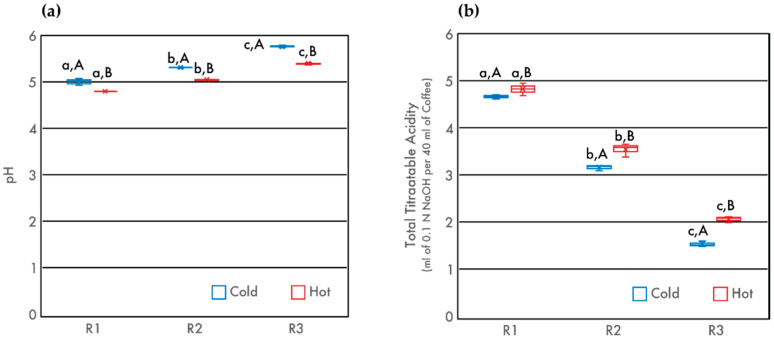
- Coffee acidity decreased as roast level increased; cold brew was less acidic than hot brew by mean pH differences of 0.20, 0.26, and 0.34 for R1, R2, and R3, respectively.
- TDS increased with roast for both methods, but was higher in hot brew than cold brew at all roast levels, and the difference widened with darker roasts.
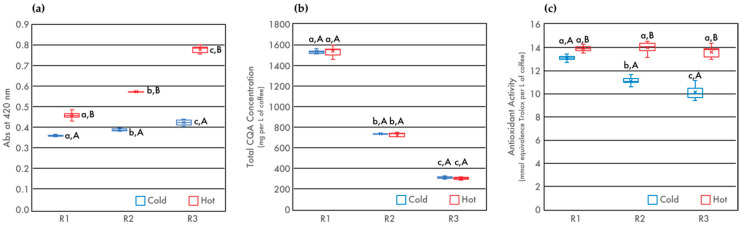
- Browned compounds (Abs 420 nm) increased with roast, and hot brew always had significantly more browned compounds than cold brew.
- Caffeine and total CQA concentration were reported as comparable between hot and cold brew; TAC differed by method and roast, with hot brew TAC constant across roast levels while cold brew TAC decreased with darker roast.
## Methods
- Green organic Colombian beans were roasted to three final temperatures: 194 °C (R1), 203 °C (R2), and 209 °C (R3); four batches were made per roast, then ground coarsely and sieved to 500–2000 µm.
- Hot brew used 20 g coffee + 200 mL DI water at 100 °C for 6 min; cold brew used 20 g coffee + 200 mL DI water at room temperature for 7 h; samples were filtered and analyzed within 10 min.
- Outcomes measured included pH, TTA to pH 6.5, TDS, Abs 420 nm browned compounds, caffeine, total CQA (3-CQA, 4-CQA, 5-CQA), and TAC; analysis used two-way ANOVA with Tukey HSD.
## Limitations
- The paper explicitly notes only one origin/varietal was tested: a single-origin Colombian Arabica coffee, so generalizability to other beans is limited.
- Evidence from the text: brewing was done with one hot protocol (100 °C, 6 min) and one cold protocol (room temperature, 7 h), so the results do not isolate temperature from time or other brewing-condition differences.
- Evidence from the text: the study infers mechanisms such as wetting, pore dynamics, and solubility from measured chemistry, but it does not directly measure those physical processes.
Model-written summary. Check it against the paper before relying on it.
Integrity signals
Registry
Cites
Statistics
Figures
Verification
Claims the paper makes
7 Valid · 0 Not valid · 10 Not checked · 27 Own results and interpretations
The sources with a verdict support this claim; the rest weren’t checked yet, have no full text we could read, or their verdicts aren’t rated yet.
In the paper
“It is known that degree of roast significantly affects the chemistry of hot brew coffee [6,11,12]”
§ Physiochemical Characteristics of Hot and Cold Brew Coffee Chemistry: The Effects of Roast Level and Brewing Temperature on Compound Extraction > 1. Introduction
What the sources say
- Supportedcites [6] Vignoli J.A. Viegas M.C. Bassoli D.G. de Toledo Benassi M. Roasting Process Affects Differently the Bioactive Compounds and the Antioxidant Activity of Arabica and Robusta Coffees Food Res. Int. 2014 61 279 285 10.1016/j.foodres.2013.06.006 source
The Methods (section 2.1.1; page unavailable) describe preparing coffee extracts with water at 95 °C. The Results (section 3.1; page unavailable) report that the levels of several compounds changed as roasting degree increased, supporting the claim for hot-water coffee extracts. (LLM, conf=0.92)
- Not checked — no full text of the sourcecites [11] Ginz M. Balzer H.H. Bradbury A.G.W. Maier H.G. Formation of Aliphatic Acids by Carbohydrate Degradation during Roasting of Coffee Eur. Food Res. Technol. 2000 211 404 410 10.1007/s002170000215 source
- Not checked — no full text of the sourcecites [12] Moon J.-K. Shibamoto T. Role of Roasting Conditions in the Profile of Volatile Flavor Chemicals Formed from Coffee Beans J. Agric. Food Chem. 2009 57 5823 5831 10.1021/jf901136e 19579294 source
boostedstates a cause- Asserted: passes — The authors put it forward as true.
- Checkable: passes — It can be checked against evidence.
- Load-bearing: passes — The paper’s conclusions depend on it.
- Based: passes — The paper gives a reason why it holds.
- Supported
The sources with a verdict support this claim; the rest weren’t checked yet, have no full text we could read, or their verdicts aren’t rated yet.
In the paper
“Two previous studies by Vignoli et al. showed that degree of roast had little effect on the TAC of hot brew coffee [6,28]”
§ Physiochemical Characteristics of Hot and Cold Brew Coffee Chemistry: The Effects of Roast Level and Brewing Temperature on Compound Extraction > 3. Results and Discussion > 3.3. Browned Compounds, CQA Concentration, and Total Antioxidant Capacity (TAC)
What the sources say
- Supportedcites [6] Vignoli J.A. Viegas M.C. Bassoli D.G. de Toledo Benassi M. Roasting Process Affects Differently the Bioactive Compounds and the Antioxidant Activity of Arabica and Robusta Coffees Food Res. Int. 2014 61 279 285 10.1016/j.foodres.2013.06.006 source
Section 2.1.1 describes coffee extracts prepared with 95 °C water to simulate coffee brews. Section 3.2 says antioxidant activity generally remained stable or slightly decreased as roasting increased, supporting the claim's broad summary, although the size of the change depended on the assay. (LLM, conf=0.87)
- Not checked — no full text of the sourcecites [28] Vignoli J.A. Bassoli D.G. Benassi M.T. Antioxidant Activity, Polyphenols, Caffeine and Melanoidins in Soluble Coffee: The Influence of Processing Conditions and Raw Material Food Chem. 2011 124 863 868 10.1016/j.foodchem.2010.07.008 source
plain- Asserted: passes — The authors put it forward as true.
- Checkable: passes — It can be checked against evidence.
- Load-bearing: unclear — It is unclear whether the paper’s conclusions depend on it.
- Based: passes — The paper gives a reason why it holds.
- Supported
The cited sources support only part of this claim — read each source’s verdict below.
In the paper
“It is well established that, as roasting temperature increases, CQA concentrations in the solid bean matrix decrease due to compound degradation [6,25,42,43].”
§ Physiochemical Characteristics of Hot and Cold Brew Coffee Chemistry: The Effects of Roast Level and Brewing Temperature on Compound Extraction > 3. Results and Discussion > 3.3. Browned Compounds, CQA Concentration, and Total Antioxidant Capacity (TAC)
What the sources say
- Partly supportedcites [6] Vignoli J.A. Viegas M.C. Bassoli D.G. de Toledo Benassi M. Roasting Process Affects Differently the Bioactive Compounds and the Antioxidant Activity of Arabica and Robusta Coffees Food Res. Int. 2014 61 279 285 10.1016/j.foodres.2013.06.006 sourceExperimental — accuracy not yet measured
Section 3.1 reports that 5-CQA decreased as roasting degree increased and describes degradation of chlorogenic acids during roasting. But Sections 2.1.1 and 2.2.2 show that the study varied roasting time as well as temperature and measured 5-CQA in brewed soluble solids, not directly in the solid bean matrix. Page numbers are unavailable in our copy. (LLM, conf=0.87)
- Not checked — no full text of the sourcecites [25] Moon J.-K. Yoo H.S. Shibamoto T. Role of Roasting Conditions in the Level of Chlorogenic Acid Content in Coffee Beans: Correlation with Coffee Acidity J. Agric. Food Chem. 2009 57 5365 5369 10.1021/jf900012b 19530715 source
- Partly supportedcites [42] Opitz S.E.W. Smrke S. Goodman B.A. Keller M. Schenker S. Yeretzian C. Antioxidant Generation during Coffee Roasting: A Comparison and Interpretation from Three Complementary Assays Foods 2014 3 586 604 10.3390/foods3040586 28234339 PMC5302239 sourceExperimental — accuracy not yet measured
The Introduction states that chlorogenic acids (CGAs) are partially degraded during roasting, and Results and Discussion §3.2 links higher temperatures to greater CGA degradation. The paper does not directly measure caffeoylquinic acid concentrations in the solid bean matrix; it infers CGA degradation from antioxidant-assay results, so the claim is more specific than the evidence. (LLM, conf=0.86)
- Not checked — no full text of the sourcecites [43] Nicoli M.C. Anese M. Manzocco L. Lerici C.R. Antioxidant Properties of Coffee Brews in Relation to the Roasting Degree LWT Food Sci. Technol. 1997 30 292 297 10.1006/fstl.1996.0181 source
boostedstates a cause- Asserted: passes — The authors put it forward as true.
- Checkable: passes — It can be checked against evidence.
- Load-bearing: unclear — It is unclear whether the paper’s conclusions depend on it.
- Based: passes — The paper gives a reason why it holds.
- Partly supported
None of the sources cited for this claim have been checked yet.
In the paper
“As was found in previous studies [8,26], TDS was higher for hot brew coffees than cold brew coffees at all roast levels.”
§ Physiochemical Characteristics of Hot and Cold Brew Coffee Chemistry: The Effects of Roast Level and Brewing Temperature on Compound Extraction > 3. Results and Discussion > 3.2. Total Dissolved Solids (TDS)
plainstates an association- Asserted: passes — The authors put it forward as true.
- Checkable: passes — It can be checked against evidence.
- Load-bearing: passes — The paper’s conclusions depend on it.
- Based: passes — The paper gives a reason why it holds.
A result the paper states — it cites no source for it, so there is none to check. The quote shows it is in the paper.
In the paper
“Similar to TDS, the difference in the concentration of browned compounds between cold and hot brew samples increased with degree of roast.”
§ Physiochemical Characteristics of Hot and Cold Brew Coffee Chemistry: The Effects of Roast Level and Brewing Temperature on Compound Extraction > 3. Results and Discussion > 3.3. Browned Compounds, CQA Concentration, and Total Antioxidant Capacity (TAC)
plainstates an association- Asserted: passes — The authors put it forward as true.
- Checkable: passes — It can be checked against evidence.
- Load-bearing: unclear — It is unclear whether the paper’s conclusions depend on it.
- Based: passes — The paper gives a reason why it holds.
29 more claims
Create a free account to see all 44 claims and every source verdict.
- Borderline: one of the tests for a substantial claim is unclear. 2
- Probably not a substantial claim. 4
- It may state two separate claims as one. 5
Claims other papers make about this one
Each is checked against this paper’s own text: does it say what the citing paper says it does?
The source backs part of the claim, not all of it — or backs it for a different population, condition or comparison.
In the citing paper
“no significant difference was detected in the quantities of a few common compounds associated with coffee bitterness, such as total caffeoylquinic acids, caffeine, and trigonelline [11,12].”
From Comparative Profiling of Hot and Cold Brew Coffee Flavor Using Chromatographic and Sensory Approaches (2022) · cites this paper as [12]
Experimental — accuracy not yet measuredThe cited source says what the claim attributes to it.
In the citing paper
“Recent studies indicate that hot and cold brew coffees have small but important differences, particularly in the total antioxidant capacity of the resulting coffee [21].”
From Effects of Coffee and Its Components on the Gastrointestinal Tract and the Brain–Gut Axis (2020) · cites this paper as [21]
Self-check
Percentages, sums and reported differences re-computed from the paper’s own numbers.
Each contradiction between two passages listed here was confirmed by an independent check.
Rated major: it would touch a result — a value a result rests on, reported and recomputed p-values on opposite sides of the significance level, two passages that conflict with no sign which is right, or a cited work retracted before this paper was published.
In the paper
§ Physiochemical Characteristics of Hot and Cold Brew Coffee Chemistry: The Effects of Roast Level and Brewing Temperature on Compound Extraction > 3. Results and Discussion > 3.3. Browned Compounds, CQA Concentration, and Total Antioxidant Capacity (TAC)
“Degree of roast did not significantly affect TAC in hot brew coffees, as shown by a two-way ANOVA analysis.”
§ Physiochemical Characteristics of Hot and Cold Brew Coffee Chemistry: The Effects of Roast Level and Brewing Temperature on Compound Extraction > 4. Conclusions
“This study found that pH, TTA, concentration of browned compounds, and TAC for both cold and hot brew coffees varied by each of the three roast levels tested.”
Citations
Cites
Antioxidant activity applying an improved ABTS radical cation decolorization assay
Re, R., Pellegrini, N., Proteggente, A., Pannala, A., Yang, M., & Rice-Evans, C. (1999) · Free Radical Biology and Medicine · doi:10.1016/s0891-5849(98)00315-3 · Cited by 26,165
Melanoidins produced by the Maillard reaction: Structure and biological activity
Wang, H.-Y., Qian, H., & Yao, W.-R. (2011) · Food Chemistry · doi:10.1016/j.foodchem.2011.03.075 · Cited by 719 · cited 1×
“Natural phenolic and other acids are lost during heating, while Maillard reaction products, including melanoidins, are generated [4].”
BackgroundEffect of Roasting on the Formation of Chlorogenic Acid Lactones in Coffee
Farah, A., de Paulis, T., Trugo, L. C., & Martin, P. R. (2005) · Journal of Agricultural and Food Chemistry · doi:10.1021/jf048701t · Cited by 540 · cited 1×
“During roasting, CQA concentrations decrease due to transformation into chlorogenic acid lactones [17] and partial incorporation into the production of melanoidin compounds [59,60].”
BackgroundChemical Characterization and Antioxidant Properties of Coffee Melanoidins
Borrelli, R. C., Visconti, A., Mennella, C., Anese, M., & Fogliano, V. (2002) · Journal of Agricultural and Food Chemistry · doi:10.1021/jf025686o · Cited by 384
Vignoli, J. A., Bassoli, D. G., & Benassi, M. T. (2011) · Food Chemistry · doi:10.1016/j.foodchem.2010.07.008 · Cited by 375 · cited 3×
“showed that degree of roast had little effect on the TAC of hot brew coffee [6,28], which agrees with the TAC profile observed in hot brew coffee here.”
BackgroundResultEffect of Roasting on the Antioxidant Activity of Coffee Brews
del Castillo, M. D., Ames, J. M., & Gordon, M. H. (2002) · Journal of Agricultural and Food Chemistry · doi:10.1021/jf011702q · Cited by 372
Hečimović, I., Belščak-Cvitanović, A., Horžić, D., & Komes, D. (2011) · Food Chemistry · doi:10.1016/j.foodchem.2011.05.059 · Cited by 334 · cited 2×
“However, a decrease in caffeine concentrations due to degradation during roasting has been observed in other studies [48,56].”
MethodResultAssessing the Antioxidant Activity of Melanoidins from Coffee Brews by Different Antioxidant Methods
Delgado-Andrade, C., Rufián-Henares, J. A., & Morales, F. J. (2005) · Journal of Agricultural and Food Chemistry · doi:10.1021/jf0512353 · Cited by 334
Antioxidant Properties of Coffee Brews in Relation to the Roasting Degree
Nicoli, M. C., Anese, M., Manzocco, L., & Lerici, C. R. (1997) · LWT - Food Science and Technology · doi:10.1006/fstl.1996.0181 · Cited by 299 · cited 2×
“It is well established that, as roasting temperature increases, CQA concentrations in the solid bean matrix decrease due to compound degradation [6,25,42,43].”
BackgroundVignoli, J. A., Viegas, M. C., Bassoli, D. G., & Benassi, M. D. T. (2014) · Food Research International · doi:10.1016/j.foodres.2013.06.006 · Cited by 261 · cited 8×
“argued that, although prolonged roasting may not produce enough additional antioxidant compounds to compensate for the loss of phenolic compounds, significant structural changes in the sold bean matrix may increase the extraction efficiency for all antioxidant compounds [6,28].”
BackgroundResultInfluential
Cited by
Acids in coffee: A review of sensory measurements and meta-analysis of chemical composition
Yeager, S. E., Batali, M. E., Guinard, J.-X., & Ristenpart, W. D. (2023) · Critical Reviews in Food Science and Nutrition · doi:10.1080/10408398.2021.1957767 · Cited by 173
From Plantation to Cup: Changes in Bioactive Compounds during Coffee Processing
Bastian, F., Hutabarat, O. S., Dirpan, A., Nainu, F., Harapan, H., Emran, T. B., & Simal-Gandara, J. (2021) · Foods · doi:10.3390/foods10112827 · Cited by 167
Effects of Coffee and Its Components on the Gastrointestinal Tract and the Brain–Gut Axis
Iriondo-DeHond, A., Uranga, J. A., del Castillo, M. D., & Abalo, R. (2020) · Nutrients · doi:10.3390/nu13010088 · Cited by 126
Córdoba, N., Moreno, F. L., Osorio, C., Velásquez, S., & Ruiz, Y. (2021) · Food Research International · doi:10.1016/j.foodres.2021.110141 · Cited by 101
Review on factors affecting coffee volatiles: from seed to cup
Wang, X., Wang, Y., Hu, G., Hong, D., Guo, T., Li, J., Li, Z., & Qiu, M. (2021) · Journal of the Science of Food and Agriculture · doi:10.1002/jsfa.11647 · Cited by 121
Influence of Various Factors on Caffeine Content in Coffee Brews
Olechno, E., Puścion‐Jakubik, A., Zujko, M. E., & Socha, K. (2021) · Foods · doi:10.3390/foods10061208 · Cited by 154
“Caffeine concentrations in Arabica coffee ranged from 0.062 g in Angeloni et al. (2018) [64] to 0.131 g in Rao et al. (2020) [61].”
BackgroundMethodInfluentialCoffee and Arterial Hypertension
Surma, S., & Oparil, S. (2021) · Current Hypertension Reports · doi:10.1007/s11906-021-01156-3 · Cited by 115
Stanek, N., Zarębska, M., Biłos, Ł., Barabosz, K., Nowakowska‐Bogdan, E., Semeniuk, I., Błaszkiewicz, J., Kulesza, R., Matejuk, R., & Szkutnik, K. (2021) · Scientific Reports · doi:10.1038/s41598-021-01001-2 · Cited by 89
Muzykiewicz-Szymańska, A., Nowak, A., Wira, D., & Klimowicz, A. (2021) · Molecules · doi:10.3390/molecules26123681 · Cited by 86
Córdoba, N., Moreno, F. L., Osorio, C., Velásquez, S., Fernandez-Alduenda, M., & Ruiz-Pardo, Y. (2021) · LWT · doi:10.1016/j.lwt.2021.111363 · Cited by 62
Farag, M. A., Zayed, A., Sallam, I. E., Abdelwareth, A., & Wessjohann, L. A. (2022) · Foods · doi:10.3390/foods11060864 · Cited by 69
Abdelwareth, A., Zayed, A., & Farag, M. A. (2021) · Food Chemistry · doi:10.1016/j.foodchem.2021.129162 · Cited by 64
The changes in chemical properties of coffee during roasting: A review
Tarigan, E. B., Wardiana, E., Hilmi, Y. S., & Komarudin, N. A. (2022) · IOP Conference Series Earth and Environmental Science · doi:10.1088/1755-1315/974/1/012115 · Cited by 92
Zhai, X., Yang, M., Zhang, J., Zhang, L., Tian, Y., Li, C., Bao, L., Ma, C., & El‐Aty, A. M. A. (2022) · Frontiers in Nutrition · doi:10.3389/fnut.2022.849811 · Cited by 54
“Qualitative Analysis A total of 97 volatile compounds were identified in hot and cold coffee brews, including furans (16), pyrazines (16), alcohols (10), pyrroles (7), aldehydes (4), ketones (11), phenols (7), pyridines (3), acids (3), esters (11), and others (9).”
BackgroundPortela, C. D. S., Almeida, I. F. D., Mori, A. L. B., Yamashita, F., & Benassi, M. D. T. (2021) · LWT · doi:10.1016/j.lwt.2021.111090 · Cited by 47
Santanatoglia, A., Angeloni, S., Fiorito, M., Fioretti, L., Ricciutelli, M., Sagratini, G., Vittori, S., & Caprioli, G. (2023) · Journal of Food Composition and Analysis · doi:10.1016/j.jfca.2023.105732 · Cited by 56
Extraction techniques in food industry: Insights into process parameters and their optimization
Sridhar, A., Vaishampayan, V., Kumar, P. S., Ponnuchamy, M., & Kapoor, A. (2022) · Food and Chemical Toxicology · doi:10.1016/j.fct.2022.113207 · Cited by 53
Hu, Q., Sellers, C., Kwon, J. S., & Wu, H. (2022) · Digital Chemical Engineering · doi:10.1016/j.dche.2022.100020 · Cited by 46
“To evaluate the flavors of coffee beverages, we prepared aqueous coffee samples using the classic cold brew method (Baggenstoss et al., 2008; Rao et al., 2020; Semmelroch and Grosch, 1996).”
MethodClaassen, L., Rinderknecht, M., Porth, T., Röhnisch, J., Seren, H. Y., Scharinger, A., Gottstein, V., Noack, D., Schwarz, S., Winkler, G., et al. (2021) · Foods · doi:10.3390/foods10040865 · Cited by 47
Kim, C., Park, S. J., Yu, J. S., & Lee, D. Y. (2022) · Food Chemistry · doi:10.1016/j.foodchem.2022.133749 · Cited by 43
Wang, M., Jian, Z., Chi, Y., Jin, X., Li, H., & Wang, K. (2021) · Nutrients · doi:10.3390/nu13072317 · Cited by 39
Cai, Y., Xu, Z., Pan, X., Gao, M., Wu, M., Wu, J., & Lao, F. (2022) · Foods · doi:10.3390/foods11192968 · Cited by 31
Coffee and cardiac arrhythmias: Up-date review of the literature and clinical studies
Surma, S., Romańczyk, M., Filipiak, K. J., & Lip, G. Y. H. (2022) · Cardiology Journal · doi:10.5603/cj.a2022.0068 · Cited by 40
“Worldwide, from the commercial point of view, the most important types are Arabica coffee ( Cof-fea arabica ), robusta coffee ( Coffea canephora ) and Liberian coffee ( Coffea liberica ) (Table 1) [17–19].”
Lopes, G. R., Petronilho, S., Ferreira, A. S., Pinto, M., Passos, C. P., Coelho, E., Rodrigues, C., Figueira, C., Rocha, S. M., & Coimbra, M. A. (2021) · Foods · doi:10.3390/foods10102508 · Cited by 36
Wang, X., & Lim, L. (2023) · Applied Food Research · doi:10.1016/j.afres.2023.100334 · Cited by 38
Extraction and physicochemical characteristics of high pressure-assisted cold brew coffee
Zhang, L., Wang, X., Manickavasagan, A., & Lim, L. (2022) · Future Foods · doi:10.1016/j.fufo.2022.100113 · Cited by 30
Portela, C. D. S., de Almeida, I. F., dos Reis, T. A. D., BÖGER, B. R., & Benassi, M. D. T. (2021) · Food Research International · doi:10.1016/j.foodres.2021.110860 · Cited by 33
Kwok, R., Lee, K. W. T., Schwarz, S., Claassen, L., & Lachenmeier, D. W. (2020) · Challenges · doi:10.3390/challe11020026 · Cited by 27
Comparison of Characterization of Cold Brew and Hot Brew Coffee Prepared at Various Roasting Degrees
Pan, L., Xiao, Y., Jiang, F., Jiang, T., Zhu, J. F., Tang, W., Liu, X., Zhou, Y., & Yu, L. M. (2023) · Journal of Food Processing and Preservation · doi:10.1155/2023/3175570 · Cited by 32
Physicochemical Properties and Structure Changes of Food Products during Processing
Igual, M., & Martı́nez-Monzó, J. (2022) · Foods · doi:10.3390/foods11152365 · Cited by 31
Wang, X., & Lim, L. (2021) · Journal of Food Process Engineering · doi:10.1111/jfpe.13748 · Cited by 22
Ismail, B. B., Huang, R., Liu, D., Ye, X., & Guo, M. (2022) · Food Chemistry · doi:10.1016/j.foodchem.2022.133475 · Cited by 26
Uslu, N. (2022) · European Food Research and Technology · doi:10.1007/s00217-022-04027-6 · Cited by 26
“The obtained results showed that the brewing method or time had major effects on total phenolic, total flavonoid, total tannin, and caffeine contents, antioxidant activity (DPPH and ABTS) and phenolic compounds (especially catechin and caffeic acid).”
MethodInfluentialChen, S., Xiao, Y., Tang, W., Jiang, F., Zhu, J. F., Zhou, Y., & Ye, L. (2023) · Foods · doi:10.3390/foods12203857 · Cited by 22
“To achieve total titratable acidity (TTA), 50 mL of the coffee extract was titrated with 0.1 M NaOH until pH 6.5 was attained [6].”
MethodInfluentialKyroglou, S., Laskari, R., & Vareltzis, P. K. (2022) · Molecules · doi:10.3390/molecules27092971 · Cited by 21
Yust, B. G., Rao, N. Z., Schwarzmann, E. T., & Peoples, M. (2022) · Molecules · doi:10.3390/molecules27165124 · Cited by 21
Self-citationLapčíková, B., Lapčík, L., Barták, P., Valenta, T., & Dokládalová, K. (2023) · Foods · doi:10.3390/foods12224125 · Cited by 28
“The aroma compounds in cold brews significantly differ from those in hot brews [2,5] and offer a sensory profile preferred over that of static cold coffee beverages [3].”
BackgroundHernández‐Montesinos, I. Y., Carreón‐Delgado, D. F., Lazo-Zamalloa, O., Tapia-López, L., Morales, M. R., Ochoa‐Velasco, C. E., Hernández‐Carranza, P., Cruz‐Narváez, Y., & Ramírez‐López, C. (2024) · Antioxidants · doi:10.3390/antiox13080925 · Cited by 22
How Coffee Capsules Affect the Volatilome in Espresso Coffee
Greco, G., Núñez-Carmona, E., Abbatangelo, M., et al. (2021) · Separations · doi:10.3390/separations8120248 · Cited by 16
Variables Affecting the Extraction of Antioxidants in Cold and Hot Brew Coffee: A Review
Yust, B. G., Wilkinson, F. H., & Rao, N. Z. (2023) · Antioxidants · doi:10.3390/antiox13010029 · Cited by 24
“In a follow up study, they found a general inverse trend be-tween 5-CQA concentration and degree of roast in Colombian coffee with 757 ± 27 mg/L, 353 ± 15 mg/L, and 147 ± 14 mg/L reported for light, medium, and dark roasts, respectively, after 420 min of brewing [136].”
BackgroundSelf-citationPonder, A., Krakówko, K., Kruk, M., Kuliński, S., Magoń, R., Ziółkowski, D., Jariené, E., & Hallmann, E. (2025) · Molecules · doi:10.3390/molecules30061290 · Cited by 16
Antioxidant Activity of Coffee Components Influenced by Roast Degree and Preparation Method
Wołosiak, R., Pakosz, P., Drużyńska, B., & Janowicz, M. (2023) · Applied Sciences · doi:10.3390/app13042057 · Cited by 23
Jeong, H., Yoon, S., Jo, S. M., Hong, S. J., Kim, Y. J., Kim, J. K., & Shin, E. (2023) · Journal of Food Science · doi:10.1111/1750-3841.16470 · Cited by 18
Duangjai, A., Saokaew, S., Goh, B. H., & Phisalprapa, P. (2021) · Frontiers in Nutrition · doi:10.3389/fnut.2021.724591 · Cited by 15
“(10), who found that roasting had more of an influence on the acidity of the brew than the water extraction temperature.”
BackgroundInfluentialUltrafast cold-brewing of coffee by picosecond-pulsed laser extraction
Ziefuß, A. R., Hupfeld, T., Meckelmann, S. W., Meyer, M., Schmitz, O. J., Kaziur-Cegla, W., Tintrop, L. K., Schmidt, T. C., Gökce, B., & Barcikowski, S. (2022) · npj Science of Food · doi:10.1038/s41538-022-00134-6 · Cited by 16
Lin, Y.-W., Lu, W.-C., Liao, C.-H., & Huang, P. (2024) · Journal of Agriculture and Food Research · doi:10.1016/j.jafr.2024.101024 · Cited by 18
Zakaria, N. H., Whanmek, K., Thangsiri, S., Chathiran, W., Srichamnong, W., Suttisansanee, U., & Santivarangkna, C. (2023) · Foods · doi:10.3390/foods12122412 · Cited by 10
“This is contradictory to the finding by Rao et al. (2020), where the caffeine concentration was similar in both cold and hot brew coffee samples [33].”
ResultBaşaran, B., Abanoz, Y. Y., & Boyraz, A. (2024) · Journal of Food Composition and Analysis · doi:10.1016/j.jfca.2024.106420 · Cited by 10
Maiyah, N., Kerdpiboon, S., Supapvanich, S., KERR, W. L., Sriprom, P., Chotigavin, N., Klaypradit, W., & Puttongsiri, T. (2025) · Journal of Agriculture and Food Research · doi:10.1016/j.jafr.2025.101789 · Cited by 27
Barroso, L. A., Macedo, A. S., Lemos, I. L., Neves, N. D. A., Schmiele, M. M., da Silveira, J. V. W., Amaral, T. N., & Fonte, P. (2022) · JSFA reports · doi:10.1002/jsf2.33 · Cited by 11
Using ground coffee particle size and distribution to remodel beverage properties
Angeloni, G., Masella, P., Spadi, A., Guerrini, L., Corti, F., Bellumori, M., Calamai, L., Innocenti, M., & Parenti, A. (2023) · European Food Research and Technology · doi:10.1007/s00217-023-04210-3 · Cited by 23
“These studies have been focused on the impact of grinding step on the physical (pH, total solids), chemical (kinetics and mechanism of Caffeine and CGAs infusion) [2, 13] Particularly, Severini and co-authors [14] showed that a highly significant source of variation in espresso coffee quality was the grinding class, a…”
BackgroundShi, Q., Xiao, Y., Zhou, Y., Tang, W., Jiang, F., Zhou, X., & Lu, H. (2024) · Foods · doi:10.3390/foods13193119 · Cited by 12
Nerurkar, P. V., Yokoyama, J., Ichimura, K., Kutscher, S., Wong, J., Bittenbender, H. C., & Deng, Y. (2023) · Metabolites · doi:10.3390/metabo13030412 · Cited by 11
Physicochemical Analysis of Cold Brew and Hot Brew Peaberry Coffee
Schwarzmann, E. T., Washington, M. P., & Rao, N. Z. (2022) · Processes · doi:10.3390/pr10101989 · Cited by 13
Self-citationImpact of The Roast Level on Chemical Composition of Coffee from Colombia
Laukaleja, I., Krūma, Z., & Cinkmanis, I. (2022) · Proceedings of the Latvian Academy of Sciences Section B Natural Exact and Applied Sciences · doi:10.2478/prolas-2022-0022 · Cited by 9
Hanifah, D., Andarwulan, N., & Herawati, D. (2022) · Jurnal Teknologi dan Industri Pangan · doi:10.6066/jtip.2022.33.1.39 · Cited by 16
“…masa seduhannya, yang perbedaan nilai TPTnya diduga berkorelasi terhadap perbedaan komposisi kimia kopi (Cordoba et al., 2020), selain itu struktur mikro pada biji dilaporkan berkorelasi terhadap efektivitas ekstraksi padatan terlarutnya sehingga berpengaruh terhadap TPT seduhan (Rao et al., 2020).”
BackgroundPolanco-Estibález, B., García-Santa-Cruz, R., Queirós, R. P., Serment‐Moreno, V., González-Angulo, M., Tonello-Samson, C., & Rivero-Perez, M. D. (2023) · Foods · doi:10.3390/foods12234231 · Cited by 10
Caffeine content in filter coffee brews as a function of degree of roast and extraction yield
Lindsey, Z. R., Williams, J. R., Burgess, J. S., Moore, N. T., & Splichal, P. A. (2024) · Scientific Reports · doi:10.1038/s41598-024-80385-3 · Cited by 15
“Most of these studies only quantified changes in “brew strength” via measurements of total dissolved solids (TDS), and conflicting trends of increasing 10,37 and decreasing 38 TDS values with increasing degree of roast were reported.”
Cerca, N. F., DePaula, J., Calado, V. M. D. A., Miguel, M. A. L., & Farah, A. (2023) · Food Research International · doi:10.1016/j.foodres.2023.113667 · Cited by 6
León-Inga, A. M., Velásquez, S., Quintero, M., Taborda, N., & Cala, M. P. (2024) · Food Chemistry · doi:10.1016/j.foodchem.2024.139396 · Cited by 6
Narváez, E., Zapata, E., Dereix, J. D., Lopez, C., Gutiérrez, S. A. T., & Zapata, J. (2024) · Molecules · doi:10.3390/molecules29163791 · Cited by 6
“Two methodologies have become famous for CB preparation: the cold drip system, which allows continuous water renewal, and cold immersion systems, in which coffee is directly immersed in water [4].”
MethodPatil, S. A., & Murthy, P. S. (2022) · Waste and Biomass Valorization · doi:10.1007/s12649-022-01771-4 · Cited by 6
“Samples (50 μl) were diluted up to 1 ml with deionized water [12].”
MethodMaksimowski, D., Oziembłowski, M., Kolniak‐Ostek, J., Stach, M., Zubaidi, M. A., & Nawirska‐Olszańska, A. (2023) · Foods · doi:10.3390/foods12203840 · Cited by 9
“…et al. [18], cold brewing methods significantly increased the ABTS, whereas the data of analyzed CQA concentrations along with isomers by Rao et al. [19] indicate that the water extraction temperature does not significantly differentiate the total content of compounds between cold brew and hot brew.”
BackgroundJeon, H., Park, H.-J., & Lee, K. (2025) · Food Chemistry · doi:10.1016/j.foodchem.2025.147509 · Cited by 7
Choe, W., Woo, J., Hong, M., Jang, H., Deepa, P., & Kim, S. (2023) · Journal of Applied Pharmaceutical Science · doi:10.7324/japs.2023.143318 · Cited by 13
“In general, coffee beans produce different aromas under identical roasting or brewing conditions due to coffee bean cultivars, geographical origins, and postharvest treatments (Lopez-Galilea et al ., 2006; Pereira et al ., 2019; Rao et al ., 2020).”
Quality Characteristics and Acrylamide Content Based on Coffee Bean Roasting Conditions
Hwang, E., & Moon, S. (2022) · Journal of the Korean Society of Food Science and Nutrition · doi:10.3746/jkfn.2022.51.7.697 · Cited by 5
Otsogile, K., Seifu, E., & Bultosa, G. (2022) · Heliyon · doi:10.1016/j.heliyon.2022.e10829 · Cited by 9
“Three drops of phenolphthalein were added as an indicator and the solution was titrated with 0.1 N NaOH (Rao et al., 2020).”
InfluentialSensory and Physicochemical Characteristics of Two Common Roast Defects in Robusta Coffee
Sunarharum, W. B., Mahatmanto, T., Ali, D. Y., Prananto, Y. P., Efrat, N., Asih, N. E., & Mirillia, N. G. (2022) · International Journal on Advanced Science Engineering and Information Technology · doi:10.18517/ijaseit.12.1.13805 · Cited by 7
Effect of ultraviolet irradiation on the shelf life and chemical composition of cold brew coffee
Orjuela, M. A., Moreno, F. L., Córdoba, N., Osorio, C., & Ruiz-Pardo, R. Y. (2024) · Food and Bioproducts Processing · doi:10.1016/j.fbp.2024.11.007 · Cited by 4
The Effect of Type and Duration of Digestive Enzyme Treatment on Coffee Bean Composition
Pakosz, P., Wołosiak, R., Drużyńska, B., et al. (2024) · Applied Sciences · doi:10.3390/app14062484 · Cited by 4
Review of Various Influential Factors in the Production of Robusta Coffee Effervescent Drink Tablets
Ni’mah, M. W., Lestari, D. D., Maulida, A. R., & Hasbullah, U. H. A. (2021) · International Journal of Advance Tropical Food · doi:10.26877/ijatf.v3i1.9349 · Cited by 4
“This causes lower hygroscopic power (Regiarti & Susanto, 2015).”
BackgroundFoster, J. M., Lee, W. T., Moroney, K. M., Prjamkov, D., Salamon, M., Smith, A. P., Petrassem-de-Sousa, J., & Vynnycky, M. (2025) · Physics of Fluids · doi:10.1063/5.0245167 · Cited by 3
Kowalski, R. K., Belniak, K., Kowalska, G., Włodarczyk-Stasiak, M., Mazurek, A., & Baj, T. (2025) · Frontiers in Chemistry · doi:10.3389/fchem.2025.1681137 · Cited by 4
Processing and Shelf Life of Cold Brew Organic Coffee
Soares, E. A., Bento, G. P., Nogueira, L., Arismendes, T. L. C., Machado, C. L. D. O., Guerra, E. L., Verruma-Bernardi, M. R., & Petrus, R. R. (2025) · Processes · doi:10.3390/pr13010243 · Cited by 4
Effects of Roasting Degree and Grinding Size on Caffeine Content and Sensorial Quality of Coffee
Duke, B. W., Mokonon, M. A., Mekonin, N. D., & Kuffi, K. D. (2025) · Journal of Food Quality · doi:10.1155/jfq/2405668 · Cited by 6
Assessment of the physical stability of cold brew coffee in retorted beverages
Kazes, S., Sanchez, J., Quintero, M., Velásquez, S., Restrepo, T., & Casanova, H. (2024) · Journal of Food Composition and Analysis · doi:10.1016/j.jfca.2024.106210 · Cited by 5
Physicochemical, Antioxidant and Mineral Composition of Cascara Beverage Prepared by Cold Brewing
Muriqi, S., Červenka, L., Česlová, L., Kašpar, M., Řezková, S., Husáková, L., Patočka, J., Česla, P., & Velichová, H. (2025) · Food Technology and Biotechnology · doi:10.17113/ftb.63.01.25.8605 · Cited by 3
“It also contains less caffeine and brown compounds than its hot-brewed counter-part ( 14,16,17 ).”
InfluentialYu, J., Zhou, L. L., Chen, Z., & Luning, P. A. (2025) · Comprehensive Reviews in Food Science and Food Safety · doi:10.1111/1541-4337.70286 · Cited by 2
Effects of grind size and brewing time on properties of cold brewed Robusta Ijen coffee
JAYUS, J., Darmajana, D. A., Fitria, A. N., & Afriliana, A. (2026) · Journal of Food Science and Technology · doi:10.1007/s13197-026-06628-5 · Cited by 3
Darmajana, D. A., WULANDARI, R., & Sagita, D. (2022) · INMATEH Agricultural Engineering · doi:10.35633/inmateh-68-83 · Cited by 4
Physicochemical properties of robusta coffee during roasting temperature and time degradation
Tarigan, E. B., Hanifah, D., & Rahardini, R. F. (2024) · AIP conference proceedings · doi:10.1063/5.0184639 · Cited by 2
Assessing the antioxidant potential of soft beverages in the Turkish market: a comprehensive study
Yeniçağ, R., & Rakıcıoğlu, N. (2024) · International Journal of Food Properties · doi:10.1080/10942912.2024.2322160 · Cited by 4
Karpova, M. O., Makarova, N. V., Ignatova, D. F., & Budylin, D. V. (2021) · Научный журнал НИУ ИТМО. Серия «Процессы и аппараты пищевых производств» · doi:10.17586/2310-1164-2021-14-3-49-59 · Cited by 2
Food Processing and Its Impact on Phenolic and other Bioactive Constituents in Food
Oszmiański, J., & Lachowicz, S. (2022) · MDPI eBooks · doi:10.3390/books978-3-0365-4459-5 · Cited by 1
Evaluating acidity levels in packaged coffee to enhance product label accuracy
Eddin, A. S., Yeboah, P. J., & Ibrahim, S. A. (2024) · Bioactive Compounds in Health and Disease · doi:10.31989/bchd.v7i3.1303 · Cited by 3
“CGAs, particularly chloroquinic acids, contribute to coffee's bitterness and are recognized for their antioxidant properties, which could potentially offer health advantages to coffee consumers [9].”
BackgroundResultRahmawati, I., & Asrori, S. H. (2024) · JKPK (Jurnal Kimia dan Pendidikan Kimia) · doi:10.20961/jkpk.v9i1.84991 · Cited by 2
“In contrast, the cold brew technique involves brewing at room temperature (20-25°C or colder) and steeping for 8 to 24 hours, significantly longer than the traditional hot brew method [17].”
BackgroundCold Brew Coffee: Profile and Preservation
Soares, E. A., & Petrus, R. R. (2024) · Food Reviews International · doi:10.1080/87559129.2024.2438301 · Cited by 2
“[103,104] Rao, Fuller and Grim [26] investigated differences between the antioxidant activity in hot and CBC drinks prepared with beans subjected to light, medium and dark roasting, with no difference being found ( p ≤ 0.05) between the brewing methods.”
InfluentialNILOVA, L. P., Malyutenkova, S. M., & Tverskoy, V. (2025) · New Technologies · doi:10.47370/2072-0920-2024-20-4-35-44 · Cited by 1
Hlangwani, E., & Dlamini, B. C. (2025) · South African Journal of Botany · doi:10.1016/j.sajb.2025.10.036 · Cited by 1
Gulshan, A., Yiasmin, M. N., Zeb, M., Mushtaq, A., Cao, W., Lu, R., Li, X., & Hua, X. (2025) · Food Chemistry · doi:10.1016/j.foodchem.2025.147716 · Cited by 5
Eder, M., Bacher, M., Rosenau, T., & Potthast, A. (2026) · Carbohydrate Polymers · doi:10.1016/j.carbpol.2026.125285 · Cited by 1
Direct electrochemical appraisal of black coffee quality using cyclic voltammetry
Bumbaugh, R. E., Pennington, D. L., Wehn, L. C., Rheingold, E. J., Williams, J. R., Alemán, B. J., & Hendon, C. H. (2026) · Nature Communications · doi:10.1038/s41467-026-71526-5 · Cited by 7
“However, the response does not fully address my concerns regarding the influence of the applied electric field or the liquid environment, both of which are known to significantly affect adsorption behavior in electrochemical systems.”
Green antioxidant composites based on coffee by-products from the alcohol industry
Terroba-Delicado, E., Martínez, J. I., Gómez-Caturla, J., Sánchez‐Nacher, L., & Muñoz, N. M. (2023) · Green Materials · doi:10.1680/jgrma.22.00084 · Cited by 1
Concentration gradient inversion via sedimentation of coffee grounds in full immersion brewing
Liang, J., Brown, H. G., Dunkin, M. M., & Ristenpart, W. D. (2023) · Journal of Food Engineering · doi:10.1016/j.jfoodeng.2023.111619 · Cited by 1
Violin, J. L., Acre, L. B., Francisco, J. S., Mori, A. L. B., & Benassi, M. D. T. (2021) · Coffee Science · doi:10.25186/.v16i.1911 · Cited by 2
Kārkliņa, K., & Kampuse, S. (2021) · Proceedings of the Latvian Academy of Sciences Section B Natural Exact and Applied Sciences · doi:10.2478/prolas-2021-0070 · Cited by 2
“The extracts of other coffee brands had higher soluble solid concentration in samples with the cold-brew preparation method (Rao et al., 2020).”
BackgroundMethodRamadhan, I., & Murtini, E. S. (2022) · Jurnal Teknologi Pertanian · doi:10.21776/ub.jtp.2022.023.03.1 · Cited by 6
Pajarwati, P., Wijaya, A., & Santoso, B. (2023) · World Journal of Advanced Research and Reviews · doi:10.30574/wjarr.2023.18.3.1061
“Brewing using water with different temperatures and brewing times will trigger different chemical reactions and affect the number of chemical compounds dissolved [3].”
BackgroundEvaluating Acidity Levels in Packaged Coffee to Enhance Product Label AccuracyPreprint
Eddin, A. S., Yeboah, P. J., & Ibrahim, S. A. (2023) · Preprints.org · doi:10.20944/preprints202311.1451.v1
Metadata
- Authors
- Rao, N. Z., Fuller, M., & Grim, M. D.
- Affiliations
- Thomas Jefferson University (US)
- Corresponding author
- Rao, Niny Z.
- Venue
- Foods
- Publisher
- MDPI AG
- Published
- 2020-07-09
- Volume
- 9
- Issue
- 7
- Pages
- 902
- ISSN
- 2304-8158 (ISSN-L)
- PMC
- PMC7404565
- OpenAlex
- W3041291741
- Semantic Scholar
- 1acfebba99b1ff7b99b89d8795b868280bc6e920
- Cited by
- 113
- References
- 62
- Citations by year
- 2026: 9 · 2025: 17 · 2024: 18 · 2023: 18 · 2022: 27 · 2021: 22 · 2020: 2
- FWCI
- 10.36
- Type
- journal article
- Language
- en
- Open access
- gold
- dx.doi.org
- Licence
- Locations
- Foods (publishedVersion, cc-by)
- PubMed Central (publishedVersion, cc-by)
- PubMed (publishedVersion)
- The Medicine Forum (submittedVersion, cc-by)
- DOAJ (DOAJ: Directory of Open Access Journals) (submittedVersion, cc-by-sa)
- Funders
- National Institute of Food and Agriculture (2019-67018-29187/1018488)
- Topics
- Health Sciences › Medicine › Pharmacology (medical) › Coffee research and impacts
- Life Sciences › Agricultural and Biological Sciences › Food Science › Food Chemistry and Fat Analysis
- Life Sciences › Agricultural and Biological Sciences › Food Science › Fermentation and Sensory Analysis
- Keywords
- cold brew coffee, coffee roasting, brewing temperature, extraction, Coffea arabica, total antioxidant capacity, coffee acidity, total dissolved solids, water temperature
About these checks
Registry, retraction, Cites and statistics results are computed, not judged, with one exception: a printed reference that no index lists is read once by a model before it counts as a citation error. Claims are extracted by a model and kept only when their quote appears verbatim in the text; each cited source is then checked, with a model’s help, for whether it says what the claim relies on. Those verdicts can be wrong — read the claim’s quote and the cited source before relying on one.
The claim verdicts this report counts are experimental: their accuracy is not yet measured.
A language model drew the claims from the paper on 2026-10-10, under version 3 of the claim definition (model deepseek-v4.1-flash, prompt extract-v3).
A second model labelled each claim on 2026-10-10 (model jev-1.13-20260917, definition revision gold-guideline-v0.2).
Cited sources are checked with a language model’s help (gpt-6-sol).
Statistics and arithmetic are recomputed, not judged.
Confidence bands are shown only for fields calibrated on our annotated test set. None is calibrated yet, so no band is shown.
What counts as a claim ›How we measure confidence ›How we check this ›
Are you an author, or do you see a problem with this page? Request a review
Data sources
Bibliographic data: Semantic Scholar, OpenAlex, Crossref.
Contains information from the Semantic Scholar Academic Graph Datasets, made available under the ODC Attribution License (ODC-BY 1.0).
Semantic Scholar’s data is described in: Kinney, R., et al. (2023). The Semantic Scholar Open Data Platform. arXiv:2301.10140.
