

Physiochemical Characteristics of Hot and Cold Brew Coffee Chemistry: The Effects of Roast Level and Brewing Temperature on Compound Extraction
Open accessThe DOI matches its Crossref record; 60 of the 62 references it cites were found in a registry or an index; 9 of the 23 sources its claims cite were checked for support.
Abstract
The role of roasting in cold brew coffee chemistry is poorly understood. The brewing temperature influences extraction processes and may have varying effects across the roast spectrum. To understand the relationship between brew temperature and roast temperature, hot and cold brew coffees were prepared from Arabica Columbian coffee beans roasted to light, medium, and dark levels. Chemical and physical parameters were measured to investigate the relationships among degree of roast, water temperature, and key characteristics of resulting coffees. Cold brew coffees showed differential extraction marked by decreased acidity, lower concentration of browned compounds, and fewer TDS indicating that cold water brewing extracts some compounds less effectively than hot water brewing. Compounds in coffee did exhibit sensitivity to degree of roast, with darker roasts resulting in decreased concentrations for both hot and cold brew coffees. Total antioxidant capacity (TAC) was only sensitive to degree of roast in cold brew coffees, while hot brew coffees had a constant TAC for all three roast levels. This indicates that the solid bean matrix and its chemical constituents interact with cold water differently than with hot water. Surface wetting, pore dynamics, and solubility all contribute to the extraction potential during brewing and are all functions of water temperature.
Overview
CoChat Summary
## TL;DR
This study compared hot and cold brew coffees made from the same Colombian beans roasted to three levels and found that roast level and brewing temperature both shape coffee chemistry. Cold brew generally extracted less acidity, fewer browned compounds, lower total dissolved solids, and lower antioxidant capacity than hot brew, with the hot–cold differences growing as roast darkened.
## Key findings
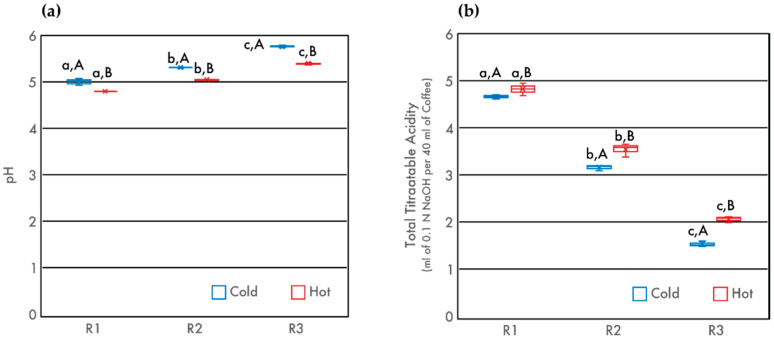
- Coffee acidity decreased as roast level increased; cold brew was less acidic than hot brew by mean pH differences of 0.20, 0.26, and 0.34 for R1, R2, and R3, respectively.
- TDS increased with roast for both methods, but was higher in hot brew than cold brew at all roast levels, and the difference widened with darker roasts.
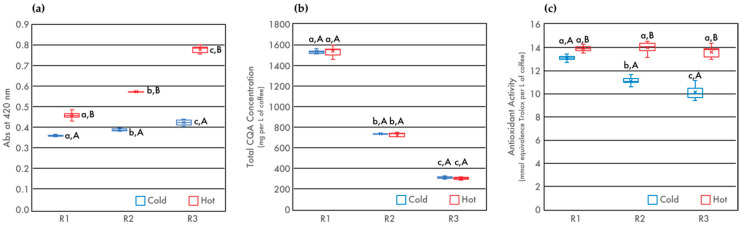
- Browned compounds (Abs 420 nm) increased with roast, and hot brew always had significantly more browned compounds than cold brew.
- Caffeine and total CQA concentration were reported as comparable between hot and cold brew; TAC differed by method and roast, with hot brew TAC constant across roast levels while cold brew TAC decreased with darker roast.
## Methods
- Green organic Colombian beans were roasted to three final temperatures: 194 °C (R1), 203 °C (R2), and 209 °C (R3); four batches were made per roast, then ground coarsely and sieved to 500–2000 µm.
- Hot brew used 20 g coffee + 200 mL DI water at 100 °C for 6 min; cold brew used 20 g coffee + 200 mL DI water at room temperature for 7 h; samples were filtered and analyzed within 10 min.
- Outcomes measured included pH, TTA to pH 6.5, TDS, Abs 420 nm browned compounds, caffeine, total CQA (3-CQA, 4-CQA, 5-CQA), and TAC; analysis used two-way ANOVA with Tukey HSD.
## Limitations
- The paper explicitly notes only one origin/varietal was tested: a single-origin Colombian Arabica coffee, so generalizability to other beans is limited.
- Evidence from the text: brewing was done with one hot protocol (100 °C, 6 min) and one cold protocol (room temperature, 7 h), so the results do not isolate temperature from time or other brewing-condition differences.
- Evidence from the text: the study infers mechanisms such as wetting, pore dynamics, and solubility from measured chemistry, but it does not directly measure those physical processes.
Model-written summary. Check it against the paper before relying on it.
Integrity signals
Registry
Cites
Statistics
Figures
Verification
Claims the paper makes
7 Valid · 0 Not valid · 10 Not checked · 27 Own results and interpretations
The sources with a verdict support this claim; the rest weren’t checked yet, have no full text we could read, or their verdicts aren’t rated yet.
In the paper
“It is known that degree of roast significantly affects the chemistry of hot brew coffee [6,11,12]”
§ Physiochemical Characteristics of Hot and Cold Brew Coffee Chemistry: The Effects of Roast Level and Brewing Temperature on Compound Extraction > 1. Introduction
What the sources say
- Supportedcites [6] Vignoli J.A. Viegas M.C. Bassoli D.G. de Toledo Benassi M. Roasting Process Affects Differently the Bioactive Compounds and the Antioxidant Activity of Arabica and Robusta Coffees Food Res. Int. 2014 61 279 285 10.1016/j.foodres.2013.06.006 source
The Methods (section 2.1.1; page unavailable) describe preparing coffee extracts with water at 95 °C. The Results (section 3.1; page unavailable) report that the levels of several compounds changed as roasting degree increased, supporting the claim for hot-water coffee extracts. (LLM, conf=0.92)
- Not checked — no full text of the sourcecites [11] Ginz M. Balzer H.H. Bradbury A.G.W. Maier H.G. Formation of Aliphatic Acids by Carbohydrate Degradation during Roasting of Coffee Eur. Food Res. Technol. 2000 211 404 410 10.1007/s002170000215 source
- Not checked — no full text of the sourcecites [12] Moon J.-K. Shibamoto T. Role of Roasting Conditions in the Profile of Volatile Flavor Chemicals Formed from Coffee Beans J. Agric. Food Chem. 2009 57 5823 5831 10.1021/jf901136e 19579294 source
boostedstates a cause- Asserted: passes — The authors put it forward as true.
- Checkable: passes — It can be checked against evidence.
- Load-bearing: passes — The paper’s conclusions depend on it.
- Based: passes — The paper gives a reason why it holds.
- Supported
The sources with a verdict support this claim; the rest weren’t checked yet, have no full text we could read, or their verdicts aren’t rated yet.
In the paper
“Two previous studies by Vignoli et al. showed that degree of roast had little effect on the TAC of hot brew coffee [6,28]”
§ Physiochemical Characteristics of Hot and Cold Brew Coffee Chemistry: The Effects of Roast Level and Brewing Temperature on Compound Extraction > 3. Results and Discussion > 3.3. Browned Compounds, CQA Concentration, and Total Antioxidant Capacity (TAC)
What the sources say
- Supportedcites [6] Vignoli J.A. Viegas M.C. Bassoli D.G. de Toledo Benassi M. Roasting Process Affects Differently the Bioactive Compounds and the Antioxidant Activity of Arabica and Robusta Coffees Food Res. Int. 2014 61 279 285 10.1016/j.foodres.2013.06.006 source
Section 2.1.1 describes coffee extracts prepared with 95 °C water to simulate coffee brews. Section 3.2 says antioxidant activity generally remained stable or slightly decreased as roasting increased, supporting the claim's broad summary, although the size of the change depended on the assay. (LLM, conf=0.87)
- Not checked — no full text of the sourcecites [28] Vignoli J.A. Bassoli D.G. Benassi M.T. Antioxidant Activity, Polyphenols, Caffeine and Melanoidins in Soluble Coffee: The Influence of Processing Conditions and Raw Material Food Chem. 2011 124 863 868 10.1016/j.foodchem.2010.07.008 source
plain- Asserted: passes — The authors put it forward as true.
- Checkable: passes — It can be checked against evidence.
- Load-bearing: unclear — It is unclear whether the paper’s conclusions depend on it.
- Based: passes — The paper gives a reason why it holds.
- Supported
The cited sources support only part of this claim — read each source’s verdict below.
In the paper
“It is well established that, as roasting temperature increases, CQA concentrations in the solid bean matrix decrease due to compound degradation [6,25,42,43].”
§ Physiochemical Characteristics of Hot and Cold Brew Coffee Chemistry: The Effects of Roast Level and Brewing Temperature on Compound Extraction > 3. Results and Discussion > 3.3. Browned Compounds, CQA Concentration, and Total Antioxidant Capacity (TAC)
What the sources say
- Partly supportedcites [6] Vignoli J.A. Viegas M.C. Bassoli D.G. de Toledo Benassi M. Roasting Process Affects Differently the Bioactive Compounds and the Antioxidant Activity of Arabica and Robusta Coffees Food Res. Int. 2014 61 279 285 10.1016/j.foodres.2013.06.006 sourceExperimental — accuracy not yet measured
Section 3.1 reports that 5-CQA decreased as roasting degree increased and describes degradation of chlorogenic acids during roasting. But Sections 2.1.1 and 2.2.2 show that the study varied roasting time as well as temperature and measured 5-CQA in brewed soluble solids, not directly in the solid bean matrix. Page numbers are unavailable in our copy. (LLM, conf=0.87)
- Not checked — no full text of the sourcecites [25] Moon J.-K. Yoo H.S. Shibamoto T. Role of Roasting Conditions in the Level of Chlorogenic Acid Content in Coffee Beans: Correlation with Coffee Acidity J. Agric. Food Chem. 2009 57 5365 5369 10.1021/jf900012b 19530715 source
- Partly supportedcites [42] Opitz S.E.W. Smrke S. Goodman B.A. Keller M. Schenker S. Yeretzian C. Antioxidant Generation during Coffee Roasting: A Comparison and Interpretation from Three Complementary Assays Foods 2014 3 586 604 10.3390/foods3040586 28234339 PMC5302239 sourceExperimental — accuracy not yet measured
The Introduction states that chlorogenic acids (CGAs) are partially degraded during roasting, and Results and Discussion §3.2 links higher temperatures to greater CGA degradation. The paper does not directly measure caffeoylquinic acid concentrations in the solid bean matrix; it infers CGA degradation from antioxidant-assay results, so the claim is more specific than the evidence. (LLM, conf=0.86)
- Not checked — no full text of the sourcecites [43] Nicoli M.C. Anese M. Manzocco L. Lerici C.R. Antioxidant Properties of Coffee Brews in Relation to the Roasting Degree LWT Food Sci. Technol. 1997 30 292 297 10.1006/fstl.1996.0181 source
boostedstates a cause- Asserted: passes — The authors put it forward as true.
- Checkable: passes — It can be checked against evidence.
- Load-bearing: unclear — It is unclear whether the paper’s conclusions depend on it.
- Based: passes — The paper gives a reason why it holds.
- Partly supported
None of the sources cited for this claim have been checked yet.
In the paper
“As was found in previous studies [8,26], TDS was higher for hot brew coffees than cold brew coffees at all roast levels.”
§ Physiochemical Characteristics of Hot and Cold Brew Coffee Chemistry: The Effects of Roast Level and Brewing Temperature on Compound Extraction > 3. Results and Discussion > 3.2. Total Dissolved Solids (TDS)
plainstates an association- Asserted: passes — The authors put it forward as true.
- Checkable: passes — It can be checked against evidence.
- Load-bearing: passes — The paper’s conclusions depend on it.
- Based: passes — The paper gives a reason why it holds.
A result the paper states — it cites no source for it, so there is none to check. The quote shows it is in the paper.
In the paper
“Similar to TDS, the difference in the concentration of browned compounds between cold and hot brew samples increased with degree of roast.”
§ Physiochemical Characteristics of Hot and Cold Brew Coffee Chemistry: The Effects of Roast Level and Brewing Temperature on Compound Extraction > 3. Results and Discussion > 3.3. Browned Compounds, CQA Concentration, and Total Antioxidant Capacity (TAC)
plainstates an association- Asserted: passes — The authors put it forward as true.
- Checkable: passes — It can be checked against evidence.
- Load-bearing: unclear — It is unclear whether the paper’s conclusions depend on it.
- Based: passes — The paper gives a reason why it holds.
29 more claims
Create a free account to see all 44 claims and every source verdict.
- Borderline: one of the tests for a substantial claim is unclear. 2
- Probably not a substantial claim. 4
- It may state two separate claims as one. 5
Claims other papers make about this one
Each is checked against this paper’s own text: does it say what the citing paper says it does?
The source backs part of the claim, not all of it — or backs it for a different population, condition or comparison.
In the citing paper
“no significant difference was detected in the quantities of a few common compounds associated with coffee bitterness, such as total caffeoylquinic acids, caffeine, and trigonelline [11,12].”
From Comparative Profiling of Hot and Cold Brew Coffee Flavor Using Chromatographic and Sensory Approaches (2022) · cites this paper as [12]
Experimental — accuracy not yet measuredThe cited source says what the claim attributes to it.
In the citing paper
“Recent studies indicate that hot and cold brew coffees have small but important differences, particularly in the total antioxidant capacity of the resulting coffee [21].”
From Effects of Coffee and Its Components on the Gastrointestinal Tract and the Brain–Gut Axis (2020) · cites this paper as [21]
Self-check
Percentages, sums and reported differences re-computed from the paper’s own numbers.
Each contradiction between two passages listed here was confirmed by an independent check.
Rated major: it would touch a result — a value a result rests on, reported and recomputed p-values on opposite sides of the significance level, two passages that conflict with no sign which is right, or a cited work retracted before this paper was published.
In the paper
§ Physiochemical Characteristics of Hot and Cold Brew Coffee Chemistry: The Effects of Roast Level and Brewing Temperature on Compound Extraction > 3. Results and Discussion > 3.3. Browned Compounds, CQA Concentration, and Total Antioxidant Capacity (TAC)
“Degree of roast did not significantly affect TAC in hot brew coffees, as shown by a two-way ANOVA analysis.”
§ Physiochemical Characteristics of Hot and Cold Brew Coffee Chemistry: The Effects of Roast Level and Brewing Temperature on Compound Extraction > 4. Conclusions
“This study found that pH, TTA, concentration of browned compounds, and TAC for both cold and hot brew coffees varied by each of the three roast levels tested.”
Citations
Cites
Antioxidant activity applying an improved ABTS radical cation decolorization assay
Re, R., Pellegrini, N., Proteggente, A., Pannala, A., Yang, M., & Rice-Evans, C. (1999) · Free Radical Biology and Medicine · doi:10.1016/s0891-5849(98)00315-3 · Cited by 26,165
Melanoidins produced by the Maillard reaction: Structure and biological activity
Wang, H.-Y., Qian, H., & Yao, W.-R. (2011) · Food Chemistry · doi:10.1016/j.foodchem.2011.03.075 · Cited by 719 · cited 1×
“Natural phenolic and other acids are lost during heating, while Maillard reaction products, including melanoidins, are generated [4].”
BackgroundEffect of Roasting on the Formation of Chlorogenic Acid Lactones in Coffee
Farah, A., de Paulis, T., Trugo, L. C., & Martin, P. R. (2005) · Journal of Agricultural and Food Chemistry · doi:10.1021/jf048701t · Cited by 540 · cited 1×
“During roasting, CQA concentrations decrease due to transformation into chlorogenic acid lactones [17] and partial incorporation into the production of melanoidin compounds [59,60].”
BackgroundChemical Characterization and Antioxidant Properties of Coffee Melanoidins
Borrelli, R. C., Visconti, A., Mennella, C., Anese, M., & Fogliano, V. (2002) · Journal of Agricultural and Food Chemistry · doi:10.1021/jf025686o · Cited by 384
Vignoli, J. A., Bassoli, D. G., & Benassi, M. T. (2011) · Food Chemistry · doi:10.1016/j.foodchem.2010.07.008 · Cited by 375 · cited 3×
“showed that degree of roast had little effect on the TAC of hot brew coffee [6,28], which agrees with the TAC profile observed in hot brew coffee here.”
BackgroundResultEffect of Roasting on the Antioxidant Activity of Coffee Brews
del Castillo, M. D., Ames, J. M., & Gordon, M. H. (2002) · Journal of Agricultural and Food Chemistry · doi:10.1021/jf011702q · Cited by 372
Hečimović, I., Belščak-Cvitanović, A., Horžić, D., & Komes, D. (2011) · Food Chemistry · doi:10.1016/j.foodchem.2011.05.059 · Cited by 334 · cited 2×
“However, a decrease in caffeine concentrations due to degradation during roasting has been observed in other studies [48,56].”
MethodResultAssessing the Antioxidant Activity of Melanoidins from Coffee Brews by Different Antioxidant Methods
Delgado-Andrade, C., Rufián-Henares, J. A., & Morales, F. J. (2005) · Journal of Agricultural and Food Chemistry · doi:10.1021/jf0512353 · Cited by 334
Antioxidant Properties of Coffee Brews in Relation to the Roasting Degree
Nicoli, M. C., Anese, M., Manzocco, L., & Lerici, C. R. (1997) · LWT - Food Science and Technology · doi:10.1006/fstl.1996.0181 · Cited by 299 · cited 2×
“It is well established that, as roasting temperature increases, CQA concentrations in the solid bean matrix decrease due to compound degradation [6,25,42,43].”
BackgroundVignoli, J. A., Viegas, M. C., Bassoli, D. G., & Benassi, M. D. T. (2014) · Food Research International · doi:10.1016/j.foodres.2013.06.006 · Cited by 261 · cited 8×
“argued that, although prolonged roasting may not produce enough additional antioxidant compounds to compensate for the loss of phenolic compounds, significant structural changes in the sold bean matrix may increase the extraction efficiency for all antioxidant compounds [6,28].”
BackgroundResultInfluentialMoon, J.-K., Yoo, H. S., & Shibamoto, T. (2009) · Journal of Agricultural and Food Chemistry · doi:10.1021/jf900012b · Cited by 254 · cited 6×
“It is well established that, as roasting temperature increases, CQA concentrations in the solid bean matrix decrease due to compound degradation [6,25,42,43].”
BackgroundResultInfluentialBrowning determination in citrus products
Meydav, S., Saguy, I., & Kopelman, I. J. (1977) · Journal of Agricultural and Food Chemistry · doi:10.1021/jf60211a030 · Cited by 226 · cited 1×
“The quantity of browned compounds generated during brewing has been used as an indicator for degree of caramelization and development of Maillard reactions, and was determined via the absorbance of diluted brewed coffee at 420 nm [20].”
MethodVariations in Caffeine and Chlorogenic Acid Contents of Coffees: What Are We Drinking?
Ludwig, I. A., Mena, P., Calani, L., Cid, C., Del Rio, D., Lean, M. E. J., & Crozier, A. (2014) · Food Funct. · doi:10.1039/c4fo00290c · Cited by 226
Role of Roasting Conditions in the Profile of Volatile Flavor Chemicals Formed from Coffee Beans
Moon, J.-K., & Shibamoto, T. (2009) · Journal of Agricultural and Food Chemistry · doi:10.1021/jf901136e · Cited by 219 · cited 1×
“It is known that degree of roast significantly affects the chemistry of hot brew coffee [6,11,12], but little is known about the effect of degree of roast on cold brew coffee chemistry.”
BackgroundFormation of aliphatic acids by carbohydrate degradation during roasting of coffee
Ginz, M., Balzer, H. H., Bradbury, A. G. W., & Maier, H. G. (2000) · European Food Research and Technology · doi:10.1007/s002170000215 · Cited by 191 · cited 5×
“There is an apparent l ss f s l l protonated acidic compounds during the roasting process, due to either decomposition during pyrolysis or consumption in synthesis reactions [11].”
BackgroundInfluentialExtraction of coffee antioxidants: Impact of brewing time and method
Ludwig, I. A., Sanchez, L., Caemmerer, B., Kroh, L. W., De Peña, M. P., & Cid, C. (2012) · Food Research International · doi:10.1016/j.foodres.2012.02.023 · Cited by 185 · cited 1×
“Bean origin [47] and varietal [48], roasting procedure [42], and extraction methods [49,50] all contribute to a lack of consistency among TAC profiles.”
MethodChlorogenic acid composition of instant coffees
Trugo, L. C., & Macrae, R. (1984) · The Analyst · doi:10.1039/an9840900263 · Cited by 184
Fuller, M., & Rao, N. Z. (2017) · Scientific Reports · doi:10.1038/s41598-017-18247-4 · Cited by 180 · cited 5×
“Rao and Fuller found that, for a variety of regions, medium roast hot brew coffees had higher TAC than their cold brew counterparts, as evaluated using the ABTS decolorization assay [10].”
BackgroundResultInfluentialSelf-citationAntioxidant activity of coffee brews
Cämmerer, B., & Kroh, L. W. (2006) · European Food Research and Technology · doi:10.1007/s00217-005-0226-4 · Cited by 178
Nunes, F. M., & Coimbra, M. A. (2007) · Journal of Agricultural and Food Chemistry · doi:10.1021/jf063735h · Cited by 166 · cited 2×
“The browning of coffee beans during roasting is largely due to the production of melanoidin compounds [32,33].”
BackgroundCordoba, N., Pataquiva, L., Osorio, C., Moreno, F. L. M., & Ruiz, R. Y. (2019) · Scientific Reports · doi:10.1038/s41598-019-44886-w · Cited by 166 · cited 3×
“As was found in previous studies [8,26], TDS was higher for hot brew coffees than cold brew coffees at all roast levels.”
BackgroundResultSacchetti, G., Mattia, C. D., Pittia, P., & Mastrocola, D. (2008) · Journal of Food Engineering · doi:10.1016/j.jfoodeng.2008.06.005 · Cited by 163
Antioxidative Activities of Fractions Obtained from Brewed Coffee
Yanagimoto, K., Ochi, H., Lee, K.-G., & Shibamoto, T. (2004) · Journal of Agricultural and Food Chemistry · doi:10.1021/jf030317t · Cited by 160 · cited 1×
“, volatile heterocyclic compounds [61].”
Pore Structure of Coffee Beans Affected by Roasting Conditions
Schenker, S., Handschin, S., Frey, B., Perren, R., & Escher, F. (2000) · Journal of Food Science · doi:10.1111/j.1365-2621.2000.tb16026.x · Cited by 155 · cited 1×
“Due to the generation and release of gases during heating, the roasting process results in lower bean density and greater bean volume [2].”
BackgroundRoasting Effects on Formation Mechanisms of Coffee Brew Melanoidins
Bekedam, E. K., Loots, M. J., Schols, H. A., Van Boekel, M. A. J. S., & Smit, G. (2008) · Journal of Agricultural and Food Chemistry · doi:10.1021/jf800999a · Cited by 148 · cited 1×
“During roasting, CQA concentrations decrease due to transformation into chlorogenic acid lactones [17] and partial incorporation into the production of melanoidin compounds [59,60].”
BackgroundAcidity and Antioxidant Activity of Cold Brew Coffee
Rao, N. Z., & Fuller, M. (2018) · Scientific Reports · doi:10.1038/s41598-018-34392-w · Cited by 144 · cited 5×
“Rao and Fuller found that, for a variety of regions, medium roast hot brew coffees had higher TAC than their cold brew counterparts, as evaluated using the ABTS decolorization assay [10].”
BackgroundMethodResultInfluentialSelf-citationLiu, Y., & Kitts, D. D. (2011) · Food Research International · doi:10.1016/j.foodres.2010.12.037 · Cited by 124 · cited 1×
“Melanoidin compounds are responsible for the brown color of roasted beans and are known to contribute to the antioxidant activity of coffee [5].”
BackgroundBudryn, G., Nebesny, E., Podsędek, A., Żyżelewicz, D., Materska, M., Jankowski, S., & Janda, B. (2009) · European Food Research and Technology · doi:10.1007/s00217-008-1004-x · Cited by 124 · cited 2×
“Hot brew coffees always had significantly more browned compounds than their cold brew counterparts, with browned compounds increasing as a function of roast level [21,30,39].”
BackgroundMethod(1985) · doi:10.1007/978-94-009-4948-5 · Cited by 112
Liang, N., Xue, W., Kennepohl, P., & Kitts, D. D. (2016) · Food Chemistry · doi:10.1016/j.foodchem.2016.06.041 · Cited by 108 · cited 1×
“Hot brew coffees always had significantly more browned compounds than their cold brew counterparts, with browned compounds increasing as a function of roast level [21,30,39].”
BackgroundCharacterization and comparison of cold brew and cold drip coffee extraction methods
Angeloni, G., Guerrini, L., Masella, P., Innocenti, M., Bellumori, M., & Parenti, A. (2019) · Journal of the Science of Food and Agriculture · doi:10.1002/jsfa.9200 · Cited by 107 · cited 2×
“Early research on cold brew coffee chemistry found that grind size and roast [7,8], brewing method [9], and region of origin [10] all influence the bioactive compounds found in cold brew coffee.”
BackgroundResultRole of Degradation Products of Chlorogenic Acid in the Antioxidant Activity of Roasted Coffee
Kamiyama, M., Moon, J.-K., Jang, H. W., & Shibamoto, T. (2015) · Journal of Agricultural and Food Chemistry · doi:10.1021/jf5060563 · Cited by 106 · cited 1×
“Bean origin [47] and varietal [48], roasting procedure [42], and extraction methods [49,50] all contribute to a lack of consistency among TAC profiles.”
MethodAssessment of Total (Free and Bound) Phenolic Compounds in Spent Coffee Extracts
Monente, C., Ludwig, I. A., Irigoyen, A., De Peña, M.-P., & Cid, C. (2015) · Journal of Agricultural and Food Chemistry · doi:10.1021/acs.jafc.5b01619 · Cited by 93
Influence of Brewing Method and Acidity Regulators on the Antioxidant Capacity of Coffee Brews
Pérez-Martínez, M., Caemmerer, B., De Peña, M. P., Cid, C., & Kroh, L. W. (2010) · Journal of Agricultural and Food Chemistry · doi:10.1021/jf9037375 · Cited by 88 · cited 1×
“Bean origin [47] and varietal [48], roasting procedure [42], and extraction methods [49,50] all contribute to a lack of consistency among TAC profiles.”
MethodDetermination of caffeine content of tea and instant coffee brands found in the Kenyan market.
Wanyika, H., Gatebe, E., Gitu, L., Ngumba, E. K., & Maritim, C. W. (2010) · African Journal of Food Science · doi:10.5897/ajfs.9000071 · Cited by 85
Herawati, D., Giriwono, P. E., Dewi, F. N. A., Kashiwagi, T., & Andarwulan, N. (2019) · Food Science and Biotechnology · doi:10.1007/s10068-018-0442-x · Cited by 85
Role of Hydroxycinnamates in Coffee Melanoidin Formation
Nunes, F. M., & Coimbra, M. A. (2010) · Phytochemistry Reviews · doi:10.1007/s11101-009-9151-7 · Cited by 82 · cited 2×
“The extraction behavior and antioxidant activity of melanoidins in coffees have not been fully identified, as the compounds are often co-present in complex mixtures with polysaccharides, proteins, and other phenolic compounds [60].”
BackgroundThe Roast—Creating the Beans' Signature
Schenker, S., & Rothgeb, T. (2017) · Elsevier eBooks · doi:10.1016/b978-0-12-803520-7.00011-6 · Cited by 69
Quantification of Caffeoylquinic Acids in Coffee Brews by HPLC-DAD
Moeenfard, M., Rocha, L., & Alves, A. (2014) · Journal of Analytical Methods in Chemistry · doi:10.1155/2014/965353 · Cited by 62 · cited 2×
“All brewed coffee was filtered using a 0.45 µm Acrodisc® Syringe Filter with a Universal PTFE Membrane (Pall, New York, NY, USA) [14].”
InfluentialTfouni, S. A. V., Carreiro, L. B., Teles, C. R. A., Furlani, R. P. Z., Cipolli, K. M. V. A. B., & Camargo, M. C. R. (2014) · International Journal of Food Science & Technology · doi:10.1111/ijfs.12361 · Cited by 60
The effect of bean origin and temperature on grinding roasted coffee
Uman, E., Colonna-Dashwood, M., Colonna-Dashwood, L., Perger, M., Klatt, C., Leighton, S., Miller, B., Butler, K. T., Melot, B. C., Speirs, R. W., et al. (2016) · Scientific Reports · doi:10.1038/srep24483 · Cited by 58 · cited 1×
“The batches were mixed and frozen for a minimum of 12 h [13] and ground using a conical burr grinder (Model No.”
MethodLudwig, I. A., Bravo, J., De Peña, M. P., & Cid, C. (2013) · LWT - Food Science and Technology · doi:10.1016/j.lwt.2012.12.010 · Cited by 51
Morales, F. J. (2004) · Analytica Chimica Acta · doi:10.1016/j.aca.2004.11.028 · Cited by 51 · cited 1×
“The browning of coffee beans during roasting is largely due to the production of melanoidin compounds [32,33].”
BackgroundSmrke, S., Opitz, S. E. W., Vovk, I., & Yeretzian, C. (2013) · Food & Function · doi:10.1039/c3fo30377b · Cited by 46
Investigation on the extractability of melanoidins in portioned espresso coffee
Bartel, C., Mesías, M., & Morales, F. J. (2014) · Food Research International · doi:10.1016/j.foodres.2014.11.053 · Cited by 45
Bicho, N. C., Leitão, A. E., Ramalho, J. C., & Lidon, F. C. (2011) · European Food Research and Technology · doi:10.1007/s00217-011-1518-5 · Cited by 44 · cited 1×
“Moreover, the degradation of the coffee cellular matrix during the roasting process may also lead to resolubilization of celluloses, carbohydrates, and denatured proteins [27,29].”
BackgroundMateus, M.-L., Champion, D., Liardon, R., & Voilley, A. (2007) · Journal of Food Engineering · doi:10.1016/j.jfoodeng.2006.12.015 · Cited by 40 · cited 2×
“found that closed porosity in roasted coffee grinds decreased from ~30% in dry coffee to ~5% in coffee with 30% w/w water content [58], indicating that the wetting process changes the porosity network of the grinds.”
BackgroundOpitz, S., Smrke, S., Goodman, B., Keller, M., Schenker, S., & Yeretzian, C. (2014) · Foods · doi:10.3390/foods3040586 · Cited by 39 · cited 4×
“It is well established that, as roasting temperature increases, CQA concentrations in the solid bean matrix decrease due to compound degradation [6,25,42,43].”
BackgroundMethodInfluentialCatelani, T. A., Páscoa, R. N. M. J., Santos, J. R., Pezza, L., Pezza, H. R., Lima, J. L. F. C., & Lopes, J. A. (2016) · Food and Bioprocess Technology · doi:10.1007/s11947-016-1843-6 · Cited by 35 · cited 2×
“Results from previous studies on the TAC of roasted coffee have been somewhat inconclusive, and the discrepancies among those studies have been well documented [6,28,44,45].”
BackgroundResultParâmetro bromatológicos de grãos crus e torrados de cultivares de café(Coffea arabica L.)
Mendonça, L. M. V. L., Pereira, R. G. F. A., & Mendes, A. N. G. (2005) · Food Science and Technology · doi:10.1590/s0101-20612005000200009 · Cited by 34
Bilge, G. (2020) · Journal of Food Science and Technology · doi:10.1007/s13197-020-04367-9 · Cited by 33 · cited 3×
“e aci it f all c ffee e era es ecrease as e ree f r ast i crease , i a ree e t it re i s st ies [24,25].”
BackgroundMethodResultMoreno, F. L., Raventós, M., Hernández, E., Santamaría, N. A., Acosta, J., Pirachican, O., Torres, L., & Ruíz, Y. (2014) · International Journal of Food Properties · doi:10.1080/10942912.2013.833221 · Cited by 30
Pilipczuk, T., Kusznierewicz, B., Zielińska, D., & Bartoszek, A. (2015) · Journal of Food Science and Technology · doi:10.1007/s13197-014-1646-6 · Cited by 27
MODELING THE SOLUBILIZATION PROCESS DURING COFFEE BREWING
VOILLEY, A., & SIMATOS, D. (1979) · Journal of Food Process Engineering · doi:10.1111/j.1745-4530.1979.tb00238.x · Cited by 27
Lane, S., Palmer, J., Christie, B., Ehlting, J., & Le, C. (2017) · The Arbutus Review · doi:10.18357/tar81201716816 · Cited by 26
Use of a 5-Caffeoylquinic Acid/Caffeine Ratio to Monitor the Coffee Roasting Process
PURDON, M. P., & McCAMEY, D. A. (1987) · Journal of Food Science · doi:10.1111/j.1365-2621.1987.tb05905.x · Cited by 22
The Kinetics and Mechanism of Caffeine Infusion from Coffee: The Effect of Roasting
Spiro, M., & Hunter, J. E. (1985) · Journal of the Science of Food and Agriculture · doi:10.1002/jsfa.2740360917 · Cited by 21 · cited 1×
“Hot brew coffees always had significantly more browned compounds than their cold brew counterparts, with browned compounds increasing as a function of roast level [21,30,39].”
BackgroundSensory and Chemical Changes of Cold and Hot Brew Arabica Coffee at Various Resting Time
Asiah, N., Aqil, M., Dwiranti, N. S., David, W., & Ardiansyah, A. (2019) · Asia Pacific Journal of Sustainable Agriculture, Food and Energy · doi:10.36782/apjsafe.v7i2.1948 · Cited by 9 · cited 1×
“As was found in previous studies [8,26], TDS was higher for hot brew coffees than cold brew coffees at all roast levels.”
ResultModified coffee roasting as a means of acidity increase.
Degenhardt, A. G., Mendl, C., Ceriali, S., et al. (2007) · 21st International Conference on Coffee Science, Montpellier, France, 11-15 September, 2006. · Cited by 3
Anese (1999) · doi:10.1002/(sici)1097-0010(199904)79:5
Cited by
Acids in coffee: A review of sensory measurements and meta-analysis of chemical composition
Yeager, S. E., Batali, M. E., Guinard, J.-X., & Ristenpart, W. D. (2023) · Critical Reviews in Food Science and Nutrition · doi:10.1080/10408398.2021.1957767 · Cited by 173
From Plantation to Cup: Changes in Bioactive Compounds during Coffee Processing
Bastian, F., Hutabarat, O. S., Dirpan, A., Nainu, F., Harapan, H., Emran, T. B., & Simal-Gandara, J. (2021) · Foods · doi:10.3390/foods10112827 · Cited by 167
Effects of Coffee and Its Components on the Gastrointestinal Tract and the Brain–Gut Axis
Iriondo-DeHond, A., Uranga, J. A., del Castillo, M. D., & Abalo, R. (2020) · Nutrients · doi:10.3390/nu13010088 · Cited by 126
Córdoba, N., Moreno, F. L., Osorio, C., Velásquez, S., & Ruiz, Y. (2021) · Food Research International · doi:10.1016/j.foodres.2021.110141 · Cited by 101
Review on factors affecting coffee volatiles: from seed to cup
Wang, X., Wang, Y., Hu, G., Hong, D., Guo, T., Li, J., Li, Z., & Qiu, M. (2021) · Journal of the Science of Food and Agriculture · doi:10.1002/jsfa.11647 · Cited by 121
Metadata
- Authors
- Rao, N. Z., Fuller, M., & Grim, M. D.
- Affiliations
- Thomas Jefferson University (US)
- Corresponding author
- Rao, Niny Z.
- Venue
- Foods
- Publisher
- MDPI AG
- Published
- 2020-07-09
- Volume
- 9
- Issue
- 7
- Pages
- 902
- ISSN
- 2304-8158 (ISSN-L)
- PMC
- PMC7404565
- OpenAlex
- W3041291741
- Cited by
- 113
- References
- 62
- Citations by year
- 2026: 9 · 2025: 17 · 2024: 18 · 2023: 18 · 2022: 27 · 2021: 22 · 2020: 2
- FWCI
- 10.36
- Type
- journal article
- Language
- en
- Open access
- gold
- dx.doi.org
- Licence
- Locations
- Foods (publishedVersion, cc-by)
- PubMed Central (publishedVersion, cc-by)
- PubMed (publishedVersion)
- The Medicine Forum (submittedVersion, cc-by)
- DOAJ (DOAJ: Directory of Open Access Journals) (submittedVersion, cc-by-sa)
- Funders
- National Institute of Food and Agriculture (2019-67018-29187/1018488)
- Topics
- Health Sciences › Medicine › Pharmacology (medical) › Coffee research and impacts
- Life Sciences › Agricultural and Biological Sciences › Food Science › Food Chemistry and Fat Analysis
- Life Sciences › Agricultural and Biological Sciences › Food Science › Fermentation and Sensory Analysis
- Keywords
- cold brew coffee, coffee roasting, brewing temperature, extraction, Coffea arabica, total antioxidant capacity, coffee acidity, total dissolved solids, water temperature
About these checks
Registry, retraction, Cites and statistics results are computed, not judged, with one exception: a printed reference that no index lists is read once by a model before it counts as a citation error. Claims are extracted by a model and kept only when their quote appears verbatim in the text; each cited source is then checked, with a model’s help, for whether it says what the claim relies on. Those verdicts can be wrong — read the claim’s quote and the cited source before relying on one.
The claim verdicts this report counts are experimental: their accuracy is not yet measured.
A language model drew the claims from the paper on 2026-10-10, under version 3 of the claim definition (model deepseek-v4.1-flash, prompt extract-v3).
A second model labelled each claim on 2026-10-10 (model jev-1.13-20260917, definition revision gold-guideline-v0.2).
Cited sources are checked with a language model’s help (gpt-6-sol).
Statistics and arithmetic are recomputed, not judged.
Confidence bands are shown only for fields calibrated on our annotated test set. None is calibrated yet, so no band is shown.
What counts as a claim ›How we measure confidence ›How we check this ›
Are you an author, or do you see a problem with this page? Request a review
Data sources
Bibliographic data: Semantic Scholar, OpenAlex, Crossref.
Contains information from the Semantic Scholar Academic Graph Datasets, made available under the ODC Attribution License (ODC-BY 1.0).
Semantic Scholar’s data is described in: Kinney, R., et al. (2023). The Semantic Scholar Open Data Platform. arXiv:2301.10140.
