

The DOI matches its Crossref record; 56 of the 60 references it cites were found in a registry or an index; none of the 23 sources its claims cite is checked for support yet.
Ancient Components and Recent Expansion in the Eurasian Heartland: Insights into the Revised Phylogeny of Y-Chromosomes from Central Asia
Open accessAbstract
In the past two decades, studies of Y chromosomal single nucleotide polymorphisms (Y-SNPs) and short tandem repeats (Y-STRs) have shed light on the demographic history of Central Asia, the heartland of Eurasia. However, complex patterns of migration and admixture have complicated population genetic studies in Central Asia. Here, we sequenced and analyzed the Y-chromosomes of 187 male individuals from Kazakh, Kyrgyz, Uzbek, Karakalpak, Hazara, Karluk, Tajik, Uyghur, Dungan, and Turkmen populations. High diversity and admixture from peripheral areas of Eurasia were observed among the paternal gene pool of these populations. This general pattern can be largely attributed to the activities of ancient people in four periods, including the Neolithic farmers, Indo-Europeans, Turks, and Mongols. Most importantly, we detected the consistent expansion of many minor lineages over the past thousand years, which may correspond directly to the formation of modern populations in these regions. The newly discovered sub-lineages and variants provide a basis for further studies of the contributions of minor lineages to the formation of modern populations in Central Asia.
Overview
CoChat Summary
Written by AI from the paper’s full text.
TL;DR
This study sequenced and analyzed Y-chromosomes of 187 males from ten Central Asian populations to reconstruct paternal phylogeny and demographic history. It reports high diversity and admixture from peripheral Eurasian regions, with many minor lineages expanding in the past 1000–3000 years, possibly corresponding to the formation of modern Central Asian populations.
Key findings
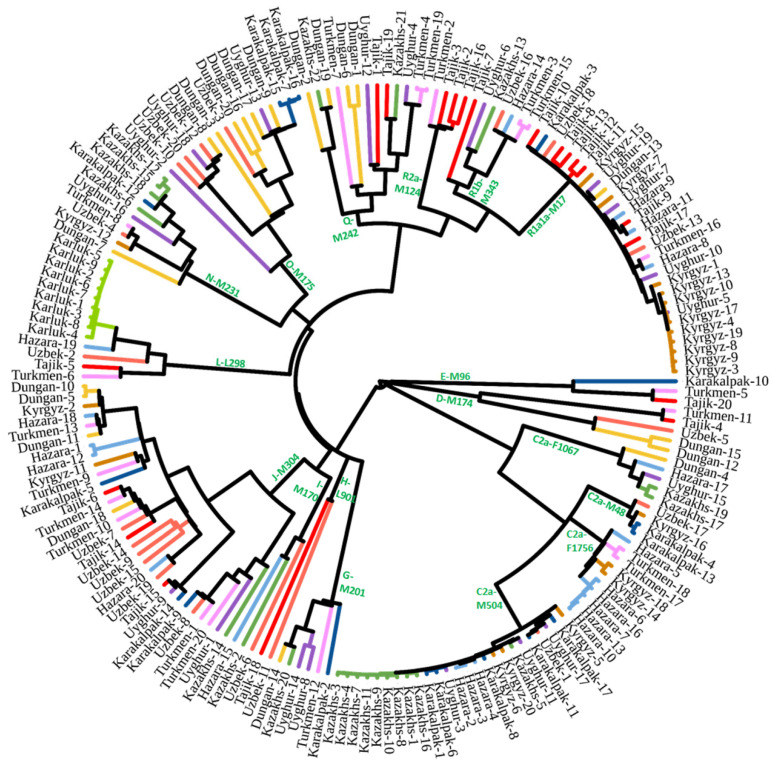
- The paternal gene pool showed high diversity and admixture from South Asia, the Middle East, Europe, North Asia, and East Asia, attributed largely to four periods: Neolithic farmers, Indo-Europeans, Turks, and Mongols.
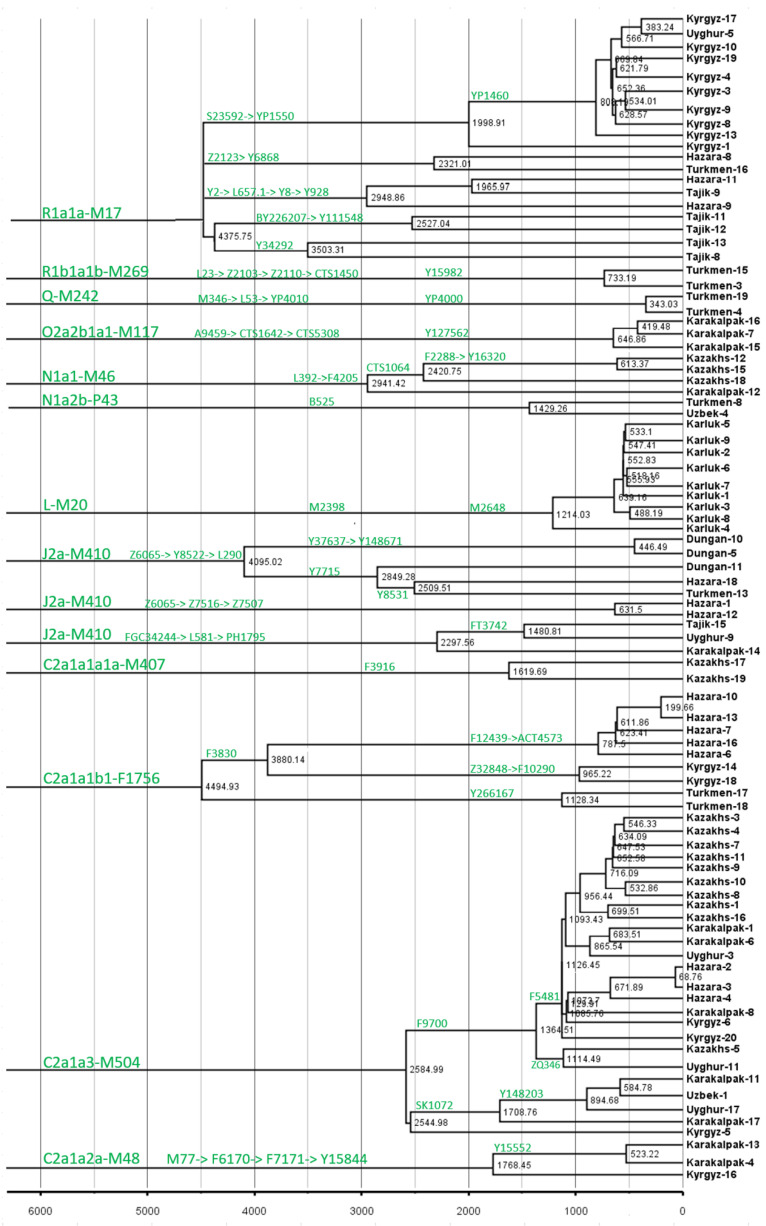
- The authors identified tens of minor lineages, including 33 minor lineages with ages younger than 2000 years, and many sub-branches that expanded in the last 1000 years, such as C2a1a3-M504-F5481, L-M20-M2648, and R1a1a-M17-YP1460.
- A unique sub-branch, L1a2a-M2398-Y236528, was found in nine Karluk samples and separated from lineages found in India about 1500 years ago.
- Haplogroup C2a1a1b1-F1756 appeared among Hazara, Kyrgyz, and Turkmen, suggesting Eastern Eurasian origins; C2a1a2a-M48-F6379 was frequent in Junior Juz Kazakh and Oirat people and also appeared in Karakalpak.
Methods
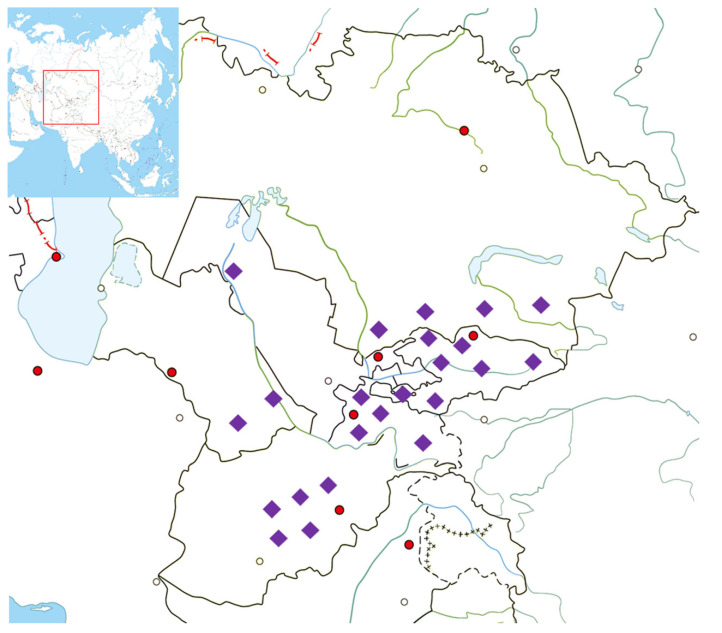
- Saliva samples from 187 unrelated healthy males were sequenced: 20 Kyrgyz, 20 Uzbeks, 17 Karakalpaks, 20 Hazara, 9 Karluks, 20 Tajiks, 19 Uyghur, 20 Dungan, 20 Turkmen, and 22 Kazakhs from Kazakhstan.
- Next-generation sequencing used the Illumina HiSeq2000 platform with a target depth of 10×; read mapping and SNP calling used BWA and SAMtools against human reference genome hg38.
- Bayesian evolutionary analyses used BEAST v.2.4.3 with a point mutation rate of 0.74 × 10⁻⁹ per site per year; results were compared with ancient DNA data and public Y-chromosome trees.
Limitations
- The paper states that more work is needed to explore the detailed demographic history in Central Asia.
- Evident from the text: some population samples are small or unevenly sized, such as 9 Karluks, which may limit population-level inference.
- Evident from the text: the study focuses on Y-chromosome paternal lineages only, so conclusions about overall population history do not incorporate maternal or autosomal evidence.
Model-written summary. Check it against the paper before relying on it.
Integrity signals
Registry
Cites
Statistics
Figures
Verification
Claims the paper makes
18 Own interpretation · 16 Own result · 6 Check pending · 3 Not checked yet · 1 No full text of the sources · 1 Own method · 1 No basis given
A result the paper reports from its own data — it cites no other source for it, so there is none to check. The quote shows it is in the paper.
In the paper
“We detected diverse sub-lineages of Q-M242 (Table S1).”
§ Ancient Components and Recent Expansion in the Eurasian Heartland: Insights into the Revised Phylogeny of Y-Chromosomes from Central Asia > 3. Results
plain- Asserted: passes — The authors put it forward as true.
- Checkable: passes — It can be checked against evidence.
- Load-bearing: unclear — It is unclear whether the paper’s conclusions depend on it.
- Based: passes — The paper gives a reason why it holds.
A result the paper reports from its own data — it cites no other source for it, so there is none to check. The quote shows it is in the paper.
In the paper
“We also observed multiple layers of deposition of genetic components of ancient populations.”
§ Ancient Components and Recent Expansion in the Eurasian Heartland: Insights into the Revised Phylogeny of Y-Chromosomes from Central Asia > 4. Discussion > 4.1. Multiple Layers of Deposition of Ancient Components
plain- Asserted: passes — The authors put it forward as true.
- Checkable: passes — It can be checked against evidence.
- Load-bearing: passes — The paper’s conclusions depend on it.
- Based: passes — The paper gives a reason why it holds.
A result the paper reports from its own data — it cites no other source for it, so there is none to check. The quote shows it is in the paper.
In the paper
“At the sub-branch level, Central Asian populations have specific dominant haplogroups.”
§ Ancient Components and Recent Expansion in the Eurasian Heartland: Insights into the Revised Phylogeny of Y-Chromosomes from Central Asia > 4. Discussion > 4.2. Recent Expansion and the Formation of Modern Populations
plain- Asserted: passes — The authors put it forward as true.
- Checkable: passes — It can be checked against evidence.
- Load-bearing: passes — The paper’s conclusions depend on it.
- Based: passes — The paper gives a reason why it holds.
A result the paper reports from its own data — it cites no other source for it, so there is none to check. The quote shows it is in the paper.
In the paper
“this lineage separated from the lineages found in India about 1500 years ago (Tables S1 and S2, Figure S1).”
§ Ancient Components and Recent Expansion in the Eurasian Heartland: Insights into the Revised Phylogeny of Y-Chromosomes from Central Asia > 3. Results
plainn = 9- Asserted: passes — The authors put it forward as true.
- Checkable: passes — It can be checked against evidence.
- Load-bearing: passes — The paper’s conclusions depend on it.
- Based: passes — The paper gives a reason why it holds.
None of the sources cited for this claim have been checked yet.
In the paper
“The high frequency of this lineage in the Hazara, Karakalpak, Kazakh, Kyrgyz, and Uyghur populations in this study is consistent with the proposed origin of these populations and previous research [24,48].”
§ Ancient Components and Recent Expansion in the Eurasian Heartland: Insights into the Revised Phylogeny of Y-Chromosomes from Central Asia > 3. Results
What the sources say
- Not checked — no full text of the sourcecites [24] He, 2019, A comprehensive exploration of the genetic legacy and forensic features of Afghanistan and Pakistan Mongolian-descent Hazara, Forensic Sci. Int. Genet. source
- Not checked yetcites [48] Zerjal, 2003, The Genetic Legacy of the Mongols, Am. J. Hum. Genet. source
plainstates an association- Asserted: passes — The authors put it forward as true.
- Checkable: passes — It can be checked against evidence.
- Load-bearing: passes — The paper’s conclusions depend on it.
- Based: passes — The paper gives a reason why it holds.
- It may state two separate claims as one. 9
- Probably not a substantial claim. 7
Create a free account to see these claims.
Create a free account to see these assumptions.
27 more claims
Create a free account to see all 46 claims and to verify the 14 references still open.
Self-check
Percentages, sums and reported differences re-computed from the paper’s own numbers.
Each contradiction between two passages listed here was confirmed by an independent check.
Rated minor: it would not touch a result — a value no result rests on, a p-value that stays on the same side of the significance level, or a conflict that is clerical, resolved elsewhere in the paper, or outside its own findings.
In the paper
§ Ancient Components and Recent Expansion in the Eurasian Heartland: Insights into the Revised Phylogeny of Y-Chromosomes from Central Asia > 3. Results
“Haplogroup C2a1a1b1-F1756 was the predominant paternal lineage of the ancient Dong-Hu and Xian-Bei tribes [45,46,47].”
§ Ancient Components and Recent Expansion in the Eurasian Heartland: Insights into the Revised Phylogeny of Y-Chromosomes from Central Asia > 4. Discussion > 4.1. Multiple Layers of Deposition of Ancient Components
“some lineages downstream of Q-M242, N1a1-M46, R1a1a-M17, and C2a1b1-F1756 in Central Asia could be attributed to migration by Turkic people.”
Citations
Cites
The Sequence Alignment/Map format and SAMtools
Li, H., Handsaker, B., Wysoker, A., Fennell, T., Ruan, J., Homer, N., Marth, G., Abecasis, G., Durbin, R., & 1000 Genome Project Data Processing Subgroup (2009) · Bioinformatics · doi:10.1093/bioinformatics/btp352 · Cited by 62,041
Self-citationFast and accurate short read alignment with Burrows-Wheeler transform
Li, H., & Durbin, R. (2009) · Bioinformatics · doi:10.1093/bioinformatics/btp324 · Cited by 58,607
Self-citationFast and accurate long-read alignment with Burrows-Wheeler transform.
Li, H., & Durbin, R. (2010) · Bioinformatics · doi:10.1093/bioinformatics/btp698 · Cited by 12,063
Self-citationPosterior summarization in Bayesian phylogenetics using tracer 1.7
Rambaut, A., Drummond, A. J., Xie, D., Baele, G., & Suchard, M. A. (2018) · Systematic Biology · doi:10.1093/sysbio/syy032 · Cited by 11,159
BEAST 2: a software platform for Bayesian evolutionary analysis
Bouckaert, R., Heled, J., Kühnert, D., Vaughan, T., Wu, C.-H., Xie, D., Suchard, M. A., Rambaut, A., & Drummond, A. J. (2014) · PLoS Computational Biology · doi:10.1371/journal.pcbi.1003537 · Cited by 6,527
Massive migration from the steppe was a source for Indo-European languages in Europe
Haak, W., Lazaridis, I., Patterson, N., Rohland, N., Mallick, S., Llamas, B., Brandt, G., Nordenfelt, S., Harney, E., Stewardson, K., et al. (2015) · Nature · doi:10.1038/nature14317 · Cited by 1,940
Population genomics of Bronze Age Eurasia
Allentoft, M. E., Sikora, M., Sjögren, K.-G., Rasmussen, S., Rasmussen, M., Stenderup, J., Damgaard, P. B., Schroeder, H., Ahlström, T., Vinner, L., et al. (2015) · Nature · doi:10.1038/nature14507 · Cited by 1,550
Genome sequence of a 45,000-year-old modern human from western Siberia
Fu, Q., Li, H., Moorjani, P., Jay, F., Slepchenko, S. M., Bondarev, A. A., Johnson, P. L. F., Aximu-Petri, A., Prüfer, K., de Filippo, C., et al. (2014) · Nature · doi:10.1038/nature13810 · Cited by 1,023
Self-citationUpper Palaeolithic Siberian genome reveals dual ancestry of Native Americans
Raghavan, M., Skoglund, P., Graf, K. E., Metspalu, M., Albrechtsen, A., Moltke, I., Rasmussen, S., Stafford Jr, T. W., Orlando, L., Metspalu, E., et al. (2014) · Nature · doi:10.1038/nature12736 · Cited by 963
Self-citationThe genetic history of Ice Age Europe
Fu, Q., Posth, C., Hajdinjak, M., Petr, M., Mallick, S., Fernandes, D., Furtwängler, A., Haak, W., Meyer, M., Mittnik, A., et al. (2016) · Nature · doi:10.1038/nature17993 · Cited by 959
Research works printed but not linked: 3
- Thompson, E.A. (1996). The Huns, Wiley-Blackwell.
- Zhabagin, M.K., Dibirova, H.D., Frolova, S.A., and Sabitov, Z. (2014). The Relation between the Y-Chromosomal Variation and the Clan Structure: The Gene Pool of the Steppe Aristocracy and the Steppe Clergy of the Kazakhs, Moscow University Anthropology Bulletin.
- Turuspekov, 2011, The Kazakhstan DNA project hits first hundred Y-profiles for ethnic Kazakhs, Russ. J. Genet. Geneal., 2, 69
Cited by
Wang, M., Huang, Y., Liu, K., Wang, Z., Zhang, M., Yuan, H., Duan, S., Wei, L., Yao, H., Sun, Q., et al. (2024) · Molecular Biology and Evolution · doi:10.1093/molbev/msae122 · Cited by 52
Self-citationHe, G., Wang, M., Luo, L., Sun, Q., Yuan, H., Lv, H., Feng, Y., Liu, X., Cheng, J., Bu, F., et al. (2024) · hLife · doi:10.1016/j.hlife.2024.06.006 · Cited by 34
Self-citationPathak, A. K., Simonian, H., Ibrahim, I. A. A., Hrechdakian, P., Behar, D. M., Ayub, Q., Arsanov, P., Metspalu, E., Yepiskoposyan, L., Rootsi, S., et al. (2024) · iScience · doi:10.1016/j.isci.2024.110016 · Cited by 10
Liu, Y., Luo, L., Jiang, Y., Zhao, M., Yang, T., Wang, Z., Luo, L., Feng, Y., Zhu, Z., Wang, Y., et al. (2026) · Advanced Science · doi:10.1002/advs.202515930 · Cited by 8
Zhabagin, M., Bukayev, A., Dyussenova, Z., Zhuraliyeva, A., Tashkarayeva, A., Zhunussova, A., Aidarov, B., Darmenov, A., Akilzhanova, A., Schamiloglu, U., et al. (2024) · PLOS ONE · doi:10.1371/journal.pone.0309080 · Cited by 5
Self-citationGenetic genealogy of Y-chromosome in the Zhetiru tribe of the Kazakh population from Kazakhstan
Zhunussova, A., Tayshanova, S., Bukayev, A., Mailenova, A., Aidarov, B., Temirgaliev, R., Sabitov, Z. M., & Zhabagin, M. K. (2025) · Frontiers in Genetics · doi:10.3389/fgene.2025.1516130 · Cited by 2
Self-citationHigh-resolution present-day Y-chromosome phylogeny refines golden horde lineage placement
Zhabagin, M. K., & Sabitov, Z. (2026) · Proceedings of the National Academy of Sciences · doi:10.1073/pnas.2607193123 · Cited by 2
Self-citationGenetic Analysis of 27 Y-STR Haplotypes in 11 Iranian Ethnic Groups
Alinaghi, S., Mohseni, M., Fattahi, Z., Beheshtian, M., Ghodratpour, F., Ashrafi, F. Z., Arzhangi, S., Jalalvand, K., Najafipour, R., Khorshid, H. R. K., et al. (2024) · Archives of Iranian Medicine · doi:10.34172/aim.2024.13 · Cited by 1
Genetic Polymorphism of Y-Chromosome in Turkmen Population from Turkmenistan
Zhabagin, M. K., Tashkarayeva, A., Bukayev, A., Zhunussova, A., Ponomarev, G., Tayshanova, S., Maxutova, A., Adamov, D., Balanovska, E. V., & Sabitov, Z. M. (2024) · Genes · doi:10.3390/genes15121501 · Cited by 1
Self-citationDemographic History of Ancient Okunev People and Their Kin across Eurasia: A Patrilineal Perspective
Liu, L., Xie, S., Li, H., Wei, L., & Yu, H. (2025) · Nature anthropology · doi:10.70322/natanthropol.2025.10006 · Cited by 1
Self-citationMenato, F., Pepe, G., Mercuri, E., Zangaro, F., Cangialosi, G., Jodice, C., Gulì, M., Cruciani, F., Trombetta, B., Helmer‐Citterich, M., et al. (2025) · Scientific Reports · doi:10.1038/s41598-025-31756-x · Cited by 1
Y-chromosome polymorphisms in Nogai subethnicities in the context of Caucasian gene pools
Владимировна, Б. Е., Roza, S., Idrisov, E., Ponomarev, G., Adamov, D., Михайлович, К. С., Zhabagin, M. K., & Pocheshkhova, E. (2025) · Camera praehistorica · doi:10.31250/2658-3828-2025-2-120-135
Self-citationThe genetic history of East Asians: a genetic genealogy perspective
ShuYi, L. I., LanHai, W. E. I., Chuanchao, W. A. N. G., Li, J., & Li, H. (2026) · Scientia Sinica Vitae · doi:10.1360/ssv-2025-0257
Self-citationAppreciating diversity: a review of the Iranian genomic landscape
Alinaghi, S., Ashrafi, F. Z., Elahi, Z., Ghasemi, M., Najmabadi, H., & Nothnagel, M. (2026) · European Journal of Human Genetics · doi:10.1038/s41431-026-02220-9
Zhabagin, M. K., Bukayev, A., Mailenova, A., Zhunussova, A., Dyussenova, Z., Toxanbayev, A., & Sabitov, Z. (2026) · International Journal of Molecular Sciences · doi:10.3390/ijms27198641
Self-citationWang, M., Feng, Y., Guo, M., Wang, Z., Liu, Y., Yao, J., Yuan, H., Chen, J., Huang, Y., Tang, R., et al. (2026) · Science Advances · doi:10.1126/sciadv.aeg8897
Genetic Basis of Social Structure in the Pastoral Nomads of Central Eurasia
Askapuli, A., Vilar, M. G., Zhabagin, M. K., Sabitov, Z., Zhumadilov, Z., Ragsdale, A. P., Schurr, T. G., Hawks, J. D., & Saitou, N. (2026) · Genome Biology and Evolution · doi:10.1093/gbe/evag249
Self-citation
Metadata
- Authors
- Zhabagin, M., Wei, L.-H., Sabitov, Z., Ma, P.-C., Sun, J., Dyussenova, Z., Balanovska, E., Li, H., & Ramankulov, Y.
- Affiliations
- National Center for Biotechnology (KZ)
- Inner Mongolia Normal University (CN)
- L. N. Gumilyov Eurasian National University (KZ)
- School of Life Sciences, Jilin University, Changchun 130012, China
- Minzu Normal University of Xingyi (CN)
- Research Centre for Medical Genetics (RU)
- Fudan University (CN)
- Corresponding author
- Ramankulov, Yerlan
- ORCID
- Venue
- Genes
- Publisher
- MDPI AG
- Published
- 2022-10-01
- Volume
- 13
- Issue
- 10
- Pages
- 1776
- ISSN
- 2073-4425 (ISSN-L)
- PMC
- PMC9601478
- OpenAlex
- W4303685823
- Semantic Scholar
- 95670986fbb7ed01ee912ec0bdfde0203a7a4cb1
- Cited by
- 17
- References
- 60
- Citations by year
- 2026: 7 · 2025: 4 · 2024: 6
- FWCI
- 1.22
- Type
- journal article
- Language
- en
- Open access
- gold
- doi.org
- Licence
- Locations
- Genes (publishedVersion, cc-by)
- PubMed (publishedVersion)
- PubMed Central (publishedVersion, cc-by)
- Nazarbayev University Repository (Nazarbayev University) (submittedVersion, cc-by-nc-sa)
- DOAJ (DOAJ: Directory of Open Access Journals) (submittedVersion, cc-by-sa)
- Funders
- Science Committee of the Ministry of Education and Science of the Republic of Kazakhstan (AP09259560, SST2019012, 18490750300, 2020YFE0201600, 31900406)
- Faculty-development competitive research grants programs of Nazarbayev University (AP09259560, SST2019012, 18490750300, 2020YFE0201600, 31900406)
- Russian Ministry of Science and Higher Education (State Assignments for the Research Centre for Medical Genetics) (AP09259560, SST2019012, 18490750300, 2020YFE0201600, 31900406)
- Scientific and Technology Committee of Shanghai Municipality (AP09259560, SST2019012, 18490750300, 2020YFE0201600, 31900406)
- Key projects of strategic international scientific and technological innovation cooperation of the Chinese Ministry of Science and Technology (AP09259560, SST2019012, 18490750300, 2020YFE0201600, 31900406)
- National Natural Science Foundation of China (AP09259560, SST2019012, 18490750300, 2020YFE0201600, 31900406)
- Topics
- Life Sciences › Biochemistry, Genetics and Molecular Biology › Genetics › Forensic and Genetic Research
- Life Sciences › Biochemistry, Genetics and Molecular Biology › Genetics › Genetic diversity and population structure
- Life Sciences › Biochemistry, Genetics and Molecular Biology › Genetics › Genetic Associations and Epidemiology
- Keywords
- Y-chromosome phylogeny, Central Asian populations, admixture, Neolithic farmers, Indo-Europeans, Mongol expansion, population growth, Kazakhs, Kyrgyz, Uzbek language, Tajiks, Uyghurs, Turkmen, Karakalpak language, Hazara, Karluks
- MeSH terms
- Asia, Genetics, Population, Haplotypes, Humans, Male, Phylogeny, Chromosomes, Human, Y
About these checks
Registry, retraction, Cites and statistics results are computed, not judged, with one exception: a printed reference that no index lists is read once by a model before it counts as a citation error. Claims are extracted by a model and kept only when their quote appears verbatim in the text; each cited source is then checked, with a model’s help, for whether it says what the claim relies on. Those verdicts can be wrong — read the claim’s quote and the cited source before relying on one.
A language model drew the claims from the paper on 2026-11-12, under version 3 of the claim definition (model deepseek-v4.1-flash, prompt extract-v3).
A second model labelled each claim on 2026-11-12 (model jev-1.13-20260917, definition revision gold-guideline-v0.2).
Statistics and arithmetic are recomputed, not judged.
Confidence bands are shown only for fields calibrated on our annotated test set. None is calibrated yet, so no band is shown.
What counts as a claim ›How we measure confidence ›How we check this ›
Are you an author, or do you see a problem with this page? Request a review
