

Mindfulness in Family Caregivers of Persons with Dementia: Systematic Review and Meta-Analysis
Open accessThe DOI matches its Crossref record; 38 of the 39 references it cites were found in a registry or an index, and 1 are not checked yet.
Abstract
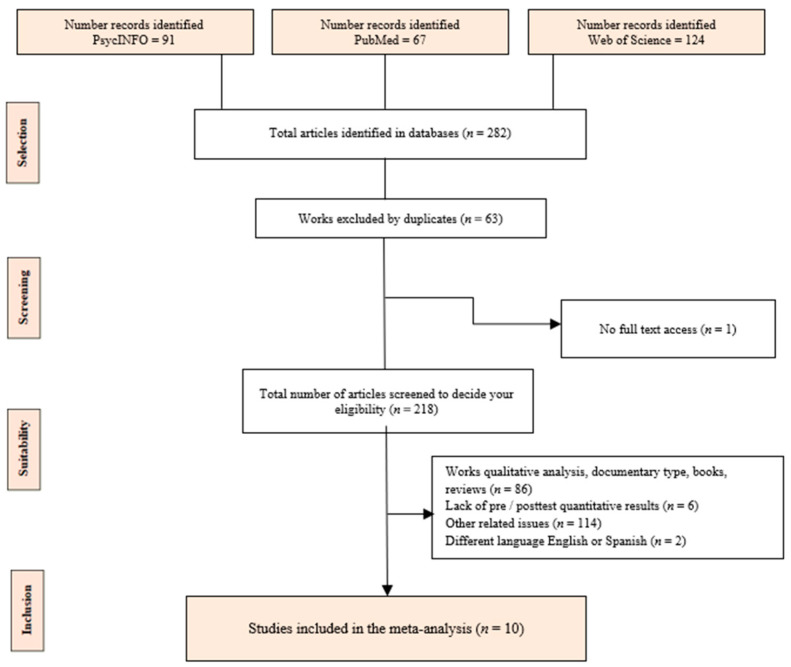
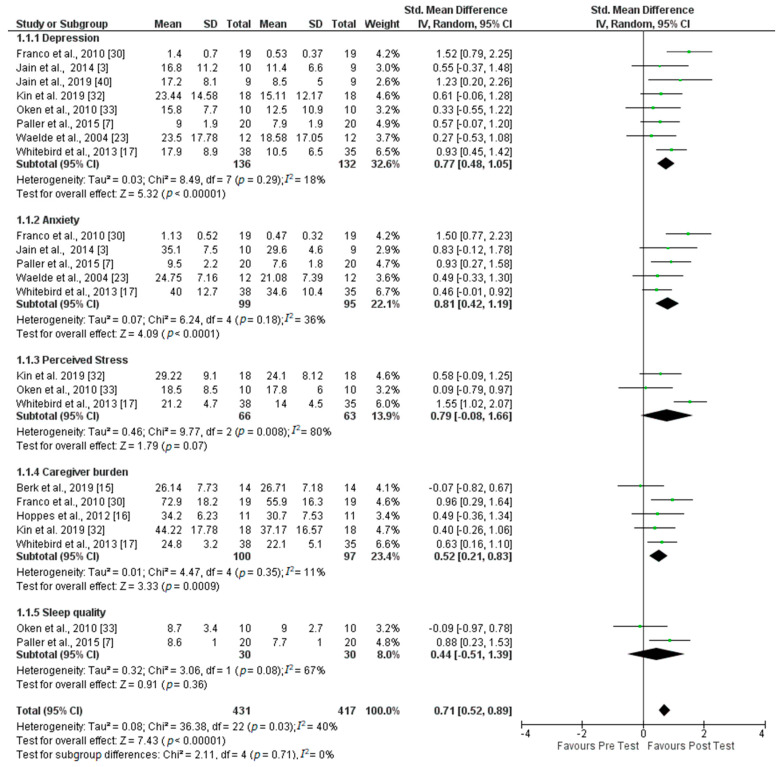
Social and healthcare problems associated with dementia not only affect those who suffer from this disease, but their caregivers as well. The purpose of this study was to analyze the efficacy of mindfulness intervention on psychological variables of caregivers of persons with dementia. A search for scientific articles published from 2000 to 2019 in the PubMed, Web of Science and PsycINFO databases found a total of 282 articles. After screening with preestablished inclusion criteria, ten studies with participation of 161 caregivers remained for the meta-analysis. The results were significant in favor of mindfulness intervention for the variables studied with a standardized difference of mean of 0.71 at a 95% CI, 0.71 (0.52, 0.89); p ≤ 0.00001. Heterogeneity of the studies included was moderate (I2 = 40%). The main conclusion suggested by empirical evidence was that mindfulness intervention seems to be effective for the variables analyzed. However, continued in-depth study of this subject is recommended.
Overview
The claims and statistics of this paper haven’t been checked yet.
Free: it reads the open-access text and checks the first 5 claims that cite a source we can check. Create a free account to check every claim.
Integrity signals
Registry
Cites
Statistics
Figures
Verification
Claims the paper makes
The claims and statistics of this paper haven’t been checked yet.
Free: it reads the open-access text and checks the first 5 claims that cite a source we can check. Create a free account to check every claim.
Claims other papers make about this one
Each is checked against this paper’s own text: does it say what the citing paper says it does?
The source backs part of the claim, not all of it — or backs it for a different population, condition or comparison.
In the citing paper
“Recent meta-analyses pooling data across multiple randomized controlled trials of mindfulness-based training interventions are consistent in reporting benefits in terms of reduced depression, burden, and perceived stress, and improved sleep quality and health-related quality of life among FCGs of PLwD [21–24].”
From Mindfulness and Care Experience in Family Caregivers of Persons Living with Dementia (2023) · cites this paper as [23]
Experimental — accuracy not yet measuredThe source backs part of the claim, not all of it — or backs it for a different population, condition or comparison.
In the citing paper
“Studies exploring the relationship between mindfulness and caregiver mental health are even scarcer [81,82].”
From Relationship of Psychological Flexibility and Mindfulness to Caregiver Burden, and Depressive and Anxiety Symptoms in Caregivers of People with Dementia (2023) · cites this paper as [81]
Experimental — accuracy not yet measured
Self-check
Percentages, sums and reported differences re-computed from the paper’s own numbers.
The self-check needs the paper’s full text.
Citations
Cites
Preferred Reporting Items for Systematic Reviews and Meta-Analyses: the PRISMA statement
Moher, D., Liberati, A., Tetzlaff, J., Altman, D. G., & for the PRISMA Group (2009) · BMJ · doi:10.1136/bmj.b2535 · Cited by 83,823
Preferred Reporting Items for Systematic Reviews and Meta-Analyses: The PRISMA Statement
Moher, D., Liberati, A., Tetzlaff, J., Altman, D. G., & The PRISMA Group (2009) · PLoS Medicine · doi:10.1371/journal.pmed.1000097 · Cited by 64,042
Measuring inconsistency in meta-analyses
Higgins, J. P. T., Thompson, S. G., Deeks, J. J., & Altman, D. G. (2003) · BMJ · doi:10.1136/bmj.327.7414.557 · Cited by 63,139 · cited 1×
“Interpretation of the effect estimates (SMD) was in line with Cohen’s guidelines [39], where 0.”
ResultThe Cochrane Collaboration's tool for assessing risk of bias in randomised trials
Higgins, J. P. T., Altman, D. G., Gotzsche, P. C., Juni, P., Moher, D., Oxman, A. D., Savovic, J., Schulz, K. F., Weeks, L., Sterne, J. A. C., et al. (2011) · BMJ · doi:10.1136/bmj.d5928 · Cited by 33,817
Dermyshi, E., Wang, Y., Yan, C., Hong, W., Qiu, G., Gong, X., & Zhang, T. (2017) · Neonatology · doi:10.1159/000454668 · Cited by 24,451
Wang, G., Ma, R., Qiao, G., Wada, K., Aizawa, Y., & Satoh, T. (2015) · Integrative Medicine International · doi:10.1159/000368408 · Cited by 18,657
Cohen, J. (1992) · Psychological Bulletin · doi:10.1037//0033-2909.112.1.155 · Cited by 8,771
(1993) · Cited by 7,136
(1999) · Cited by 5,934
Kabat-Zinn, J. (1982) · General Hospital Psychiatry · doi:10.1016/0163-8343(82)90026-3 · Cited by 4,255 · cited 3×
“Mindfulness Based Cognitive Therapy (MBCT) emerged from the study by Kabat-Zinn and Santorelli [11] at the UMAS Massachusetts Medical Center in Boston.”
MethodResultVirgili, M. (2015) · Mindfulness · doi:10.1007/s12671-013-0264-0 · Cited by 273 · cited 1×
“Some authors have found that MBIs are also useful for coping with burnout [20], which can have serious repercussions on the psychological health of workers [21], and in which emotional intelligence also has a relevant role in prevention [22].”
BackgroundMindfulness-based stress reduction for family caregivers: a randomized controlled trial.
Whitebird, R. R., Kreitzer, M., Crain, A. L., Lewis, B. A., Hanson, L. R., & Enstad, C. J. (2013) · The Gerontologist · doi:10.1093/geront/gns126 · Cited by 252 · cited 6×
“On the contrary, application of MBI has been related to an increase in self-efficacy [33], making it possible to fight stress [17] and improve the caregiver’s quality of life [7].”
BackgroundInfluentialA pilot study of a yoga and meditation intervention for dementia caregiver stress
Waelde, L. C., Thompson, L., & Gallagher‐Thompson, D. (2004) · Journal of Clinical Psychology · doi:10.1002/jclp.10259 · Cited by 245 · cited 12×
“In this respect, several authors thought yoga and meditation in mindfulness increased perceived self‐efficacy, quality of life, attention, self‐compassion and vitality [23].”
BackgroundMethodResultInfluentialPilot Controlled Trial of Mindfulness Meditation and Education for Dementia Caregivers
Oken, B. S., Fonareva, I., Haas, M., Wahbeh, H., Lane, J. B., Zajdel, D., & Amen, A. (2010) · The Journal of Alternative and Complementary Medicine · doi:10.1089/acm.2009.0733 · Cited by 232 · cited 4×
“Oken, Fonareva, Haas, and Wahbeh, 2010 [33] Uncontrolled trial, 3 groups Portland Mindfulness, cognitive means, physiological means, expectations and sampling based on experience 10 7 weeks (90 min/week) Caregivers showed higher self-efficacy and cognitive means”
BackgroundInfluentialPaller, K. A., Creery, J. D., Florczak, S. M., Weintraub, S., Mesulam, M.-M., Reber, P. J., Kiragu, J., Rooks, J., Safron, A., Morhardt, D., et al. (2015) · American Journal of Alzheimer's Disease & Other Dementias® · doi:10.1177/1533317514545377 · Cited by 150 · cited 4×
“Paller, Creery, Florczak, Weintraub, Mesulam, Reber, Kiragu, Rooks, Safron, Morhardt, and O’Hara, 2015 [7] Uncontrolled trial, 4 groups Evanston Quality of life, depression, anxiety, subjective sleep quality, visual attention and socioemotional and physical health 20 8 weeks (8 weekly sessions of 1 h–30 min sessions)…”
BackgroundInfluentialTo Confront Versus not to Confront: Women’s Perception of Sexual Harassment
Herrera, M. C., Herrera, A., & Expósito, F. (2017) · The European Journal of Psychology Applied to Legal Context · doi:10.1016/j.ejpal.2017.04.002 · Cited by 107
Strawn, J. R., Cotton, S., Luberto, C. M., Patino, L. R., Stahl, L. A., Weber, W. A., Eliassen, J. C., Sears, R., & DelBello, M. P. (2016) · Journal of Child and Adolescent Psychopharmacology · doi:10.1089/cap.2015.0054 · Cited by 93
Danucalov, M. A., Kozasa, E. H., Afonso, R. F., Galduroz, J. C., & Leite, J. R. (2017) · Geriatrics & Gerontology International · doi:10.1111/ggi.12675 · Cited by 86 · cited 3×
“Considering that one of the main goals of MBI is helping people (in this case caregivers) to learn and apply awareness exercises in their daily lives to help them understand and accept factors affecting them, adherence to this practice in the home may improve if the professionals provide caregivers with the correspond…”
BackgroundBurnout y engagement en estudiantes de Ciencias de la Salud
Martos, Á., Pérez-Fuentes, M. D. C., Molero, M. D. M., Gázquez, J. J., Simón, M. D. M., & Barragán, A. B. (2018) · European Journal of Investigation in Health, Psychology and Education · doi:10.30552/ejihpe.v8i1.223 · Cited by 83 · cited 1×
“Some authors have found that MBIs are also useful for coping with burnout [20], which can have serious repercussions on the psychological health of workers [21], and in which emotional intelligence also has a relevant role in prevention [22].”
BackgroundMindfulness Improves Emotion Regulation and Executive Control on Bereaved Individuals: An fMRI Study
Huang, F.-Y., Hsu, A.-L., Hsu, L.-M., Tsai, J.-S., Huang, C.-M., Chao, Y.-P., Hwang, T.-J., & Wu, C. W. (2019) · Frontiers in Human Neuroscience · doi:10.3389/fnhum.2018.00541 · Cited by 79 · cited 1×
“This progress in research has been due partly to the findings of studies which agree that practicing mindfulness is psychologically beneficial as it reduces symptoms of anxiety, stress, insomnia and depression [3–8] and promotes wellbeing by influencing mood and thinking [9].”
BackgroundResiliencia, optimismo y burnout académico en estudiantes universitarios
Vizoso-Gómez, C., & Arias-Gundín, O. (2018) · European Journal of Education and Psychology · doi:10.30552/ejep.v11i1.185 · Cited by 67 · cited 1×
“Some authors have found that MBIs are also useful for coping with burnout [20], which can have serious repercussions on the psychological health of workers [21], and in which emotional intelligence also has a relevant role in prevention [22].”
BackgroundLongitudinal associations between mindfulness and well-being in people with multiple sclerosis
Pagnini, F., Cavalera, C., Rovaris, M., Mendozzi, L., Molinari, E., Phillips, D., & Langer, E. (2019) · International Journal of Clinical and Health Psychology · doi:10.1016/j.ijchp.2018.11.003 · Cited by 63
Effects of Mindfulness Training on Sleep Problems in Patients With Fibromyalgia
Amutio, A., Franco, C., Sánchez-Sánchez, L. C., Pérez-Fuentes, M. D. C., Gázquez-Linares, J. J., Van Gordon, W., & Molero-Jurado, M. D. M. (2018) · Frontiers in Psychology · doi:10.3389/fpsyg.2018.01365 · Cited by 60
Kor, P. P. K., Liu, J. Y. W., & Chien, W. T. (2019) · International Journal of Nursing Studies · doi:10.1016/j.ijnurstu.2019.02.020 · Cited by 58 · cited 4×
“Kin, Wa, and Tong (2019) [32] One-group randomized controlled trial China Stress, caregiver burden, depression, anxiety, resilience, quality of life and mindfulness 18 10 weeks (7 sessions of 2 h) Caregivers showed reduction in stress levels and improved psychological wellbeing”
BackgroundInfluentialMartín-Asuero, A., & García de la Banda, G. (2007) · Redalyc (Universidad Autónoma del Estado de México) · Cited by 47
Berk, L., Warmenhoven, F., Stiekema, A. P. M., van Oorsouw, K., van Os, J., de Vugt, M., & van Boxtel, M. (2019) · Frontiers in Aging Neuroscience · doi:10.3389/fnagi.2019.00092 · Cited by 45 · cited 5×
“[15], and, fi ally, for the sleep quality v riable, it was the work by O en et al.”
BackgroundMethodInfluentialFranco, C., Sola, M. D. M., & Martínez, E. J. (2010) · Revista Española de Geriatría y Gerontología · doi:10.1016/j.regg.2010.03.006 · Cited by 41
The Effects of Brief Mindfulness Training on Caregivers' Well-Being
Hoppes, S., Bryce, H., Hellman, C., & Finlay, E. (2012) · Activities, Adaptation & Aging · doi:10.1080/01924788.2012.673154 · Cited by 39 · cited 2×
“They include mindfulness, which involves becoming aware of and paying attention to the purpose of the present moment, nonjudgmentally, accepting things the way they are [16].”
BackgroundFranco, C., Amutio, A., Mañas, I., Gázquez, J. J., & Pérez-Fuentes, M. D. C. (2017) · Terapia psicológica · doi:10.4067/s0718-48082017000100007 · Cited by 39
Feasibility of Central Meditation and Imagery Therapy for dementia caregivers
Jain, F. A., Nazarian, N., & Lavretsky, H. (2014) · International Journal of Geriatric Psychiatry · doi:10.1002/gps.4076 · Cited by 38 · cited 2×
“Jain, Nazarian and Lavretsky, 2014 [3] Uncontrolled trial, 1 group Germany Depression, anxiety, quality of life, enjoyment and satisfaction, insomnia and mindfulness 10 8 weeks (3 weekly sessions of 1 h–15 min sessions) Pain, depression and mindfulness were interrelated, but their neural mechanisms did not overlap, at…”
BackgroundMacías, J., Valero-Aguayo, L., Bond, F., & Blanca, M. (2019) · Psicothema · doi:10.7334/psicothema2018.202 · Cited by 28 · cited 2×
“[1] or in a normalized population with a sample of public employees by Macías, Valero-Aguayo, Bond, and Blanca [2].”
BackgroundCarballido, C. P., & Cabanach, R. G. (2019) · European journal of health research · doi:10.30552/ejhr.v5i1.137 · Cited by 26
(2017) · Revista Iberoamericana de Psicología y Salud · doi:10.23923/j.rips.2018.02.023 · Cited by 24 · cited 2×
“Heterogeneity is considered high if I2 ≥ 75%, medium from 50 to 75% and low when the I2 ≤ 25% [34].”
BackgroundInventory of Overburden in Alzheimer's Patient Family Caregivers with no Specialized Training
Pérez-Fuentes, M. D. C., Gázquez Linares, J. J., Ruiz Fernández, M. D., & Molero Jurado, M. D. M. (2017) · International Journal of Clinical and Health Psychology · doi:10.1016/j.ijchp.2016.09.004 · Cited by 23 · cited 1×
“Some authors have suggested that the life of an Alzheimer’s patient caregiver undergoes a radical change due to patient demands implicit in this type of disease [27,28].”
BackgroundSafran, J. D., Muran, J. C., & Rothman, M. (2006) · Elsevier eBooks · doi:10.1016/b978-012088416-2/50003-7 · Cited by 20
Grief, Mindfulness and Neural Predictors of Improvement in Family Dementia Caregivers
Jain, F. A., Connolly, C. G., Moore, L. C., Leuchter, A. F., Abrams, M., Ben-Yelles, R. W., Chang, S. E., Ramirez Gomez, L. A., Huey, N., Lavretsky, H., et al. (2019) · Frontiers in Human Neuroscience · doi:10.3389/fnhum.2019.00155 · Cited by 18
Grief, Mindfulness and Neural Predictors of Improvement in Family Dementia Caregivers
Jain, F. A., Connolly, C. G., Christov-Moore, L., Leuchter, A. F., Abrams, M., Ben-Yelles, R. W., Chang, S., Gomez, L. A. R., Huey, N. D., Lavretsky, H., et al. (2018) · doi:10.31231/osf.io/kqje7 · Cited by 18
Los enfermos de Alzheimer y sus cuidadores: intervenciones de enfermería
Martínez, M. N., Navascués, L. J., Manzanares, M. A. C. G., Calleja, M. D. P., & Tobar, E. B. (2018) · DOAJ (DOAJ: Directory of Open Access Journals) · Cited by 6
Sandoval, J. D. J., Turra, C. M., & Loschi, R. H. (2019) · Cadernos de Saúde Pública · doi:10.1590/0102-311x00091918 · Cited by 5
Research works printed but not linked: 2
- Larrubia A. Mindfulness Based Intervention (MBI). Desarrollo profesional y salud laboral (Professional development and occupational health) J. Res. Educ. Health Sci. 2019 4 4 27
- Peinado A.I. de los Fayos G.E.J. Burnout en cuidadores principales de pacientes con Alzheimer: El síndrome del asistente desasistido (Burnout in primary caregivers of Alzheimer’s patients: The unattended assistant syndrome) An. Psicol. (Spain) 1998 14 3 93
Cited by
Sun, Y., Ji, M., Leng, M., Li, X., Zhang, X., & Wang, Z. (2022) · International Journal of Nursing Studies · doi:10.1016/j.ijnurstu.2022.104204 · Cited by 176
Salvado, M., Marques, D. L., Pires, I. M., & Silva, N. M. (2021) · Healthcare · doi:10.3390/healthcare9101342 · Cited by 88
Dementia caregiving across Latin America and the Caribbean and brain health diplomacy
Ibáñez, A., Pina-Escudero, S. D., Possin, K. L., Quiroz, Y. T., Peres, F. A., Slachevsky, A., Sosa, A. L., Brucki, S. M. D., & Miller, B. L. (2021) · The Lancet Healthy Longevity · doi:10.1016/s2666-7568(21)00031-3 · Cited by 65
Tan, K. P., Ang, J. K., Koh, E. B. Y., Pang, N. T. P., & Mat Saher, Z. (2023) · International Journal of Environmental Research and Public Health · doi:10.3390/ijerph20054232 · Cited by 23
Saragih, I. D., Batubara, S. O., Sharma, S. D., Saragih, I. S., & Chou, F. (2023) · Worldviews on Evidence-Based Nursing · doi:10.1111/wvn.12690 · Cited by 21
Metadata
- Authors
- Molero Jurado, M. D. M., Pérez-Fuentes, M. D. C., Barragán Martín, A. B., Soriano Sánchez, J. G., Oropesa Ruiz, N. F., Sisto, M., & Gázquez Linares, J. J.
- Affiliations
- Department of Psychology, Faculty of Psychology, University of Almería, 04120 Almería, Spain
- Department of Psychology, Universidad Autónoma de Chile, Santiago 4780000, Chile
- ORCID
- Venue
- Healthcare
- Publisher
- MDPI AG
- Published
- 2020-06-30
- Volume
- 8
- Issue
- 3
- Pages
- 193
- ISSN
- 2227-9032 (ISSN-L)
- PMC
- PMC7551694
- OpenAlex
- W3038238706
- Semantic Scholar
- 90bb30b50a4988ddc54db714200afe126dde92f8
- Cited by
- 32
- References
- 39
- Citations by year
- 2026: 3 · 2025: 6 · 2024: 5 · 2023: 9 · 2022: 6 · 2021: 2
- FWCI
- 0.33
- Type
- journal article
- Language
- en
- Open access
- gold
- dx.doi.org
- Licence
- Locations
- Healthcare (publishedVersion, cc-by)
- PubMed Central (publishedVersion, cc-by)
- PubMed (publishedVersion)
- LA Referencia (Red Federada de Repositorios Institucionales de Publicaciones Científicas) (submittedVersion, other-oa)
- DOAJ (DOAJ: Directory of Open Access Journals) (submittedVersion, cc-by-sa)
- Repositorio de Patentes de la Universidad de Almería (Universidad de Almería) (submittedVersion, cc-by-nc-nd)
- Funders
- European Commission
- Topics
- Social Sciences › Psychology › Clinical Psychology › Mindfulness and Compassion Interventions
- Health Sciences › Medicine › Psychiatry and Mental health › Dementia and Cognitive Impairment Research
- Health Sciences › Nursing › Research and Theory › Nursing care and research
- Keywords
- mindfulness-based interventions, family caregivers, dementia, caregiver burden, psychological well-being, caregiver stress, intervention efficacy
About these checks
Registry, retraction, Cites and statistics results are computed, not judged, with one exception: a printed reference that no index lists is read once by a model before it counts as a citation error. Claims are extracted by a model and kept only when their quote appears verbatim in the text; each cited source is then checked, with a model’s help, for whether it says what the claim relies on. Those verdicts can be wrong — read the claim’s quote and the cited source before relying on one.
Statistics and arithmetic are recomputed, not judged.
Confidence bands are shown only for fields calibrated on our annotated test set. None is calibrated yet, so no band is shown.
What counts as a claim ›How we measure confidence ›How we check this ›
Are you an author, or do you see a problem with this page? Request a review
Data sources
Bibliographic data: Semantic Scholar, OpenAlex, Crossref.
Contains information from the Semantic Scholar Academic Graph Datasets, made available under the ODC Attribution License (ODC-BY 1.0).
Semantic Scholar’s data is described in: Kinney, R., et al. (2023). The Semantic Scholar Open Data Platform. arXiv:2301.10140.
