

The Impact of COVID-19 on Physician Burnout Globally: A Review
Open accessThe DOI matches its Crossref record; 25 of the 25 references it cites were found in a registry or an index.
Abstract
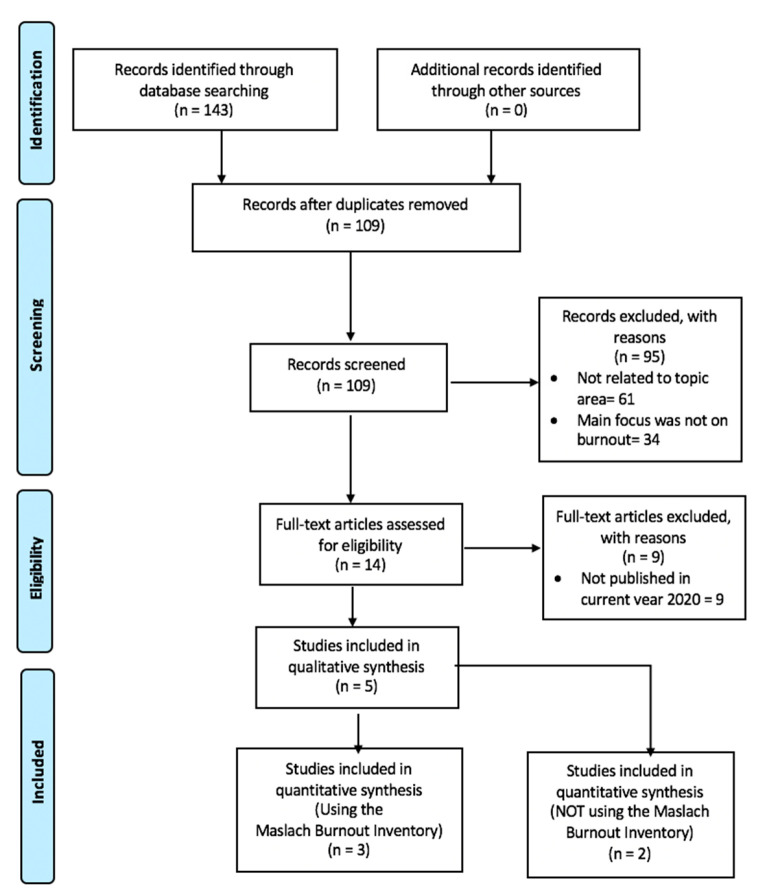
Background: The current pandemic, COVID-19, has added to the already high levels of stress that medical professionals face globally. While most health professionals have had to shoulder the burden, physicians are not often recognized as being vulnerable and hence little attention is paid to morbidity and mortality within this group. Objective: To analyse and summarise the current knowledge on factors/potential factors contributing to burnout amongst healthcare professionals amidst the pandemic. This review also makes a few recommendations on how best to prepare intervention programmes for physicians. Methods: In August 2020, a systematic review was performed using the database Medline and Embase (OVID) to search for relevant papers on the impact of COVID-19 on physician burnout–the database was searched for terms such as “COVID-19 OR pandemic” AND “burnout” AND “healthcare professional OR physician”. A manual search was done for other relevant studies included in this review. Results: Five primary studies met the inclusion criteria. A further nine studies were included which evaluated the impact of occupational factors (n = 2), gender differences (n = 4) and increased workload/sleep deprivation (n = 3) on burnout prior to the pandemic. Additionally, five reviews were analysed to support our recommendations. Results from the studies generally showed that the introduction of COVID-19 has heightened existing challenges that physicians face such as increasing workload, which is directly correlated with increased burnout. However, exposure to COVID-19 does not necessarily correlate with increased burnout and is an area for more research. Conclusions: There is some evidence showing that techniques such as mindfulness may help relieve burnout. However, given the small number of studies focusing on physician burnout amidst a pandemic, conclusions should be taken with caution. More studies are needed to support these findings.
Overview
The claims and statistics of this paper haven’t been checked yet.
Free: it reads the open-access text and checks the first 5 claims that cite a source we can check. Create a free account to check every claim.
Integrity signals
Registry
Cites
Statistics
Figures
Verification
Claims the paper makes
The claims and statistics of this paper haven’t been checked yet.
Free: it reads the open-access text and checks the first 5 claims that cite a source we can check. Create a free account to check every claim.
Claims other papers make about this one
Each is checked against this paper’s own text: does it say what the citing paper says it does?
The source backs part of the claim, not all of it — or backs it for a different population, condition or comparison.
In the citing paper
“MBI-HSS has been suggested by previous studies as the “instrument of choice” for assessing burnout.12 , 13”
From Burnout syndrome among residents of different surgical specialties in a tertiary referral teaching hospital in Indonesia during COVID-19 pandemic (2022) · cites this paper as [13]
Experimental — accuracy not yet measuredThe source backs part of the claim, not all of it — or backs it for a different population, condition or comparison.
In the citing paper
“Escalating this issue are high rates of absence and turnover, driven by an unprecedented level of physician and nurse burnout due to psychosocial stressors and occupational hazards such as exposure to infectious diseases, shiftwork, or ergonomic challenges, that place health care workers at risk for long-term mental and physical health consequences [6-9].”
From AI Interventions to Alleviate Healthcare Shortages and Enhance Work Conditions in Critical Care: Qualitative Analysis (2025) · cites this paper as [6]
Experimental — accuracy not yet measured
Self-check
Percentages, sums and reported differences re-computed from the paper’s own numbers.
The self-check needs the paper’s full text.
Citations
Cites
Shanafelt, T. D., Boone, S., Tan, L., Dyrbye, L. N., Sotile, W., Satele, D., West, C. P., Sloan, J., & Oreskovich, M. R. (2012) · Archives of Internal Medicine · doi:10.1001/archinternmed.2012.3199 · Cited by 3,439 · cited 4×
“agree that having a partner or being married was associated with a decreased risk of burnout [6].”
BackgroundInfluentialAssessing Risk of Bias in Included Studies
Higgins, J. P., & Altman, D. G. (2008) · Cochrane Handbook for Systematic Reviews of Interventions · doi:10.1002/9780470712184.ch8 · Cited by 3,396 · cited 2×
“In order to assess the risk of bias, we used the Cochrane Manual for Systematic Intervention Review [22] as a guide; any discrepancies were discussed and agreed between the authors.”
MethodShanafelt, T., Ripp, J., & Trockel, M. (2020) · JAMA · doi:10.1001/jama.2020.5893 · Cited by 1,956 · cited 3×
“Being busy was often cited as a reason for not being able to be part of the study [21].”
BackgroundInfluentialKrasner, M. S. (2009) · JAMA · doi:10.1001/jama.2009.1384 · Cited by 1,650 · cited 2×
“The authors saw the role of a mindfulness-based programme as being positive [20].”
BackgroundMorgantini, L. A., Naha, U., Wang, H., Francavilla, S., Acar, Ö., Flores, J. M., Crivellaro, S., Moreira, D., Abern, M., Eklund, M., et al. (2020) · PLOS ONE · doi:10.1371/journal.pone.0238217 · Cited by 682
Relationship Between Work-Home Conflicts and Burnout Among American Surgeons: A Comparison by Sex
Dyrbye, L. N. (2011) · Archives of Surgery · doi:10.1001/archsurg.2010.310 · Cited by 591 · cited 2×
“, 2011 [2] Cross-sectional survey of Members of the American College of Surgeons.”
BackgroundResultWu, Y., Wang, J., Luo, C., Hu, S., Lin, X., Anderson, A. E., Bruera, E., Yang, X., Wei, S., & Qian, Y. (2020) · Journal of Pain and Symptom Management · doi:10.1016/j.jpainsymman.2020.04.008 · Cited by 567 · cited 1×
“Wu et al., 2020 [7] A survey compose of the MBI was administered to physicians and nurses on the frontline (FL) wards compared with those working in usual wards (UWs).”
MethodThe psychological impact of the COVID-19 outbreak on health professionals: A cross-sectional study
Giusti, E. M., Pedroli, E., D'Aniello, G. E., Stramba Badiale, C., Pietrabissa, G., Manna, C., Stramba Badiale, M., Riva, G., Castelnuovo, G., & Molinari, E. (2020) · Frontiers in Psychology · doi:10.3389/fpsyg.2020.01684 · Cited by 533 · cited 8×
“, 2020 [12] A cross-sectional study of health professionals working in an institution in Northern Italy were sent online surveys investigating burnout using MBI.”
BackgroundMethodResultInfluentialRuiz‐Fernández, M. D., Ramos‐Pichardo, J. D., Ibáñez‐Masero, O., Cabrera‐Troya, J., Carmona‐Rega, M. I., & Ortega‐Galán, Á. M. (2020) · Journal of Clinical Nursing · doi:10.1111/jocn.15469 · Cited by 514 · cited 1×
“used the “Professional Quality of Life Questionnaire” (ProQoL) to assess burnout and found that burnout levels amongst Spanish healthcare professionals have remained similar to those studies prior to the pandemic despite the health crisis situation [8].”
MethodKoh, D., Lim, M. K., Chia, S. E., Ko, S. M., Qian, F., Ng, V., Tan, B. H., Wong, K. S., Chew, W. M., Tang, H. K., et al. (2005) · Medical Care · doi:10.1097/01.mlr.0000167181.36730.cc · Cited by 454
Research works printed but not linked: 1
- Maslach C. Jackson S.E. Leiter M.P. Maslach Burnout Inventory Manual 3rd ed. Consulting Psychologists Press Palo Alto, CA, USA 1996
Cited by
Items 201–274 of 274
Il vissuto degli operatori e l'emergenza Covid-19 nelle Residenze Sanitarie Assistenziali
Barsanti, S., Sommati, V., & Colombini, G. (2022) · MECOSAN · doi:10.3280/mesa2022-122oa14615 · Cited by 1
Nebulized Ethanol: An Old Treatment for a New Disease
Stogner, S. W. (2023) · IntechOpen eBooks · doi:10.5772/intechopen.111695 · Cited by 1
ASSOCIATION OF PHYSICIAN BURNOUT WITH HEADACHE AND LOW BACK PAIN DURING PANDEMIC COVID-19
Husodo, K. R. (2023) · MNJ (Malang Neurology Journal) · doi:10.21776/ub.mnj.2023.009.02.7 · Cited by 1
We Care: A Wellness Intervention Project for Palliative Care Physicians
Burke, C., Clark, S., Gholson, K. L., & Mazur, J. (2023) · Journal of Pain and Symptom Management · doi:10.1016/j.jpainsymman.2023.08.027 · Cited by 1
Fitzgerald, C., Vaughan, A., Barry, L. A., Corey, G., Leahy, F. C., Egan, S., Conway, E., O’Connor, M., & Galvin, R. (2023) · BMC Research Notes · doi:10.1186/s13104-023-06534-5 · Cited by 1
“[9, 19].”
BackgroundFamily Physician Motivation and Well-Being in the Digital Era
Neufeld, A., Бабенко, О., & Bhella, V. S. (2023) · The Annals of Family Medicine · doi:10.1370/afm.3031 · Cited by 3
“29 Our findings align with SDT and suggest several key concepts.”
ResultSleep quality among family medicine physicians before and during COVID-19 in Jeddah, Saudi Arabia
Alshafei, E. A., Alsulami, A., Alqurashi, A. A., Salahuddin, H., luhaibi, H. A., Albaqami, M. M., Banat, Z. M. A., Alzahrani, M. A., Almutairi, R., Althoubaity, N., et al. (2024) · International Journal of Community Medicine and Public Health · doi:10.18203/2394-6040.ijcmph20240017 · Cited by 1
Psychological Impact of the COVID-19 Pandemic on Canadian Surgical Residents: A Province-Wide Study
Lie, J. J., Huynh, C., Li, J. S. Y., Mak, N. T., & Wiseman, S. M. (2024) · Journal of surgical education · doi:10.1016/j.jsurg.2023.12.013 · Cited by 1
Lee, T. J., Bassiouni, A., Wilkie, M. D., Foreman, A., Krishnan, S., & Hodge, J.-C. (2024) · Australian Journal of Otolaryngology · doi:10.21037/ajo-23-21 · Cited by 2
Aljohani, A. A. A. A., Alharbi, S. S., Albalawi, M. F., Alhawiti, M. E., Alsulami, A. N. M., Raea, S. M., Alyamani, A. M. A., Alfawzan, I. S. A., Alruqaie, R. I. M., Alamri, B. J., et al. (2022) · International Journal of Health Sciences · doi:10.53730/ijhs.v6ns10.15421 · Cited by 1
“Similar to the specific population addressed in this review, the authors found that while the pandemic exacerbated existing challenges faced by physicians, it was not necessarily linked to an increase in burnout levels [40].”
A Mixed-Method Study of Burnout Among American Pastoral Musicians
Behel, K., Surve, S. A., Conrady, M., & Lee, Y. (2024) · Pastoral Psychology · doi:10.1007/s11089-024-01189-w · Cited by 1
“Most research indicates that the pandemic increased burnout rates, though some found no significant difference (Amanullah & Ramesh Shankar, 2020; Loscalzo et al., 2021).”
Abdo, S., Mackinnon, S. P., Wong, M. J., Leiter, M. P., & Bailey, J. G. (2025) · Occupational Health Science · doi:10.1007/s41542-025-00221-6 · Cited by 1
“…working in the front line of care, being female, sleep deprivation, lack of personal protective equipment (PPE), perception of high risk, and high contact with the virus were factors associated with burnout incidence (Amanullah & Ramesh Shankar, 2020; Bailey et al., 2021; Sharifi et al., 2021).”
Chakraborty, N. (2020) · Sushruta Journal of Health Policy & Opinions · doi:10.38192/14.1.10 · Cited by 1
Huecker, M. R. (2020) · Journal of Wellness · doi:10.18297/jwellness/vol3/iss1/4 · Cited by 1
“Interestingly, however, exposure to COVID-19 itself did not necessarily lead to increased burnout [31].”
BackgroundMicheli, G. D., Marton, G., Mazzoni, D., & Vergani, L. (2022) · Behavioral Science · doi:10.3390/bs12060189 · Cited by 1
Navigating through the COVID‐19 storm toward posttraumatic growth
Merlo, L. J., & Radhakrishnan, N. S. (2022) · Journal of Hospital Medicine · doi:10.1002/jhm.12912
“Data show that rates of burnout and moral injury increased among physicians and other healthcare workers during pandemic surges.(1,2) Indeed, after more than 2 years of this public health crisis, most healthcare workers are seasick; and many feel we have fallen—or been pushed—into the water.”
BackgroundProceedings of the Inter Disciplinary Conclave (IDC)-2021
Levy, G. A. (2021) · Journal of Stem Cells and Regenerative Medicine · doi:10.46582/jsrm.1702011
Peñaloza-Valle, R. A., & Aguilar-Salazar, A. F. (2023) · MQRInvestigar · doi:10.56048/mqr20225.7.3.2023.3444-3463 · Cited by 2
Inpatient group psychotherapy for addiction patients in times of COVID-19
Mondon, M. A., Pons-Cabrera, M. T., Navarro-Cortés, L., & Gimenez, P. (2021) · Adicciones · doi:10.20882/adicciones.1702 · Cited by 2
Perfectionism as a Predictor of Physician BurnoutPreprint
Martin, S. R., Fortier, M. A., Heyming, T. W., Ahn, K. S., Nichols, W., Golden, C. J., Saadat, H., & Kain, Z. N. (2022) · Research Square · doi:10.21203/rs.3.rs-1366911/v1 · Cited by 1
Addressing Burnout: Complex Solutions Start With Small Steps
Jesse, M. T. (2022) · Liver Transplantation · doi:10.1002/lt.26438 · Cited by 1
Telemedicine Use by Pediatric Rheumatologists during the COVID-19 PandemicPreprint
Pooni, R., Ronis, T., & Lee, T. C. (2020) · doi:10.21203/rs.3.rs-109539/v1 · Cited by 1
Lee-Cheong, S., Alaverdashvili, M., Jardine, M., Kolla, N. J., & Maharaj, V. S. (2024) · Preprints.org · doi:10.20944/preprints202408.1644.v1 · Cited by 1
Sarikhani, Y., Khatami, K., Salehi‐Marzijarani, M., Estedlal, A., Sivandzadeh, G. R., Kouhi, P., Shahabi, S., Zarei, L., Heydari, S. T., & Lankarani, K. B. (2021) · Research Square · doi:10.21203/rs.3.rs-410345/v1
Sharma, N. (2021) · International Journal for Research in Applied Science and Engineering Technology · doi:10.22214/ijraset.2021.37397
“02 (2) 12 (12) 33 (33) 01 (1) 01 (1) 07 (7) 28 (28) 12 (12)”
MethodInfluentialO'Brien, M. W., Wong, M., Sui, W., Voss, L., Bray, N. W., Turnbull, N., Nagpal, T. S., & Fowles, J. R. (2021) · Journal of Medical Education Research · doi:10.5750/jmer.v1i1.1894
Reappraising Burnout Syndrome in Healthcare under Sars-Cov-2 Pandemic
Luis Madeira, L. D. A., Narciso, M. H., & Heitor, M. J. (2021) · Journal of Psychiatry and Mental Health · doi:10.16966/2474-7769.143
A Síndrome de Burnout em professores médicos durante a pandemia da Covid-19
Miyazato, E. S., Amaral, J. P. N., de Souza, A. S., & Stolf, A. R. (2022) · Revista Eletrônica Acervo Saúde · doi:10.25248/reas.e9597.2022 · Cited by 8
American Geriatrics Society Offers New and Updated Mobile Apps and Tools for Clinicians
Hollmann, P. A. (2022) · Journal of Gerontological Nursing · doi:10.3928/00989134-20211207-02
Síndrome de Burnout em Profissionais de Saúde Angolanos durante a Pandemia da Covid-19
de Oliveira, P. R. S., Garcia, D. D., Lueto, O., Martínez, F. C., Tchonhi, C., Bernardo, J., Silva, P., Mirandela, M., Gamboa, I., & Amaro, T. (2021) · Revista Portuguesa de Saúde Ocupacional · doi:10.31252/rpso/11.09.2021 · Cited by 3
Perfectionism as a Predictor of Physician BurnoutPreprint
Martin, S. R., Fortier, M. A., Heyming, T. W., Ahn, K. S., Nichols, W., Golden, C. J., Saadat, H., & Kain, Z. N. (2022) · Research Square · doi:10.21203/rs.3.rs-1366911/v2 · Cited by 1
Hakverdi, Ö. A., & Bulut, S. (2023) · Sağlık Akademisi Kastamonu · doi:10.25279/sak.972192
BURNOUT EM PROFISSIONAIS DE TERAPIA INTENSIVA: UM OLHAR PRÉ E PÓS-PANDEMIA
Pedro, J. P. S., da Cunha, D. B. A., Borges, J. B. F., Klein, C. L., Wanderlei, M. M., & Reis, A. G. (2022) · RECIMA21 - Revista Científica Multidisciplinar · doi:10.47820/recima21.v3i2.1102
The Use of Hyperbaric Oxygen Therapy to Treat Necrosis and Open Wounds due to Ionizing Radiation
Rehman, R. S. (2022) · Florida Undergraduate Research Journal · doi:10.55880/furj1.1.04
"Just" Utility? A Bioethical Analysis of COVID-19 Resource Allocation
Jacus, I. G. (2022) · Florida Undergraduate Research Journal · doi:10.55880/furj1.1.01
Everglades National Park's Historical Impact on The Seminole and Miccosukee Nations
Ryan, K. (2022) · Florida Undergraduate Research Journal · doi:10.55880/furj1.1.05
Chin, M., & Sanders, J. (2022) · Florida Undergraduate Research Journal · doi:10.55880/furj1.1.02
Guedouar, E. G. (2022) · Florida Undergraduate Research Journal · doi:10.55880/furj1.1.03
Fitzgerald, C., Vaughan, A., Barry, L. A., Corey, G., Leahy, F. C., Egan, S. M., Conway, E., O’Connor, M., & Galvin, R. (2022) · Research Square · doi:10.21203/rs.3.rs-1861134/v1
Medical Students Will Take Care of the People, We Need to Take Care of Them
Alahdab, F. (2022) · Avicenna Journal of Medicine · doi:10.1055/s-0042-1755183
Why Otolaryngologists Should Be Interested in Psychedelic Medicine
Asher, B. F. (2022) · Otolaryngologic Clinics of North America · doi:10.1016/j.otc.2022.06.002 · Cited by 1
Dias, F. F., Perdigão, D. H. R., Soares, I. A. G., Teixeira, J. P., Sávio, K. C. D. S., Gonçalves, L. S., Paes, M. R. S., & Vanzeler, M. L. A. (2022) · Brazilian Journal of Health Review · doi:10.34119/bjhrv5n5-229
Vasiliu, O. (2022) · Romanian Journal of Military Medicine · doi:10.55453/rjmm.2022.125.3.25
Johnson, C. (2023) · Advances in medical education, research, and ethics (AMERE) book series · doi:10.4018/978-1-6684-5493-0.ch016 · Cited by 2
Aron, D. C. (2023) · Springer eBooks · doi:10.1007/978-3-031-19535-8_20
How Covid 19 Fear Affected Nutritional Support in Healthcare Professionals
Döner, P., Aksoy, H., & Dirican, E. (2023) · Genel Tıp Dergisi · doi:10.54005/geneltip.1075733
Burnout and resilience among resident doctors working at a COVID-19 nodal center in India
Sriperambudoori, V., Pingali, S., Molanguri, U., Deekshith, T., & Joopaka, A. K. (2023) · Archives of Mental Health · doi:10.4103/amh.amh_140_22
Nashashibi, L., Khouri, M., Meretyk, I., Livni, T., Cohen, N., & Fruchter, E. (2023) · Frontiers in Psychiatry · doi:10.3389/fpsyt.2023.1105632
“(2) Previous history of mental illness.”
BackgroundInfluentialAsif, M., Bakhtiari, M., Tahir, R., Khan, A. H., & Chaudhry, M. A. (2022) · Khyber Medical University Journal · doi:10.35845/kmuj.2022.21656 · Cited by 1
Gambaran Stres pada Caregiver Lansia
Markhamah, I. L., Almira, A. N., Ghurriah, A., & Mukhoyyaroh, T. (2023) · Al-Ihath Jurnal Bimbingan dan Konseling Islam · doi:10.53915/jbki.v3i1.304 · Cited by 10
McKay, M., Brown, R., Mallam, K., Green, A. M., & Bernard, A. (2023) · Healthcare Management Forum · doi:10.1177/08404704231199083 · Cited by 1
Byrd, J. N., Lin, I.-C. F., Prasetyono, T. O. H., & Chung, K. C. (2023) · Global Surgical Education - Journal of the Association for Surgical Education · doi:10.1007/s44186-023-00162-0
Multiple Sensor Fusion for Stress Detection in the Hospital Environment
Fauzi, M. A., & Yang, B. (2023) · EAI/Springer Innovations in Communication and Computing · doi:10.1007/978-3-031-34750-4_16
Virtual Visit Trends in Nursing Homes During the COVID-19 Pandemic
Sandell, L., Baar, T. M., Zell, A., & Haque, R. (2023) · Telemedicine Journal and e-Health · doi:10.1089/tmj.2023.0216
Briles, B. L., Kahl, A., Anaissie, J. E., Brettmann, L., Pathak, U. I., Staggers, K. A., Popat, S., Agrawal, A., Rose, S., & Taylor, J. M. (2024) · Postgraduate Medicine · doi:10.1080/00325481.2024.2303974 · Cited by 1
“With the onset of the pandemic, even greater levels of stress, anxiety, depression, and burnout have been reported [3,7,12–16].”
BackgroundWu, X., Huihong, R., Feng, X., Chaojun, X., O’Donnell, R. R., & Zhoubin, Z. (2024) · Research Square · doi:10.21203/rs.3.rs-4101043/v1
Multiple Perspectives of Working From Home: Lessons Learned During the Pandemic
Ngotngamwong, R., & Ortiz, R. L. (2024) · Human Behavior, Development and Society · doi:10.62370/hbds.v25i1.269162
Mental Health Concerns on Nurses During COVID-19
Rahane, S., & Alam, K. (2024) · Springer eBooks · doi:10.1007/978-3-031-52110-2_4
Burnout during the COVID-19 pandemic: Modulating role of mindfulness
Sampei, M., & Morisaki, N. (2024) · Elsevier eBooks · doi:10.1016/b978-0-323-95650-5.00036-7
Hamidi, F., Hamishehkar, H., Markid, P. P. A., & Sarbakhsh, P. (2024) · Heliyon · doi:10.1016/j.heliyon.2024.e35561 · Cited by 1
“The surge in COVID-19 cases has also led to staff shortages, burnout, and mental health issues due to increased workloads [3 – 5].”
BackgroundWu, X., Ruan, H., Feng, X., Xie, C., O’Donnell, R. R., & Zhang, Z. (2025) · Journal of Family Medicine and Primary Care · doi:10.4103/jfmpc.jfmpc_891_24
“[7] The workload from providing vaccination services, conducting epidemiological investigations and massive nucleic acid screenings among the whole population, imposing strict quarantine measures on both local close contacts and international arrivals, [8] was so heavy that most PHCW had to work…”
Occupational Stress and Burnout among American Pastoral Musicians
Behel, K. (2022) · University of North Texas Digital Library (University of North Texas) · doi:10.12794/metadc1985394
Supporting Our Trainees: How Psychiatry Faculty Can Nurture Supervisees’ Well-Being
Bommarito, S., & Tamarelli, C. M. (2025) · Academic Psychiatry · doi:10.1007/s40596-025-02138-2
“Some involve training programs to introduce specific skills that have an existing evidence base for stress management and/or treatment of depression, such as courses in self-compassion, mindfulness meditation, or self-care strategies [9, 14–16].”
Etezad, E., Fiset, J. E., & Hajj, R. A. (2025) · doi:10.2196/preprints.80417
Uşkun, E., Doğan, E., Öztop, R., Aslan, C., Önal, Ö., & Kişioğlu, A. N. (2024) · Mental Health Religion & Culture · doi:10.1080/13674676.2024.2446786
“A global review highlighted that increased workload directly contributes to higher burnout rates among physicians (Amanullah & Shankar, 2020).”
Spilg, E. G., Rushton, C. H., Phillips, J. L., Kendzerska, T., Saad, M., Gifford, W., Gautam, M., Bhatla, R., Edwards, J. D., Quilty, L., et al. (2022) · Figshare · doi:10.6084/m9.figshare.17982502
Additional file 1 of Telemedicine use by pediatric rheumatologists during the COVID-19 pandemic
Pooni, R., Ronis, T., & Lee, T. C. (2021) · Figshare · doi:10.6084/m9.figshare.14795048
FitzGerald, C., Vaughan, A., Barry, L. A., Corey, G., Leahy, F. C., Egan, S., Conway, E., O’Connor, M., & Galvin, R. (2023) · Figshare · doi:10.6084/m9.figshare.24225220
Trends in Resident Trainee Humor Styles and Burnout During Residency TrainingPreprint
Rosenberg, M., Furrukh, A. J., Coulter, A. M. P., & Tirabassi, M. V. (2026) · Research Square · doi:10.21203/rs.3.rs-8554720/v1
Hakverdi, Ö. A., & Bulut, S. (2021) · DergiPark (Istanbul University)
Etezad, E., Fiset, J. E., & Hajj, R. A. (2026) · doi:10.2196/preprints.94871
Etezad, E., Fiset, J. E., & Hajj, R. A. (2026) · doi:10.2196/preprints.95845
Correlation of residents’ humor style with burnout during training
Rosenberg, M., Furrukh, A. J., Coulter, A. M. P., & Tirabassi, M. V. (2026) · Global Surgical Education - Journal of the Association for Surgical Education · doi:10.1007/s44186-026-00527-1
O efeito espelho: como o autocuidado do profissional reflete na saúde do paciente.
Corrêa, L. C., Lopes, J. P. F., Sperandio, Á. B., & Rocha, I. D. O. (2025) · Congresso Brasileiro de Medicina do Estilo de Vida · doi:10.61661/congresso.cbmev.8.2025.222
Metadata
- Authors
- Amanullah, S., & Ramesh Shankar, R.
- Affiliations
- University of Toronto (CA)
- Norwich Medical School, University of East Anglia, Norwich NR4 7TJ, UK
- Corresponding author
- Amanullah, Shabbir
- Venue
- Healthcare
- Publisher
- MDPI AG
- Published
- 2020-10-22
- Volume
- 8
- Issue
- 4
- Pages
- 421
- ISSN
- 2227-9032 (ISSN-L)
- PMC
- PMC7712764
- OpenAlex
- W3093585517
- Semantic Scholar
- c83bb9c3ba0b28d229b5bdee7b2bd34b652f22f9
- Cited by
- 276
- References
- 24
- Citations by year
- 2026: 6 · 2025: 18 · 2024: 41 · 2023: 61 · 2022: 94 · 2021: 53 · 2020: 3
- FWCI
- 55.08
- Type
- journal article
- Language
- en
- Open access
- gold
- doi.org
- Licence
- Locations
- Healthcare (publishedVersion, cc-by)
- PubMed Central (publishedVersion, cc-by)
- PubMed (publishedVersion)
- DOAJ (DOAJ: Directory of Open Access Journals) (submittedVersion, cc-by-sa)
- Topics
- Health Sciences › Health Professions › General Health Professions › Healthcare professionals’ stress and burnout
- Social Sciences › Psychology › Clinical Psychology › COVID-19 and Mental Health
- Health Sciences › Medicine › Public Health, Environmental and Occupational Health › Occupational Health and Burnout
- Keywords
- physician burnout, COVID-19 pandemic, occupational stress, physician workload, sleep deprivation, gender differences in burnout, mindfulness-based interventions, burnout prevention, healthcare workers
About these checks
Registry, retraction, Cites and statistics results are computed, not judged, with one exception: a printed reference that no index lists is read once by a model before it counts as a citation error. Claims are extracted by a model and kept only when their quote appears verbatim in the text; each cited source is then checked, with a model’s help, for whether it says what the claim relies on. Those verdicts can be wrong — read the claim’s quote and the cited source before relying on one.
Statistics and arithmetic are recomputed, not judged.
Confidence bands are shown only for fields calibrated on our annotated test set. None is calibrated yet, so no band is shown.
What counts as a claim ›How we measure confidence ›How we check this ›
Are you an author, or do you see a problem with this page? Request a review
Data sources
Bibliographic data: Semantic Scholar, OpenAlex, Crossref.
Contains information from the Semantic Scholar Academic Graph Datasets, made available under the ODC Attribution License (ODC-BY 1.0).
Semantic Scholar’s data is described in: Kinney, R., et al. (2023). The Semantic Scholar Open Data Platform. arXiv:2301.10140.
