

The DOI matches its Crossref record; 98 of the 101 references it cites were found in a registry or an index.
The Association between Chronotype and Dietary Pattern among Adults: A Scoping Review
Open accessAbstract
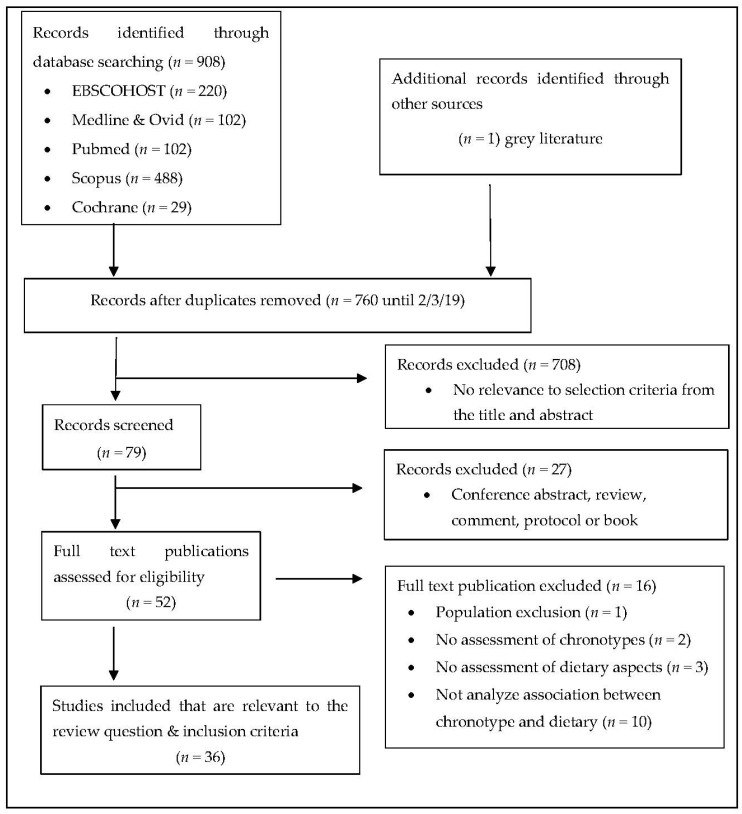
Chronotype reflects an individual’s preferred time of the day for an activity/rest cycle and individuals can be classified as a morning, intermediate, or evening type. A growing number of studies have examined the relationship between chronotype and general health. This review aimed to map current evidence of the association between chronotype and dietary intake among the adult population. A systematic search was conducted across five databases: EBSCO Host, Medline & Ovid, Pubmed, Scopus, and The Cochrane Library. The inclusion criteria were adult subjects (more than 18 years old), and included an assessment of (i) chronotype, (ii) dietary behaviour/nutrient intake/food group intake, and (iii) an analysis of the association between chronotype and dietary behaviour/nutrient intake/food group intake. A total of 36 studies were included in the review. This review incorporated studies from various study designs, however, the majority of these studies were based on a cross-sectional design (n = 29). Dietary outcomes were categorized into three main groups, namely dietary behaviour, nutrient intake, and specific food group intake. This scoping review demonstrates that evening-type individuals are mostly engaged with unhealthy dietary habits related to obesity and were thus hampered in the case of weight loss interventions. Hence, this review has identified several dietary aspects that can be addressed in the development of a personalised chrono-nutrition weight loss intervention.
Overview
The claims and statistics of this paper haven’t been checked yet.
Run the check — free, no account needed. It reads the open-access text and checks the sources it cites.
Integrity signals
Registry
Cites
Statistics
Figures
Verification
Claims the paper makes
The claims and statistics of this paper haven’t been checked yet.
Run the check — free, no account needed. It reads the open-access text and checks the sources it cites.
Claims other papers make about this one
Each is checked against this paper’s own text: does it say what the citing paper says it does?
In the citing paper
“Finally, individuals with an inherent later chronotype also tend to have a higher BMI presumably because they consume their meals later in the day [264].”
From Effects of diet, lifestyle, Chrononutrition and alternative dietary interventions on postprandial Glycemia and insulin resistance (2022) · cites this paper as [264]
Self-check
Percentages, sums and reported differences re-computed from the paper’s own numbers.
The self-check needs the paper’s full text.
Citations
Cites
Scoping studies: towards a methodological framework
Arksey, H., & O'Malley, L. (2005) · International Journal of Social Research Methodology · doi:10.1080/1364557032000119616 · Cited by 36,742
A self-assessment questionnaire to determine morningness- eveningness in human circadian rhythms
Home, J. K. (1976) · Medical Entomology and Zoology · Cited by 4,783
(1976) · PubMed · Cited by 3,979
Central and Peripheral Circadian Clocks in Mammals
Mohawk, J. A., Green, C. B., & Takahashi, J. S. (2012) · Annual Review of Neuroscience · doi:10.1146/annurev-neuro-060909-153128 · Cited by 2,265
Epidemiology of the human circadian clock
Roenneberg, T., Kuehnle, T., Juda, M., Kantermann, T., Allebrandt, K., Gordijn, M., & Merrow, M. (2007) · Sleep Medicine Reviews · doi:10.1016/j.smrv.2007.07.005 · Cited by 1,545
Circadian typology: a comprehensive review
Adan, A., Archer, S. N., Hidalgo, M. P., Di Milia, L., Natale, V., & Randler, C. (2012) · Chronobiology International · doi:10.3109/07420528.2012.719971 · Cited by 1,384
Smith, C. S., Reilly, C., & Midkiff, K. (1989) · Journal of Applied Psychology · doi:10.1037/0021-9010.74.5.728 · Cited by 1,106
Timing of food intake predicts weight loss effectiveness
Garaulet, M., Gómez-Abellán, P., Alburquerque-Béjar, J. J., Lee, Y.-C., Ordovás, J. M., & Scheer, F. A. J. L. (2013) · International Journal of Obesity · doi:10.1038/ijo.2012.229 · Cited by 639
A diurnal type scale. Construction, consistency and validation in shift work.
Torsvall, L., & Åkerstedt, T. (1980) · Scandinavian Journal of Work Environment & Health · doi:10.5271/sjweh.2608 · Cited by 434
Genetic control of de novo lipogenesis: role in diet-induced obesity
Strable, M. S., & Ntambi, J. M. (2010) · Critical Reviews in Biochemistry and Molecular Biology · doi:10.3109/10409231003667500 · Cited by 428
Research works printed but not linked: 3
- 2007, How to measure circadian rhythms in humans, Medicographia, 29, 84
- Zainuddin, 2018, Sugar intake and metabolic syndrome among older adults in Peninsular Malaysia, Malays. J. Nutr., 24, 163
- Saat, 2010, Stress And Its Relationship With Body Mass Index Among Biomedical Science Students In Kuala Lumpur, Malaysia, ASEAN J. Psychiatry, 11, 190
Cited by
Sorted by citations
Chronotype, circadian rhythm, and psychiatric disorders: Recent evidence and potential mechanisms
Zou, H., Zhou, H., Yan, R., Yao, Z., & Lu, Q. (2022) · Frontiers in Neuroscience · doi:10.3389/fnins.2022.811771 · Cited by 297
Papakonstantinou, E., Oikonomou, C., Nychas, G., & Dimitriadis, G. D. (2022) · Nutrients · doi:10.3390/nu14040823 · Cited by 199
van der Merwe, C., Münch, M. Y., & Kruger, R. (2022) · Advances in Nutrition · doi:10.1093/advances/nmac093 · Cited by 158
Circadian rhythms, gut microbiota, and diet: Possible implications for health
Lotti, S., Dinu, M., Colombini, B., Amedei, A., & Sofi, F. (2023) · Nutrition Metabolism and Cardiovascular Diseases · doi:10.1016/j.numecd.2023.05.009 · Cited by 105
Marjot, T., Tomlinson, J., Hodson, L., & Ray, D. W. (2023) · Gut · doi:10.1136/gutjnl-2023-329998 · Cited by 91
Metadata
- Authors
- Mazri, F. H., Manaf, Z. A., Shahar, S., & Mat Ludin, A. F.
- Affiliations
- National University of Malaysia (MY)
- Biomedical Science Program and Centre for Healthy Aging & Wellness, Faculty of Health Sciences, Universiti Kebangsaan Malaysia, Jalan Raja Muda Abdul Aziz, Kuala Lumpur 50300, Malaysia
- Corresponding author
- Manaf, Zahara Abdul
- Venue
- International Journal of Environmental Research and Public Health
- Publisher
- MDPI AG
- Published
- 2019-12-20
- Volume
- 17
- Issue
- 1
- Pages
- 68
- ISSN
- 1660-4601 (ISSN-L)
- PMC
- PMC6981497
- OpenAlex
- W2996580103
- Cited by
- 198
- References
- 101
- Citations by year
- 2026: 21 · 2025: 31 · 2024: 38 · 2023: 37 · 2022: 32 · 2021: 33 · 2020: 4
- FWCI
- 2.07
- Type
- journal article
- Language
- en
- Open access
- gold
- dx.doi.org
- Licence
- Locations
- International Journal of Environmental Research and Public Health (publishedVersion, cc-by)
- Europe PMC (PubMed Central) (publishedVersion, cc-by)
- PubMed Central (publishedVersion, cc-by)
- PubMed (publishedVersion)
- RePEc: Research Papers in Economics (submittedVersion)
- Funders
- Fundamental Research Grant Scheme (FRGS) (FRGS/1/2018/SKK06/UKM/02/3)
- Topics
- Life Sciences › Neuroscience › Endocrine and Autonomic Systems › Circadian rhythm and melatonin
- Social Sciences › Psychology › Experimental and Cognitive Psychology › Sleep and related disorders
- Health Sciences › Medicine › Public Health, Environmental and Occupational Health › Nutritional Studies and Diet
- Keywords
- chronotype, dietary habits, dietary behaviour, nutrient intake, food group intake, evening chronotype, morning chronotype, obesity, weight loss interventions, chrononutrition, personalized nutrition
- MeSH terms
- Energy Intake, Circadian Rhythm, Cross-Sectional Studies, Diet, Feeding Behavior, Humans, Obesity, Weight Loss
About these checks
Registry, retraction, Cites and statistics results are computed, not judged, with one exception: a printed reference that no index lists is read once by a model before it counts as a citation error. Claims are extracted by a model and kept only when their quote appears verbatim in the text; each cited source is then checked, with a model’s help, for whether it says what the claim relies on. Those verdicts can be wrong — read the claim’s quote and the cited source before relying on one.
Statistics and arithmetic are recomputed, not judged.
Confidence bands are shown only for fields calibrated on our annotated test set. None is calibrated yet, so no band is shown.
What counts as a claim ›How we measure confidence ›How we check this ›
Are you an author, or do you see a problem with this page? Request a review
