

The Prevalence of Depression, Anxiety and Stress and Their Associated Factors in College Students.
Open accessThe DOI matches its Crossref record; 65 of the 69 references it cites were found in a registry or an index; 4 of the 10 sources its claims cite were checked for support.
Abstract
AIM: To estimate the prevalence of symptoms of depression, anxiety, stress and associated factors in a population of college students. METHOD: Cross-sectional study of psychological distress measured through the Depression, Anxiety and Stress Scale (DASS-21) in a sample of 1074 college students. RESULTS: We found a moderate prevalence of depression (18.4%), anxiety (23.6%) and stress (34.5%) symptoms in our study population. Being <21, having problematic Internet use behavior, smoking, presenting insomnia and having a low self-esteem were independently associated with symptoms of depression, anxiety and stress. Being a woman, living with their family, having a stable partner, consuming alcohol frequently and having poor nutritional habits were significantly associated with symptoms of stress; lacking a stable partner was significantly associated with depressive symptoms; and frequent consumption of alcohol was significantly associated with symptoms of anxiety. CONCLUSION: We found a moderate prevalence of depression, anxiety and stress symptoms in our population. Interventions aimed at promoting mental health among college students should be implemented.
Overview
CoChat Summary
TL;DR
This cross-sectional study of 1,074 Spanish college students found moderate symptom prevalence of depression, anxiety, and stress measured by DASS-21. Younger age, problematic Internet use, smoking, insomnia, low self-esteem, and some lifestyle/living factors were associated with higher psychological distress.
Key findings
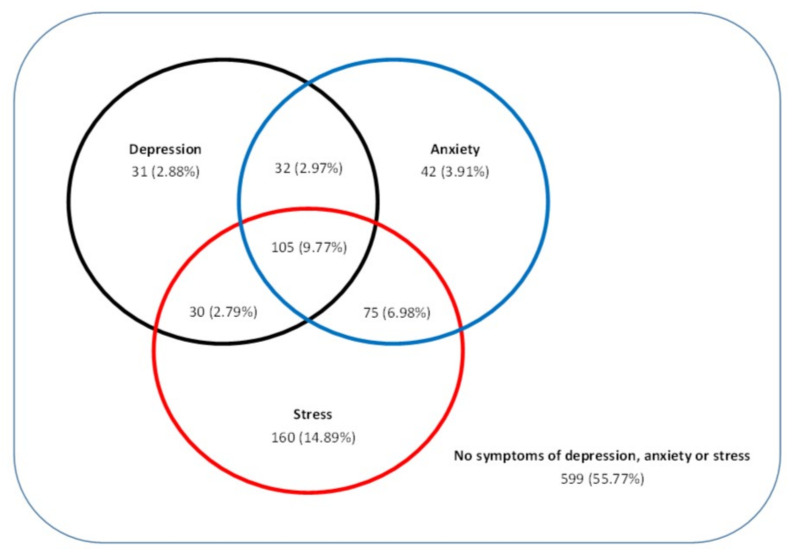
- In 1,074 undergraduate students, prevalence of symptoms above the normal range was 18.4% for depression, 23.6% for anxiety, and 34.5% for stress.
- 22.5% of participants had symptoms of two mental disorders, and 9.7% had symptoms of anxiety, depression, and stress simultaneously.
- In the final binary logistic regression, being <21, experiencing problematic Internet use, smoking, having insomnia, and low self-esteem were associated with depression, anxiety, and stress.
- Additional significant associations reported were: stress with being a woman, living with family, having a stable partner, frequent alcohol consumption, and poor diet; depression with lacking a stable partner; and anxiety with frequent alcohol consumption.
Methods
- Cross-sectional study of undergraduate students at San Jorge University (Zaragoza, Spain) during the 2018–2019 academic year.
- Sample: 1,074 students out of a total population of 1,341 who consented and completed the questionnaire.
- Main measures: DASS-21 for depression/anxiety/stress; sociodemographic and lifestyle variables including age, gender, relationship status, smoking, alcohol, physical activity, diet, Internet use, insomnia, and self-esteem.
- Analysis used descriptive statistics, bivariate tests, and binary logistic regression with backward stepwise selection; results presented were from the model including outliers.
Limitations
- The paper states that DASS-21 is a screening tool, not a formal diagnostic instrument, so additional tools would be needed for diagnosis.
- The authors note the cross-sectional design cannot establish causality, only associations.
- They say data were collected over eight months, so students may have experienced different academic conditions during collection.
- The authors state generalizability may be limited because the study was conducted in a private college in Spain.
Model-written summary. Check it against the paper before relying on it.
Integrity signals
Registry
Cites
Statistics
Figures
Verification
Claims the paper makes
3 Valid · 0 Not valid · 4 Not checked · 27 Own results and interpretations
A result the paper reports from its own data — it cites no other source for it, so there is none to check. The quote shows it is in the paper.
In the paper
“However, physical activity was not clearly associated with psychological distress in our sample.”
§ The Prevalence of Depression, Anxiety and Stress and Their Associated Factors in College Students > 4. Discussion
hedged- Asserted: passes — The authors put it forward as true.
- Checkable: passes — It can be checked against evidence.
- Load-bearing: passes — The paper’s conclusions depend on it.
- Based: passes — The paper gives a reason why it holds.
A result the paper reports from its own data — it cites no other source for it, so there is none to check. The quote shows it is in the paper.
In the paper
“It is also worth highlighting that being enrolled in a healthcare program did not increase the risk of experiencing symptoms of depression, anxiety and stress in our sample.”
§ The Prevalence of Depression, Anxiety and Stress and Their Associated Factors in College Students > 4. Discussion
plain- Asserted: passes — The authors put it forward as true.
- Checkable: passes — It can be checked against evidence.
- Load-bearing: unclear — It is unclear whether the paper’s conclusions depend on it.
- Based: passes — The paper gives a reason why it holds.
A result the paper reports from its own data — it cites no other source for it, so there is none to check. The quote shows it is in the paper.
In the paper
“We found a moderate prevalence of depression (18.4%), anxiety (23.6%) and stress (34.5%) symptoms in our study population.”
- Also stated in: § 3. Results · plain
“Of our participants, 23.6% and 34.5% had symptoms of anxiety and stress above the normal range, respectively.”
- Also stated in: § 4. Discussion · plain
“We identified a significant prevalence of symptoms of stress (34.5%), anxiety (23.6%) and depression (18.4%) in our population.”
§ The Prevalence of Depression, Anxiety and Stress and Their Associated Factors in College Students > Abstract
plain- Asserted: passes — The authors put it forward as true.
- Checkable: passes — It can be checked against evidence.
- Load-bearing: passes — The paper’s conclusions depend on it.
- Based: passes — The paper gives a reason why it holds.
- Also stated in: § 3. Results · plain
A result the paper reports from its own data — it cites no other source for it, so there is none to check. The quote shows it is in the paper.
In the paper
“In addition, being a woman, living with their family, having a stable partner, consuming alcohol regularly and following an inadequate or unhealthy diet were significantly associated with stress”
- Also stated in: § 3. Results · plain
“In both cases, women’s levels of anxiety and stress were higher than men’s (p < 0.05).”
- Also stated in: § 4. Discussion · plain
“In our sample, female students presented a higher prevalence of symptoms of stress and anxiety compared to male students.”
§ The Prevalence of Depression, Anxiety and Stress and Their Associated Factors in College Students > 3. Results
plainstates an association- Asserted: passes — The authors put it forward as true.
- Checkable: passes — It can be checked against evidence.
- Load-bearing: passes — The paper’s conclusions depend on it.
- Based: passes — The paper gives a reason why it holds.
- Also stated in: § 3. Results · plain
A result the paper reports from its own data — it cites no other source for it, so there is none to check. The quote shows it is in the paper.
In the paper
“The final models of binary logistic regression evidenced that being <21, experiencing PIU, smoking, having insomnia and reporting a low level of self-esteem were associated with depression, anxiety and stress (p < 0.05).”
- Also stated in: § 4. Discussion · plain
“As has been reported in previous studies involving similar samples, we found an association between certain habits such as tobacco and alcohol consumption [32], presenting PIU [11] and eating unhealthily [43,55] with higher levels of psychological distress.”
§ The Prevalence of Depression, Anxiety and Stress and Their Associated Factors in College Students > 3. Results
plainstates an association- Asserted: passes — The authors put it forward as true.
- Checkable: passes — It can be checked against evidence.
- Load-bearing: passes — The paper’s conclusions depend on it.
- Based: passes — The paper gives a reason why it holds.
- Also stated in: § 4. Discussion · plain
16 more claims
Create a free account to see all 34 claims and every source verdict.
- Probably not a substantial claim. 8
- The quote only partly states this claim. 6
- It may state two separate claims as one. 3
Claims other papers make about this one
Each is checked against this paper’s own text: does it say what the citing paper says it does?
The source backs part of the claim, not all of it — or backs it for a different population, condition or comparison.
In the citing paper
“which is significantly higher than college students (Ramón‐Arbués et al., 2020) and even higher than the medical student population (Quek et al., 2019).”
From Global prevalence and trend of anxiety among graduate students: A systematic review and meta‐analysis (2023) · cites this paper as Ramón‐Arbués et al., 2020
Experimental — accuracy not yet measuredThe cited source says what the claim attributes to it.
In the citing paper
“there is some literature that indicates that college students may be more likely to endorse symptoms of stress, in comparison to depression or anxiety symptoms (Ramón-Arbués et al., 2020).”
From Using network analysis to examine connections between Acceptance and Commitment Therapy (ACT) processes, internalizing symptoms, and well-being in a sample of undergraduates (2023) · cites this paper as Ramón-Arbués et al., 2020
Citations
Cites
James, S. L., Abate, D., Abate, K. H., Abay, S. M., Abbafati, C., Abbasi, N., Abbastabar, H., Abd-Allah, F., Abdela, J., Abdelalim, A., et al. (2018) · The Lancet · doi:10.1016/s0140-6736(18)32279-7 · Cited by 13,867
Vos, T., Abajobir, A. A., Abate, K. H., Abbafati, C., Abbas, K. M., Abd-Allah, F., Abdulkader, R. S., Abdulle, A. M., Abebo, T. A., Abera, S. F., et al. (2017) · The Lancet · doi:10.1016/s0140-6736(17)32154-2 · Cited by 13,220
Validation of the Insomnia Severity Index as an outcome measure for insomnia research
Bastien, C. (2001) · Sleep Medicine · doi:10.1016/s1389-9457(00)00065-4 · Cited by 8,067 · cited 1×
“The ISI total score is interpreted as follows: absence of insomnia (0–7); sub-threshold insomnia (8–14); moderate insomnia (15–21); and severe insomnia (22–28) [35].”
BackgroundThe prevalence and correlates of depression, anxiety, and stress in a sample of college students
Beiter, R., Nash, R., McCrady, M., Rhoades, D., Linscomb, M., Clarahan, M., & Sammut, S. (2015) · Journal of Affective Disorders · doi:10.1016/j.jad.2014.10.054 · Cited by 2,030
A systematic review of studies of depression prevalence in university students
Ibrahim, A. K., Kelly, S. J., Adams, C. E., & Glazebrook, C. (2013) · Journal of Psychiatric Research · doi:10.1016/j.jpsychires.2012.11.015 · Cited by 1,988
Physical Activity for Cognitive and Mental Health in Youth: A Systematic Review of Mechanisms
Lubans, D., Richards, J., Hillman, C., Faulkner, G., Beauchamp, M., Nilsson, M., Kelly, P., Smith, J., Raine, L., & Biddle, S. (2016) · Pediatrics · doi:10.1542/peds.2016-1642 · Cited by 1,548 · cited 1×
“Thus, physical activity has often been associated with psychological wellbeing through a range of mechanisms including the secretion of endogen substances such as endorphins, the activity of the regulation of stress responses through the hypothalamic-pituitary-adrenal (HPA) axis, the improvement of sleep quality and t…”
BackgroundMental health problems in college freshmen: Prevalence and academic functioning
Bruffaerts, R., Mortier, P., Kiekens, G., Auerbach, R. P., Cuijpers, P., Demyttenaere, K., Green, J. G., Nock, M. K., & Kessler, R. C. (2018) · Journal of Affective Disorders · doi:10.1016/j.jad.2017.07.044 · Cited by 1,047 · cited 1×
“Worldwide, it is estimated that 12–50% of college students present at least one diagnostic criterion for one or more mental disorders [14].”
BackgroundChange in mental health after smoking cessation: systematic review and meta-analysis
Taylor, G., McNeill, A., Girling, A., Farley, A., Lindson-Hawley, N., & Aveyard, P. (2014) · BMJ · doi:10.1136/bmj.g1151 · Cited by 1,039 · cited 1×
“First, it is likely that tobacco use and mental health problems have a common root; people who experience mental health problems may smoke to regulate feelings of low mood, stress and anxiety; smoking could also cause or exacerbate existing mental health problems [46].”
BackgroundChallenges and opportunities in global mental health: a research-to-practice perspective
Wainberg, M. L., Scorza, P., Shultz, J. M., Helpman, L., Mootz, J. J., Johnson, K. A., Neria, Y., Bradford, J.-M. E., Oquendo, M. A., & Arbuckle, M. R. (2017) · Current Psychiatry Reports · doi:10.1007/s11920-017-0780-z · Cited by 875 · cited 2×
“Yet, mental health problems are the first cause of disability and a major public health issue worldwide due to disease progression, difficulties in therapeutic management and increasing prevalence [2,3].”
BackgroundResultLai, J. S., Hiles, S., Bisquera, A., Hure, A. J., McEvoy, M., & Attia, J. (2014) · The American Journal of Clinical Nutrition · doi:10.3945/ajcn.113.069880 · Cited by 786 · cited 1×
“However, two previous systematic reviews [53,54] found limited and contradictory evidence to support the association between dietary patterns and mental health problems in adults.”
Result
Research works printed but not linked: 2
- Kumaraswamy, 2013, Academic stress, anxiety and depression among college students—A brief review, Int. Rev. Soc. Sci. Hum., 5, 135
- Balanza, 2008, Academic and psycho-socio-familiar factors associated to anxiety and depression in university students. Reliability and validity of a questionnaire, Rev. Esp. Salud Publica, 82, 189
Cited by
Items 401–500 of 617
Dauda, R. B., & Abdulkadir, A. O. (2025) · Fenomena · doi:10.35719/fenomena.v24i2.255 · Cited by 1
“The data unequivocally demonstrates that academic pressure and financial hardship are the predominant stressors, identified by 68% and 55% of students respectively, and are the most significant predictors of depressive symptoms (Ramón-Arbués et al., 2020).”
Causal Analysis of Health and Behaviors for Personalized Healthcare
Zhang, J., Cong, R., Nishimura, S., Ogihara, A., & Jin, Q. (2025) · IEEE Intl Conf on Dependable, Autonomic and Secure Computing, Intl Conf on Pervasive Intelligence and Computing, Intl Conf on Cloud and Big Data Computing, Intl Conf on Cyber Science and Technology Congress (DASC/PiCom/CBDCom/CyberSciTech) · doi:10.1109/cyberscitech68397.2025.00077 · Cited by 1
“Unhealthy lifestyle patterns such as irregular sleep [1][2], poor diet [3], insufficient physical activity [4], and substance use [6] are widely recognized as contributing to obesity, stress, and mental health issues.”
Sirois, F. M., & Hirsch, J. K. (2026) · Personality and Individual Differences · doi:10.1016/j.paid.2026.113683 · Cited by 1
Sairitupa-Sanchez, L. Z., Morales-García, S. B., Rivera-Lozada, O., & Morales-García, W. C. (2026) · Behavioral Sciences · doi:10.3390/bs16020269 · Cited by 1
“…depression, anxiety, and stress in school populations impair quality of life, academic performance, and interpersonal relationships, and in extreme cases may be associated with suicidal ideation and attempts (Deng et al., 2022; Ramón-Arbués et al., 2020; Schulte-Körne, 2016; Zheng et al., 2023).”
Examining the Predictors of Life Satisfaction in College Students With Intellectual Disability
Gaasbeek, E. K. V., & Tassé, M. J. (2026) · Journal of Intellectual Disability Research · doi:10.1111/jir.70090 · Cited by 1
“…for anxiety and depression may be due to increased stressors, such living independently for the first time, making major life decisions, financial stressors and greater academic re-sponsibilities (Ibrahim et al. 2013; Moeller and Seehuus 2019; Pedrelli et al. 2015; Ramón-Arbués et al. 2020).”
Chen, P., Jia, S., Deng, Y., Cheng, J., Tang, T., Li, H., Li, H., Ma, H., & Zhang, T. (2026) · BMC Psychology · doi:10.1186/s40359-026-04224-y · Cited by 3
“College students often experience heightened stress related to academic demands, social transitions, and identity formation, which collectively increase their vulnerability to anxiety and depression [98].”
Chen, C., Chen, I.-H., Hou, W., Chou, P.-Y., Üztemur, S., Chen, X., Huang, R.-Y., Potenza, M. N., Demetrovics, Z., Griffiths, M. D., et al. (2026) · Computers in Human Behavior · doi:10.1016/j.chb.2026.108977 · Cited by 1
Yan, C., Wang, Y., Liang, Z., Sun, H., Zhang, T., & Wang, B. (2026) · Frontiers in Psychology · doi:10.3389/fpsyg.2026.1738521 · Cited by 2
Jiang, T., Zhang, S., & Jiang, D. (2026) · Frontiers in Psychiatry · doi:10.3389/fpsyt.2026.1809332 · Cited by 2
“The former may re fl ect the real-life stress burden recently experienced by individuals (54), whereas the latter may further affect emotional health through circadian rhythms, self-regulation, and physical status (55).”
Huang, X., Them, S., Liu, A., Wen, S., & Deng, J. (2026) · Medicine · doi:10.1097/md.0000000000045873 · Cited by 1
Popovici, R. A., Vlad-Dumitru, B., Trusculescu, L.-M., Kiș, A. M., Enache, A., Bodo, C. R., Seni, A. G., Dehelean, L., Porumb, A., Marian, D., et al. (2026) · Nutrients · doi:10.3390/nu18121837 · Cited by 1
Mordeno, I. G., Lucero, L., & Bigcas, J. D. (2026) · Frontiers in Education · doi:10.3389/feduc.2026.1850327 · Cited by 2
da Silva, C. S., Teles, G. D. O., Marques, V. A., Silva, M. S., Rebelo, A. C. S., & Fiuza, T. D. S. (2022) · Research Society and Development · doi:10.33448/rsd-v11i1.25000 · Cited by 2
“Other factors associated with high rates of depression are inadequate diet, alcohol consumption, and smoking (Ramón-Arbués et al., 2020).”
BackgroundDiengdoh, I., & Ali, A. (2023) · MGM Journal of Medical Sciences · doi:10.4103/mgmj.mgmj_165_22 · Cited by 2
Tymoshchuk, O. V., Serheta, I. V., Malyshevska, O. S., et al. (2023) · Medicni perspektivi · doi:10.26641/2307-0404.2023.1.276203 · Cited by 1
Ничипоренко, Н. П. (2023) · Kazan Pedagogical Journal · doi:10.51379/kpj.2023.159.2.025 · Cited by 3
“В выборке из 1074 испанских студентов обнаружена умеренная распространенность симптомов депрессии (18,4%), тревоги (23,6%) и стресса (34,5%) [23].”
InfluentialLimachi, R. E. M., & Pinto, J. F. S. K. C. (2023) · Revista Científica de Ciencias de la Salud · doi:10.17162/rccs.v16i1.1992 · Cited by 1
Lima, B. D., Casarin, M., Juárez, H. A. B., & Muniz, F. W. M. G. (2023) · Revista da ABENO · doi:10.30979/revabeno.v23i1.2092 · Cited by 2
EMOTIONAL INTELLIGENCE AND MENTAL HEALTH AMONG HUE UNIVERSITY STUDENTS
Nguyen, A. H. (2022) · HUE UNIVERSITY JOURNAL OF SCIENCE SOCIAL SCIENCES AND HUMANITIES · doi:10.26459/hueunijssh.v131i6c.6515 · Cited by 3
“Anxiety and stress were 23.6% and 34.5% [43].”
BackgroundInfluentialHubungan perilaku hidup sehat dengan distres psikologis pada mahasiswa keperawatan
Wuisang, M., & Lainsamputty, F. (2023) · HOLISTIK JURNAL KESEHATAN · doi:10.33024/hjk.v17i2.9363 · Cited by 7
Empowering Youth by Mitigating Depression, Anxiety, and Suicidal Thoughts through Cricket Sport
Ali, A., Ali, A., & Ahmed, F. (2023) · Pakistan Social Sciences Review · doi:10.35484/pssr.2023(7-iv)55 · Cited by 1
Gębska, M., Mielcarska, S., Dalewski, B., Pałka, Ł., Weber‐Nowakowska, K., & Kołodziej, Ł. (2023) · doi:10.56984/8zg20bzsv · Cited by 1
Avaliação da ansiedade em estudantes universitários no cenário brasileiro: scoping review
de Oliveira, M. D. D. N., Chaves, R. L., da Silva, P. C. M., Paiva, M. A. B., Chaves, G. L., Costa, I. C. P., Costa, A. C. B., & Chaves, É. D. C. L. (2024) · Contribuciones a las Ciencias Sociales · doi:10.55905/revconv.17n.1-236 · Cited by 1
Research on the Influence of Competency on the Job Performance of College Counsellors
Gang, L., & Xi, L. (2024) · Journal of Law and Sustainable Development · doi:10.55908/sdgs.v12i1.2586 · Cited by 6
“Stress, anxiety, sadness, and other mental health issues are common among students during their college years (Ramón-Arbués et al., 2020).”
BackgroundHusić, I., & Dautbegović, A. (2024) · Obrazovanje odraslih/Adult Education · doi:10.53617/issn2744-2047.2023.23.1.81 · Cited by 1
Khadka, R. R., Gyawali, M., Abdullah, A., Jamshaid, H., & Kumar, A. (2024) · International Journal of Innovative Science and Research Technology (IJISRT) · doi:10.38124/ijisrt/ijisrt24mar1858 · Cited by 2
Childhood Trauma: Effects on Adolescents' Mental Health
Lin, X. (2024) · Applied & Educational Psychology · doi:10.23977/appep.2024.050306 · Cited by 4
“Complex traumas, such as long-term interpersonal trauma, can negatively affect children's brain development, leading to cognitive and neuropsychological deficits[4].”
BackgroundSirotiak, Z., Adamowicz, J. L., & Thomas, E. B. K. (2024) · Adolescent Psychiatry · doi:10.2174/0122106766288982240509041026 · Cited by 1
Song, Z., Grigoryan, A. K., & Khachatryan, N. (2023) · Bulletin of Yerevan University E Philosophy Psychology · doi:10.46991/bysu:e/2024.15.1.057 · Cited by 1
Examining audiologist candidates' self-esteem and professional self-esteem
Koçyiğit, A. A., & Dizdar, H. T. (2024) · The Egyptian Journal of Otolaryngology · doi:10.1186/s43163-024-00632-2 · Cited by 1
Alves, B. D. O., Lourenço, B. G., de Assis, B. B., Toledo, L. V., Chaves, R. L., Chaves, É. D. C. L., Chianca, T. C. M., & Moura, C. D. C. (2024) · Revista Brasileira de Enfermagem · doi:10.1590/0034-7167-2024-0040pt · Cited by 1
Rizky, M., & Ikrimach, I. (2024) · International Journal of Science Technology Engineering and Mathematics · doi:10.53378/ijstem.353130 · Cited by 1
“In Indonesia alone, nearly 153 clients accessed online consultation services during the pandemic, with the majority reporting symptoms of anxiety and depression (Ramón-Arbués et al., 2020).”
Exploring the relationship between social demographic factors and anxiety in college students
Ogunrinde, J. O., Dang, P., Martins, L., Niazi-Galindo, N., Adepoju, O. E., & Mitchell, L. Y. (2025) · Journal of Affective Disorders Reports · doi:10.1016/j.jadr.2025.100896 · Cited by 4
Yan, K., Ikani, N., Yusainy, C., Witteman, C. L. M., & Spijker, J. (2025) · Trials · doi:10.1186/s13063-025-08858-y · Cited by 2
“Research indeed shows a high global prevalence of stress, anxiety, and depression among undergraduate students [2, 3].”
Evaluation of health anxiety and cyberchondria levels in adolescent high school students
Demir, G., Bahar, Z., & Yıldırım, D. (2025) · Journal of Child and Adolescent Mental Health · doi:10.2989/17280583.2025.2490650 · Cited by 5
“Specifically, those aged 15 years experienced more anxiety than those aged 16 years (Korkmaz, 2014) Individuals living with chronic illnesses often face significant psychological challenges due and future planning (Bakıcı, 2021; Polat, 2020; Ramón-Arbués et al., 2020).”
InfluentialDevelopmental Issues of University Students in Hong Kong
Shek, D. T. L., & Wong, T. T. Y. (2025) · Quality of life in Asia · doi:10.1007/978-981-96-0251-3_3 · Cited by 2
Subirón‐Valera, A. B., Lucha-López, A. C., Rodríguez‐Roca, B., Urcola‐Pardo, F., Anguas-Gracia, A., Satústegui-Dordá, P. J., Fernández‐Rodrigo, M. T., & Antón‐Solanas, I. (2022) · Revista da Escola de Enfermagem da USP · doi:10.1590/1980-220x-reeusp-2021-0548es · Cited by 1
Self-citationRelationship of Anxiety, Stress & Depression with Self Esteem Among Undergraduate Medical Students
Amjad, N., Sarwar, S., Khan, M. A., Sarfraz, F., Saeed, R., & Mehfooz, Q. (2022) · Pakistan Journal of Medical and Health Sciences · doi:10.53350/pjmhs22167400 · Cited by 1
Adaptação transcultural do University Student Depression Inventory para o contexto brasileiro
Machado, F. P., & Soares, M. H. (2022) · Revista Brasileira de Enfermagem · doi:10.1590/0034-7167-2022-0004pt · Cited by 1
Salud mental en los docentes de instituciones educativas rurales en el contexto de pospandemia
Estrada-Araoz, E. G. (2023) · Revista Brasileira de Educação do Campo · doi:10.20873/uft.rbec.e16034 · Cited by 1
SOCIAL SUPPORT AND RESILIENCE ON THE STRESS OF COMPLETING FINAL PROJECTS
Mujidin, M., Rustam, H. K., & Putri, H. B. (2023) · Journal of Educational Health and Community Psychology · doi:10.12928/jehcp.v1i2.25004 · Cited by 1
Gamage, C. K. W., PERERA, V. B. J., SIVENDRAN, K., PATABANDIGE, D. K. J., DEWAGE, S. D. H., & Fernando, N. (2021) · Research Square · doi:10.21203/rs.3.rs-542811/v1 · Cited by 1
Kirabira, J., Kagoya, E. K., Mpagi, J. L., Atala, C. E., Nsubuga, A. G., Okello, F. O., Okibure, A., Ainembabazi, A., & Waako, P. J. (2023) · Research Square · doi:10.21203/rs.3.rs-2905148/v1 · Cited by 1
The Current Situation and Influencing Factors of Adversity Quotient of Medical UndergraduatesPreprint
Wang, X., Zhou, Y., Ma, L., Ma, T., Wang, Y., Liu, C., Wang, Q., Zhang, Y., & Dou, X. (2023) · Research Square · doi:10.21203/rs.3.rs-3758823/v1 · Cited by 2
Okonkwo, U. P., Udechukwu, R.-T. C., Chukwuemeka, U. M., Amaechi, I. A., & Akobundu, U. N. (2024) · Research Square · doi:10.21203/rs.3.rs-4227413/v1 · Cited by 1
Rong, S., Yang, Z., Yang, L., Li, Y., Zhou, J., Hu, X., Ke, S., Wang, Q., Fan, Q., Duan, W., et al. (2024) · Research Square · doi:10.21203/rs.3.rs-4373381/v1 · Cited by 1
Integrating Generative AI into Art Therapy: A Technical Showcase (Preprint)Preprint
Schmutz, Y. V., Kravchenko, T., Souissi, S. B., & Kurpicz-Briki, M. (2024) · doi:10.2196/preprints.66328 · Cited by 5
Ramos-Galarza, C., Flores, F., Argoti, T., et al. (2025) · Research Square · doi:10.21203/rs.3.rs-5868432/v1 · Cited by 1
Dadi, M. A., Adugna, B. A., Daba, M., Gichamo, F. G., Kassa, H. G., Anley, H. Y., Hagos, E. H., Yigzaw, H. D., Ibrahim, F., Tessema, G., et al. (2025) · Research Square · doi:10.21203/rs.3.rs-7505741/v1 · Cited by 1
Prevalence of depression, anxiety, stress, and substance use among medical undergraduates
Chauhan, P., & Katkuri, S. (2021) · MRIMS Journal of Health Sciences · doi:10.4103/mjhs.mjhs_19_21
Covid-19 Pandemic and its Effect on Residents’ Mental Well-BeingPreprint
Yazdani, A., Esmaeili, H., AlSaleh, A. K., Sultan, A., Alamad, E., Bandar, A., Rawdhan, H., & Ayed, M. (2021) · medRxiv · doi:10.1101/2021.11.12.21266292
How do the relationships among health phenomena explain the nursing students’ quality of life?
da Silva, R. M., Costa, A. L. S., Heitkemper, M., Mussi, F. C., Batista, K. D. M., & Kimura, C. A. (2021) · Journal of Nursing Education and Practice · doi:10.5430/jnep.v12n5p26
“Regarding the relationship between stress and depressive symptoms, this was verified in research developed with approximately 1074 Spanish university students, so that higher stress levels were associated with higher depressive symptoms rates.[7] Also, few researchers state that depressive symptoms may predict poor sl…”
ResultSheroze, M. W. (2022) · Research Review · doi:10.52845/jmrhs/2022-5-2-4 · Cited by 9
Paramedik öğrencilerinin kaygı düzeyleri ile yaşam nedenleri arasındaki ilişki
Kaplan, M., Kerkez, M., & Çetkin, T. (2022) · Anatolian Journal of Health Research · doi:10.29228/anatoljhr.62412
Yazdanpanah, M., Iranpour, A., Nekoonam, G., & Alizadeh, S. (2022) · Journal of Public Health and Development · doi:10.55131/jphd/2022/200315
Azevedo, M. D. S., Silva, L. F., Schincaglia, R. M., de Souza, L. B., & Guimarães, M. M. (2023) · Nutrition & Food Science · doi:10.1108/nfs-05-2022-0140
Morales, M. T. R., Espinoza, J. M. G., Escobedo, E. H. M., & Arriaga, A. G. M. (2023) · Revista Relep - Educación y Pedagogía en Latinoamérica · doi:10.46990/relep.2023.5.1.989
Wang, Z., Whipp, A. M., Heinonen-Guzejev, M., Júlvez, J., & Kaprio, J. A. (2023) · medRxiv · doi:10.1101/2023.03.27.23287783
Moderate or major anxiety and depression versus high alcohol consumption in women in Honduras.Preprint
Espinoza-Turcios, E., Sosa-Mendoza, C. A., Zambrano, L. I., Ramos, H. N. C., Pacheco, J. M. A., & Mejia, C. R. (2023) · Research Square · doi:10.21203/rs.3.rs-2899624/v1
Nguyễn, T. M. T., Nguyễn, T. T. L., Nguyễn, T. T. H., et al. (2023) · Tạp chí Khoa học Điều dưỡng · doi:10.54436/jns.2023.03.583
Ismail, N. A., & Jamil, N. A. (2023) · Journal of Medical Education Development · doi:10.52547/edcj.16.49.5 · Cited by 2
“Another study by Ramón-Arbués et al. (2020) in Spain reported different results in the prevalence of depression (18.4%), anxiety (23.6%), and stress (34.5”
ResultInfluentialStress and Resilience as Predictors of Quality of Life among Healthcare Students
Orines, R. D., Alomia, K. A. A., Canoy, J. M. L., Pascual, K. M. D. J., Pol-ot, M. A. I., Servas, A. F. R., & Tan, S. D. T. (2023) · Asian Journal of Research in Education and Social Sciences · doi:10.55057/ajress.2023.5.2.9 · Cited by 2
The use of saffron in depression among nursing students in Indonesia: A quasi-experimental study
Sumiyarini, R., & Diaz, K. (2023) · Journal of Holistic Nursing Science · doi:10.31603/nursing.v10i1.8203 · Cited by 1
“Depression is a psychiatric problem faced by many college students (Ramón-Arbués et al., 2020).”
BackgroundŞahin, A. B., Büyüktopcu, E., & Tükel, R. (2023) · Turkish Journal of Psychiatry · doi:10.5080/u26948
Ferizi, J. N., Ashouri, A., Gharraee, B., & Farid, A. A. A. (2023) · Progress in Psychiatry and Behavioral Sciences · doi:10.5812/ppbs-130443 · Cited by 1
“In a recent study, depression prevalence among university students was reported to be higher than in the general population (8).”
BackgroundFidianingsih, I., Ismail, N. A., & Adnan, M. F. (2023) · IIUM Medical Journal Malaysia · doi:10.31436/imjm.v22i3.2296 · Cited by 3
Ferizi, J. N., Ashouri, A., Gharraee, B., & Farid, A. A. A. (2023) · Iranian Journal of Psychiatry and Behavioral Sciences · doi:10.5812/ijpbs-130443 · Cited by 3
INFLUENCE OF STRESS ON STUDENTS’ ACADEMIC AND SOCIAL LIVES: A CASE OF A PRIVATE COLLEGE OF KARACHI
Ali, Z. H. S. S. (2023) · Pakistan Journal of Educational Research · doi:10.52337/pjer.v6i2.795 · Cited by 4
Farão, E. M. D., Costa, D. V. S. D., Valvassoura, S. A., Andrade, V. R., Fernandes, E. V., Gouvêa-e-Silva, L. F., & de Oliveira, D. M. (2023) · Revista Interfaces Saúde Humanas e Tecnologia · doi:10.16891/2317-434x.v11.e2.a2023.pp1875-1887 · Cited by 4
Latent Class Analysis of Stressful Life Experience and Risk of Suicidal Behaviors in CollegePreprint
Shin, M., Joh, H., Jang, J., & Kim, E. Y. (2023) · SSRN Electronic Journal · doi:10.2139/ssrn.4525614
Li, X. (2023) · International Journal of Research Studies in Psychology · doi:10.5861/ijrsp.2023.2003
Gutierrez, A. L. A. (2022) · Universidad Privada San Juan Bautista · doi:10.59590/upsjb/fcs.med.hum/tesis/4119
Stress Prevention Measures in the Workplace
Erskine, J., & Fauquet-Alekhine, P. (2023) · Springer eBooks · doi:10.1007/978-3-031-27349-0_20
da Silva, B. L., Souza, A. P. D. C., & Fortaleza, L. M. D. M. (2023) · Research Society and Development · doi:10.33448/rsd-v12i8.40341 · Cited by 1
Ding, Y. (2023) · Advances in Social Science, Education and Humanities Research/Advances in social science, education and humanities research · doi:10.2991/978-2-38476-092-3_165
Prevalence of Depression and Anxiety Among School and College Students
P, S. K. B., Lohita, S., Rakshith, H. T., Raghavendra, S. K., & Rebello, A. P. (2023) · International Journal of Pharmaceutical Sciences Review and Research · doi:10.47583/ijpsrr.2023.v81i01.020
PROBLEMATIC INTERNET USE AND ADOLESCENT MENTAL HEALTH
Пичиков, А. А., & Tikhomirov, D. I. (2023) · Themed collection of papers from Foreign intemational scientific conference «Joint innovation - joint development». Medical sciences . Part 2. Ьу НNRI «National development» in cooperation with PS of UA. June 2023 · doi:10.37539/230629.2023.52.59.045
Factors Associated with Depression Among Undergraduates: A Review of Existing LiteraturePreprint
Perera, M., Tham, J., & Azam, S. M. F. (2023) · Research Square · doi:10.21203/rs.3.rs-3376213/v1
Xu, H., Wang, Z., Zhang, C., Xu, J., Shen, Z., Peng, L., Mi, Y., & Liu, X. (2023) · Research Square · doi:10.21203/rs.3.rs-3472098/v1
Os impactos psicológicos na síndrome pós COVID-19 em estudantes da saúde
Reis, R. D. C., Breuel, L. R., & Albuquerque, A. R. D. (2023) · Brazilian Journal of Health Review · doi:10.34119/bjhrv6n6-063
Are You Anxious? A Study of Malaysian University Students during the COVID-19 Pandemic
Malaysia, U. S., Ng, J. J., Ng, J. Y., Malaysia, U. S., Ng, J. Y., Malaysia, U. S., Ng, X. N., & Malaysia, U. S. (2023) · Asia Pacific Journal of Management and Education · doi:10.32535/apjme.v6i3.2672 · Cited by 2
“Low self-esteem has also been linked to anxiety symptoms (Ramón-Arbués et al., 2020), leading to reduced quality of life and suicidal ideation (Nguyen, Wright, Dedding, Pham, & Bunders, 2019).”
BackgroundShahjahan, M., Islam, M. M., Islam, M., Das, K. P., & Sabbir, A. A. (2023) · Journal of Human Behavior in the Social Environment · doi:10.1080/10911359.2023.2282695
“Even before this pandemic, many studies worldwide stated a higher level of depression, anxiety, and stress among students than the general population (Asif et al., 2020; Mutalik et al., 2016; Ramón-Arbués et al., 2020).”
Simões, M. F., Braga, A. C. M., Ponciano, A. P. C., dos Santos, L. S., Meira, F. D. M. S., & Freitas, F. V. (2023) · Encontro Latino Americano de Iniciação Científica, Encontro Latino Americano de Pós-Graduação, INIC Jr, INID e ENEXUN (INIC/EPG) · doi:10.18066/inic0095.23
Salud Mental en Estudiantes de Lenguas
Toto, B. P. M., Vázquez, E. M., & Cornelio, M. R. R. (2023) · Ciencia Latina Revista Científica Multidisciplinar · doi:10.37811/cl_rcm.v7i5.8579
The relationship between stress and sociodemographic and academic characteristics among students
Husić, I., & Leto, A. (2023) · Zbornik radova Islamskog pedagoškog fakulteta u Zenici (Online) · doi:10.51728/issn.2637-1480.2023.77
Correlation of Physical Activity with Depression and Anxiety in College Students
Soni, S., & Suthar, N. (2023) · International Journal of Health Sciences and Research · doi:10.52403/ijhsr.20231228
(2024) · The Egyptian Journal of Hospital Medicine · doi:10.21608/ejhm.2024.334355
“Another study (28) reported that stress, anxiety, and depression, were independently associated with internet addiction.”
BackgroundMa, S. (2024) · Research Square · doi:10.21203/rs.3.rs-3908488/v1
PREVALÊNCIA DE INATIVIDADE FÍSICA ASSOCIADA AOS SINTOMAS DE TRANSTORNOS MENTAIS COMUNS
Ferreira, I. P., de Sousa, G. B., da Silva, G. E., Justiniano, A. F. A., Seguro, G. G., Oliveira, L. C., de Pinho, S. T., & Farias, E. D. S. (2024) · Revista CPAQV - Centro de Pesquisas Avançadas em Qualidade de Vida · doi:10.36692/v16n1-4 · Cited by 1
Xing, W., Liu, C., Zhang, K., Peng, Y., Li, X., Li, K., Wei, X., Wu, S., Ren, L., & Liu, X. (2024) · SSRN Electronic Journal · doi:10.21203/rs.3.rs-3933883/v1 · Cited by 3
Zhao, Y., Qian, W., Chen, Y., Wu, D., Luo, Y., Wu, K., & Liu, Z. (2024) · doi:10.2196/preprints.57766
Obrazovanje odraslih/Adult Education
(2024) · Obrazovanje odraslih/Adult Education · doi:10.53617/issn2744-2047.2023.23.1
Tin, T. T., Ee, L. C., Rong, J. C. J., & Mohan, S. A. (2024) · International Journal of Innovative Research and Scientific Studies · doi:10.53894/ijirss.v7i2.2864 · Cited by 3
Moderate or major anxiety and depression versus high alcohol consumption in women in Honduras
Espinoza-Turcios, E., Sosa-Mendoza, C. A., Zambrano, L. I., Ramos, H. N. C., Pacheco, J. M. A., & Mejia, C. R. (2024) · Electronic Journal of General Medicine · doi:10.29333/ejgm/14382 · Cited by 2
“It was found in 1,074 undergraduate students (71.0% women and 29.0% men) aged 18 to 42, that being a woman, frequently consuming alcohol was associated with anxiety [26].”
BackgroundInfluentialFactors Affecting Perceived Stress-Cortisol Responses in Young Adults
Seo, S., Kim, C., Kang, H. S., & Schlenk, E. A. (2024) · Daehan imsang geon-gang jeungjin hakoeji/Daehan imsang geon'gang jeungjin haghoeji · doi:10.15384/kjhp.2024.00031 · Cited by 1
Çiftçi, M. Ç., & Tutuk, S. P. M. (2024) · Research Square · doi:10.21203/rs.3.rs-4075404/v1
RetractedBakkar, S., AlAzzam, M., Hamaideh, S. H., & Abdalrahim, A. (2024) · Jordan Journal of Nursing Research · doi:10.14525/jjnr.v3i2.03 · Cited by 1
Metadata
- Authors
- Ramón-Arbués, E., Gea-Caballero, V., Granada-López, J. M., Juárez-Vela, R., Pellicer-García, B., & Antón-Solanas, I.
- Affiliations
- Faculty of Health Sciences, Campus Universitario Villanueva de Gállego, Universidad San Jorge, 50830 Villanueva de Gállego, Zaragoza, Spain
- Universitat de València (ES)
- Universidad de Zaragoza (ES)
- Faculty of Health Sciences, La Rioja University, 26006 Logroño, Spain
- Servicio Aragonés de Salud (ES)
- Department of Physiatry and Nursing, Faculty of Health Sciences, University of Zaragoza, 50009 Zaragoza, Spain
- Corresponding author
- Gea-Caballero, Vicente
- Granada-López, José Manuel
- Venue
- International Journal of Environmental Research and Public Health
- Publisher
- MDPI AG
- Published
- 2020-09-24
- Volume
- 17
- Issue
- 19
- Pages
- 7001
- ISSN
- 1660-4601 (ISSN-L)
- PMC
- PMC7579351
- OpenAlex
- W3088546900
- Semantic Scholar
- 259f0a5e1460c4efcaa63718e8c4330369081b27
- Cited by
- 637
- References
- 69
- Citations by year
- 2026: 85 · 2025: 150 · 2024: 151 · 2023: 134 · 2022: 86 · 2021: 29 · 2020: 2
- FWCI
- 94.54
- Type
- journal article
- Language
- en
- Open access
- gold
- doi.org
- Licence
- Locations
- International Journal of Environmental Research and Public Health (publishedVersion, cc-by)
- PubMed Central (publishedVersion, cc-by)
- PubMed (publishedVersion)
- Zaguan (University of Zaragoza Repository) (submittedVersion, cc-by)
- RePEc: Research Papers in Economics (submittedVersion)
- DOAJ (DOAJ: Directory of Open Access Journals) (submittedVersion)
- RIUR (Universidad de La Rioja) (submittedVersion, other-oa)
- Topics
- Social Sciences › Psychology › Developmental and Educational Psychology › Student Stress and Coping
- Health Sciences › Medicine › Psychiatry and Mental health › Mental Health Treatment and Access
- Health Sciences › Health Professions › General Health Professions › Healthcare professionals’ stress and burnout
- Keywords
- depression, anxiety, stress, university students, psychological distress, prevalence, problematic internet use, smoking, insomnia, self-esteem, alcohol consumption, dietary habits, gender differences, mental health promotion
- MeSH terms
- Anxiety, Cross-Sectional Studies, Depression, Female, Humans, Male, Stress, Psychological, Students, Universities, Prevalence, Young Adult
About these checks
Registry, retraction, Cites and statistics results are computed, not judged, with one exception: a printed reference that no index lists is read once by a model before it counts as a citation error. Claims are extracted by a model and kept only when their quote appears verbatim in the text; each cited source is then checked, with a model’s help, for whether it says what the claim relies on. Those verdicts can be wrong — read the claim’s quote and the cited source before relying on one.
The claim verdicts this report counts are experimental: their accuracy is not yet measured.
A language model drew the claims from the paper on 2026-10-10, under version 3 of the claim definition (model deepseek-v4.1-flash, prompt extract-v3).
A second model labelled each claim on 2026-10-10 (model jev-1.13-20260917, definition revision gold-guideline-v0.2).
Statistics and arithmetic are recomputed, not judged.
Confidence bands are shown only for fields calibrated on our annotated test set. None is calibrated yet, so no band is shown.
What counts as a claim ›How we measure confidence ›How we check this ›
Are you an author, or do you see a problem with this page? Request a review
Data sources
Bibliographic data: Semantic Scholar, OpenAlex, Crossref.
Contains information from the Semantic Scholar Academic Graph Datasets, made available under the ODC Attribution License (ODC-BY 1.0).
Semantic Scholar’s data is described in: Kinney, R., et al. (2023). The Semantic Scholar Open Data Platform. arXiv:2301.10140.
