

The Prevalence of Depression, Anxiety and Stress and Their Associated Factors in College Students.
Open accessThe DOI matches its Crossref record; 65 of the 69 references it cites were found in a registry or an index; 4 of the 10 sources its claims cite were checked for support.
Abstract
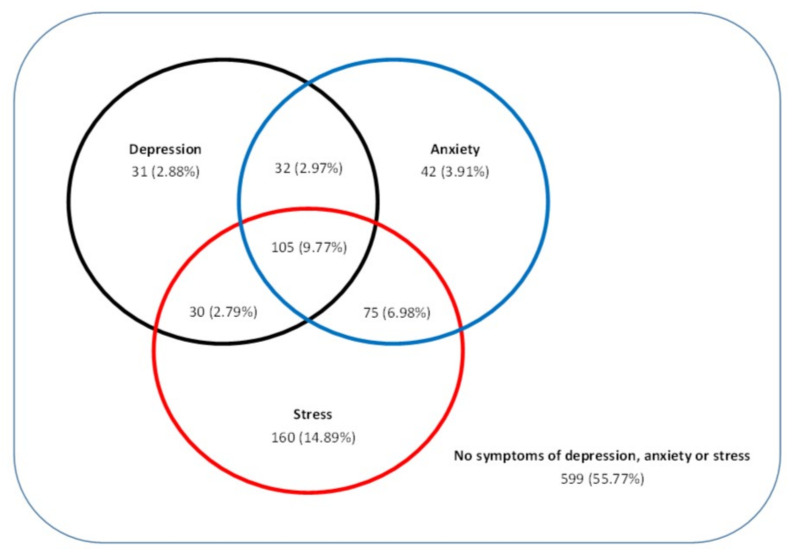
AIM: To estimate the prevalence of symptoms of depression, anxiety, stress and associated factors in a population of college students. METHOD: Cross-sectional study of psychological distress measured through the Depression, Anxiety and Stress Scale (DASS-21) in a sample of 1074 college students. RESULTS: We found a moderate prevalence of depression (18.4%), anxiety (23.6%) and stress (34.5%) symptoms in our study population. Being <21, having problematic Internet use behavior, smoking, presenting insomnia and having a low self-esteem were independently associated with symptoms of depression, anxiety and stress. Being a woman, living with their family, having a stable partner, consuming alcohol frequently and having poor nutritional habits were significantly associated with symptoms of stress; lacking a stable partner was significantly associated with depressive symptoms; and frequent consumption of alcohol was significantly associated with symptoms of anxiety. CONCLUSION: We found a moderate prevalence of depression, anxiety and stress symptoms in our population. Interventions aimed at promoting mental health among college students should be implemented.
Overview
CoChat Summary
TL;DR
This cross-sectional study of 1,074 Spanish college students found moderate symptom prevalence of depression, anxiety, and stress measured by DASS-21. Younger age, problematic Internet use, smoking, insomnia, low self-esteem, and some lifestyle/living factors were associated with higher psychological distress.
Key findings
- In 1,074 undergraduate students, prevalence of symptoms above the normal range was 18.4% for depression, 23.6% for anxiety, and 34.5% for stress.
- 22.5% of participants had symptoms of two mental disorders, and 9.7% had symptoms of anxiety, depression, and stress simultaneously.
- In the final binary logistic regression, being <21, experiencing problematic Internet use, smoking, having insomnia, and low self-esteem were associated with depression, anxiety, and stress.
- Additional significant associations reported were: stress with being a woman, living with family, having a stable partner, frequent alcohol consumption, and poor diet; depression with lacking a stable partner; and anxiety with frequent alcohol consumption.
Methods
- Cross-sectional study of undergraduate students at San Jorge University (Zaragoza, Spain) during the 2018–2019 academic year.
- Sample: 1,074 students out of a total population of 1,341 who consented and completed the questionnaire.
- Main measures: DASS-21 for depression/anxiety/stress; sociodemographic and lifestyle variables including age, gender, relationship status, smoking, alcohol, physical activity, diet, Internet use, insomnia, and self-esteem.
- Analysis used descriptive statistics, bivariate tests, and binary logistic regression with backward stepwise selection; results presented were from the model including outliers.
Limitations
- The paper states that DASS-21 is a screening tool, not a formal diagnostic instrument, so additional tools would be needed for diagnosis.
- The authors note the cross-sectional design cannot establish causality, only associations.
- They say data were collected over eight months, so students may have experienced different academic conditions during collection.
- The authors state generalizability may be limited because the study was conducted in a private college in Spain.
Model-written summary. Check it against the paper before relying on it.
Integrity signals
Registry
Cites
Statistics
Figures
Verification
Claims the paper makes
3 Valid · 0 Not valid · 4 Not checked · 27 Own results and interpretations
A result the paper reports from its own data — it cites no other source for it, so there is none to check. The quote shows it is in the paper.
In the paper
“However, physical activity was not clearly associated with psychological distress in our sample.”
§ The Prevalence of Depression, Anxiety and Stress and Their Associated Factors in College Students > 4. Discussion
hedged- Asserted: passes — The authors put it forward as true.
- Checkable: passes — It can be checked against evidence.
- Load-bearing: passes — The paper’s conclusions depend on it.
- Based: passes — The paper gives a reason why it holds.
A result the paper reports from its own data — it cites no other source for it, so there is none to check. The quote shows it is in the paper.
In the paper
“It is also worth highlighting that being enrolled in a healthcare program did not increase the risk of experiencing symptoms of depression, anxiety and stress in our sample.”
§ The Prevalence of Depression, Anxiety and Stress and Their Associated Factors in College Students > 4. Discussion
plain- Asserted: passes — The authors put it forward as true.
- Checkable: passes — It can be checked against evidence.
- Load-bearing: unclear — It is unclear whether the paper’s conclusions depend on it.
- Based: passes — The paper gives a reason why it holds.
A result the paper reports from its own data — it cites no other source for it, so there is none to check. The quote shows it is in the paper.
In the paper
“We found a moderate prevalence of depression (18.4%), anxiety (23.6%) and stress (34.5%) symptoms in our study population.”
- Also stated in: § 3. Results · plain
“Of our participants, 23.6% and 34.5% had symptoms of anxiety and stress above the normal range, respectively.”
- Also stated in: § 4. Discussion · plain
“We identified a significant prevalence of symptoms of stress (34.5%), anxiety (23.6%) and depression (18.4%) in our population.”
§ The Prevalence of Depression, Anxiety and Stress and Their Associated Factors in College Students > Abstract
plain- Asserted: passes — The authors put it forward as true.
- Checkable: passes — It can be checked against evidence.
- Load-bearing: passes — The paper’s conclusions depend on it.
- Based: passes — The paper gives a reason why it holds.
- Also stated in: § 3. Results · plain
A result the paper reports from its own data — it cites no other source for it, so there is none to check. The quote shows it is in the paper.
In the paper
“In addition, being a woman, living with their family, having a stable partner, consuming alcohol regularly and following an inadequate or unhealthy diet were significantly associated with stress”
- Also stated in: § 3. Results · plain
“In both cases, women’s levels of anxiety and stress were higher than men’s (p < 0.05).”
- Also stated in: § 4. Discussion · plain
“In our sample, female students presented a higher prevalence of symptoms of stress and anxiety compared to male students.”
§ The Prevalence of Depression, Anxiety and Stress and Their Associated Factors in College Students > 3. Results
plainstates an association- Asserted: passes — The authors put it forward as true.
- Checkable: passes — It can be checked against evidence.
- Load-bearing: passes — The paper’s conclusions depend on it.
- Based: passes — The paper gives a reason why it holds.
- Also stated in: § 3. Results · plain
A result the paper reports from its own data — it cites no other source for it, so there is none to check. The quote shows it is in the paper.
In the paper
“The final models of binary logistic regression evidenced that being <21, experiencing PIU, smoking, having insomnia and reporting a low level of self-esteem were associated with depression, anxiety and stress (p < 0.05).”
- Also stated in: § 4. Discussion · plain
“As has been reported in previous studies involving similar samples, we found an association between certain habits such as tobacco and alcohol consumption [32], presenting PIU [11] and eating unhealthily [43,55] with higher levels of psychological distress.”
§ The Prevalence of Depression, Anxiety and Stress and Their Associated Factors in College Students > 3. Results
plainstates an association- Asserted: passes — The authors put it forward as true.
- Checkable: passes — It can be checked against evidence.
- Load-bearing: passes — The paper’s conclusions depend on it.
- Based: passes — The paper gives a reason why it holds.
- Also stated in: § 4. Discussion · plain
16 more claims
Create a free account to see all 34 claims and every source verdict.
- Probably not a substantial claim. 8
- The quote only partly states this claim. 6
- It may state two separate claims as one. 3
Claims other papers make about this one
Each is checked against this paper’s own text: does it say what the citing paper says it does?
The source backs part of the claim, not all of it — or backs it for a different population, condition or comparison.
In the citing paper
“which is significantly higher than college students (Ramón‐Arbués et al., 2020) and even higher than the medical student population (Quek et al., 2019).”
From Global prevalence and trend of anxiety among graduate students: A systematic review and meta‐analysis (2023) · cites this paper as Ramón‐Arbués et al., 2020
Experimental — accuracy not yet measuredThe cited source says what the claim attributes to it.
In the citing paper
“there is some literature that indicates that college students may be more likely to endorse symptoms of stress, in comparison to depression or anxiety symptoms (Ramón-Arbués et al., 2020).”
From Using network analysis to examine connections between Acceptance and Commitment Therapy (ACT) processes, internalizing symptoms, and well-being in a sample of undergraduates (2023) · cites this paper as Ramón-Arbués et al., 2020
Citations
Cites
James, S. L., Abate, D., Abate, K. H., Abay, S. M., Abbafati, C., Abbasi, N., Abbastabar, H., Abd-Allah, F., Abdela, J., Abdelalim, A., et al. (2018) · The Lancet · doi:10.1016/s0140-6736(18)32279-7 · Cited by 13,867
Vos, T., Abajobir, A. A., Abate, K. H., Abbafati, C., Abbas, K. M., Abd-Allah, F., Abdulkader, R. S., Abdulle, A. M., Abebo, T. A., Abera, S. F., et al. (2017) · The Lancet · doi:10.1016/s0140-6736(17)32154-2 · Cited by 13,220
Validation of the Insomnia Severity Index as an outcome measure for insomnia research
Bastien, C. (2001) · Sleep Medicine · doi:10.1016/s1389-9457(00)00065-4 · Cited by 8,067 · cited 1×
“The ISI total score is interpreted as follows: absence of insomnia (0–7); sub-threshold insomnia (8–14); moderate insomnia (15–21); and severe insomnia (22–28) [35].”
BackgroundThe prevalence and correlates of depression, anxiety, and stress in a sample of college students
Beiter, R., Nash, R., McCrady, M., Rhoades, D., Linscomb, M., Clarahan, M., & Sammut, S. (2015) · Journal of Affective Disorders · doi:10.1016/j.jad.2014.10.054 · Cited by 2,030
A systematic review of studies of depression prevalence in university students
Ibrahim, A. K., Kelly, S. J., Adams, C. E., & Glazebrook, C. (2013) · Journal of Psychiatric Research · doi:10.1016/j.jpsychires.2012.11.015 · Cited by 1,988
Physical Activity for Cognitive and Mental Health in Youth: A Systematic Review of Mechanisms
Lubans, D., Richards, J., Hillman, C., Faulkner, G., Beauchamp, M., Nilsson, M., Kelly, P., Smith, J., Raine, L., & Biddle, S. (2016) · Pediatrics · doi:10.1542/peds.2016-1642 · Cited by 1,548 · cited 1×
“Thus, physical activity has often been associated with psychological wellbeing through a range of mechanisms including the secretion of endogen substances such as endorphins, the activity of the regulation of stress responses through the hypothalamic-pituitary-adrenal (HPA) axis, the improvement of sleep quality and t…”
BackgroundMental health problems in college freshmen: Prevalence and academic functioning
Bruffaerts, R., Mortier, P., Kiekens, G., Auerbach, R. P., Cuijpers, P., Demyttenaere, K., Green, J. G., Nock, M. K., & Kessler, R. C. (2018) · Journal of Affective Disorders · doi:10.1016/j.jad.2017.07.044 · Cited by 1,047 · cited 1×
“Worldwide, it is estimated that 12–50% of college students present at least one diagnostic criterion for one or more mental disorders [14].”
BackgroundChange in mental health after smoking cessation: systematic review and meta-analysis
Taylor, G., McNeill, A., Girling, A., Farley, A., Lindson-Hawley, N., & Aveyard, P. (2014) · BMJ · doi:10.1136/bmj.g1151 · Cited by 1,039 · cited 1×
“First, it is likely that tobacco use and mental health problems have a common root; people who experience mental health problems may smoke to regulate feelings of low mood, stress and anxiety; smoking could also cause or exacerbate existing mental health problems [46].”
BackgroundChallenges and opportunities in global mental health: a research-to-practice perspective
Wainberg, M. L., Scorza, P., Shultz, J. M., Helpman, L., Mootz, J. J., Johnson, K. A., Neria, Y., Bradford, J.-M. E., Oquendo, M. A., & Arbuckle, M. R. (2017) · Current Psychiatry Reports · doi:10.1007/s11920-017-0780-z · Cited by 875 · cited 2×
“Yet, mental health problems are the first cause of disability and a major public health issue worldwide due to disease progression, difficulties in therapeutic management and increasing prevalence [2,3].”
BackgroundResultLai, J. S., Hiles, S., Bisquera, A., Hure, A. J., McEvoy, M., & Attia, J. (2014) · The American Journal of Clinical Nutrition · doi:10.3945/ajcn.113.069880 · Cited by 786 · cited 1×
“However, two previous systematic reviews [53,54] found limited and contradictory evidence to support the association between dietary patterns and mental health problems in adults.”
Result
Research works printed but not linked: 2
- Kumaraswamy, 2013, Academic stress, anxiety and depression among college students—A brief review, Int. Rev. Soc. Sci. Hum., 5, 135
- Balanza, 2008, Academic and psycho-socio-familiar factors associated to anxiety and depression in university students. Reliability and validity of a questionnaire, Rev. Esp. Salud Publica, 82, 189
Cited by
Li, W., Zhao, Z., Chen, D., Peng, Y., & Lu, Z. (2022) · Journal of Child Psychology and Psychiatry · doi:10.1111/jcpp.13606 · Cited by 601
Zhang, C., Shi, L., Tian, T., Zhou, Z., Peng, X., Shen, Y., Li, Y., & Ou, J. (2022) · Psychology Research and Behavior Management · doi:10.2147/prbm.s353778 · Cited by 149
“6% of the students in this study have experienced different degrees of anxiety symptoms, which is greater than the discovery of Enrique’s funding but lower than Liu and Beiter’s funding.(13,37,38) Disparities may be explained in part by differences in study methods, instruments used, and compositions of the studied po…”
ResultLiu, Z., Liu, R., Zhang, Y., Zhang, R., Liang, L., Wang, Y., Wei, Y., Zhu, R., & Wang, F. (2021) · Journal of Affective Disorders · doi:10.1016/j.jad.2021.05.028 · Cited by 168
“This correlation has been observed in medical students previously (Azim and Baig, 2019; Ludwig et al., 2015; McGrady et al., 2012; Romo-Nava et al., 2016; Silva and Figueiredo-Braga, 2018; Zeng et al., 2019).”
BackgroundResultA Survey on Wearable Sensors for Mental Health Monitoring
Gomes, N., Pato, M. P. M., Lourenço, A., & Datia, N. (2023) · Sensors · doi:10.3390/s23031330 · Cited by 177
Ahmed, I., Hazell, C. M., Edwards, B., Glazebrook, C., & Davies, E. B. (2023) · BMC Psychiatry · doi:10.1186/s12888-023-04645-8 · Cited by 168
“Three studies found younger age groups were significantly more likely to screen above anxiety cut-offs [42, 64, 70, 112], with two reporting a significant association but not describing directionality [43, 102], and one study reporting older age groups were more likely to screen for anxiety [106].”
BackgroundChi, T., Cheng, L., & Zhang, Z. (2023) · Brain and Behavior · doi:10.1002/brb3.2909 · Cited by 92
“Of these samples included, 19.1%hadmild anxiety, 15.1%moderate anxiety, and 1.3% had severe anxiety, which is significantly higher than college students (Ramón-Arbués et al., 2020) and even higher than the medical student population (Quek et al., 2019).”
BackgroundInfluentialThe Impact of the COVID-19 Pandemic on Students’ Mental Health and Sleep in Saudi Arabia
Alyoubi, A., Halstead, E. J., Zambelli, Z., & Dimitriou, D. (2021) · International Journal of Environmental Research and Public Health · doi:10.3390/ijerph18179344 · Cited by 106
Liu, X., Guo, Y.-X., & Xu, Y. (2023) · World Journal of Clinical Cases · doi:10.12998/wjcc.v11.i7.1442 · Cited by 112
Gong, Z. Z., Wang, H., Zhong, M., & Shao, Y. (2023) · BMC Psychiatry · doi:10.1186/s12888-023-04783-z · Cited by 134
“Introduction With the increasingly fierce social competition and the gradual popularization of higher education, college students will face certain learning pressure, including learning pressure from their own internal and external environment [1].”
BackgroundMittal, S. A., Mahendra, S., Sanap, V., & Churi, P. P. (2022) · International Journal of Information Management Data Insights · doi:10.1016/j.jjimei.2022.100110 · Cited by 109
Factors Related to Diet Quality: A Cross-Sectional Study of 1055 University Students
Arbués, E. R., Granada-López, J. M., Martínez-Abadía, B., Echániz-Serrano, E., Antón‐Solanas, I., & Jerue, B. A. (2021) · Nutrients · doi:10.3390/nu13103512 · Cited by 101
Self-citationDoes Low Self-Esteem Predict Anxiety Among Chinese College Students?
Liu, X., Cao, X., & Gao, W. (2022) · Psychology Research and Behavior Management · doi:10.2147/prbm.s361807 · Cited by 91
“Another study found that about 1 in 5 college students in Spain experienced anxiety symptoms above the normal range, which coexisted with depression and stress.(8) Similar situations also applied to other groups such as patients with cancer or inflammation,(9,10) infertile women,(11) and women with marital conflict.”
BackgroundLiu, Y., Chen, J., Chen, K., Liu, J., & Wang, W. (2023) · Acta Psychologica · doi:10.1016/j.actpsy.2023.104014 · Cited by 104
The Epidemiology of Bruxism in Relation to Psychological Factors
Flueraşu, M. I., Bocșan, I. C., Țig, I. A., Iacob, S. M., Popa, D., & Buduru, S. D. (2022) · International Journal of Environmental Research and Public Health · doi:10.3390/ijerph19020691 · Cited by 86
Yang, M., Wei, W., Ren, L., Pu, Z., Zhang, Y., Li, Y., Li, X., & Wu, S. (2023) · BMC Public Health · doi:10.1186/s12889-023-17435-4 · Cited by 78
“…the transition from late adolescence to adulthood, university students find themselves in a critical stage, which is typically accompanied by social, structural, and behavioral changes, making the mental health of university students a subject of great concern for schools and communities [1, 2].”
BackgroundPredictors of the Quality of Life of University Students: A Cross-Sectional Study
Arbués, E. R., Echániz-Serrano, E., Martínez-Abadía, B., Antón‐Solanas, I., Cobos-Rincón, A., Santolalla‐Arnedo, I., Juárez‐Vela, R., & Jerue, B. A. (2022) · International Journal of Environmental Research and Public Health · doi:10.3390/ijerph191912043 · Cited by 102
Self-citationPopa-Velea, O., Pîrvan, I., & Diaconescu, L. V. (2021) · International Journal of Environmental Research and Public Health · doi:10.3390/ijerph18178911 · Cited by 87
Xie, X., Cheng, H., & Chen, Z. (2023) · Frontiers in Psychology · doi:10.3389/fpsyg.2022.1102066 · Cited by 72
“Among college students, emotional problems are more common, particularly depression and anxiety (Ramón-Arbués et al., 2020).”
BackgroundLatorre, M. F., Estrada-Araoz, E. G., Condori, W. G. L., Ulloa-Gallardo, N. J., Álvarez, D. A. C., Orue, L. A. M., Yancachajlla-Quispe, L. I., & Ramírez, S. S. R. (2023) · Sustainability · doi:10.3390/su151511924 · Cited by 74
High-precision flexible sweat self-collection sensor for mental stress evaluation
Wang, C., Wang, Z., Wei, W., Zhang, Z., Li, A. A., Huang, G., Li, X., Ge, S. S., Zhou, L., & Kong, H. (2024) · npj Flexible Electronics · doi:10.1038/s41528-024-00333-z · Cited by 70
“However, prolonged psychological stress can lead to various mental disorders, including depression, anxiety, and post-traumatic stress disorder 1 – 3 .”
Roy, S., Biswas, A. K., & Sharma, M. (2025) · Healthcare · doi:10.3390/healthcare13161948 · Cited by 89
Stress, mental health, and protective factors in nursing students: An observational study
Visier‐Alfonso, M. E., Sarabia‐Cobo, C., Cobo‐Cuenca, A. I., Nieto, M., Honrubia, R. L., Gutiérrez, R. B., Alconero‐Camarero, A. R., & González‐López, J. R. (2024) · Nurse Education Today · doi:10.1016/j.nedt.2024.106258 · Cited by 89
Agyapong-Opoku, G., Agyapong, B., Obuobi-Donkor, G., & Eboreime, E. (2023) · Behavioral Sciences · doi:10.3390/bs13121002 · Cited by 80
Using network analysis to identify central symptoms of college students' mental health
Ma, S., Yang, J., Xu, J., Zhang, N., Kang, L., Wang, P., Wang, W. J., Yang, B. X., Li, R., Xiang, D., et al. (2022) · Journal of Affective Disorders · doi:10.1016/j.jad.2022.05.065 · Cited by 52
Technostress, anxiety, and depression among university students: A report from Paraguay
Torales, J., Torres-Romero, A. D., Di Giuseppe, M. F., Rolón-Méndez, E. R., Martínez-López, P. L., Heinichen-Mansfeld, K. V., Barrios, I., O’Higgins, M., Almirón-Santacruz, J., Melgarejo, O., et al. (2022) · International Journal of Social Psychiatry · doi:10.1177/00207640221099416 · Cited by 45
“…of University students was represented by females: this finding was similarly reported in all studies carried out on the prevalence of depression, anxiety, and stress in University students of Latin America and Europe in the last 5 years, (Fernandes et al., 2018; Ramón-Arbués et al., 2020).”
ResultSit, H. F., Hong, I. W., Burchert, S., Sou, E. K. L., Wong, M., Chen, W. L., Lam, A. I. F., & Hall, B. J. (2022) · Frontiers in Psychiatry · doi:10.3389/fpsyt.2021.812667 · Cited by 50
Salari, N., Heidarian, P., Far, A. H., Babajani, F., & Mohammadi, M. (2024) · Journal of Prevention · doi:10.1007/s10935-024-00784-0 · Cited by 54
Dalpati, N., Jena, S., Jain, S., & Sarangi, P. P. (2022) · Brain Behavior & Immunity - Health · doi:10.1016/j.bbih.2022.100420 · Cited by 60
“Metabolic rate is also associated with the control of various metabolic mediators (e.g., C reactive protein, IL-6, n-3 fatty acids, lactate), which can boost the body's immunity and promote wellbeing (Huang et al., 2016; Kominsky et al., 2010; Radzikowska et al., 2019; Swanson et al., 2012).”
Mental Health Impact of COVID-19 on Quarantine Hotel Employees in China
Teng, Y.-M., Wu, K., Lin, K.-L., & Xu, D. (2020) · Risk Management and Healthcare Policy · doi:10.2147/rmhp.s286171 · Cited by 55
Jo, S.-H., Park, J.-S., & Yeon, P. (2021) · International Journal of Environmental Research and Public Health · doi:10.3390/ijerph182312805 · Cited by 48
Hering, C., Gangnus, A., Budnick, A., Kohl, R., Steinhagen‐Thiessen, E., Kuhlmey, A., & Gellert, P. R. (2022) · BMC Nursing · doi:10.1186/s12912-022-00807-3 · Cited by 53
Parsons, D. N., Gardner, P., Parry, S. P., & Smart, S. J. (2021) · Mindfulness · doi:10.1007/s12671-021-01740-3 · Cited by 63
Blanco, V., Salmerón, M., Otero, P., & Vázquez, F. L. (2021) · International Journal of Environmental Research and Public Health · doi:10.3390/ijerph18115845 · Cited by 53
Laranjeira, C., Dixe, M. D. A., VALENTİM, O. M. M. D. S., Charepe, Z. B., & Querido, A. (2021) · International Journal of Environmental Research and Public Health · doi:10.3390/ijerph19010337 · Cited by 52
Marthoenis, M., Maskur, Fathiariani, L., & Nassimbwa, J. (2021) · BMC Nursing · doi:10.1186/s12912-021-00596-1 · Cited by 42
Cénat, J. M. (2024) · Public Health · doi:10.1016/j.puhe.2024.02.030 · Cited by 46
Li, L., Wang, P., Li, S., Liu, Q., Fen, Y., Guo, Z., Jia, S., & Wang, X. (2023) · Scientific Reports · doi:10.1038/s41598-023-38682-w · Cited by 44
Wu, X., Zhang, W., Li, Y., Zheng, L., Liu, J., Jiang, Y., & Peng, Y. (2024) · PLoS ONE · doi:10.1371/journal.pone.0295118 · Cited by 54
Yu, Y., Yan, W., Yu, J., Xu, Y., Wang, D., & Wang, Y. (2022) · Frontiers in Psychology · doi:10.3389/fpsyg.2022.842378 · Cited by 61
Valdés, J., Díaz, F. J., Christiansen, P. M., Lorca, G. A., Solorza, F. J., Alvear, M., Ramírez, S., Núñez, D., Araya, R., & Gaete, J. (2022) · Frontiers in Psychiatry · doi:10.3389/fpsyt.2022.833263 · Cited by 58
Anxiety Assessment in Polish Students during the Russian–Ukrainian War
Skwirczyńska, E., Kozłowski, M., Nowak, K., Wróblewski, O., Sompolska‐Rzechuła, A., Kwiatkowski, S., & Cymbaluk‐Płoska, A. (2022) · International Journal of Environmental Research and Public Health · doi:10.3390/ijerph192013284 · Cited by 49
Kamruzzaman, M., Hossain, A., Islam, M. A., Ahmed, M. S., Kabir, E., & Khan, M. N. (2024) · Clinical Epidemiology and Global Health · doi:10.1016/j.cegh.2024.101677 · Cited by 36
Exploring life stressors, depression, and coping strategies in college students
Terrell, K. R., Stanton, B. R., Hamadi, H. Y., Merten, J. W., & Quinn, N. (2022) · Journal of American College Health · doi:10.1080/07448481.2022.2061311 · Cited by 50
Guo, J., Huang, X., Zheng, A., Chen, W., Lei, Z., Tang, C., Chen, H., Ma, H., & Li, X. (2022) · Frontiers in Psychiatry · doi:10.3389/fpsyt.2022.836956 · Cited by 38
“It is reported that college students are facing greater mental health challenges than general population due to high expectations of families and society (5, 6).”
BackgroundEEG microstate temporal Dynamics Predict depressive symptoms in College Students
Qin, X., Xiong, J., Cui, R., Zou, G., Long, C., & Lei, X. (2022) · Brain Topography · doi:10.1007/s10548-022-00905-0 · Cited by 38
Mental health and drug use in college students: Should we take action?
Pérez, T., Pardo, M. D. C., Cabellos, Y., Peressini, M., Ureña-Vacas, I., Serrano, D. R., & González‐Burgos, E. (2023) · Journal of Affective Disorders · doi:10.1016/j.jad.2023.05.080 · Cited by 61
War-Related Stress among Israeli College Students Following 7 October 2023 Terror Attack in Israel
Dopelt, K., & Houminer-Klepar, N. (2024) · European Journal of Investigation in Health Psychology and Education · doi:10.3390/ejihpe14080145 · Cited by 53
“Notably, women reported experiencing any level of stress significantly more than men (41% vs. 19%, respectively) [38].”
BackgroundStress Severity Detection in College Students Using Emotional Pulse Signals and Deep Learning
Li, M., Li, J., Chen, Y., & Hu, B. (2025) · IEEE Transactions on Affective Computing · doi:10.1109/taffc.2025.3547753 · Cited by 42
“T HE mental health of college students is primarily characterized by high stress, and poor psychological endurance and adaptability [1], and they are more prone to mental health issues [2], [3], [4].”
Doyle, N. A., Davis, R. E., Quadri, S. S. A., Mann, J. R., Sharma, M., Wardrop, R. M., & Nahar, V. K. (2021) · Journal of Osteopathic Medicine · doi:10.1515/jom-2020-0171 · Cited by 47
Pritchard, M., Brasil, K., McDermott, R., & Holdiman, A. (2021) · Body Image · doi:10.1016/j.bodyim.2021.10.002 · Cited by 34
“Anxiety related issues are a common reason that students seek out mental health services (Ramón-Arbués et al., 2020).”
BackgroundZhang, L., Wang, B., Xu, Q., & Fu, C. (2023) · Frontiers in Public Health · doi:10.3389/fpubh.2023.1201079 · Cited by 41
Zhang, J., Zheng, S., Hu, Z., & Wang, J. (2024) · BMC Psychology · doi:10.1186/s40359-023-01468-w · Cited by 42
“Depression often manifests itself in the form of lack of motivation, reduced will, sleep disturbance, and low academic efficiency, and in severe cases, even self-harm and suicidal ideation or behavior [3].”
BackgroundAhmead, M., Sharif, N. E., Abuiram, I., Alshawish, E., & Dweib, M. (2024) · Frontiers in Public Health · doi:10.3389/fpubh.2024.1436672 · Cited by 32
Serrano, I. M. A., Cuyugan, A. M. N., Cruz, K., Mahusay, J. M. A., & Alibudbud, R. (2023) · Frontiers in Psychiatry · doi:10.3389/fpsyt.2023.1225035 · Cited by 32
“Moreover, it was said that women had a high prevalence rate of experiencing stress, anxiety, and other mental health issues (44, 45).”
BackgroundMoreno-Montero, E., Ferradás, M. D. M., & Freire, C. (2024) · European Journal of Investigation in Health Psychology and Education · doi:10.3390/ejihpe14100177 · Cited by 56
“Several meta-analyses highlight the increasing prevalence of depression and anxiety in university students [1,2], especially after the COVID-19 pandemic [3,4].”
BackgroundPandey, D., Hasan, A., Pandey, B. K., Lelisho, M. E., George, A. S., & Shahul, A. (2023) · CSI Transactions on ICT · doi:10.1007/s40012-023-00383-0 · Cited by 31
Yi, Z., Wang, W., Wang, N., & Liu, Y. (2025) · The Journal of Genetic Psychology · doi:10.1080/00221325.2025.2453705 · Cited by 39
“A cross-sectional study involving 1,074 college students reported a prevalence rate of anxiety at 23.6% (Ramón-Arbués et al., 2020), while another study among 210 medical students found a prevalence rate of 52.4% (Javaeed et al., 2019).”
InfluentialRabby, M. R.-A., Islam, M. S., Orthy, M. T., Jami, A. T., & Hasan, M. T. (2023) · Frontiers in Public Health · doi:10.3389/fpubh.2023.1136557 · Cited by 30
Albikawi, Z. F. (2022) · Journal of Personalized Medicine · doi:10.3390/jpm12111887 · Cited by 35
Cao, X., & Liu, X. (2024) · Current Psychology · doi:10.1007/s12144-024-05781-4 · Cited by 41
“…theory, an individual’s self-esteem, which includes self-evaluations and attitudes towards oneself, constitutes a fundamental compared to depression, the prevalence of anxiety among university students is higher by over 10% and 5%, respec - tively (Ghrouz et al., 2019 ; Ramón-Arbués et al., 2020 ).”
Aveiro-Róbalo, T. R., Torales, L. D. G., Chumán-Sánchez, M., Pereira-Victorio, C. J., Huaman-Garcia, M., Failoc‐Rojas, V. E., & Valladares-Garrido, M. J. (2022) · International Journal of Environmental Research and Public Health · doi:10.3390/ijerph191912930 · Cited by 39
Tang, Q., Zou, X., Gui, J., Wang, S., Liu, X., Liu, G., & Tao, Y. (2024) · Journal of Affective Disorders · doi:10.1016/j.jad.2024.05.018 · Cited by 30
Chen, Y., Ke, X., Liu, J., Du, J., Zhang, J., Jiang, X. J., Zhou, T., & Xiao, X. (2024) · Frontiers in Psychology · doi:10.3389/fpsyg.2024.1387983 · Cited by 31
Juul, L., Brorsen, E., Gøtzsche, K., Nielsen, B. L., & Fjorback, L. O. (2021) · Frontiers in Psychology · doi:10.3389/fpsyg.2021.722771 · Cited by 40
“Furthermore, evidence on mechanisms of change of MBSR is not well-established (Rosenkranz et al., 2019).”
BackgroundMüller, C., El-Ansari, K., & Ansari, W. E. (2022) · International Journal of Environmental Research and Public Health · doi:10.3390/ijerph191912670 · Cited by 41
“For instance, 84–90% of college students in India, Iran, and Spain reported at least medium self-esteem [18–20], for which negative correlations with student irritation [21] and independent associations with symptoms of depression, anxiety, and stress [20] have been demonstrated.”
BackgroundCénat, J. M., Farahi, S. M. M. M., & Dalexis, R. D. (2023) · Psychiatry Research · doi:10.1016/j.psychres.2023.115341 · Cited by 30
Arbués, E. R., Sagarra‐Romero, L., Echániz-Serrano, E., Granada-López, J. M., Cobos-Rincón, A., Juárez‐Vela, R., Navas-Echazarreta, N., & Antón‐Solanas, I. (2023) · Frontiers in Public Health · doi:10.3389/fpubh.2023.1265775 · Cited by 36
Self-citationMohamed, M. G., Al-Yafeai, T. M., Adam, S., Hossain, M. M., Ravi, R. K., Jalo, F. M., & Osman, A. E. (2025) · Global Transitions · doi:10.1016/j.glt.2025.02.003 · Cited by 47
Park, C., & Shimada, S. (2022) · BMC Public Health · doi:10.1186/s12889-022-14698-1 · Cited by 39
Landa, J. M. A., García‐Martínez, I., & León, S. P. (2022) · Psychological Reports · doi:10.1177/00332941221144603 · Cited by 48
Mental Health of University Students When Returning to Face-to-Face Classes: A Cross-Sectional Study
Estrada-Araoz, E. G., Bautista-Quispe, J. A., Córdova-Rojas, L. M., Chayña, E. T., Mamani-Coaquira, H., & Tomanguilla, J. H. (2023) · Behavioral Sciences · doi:10.3390/bs13060438 · Cited by 34
Gnardellis, C., Vagka, E., Lagiou, A., & Notara, V. (2023) · European Journal of Investigation in Health Psychology and Education · doi:10.3390/ejihpe13120191 · Cited by 42
“Results from several empirical studies highlight this relationship, documenting it for all three DASS scales [42–47].”
BackgroundInfluence of physical education on anxiety, depression, and self-esteem among college students
Fu, H., Wang, J., & Hu, J.-X. (2023) · World Journal of Psychiatry · doi:10.5498/wjp.v13.i12.1121 · Cited by 25
Li, T., & Xie, Q. (2022) · International Journal of Mental Health Promotion · doi:10.32604/ijmhp.2022.019177 · Cited by 26
Lekkas, D., Gyorda, J. A., Price, G. D., & Jacobson, N. C. (2023) · Behaviour Research and Therapy · doi:10.1016/j.brat.2023.104382 · Cited by 26
Changqing, S., Zhu, Z., Zhang, P., Wang, L., Zhang, Q., Guo, Y., Guo, L., Yang, L., Wang, P., Hu, B., et al. (2024) · Frontiers in Psychiatry · doi:10.3389/fpsyt.2024.1402680 · Cited by 31
Bress, J. N., Falk, A. E., Schier, M. M., Jaywant, A., Moroney, E., Dargis, M. A., Bennett, S. M., Scult, M. A., Volpp, K. G. M., Asch, D. A., et al. (2024) · JAMA Network Open · doi:10.1001/jamanetworkopen.2024.28372 · Cited by 40
Milić, J., Skitarelić, N., Majstorović, D., Zoranić, S., Čivljak, M., Ivanišević, K., Marendić, M., Mesarić, J., Puharić, Z., Neuberg, M., et al. (2024) · BMC Psychiatry · doi:10.1186/s12888-024-05498-5 · Cited by 36
“Women students are usually more affected [37–40], even though a recent meta-analysis found no gender-related differences in anxiety in the medical student population [10].”
BackgroundTest anxiety and coping strategies among university students an exploratory study in the UAE
Jirjees, F., Odeh, M. M., AlHaddad, A., Ass’ad, R., Hassanin, Y., Al-Obaidi, H. J., Kharaba, Z. J., Alfoteih, Y., & Alzoubi, K. H. (2024) · Scientific Reports · doi:10.1038/s41598-024-59739-4 · Cited by 53
Oh, Y.-T., Ryu, M.-A., & Uhm, J.-P. (2025) · Frontiers in Psychiatry · doi:10.3389/fpsyt.2025.1582731 · Cited by 28
Understanding the burden of depression, anxiety and stress among first-year undergraduate students
Haruna, U., Mohammed, A., & Braimah, M. (2025) · BMC Psychiatry · doi:10.1186/s12888-025-07069-8 · Cited by 63
Machine learning models for predicting depression in Korean young employees
Kim, S., Gil, M., & Min, E. J. (2023) · Frontiers in Public Health · doi:10.3389/fpubh.2023.1201054 · Cited by 29
“Several studies identified factors associated with depression, including sociodemographic factors, traits, stressors, relationship stability, and cognitive processes (14, 15).”
The relationship of smartphone addiction with depression, anxiety, and stress among medical students
Sarhan, A. L. (2024) · SAGE Open Medicine · doi:10.1177/20503121241227367 · Cited by 41
“38 In the same line, one previous finding revealed that the sub-scores for depression, anxiety, and stress were all substantially and positively linked with higher SPA scores.”
ResultMalebari, A. M., Alamoudi, S. O., AL-Alawi, T. I., Alkhateeb, A. A., Albuqayli, A. S., & Alothmany, H. N. (2024) · Frontiers in Public Health · doi:10.3389/fpubh.2024.1441695 · Cited by 40
Peoples, J. E., Butler‐Barnes, S. T., Stafford, J. D., Williams, S.-L. L., & Smith, I. N. (2023) · Journal of American College Health · doi:10.1080/07448481.2022.2155466 · Cited by 30
“69,70 Therefore, it is possible that perceiving a campus climate as supportive may positively contribute to Black college students’ self-esteem, which in turn facilitates students’ engagement in healthy coping strategies that help relieve or change painful affect states associated with facing life…”
Comprehensive analysis of stress factors affecting students: a machine learning approach
de Filippis, R., & Foysal, A. A. (2024) · Discover Artificial Intelligence · doi:10.1007/s44163-024-00169-6 · Cited by 52
“Psychological factors such as self-esteem, anxiety, and depression are significant contributors to student stress [13].”
Silva, I., Meireles, A. L., Chagas, C. M. D. S., Cardoso, C. S., de Oliveira, H. N., de Freitas, E. D., Vidigal, F. D. C., Nobre, L. N., da Silva, L. S., de Paula, W., et al. (2025) · International Journal of Environmental Research and Public Health · doi:10.3390/ijerph22030354 · Cited by 29
“This classification followed the questionnaire authors’ guidelines [36,37] and has also been observed in other studies [38,39].”
InfluentialEffects of Changes in Environmental Color Chroma on Heart Rate Variability and Stress by Gender
Oh, J., & Park, H. (2022) · International Journal of Environmental Research and Public Health · doi:10.3390/ijerph19095711 · Cited by 28
Yang, S.-W., & Koo, M. (2022) · International Journal of Environmental Research and Public Health · doi:10.3390/ijerph192416468 · Cited by 28
Eadeh, H.-M., Adamowicz, J. L., Markon, K., & Thomas, E. B. K. (2023) · Journal of Affective Disorders · doi:10.1016/j.jad.2022.10.004 · Cited by 18
Anxiety and depression in first-year university students: the role of family and social support
Estrella-Proaño, A., Rivadeneira, M. F., Alvarado, J., Murtagh, M., Guijarro, S., Alomoto, L., & Cañarejo, G. (2024) · Frontiers in Psychology · doi:10.3389/fpsyg.2024.1462948 · Cited by 35
Dong, Z., Wang, P., Xin, X., Li, S., Wang, J., Zhao, J., & Wang, X. (2022) · Frontiers in Human Neuroscience · doi:10.3389/fnhum.2022.1009540 · Cited by 23
“88% of college students suffer from the invasion of anxiety (Mu et al., 2019; Ramón-Arbués et al., 2020; Zhao et al., 2021), 48.”
BackgroundDong, X., Li, D., Miao, Y.-F., Zhang, T., Wu, Y., & Pan, C. (2023) · Journal of Affective Disorders · doi:10.1016/j.jad.2023.04.034 · Cited by 20
Liu, X., Zeng, J., Zhang, Y., Yi, Z., Chen, S., & Liu, Y. (2024) · Journal of Child and Family Studies · doi:10.1007/s10826-023-02775-x · Cited by 22
Al-Shaer, E. A., Aliedan, M. M., Zayed, M. A., Elrayah, M., & Moustafa, M. A. (2024) · Sustainability · doi:10.3390/su16020644 · Cited by 41
Liu, X., Wang, Z., Zhang, C., Xu, J., Shen, Z., Peng, L., Mi, Y., & Liu, X. (2024) · Psychology Research and Behavior Management · doi:10.2147/prbm.s452993 · Cited by 30
Pardhan, S., Smith, L., Bourne, R., Davis, A. C., Leveziel, N., Jacob, L., Koyanagi, A., & Sánchez, G. F. L. (2021) · Frontiers in Psychology · doi:10.3389/fpsyg.2020.627980 · Cited by 21
“0%) or in Brazilian adults (depression 14%) (Sahoo and Khess, 2010; Silva et al., 2014; Ramón-Arbués et al., 2020).”
BackgroundMukta, M. S. H., Islam, S., Shatabda, S., Ali, M. E., & Zaman, A. (2022) · Behavioral Sciences · doi:10.3390/bs12040087 · Cited by 30
Family Background Issues as Predictors of Mental Health Problems for University Students
Luvira, V., Nonjui, P., Butsathon, N., Deenok, P., & Aunruean, W. (2023) · Healthcare · doi:10.3390/healthcare11030316 · Cited by 30
Chai, Y., Fu, G., Liu, Y., Song, Q., Xue, C., & Luo, S. (2024) · Frontiers in Public Health · doi:10.3389/fpubh.2024.1466700 · Cited by 28
Metadata
- Authors
- Ramón-Arbués, E., Gea-Caballero, V., Granada-López, J. M., Juárez-Vela, R., Pellicer-García, B., & Antón-Solanas, I.
- Affiliations
- Faculty of Health Sciences, Campus Universitario Villanueva de Gállego, Universidad San Jorge, 50830 Villanueva de Gállego, Zaragoza, Spain
- Universitat de València (ES)
- Universidad de Zaragoza (ES)
- Faculty of Health Sciences, La Rioja University, 26006 Logroño, Spain
- Servicio Aragonés de Salud (ES)
- Department of Physiatry and Nursing, Faculty of Health Sciences, University of Zaragoza, 50009 Zaragoza, Spain
- Corresponding author
- Gea-Caballero, Vicente
- Granada-López, José Manuel
- Venue
- International Journal of Environmental Research and Public Health
- Publisher
- MDPI AG
- Published
- 2020-09-24
- Volume
- 17
- Issue
- 19
- Pages
- 7001
- ISSN
- 1660-4601 (ISSN-L)
- PMC
- PMC7579351
- OpenAlex
- W3088546900
- Semantic Scholar
- 259f0a5e1460c4efcaa63718e8c4330369081b27
- Cited by
- 637
- References
- 69
- Citations by year
- 2026: 85 · 2025: 150 · 2024: 151 · 2023: 134 · 2022: 86 · 2021: 29 · 2020: 2
- FWCI
- 94.54
- Type
- journal article
- Language
- en
- Open access
- gold
- doi.org
- Licence
- Locations
- International Journal of Environmental Research and Public Health (publishedVersion, cc-by)
- PubMed Central (publishedVersion, cc-by)
- PubMed (publishedVersion)
- Zaguan (University of Zaragoza Repository) (submittedVersion, cc-by)
- RePEc: Research Papers in Economics (submittedVersion)
- DOAJ (DOAJ: Directory of Open Access Journals) (submittedVersion)
- RIUR (Universidad de La Rioja) (submittedVersion, other-oa)
- Topics
- Social Sciences › Psychology › Developmental and Educational Psychology › Student Stress and Coping
- Health Sciences › Medicine › Psychiatry and Mental health › Mental Health Treatment and Access
- Health Sciences › Health Professions › General Health Professions › Healthcare professionals’ stress and burnout
- Keywords
- depression, anxiety, stress, university students, psychological distress, prevalence, problematic internet use, smoking, insomnia, self-esteem, alcohol consumption, dietary habits, gender differences, mental health promotion
- MeSH terms
- Anxiety, Cross-Sectional Studies, Depression, Female, Humans, Male, Stress, Psychological, Students, Universities, Prevalence, Young Adult
About these checks
Registry, retraction, Cites and statistics results are computed, not judged, with one exception: a printed reference that no index lists is read once by a model before it counts as a citation error. Claims are extracted by a model and kept only when their quote appears verbatim in the text; each cited source is then checked, with a model’s help, for whether it says what the claim relies on. Those verdicts can be wrong — read the claim’s quote and the cited source before relying on one.
The claim verdicts this report counts are experimental: their accuracy is not yet measured.
A language model drew the claims from the paper on 2026-10-10, under version 3 of the claim definition (model deepseek-v4.1-flash, prompt extract-v3).
A second model labelled each claim on 2026-10-10 (model jev-1.13-20260917, definition revision gold-guideline-v0.2).
Statistics and arithmetic are recomputed, not judged.
Confidence bands are shown only for fields calibrated on our annotated test set. None is calibrated yet, so no band is shown.
What counts as a claim ›How we measure confidence ›How we check this ›
Are you an author, or do you see a problem with this page? Request a review
Data sources
Bibliographic data: Semantic Scholar, OpenAlex, Crossref.
Contains information from the Semantic Scholar Academic Graph Datasets, made available under the ODC Attribution License (ODC-BY 1.0).
Semantic Scholar’s data is described in: Kinney, R., et al. (2023). The Semantic Scholar Open Data Platform. arXiv:2301.10140.
