

The DOI matches its Crossref record; 86 of the 86 references it cites were found in a registry or an index.
Exploring Influential Factors Including COVID-19 on Green Food Purchase Intentions and the Intention–Behaviour Gap: A Qualitative Study among Consumers in a Chinese Context
Open accessAbstract
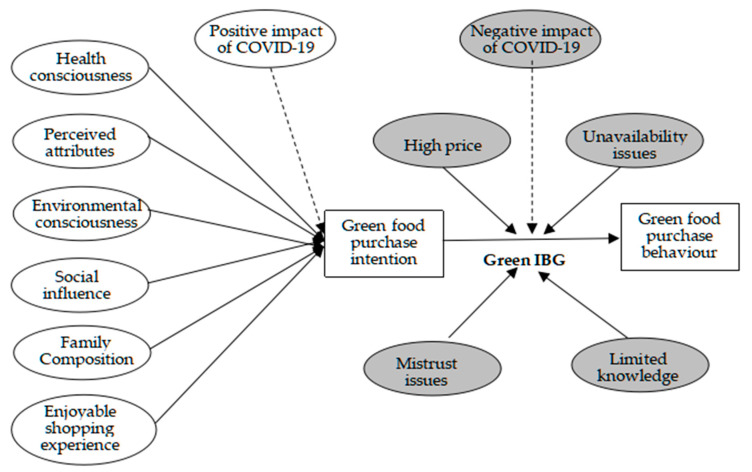
This study applied a qualitative approach to investigate the underlying influences on consumers’ green food consumption from the intention generation phase to intention execution phase in the perspectives of purchase intention and the intention–behaviour gap (IBG). Additionally, the impact of the “Coronavirus Disease 2019” (COVID-19) pandemic on consumers’ green food purchases was explored. Research data were derived from semi-structured in-depth interviews with 28 consumers and analyzed using grounded theory. The findings identified factors that influenced intentions and the IBG in the process of consumers’ green food purchases. Specifically, these findings reported that health consciousness, perceived attributes, environmental consciousness, social influence, family structure, and enjoyable shopping experiences were identified as major drivers for generating consumers’ green food purchase intentions. High prices of green food, unavailability issues, mistrust issues, and limited knowledge were factors triggering the gap between green food purchase intentions and behaviours. In addition, the results revealed that the COVID-19 crisis increased consumers’ green food purchase intentions, whereas the IBG widens as a result of issues of unavailability, price, and panic. These findings will help stakeholders build future policy and suitable strategies to better promote green food consumption in the Chinese context.
Overview
The claims and statistics of this paper haven’t been checked yet.
Run the check — free, no account needed. It reads the open-access text and checks the sources it cites.
Integrity signals
Registry
Cites
Statistics
Figures
Verification
Claims the paper makes
The claims and statistics of this paper haven’t been checked yet.
Run the check — free, no account needed. It reads the open-access text and checks the sources it cites.
Claims other papers make about this one
Each is checked against this paper’s own text: does it say what the citing paper says it does?
The source backs part of the claim, not all of it — or backs it for a different population, condition or comparison.
In the citing paper
“Multiple studies across different geographical and cultural contexts have consistently demonstrated that health consciousness strongly predicts positive attitudes toward health-oriented food products [15,66,68].”
From Psychological Determinants of Healthy Food Purchase Intention: An Integrative Model Based on Health Consciousness (2025) · cites this paper as [15]
Experimental — accuracy not yet measured
Self-check
Percentages, sums and reported differences re-computed from the paper’s own numbers.
The self-check needs the paper’s full text.
Citations
Cites
The theory of planned behavior
Ajzen, I. (1991) · Organizational Behavior and Human Decision Processes · doi:10.1016/0749-5978(91)90020-t · Cited by 90,587
The Discovery of Grounded Theory; Strategies for Qualitative Research
Glaser, B. G., Strauss, A. L., & Strutzel, E. (1968) · Nursing Research · doi:10.1097/00006199-196807000-00014 · Cited by 39,449
Handbook of qualitative research
Griffin, T. F. (1999) · Psychology and Marketing · doi:10.1002/(sici)1520-6793(199907)16:4 · Cited by 9,061
Sustainable food consumption: Exploring the consumer “attitude–behavioral intention” gap
Vermeir, I., & Verbeke, W. (2006) · Journal of Agricultural and Environmental Ethics · doi:10.1007/s10806-005-5485-3 · Cited by 2,524
Sustainable consumption: green consumer behaviour when purchasing products
Young, W., Hwang, K., McDonald, S., & Oates, C. J. (2009) · Sustainable Development · doi:10.1002/sd.394 · Cited by 1,616
Factors affecting green purchase behaviour and future research directions
Joshi, Y., & Rahman, Z. (2015) · International Strategic Management Review · doi:10.1016/j.ism.2015.04.001 · Cited by 1,518
Sustainability labels on food products: consumer motivation, understanding and use
Grunert, K. G., Hieke, S., & Wills, J. (2014) · Food Policy · doi:10.1016/j.foodpol.2013.12.001 · Cited by 1,334
Padel, S., & Foster, C. (2005) · British Food Journal · doi:10.1108/00070700510611002 · Cited by 1,214
Consumer behavior and purchase intention for organic food: A review and research agenda
Rana, J., & Paul, J. (2017) · Journal of Retailing and Consumer Services · doi:10.1016/j.jretconser.2017.06.004 · Cited by 1,097
Lost in translation: Exploring the ethical consumer intention–behavior gap
Carrington, M., Neville, B. A., & Whitwell, G. (2012) · Journal of Business Research · doi:10.1016/j.jbusres.2012.09.022 · Cited by 923
Research works printed but not linked: 6
- Ministry of Industry and Information Technology of the People’s Republic of China (2019). China Food Industry in 2018, China Light Industry Press.
- Rubin, H.J., and Rubin, I.S. (2004). Qualitative Interviewing: The Art of Hearing Data, Sage Publications. [2nd ed.].
- Goulding, 2000, Grounded theory methodology and consumer behavior, procedures, practice and pitfalls, Adv. Consum. Res., 27, 261
- Zhang, 2009, Consumers’ cognition purchasing behaviour to safe food- a survey on fresh food in Shanghai City, Chin. Agric. Sci. Bull., 25, 50
- Zhang, 2010, Consumers’ purchasing behaviour to green food, Com. Res., 12, 118
- Zhang, 2009, Consumers’ willingness to pay for green agricultural products in Guangzhou City, J. Agric. Econ., 6, 62
Cited by
Sorted by citations
COVID-19, consumer behavior, technology, and society: A literature review and bibliometric analysis
Cruz‐Cárdenas, J., Забелина, Е. В., Guadalupe-Lanas, J., Palacio-Fierro, A., & Ramos-Galarza, C. (2021) · Technological Forecasting and Social Change · doi:10.1016/j.techfore.2021.121179 · Cited by 320
Vătămănescu, E., Dabija, D., Gazzola, P., Cegarra‐Navarro, J., & Buzzi, T. (2021) · Journal of Cleaner Production · doi:10.1016/j.jclepro.2021.128945 · Cited by 203
Canio, F. D., Martinelli, E. M., & Endrighi, E. (2021) · International Journal of Retail & Distribution Management · doi:10.1108/ijrdm-08-2020-0301 · Cited by 200
Qi, X., & Ploeger, A. (2021) · Foods · doi:10.3390/foods10061200 · Cited by 146
“Moreover, recent studies that investigated the influence of the COVID-19 pandemic on food consumption show that many consumers have been increasingly concerned about the health aspects [7–9].”
BackgroundResultSelf-citationThe Impact of Awe Induced by COVID-19 Pandemic on Green Consumption Behavior in China
Sun, X., Su, W., Guo, X., & Tian, Z. (2021) · International Journal of Environmental Research and Public Health · doi:10.3390/ijerph18020543 · Cited by 114
Metadata
- Authors
- Qi, X., Yu, H., & Ploeger, A.
- Affiliations
- University of Kassel (DE)
- Qingdao National Laboratory for Marine Science and Technology (CN)
- Corresponding author
- Qi, Xin
- Venue
- International Journal of Environmental Research and Public Health
- Publisher
- MDPI AG
- Published
- 2020-09-28
- Volume
- 17
- Issue
- 19
- Pages
- 7106
- ISSN
- 1660-4601 (ISSN-L)
- PMC
- PMC7579444
- OpenAlex
- W3088101975
- Cited by
- 141
- References
- 86
- Citations by year
- 2026: 11 · 2025: 24 · 2024: 19 · 2023: 31 · 2022: 36 · 2021: 19 · 2020: 1
- FWCI
- 22.43
- Type
- journal article
- Language
- en
- Open access
- gold
- doi.org
- Licence
- Locations
- International Journal of Environmental Research and Public Health (publishedVersion, cc-by)
- PubMed Central (publishedVersion, cc-by)
- PubMed (publishedVersion)
- RePEc: Research Papers in Economics (submittedVersion)
- DOAJ (DOAJ: Directory of Open Access Journals) (submittedVersion)
- Funders
- National Natural Science Foundation of China (2016YFC1401800, 41930534)
- National Key Research and Development Program of China (2016YFC1401800., 41930534)
- Topics
- Social Sciences › Business, Management and Accounting › Marketing › Environmental Sustainability in Business
- Life Sciences › Agricultural and Biological Sciences › Plant Science › Organic Food and Agriculture
- Social Sciences › Sociology and Political Science › Consumer behavior in food and health
- Keywords
- green food, purchase intention, intention-behavior gap, COVID-19 pandemic, consumer behavior, health consciousness, environmental awareness, social influence, family structure, customer experience, green food consumption, Chinese consumers
- MeSH terms
- Betacoronavirus, COVID-19, SARS-CoV-2, China, Consumer Behavior, Humans, Pneumonia, Viral, Surveys and Questionnaires, Vegetables, Coronavirus Infections, Intention, Pandemics
About these checks
Registry, retraction, Cites and statistics results are computed, not judged, with one exception: a printed reference that no index lists is read once by a model before it counts as a citation error. Claims are extracted by a model and kept only when their quote appears verbatim in the text; each cited source is then checked, with a model’s help, for whether it says what the claim relies on. Those verdicts can be wrong — read the claim’s quote and the cited source before relying on one.
Statistics and arithmetic are recomputed, not judged.
Confidence bands are shown only for fields calibrated on our annotated test set. None is calibrated yet, so no band is shown.
What counts as a claim ›How we measure confidence ›How we check this ›
Are you an author, or do you see a problem with this page? Request a review
