

The DOI matches its Crossref record; 180 of the 183 references it cites were found in a registry or an index.
A Review of the Applications, Environmental Release, and Remediation Technologies of Per- and Polyfluoroalkyl Substances
Open accessAbstract
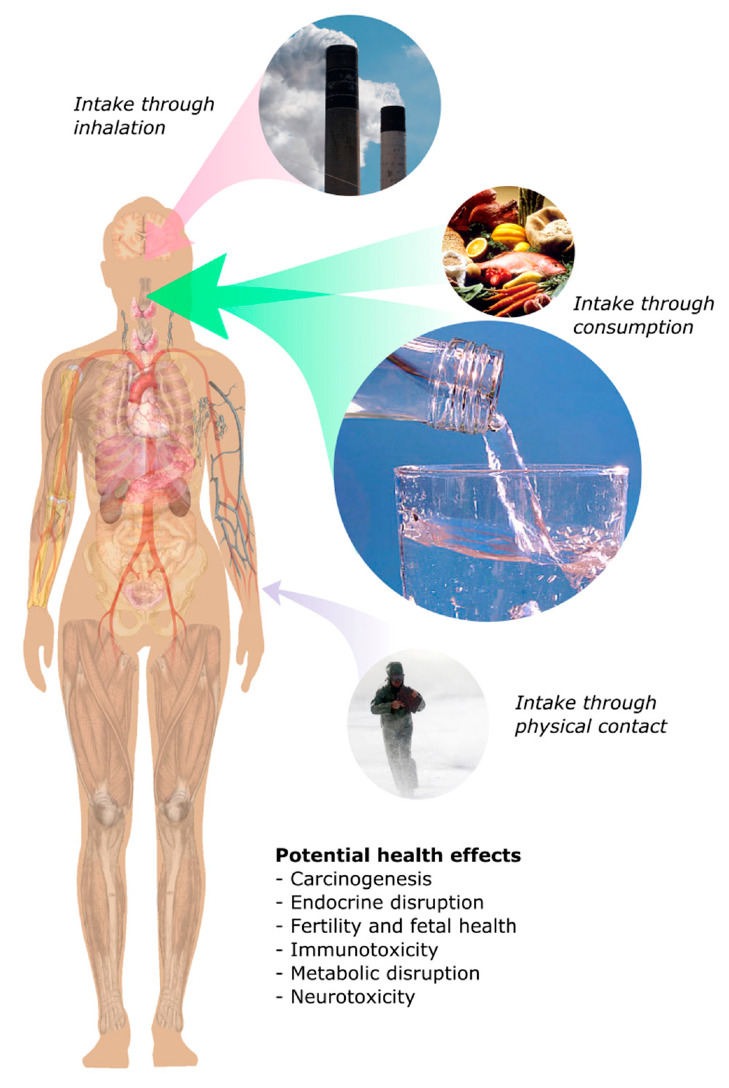
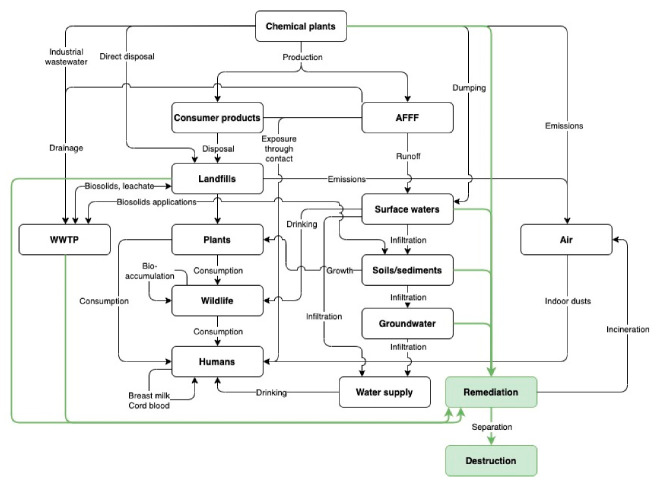
Per- and polyfluoroalkyl substances (PFAS) are pollutants that have demonstrated a high level of environmental persistence and are very difficult to remediate. As the body of literature on their environmental effects has increased, so has regulatory and research scrutiny. The widespread usage of PFAS in industrial applications and consumer products, complicated by their environmental release, mobility, fate, and transport, have resulted in multiple exposure routes for humans. Furthermore, low screening levels and stringent regulatory standards that vary by state introduce considerable uncertainty and potential costs in the environmental management of PFAS. The recalcitrant nature of PFAS render their removal difficult, but existing and emerging technologies can be leveraged to destroy or sequester PFAS in a variety of environmental matrices. Additionally, new research on PFAS remediation technologies has emerged to address the efficiency, costs, and other shortcomings of existing remediation methods. Further research on the impact of field parameters such as secondary water quality effects, the presence of co-contaminants and emerging PFAS, reaction mechanisms, defluorination yields, and the decomposition products of treatment technologies is needed to fully evaluate these emerging technologies, and industry attention should focus on treatment train approaches to improve efficiency and reduce the cost of treatment.
Overview
The claims and statistics of this paper haven’t been checked yet.
Run the check — free, no account needed. It reads the open-access text and checks the sources it cites.
Integrity signals
Registry
Cites
Statistics
Figures
Verification
Claims the paper makes
The claims and statistics of this paper haven’t been checked yet.
Run the check — free, no account needed. It reads the open-access text and checks the sources it cites.
Claims other papers make about this one
Each is checked against this paper’s own text: does it say what the citing paper says it does?
The source backs part of the claim, not all of it — or backs it for a different population, condition or comparison.
In the citing paper
“Additionally, the hydrophobic and lipophobic nature of PFAS can be primarily attributed to the low polarizability of fluorine atoms, combined with the presence of a stable terminal functional group attached to the fluoroalkyl chain (Gagliano et al., 2020; Meegoda et al., 2020).”
From Estimation of per- and polyfluoroalkyl substances (PFAS) half-lives in human studies: a systematic review and meta-analysis (2024) · cites this paper as Meegoda et al., 2020
Experimental — accuracy not yet measuredThe cited source says what the claim attributes to it.
In the citing paper
“Membrane systems, especially RO are expensive compared to GAC and ion exchange [23].”
From A Mini-Review of Full-Scale Drinking Water Treatment Plants for Per- and Polyfluoroalkyl Substances (PFAS) Removal: Possible Solutions and Future Directions (2025) · cites this paper as [23]
The cited source says what the claim attributes to it.
In the citing paper
“Longer-chain PFAS compounds typically exhibit higher sorption affinities for soil, influenced by hydrophobic interactions and the molecular size of the compounds [87,88].”
From Industrial Applications, Environmental Fate, Human Exposure, and Health Effects of PFAS (2025) · cites this paper as [88]
Self-check
Percentages, sums and reported differences re-computed from the paper’s own numbers.
The self-check needs the paper’s full text.
Citations
Cites
Buck, R. C., Franklin, J., Berger, U., Conder, J. M., Cousins, I. T., de Voogt, P., Jensen, A. A., Kannan, K., Mabury, S. A., & van Leeuwen, S. P. (2011) · Integrated Environmental Assessment and Management · doi:10.1002/ieam.258 · Cited by 4,641
Understanding organofluorine chemistry. An introduction to the C–F bond
O’Hagan, D. (2007) · Chemical Society Reviews · doi:10.1039/b711844a · Cited by 4,128
Sunderland, E. M., Hu, X. C., Dassuncao, C., Tokranov, A. K., Wagner, C. C., & Allen, J. G. (2019) · Journal of Exposure Science & Environmental Epidemiology · doi:10.1038/s41370-018-0094-1 · Cited by 2,786
Global Distribution of Perfluorooctane Sulfonate in Wildlife
Giesy, J. P., & Kannan, K. (2001) · Environmental Science & Technology · doi:10.1021/es001834k · Cited by 2,750
Sources, fate and transport of perfluorocarboxylates
Prevedouros, K., Cousins, I. T., Buck, R. C., & Korzeniowski, S. H. (2006) · Environmental Science & Technology · doi:10.1021/es0512475 · Cited by 2,594
Hydrothermal liquefaction of biomass: A review of subcritical water technologies
Toor, S. S., Rosendahl, L., & Rudolf, A. (2011) · Energy · doi:10.1016/j.energy.2011.03.013 · Cited by 1,840
Sorption of Perfluorinated Surfactants on Sediments
Higgins, C. P., & Luthy, R. G. (2006) · Environmental Science & Technology · doi:10.1021/es061000n · Cited by 1,563 · cited 4×
“Changes in pH can also alter surface charges such that the sorption of anionic PFAS increases with decreasing pH [69].”
BackgroundInfluentialHu, X. C., Andrews, D. Q., Lindstrom, A. B., Bruton, T. A., Schaider, L. A., Grandjean, P., Lohmann, R., Carignan, C. C., Blum, A., Balan, S. A., et al. (2016) · Environmental Science & Technology Letters · doi:10.1021/acs.estlett.6b00260 · Cited by 1,333
Gagliano, E., Sgroi, M., Falciglia, P. P., Vagliasindi, F. G. A., & Roccaro, P. (2020) · Water Research · doi:10.1016/j.watres.2019.115381 · Cited by 1,249 · cited 2×
“Increasing chain length is associated with increasing lipophilicity and hydrophobicity [60,62].”
BackgroundAdsorption behavior and mechanism of perfluorinated compounds on various adsorbents—A review
Du, Z., Deng, S., Bei, Y., Huang, Q., Wang, B., Huang, J., & Yu, G. (2014) · Journal of Hazardous Materials · doi:10.1016/j.jhazmat.2014.04.038 · Cited by 1,236
Research works printed but not linked: 6
- Jansen, 2019, ‘Forever Chemicals’ No More? These Technologies Aim to Destroy PFAS in Water, Chem. Eng. News, 97, 1
- Dean, 2020, A Framework for Regulation of New and Existing PFAS by EPA, J. Sci. Policy Gov., 16, 14
- Zemba, S. (2019, January 14–15). PFAS Cycling Between Landfills and WWTPs. Proceedings of the Environmental Research and Education Summit (EREF), Ann Arbor, MI, USA.
- Dickenson, E.R.V., and Verdugo, E.M. (2018). Perfluoroalkyl Substances in the Environment, CRC Press.
- Scollitt-Davis, J. (2020, March 07). AECOM to Launch PFAS Solution DE-FLUOROTM at CleanUp 2019 in Adelaide. Available online: https://aecom.com/press-releases/aecom-to-launch-pfas-solution-de-fluoro-at-cleanup-2019-in-adelaide/#:~:text=PressRelease-,AECOMtolaunchPFASsolutionDE-FLUORO,atCleanUp2019inAdelaide&text=ADELAIDE(Sept.,‘PFAS’)atCleanUp2019.
- Field, J.A. (2019, January 14–15). PFASs in Leachate and Wastewater. Proceedings of the Environmental Research and Education Summit (EREF), Ann Arbor, MI, USA.
Cited by
Sorted by citations
PFAS Molecules: A Major Concern for the Human Health and the Environment
Panieri, E., Baralic, K., Djukic-Cosic, D., Buha Djordjevic, A., & Saso, L. (2022) · Toxics · doi:10.3390/toxics10020044 · Cited by 651
Biodegradation of Per- and Polyfluoroalkyl Substances (PFAS): A Review
Zhang, Z., Sarkar, D., Biswas, J. K., & Datta, R. (2022) · Bioresource Technology · doi:10.1016/j.biortech.2021.126223 · Cited by 353
Leung, S. C. E., Wanninayake, D., Chen, D., Nguyen, N., & Li, Q. (2023) · The Science of The Total Environment · doi:10.1016/j.scitotenv.2023.166764 · Cited by 318
Rosato, I., Bonato, T., Fletcher, T., Batzella, E., & Canova, C. (2024) · Environmental Research · doi:10.1016/j.envres.2023.117743 · Cited by 273
Peroxymonosulfate activation through LED-induced ZnFe2O4 for levofloxacin degradation
Zhong, Y., Shih, K., Diao, Z.-H., Song, G., Su, M., Hou, L., Chen, D., & Kong, L. (2021) · Chemical Engineering Journal · doi:10.1016/j.cej.2021.129225 · Cited by 227
A Review of PFAS Destruction Technologies
Meegoda, J. N., de Souza, B. B., Casarini, M. M., & Kewalramani, J. A. (2022) · International Journal of Environmental Research and Public Health · doi:10.3390/ijerph192416397 · Cited by 247
Self-citationUpdated review on emerging technologies for PFAS contaminated water treatment
Yadav, S., Ibrar, I., Al-Juboori, R. A., Singh, L., Ganbat, N., Kazwini, T., Karbassiyazdi, E., Samal, A. K., Subbiah, S., & Altaee, A. (2022) · Process Safety and Environmental Protection · doi:10.1016/j.cherd.2022.04.009 · Cited by 184
Hamid, N., Junaid, M., Sultan, M., Suman, T. Y., & Ong, M. C. (2023) · Water Research · doi:10.1016/j.watres.2023.121044 · Cited by 174
Tshangana, C. S., Nhlengethwa, S. T., Glass, S., Denison, S. B., Kuvarega, A. T., Nkambule, T. T. I., Mamba, B. B., Alvarez, P. J. J., & Muleja, A. A. (2025) · npj Clean Water · doi:10.1038/s41545-025-00457-3 · Cited by 169
Synthetic Advantages of Defluorinative C−F Bond Functionalization
Hooker, L. V., & Bandar, J. S. (2023) · Angewandte Chemie International Edition · doi:10.1002/anie.202308880 · Cited by 155
Treatment technologies for removal of per- and polyfluoroalkyl substances (PFAS) in biosolids
Garg, A., Shetti, N. P., Basu, S., Nadagouda, M. N., & Aminabhavi, T. M. (2022) · Chemical Engineering Journal · doi:10.1016/j.cej.2022.139964 · Cited by 132
Teymourian, T., Teymoorian, T., Kowsari, E., & Ramakrishna, S. (2021) · Research on Chemical Intermediates · doi:10.1007/s11164-021-04603-7 · Cited by 123
Toward a mechanistic understanding of poly-and perfluoroalkylated substances and cancer
Boyd, R. I., Ahmad, S., Singh, R., Fazal, Z., Prins, G. S., Madak Erdogan, Z., Irudayaraj, J., & Spinella, M. J. (2022) · Cancers · doi:10.3390/cancers14122919 · Cited by 110
Mazumder, N., Hossain, M. T., Jahura, F. T., Girase, A., Hall, A. S., Lu, J., & Ormond, R. B. (2023) · Frontiers in Materials · doi:10.3389/fmats.2023.1143411 · Cited by 125
Zheng, J., Liu, S., Yang, J., Zheng, S., & Sun, B. (2024) · The Science of The Total Environment · doi:10.1016/j.scitotenv.2024.176158 · Cited by 99
Ma, T., Ye, C., Wang, T., Li, X., & Luo, Y. (2022) · International Journal of Environmental Research and Public Health · doi:10.3390/ijerph192416729 · Cited by 95
Tolaymat, T., Robey, N., Krause, M., Larson, J., Weitz, K., Parvathikar, S., Phelps, L., Linak, W., Burden, S., Speth, T., et al. (2023) · Science of The Total Environment · doi:10.1016/j.scitotenv.2023.167185 · Cited by 92
Neurotoxicity of per- and polyfluoroalkyl substances: Evidence and future directions
Bharal, B., Ruchitha, C., Kumar, P., Pandey, R., Rachamalla, M., Niyogi, S., Naidu, R., & Kaundal, R. K. (2024) · The Science of The Total Environment · doi:10.1016/j.scitotenv.2024.176941 · Cited by 94
Sanzana, S., Fenti, A., Iovino, P., & Pánico, A. (2025) · Journal of Water Process Engineering · doi:10.1016/j.jwpe.2025.107793 · Cited by 87
Exposure to per- and polyfluoroalkyl substances (PFAS) and type 2 diabetes risk
Roth, K., & Petriello, M. C. (2022) · Frontiers in Endocrinology · doi:10.3389/fendo.2022.965384 · Cited by 78
Coupled high and low-frequency ultrasound remediation of PFAS-contaminated soils
Kewalramani, J. A., Wang, B., Marsh, R. W., Meegoda, J. N., & Rodríguez-Freire, L. (2022) · Ultrasonics Sonochemistry · doi:10.1016/j.ultsonch.2022.106063 · Cited by 71
Self-citationEnvironmental remediation and the efficacy of ceramic membranes in wastewater treatment—a review
Jarrar, R., Abbas, M. K. G., & Al‐Ejji, M. (2024) · Emergent Materials · doi:10.1007/s42247-024-00687-0 · Cited by 72
Light-Induced Advanced Oxidation Processes as PFAS Remediation Methods: A Review
Leonello, D., Fendrich, M. A., Parrino, F., Patel, N., Orlandi, M., & Miotello, A. (2021) · Applied Sciences · doi:10.3390/app11188458 · Cited by 70
Towards Solving the PFAS Problem: The Potential Role of Metal‐Organic Frameworks
FitzGerald, L. I., Olorunyomi, J. F., Singh, R., & Doherty, C. M. (2022) · ChemSusChem · doi:10.1002/cssc.202201136 · Cited by 67
Saliu, T. D., & Sauvé, S. (2024) · Frontiers in Environmental Chemistry · doi:10.3389/fenvc.2024.1383185 · Cited by 72
Obiako, P., Ayisire, S., & Sayes, C. M. (2024) · Environment International · doi:10.1016/j.envint.2024.108864 · Cited by 67
Forever Chemicals, Per-and Polyfluoroalkyl Substances (PFAS), in Lubrication
Dias, D., Bons, J., Kumar, A., Kabir, M., & Liang, H. (2024) · Lubricants · doi:10.3390/lubricants12040114 · Cited by 64
Chen, Z., Hua, Z., & Guo, P. (2024) · Water Research · doi:10.1016/j.watres.2024.121878 · Cited by 64
Bonato, T., Pal, T., Benna, C., & Maria, F. D. (2025) · The Science of The Total Environment · doi:10.1016/j.scitotenv.2024.178337 · Cited by 71
Chen, Y., Zhang, H., Liu, Y., Bowden, J. A., Tolaymat, T. M., Townsend, T. G., & Solo-Gabriele, H. M. (2022) · Waste Management · doi:10.1016/j.wasman.2022.08.024 · Cited by 54
Ohoro, C. R., Amaku, J. F., Conradie, J., Olisah, C., Akpomie, K. G., Malloum, A., Akpotu, S. O., Adegoke, K. A., Okeke, E. S., & Omotola, E. O. (2024) · Marine Pollution Bulletin · doi:10.1016/j.marpolbul.2024.117040 · Cited by 56
Health Impacts of Per- and Polyfluoroalkyl Substances (PFASs): A Comprehensive Review
Mišľanová, C., & Valachovičová, M. (2025) · Life · doi:10.3390/life15040573 · Cited by 59
Zhang, W., & Liang, Y. (2022) · Environmental Pollution · doi:10.1016/j.envpol.2022.119724 · Cited by 51
A Path to a Reduction in Micro and Nanoplastics Pollution
Meegoda, J. N., & Hettiarachchi, M. C. (2023) · International Journal of Environmental Research and Public Health · doi:10.3390/ijerph20085555 · Cited by 53
Self-citationZhang, S., Yan, X., Tang, B., Luo, W., Chen, S.-J., Luo, X., Zheng, J., Mai, B., & Yu, Y. (2023) · The Science of The Total Environment · doi:10.1016/j.scitotenv.2023.164341 · Cited by 50
Adsorption of per- and polyfluoroalkyl substances (PFAS) from water with porous organic polymers
Zhang, Y., Wang, B., Ma, S., & Zhang, Q. (2023) · Chemosphere · doi:10.1016/j.chemosphere.2023.140600 · Cited by 52
Hakeem, I. G., Halder, P. K., Patel, S., Selezneva, E., Rathnayake, N., Marzbali, M. H., Veluswamy, G., Sharma, A., Kundu, S. K., Surapaneni, A., et al. (2024) · Chemical Engineering Journal · doi:10.1016/j.cej.2024.152537 · Cited by 52
Casey, J. S., Jackson, S. R., Ryan, J., & Newton, S. (2022) · Journal of Chromatography A · doi:10.1016/j.chroma.2023.463884 · Cited by 51
Complex monitoring of perfluoroalkyl substances (PFAS) from tap drinking water in the Czech Republic
Dvořáková, D., Jurikova, M., Svobodová, V., Parizek, O., Kožíšek, F., Kotal, F., Jeligová, H., Mayerová, L., & Pulkrábová, J. (2023) · Water Research · doi:10.1016/j.watres.2023.120764 · Cited by 48
Yu, R.-S., Yu, H.-C., Yang, Y.-F., & Singh, S. (2025) · Toxics · doi:10.3390/toxics13040251 · Cited by 40
Macheka, L. R., Abafe, O. A., Mugivhisa, L. L., & Olowoyo, J. O. (2021) · Chemosphere · doi:10.1016/j.chemosphere.2021.132601 · Cited by 44
Per- and polyfluoroalkyl substances (PFASs) in consumable species and food products
Torres, F. G., & De-la-Torre, G. E. (2022) · Journal of Food Science and Technology · doi:10.1007/s13197-022-05545-7 · Cited by 45
Choudhary, A. V., Tsunduru, A., Tsianou, M., Alexandridis, P., & Bedrov, D. (2024) · Journal of Colloid and Interface Science · doi:10.1016/j.jcis.2024.10.041 · Cited by 48
Insights into PFAS environmental fate through computational chemistry: A review
de Souza, B. B., & Meegoda, J. N. (2024) · The Science of The Total Environment · doi:10.1016/j.scitotenv.2024.171738 · Cited by 49
Self-citationPatisaul, H. B. (2021) · Advances in pharmacology · doi:10.1016/bs.apha.2021.03.007 · Cited by 44
Abou-Khalil, C., Kewalramani, J., Zhang, Z.-M., Sarkar, D., Abrams, S., & Boufadel, M. (2023) · Environmental Pollution · doi:10.1016/j.envpol.2023.121160 · Cited by 37
Self-citationKannan, U., Ravichandran, M. K., Monisha, M., Krishnasamy, S., Valliammai, Prabakar, P. C. J., Darshini, D., & Sunantha, G. (2025) · Results in Chemistry · doi:10.1016/j.rechem.2025.103000 · Cited by 49
Mottaleb, M. A., Ding, Q., Pennell, K. G., Haynes, E. N., & Morris, A. J. (2021) · Journal of Chromatography A · doi:10.1016/j.chroma.2021.462426 · Cited by 41
Low-Temperature Mineralization of Fluorotelomers with Diverse Polar Head Groups
Monsky, R. J., Li, Y., Houk, K. N., & Dichtel, W. R. (2024) · Journal of the American Chemical Society · doi:10.1021/jacs.4c03117 · Cited by 40
Pezeshki, H., Rajabi, S., Hashemi, M., Moradalizadeh, S., & Nasab, H. (2025) · Heliyon · doi:10.1016/j.heliyon.2025.e42782 · Cited by 39
Contributions of reactor geometry and ultrasound frequency on the efficiency of sonochemical reactor
Kewalramani, J. A., de Souza, B. B., Marsh, R. W., & Meegoda, J. N. (2023) · Ultrasonics Sonochemistry · doi:10.1016/j.ultsonch.2023.106529 · Cited by 36
Self-citationMolecular scale adsorption behavior of per- and poly-fluoroalkyl substances (PFAS) on model surfaces
Dunmyer, M., Welchert, J., Bellido-Aguilar, D. A., Brusseau, M. L., Savagatrup, S., & Karanikola, V. (2024) · Chemical Engineering Journal · doi:10.1016/j.cej.2024.154286 · Cited by 35
Bayode, A. A., Emmanuel, S. S., Akinyemi, A. O., Ore, O. T., Akpotu, S. O., Koko, D. T., Momodu, D. E., & López‐Maldonado, E. A. (2024) · Environmental Research · doi:10.1016/j.envres.2024.119719 · Cited by 40
Kikanme, K. N., Dennis, N. M., Orikpete, O. F., & Ewim, D. R. E. (2024) · Heliyon · doi:10.1016/j.heliyon.2024.e29922 · Cited by 37
Kewalramani, J. A., Marsh, R. W., Prajapati, D., & Meegoda, J. N. (2023) · Journal of Water Process Engineering · doi:10.1016/j.jwpe.2023.103752 · Cited by 34
Self-citationFrangione, B., Birk, S., Benzouak, T., Rodríguez-Villamizar, L. A., Karim, F. A., Dugandzic, R. M., & Villeneuve, P. J. (2023) · International Journal of Obesity · doi:10.1038/s41366-023-01401-6 · Cited by 38
Awoyemi, O. S., Luo, Y., Niu, J., Naidu, R., & Fang, C. (2024) · Chemosphere · doi:10.1016/j.chemosphere.2024.142420 · Cited by 34
González, N., & Domingo, J. L. (2025) · Archives of Toxicology · doi:10.1007/s00204-025-03980-x · Cited by 35
Ihsanullah, I., Bilal, M., Khan, U., Zulfiqar, R., Ali, S., & Khan, M. T. (2025) · Separation and Purification Technology · doi:10.1016/j.seppur.2025.132674 · Cited by 36
Hexafluoropropylene oxide dimer acid (GenX) exposure induces apoptosis in HepG2 cells
Yoo, H. J., Pyo, M. C., Park, Y., Kim, B., & Lee, K. (2021) · Heliyon · doi:10.1016/j.heliyon.2021.e08272 · Cited by 32
Zahra, Z., Song, M., Habib, Z., & Ikram, S. (2024) · Emerging contaminants · doi:10.1016/j.emcon.2024.100434 · Cited by 35
Malouchi, N., Chatzimichailidou, S., Tolkou, A. K., Kyzas, G. Z., Calgaro, L., Marcomini, A., & Katsoyiannis, I. A. (2024) · Separations · doi:10.3390/separations11040122 · Cited by 33
PFAS: The Journey from Wonder Chemicals to Environmental Nightmares and the Search for Solutions
Perera, D. C., & Meegoda, J. N. (2024) · Applied Sciences · doi:10.3390/app14198611 · Cited by 34
Self-citationBehroozi, A., Meunier, L., Mirahsani, A., Champagne, P., & Koupaie, E. H. (2025) · Journal of Hazardous Materials Advances · doi:10.1016/j.hazadv.2025.100626 · Cited by 46
Understanding PFOS Adsorption on a Pt Electrode for Electrochemical Sensing Applications
Gogoi, P., Yao, Y., & Li, Y. (2022) · ChemElectroChem · doi:10.1002/celc.202201006 · Cited by 30
Ali, S., Wang, R., Haiou, H., Yin, S., & Feng, X. (2024) · Environmental Science Water Research & Technology · doi:10.1039/d4ew00066h · Cited by 33
Removal of Per- and Polyfluoroalkyl Substances by Adsorption on Innovative Adsorbent Materials
Collivignarelli, M. C., Bellazzi, S., Caccamo, F. M., Calatroni, S., Milanese, C., Baldi, M., Abbà, A., Sorlini, S., & Bertanza, G. (2023) · Sustainability · doi:10.3390/su151713056 · Cited by 32
Zhu, Y., Qu, Z., Yang, L., Jia, Y., Zhang, Y., & Zhu, L. Y. (2025) · Environmental Science & Technology · doi:10.1021/acs.est.4c10349 · Cited by 28
Nadal, M., & Domingo, J. L. (2025) · Toxics · doi:10.3390/toxics13020134 · Cited by 29
Hajalifard, Z., Kazemi, S., Eftekhari, S., Rezaei, S., Mousazadeh, M., & Usman, M. (2023) · International Journal of Environmental & Analytical Chemistry · doi:10.1080/03067319.2023.2225412 · Cited by 28
Elgarahy, A. M., Eloffy, M. G., Saber, A. N., Abouzid, M., Rashad, E., Ghorab, M. A., El‐Sherif, D. M., & Elwakeel, K. Z. (2024) · Environmental Monitoring and Assessment · doi:10.1007/s10661-024-13334-2 · Cited by 28
Jafarinejad, S. (2025) · Sustainability · doi:10.3390/su17020451 · Cited by 27
Cunha, M., Nardi, A., Soares, A. M. V. M., Gil, A. M., & Freitas, R. (2024) · Journal of Hazardous Materials · doi:10.1016/j.jhazmat.2024.136823 · Cited by 26
Marsh, R. W., Kewalramani, J. A., de Souza, B. B., & Meegoda, J. N. (2024) · Chemosphere · doi:10.1016/j.chemosphere.2024.141270 · Cited by 24
Self-citationArulananthan, A., Vilhelmsson, O. Þ., Karsten, U., Grossart, H., Sigurbjörnsdóttir, A., Rolfsson, Ó., Joerss, H., & Scholz, B. (2025) · Frontiers in Environmental Science · doi:10.3389/fenvs.2025.1559941 · Cited by 27
Effects of persistent organic pollutants on environment, health and mountains: a review
Assey, G. E., & Mogusu, E. (2023) · Journal of Environmental Engineering and Science · doi:10.1680/jenes.22.00089 · Cited by 21
Sharma, M., Bains, A., Sridhar, K., Chawla, P., & Sharma, M. (2024) · Food and Chemical Toxicology · doi:10.1016/j.fct.2024.115038 · Cited by 20
A ReaxFF-based molecular dynamics study of the destruction of PFAS due to ultrasound
de Souza, B. B., Hewage, S. A., Kewalramani, J. A., van Duin, A. C. T., & Meegoda, J. N. (2023) · Environmental Pollution · doi:10.1016/j.envpol.2023.122026 · Cited by 22
Self-citationUnveiling nano-empowered catalytic mechanisms for PFAS sensing, removal and destruction in water
Yadav, M., Osonga, F. J., & Sadik, O. A. (2023) · The Science of The Total Environment · doi:10.1016/j.scitotenv.2023.169279 · Cited by 21
Khodabakhshloo, N., & Biswas, B. (2023) · Applied Clay Science · doi:10.1016/j.clay.2023.107101 · Cited by 20
Qian, B., Rayner, J. L., Davis, G. B., Trinchi, A., Collis, G. E., Kyratzis, I. L., & Kumar, A. (2024) · Ecotoxicology and Environmental Safety · doi:10.1016/j.ecoenv.2024.116932 · Cited by 20
Awoyemi, O. S., Naidu, R., & Fang, C. (2024) · Environments · doi:10.3390/environments11090187 · Cited by 19
Nübler, S., Esteban, M., Castaño, A., Mol, H. G. J., Haji-Abbas-Zarrabi, K., Schäfer, M., Müller, J., Hajšlová, J., Dvořáková, D., Antignac, J., et al. (2022) · The Science of The Total Environment · doi:10.1016/j.scitotenv.2022.157481 · Cited by 21
Industrial Applications, Environmental Fate, Human Exposure, and Health Effects of PFAS
Hasan, M., Habib, A., Alam, M., Islam, S., & Halim, E. (2025) · Pollutants · doi:10.3390/pollutants5040043 · Cited by 21
“Longer-chain PFAS compounds typically exhibit higher sorption affinities for soil, influenced by hydrophobic interactions and the molecular size of the compounds [87,88].”
Emerging PFAS alternatives: Unveiling environmental fates and ecological risks
Chen, C., Zhu, X., Li, J., Ornelas‐Soto, N., & Wang, Y. (2025) · Energy & Environmental Sustainability · doi:10.1016/j.eesus.2025.100041 · Cited by 21
Moro, G., Foumthuim, C. J. D., Spinaci, M., Martini, E., Cimino, D., Balliana, E., Lieberzeit, P. A., Romano, F., Giacometti, A., Campos, R., et al. (2022) · Analytica Chimica Acta · doi:10.1016/j.aca.2022.339740 · Cited by 18
Vieira, H. G., Canela, M. C., Urban, R. C., & Sánchez, B. (2025) · Chemosphere · doi:10.1016/j.chemosphere.2025.144703 · Cited by 20
Etz, B. D., Mifkovic, M., Vyas, S., & Shukla, M. K. (2022) · Chemosphere · doi:10.1016/j.chemosphere.2022.136351 · Cited by 20
Advanced Oxidation Processes Used in The Treatment of Perfluoroalkylated Substances in Water
Marín-Marín, M. L., Rubio-Clemente, A., & Peñuela, G. A. (2023) · Revista UIS Ingenierías · doi:10.18273/revuin.v22n3-2023010 · Cited by 17
Jia, X., He, H., Zhao, X., Li, Y., Wang, C., Wu, J., & Yang, Y. (2025) · Environmental Research · doi:10.1016/j.envres.2025.121569 · Cited by 17
Adsorption Technology for PFAS Removal in Water: Comparison between Novel Carbonaceous Materials
Papini, M. P., Senofonte, M., Cuzzola, R. A., Remmani, R., Pettiti, I., Riccardi, C., & Simonetti, G. (2024) · Materials · doi:10.3390/ma17174169 · Cited by 16
Perfluoroalkyl and polyfluoroalkyl substances (PFAS) — Fibrous substrates
Newland, A. M., Khyum, M. M. O., Halámek, J., & Ramkumar, S. (2023) · TAPPI Journal · doi:10.32964/tj22.9.559 · Cited by 16
Ezeorba, T. P. C., Okeke, E. S., Nwankwo, C. E. I., Emencheta, S. C., Enochoghene, A. E., Okeke, V. C., & Ozougwu, V. E. (2024) · Chemosphere · doi:10.1016/j.chemosphere.2024.143168 · Cited by 17
Narasimhappa, P., Singh, S., Varshney, R., Chauhan, V., Kour, R., Ramamurthy, P. C., & Shehata, N. (2025) · RSC Advances · doi:10.1039/d5ra07672b · Cited by 19
Wang, J., Habiba, U., Reza, M. S., Fattah, I. M. R., Altaee, A., & Mahlia, T. M. I. (2025) · Journal of Water Process Engineering · doi:10.1016/j.jwpe.2025.109341 · Cited by 15
Yang, Z., Roth, K., Ding, J., Kassotis, C. D., Mor, G., & Petriello, M. C. (2022) · Toxicology and Applied Pharmacology · doi:10.1016/j.taap.2022.116284 · Cited by 16
Physiological and Molecular Modulations to Drought Stress in the Brassica Species
Yoo, M., Hwang, Y., Koh, Y.-M., Zhu, F., Deshpande, A. S., Bechard, T., & Andreescu, S. (2024) · International Journal of Molecular Sciences · doi:10.3390/ijms25063306 · Cited by 18
Lockington, C., & Favetta, L. A. (2024) · Journal of Xenobiotics · doi:10.3390/jox14020038 · Cited by 15
Gautam, R. K., Mottaghipisheh, J., Verma, S., Singh, R. P., Muthukumaran, S., Navaratna, D., & Ahrens, L. (2025) · Journal of Hazardous Materials Advances · doi:10.1016/j.hazadv.2025.100748 · Cited by 16
de Souza, B. B., Kewalramani, J. A., Marsh, R. W., & Meegoda, J. (2025) · Water · doi:10.3390/w17071025 · Cited by 11
Self-citation
Metadata
- Authors
- Meegoda, J. N., Kewalramani, J. A., Li, B., & Marsh, R. W.
- Affiliations
- New Jersey Institute of Technology (US)
- Princeton University (US)
- Corresponding author
- Meegoda, Jay N.
- Venue
- International Journal of Environmental Research and Public Health
- Publisher
- MDPI AG
- Published
- 2020-11-03
- Volume
- 17
- Issue
- 21
- Pages
- 8117
- ISSN
- 1660-4601 (ISSN-L)
- PMC
- PMC7663283
- OpenAlex
- W3095851882
- Cited by
- 256
- References
- 183
- Citations by year
- 2026: 61 · 2025: 71 · 2024: 53 · 2023: 36 · 2022: 23 · 2021: 12
- FWCI
- 1.29
- Type
- journal article
- Language
- en
- Open access
- gold
- doi.org
- Licence
- Locations
- International Journal of Environmental Research and Public Health (publishedVersion, cc-by)
- PubMed Central (publishedVersion, cc-by)
- PubMed (publishedVersion)
- RePEc: Research Papers in Economics (submittedVersion)
- DOAJ (DOAJ: Directory of Open Access Journals) (submittedVersion)
- Funders
- National Science Foundation (2016168)
- Topics
- Physical Sciences › Environmental Science › Environmental Chemistry › Per- and polyfluoroalkyl substances research
- Physical Sciences › Environmental Science › Environmental Engineering › Environmental remediation with nanomaterials
- Physical Sciences › Chemistry › Organic Chemistry › Fluorine in Organic Chemistry
- Keywords
- per- and polyfluoroalkyl substances, PFAS, environmental persistence, environmental release, PFAS fate and transport, human exposure pathways, PFAS regulation, remediation strategies, defluorination, emerging PFAS, co-contaminants, treatment train
- MeSH terms
- Construction Materials, Environmental Pollutants, Fluorocarbons, Humans, Water Pollutants, Chemical, Water Quality
About these checks
Registry, retraction, Cites and statistics results are computed, not judged, with one exception: a printed reference that no index lists is read once by a model before it counts as a citation error. Claims are extracted by a model and kept only when their quote appears verbatim in the text; each cited source is then checked, with a model’s help, for whether it says what the claim relies on. Those verdicts can be wrong — read the claim’s quote and the cited source before relying on one.
Statistics and arithmetic are recomputed, not judged.
Confidence bands are shown only for fields calibrated on our annotated test set. None is calibrated yet, so no band is shown.
What counts as a claim ›How we measure confidence ›How we check this ›
Are you an author, or do you see a problem with this page? Request a review
