

Skin Cancer Detection: A Review Using Deep Learning Techniques
Open accessThe DOI matches its Crossref record; 70 of the 70 references it cites were found in a registry or an index.
Abstract
Skin cancer is one of the most dangerous forms of cancer. Skin cancer is caused by un-repaired deoxyribonucleic acid (DNA) in skin cells, which generate genetic defects or mutations on the skin. Skin cancer tends to gradually spread over other body parts, so it is more curable in initial stages, which is why it is best detected at early stages. The increasing rate of skin cancer cases, high mortality rate, and expensive medical treatment require that its symptoms be diagnosed early. Considering the seriousness of these issues, researchers have developed various early detection techniques for skin cancer. Lesion parameters such as symmetry, color, size, shape, etc. are used to detect skin cancer and to distinguish benign skin cancer from melanoma. This paper presents a detailed systematic review of deep learning techniques for the early detection of skin cancer. Research papers published in well-reputed journals, relevant to the topic of skin cancer diagnosis, were analyzed. Research findings are presented in tools, graphs, tables, techniques, and frameworks for better understanding.
Overview
The claims and statistics of this paper haven’t been checked yet.
Free: it reads the open-access text and checks the first 5 claims that cite a source we can check. Create a free account to check every claim.
Integrity signals
Registry
Cites
Statistics
Figures
Verification
Claims the paper makes
The claims and statistics of this paper haven’t been checked yet.
Free: it reads the open-access text and checks the first 5 claims that cite a source we can check. Create a free account to check every claim.
Self-check
Percentages, sums and reported differences re-computed from the paper’s own numbers.
The self-check needs the paper’s full text.
Citations
Cites
Dermatologist-level classification of skin cancer with deep neural networks
Esteva, A., Kuprel, B., Novoa, R. A., Ko, J., Swetter, S. M., Blau, H. M., & Thrun, S. (2017) · Nature · doi:10.1038/nature21056 · Cited by 14,362 · cited 1×
“[39] Melanoma /benign Keratinocyte carcinomas/benign SK Deep CNN ISIC-Dermoscopic Archive Expert-level performance against 21 certified dermatologists Accuracy (72.”
BackgroundA scaled conjugate gradient algorithm for fast supervised learning
Møller, M. F. (1993) · Neural Networks · doi:10.1016/s0893-6080(05)80056-5 · Cited by 4,052
Tschandl, P., Rosendahl, C., & Kittler, H. (2018) · Scientific Data · doi:10.1038/sdata.2018.161 · Cited by 3,628
Byrd, A. L., Belkaid, Y., & Segre, J. A. (2018) · Nature Reviews Microbiology · doi:10.1038/nrmicro.2017.157 · Cited by 2,806 · cited 1×
“As the skin is the body’s largest organ, the point of considering skin cancer as the most common type of cancer among humans is understandable [2].”
BackgroundCodella, N. C. F., Gutman, D., Celebi, M. E., Helba, B., Marchetti, M. A., Dusza, S. W., Kalloo, A., Liopyris, K., Mishra, N., Kittler, H., et al. (2018) · 2018 IEEE 15th International Symposium on Biomedical Imaging (ISBI 2018) · doi:10.1109/isbi.2018.8363547 · Cited by 2,620
NIPS 2016 Tutorial: Generative Adversarial Networks
Goodfellow, I. (2016) · arXiv (Cornell University) · doi:10.48550/arxiv.1701.00160 · Cited by 1,229
Automated Melanoma Recognition in Dermoscopy Images via Very Deep Residual Networks
Yu, L., Chen, H., Dou, Q., Qin, J., & Heng, P.-A. (2017) · IEEE Transactions on Medical Imaging · doi:10.1109/tmi.2016.2642839 · Cited by 1,140 · cited 3×
“This limited variation makes the task of image analysis and classification very complex [32].”
BackgroundMethodInfluentialPH2 - A dermoscopic image database for research and benchmarking
Mendonca, T., Ferreira, P. M., Marques, J. S., Marcal, A. R. S., & Rozeira, J. (2013) · 2013 35th Annual International Conference of the IEEE Engineering in Medicine and Biology Society (EMBC) · doi:10.1109/embc.2013.6610779 · Cited by 1,009 · cited 1×
“The dermoscopic images in the PH2 dataset were collected at the Dermatology Center of Pedro Hispano Hospital, Portugal [68].”
MethodThe Benefits and Challenges of Using Systematic Reviews in International Development Research
Mallett, R., Hagen-Zanker, J., Slater, R., & Duvendack, M. (2012) · Journal of Development Effectiveness · doi:10.1080/19439342.2012.711342 · Cited by 565 · cited 1×
“Once systematic literature is completed, it provides a more sensible, logical, and robust answer to the underlying question of the research [11].”
BackgroundVisualizing and Understanding Convolutional Networks
Zeiler, M. D., & Fergus, R. (2013) · arXiv · doi:10.48550/arxiv.1311.2901 · Cited by 522
Research works printed but not linked: 7
- Schlosser, 2006, The Role of Systematic Reviews in Evidence-Based Practice, Research and Development, Focus, 15, 1
- Kanimozhi, 2016, Computer-Aided Melanoma Skin Cancer Detection Using Artificial Neural Network Classifier, J. Sel. Areas Microelectron., 8, 35
- Bayot, 2007, Malignancy Detection of Candidate for Basal Cell Carcinoma Using Image Processing and Artificial Neural Network, Dlsu Eng. E J., 1, 70
- Kalouche, S. (2021, January 10). Vision-Based Classification of Skin Cancer Using Deep Learning. Available online: https://www.semanticscholar.org/paper/Vision-Based-Classification-of-Skin-Cancer-using-Kalouche/b57ba909756462d812dc20fca157b3972bc1f533.
- Sajid, 2018, Performance Evaluation of Classifiers for Automatic Early Detection of Skin Cancer, J. Adv. Res. Dyn. Control. Syst., 10, 454
- Shoieb, 2016, Computer-Aided Model for Skin Diagnosis Using Deep Learning, J. Image Graph., 4, 116
- Stanley, R.J., Stoecker, W.V., Moss, R.H., Gupta, K., and Jella, P. (2005, January 6–10). Color and Structural Features for Automatic Skin Lesion Discrimination in Dermoscopy Images. Proceedings of the 6th World Congress on Melanoma, Vancouver, BC, Canada.
Cited by
Items 501–598 of 598
Advancing Skin Cancer Detection with CNNs, and Max Pooling Layers
Tiwari, A. K., Mishra, R., Vats, T., & Arora, Y. (2025) · International Conference on Signal Processing, Computing and Control (ISPCC) · doi:10.1109/ispcc66872.2025.11039436
Advanced Skin Cancer Detection Using CNN and Transfer Learning
javaid, H., Abid, M. K., Saleem, M. H., Batool, S. A., Fuzail, M., Naeem, A., & Aslam, N. (2025) · Kashf Journal of Multidisciplinary Research · doi:10.71146/kjmr491
Skin Lesion Classification For Cancer Detection Using Convolutional Neural Network
Mukunthan, M. A., Sanuth, D. S., Manikanta, M., & Dheeraj, K. (2025) · International Conference on Research Methodologies in Knowledge Management, Artificial Intelligence and Telecommunication Engineering (RMKMATE) · doi:10.1109/rmkmate64874.2025.11042599
A New Deep Learning Method for Delineating Early Gastrointestinal Cancer
Hajsalem, I. D., Abbes, A., & BenAyed, Y. (2025) · Lecture notes in networks and systems · doi:10.1007/978-3-031-78931-1_6
Efficient skin disease detection with CNNs
Dogga, A., Dogga, P., Geddam, G., Lakshmi, G., & Manikanta, V. (2025) · AIP conference proceedings · doi:10.1063/5.0284693
An Efficient Metadata Processing Method Based on Attention Mechanism
Chai, X., Wang, Z., Liang, S., Mao, W., Tian, Z., & Zhang, Y. (2025) · Lecture notes in computer science · doi:10.1007/978-981-95-0027-7_13
Enhancing Skin Cancer Detection: A Deep Learning Approach with Augmented CNNs
Vincy, K. A. J., & Santhanam, S. (2025) · International Conference on Advances in Modern Age Technologies for Health and Engineering Science (AMATHE) · doi:10.1109/amathe65477.2025.11080713
“Dildar et al., [9] examined deep learning methods for skin cancer detection including CNNs, KNNs, and GANs, highlighting dataset imbalance and hardware limitations as key challenges.”
Kalhor, E., Noori, A., & Rad, S. S. (2025) · Computer Methods in Biomechanics & Biomedical Engineering · doi:10.1080/10255842.2025.2519418
Melanoma Detection Using Deep Learning and Cool & Warm Color SegmentationPreprint
Piroti, Z. (2025) · Research Square · doi:10.21203/rs.3.rs-7329646/v1
Skin Lesion Hybrid Classification and Segmentation Based on Extracted Deep Features
Aakaou, A., Thurnhofer‐Hemsi, K., & Domínguez, E. (2025) · Lecture notes in computer science · doi:10.1007/978-3-032-00656-1_25
Advances in dermatology research: A comprehensive literature review
Eskandar, K. (2025) · Saratov Medical Journal · doi:10.15275/sarmj.2024.0202
Convolutional Neural Network (CNN) Based Skin Cancer Classification: A Deep Learning Approach
Daware, F. U., & Malgwi, Y. M. (2025) · BIMA JOURNAL OF SCIENCE AND TECHNOLOGY GOMBE · doi:10.64290/bima.v9i2b.1296
Prashar, A. (2025) · INTERNATIONAL JOURNAL OF RESEARCH AND ANALYTICAL REVIEWS · doi:10.56975/ijrar.v12i3.318994
Retracted: Automatically Early Detection of Skin Cancer using Hybrid Neural Network Models
Sahu, S. R., Poongothai, S., Nayak, M. S. S., Rawal, R. K., Aijaz, M., & Kalra, G. (2025) · International Conference on Computing Methodologies and Communication (ICCMC) · doi:10.1109/iccmc65190.2025.11140682
“Given that the lesion area has been appropriately segmented which seeks to isolate the lesion from the surrounding image [3].”
RetractedCerqueira, I. H., Catirse, N. P., Fernandes, P. D. A., Ozelin, S. D., Dias, D. D. S., Ribeiro, C. A., Barud, H. D. S., & Resende, F. A. (2025) · ACS Omega · doi:10.1021/acsomega.5c06925
Comprehensive Review of Deep Learning Techniques for Skin Cancer Diagnosis
Gupta, A., Bansal, K., Arti, A., Anand, R., Sabharwal, A., & Reddy, S. R. N. (2025) · Lecture notes in networks and systems · doi:10.1007/978-981-96-6681-2_36 · Cited by 1
Neural Network-Based Smart Detection of Skin Cancer Using Radial Basis Function Networks
Vijayakumar, S., Vijayakumari, G., Praveenkumar, R., Kumar, V., Velmurugan, T., & Brinda, G. (2025) · Information systems engineering and management · doi:10.1007/978-3-031-97713-8_2
Kumari, A., & Rattan, P. (2025) · Lecture notes in networks and systems · doi:10.1007/978-981-96-7137-3_28
Entropy-based feature fusion via BlockNet for robust skin cancer classification
Nguyen, T. T., & Vu, V. H. (2025) · Iran Journal of Computer Science · doi:10.1007/s42044-025-00351-8
Tiny machine learning for hyperspectral skin cancer image classification
Petracchi, B. (2026) · Knowledge-Based Systems · doi:10.1016/j.knosys.2026.116548
Christiono, D. L., & Andryani, N. A. C. (2025) · doi:10.1109/icoict66265.2025.11192943
“It has been implemented for computer-based skin cancer detection in these recent years [8].”
Skin Cancer Classification Using Hybrid Deep Learning Approaches
Tüfekçi, Z., Orman, Z., & Senan, S. (2025) · IGI Global eBooks · doi:10.4018/979-8-3373-1837-0.ch012
Skin Lesion Classification Using Focal Modulation Networks
Zan, H. (2025) · Annals of the New York Academy of Sciences · doi:10.1111/nyas.70139
Early Detection and Staging of Skin Cancer Using a Feature Extraction-Pinsage Based Hybrid Model
Chintakindi, S., Reddy, L. K. K., Kumar, B. A., Jyothi, G. B. N., Jevin, J. A., & M, S. K. T. (2025) · International Conference on Intelligent Algorithms for Computational Intelligence Systems (IACIS) · doi:10.1109/iacis65746.2025.11211251
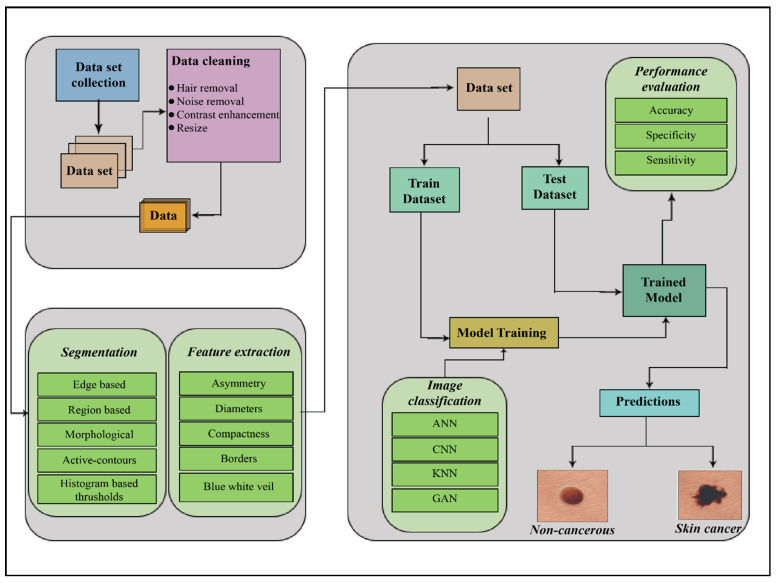
“Acquiring the image, preprocessing it, segmenting it, extracting the feature of interest, and finally classifying it is the standard technique for skin cancer diagnosis, as shown in Figure 1[11].”
Daiem, M., Fayyaz, G. Q., Irfan, S., Ali, R. N., Ali, R. Z., Bashir, M. M., Turk, M., Pontell, M. E., Miles, M. G., Nolte, J. W., et al. (2025) · Journal of Craniofacial Surgery · doi:10.1097/scs.0000000000012199
YOLOv5 with SVM-Aided Post-Classification for High-Precision Skin Lesion Detection
Srividhya, R., Gandhi, V. C., Anitha, D. P. M., Rajesh, S., Katlariwala, S. B., & Panchal, K. (2025) · International Conference on Sustainable Technologies for Humanity and Smart World (HSWTech) · doi:10.1109/hswtech64936.2025.11278157
“Additionally, multi-modal medical diagnostic research in glaucoma and diabetes prediction showcases the interdisciplinary translational potential of AI methods [23][24].”
Longitudinal Skin Lesion Tracking for Total Body Photography
Bayram, A., & Koch, S. (2025) · IEEE International Conference on Bioinformatics and Bioengineering (BIBE) · doi:10.1109/bibe66822.2025.00102
Momeni, M. A., Abianeh, F. E., Amini, M. J., Salehi, S. A., Hajishah, H., Razmara, P., Shafiee, A., & Bahri, R. A. (2025) · Neurosurgical Review · doi:10.1007/s10143-025-04004-z
DeepSkinGuard: A CNN-based Preventive System for Melanoma Identification
Reddy, A. S., Begum, S. F., Krishna, P. S. V., Lalith, E. S., & Vinay, C. (2025) · International Conference on Innovative Data Communication Technologies and Application (ICIDCA) · doi:10.1109/icidca66325.2025.11280398
“Further advancements include the review by Dildar et al. [7], who compared deep learning architectures across multiple datasets, highlighting CNN superiority in robustness and generalization.”
Integrated HealthAI: Revolutionizing Healthcare through Advanced Diagnostic Systems
Davi, N., Bakhtawar, Taj, M. T., Baloch, Z., & Kumar, B. (2025) · VAWKUM Transactions on Computer Sciences · doi:10.21015/vtcs.v13i1.2083
Cedillo-Maldonado, L., Sigüenza-Noriega, I., Miranda-Mateos, S. R., Reinoso-Fuentes, L., Pérez-Aguirre, M., Castillejos, D. E., & Escobar-Castillejos, D. (2025) · Studies in computational intelligence · doi:10.1007/978-3-031-96328-5_2
Advancing Skin Cancer Diagnosis Using Computer Vision to Aid the Visually Impaired
Palanisamy, R., Sobnath, D., & Elshimy, H. (2025) · IGI Global eBooks · doi:10.4018/979-8-3373-2033-5.ch011
Tripathy, J., Aditya, Pattanayak, P. M., Mishra, N., Wu, H., & Rathore, B. (2026) · Lecture notes in networks and systems · doi:10.1007/978-981-96-8107-5_48
AI-Enhanced Tumour Detection and Segmentation
Hussain, M. Z., Hasan, M. Z., Anjum, K., & Arha, A. (2025) · Springer eBooks · doi:10.1007/978-3-032-02963-8_6
In Vivo Efficacy of Zinc Phthalocyanine Nanocarriers IN Photodynamic Therapy of Cancer
Roberto, A. L., Costa, K. M. N., y Araújo, S. E. D. D. M., Soares, I. L. D. S., & Oshiro, J. A. (2026) · Advanced Therapeutics · doi:10.1002/adtp.202500446 · Cited by 1
“Melanoma accounts for only 1% of cases, but it is the subtype with the highest mortality rate [57].”
Patel, U. B., Thota, T., Singh, A., Khatter, U., Gite, S., & Wagle, S. A. (2026) · Smart sensors, measurement and instrumentation · doi:10.1007/978-3-032-05507-1_14
Deep Learning in Dermatology: An Empirical Analysis of CNN Architectures and Diagnostic Accuracy
Aarti, & Dudeja, D. (2025) · International Conference on Computing, Communication and Automation · doi:10.1109/iccca66364.2025.11325484 · Cited by 1
“Deep learning in skin cancer diagnosis is detailed by Dildar et al. [22], who analyse architecture like VGG, ResNet, and Inception.”
OncoScan Web Based Deep Learning System for Multi Class Skin Lesion Diagnosis
Dalal, Y. M., Deepak, R., Bhanu, S. T., Basha, H. A., Battarusetty, L. R., & Thanuja, K. (2025) · IEEE International Conference on Intelligent Signal Processing and Effective Communication Technologies (INSPECT) · doi:10.1109/inspect67393.2025.11350382
“Their integration is planned as future work to expand the applicability of the system [15].”
Valentine, L., & Lin, S. J. (2026) · Elsevier eBooks · doi:10.1016/b978-0-323-91168-9.00004-1
Someshwaran, G., Srinivasan, S., Pavithra, A., Devi priya, R., Indhuvarshini, G., & Komathy, G. (2026) · ITM Web of Conferences · doi:10.1051/itmconf/20268203006
“…the unequal distribution of healthy and AMD cases, this repository enables a detailed investigation of OCT characteristics associated with both healthy eyes and AMD intelligence for the early detection of diseases, including age-related macular degeneration (AMD), as discussed by Tamim et al [14].”
Detection of Skin Cancer Using Deep Learning
Naidana, K. S., Vikitha, K., Rizwaan, S., & Tadiparthi, S. (2025) · IEEE International Symposium on Sustainable Energy, Signal Processing and Cyber Security (iSSSC) · doi:10.1109/isssc66652.2025.11389106
“Dildar, Mehwish et al. [3] conducted a comprehensive review on deep learning applications for skin cancer detection.”
AI-Powered Skin Disease Recognition: An Implementation of CNN Architectures
Upasani, M. S., & Chaurasia, A. (2025) · International Conference on Electronics and Computing, Communication Networking Automation Technologies (ICEC2NT) · doi:10.1109/icec2nt65402.2025.11380098
“[15] To reduce the number of parameters, we replaced the squeezing and excitation components of the model with a functional channel attention component.”
Pandey, M., Paruchuri, A., & Gromiha, M. M. (2026) · Bioinformatics Advances · doi:10.1093/bioadv/vbag068
“These models are currently being used in pattern and speech recognition, histopathological image processing, computer vision, protein structure and function prediction, and genome engineering applications (Kim et al. 2017, Wen et al. 2017, Dildar et al. 2021, Liu et al. 2022, Schmidt et al. 2023).”
An Enhanced CNN with Grey Wolf Optimizer for Skin Cancer Detection
Ervina, S. E., Shidik, G. F., & Purwanto (2025) · International Conference on Advanced Technologies in Energy and Informatic (ICATEI) · doi:10.1109/icatei67676.2025.11404908
“Consequently, adjusting these parameters is vital to strengthen the pattern's ability to generalize and boost its overall work [6].”
Ensembled Deep Learning (DL) Methods for Detecting Skin Cancer Using CNN Algorithm with Multi Model
Taj, F., Muqaddas, R., Yousaf, A., Nasim, M. F., Naeem, M., & Nawaz, E. (2025) · International Conference on Engineering and Emerging Technologies (ICEET) · doi:10.1109/iceet67911.2025.11424105
“[23] Used secondary data to investigate the issue of class difference and achieved an average accuracy of 92.8%.”
InfluentialMalik, M., & Gilpin, M. (2026) · AIP conference proceedings · doi:10.1063/5.0323763
Reshma, S. K., & Reeja, S. R. (2026) · Scientific Reports · doi:10.1038/s41598-026-40522-6 · Cited by 1
Integration of handcrafted and deep-level features to improve skin disease detection
Kedar, R., & Rajagopal, M. K. (2026) · Frontiers in Artificial Intelligence · doi:10.3389/frai.2026.1732440
“Skin illnesses are usually identified using the ABCDE criteria, which consider asymmetry, border, color, dimension, and evolution (Dildar et al., 2021; Javed et al., 2020).”
Role of Smart Image Segmentation in Infection Diagnosis and Monitoring of Acute Surgical Wounds
Bayram, M. B. (2026) · Acta Infologica · doi:10.26650/acin.1756498
Deep Learning-Based Melanoma Skin Cancer Detection: A CNN Approach with Data Augmentation
Prajapati, A., Tyagi, P., & Kumar, P. (2025) · International Conference on Emerging Technologies and Innovation for Sustainability (EmergIN) · doi:10.1109/emergin67762.2025.11450813
“According to a review by Dildar et al., (2021) [5] deep learning technologies have revolutionized skin cancer detection and CNNs (convolutional neural networks) are superior to traditional machine learning methods.”
Skin Lesion Classification Using Modified NasNetMobile Model and Support Vector Machine
Mahanta, D., Hazarika, D., & Nath, V. K. (2026) · Lecture notes in networks and systems · doi:10.1007/978-981-95-3489-0_7
Apprentissage neuronal profond pour la détection du mélanome
Gouabou, A. C. F. (2023) · theses.fr (ABES) · doi:10.70675/bf284d1ez880ez4770za748zf9ffb611ffbe · Cited by 1
Enhanced skin lesion classification using hybrid feature extraction and CNN
Swetha, T., Roopa, R., Swathi, T., Thanusree, G. N., & Bharath, N. (2026) · AIP conference proceedings · doi:10.1063/5.0312845
Deep learning architectures for skin cancer detection: a contemporary review
Ailawadi, D., Anwar, K., & Yadav, A. (2026) · Life Cycle Reliability and Safety Engineering · doi:10.1007/s41872-026-00408-y
“While it supports model benchmarking, its heavy reliance on artificial augmentation may reduce clinical vari - ability and generalization (Dildar et al. 2021).”
Comparative Performance Analysis in Melanoma Detection with DeepLabV3+ Segmentation
Pranata, C. N., Halim, P. M., Dewi, C. A., & Harefa, J. (2025) · International Conference on Computer and Communication Engineering · doi:10.1109/iccce66530.2025.11473999
“Skin cancer is among the most prevalent and fastest-growing types in the last decade, which is reasonable as skin is the body’s largest organ [2].”
Melanoma Skin Cancer Diagnosis Based on Deep Learning: A Comparative Study
Mahi, A. K., Biswas, T., Hossain, M. A., & Ullah, H. (2026) · Lecture notes in electrical engineering · doi:10.1007/978-981-95-4452-3_26
A Browning and vegetation index-based deep neural network for melanoma skin cancer classification
Filho, E. Q. D. S., Salles, E. O. T., Facon, J., & Ciarelli, P. M. (2026) · Research on Biomedical Engineering · doi:10.1007/s42600-026-00478-y
“For all architectures, the original classification head was replaced by a dropout layer (50%), a dense layer with 64 to automatically identify patterns relevant to the target task (Dildar et al. 2021).”
Federated Machine Learning for Skin Lesion Diagnosis
Upasani, S. K., Pawar, S. N., Aglawe, T. P., & Nehete, P. U. (2026) · International Conference on Emerging Technologies and Future Innovations (ETFI) · doi:10.1109/etfi68128.2026.11484991
Deep Learning Approach for Early Detection of Skin Cancer Using Medical Imaging
Kommu, S. (2026) · Contemporary Computing Innovations Conference (CCIC) · doi:10.1109/ccic68129.2026.11486101
Wu, Y., Zhang, B., Yan, Y., Li, J. J., Wu, Y., Kim, S. S., Huang, K., Ye, Q., Yu, Y., & Tong, G. (2026) · medRxiv · doi:10.64898/2026.04.27.26351813
Deep learning based skin cancer classification: A comprehensive evaluation
Sekhar, A. C., & Venkatesh, D. (2026) · IEEE International Conference on Emerging Computing and Intelligent Technologies (ICoECIT) · doi:10.1109/icoecit68303.2026.11495572
“Furthermore, the network deepens, successive convolutional stages capture increasingly abstract features, such as textures, shapes and object parts [14].”
Bari, M. R., Ferdaus, J., Tonny, F. A., Bithi, T., Zubaer, T., & Sohel, A. (2025) · International Conference on Computer and Information Technology (ICCIT) · doi:10.1109/iccit68739.2025.11489533
“Though it might affect any part of the body, most of the time it affects those parts that are directly exposed to sunlight [2].”
Neuronal Biology-Inspired Multi-pooling CNNs for Skin Lesion Classification
Sun, J., Zhang, Y., Ding, E. X., & Hou, R. J. (2026) · Communications in computer and information science · doi:10.1007/978-981-95-8315-7_35
Melanoma Classification Using CNNs and Vision Transformers with Explainable AI
Yasmin, T., Arjon, S. S., Mondol, A. K., Haque, M. R., Uddin, M. R., & Aman, N. (2025) · International Conference on Computer and Information Technology (ICCIT) · doi:10.1109/iccit68739.2025.11490099
“Dildar conducted a thorough review of deep learning approaches in skin cancer classification, focusing on critical lesion features like symmetry, color variation, and border irregularity [13].”
An Ensemble-Based Deep Neural Approach for Classifying Skin Allergies
Sara, T. A., Ghosh, B., Nazifa, S. N., & Jahan, H. (2025) · International Conference on Computer and Information Technology (ICCIT) · doi:10.1109/iccit68739.2025.11491599
“Dildar et al. [10] reviewed numerous deep learning methods for skin cancer diagnosis, focusing on lesion classification using KNNs, CNNs, ANNs, and RBFNs.”
An Ensemble-Based Deep Neural Approach for Classifying Skin Allergies
Sara, T. A., Ghosh, B., Nazifa, S. N., & Jahan, H. (2025) · International Conference on Computer and Information Technology (ICCIT) · doi:10.1109/iccit68739.2025.11490536
“Dildar et al. [10] reviewed numerous deep learning methods for skin cancer diagnosis, focusing on lesion classification using KNNs, CNNs, ANNs, and RBFNs.”
Vhora, R., & Patel, B. N. (2026) · Lecture notes in networks and systems · doi:10.1007/978-3-032-19675-0_21
Aminfar, K., Scafide, K. N., Wojtusiak, J., & Lattanzi, D. (2026) · Sensors · doi:10.3390/s26103215
“Systematic reviews of AI in dermatology between 2011–2021 [24] and 2020–2022 [25] highlight a focus on detection, segmentation, and classification tasks.”
Verma, G., Kumar, K. S., Negi, P., Mishra, P. K., Sharma, N., & Gupta, R. (2026) · International Conference on Augmented Intelligence and Sustainable Systems (ICAISS) · doi:10.1109/icaiss68683.2026.11525467
“To the world, skin cancer can be defined as one of the most widespread and fastest-growing types of cancer that cause a severe challenge to public health because of its high morbidity and the likelihood of causing death in case of not being diagnosed at an early phase of metastasis [1].”
Nanotechnology in immunotherapy and targeted therapy for skin cancer
Kaur, C. D., Gupta, A., Joshi, R., & Saraf, S. (2026) · Elsevier eBooks · doi:10.1016/b978-0-443-26564-8.00013-x
XAI-SkinNet: Explainable Deep Learning Framework for Skin Cancer Diagnosis
Shajahan, S., Goli, R. R., & Krishna, N. S. (2026) · International Conference on Connected Intelligence for Industrial Applications (CI2A) · doi:10.1109/ci2a69097.2026.11576952
Vinita, L. J., Rakhee, Raghavan, A., Arjun, R., & Tharunraj, M. G. (2026) · Smart innovation, systems and technologies · doi:10.1007/978-3-032-22114-8_2
An Empirical Analysis of Deep Learning Models for Early Skin Cancer Detection
Kaushik, V., Bageshwer, K., Mehla, S., Rani, G., Dhull, S., & Gandhi, A. B. (2026) · IEEE International Conference on Computing, Power and Communication Technologies (IC2PCT) · doi:10.1109/ic2pct68894.2026.11584476
“Prompt identification is vital for lowering mortality rates, since an early diagnosis can greatly enhance the probability of effective treatment[1],[2].”
InfluentialAdvancements in Skin Cancer Detection Using Deep CNN Model
Sheenam, S., & Kumar, A. (2026) · Lecture notes in electrical engineering · doi:10.1007/978-981-95-0705-4_6
Microneedle as a Targeted Drug Delivery System for Skin Cancer Treatment
Patil, L. N., Harish, V., Babu, M. M. H., Maniyar, M. G., & Gaikwad, V. (2026) · Proceedings in Technology Transfer · doi:10.1007/978-3-032-13768-5_88
Federated Cloud Learning Model for Privacy-Preserving Skin Cancer Detection Using Image Processing
Krishnamoorthy, P., Ravishankar, K., Auguskani, J. P. L., Donthala, K. K., Acharjee, P. B., & Barkunan, S. R. (2026) · International Conference on Intelligent Technologies (CONIT) · doi:10.1109/conit69683.2026.11621374
Chatziioannidis, D., Tsintotas, K. A., & Tzekis, P. (2026) · Electronics · doi:10.3390/electronics15153346 · Cited by 1
Karantina, E., Kantaros, A., Nikolaou, G., Laskaris, N., & Zacharia, P. T. (2026) · Algorithms · doi:10.3390/a19080638
Kumar, A. P., & Jyothi, U. N. (2026) · International Conference on Inventive Computation and Information Technologies (ICICIT) · doi:10.1109/icicit69063.2026.11633898
Goyal, P. K., Bibhu, V., & Khatter, H. (2026) · Lecture notes in networks and systems · doi:10.1007/978-3-032-23317-2_44
Nano-Revolution: Transforming Pharmaceuticals with Nanostructures
Sharma, N., Tonk, A., Singh, S., & Kishore, L. (2026) · Reference series in phytochemistry · doi:10.1007/978-3-031-69044-0_24-1
Targeted nanotherapeutic strategy for melanoma using silk-fibroin based artemisinin nanoparticles
Sharda, D., Kaur, A., Pattanayak, A., & Choudhury, D. (2026) · RSC Advances · doi:10.1039/d6ra04405k
Hashem, R., El-Hussieny, H., Umezu, S., & El‐Bab, A. M. R. F. (2026) · International Journal of Intelligent Robotics and Applications · doi:10.1007/s41315-026-00567-2
Shaik, M. K., Soni, K., Shobana, V., Anjali, Nirmala, A., & Chadha, K. S. (2026) · International Conference on Sustainable Computing and Integrated Communication in Changing Landscape of AI (ICSCAI) · doi:10.1109/icscai68849.2026.11648230
An Optimized CNN with Grey Wolf Optimizer and CLAHE for Skin Cancer Detection
Ervina, S. E., Soeleman, A., Wibowo, K. I. E. W., Anisa, I., Prayoga, & Maarif, M. R. S. (2026) · International Conference on Electronics Representation and Algorithm (ICERA) · doi:10.1109/icera72709.2026.11666603
Colorectal Lesion diagnosis using transformer and deep learning with multiscale feature interface
Yadav, D. P., Sharma, B., Webber, J. L., & Mehbodniya, A. (2026) · PLoS ONE · doi:10.1371/journal.pone.0357664
Fallahi, A., Irani, S., Dehghan, A., Saleh, S. P., & Khotanlou, H. (2026) · Research Square · doi:10.21203/rs.3.rs-10703943/v1
Syambabu, J., Naganjali, K. R., Sai, P. N., & Sekhar, T. C. (2026) · International Conference on Electronics and Sustainable Communication Systems (ICESC) · doi:10.1109/icesc70182.2026.11686932
“Recent advances in nanotechnology and electromagnetic sensing have opened new possibilities for biomedical diagnostics [4].”
Advances in Automated Skin Cancer Detection Using Deep Learning Methods
Kaushik, S., & Dahiya, S. (2026) · Lecture notes in networks and systems · doi:10.1007/978-3-032-30957-0_34
Automated Multi-Class Skin Cancer Classification Using Vision Transformers
Habib, W., Siddiqui, S. I., Rehman, B. U., Khan, M. U. A., & Faheem, S. M. (2026) · International Journal of Innovations in Science and Technology · doi:10.33411/ijist/2008
A Mobile Application for Early Detection of Skin Cancer
Afifi, S. M., Aboulmagd, B., Kaur, R., Poulis, Y., Taha, R., Salem, M. A.-M., Hamed, M., & Radüntz, T. (2026) · Lecture notes in networks and systems · doi:10.1007/978-3-032-39783-6_27
SmartDermAI: Skin Cancer Detection Device
Sanap, A., Pawgi, J., & Bhandarkavthekar, N. (2026) · International Conference on Innovation & Growth in Next-Gen Intelligent Technology & Engineering (IGNITE) · doi:10.1109/ignite69592.2026.11705854
“The broader challenges facing the field were systematically documented by Dildar et al. [1], whose review identified class imbalance, dataset variability, and limited generalisation as persistent obstacles across CNN-based approaches.”
Mushtaq, S., & Singh, O. (2026) · SN Computer Science · doi:10.1007/s42979-026-05385-8
“Deep neural networks significantly aid skin cancer diag - nosis [19].”
Automatic Skin Melanoma Detection from Dermo Scoy Images using ResNet Variants
Rajaram, G., & Bharadwaj, R. H. (2026) · IEEE International Conference on Recent Advances in Electronics, Communication, Computing, Automation and Power (RECCAP) · doi:10.1109/reccap69368.2026.11724183
Sanghvi, H. A., Agritis, A., Alvarez, I., Patel, M., Wang, S., Patel, R. H., Banoub, R. G., & Makkar, T. (2026) · JMIR Dermatology · doi:10.2196/104086
“It is broadly categorized into melanoma and nonmelanoma skin cancers (NMSCs) [1].”
Malavath, P., Upadhyay, D., Rakshitha Kiran, P., Anacovid, A., Tamilarasi, R., & Prasan, U. D. (2026) · doi:10.1109/icosics70095.2026.11746640
Robust Melanoma Detection Using Enhanced Dermoscopic Imaging and Ensemble Deep Learning
Madanu, S., Kolipaka, V. A., Yalagala, L. P. K., Nallagari, S. R., Devarapalli, S. B., Sonti, T., Deshpande, A. P., & Samanta, S. (2026) · International Conference on Information, Implementation, and Innovation in Technology (I2ITCON) · doi:10.1109/i2itcon69735.2026.11747232
“…dermoscopic images generally have low contrast, high levels of noise, lack of uniform lighting across multiple images of the same patient, presence of hair or clothing over dermoscopic images, and the existence of multiple tones of skin colors across a population of patients [12], [22] .”
Immunogenetic Signature of the MICA‐129 Val/Val Genotype Associated With Metastasis in Melanoma
Fonseca, B. G., Fragelli, B. D. D. L., Rodolpho, J. M. D. A., de Godoy, K. F., Castro, C. F. B., Castelli, E. C., de Azevedo, L. R., Lopes, I. A., Benevides, L., & Aníbal, F. D. F. (2026) · Journal of Immunology Research · doi:10.1155/jimr/2883849
Metadata
- Authors
- Dildar, M., Akram, S., Irfan, M., Khan, H. U., Ramzan, M., Mahmood, A. R., Alsaiari, S. A., Saeed, A. H. M., Alraddadi, M. O., & Mahnashi, M. H.
- Affiliations
- Government Associate College for Women Mari Sargodha, Sargodha 40100, Pakistan
- University of Sargodha (PK)
- Najran University (SA)
- COMSATS University Islamabad (PK)
- University of Tabuk (SA)
- Corresponding author
- Ramzan, Muhammad
- Venue
- International Journal of Environmental Research and Public Health
- Publisher
- MDPI AG
- Published
- 2021-05-20
- Volume
- 18
- Issue
- 10
- Pages
- 5479
- ISSN
- 1660-4601 (ISSN-L)
- PMC
- PMC8160886
- OpenAlex
- W3165685657
- Semantic Scholar
- faec7030c99bf2fa29d341bc09d351b7edfa05bc
- Cited by
- 597
- References
- 62
- Citations by year
- 2026: 81 · 2025: 156 · 2024: 162 · 2023: 130 · 2022: 56 · 2021: 12
- FWCI
- 10.87
- Type
- journal article
- Language
- en
- Open access
- gold
- doi.org
- Licence
- Locations
- International Journal of Environmental Research and Public Health (publishedVersion, cc-by)
- PubMed Central (publishedVersion, cc-by)
- PubMed (publishedVersion)
- RePEc: Research Papers in Economics (submittedVersion)
- DOAJ (DOAJ: Directory of Open Access Journals) (submittedVersion)
- Funders
- Deanship of Scientific Research Najran University (DSR NU 2021)
- Topics
- Health Sciences › Medicine › Oncology › Cutaneous Melanoma Detection and Management
- Physical Sciences › Computer Science › Artificial Intelligence › AI in cancer detection
- Health Sciences › Health Professions › Health Information Management › Artificial Intelligence in Healthcare
- Keywords
- skin cancer, early detection, melanoma, benign skin lesions, deep learning, skin lesion classification, computer-aided diagnosis
- MeSH terms
- Deep Learning, Humans, Melanoma, Skin, Skin Neoplasms
About these checks
Registry, retraction, Cites and statistics results are computed, not judged, with one exception: a printed reference that no index lists is read once by a model before it counts as a citation error. Claims are extracted by a model and kept only when their quote appears verbatim in the text; each cited source is then checked, with a model’s help, for whether it says what the claim relies on. Those verdicts can be wrong — read the claim’s quote and the cited source before relying on one.
Statistics and arithmetic are recomputed, not judged.
Confidence bands are shown only for fields calibrated on our annotated test set. None is calibrated yet, so no band is shown.
What counts as a claim ›How we measure confidence ›How we check this ›
Are you an author, or do you see a problem with this page? Request a review
Data sources
Bibliographic data: Semantic Scholar, OpenAlex, Crossref.
Contains information from the Semantic Scholar Academic Graph Datasets, made available under the ODC Attribution License (ODC-BY 1.0).
Semantic Scholar’s data is described in: Kinney, R., et al. (2023). The Semantic Scholar Open Data Platform. arXiv:2301.10140.
