

The DOI matches its Crossref record; 73 of the 74 references it cites were found in a registry or an index.
Function of Green Tea Catechins in the Brain: Epigallocatechin Gallate and its Metabolites
Open accessAbstract
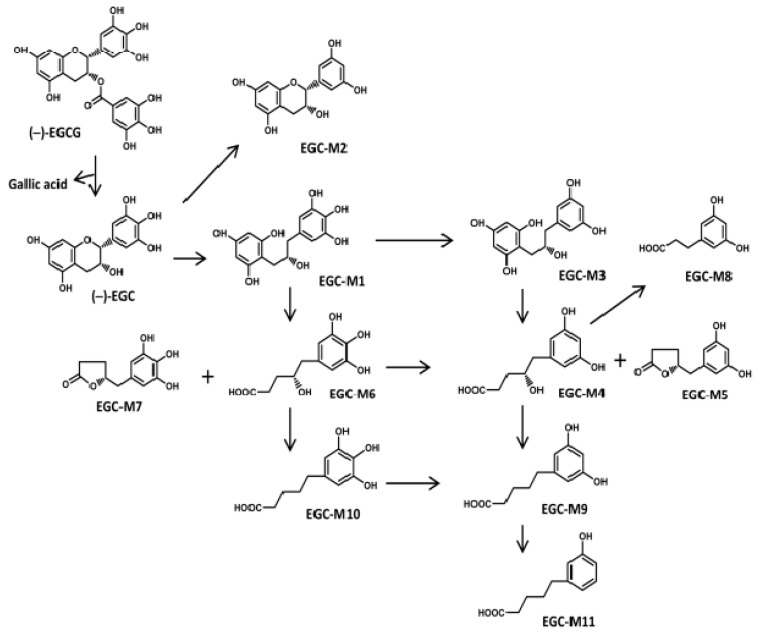
Over the last three decades, green tea has been studied for its beneficial effects, including anti-cancer, anti-obesity, anti-diabetes, anti-inflammatory, and neuroprotective effects. At present, a number of studies that have employed animal, human and cell cultures support the potential neuroprotective effects of green tea catechins against neurological disorders. However, the concentration of (-)-epigallocatechin gallate (EGCG) in systemic circulation is very low and EGCG disappears within several hours. EGCG undergoes microbial degradation in the small intestine and later in the large intestine, resulting in the formation of various microbial ring-fission metabolites which are detectable in the plasma and urine as free and conjugated forms. Recently, in vitro experiments suggested that EGCG and its metabolites could reach the brain parenchyma through the blood-brain barrier and induce neuritogenesis. These results suggest that metabolites of EGCG may play an important role, alongside the beneficial activities of EGCG, in reducing neurodegenerative diseases. In this review, we discuss the function of EGCG and its microbial ring-fission metabolites in the brain in suppressing brain dysfunction. Other possible actions of EGCG metabolites will also be discussed.
Overview
The claims and statistics of this paper haven’t been checked yet.
Run the check — free, no account needed. It reads the open-access text and checks the sources it cites.
Integrity signals
Registry
Cites
Statistics
Figures
Verification
Claims the paper makes
The claims and statistics of this paper haven’t been checked yet.
Run the check — free, no account needed. It reads the open-access text and checks the sources it cites.
Claims other papers make about this one
Each is checked against this paper’s own text: does it say what the citing paper says it does?
In the citing paper
“EGCG treatment displays some limitations such as the high rate of metabolism and subsequent degradation, which in turn prevent a sufficient concentration in human plasma (Pervin et al., 2019)”
From Exploring the Therapeutic Potential of Phytochemicals in Alzheimer’s Disease: Focus on Polyphenols and Monoterpenes (2022) · cites this paper as Pervin et al., 2019
Self-check
Percentages, sums and reported differences re-computed from the paper’s own numbers.
The self-check needs the paper’s full text.
Citations
Cites
Plant Polyphenols as Dietary Antioxidants in Human Health and Disease
Pandey, K. B., & Rizvi, S. I. (2009) · Oxidative Medicine and Cellular Longevity · doi:10.4161/oxim.2.5.9498 · Cited by 3,942
Daneman, R., & Prat, A. (2015) · Cold Spring Harbor Perspectives in Biology · doi:10.1101/cshperspect.a020412 · Cited by 3,437
Tea Polyphenols for Health Promotion
Khan, N., & Mukhtar, H. (2007) · Life Sciences · doi:10.1016/j.lfs.2007.06.011 · Cited by 1,156
Effect of tea phenolics and their aromatic fecal bacterial metabolites on intestinal microbiota
Lee, H. C., Jenner, A. M., Low, C. S., & Lee, Y. K. (2006) · Research in Microbiology · doi:10.1016/j.resmic.2006.07.004 · Cited by 697
Total Phenol, Catechin, and Caffeine Contents of Teas Commonly Consumed in the United Kingdom
Khokhar, S., & Magnusdottir, S. G. M. (2002) · Journal of Agricultural and Food Chemistry · doi:10.1021/jf010153l · Cited by 533
Absorption, distribution, elimination of tea polyphenols in rats.
Chen, L., Lee, M., Li, H., & Yang, C. S. (1997) · PubMed · Cited by 459
Green tea consumption and cognitive function: a cross-sectional study from the Tsurugaya Project
Kuriyama, S., Hozawa, A., Ohmori, K., Shimazu, T., Matsui, T., Ebihara, S., Awata, S., Nagatomi, R., Arai, H., & Tsuji, I. (2006) · The American Journal of Clinical Nutrition · doi:10.1093/ajcn/83.2.355 · Cited by 428
Lambert, J. D., Lee, M., Lu, H., Meng, X., Hong, J. J. J., Seril, D. N., Yang, C. S., & Sturgill, M. G. (2003) · Journal of Nutrition · doi:10.1093/jn/133.12.4172 · Cited by 318
Metabolism of Green Tea Catechins: An Overview
Feng, W. Y. (2006) · Current Drug Metabolism · doi:10.2174/138920006778520552 · Cited by 301
Li, C., Lee, M., Sheng, S., Meng, X., Prabhu, S., Winnik, B., Huang, B. M., Chung, J. Y., Yan, S., Ho, C., et al. (2000) · Chemical Research in Toxicology · doi:10.1021/tx9901837 · Cited by 276
Cited by
Sorted by citations
Beneficial Properties of Green Tea Catechins
Musiał, C., Kuban‐Jankowska, A., & Górska‐Ponikowska, M. (2020) · International Journal of Molecular Sciences · doi:10.3390/ijms21051744 · Cited by 851
Mokrá, D., Jošková, M., & Mokrý, J. (2022) · International Journal of Molecular Sciences · doi:10.3390/ijms24010340 · Cited by 386
Health Benefits and Chemical Composition of Matcha Green Tea: A Review
Kochman, J., Jakubczyk, K., Antoniewicz, J., Mruk, H., & Janda, K. (2020) · Molecules · doi:10.3390/molecules26010085 · Cited by 328
Green Tea Catechins: Nature’s Way of Preventing and Treating Cancer
Farhan, M. (2022) · International Journal of Molecular Sciences · doi:10.3390/ijms231810713 · Cited by 225
Nanodelivery of Natural Antioxidants: An Anti-aging Perspective
Vaiserman, A. M., Koliada, A. K., Zayachkivska, A., & Lushchak, O. V. (2020) · Frontiers in Bioengineering and Biotechnology · doi:10.3389/fbioe.2019.00447 · Cited by 215
Metadata
- Authors
- Pervin, M., Unno, K., Takagaki, A., Isemura, M., & Nakamura, Y.
- Affiliations
- Shizuoka University (JP)
- Mitsui (Japan) (JP)
- Corresponding author
- Pervin, Monira
- Unno, Keiko
- Venue
- International Journal of Molecular Sciences
- Publisher
- MDPI AG
- Published
- 2019-07-25
- Volume
- 20
- Issue
- 15
- Pages
- 3630
- ISSN
- 1422-0067 (ISSN-L)
- PMC
- PMC6696481
- OpenAlex
- W2964240146
- Cited by
- 216
- References
- 74
- Citations by year
- 2026: 21 · 2025: 27 · 2024: 30 · 2023: 28 · 2022: 43 · 2021: 33 · 2020: 31 · 2019: 3
- FWCI
- 4.09
- Type
- journal article
- Language
- en
- Open access
- gold
- dx.doi.org
- Licence
- Locations
- International Journal of Molecular Sciences (publishedVersion, cc-by)
- PubMed Central (publishedVersion, cc-by)
- PubMed (publishedVersion)
- DOAJ (DOAJ: Directory of Open Access Journals) (submittedVersion, cc-by-sa)
- Topics
- Life Sciences › Agricultural and Biological Sciences › Food Science › Tea Polyphenols and Effects
- Life Sciences › Neuroscience › Cellular and Molecular Neuroscience › Alzheimer's disease research and treatments
- Health Sciences › Medicine › Complementary and alternative medicine › Medicinal Plants and Neuroprotection
- Keywords
- green tea catechins, epigallocatechin gallate, neuroprotection, neurodegenerative diseases, blood-brain barrier, neurite outgrowth, brain parenchyma, gut-brain axis, anti-inflammatory activity
- MeSH terms
- Animals, Blood-Brain Barrier, Brain, Catechin, Cognition, Humans, Permeability, Plant Extracts, Structure-Activity Relationship, Tea, Molecular Structure, Neurogenesis
About these checks
Registry, retraction, Cites and statistics results are computed, not judged, with one exception: a printed reference that no index lists is read once by a model before it counts as a citation error. Claims are extracted by a model and kept only when their quote appears verbatim in the text; each cited source is then checked, with a model’s help, for whether it says what the claim relies on. Those verdicts can be wrong — read the claim’s quote and the cited source before relying on one.
Statistics and arithmetic are recomputed, not judged.
Confidence bands are shown only for fields calibrated on our annotated test set. None is calibrated yet, so no band is shown.
What counts as a claim ›How we measure confidence ›How we check this ›
Are you an author, or do you see a problem with this page? Request a review
