

The DOI matches its Crossref record; 370 of the 375 references it cites were found in a registry or an index; 26 of the 530 sources its claims cite were checked for support.
Mechanisms and Regulation of Cellular Senescence
Open accessAbstract
Cellular senescence entails a state of an essentially irreversible proliferative arrest in which cells remain metabolically active and secrete a range of pro-inflammatory and proteolytic factors as part of the senescence-associated secretory phenotype. There are different types of senescent cells, and senescence can be induced in response to many DNA damage signals. Senescent cells accumulate in different tissues and organs where they have distinct physiological and pathological functions. Despite this diversity, all senescent cells must be able to survive in a nondividing state while protecting themselves from positive feedback loops linked to the constant activation of the DNA damage response. This capacity requires changes in core cellular programs. Understanding how different cell types can undergo extensive changes in their transcriptional programs, metabolism, heterochromatin patterns, and cellular structures to induce a common cellular state is crucial to preventing cancer development/progression and to improving health during aging. In this review, we discuss how senescent cells continuously evolve after their initial proliferative arrest and highlight the unifying features that define the senescent state.
Overview
AI snapshot
Written from the paper’s full text.
TL;DR
This review synthesizes mechanisms and regulation of cellular senescence, emphasizing heterogeneity, cell-cycle arrest via p53/p21 and p16/RB, the SASP, metabolic/chromatin changes, and positive feedback loops. It discusses senescence’s dual roles in cancer and aging and therapeutic implications including senolytics.
Key findings
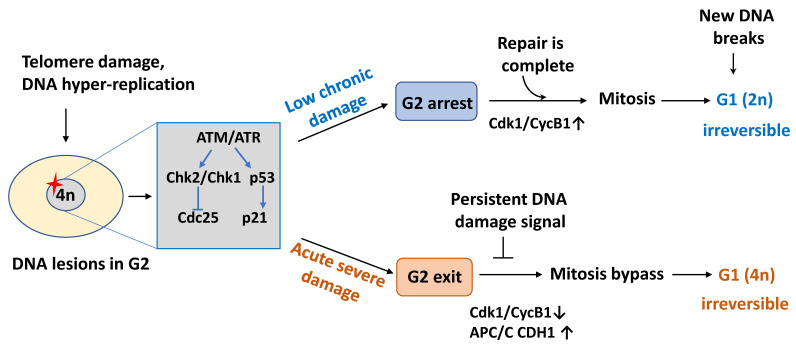
- Senescence is an essentially irreversible proliferative arrest with continued metabolic activity and a SASP; cell-cycle exit can occur in G1 or G2, with p53/p21 as early markers and p16/ARF as late markers. Acute DNA damage can trigger rapid exit within 24 h, and the G2/M checkpoint responds to 10–20 DNA breaks.
- Replicative senescence is driven by telomere erosion; mean telomere length in human senescent fibroblasts ranges between 6 and 8 kbp, with a few extremely short telomeres. Persistent DDR at telomeres, partly because TRF2 blocks repair, sustains arrest.
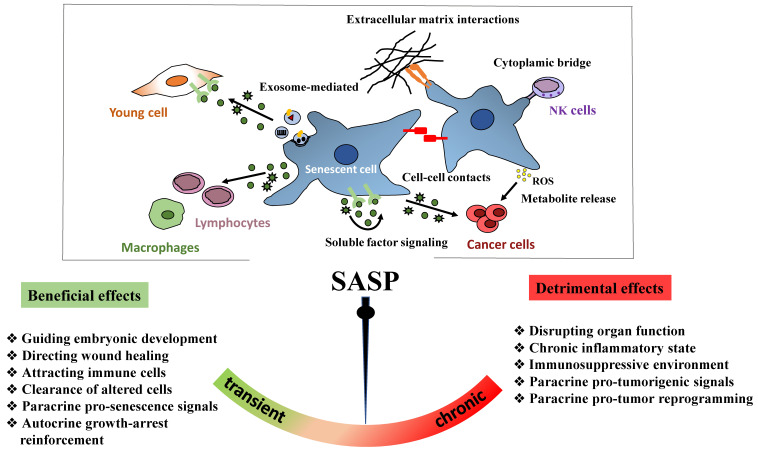
- The SASP is regulated by NF-κB/C/EBP-β, ATM, p38MAPK, GATA4, mTOR, epigenetic factors, and cGAS–STING signaling; it can reinforce senescence and drive inflammaging and paracrine senescence.
- Senescence has dual roles: it acts as a barrier to tumorigenesis, but SASP factors can promote cancer progression; senescent cell accumulation contributes to aging, and clearance via senolytics or INK-ATTAC alleviates age-related dysfunction and extends healthspan in mice.
Methods
- Narrative review; no primary experiments. It synthesizes published literature on mammalian cellular senescence mechanisms, regulation, and roles in cancer and aging.
- Covers in vitro and in vivo studies, including mouse models, human cells/tissues, and clinical observations; main analysis is thematic synthesis of signaling pathways, transcriptional/post-transcriptional control, metabolism, organelles, autophagy, epigenetics, and immune clearance.
- No systematic search or meta-analysis is described.
Limitations
- Stated: lack of specific biomarkers to identify and follow senescent cells in vivo; much knowledge comes from cultured cells that do not recapitulate organism complexity; findings need in vivo confirmation; heterogeneity complicates assigning exact roles.
- Stated: it remains challenging to study how senescent cells are induced in vivo, how the SASP changes over time, when the SASP acquires damaging traits, and how senescent cell clearance is regulated.
- Evident: as a narrative review, it does not provide a systematic or quantitative synthesis and reports no primary data to assess causality.
Model-written summary. Check it against the paper before relying on it.
Integrity signals
Registry
Cites
Statistics
Figures
Verification
Claims the paper makes
295 Not checked yet · 50 Own interpretation · 36 No basis given · 9 Partly supported · 3 Supported · 1 Own method · accuracy not yet measured
The cited sources support only part of this claim — read each source’s verdict below.
In the paper
“This initial arrest is reversible because senescent cells that express low levels of p16 can re-enter the cell cycle upon p53 inactivation [47,48].”
§ Mechanisms and Regulation of Cellular Senescence > 2. Senescence and the Control of Cell Cycle Arrest > 2.1. Cell Cycle Exit in G1
What the sources say
- Partly supportedcites [47] Gire, 1998, Reinitiation of DNA Synthesis and Cell Division in Senescent Human Fibroblasts by Microinjection of Anti-p53 Antibodies, Mol. Cell. Biol. sourceExperimental — accuracy not yet measured
The paper reports that blocking p53 in senescent human fibroblasts induced reentry into S phase and completion of cell division (opening summary; page unavailable). It does not establish that the responding cells expressed low levels of p16, so the p16 qualification is unsupported. (LLM, conf=0.85)
- Supportedcites [48] Krtolica, 2003, Reversal of human cellular senescence: Roles of the p53 and p16 pathways, EMBO J. source
The Discussion states that, in the absence of p16 expression, an established senescence arrest can be reversed by p53 inactivation. The Results further report that p53 inactivation restored proliferation in cells that senesced with reduced p16 levels. (LLM, conf=0.93)
plaindirect- Asserted: passes — The authors put it forward as true.
- Checkable: passes — It can be checked against evidence.
- Load-bearing: unclear — It is unclear whether the paper’s conclusions depend on it.
- Based: passes — The paper gives a reason why it holds.
- Partly supported
Every source the paper cites for this claim was checked and supports it.
In the paper
“The accumulation of persistent and unresolved telomeric damage might be explained by the cell inability to efficiently repair damaged telomeres [109,115].”
§ Mechanisms and Regulation of Cellular Senescence > 3. Molecular Signaling and Pathways Leading to Senescence Entry > 3.3. Oxidative Damage and Irreparable Telomeric Lesions
What the sources say
- Supportedcites [109] Hewitt, 2012, Telomeres are favoured targets of a persistent DNA damage response in ageing and stress-induced senescence, Nat. Commun. source
The Abstract proposes that an inability to repair double-strand breaks by non-homologous end joining at telomeric regions could contribute to a persistent DNA damage response. The Discussion likewise says that telomeres’ restricted repair capacity may contribute to persistent damage after genotoxic stress. This supports the citing sentence’s tentative explanation. (LLM, conf=0.93)
- Supportedcites [115] Fumagalli, 2012, Telomeric DNA damage is irreparable and causes persistent DNA-damage-response activation, Nat. Cell Biol. source
The Discussion states that telomeric tracts resist DNA damage repair despite the cell’s general capacity to repair DNA. The Results section on physiological ageing in primates explains that damage at telomeres remains unrepaired, producing persistent DNA-damage-response foci. This supports the citing sentence’s proposed explanation. (LLM, conf=0.94)
hedgedconditional- Asserted: passes — The authors put it forward as true.
- Checkable: passes — It can be checked against evidence.
- Load-bearing: passes — The paper’s conclusions depend on it.
- Based: passes — The paper gives a reason why it holds.
- Supported
The cited sources support only part of this claim — read each source’s verdict below.
In the paper
“In these senescence-associated signatures, genes involved in growth factor signaling, cell cycle progression, DNA replication, and mitosis progression control are downregulated [68,136,137,138,139,140].”
§ Mechanisms and Regulation of Cellular Senescence > 4. Transcriptional and Post-Transcriptional Control of Senescence > 4.1. The Senescence Transcriptional Program
What the sources say
- Partly supportedcites [68] Chicas, 2010, Dissecting the Unique Role of the Retinoblastoma Tumor Suppressor during Cellular Senescence, Cancer Cell sourceExperimental — accuracy not yet measured
The Results sections on gene expression report downregulation of growth-promoting genes in senescent cells and identify DNA-replication and mitotic-cell-cycle genes as repressed or expressed at low levels. They do not specifically establish downregulation of growth-factor-signaling genes, so that part of the attributed claim is unsupported. The provided passages have no page numbers. (LLM, conf=0.84)
- Not checked yetcites [136] Shelton, 1999, Microarray analysis of replicative senescence, Curr. Biol. source
- Not checked yetcites [137] Ly, 2000, Mitotic Misregulation and Human Aging, Science source
- Partly supportedcites [138] Zhang, 2003, Senescence-specific gene expression fingerprints reveal cell-type-dependent physical clustering of up-regulated chromosomal loci, Proc. Natl. Acad. Sci. USA sourceExperimental — accuracy not yet measured
The Results report that 17.9% of annotated genes downregulated specifically during senescence in human fibroblasts are involved in cell-cycle regulation. The passages do not establish downregulation of genes involved in growth-factor signaling, DNA replication, or mitosis progression control; the paper also says the altered genes differ greatly between fibroblasts and mammary epithelial cells. (LLM, conf=0.86)
- Not checked yetcites [139] Kim, 2013, Implications of time-series gene expression profiles of replicative senescence, Aging Cell source
- Partly supportedcites [140] Lackner, 2014, A genomics approach identifies senescence-specific gene expression regulation, Aging Cell sourceExperimental — accuracy not yet measured
In the results/discussion (page unavailable), the paper reports that downregulated genes were strongly enriched for proliferation and replication pathways, supporting the cell-cycle and DNA-replication portions of the claim. Our copy does not establish downregulation of growth-factor signaling or mitosis-progression control specifically. It also cautions that most expression changes seen in senescent cells are shared with other forms of cell-cycle arrest, rather than being uniquely senescence-specific. (LLM, conf=0.86)
plaincorrelational- Asserted: passes — The authors put it forward as true.
- Checkable: passes — It can be checked against evidence.
- Load-bearing: unclear — It is unclear whether the paper’s conclusions depend on it.
- Based: passes — The paper gives a reason why it holds.
- Partly supported
The cited sources support only part of this claim — read each source’s verdict below.
In the paper
“The delayed ARF expression increase probably reflects the complex organization of the responsive elements within the ARF promoter [130,131,132].”
§ Mechanisms and Regulation of Cellular Senescence > 3. Molecular Signaling and Pathways Leading to Senescence Entry > 3.4. Oncogene Activity and Replication Stress
What the sources say
- Partly supportedcites [130] Robertson, 1998, The Human ARF Cell Cycle Regulatory Gene Promoter Is a CpG Island Which Can Be Silenced by DNA Methylation and Down-Regulated by Wild-Type p53, Mol. Cell. Biol. sourceExperimental — accuracy not yet measured
The Discussion describes several potential Sp1 and E2F binding sites and other promoter regions important for ARF transcription, supporting the description of a complex promoter. The expression analysis reports time-dependent ARF induction after 5-aza-CdR treatment, but the paper does not attribute a delayed increase to the arrangement of promoter response elements; in that experiment, ARF expression slightly preceded INK4a expression. Page numbers were not available in our copy. (LLM, conf=0.85)
- Not checked yetcites [131] Inoue, 1999, Induction of ARF tumor suppressor gene expression and cell cycle arrest by transcription factor DMP1, Proc. Natl. Acad. Sci. USA source
- Partly supportedcites [132] Berkovich, 2003, E2F and Ras Synergize in Transcriptionally Activating p14ARFExpression, Cell Cycle sourceExperimental — accuracy not yet measured
The sections on E2F1 activation describe multiple responsive regions in the p14 ARF promoter, including non-canonical sites, supporting the claim that its regulation is complex. The paper does not link that organization to a delayed increase in ARF expression; a search for delay and response timing found no such explanation. Page numbers are unavailable in our copy. (LLM, conf=0.84)
hedgedconditional- Asserted: passes — The authors put it forward as true.
- Checkable: passes — It can be checked against evidence.
- Load-bearing: unclear — It is unclear whether the paper’s conclusions depend on it.
- Based: passes — The paper gives a reason why it holds.
- Partly supported
The cited sources support only part of this claim — read each source’s verdict below.
In the paper
“IκB degradation allows NF-κB translocation into the nucleus where it transactivates several SASP genes [156,157].”
§ Mechanisms and Regulation of Cellular Senescence > 4. Transcriptional and Post-Transcriptional Control of Senescence > 4.1. The Senescence Transcriptional Program
What the sources say
- Partly supportedcites [156] Miyamoto, 2011, Nuclear initiated NF-κB signaling: NEMO and ATM take center stage, Cell Res. sourceExperimental — accuracy not yet measured
The Introduction states that IκBα degradation releases NF-κB, which enters the nucleus and regulates transcription of target genes. It does not identify those targets as SASP genes, so the SASP-specific part of the claim is unsupported by this source. (LLM, conf=0.88)
- Supportedcites [157] Zhao, 2020, ATM is a key driver of NF-κB-dependent DNA-damage-induced senescence, stem cell dysfunction and aging, Aging source
The Introduction states that IκBα degradation results in NF-κB translocation into the nucleus. The Discussion’s Figure 8 description says that released p65 translocates into the nucleus and upregulates SASP factors, including TNFα and IL-6. Page numbers are not provided in our copy. (LLM, conf=0.94)
plaindirect- Asserted: passes — The authors put it forward as true.
- Checkable: passes — It can be checked against evidence.
- Load-bearing: unclear — It is unclear whether the paper’s conclusions depend on it.
- Based: passes — The paper gives a reason why it holds.
- Partly supported
Every source the paper cites for this claim was checked and supports it.
In the paper
“Removal of mitochondria in senescent cells disrupts the feedforward cycle that involves ROS production and persistent DDR activation, while preserving their cell cycle arrest [215].”
§ Mechanisms and Regulation of Cellular Senescence > 5. Changes to the Cell State during Senescence > 5.1. Senescent Cell Metabolism
What the sources say
- Supportedcites [215] Marques, 2016, Mitochondria are required for pro-ageing features of the senescent phenotype, EMBO J. source
The Results section on mitochondrial depletion reports reduced ROS generation in mitochondria-depleted senescent cells, and the Introduction states that depletion preserves cell-cycle arrest. The Discussion describes a model in which mitochondrial content affects ROS-dependent persistence of the DDR, supporting the claimed disruption of that feedback cycle. Page numbers are not available in our copy. (LLM, conf=0.90)
plaindirect- Asserted: passes — The authors put it forward as true.
- Checkable: passes — It can be checked against evidence.
- Load-bearing: passes — The paper’s conclusions depend on it.
- Based: passes — The paper gives a reason why it holds.
- Supported
The cited sources support only part of this claim — read each source’s verdict below.
In the paper
“and can recruit immune cells to contribute to cancer cell removal, reinforcing the tumor suppressive role of senescent tumor cells [263,266].”
§ Mechanisms and Regulation of Cellular Senescence > 7. Relevance of Senescence in Cancer Development and Aging > 7.2. Senescent Cells in Cancer
What the sources say
- Not checked yetcites [263] Kang, 2011, Senescence surveillance of pre-malignant hepatocytes limits liver cancer development, Nature source
- Partly supportedcites [266] Lujambio, 2013, Non-Cell-Autonomous Tumor Suppression by p53, Cell sourceExperimental — accuracy not yet measured
The Results sections on HSC secretions and macrophage interactions show that senescent hepatic stellate cells alter macrophage activity and are eliminated by macrophages; the Discussion links this process to an anti-tumor microenvironment. The cells shown to be eliminated are senescent stromal cells, not cancer cells, and these passages do not establish that immune cells remove senescent tumor cells. (LLM, conf=0.86)
plaindirect- Asserted: passes — The authors put it forward as true.
- Checkable: passes — It can be checked against evidence.
- Load-bearing: unclear — It is unclear whether the paper’s conclusions depend on it.
- Based: passes — The paper gives a reason why it holds.
The cited sources support only part of this claim — read each source’s verdict below.
In the paper
“the secretome of senescent tumor cells can also drive tumor progression by promoting inflammation and potentially stimulating the growth and invasiveness of nearby tumor cells [148,154,163].”
§ Mechanisms and Regulation of Cellular Senescence > 7. Relevance of Senescence in Cancer Development and Aging > 7.2. Senescent Cells in Cancer
What the sources say
- Partly supportedcites [148] Rodier, 2009, Persistent DNA damage signalling triggers senescence-associated inflammatory cytokine secretion, Nat. Cell Biol. sourceExperimental — accuracy not yet measured
The paper reports that senescent-cell secretions include inflammatory cytokines and can stimulate cancer-cell growth and invasion; its invasion assay found that medium from senescent cells increased breast cancer-cell invasiveness (main text, indexed under Abstract). However, the cells studied as the source of these secretions were primarily fibroblasts (Materials and Methods, Cells), so the paper does not establish the claim specifically for senescent tumor cells. (LLM, conf=0.86)
- Partly supportedcites [154] Kuilman, 2008, Oncogene-Induced Senescence Relayed by an Interleukin-Dependent Inflammatory Network, Cell sourceExperimental — accuracy not yet measured
The Discussion (page unavailable) links oncogene-induced senescence to inflammatory cytokines and says senescent cells can supply promitogenic IL-6. The paper also reports that secreted IL-6 stimulated proliferation in B9 hybridoma cells, but it does not establish increased invasiveness or growth of nearby tumor cells. Its discussion of secreted factors promoting tumorigenesis concerns senescent fibroblasts, not specifically senescent tumor cells. (LLM, conf=0.87)
- Partly supportedcites [163] Laberge, 2015, MTOR regulates the pro-tumorigenic senescence-associated secretory phenotype by promoting IL1A translation, Nat. Cell Biol. sourceExperimental — accuracy not yet measured
The Abstract (page unavailable) says the senescence-associated secretory phenotype (SASP) contains inflammatory cytokines, may contribute to inflammation, and can promote malignant phenotypes in nearby cells. The Results section (page unavailable) reports that conditioned media from senescent fibroblasts stimulated prostate cancer cell proliferation, migration and invasion, and that these fibroblasts promoted tumour growth. Although the Abstract says tumour cells can also develop a SASP, the reported tumour-promoting experiments used senescent fibroblasts, not the secretome of senescent tumour cells. (LLM, conf=0.88)
plainconditional- Asserted: passes — The authors put it forward as true.
- Checkable: passes — It can be checked against evidence.
- Load-bearing: unclear — It is unclear whether the paper’s conclusions depend on it.
- Based: passes — The paper gives a reason why it holds.
- Partly supported
A conclusion the paper draws from its own results — it cites no other source for it, so there is none to check. The quote shows it is in the paper.
In the paper
“This capacity requires changes in core cellular programs.”
§ Mechanisms and Regulation of Cellular Senescence > Abstract
plaindirect- Asserted: passes — The authors put it forward as true.
- Checkable: passes — It can be checked against evidence.
- Load-bearing: passes — The paper’s conclusions depend on it.
- Based: passes — The paper gives a reason why it holds.
None of the sources cited for this claim have been checked yet.
In the paper
“The proliferative arrest imposed by cellular senescence represents an early barrier against cancer initiation by preventing the propagation of damaged DNA to the next generation of cells [18,20].”
§ Mechanisms and Regulation of Cellular Senescence > 1. Introduction
What the sources say
plaindirect- Asserted: passes — The authors put it forward as true.
- Checkable: passes — It can be checked against evidence.
- Load-bearing: passes — The paper’s conclusions depend on it.
- Based: passes — The paper gives a reason why it holds.
- It may state two separate claims as one. 114
- Probably not a substantial claim. 12
The cited sources support only part of this claim — read each source’s verdict below.
In the paper
“In fact, cyclin B1–CDK1 complexes bound to p21 in the nucleus are inactive and cannot be activated upon CDK1 dephosphorylation by phosphatase CDC25C [60,61].”
§ Mechanisms and Regulation of Cellular Senescence > 2. Senescence and the Control of Cell Cycle Arrest > 2.2. Cell Cycle Exit in G2
What the sources say
- Partly supportedcites [60] Baus, 2003, Permanent cell cycle exit in G2 phase after DNA damage in normal human fibroblasts, EMBO J. sourceExperimental — accuracy not yet measured
The Results section on p21 association with G2/M Cdks (page unavailable) reports that p21 binds some cyclin B1–CDK1 complexes and that their activity is blocked after drug treatment. It says their inactivation appears predominantly due to inhibition of Cdc25 and that p21’s role remains under investigation. It does not establish that the complexes are nuclear or cannot be activated after dephosphorylation by CDC25C. (LLM, conf=0.85)
- Partly supportedcites [61] Gire, 2004, p21-Mediated Nuclear Retention of Cyclin B1-Cdk1 in Response to Genotoxic Stress, Mol. Biol. Cell sourceExperimental — accuracy not yet measured
The ‘p21 Binds to Inactive Cyclin B1-Cdk1 Complexes’ section reports that p21-bound complexes are inactive and retained in the nucleus. The ‘P21 Blocks Activation of Cyclin B1-Cdk1 by Cdc25’ section reports that they resisted dephosphorylation and activation in the Figure 7 assay, but the phosphatase tested was Cdc25B, not the specifically named Cdc25C. Page numbers were not supplied in our copy. (LLM, conf=0.89)
plaindirect- Asserted: passes — The authors put it forward as true.
- Checkable: passes — It can be checked against evidence.
- Load-bearing: passes — The paper’s conclusions depend on it.
- Based: passes — The paper gives a reason why it holds.
It may state two separate claims as one.
- Partly supported
Every source the paper cites for this claim was checked and supports it.
In the paper
“Due to their functional defects, the mass and number of mitochondria are increased in senescent fibroblasts [212].”
§ Mechanisms and Regulation of Cellular Senescence > 5. Changes to the Cell State during Senescence > 5.1. Senescent Cell Metabolism
What the sources say
- Supportedcites [212] Passos, J.F., Saretzki, G., Ahmed, S., Nelson, G., Richter, T., Peters, H., Wappler, I., Birket, M.J., Harold, G., and Schaeuble, K. (2007). Mitochondrial Dysfunction Accounts for the Stochastic Heterogeneity in Telomere-Dependent Senescence. PLoS Biol., 5. source
The Results section, under “Retrograde Response in Senescent Fibroblasts,” explicitly reports increased mitochondrial mass and number. The same section links mitochondrial dysfunction to increased biogenesis through the retrograde response, supporting the sentence’s framing, although it does not establish that link as a direct cause in these cells. (LLM, conf=0.93)
plaindirect- Asserted: passes — The authors put it forward as true.
- Checkable: passes — It can be checked against evidence.
- Load-bearing: unclear — It is unclear whether the paper’s conclusions depend on it.
- Based: passes — The paper gives a reason why it holds.
It may state two separate claims as one.
- Supported
The cited sources support only part of this claim — read each source’s verdict below.
In the paper
“Continuous DNA damage signaling is essential for cell cycle arrest maintenance because inactivation of checkpoint kinases, such as ATM [10,12], CHK2 [11], and p53 [47,48], results in escape from this arrest.”
§ Mechanisms and Regulation of Cellular Senescence > 6. Ensuring the Duration of the Senescence State
What the sources say
- Not checked yetcites [10] Reaper, 2003, A DNA Damage Checkpoint Response in Telomere-Initiated Senescence, Nature source
- Not checked yetcites [12] Herbig, 2004, Telomere Shortening Triggers Senescence of Human Cells through a Pathway Involving ATM, p53, and p21CIP1, but Not p16INK4a, Mol. Cell source
- Supportedcites [11] Gire, 2004, DNA damage checkpoint kinase Chk2 triggers replicative senescence, EMBO J. source
The citation to this paper is attached to CHK2, not ATM or p53. In the Results (page unavailable), knocking down Chk2 in senescent human fibroblasts increased DNA synthesis, and the cells returned to a senescent phenotype after the knockdown wore off. The Discussion explicitly describes this as a temporary escape from senescence. (LLM, conf=0.94)
- Supportedcites [47] Gire, 1998, Reinitiation of DNA Synthesis and Cell Division in Senescent Human Fibroblasts by Microinjection of Anti-p53 Antibodies, Mol. Cell. Biol. source
The Abstract reports that blocking p53 in senescent human fibroblasts induced reentry into S phase and subsequent cell division. The Discussion concludes that p53 makes an essential contribution to maintaining their growth arrest. This supports the p53 portion of the citing sentence, to which this source is attached; ATM and CHK2 have separate citations. (LLM, conf=0.92)
- Partly supportedcites [48] Krtolica, 2003, Reversal of human cellular senescence: Roles of the p53 and p16 pathways, EMBO J. sourceExperimental — accuracy not yet measured
The Results report that p53 inactivation reversed the senescence arrest in BJ fibroblasts, supporting the p53 portion of the cited sentence. The Discussion and Results also say this reversal depends on p16 status: p53 inactivation did not restore proliferation in cells with an established p16-associated arrest. The paper therefore does not support an unqualified claim that p53 inactivation causes escape from senescence arrest. (LLM, conf=0.88)
plaindirect- Asserted: passes — The authors put it forward as true.
- Checkable: passes — It can be checked against evidence.
- Load-bearing: passes — The paper’s conclusions depend on it.
- Based: passes — The paper gives a reason why it holds.
It may state two separate claims as one.
The cited sources support only part of this claim — read each source’s verdict below.
In the paper
“Recruitment and activation of T cells and natural killer cells at the location of senescent cells in the tumor microenvironment or altered polarization of macrophages promote the removal of senescent or damaged cells [29,358,359,360].”
§ Mechanisms and Regulation of Cellular Senescence > 7. Relevance of Senescence in Cancer Development and Aging > 7.2. Senescent Cells in Cancer
What the sources say
- Partly supportedcites [29] Krizhanovsky, 2008, Senescence of Activated Stellate Cells Limits Liver Fibrosis, Cell sourceExperimental — accuracy not yet measured
The Results section ('Senescent stellate cells are selectively targeted by NK cells'; page unavailable) reports NK-cell killing of senescent cells, and the Discussion identifies NK-cell cytotoxicity as a mechanism for clearing senescent activated stellate cells in fibrotic liver. The paper does not establish that T-cell recruitment or altered macrophage polarization promotes clearance, nor does its liver-fibrosis study establish those mechanisms in a tumor microenvironment. (LLM, conf=0.88)
- Partly supportedcites [358] Xue, 2007, Senescence and tumour clearance is triggered by p53 restoration in murine liver carcinomas, Nature sourceExperimental — accuracy not yet measured
The passages labeled Abstract report macrophage and natural killer cell infiltration after p53 reactivation and show that suppressing either cell type delayed clearance of senescent liver tumours. They do not establish macrophage polarization or T-cell recruitment and activation; the mice in the clearance experiment lacked functional T cells. (LLM, conf=0.88)
- Partly supportedcites [359] Iannello, 2013, p53-dependent chemokine production by senescent tumor cells supports NKG2D-dependent tumor elimination by natural killer cells, J. Exp. Med. sourceExperimental — accuracy not yet measured
The Results section ('Neutralization of CCL2 prevents NK cell recruitment in vivo and diminishes tumor cell rejection'; page not supplied) supports NK-cell recruitment and elimination of senescent tumor cells. The paper does not establish that T-cell recruitment or activation, or altered macrophage polarization, promotes their removal. (LLM, conf=0.88)
- Partly supportedcites [360] Sagiv, 2012, Granule exocytosis mediates immune surveillance of senescent cells, Oncogene sourceExperimental — accuracy not yet measured
The Introduction and Discussion (page numbers unavailable) say senescent cells can attract NK cells and show that NK cells kill senescent cells. The Discussion also reports a role for CD4 T cells and macrophages in clearing premalignant senescent hepatocytes, but does not establish T-cell recruitment and activation in the tumor microenvironment or clearance through altered macrophage polarization. (LLM, conf=0.85)
plaindirect- Asserted: passes — The authors put it forward as true.
- Checkable: passes — It can be checked against evidence.
- Load-bearing: unclear — It is unclear whether the paper’s conclusions depend on it.
- Based: passes — The paper gives a reason why it holds.
It may state two separate claims as one.
- Partly supported
None of the sources cited for this claim have been checked yet.
In the paper
“Cellular senescence entails a state of an essentially irreversible proliferative arrest in which cells remain metabolically active and secrete a range of pro-inflammatory and proteolytic factors as part of the senescence-associated secretory phenotype.”
§ Mechanisms and Regulation of Cellular Senescence > Abstract
What the sources say
- Not checked yetcites [1] Yu, 2013, Synthetic lethal metabolic targeting of cellular senescence in cancer therapy, Nature source
- Not checked yetcites [2] Childs, 2014, Senescence and apoptosis: Dueling or complementary cell fates?, EMBO Rep. source
- Not checked yetcites [3] Zhu, 2015, The Achilles’ heel of senescent cells: From transcriptome to senolytic drugs, Aging Cell source
- Not checked yetcites [7] Gorgoulis, 2019, Cellular Senescence: Defining a Path Forward, Cell source
plaindirect- Asserted: passes — The authors put it forward as true.
- Checkable: passes — It can be checked against evidence.
- Load-bearing: passes — The paper’s conclusions depend on it.
- Based: passes — The paper gives a reason why it holds.
It may state two separate claims as one.
A conclusion the paper draws from its own results — it cites no other source for it, so there is none to check. The quote shows it is in the paper.
In the paper
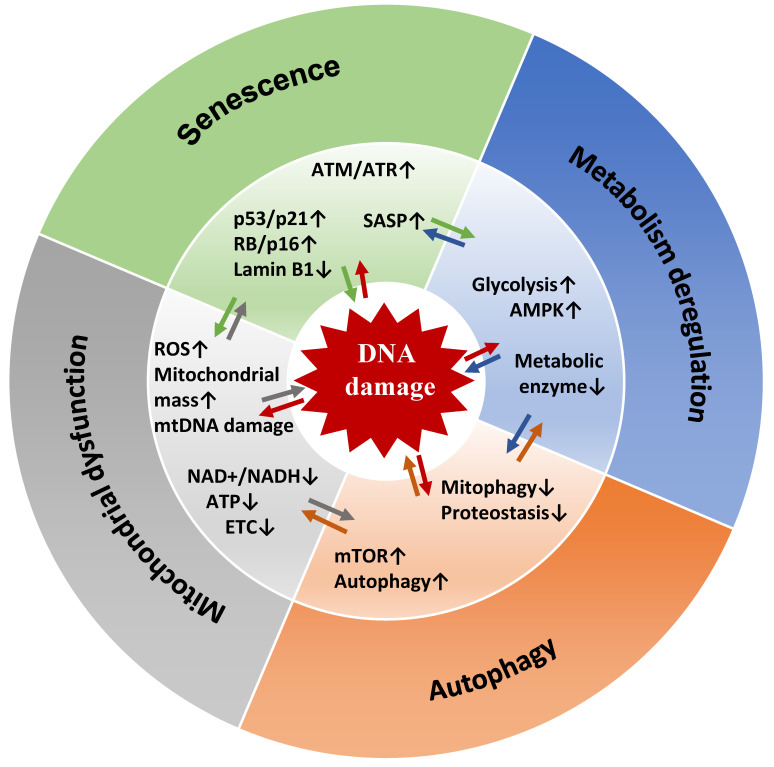
“Despite this diversity, all senescent cells must be able to survive in a nondividing state while protecting themselves from positive feedback loops linked to the constant activation of the DNA damage response.”
§ Mechanisms and Regulation of Cellular Senescence > Abstract
plaincorrelational- Asserted: passes — The authors put it forward as true.
- Checkable: passes — It can be checked against evidence.
- Load-bearing: passes — The paper’s conclusions depend on it.
- Based: unclear — It is unclear why the paper says it holds.
It may state two separate claims as one.
None of the sources cited for this claim have been checked yet.
In the paper
“These cells display high metabolic activities [1], remain viable, and actively suppress apoptosis [2,3].”
§ Mechanisms and Regulation of Cellular Senescence > 1. Introduction
What the sources say
- Not checked yetcites [1] Yu, 2013, Synthetic lethal metabolic targeting of cellular senescence in cancer therapy, Nature source
- Not checked yetcites [2] Childs, 2014, Senescence and apoptosis: Dueling or complementary cell fates?, EMBO Rep. source
- Not checked yetcites [3] Zhu, 2015, The Achilles’ heel of senescent cells: From transcriptome to senolytic drugs, Aging Cell source
plain- Asserted: passes — The authors put it forward as true.
- Checkable: passes — It can be checked against evidence.
- Load-bearing: unclear — It is unclear whether the paper’s conclusions depend on it.
- Based: passes — The paper gives a reason why it holds.
It may state two separate claims as one.
None of the sources cited for this claim have been checked yet.
In the paper
“It is induced after serial propagation of normal human cells in culture and is caused by telomere erosion and the consequent increase in DNA lesions [9,10,11,12].”
§ Mechanisms and Regulation of Cellular Senescence > 1. Introduction
What the sources say
- Not checked yetcites [9] Bodnar, 1998, Extension of Life-Span by Introduction of Telomerase into Normal Human Cells, Science source
- Not checked yetcites [10] Reaper, 2003, A DNA Damage Checkpoint Response in Telomere-Initiated Senescence, Nature source
- Not checked yetcites [11] Gire, 2004, DNA damage checkpoint kinase Chk2 triggers replicative senescence, EMBO J. source
- Not checked yetcites [12] Herbig, 2004, Telomere Shortening Triggers Senescence of Human Cells through a Pathway Involving ATM, p53, and p21CIP1, but Not p16INK4a, Mol. Cell source
plaindirect- Asserted: passes — The authors put it forward as true.
- Checkable: passes — It can be checked against evidence.
- Load-bearing: unclear — It is unclear whether the paper’s conclusions depend on it.
- Based: passes — The paper gives a reason why it holds.
It may state two separate claims as one.
The paper states this without a source or data behind it here, so there is nothing to check it against. The quote shows it is in the paper.
In the paper
“There are different types of senescent cells, and senescence can be induced in response to many DNA damage signals.”
§ Mechanisms and Regulation of Cellular Senescence > Abstract
plaindirect- Asserted: passes — The authors put it forward as true.
- Checkable: passes — It can be checked against evidence.
- Load-bearing: passes — The paper’s conclusions depend on it.
- Based: passes — The paper gives a reason why it holds.
Probably not a substantial claim. It may state two separate claims as one.
None of the sources cited for this claim have been checked yet.
In the paper
“Importantly, elimination of senescent cells can promote stem cell proliferation and delay the appearance of aging features [13,14,15].”
§ Mechanisms and Regulation of Cellular Senescence > 1. Introduction
What the sources say
- Not checked yetcites [13] Baker, 2016, Naturally occurring p16Ink4a-positive cells shorten healthy lifespan, Nature source
- Not checked yetcites [14] Chang, 2016, Clearance of senescent cells by ABT263 rejuvenates aged hematopoietic stem cells in mice, Nat. Med. source
- Not checked yetcites [15] Yosef, 2016, Directed elimination of senescent cells by inhibition of BCL-W and BCL-XL, Nat. Commun. source
plaindirect- Asserted: passes — The authors put it forward as true.
- Checkable: passes — It can be checked against evidence.
- Load-bearing: unclear — It is unclear whether the paper’s conclusions depend on it.
- Based: passes — The paper gives a reason why it holds.
It may state two separate claims as one.
In the paper
“All these factors can induce DNA damage and senescence in normal and cancer cells (in some contexts) [6].”
§ Mechanisms and Regulation of Cellular Senescence > 1. Introduction
What the sources say
- Not checked yetcites [6] 2008, Living on a break: Cellular senescence as a DNA-damage response, Nat. Rev. Cancer source
plainconditional- Asserted: passes — The authors put it forward as true.
- Checkable: passes — It can be checked against evidence.
- Load-bearing: fails — The paper’s conclusions may not depend on it.
- Based: passes — The paper gives a reason why it holds.
Probably not a substantial claim. The paper’s conclusions may not depend on it.
In the paper
“Cellular senescence is generally an irreversible proliferative arrest in damaged normal cells that have exited the cell cycle.”
§ Mechanisms and Regulation of Cellular Senescence > 1. Introduction
What the sources say
- Not checked yetcites [1] Yu, 2013, Synthetic lethal metabolic targeting of cellular senescence in cancer therapy, Nature source
hedged- Asserted: passes — The authors put it forward as true.
- Checkable: passes — It can be checked against evidence.
- Load-bearing: fails — The paper’s conclusions may not depend on it.
- Based: passes — The paper gives a reason why it holds.
Probably not a substantial claim. The paper’s conclusions may not depend on it.
In the paper
“The hallmarks of cellular senescence include: prolonged cell cycle arrest, transcriptional changes, acquisition of a bioactive secretome, known as the senescence-associated secretory phenotype (SASP), macromolecular damage, and deregulated metabolism [7].”
§ Mechanisms and Regulation of Cellular Senescence > 1. Introduction
What the sources say
- Not checked yetcites [7] Gorgoulis, 2019, Cellular Senescence: Defining a Path Forward, Cell source
plain- Asserted: passes — The authors put it forward as true.
- Checkable: passes — It can be checked against evidence.
- Load-bearing: fails — The paper’s conclusions may not depend on it.
- Based: passes — The paper gives a reason why it holds.
Probably not a substantial claim. The paper’s conclusions may not depend on it. It may state two separate claims as one.
None of the sources cited for this claim have been checked yet.
In the paper
“Therefore, it has been proposed that senescence escape is required for tumor progression to overt malignancy [18,21].”
§ Mechanisms and Regulation of Cellular Senescence > 1. Introduction
What the sources say
hedgeddirect- Asserted: passes — The authors put it forward as true.
- Checkable: passes — It can be checked against evidence.
- Load-bearing: fails — The paper’s conclusions may not depend on it.
- Based: passes — The paper gives a reason why it holds.
Probably not a substantial claim. The paper’s conclusions may not depend on it.
A conclusion the paper draws from its own results — it cites no other source for it, so there is none to check. The quote shows it is in the paper.
In the paper
“Senescent cells are heterogeneous and perform various biological functions.”
§ Mechanisms and Regulation of Cellular Senescence > 1. Introduction
plain- Asserted: passes — The authors put it forward as true.
- Checkable: passes — It can be checked against evidence.
- Load-bearing: passes — The paper’s conclusions depend on it.
- Based: fails — The paper may give no reason why it holds.
Probably not a substantial claim. The paper may give no reason why it holds. It may state two separate claims as one.
The paper states this without a source or data behind it here, so there is nothing to check it against. The quote shows it is in the paper.
In the paper
“In cultured fibroblasts, p21 levels reach a peak during the final two to three passages before senescence, but it may not be essential for senescence because its expression does not persist in senescent cells.”
§ Mechanisms and Regulation of Cellular Senescence > 2. Senescence and the Control of Cell Cycle Arrest > 2.1. Cell Cycle Exit in G1
hedgedconditional- Asserted: passes — The authors put it forward as true.
- Checkable: passes — It can be checked against evidence.
- Load-bearing: unclear — It is unclear whether the paper’s conclusions depend on it.
- Based: passes — The paper gives a reason why it holds.
It may state two separate claims as one.
None of the sources cited for this claim have been checked yet.
In the paper
“A decrease in the activity or levels of CDK inhibitors can lead to senescence escape, and their inactivation results in senescent cell reentry into the cell cycle.”
§ Mechanisms and Regulation of Cellular Senescence > 2. Senescence and the Control of Cell Cycle Arrest > 2.1. Cell Cycle Exit in G1
plaindirect- Asserted: passes — The authors put it forward as true.
- Checkable: passes — It can be checked against evidence.
- Load-bearing: passes — The paper’s conclusions depend on it.
- Based: passes — The paper gives a reason why it holds.
It may state two separate claims as one.
None of the sources cited for this claim have been checked yet.
In the paper
“Inactivation of p21 allows human senescing fibroblasts to override senescence arrest and extends their proliferative potential, probably because in these cells CDK2 activity cannot be sufficiently reduced [41,42].”
§ Mechanisms and Regulation of Cellular Senescence > 2. Senescence and the Control of Cell Cycle Arrest > 2.1. Cell Cycle Exit in G1
What the sources say
hedgeddirect- Asserted: passes — The authors put it forward as true.
- Checkable: passes — It can be checked against evidence.
- Load-bearing: passes — The paper’s conclusions depend on it.
- Based: passes — The paper gives a reason why it holds.
It may state two separate claims as one.
In the paper
“Conversely, p21 inhibition in fully senescent fibroblasts leads to aberrant S phase reentry with some DNA replication, but this is not sufficient to drive these cells through a complete cell cycle [44].”
§ Mechanisms and Regulation of Cellular Senescence > 2. Senescence and the Control of Cell Cycle Arrest > 2.1. Cell Cycle Exit in G1
What the sources say
- Not checked yetcites [44] Ma, 1999, Microinjection of anti-p21 antibodies induces senescent Hs68 human fibroblasts to synthesize DNA but not to divide, Cancer Res.
plaindirect- Asserted: passes — The authors put it forward as true.
- Checkable: passes — It can be checked against evidence.
- Load-bearing: unclear — It is unclear whether the paper’s conclusions depend on it.
- Based: passes — The paper gives a reason why it holds.
It may state two separate claims as one.
A conclusion the paper draws from its own results — it cites no other source for it, so there is none to check. The quote shows it is in the paper.
In the paper
“Although the causes of senescence are multiple, inhibition of the cell cycle machinery is the defining characteristic and is critical for both the establishment and maintenance of all cellular senescence phenotypes.”
§ Mechanisms and Regulation of Cellular Senescence > 2. Senescence and the Control of Cell Cycle Arrest
plaindirect- Asserted: passes — The authors put it forward as true.
- Checkable: passes — It can be checked against evidence.
- Load-bearing: passes — The paper’s conclusions depend on it.
- Based: passes — The paper gives a reason why it holds.
It may state two separate claims as one.
In the paper
“However, senescent cells are not effectively removed in aging tissues and this might reflect the age-related decline in immune functions [26].”
§ Mechanisms and Regulation of Cellular Senescence > 1. Introduction
What the sources say
- Not checked yetcites [26] Serrano, 2014, Cellular senescence: From physiology to pathology, Nat. Rev. Mol. Cell Biol. source
hedgedconditional- Asserted: passes — The authors put it forward as true.
- Checkable: passes — It can be checked against evidence.
- Load-bearing: unclear — It is unclear whether the paper’s conclusions depend on it.
- Based: passes — The paper gives a reason why it holds.
It may state two separate claims as one.
None of the sources cited for this claim have been checked yet.
In the paper
“Replicative senescence is bypassed upon loss of p21 [41] but not upon loss of p16 function [45,46].”
§ Mechanisms and Regulation of Cellular Senescence > 2. Senescence and the Control of Cell Cycle Arrest > 2.1. Cell Cycle Exit in G1
What the sources say
- Not checked yetcites [41] Brown, 1997, Bypass of Senescence After Disruption of p21 CIP1/WAF1 Gene in Normal Diploid Human Fibroblasts, Science source
- Not checked yetcites [45] Wei, 2003, Loss of retinoblastoma but not p16 function allows bypass of replicative senescence in human fibroblasts, EMBOJ source
- Not checked yetcites [46] Bond, 2004, Direct evidence from siRNA-directed “knock down” that p16INK4a is required for human fibroblast senescence and for limiting ras-induced epithelial cell proliferation, Exp. Cell Res. source
plaindirect- Asserted: passes — The authors put it forward as true.
- Checkable: passes — It can be checked against evidence.
- Load-bearing: passes — The paper’s conclusions depend on it.
- Based: passes — The paper gives a reason why it holds.
It may state two separate claims as one.
None of the sources cited for this claim have been checked yet.
In the paper
“It has been proposed that active p16 signaling can compensate for p53 activity decline after full senescence establishment [49,50].”
§ Mechanisms and Regulation of Cellular Senescence > 2. Senescence and the Control of Cell Cycle Arrest > 2.1. Cell Cycle Exit in G1
What the sources say
- Not checked yetcites [49] Jacobs, 2004, Significant Role for p16INK4a in p53-Independent Telomere-Directed Senescence, Curr. Biol. source
- Not checked yetcites [50] Bond, 1999, Control of Replicative Life Span in Human Cells: Barriers to Clonal Expansion Intermediate Between M1 Senescence and M2 Crisis, Mol. Cell. Biol. source
hedgeddirect- Asserted: passes — The authors put it forward as true.
- Checkable: passes — It can be checked against evidence.
- Load-bearing: fails — The paper’s conclusions may not depend on it.
- Based: passes — The paper gives a reason why it holds.
Probably not a substantial claim. The paper’s conclusions may not depend on it.
None of the sources cited for this claim have been checked yet.
In the paper
“Consequently, these cells without cyclin B1–CDK1 activity are refractory to reactivation upon damage resolution, and they do not progress into mitosis, thus marking a point-of-no-return for the irreversible cell cycle arrest in G2 [58,62,63].”
§ Mechanisms and Regulation of Cellular Senescence > 2. Senescence and the Control of Cell Cycle Arrest > 2.2. Cell Cycle Exit in G2
What the sources say
- Not checked yetcites [58] Krenning, 2014, Transient Activation of p53 in G2 Phase Is Sufficient to Induce Senescence, Mol. Cell source
- Not checked yetcites [62] Cascales, 2014, Nuclear translocation of Cyclin B1 marks the restriction point for terminal cell cycle exit in G2 phase, Cell Cycle source
- Not checked yetcites [63] Cascales, 2017, Residual Cdk1/2 activity after DNA damage promotes senescence, Aging Cell source
plaindirect- Asserted: passes — The authors put it forward as true.
- Checkable: passes — It can be checked against evidence.
- Load-bearing: passes — The paper’s conclusions depend on it.
- Based: passes — The paper gives a reason why it holds.
It may state two separate claims as one.
The paper states this without a source or data behind it here, so there is nothing to check it against. The quote shows it is in the paper.
In the paper
“Activation of p53 at G2 leads to p21 upregulation, followed by the nuclear sequestration of cyclin B1 and mitosis entry inhibition.”
§ Mechanisms and Regulation of Cellular Senescence > 2. Senescence and the Control of Cell Cycle Arrest > 2.2. Cell Cycle Exit in G2
plaindirect- Asserted: passes — The authors put it forward as true.
- Checkable: passes — It can be checked against evidence.
- Load-bearing: passes — The paper’s conclusions depend on it.
- Based: passes — The paper gives a reason why it holds.
It may state two separate claims as one.
In the paper
“Moreover, cells with low baseline p16 levels do not undergo OIS but show anchorage-independent growth (a feature of cell transformation) [54].”
§ Mechanisms and Regulation of Cellular Senescence > 2. Senescence and the Control of Cell Cycle Arrest > 2.1. Cell Cycle Exit in G1
What the sources say
- Not checked yetcites [54] Benanti, 2004, Normal Human Fibroblasts Are Resistant to RAS-Induced Senescence, Mol. Cell. Biol. source
plaincorrelational- Asserted: passes — The authors put it forward as true.
- Checkable: passes — It can be checked against evidence.
- Load-bearing: unclear — It is unclear whether the paper’s conclusions depend on it.
- Based: passes — The paper gives a reason why it holds.
It may state two separate claims as one.
In the paper
“In this setting, p16 responds adequately to telomere damage because p53 inactivation only partially relieves the cell cycle arrest imposed by telomere signaling.”
§ Mechanisms and Regulation of Cellular Senescence > 2. Senescence and the Control of Cell Cycle Arrest > 2.1. Cell Cycle Exit in G1
What the sources say
- Not checked yetcites [49] Jacobs, 2004, Significant Role for p16INK4a in p53-Independent Telomere-Directed Senescence, Curr. Biol. source
plaindirect- Asserted: passes — The authors put it forward as true.
- Checkable: passes — It can be checked against evidence.
- Load-bearing: unclear — It is unclear whether the paper’s conclusions depend on it.
- Based: passes — The paper gives a reason why it holds.
It may state two separate claims as one.
None of the sources cited for this claim have been checked yet.
In the paper
“DDR can also signal to p16, although p16 may act as a secondary mechanism to mediate the senescence-related proliferative arrest following telomere dysfunction [48,49].”
§ Mechanisms and Regulation of Cellular Senescence > 3. Molecular Signaling and Pathways Leading to Senescence Entry > 3.1. RB/p16 and p53 Pathways Engaged upon Senescence
What the sources say
hedgedconditional- Asserted: passes — The authors put it forward as true.
- Checkable: passes — It can be checked against evidence.
- Load-bearing: unclear — It is unclear whether the paper’s conclusions depend on it.
- Based: passes — The paper gives a reason why it holds.
It may state two separate claims as one.
The paper states this without a source or data behind it here, so there is nothing to check it against. The quote shows it is in the paper.
In the paper
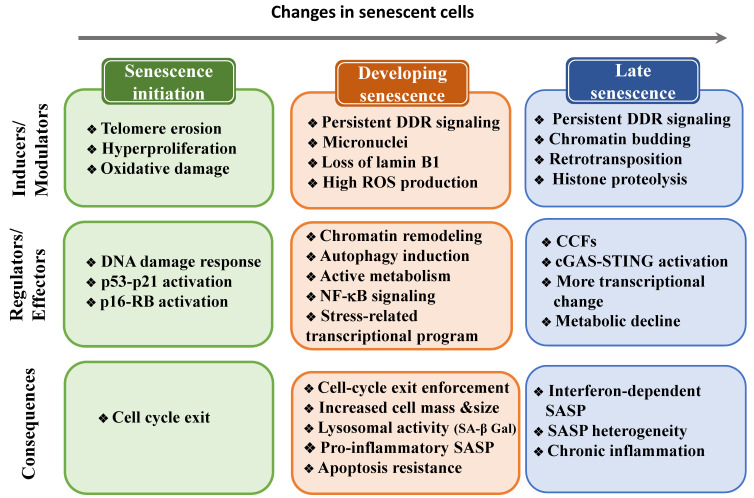
“Some markers identify the early stage (p53 and p21), while others identify the late stage (p16 and ARF, gene products of the CDKN2A locus).”
§ Mechanisms and Regulation of Cellular Senescence > 2. Senescence and the Control of Cell Cycle Arrest > 2.2. Cell Cycle Exit in G2
plaincorrelational- Asserted: passes — The authors put it forward as true.
- Checkable: passes — It can be checked against evidence.
- Load-bearing: unclear — It is unclear whether the paper’s conclusions depend on it.
- Based: passes — The paper gives a reason why it holds.
It may state two separate claims as one.
The paper states this without a source or data behind it here, so there is nothing to check it against. The quote shows it is in the paper.
In the paper
“Although frequently used, p53 and p16 are not exclusively senescence markers, but can indicate other biological functions depending on the cell context.”
§ Mechanisms and Regulation of Cellular Senescence > 2. Senescence and the Control of Cell Cycle Arrest > 2.2. Cell Cycle Exit in G2
plaincorrelational- Asserted: passes — The authors put it forward as true.
- Checkable: passes — It can be checked against evidence.
- Load-bearing: fails — The paper’s conclusions may not depend on it.
- Based: fails — The paper may give no reason why it holds.
Probably not a substantial claim. The paper’s conclusions may not depend on it. The paper may give no reason why it holds.
In the paper
“This mitotic fidelity loss with age generates daughter cells with aneuploidy and micronuclei that ultimately lead to permanent cell cycle arrest in G1 and full senescence phenotypes [65].”
§ Mechanisms and Regulation of Cellular Senescence > 2. Senescence and the Control of Cell Cycle Arrest > 2.2. Cell Cycle Exit in G2
What the sources say
- Not checked yetcites [65] Macedo, 2018, FoxM1 repression during human aging leads to mitotic decline and aneuploidy-driven full senescence, Nat. Commun. source
plaindirect- Asserted: passes — The authors put it forward as true.
- Checkable: passes — It can be checked against evidence.
- Load-bearing: passes — The paper’s conclusions depend on it.
- Based: passes — The paper gives a reason why it holds.
It may state two separate claims as one.
None of the sources cited for this claim have been checked yet.
In the paper
“Mitotic duration increases with age, whereas mitotic transcripts decrease, leading to a higher rate of chromosome mis-segregation events during mitosis.”
§ Mechanisms and Regulation of Cellular Senescence > 2. Senescence and the Control of Cell Cycle Arrest > 2.2. Cell Cycle Exit in G2
plaindirect- Asserted: passes — The authors put it forward as true.
- Checkable: passes — It can be checked against evidence.
- Load-bearing: passes — The paper’s conclusions depend on it.
- Based: passes — The paper gives a reason why it holds.
It may state two separate claims as one.
A conclusion the paper draws from its own results — it cites no other source for it, so there is none to check. The quote shows it is in the paper.
In the paper
“It appears that the signaling pathway responsible for OIS is p53-dependent in murine cells, while the RB pathway might play a predominant role in human cells.”
§ Mechanisms and Regulation of Cellular Senescence > 3. Molecular Signaling and Pathways Leading to Senescence Entry > 3.1. RB/p16 and p53 Pathways Engaged upon Senescence
hedgedconditional- Asserted: passes — The authors put it forward as true.
- Checkable: passes — It can be checked against evidence.
- Load-bearing: unclear — It is unclear whether the paper’s conclusions depend on it.
- Based: passes — The paper gives a reason why it holds.
It may state two separate claims as one.
A conclusion the paper draws from its own results — it cites no other source for it, so there is none to check. The quote shows it is in the paper.
In the paper
“The p53 and RB pathways are needed for OIS initiation and also maintenance in most systems, but their specific requirement may differ in humans and mice and might be cell type-dependent.”
§ Mechanisms and Regulation of Cellular Senescence > 3. Molecular Signaling and Pathways Leading to Senescence Entry > 3.1. RB/p16 and p53 Pathways Engaged upon Senescence
hedgedconditional- Asserted: passes — The authors put it forward as true.
- Checkable: passes — It can be checked against evidence.
- Load-bearing: passes — The paper’s conclusions depend on it.
- Based: passes — The paper gives a reason why it holds.
It may state two separate claims as one.
In the paper
“The activation of only one or both pathways for the execution and maintenance of the senescence program is dictated by the type of stress signal, the tissue, and the species of origin [67], or by a compensatory response to signaling imbalances.”
§ Mechanisms and Regulation of Cellular Senescence > 3. Molecular Signaling and Pathways Leading to Senescence Entry > 3.1. RB/p16 and p53 Pathways Engaged upon Senescence
What the sources say
- Not checked yetcites [67] Jones, 2008, Many roads lead to oncogene-induced senescence, Oncogene source
plaindirect- Asserted: passes — The authors put it forward as true.
- Checkable: passes — It can be checked against evidence.
- Load-bearing: unclear — It is unclear whether the paper’s conclusions depend on it.
- Based: passes — The paper gives a reason why it holds.
It may state two separate claims as one.
None of the sources cited for this claim have been checked yet.
In the paper
“However, neither p53 nor p16 are implicated in human mammary epithelial cells [77] or melanocytes [78] undergoing Ras-induced senescence.”
§ Mechanisms and Regulation of Cellular Senescence > 3. Molecular Signaling and Pathways Leading to Senescence Entry > 3.1. RB/p16 and p53 Pathways Engaged upon Senescence
What the sources say
- Not checked yetcites [77] Cipriano, 2011, TGF- signaling engages an ATM-CHK2-p53-independent RAS-induced senescence and prevents malignant transformation in human mammary epithelial cells, Proc. Natl. Acad. Sci. USA source
- Not checked yetcites [78] Denoyelle, 2006, Anti-oncogenic role of the endoplasmic reticulum differentially activated by mutations in the MAPK pathway, Nat. Cell Biol. source
plain- Asserted: passes — The authors put it forward as true.
- Checkable: passes — It can be checked against evidence.
- Load-bearing: passes — The paper’s conclusions depend on it.
- Based: passes — The paper gives a reason why it holds.
It may state two separate claims as one.
None of the sources cited for this claim have been checked yet.
In the paper
“Overexpression of BMI1 [80], CBX7 [81], or CBX8 [82] results in the direct repression of p16 and senescence delay in human and mouse cells.”
§ Mechanisms and Regulation of Cellular Senescence > 3. Molecular Signaling and Pathways Leading to Senescence Entry > 3.1. RB/p16 and p53 Pathways Engaged upon Senescence
What the sources say
- Not checked yetcites [80] Jacobs, 1999, The oncogene and Polycomb-group gene bmi-1 regulates cell proliferation and senescence through the ink4a locus, Nature source
- Not checked yetcites [81] Gil, 2004, Polycomb CBX7 has a unifying role in cellular lifespan, Nat. Cell Biol. source
- Not checked yetcites [82] Dietrich, 2007, Bypass of senescence by the polycomb group protein CBX8 through direct binding to the INK4A-ARF locus, EMBO J. source
plaindirect- Asserted: passes — The authors put it forward as true.
- Checkable: passes — It can be checked against evidence.
- Load-bearing: unclear — It is unclear whether the paper’s conclusions depend on it.
- Based: passes — The paper gives a reason why it holds.
It may state two separate claims as one.
None of the sources cited for this claim have been checked yet.
In the paper
“Telomere shortening is the signal for replicative senescence in human fibroblasts because telomerase reconstitutes telomere function and restores the proliferative capacity that ultimately leads to cell immortalization [8,9].”
§ Mechanisms and Regulation of Cellular Senescence > 3. Molecular Signaling and Pathways Leading to Senescence Entry > 3.2. Short Telomeres and DNA Damage Signaling
What the sources say
plaindirect- Asserted: passes — The authors put it forward as true.
- Checkable: passes — It can be checked against evidence.
- Load-bearing: passes — The paper’s conclusions depend on it.
- Based: passes — The paper gives a reason why it holds.
It may state two separate claims as one.
None of the sources cited for this claim have been checked yet.
In the paper
“Similarly, acute telomere deprotection by inactivation of the shelterin protein TRF2 leads to robust telomeric ATM signaling, NHEJ-dependent telomere end-to-end fusion, and rapid cell cycle arrest [71,95].”
§ Mechanisms and Regulation of Cellular Senescence > 3. Molecular Signaling and Pathways Leading to Senescence Entry > 3.2. Short Telomeres and DNA Damage Signaling
What the sources say
plaindirect- Asserted: passes — The authors put it forward as true.
- Checkable: passes — It can be checked against evidence.
- Load-bearing: unclear — It is unclear whether the paper’s conclusions depend on it.
- Based: passes — The paper gives a reason why it holds.
It may state two separate claims as one.
None of the sources cited for this claim have been checked yet.
In the paper
“The mean telomere length in human senescent fibroblasts ranges between 6 and 8 kbp, but senescent cells might contain a few extremely short telomeres [94] that have lost completely their protective function and expose telomere-free ends, leading to DDR activation and cell cycle arrest [10,57].”
§ Mechanisms and Regulation of Cellular Senescence > 3. Molecular Signaling and Pathways Leading to Senescence Entry > 3.2. Short Telomeres and DNA Damage Signaling
What the sources say
- Not checked yetcites [94] Baird, 2003, Extensive allelic variation and ultrashort telomeres in senescent human cells, Nat. Genet. source
- Not checked yetcites [10] Reaper, 2003, A DNA Damage Checkpoint Response in Telomere-Initiated Senescence, Nature source
- Not checked yetcites [57] Jullien, 2013, Eroded human telomeres are more prone to remain uncapped and to trigger a G2 checkpoint response, Nucleic Acids Res. source
hedgeddirect- Asserted: passes — The authors put it forward as true.
- Checkable: passes — It can be checked against evidence.
- Load-bearing: passes — The paper’s conclusions depend on it.
- Based: passes — The paper gives a reason why it holds.
It may state two separate claims as one.
None of the sources cited for this claim have been checked yet.
In the paper
“During senescence, PRC delocalization from the CDKN2A locus, transcriptional downregulation of EZH2 [83], and recruitment of JMJD3 [84,85], a histone lysine demethylase that catalyzes H3K27 demethylation, lead to removal of the repressive H3K27me3 mark at the CDKN2A locus and facilitate p16 transcription.”
§ Mechanisms and Regulation of Cellular Senescence > 3. Molecular Signaling and Pathways Leading to Senescence Entry > 3.1. RB/p16 and p53 Pathways Engaged upon Senescence
What the sources say
- Not checked yetcites [83] Bracken, 2007, The Polycomb group proteins bind throughout the INK4A-ARF locus and are disassociated in senescent cells, Genes Dev. source
- Not checked yetcites [84] Agger, 2009, The H3K27me3 demethylase JMJD3 contributes to the activation of the INK4A–ARF locus in response to oncogene- and stress-induced senescence, Genes Dev. source
- Not checked yetcites [85] Barradas, 2009, Histone demethylase JMJD3 contributes to epigenetic control of INK4a/ARF by oncogenic RAS, Genes Dev. source
plaindirect- Asserted: passes — The authors put it forward as true.
- Checkable: passes — It can be checked against evidence.
- Load-bearing: unclear — It is unclear whether the paper’s conclusions depend on it.
- Based: passes — The paper gives a reason why it holds.
It may state two separate claims as one.
None of the sources cited for this claim have been checked yet.
In the paper
“In agreement, TRF2 overexpression delays replicative senescence onset [101], indicating that TRF2 capacity to sequester the telomere terminus via the t-loop conformation [88] might suppress the DNA damage signal from too short telomere ends and protect them from ATM signaling.”
§ Mechanisms and Regulation of Cellular Senescence > 3. Molecular Signaling and Pathways Leading to Senescence Entry > 3.2. Short Telomeres and DNA Damage Signaling
What the sources say
hedgedconditional- Asserted: passes — The authors put it forward as true.
- Checkable: passes — It can be checked against evidence.
- Load-bearing: passes — The paper’s conclusions depend on it.
- Based: passes — The paper gives a reason why it holds.
It may state two separate claims as one.
In the paper
“A clear loss of shelterin association with telomeres has been observed in senescent fibroblasts, which is consistent with the progressive displacement of these complexes from short telomeres [57].”
§ Mechanisms and Regulation of Cellular Senescence > 3. Molecular Signaling and Pathways Leading to Senescence Entry > 3.2. Short Telomeres and DNA Damage Signaling
What the sources say
- Not checked yetcites [57] Jullien, 2013, Eroded human telomeres are more prone to remain uncapped and to trigger a G2 checkpoint response, Nucleic Acids Res. source
boostedcorrelational- Asserted: passes — The authors put it forward as true.
- Checkable: passes — It can be checked against evidence.
- Load-bearing: unclear — It is unclear whether the paper’s conclusions depend on it.
- Based: passes — The paper gives a reason why it holds.
It may state two separate claims as one.
None of the sources cited for this claim have been checked yet.
In the paper
“Telomeres are repetitive DNA sequences, bound by the six-subunit shelterin complex [86] that facilitates the formation of telomere loops (t-loop) to hide the telomere end [87,88], thus protecting the natural chromosome ends from signaling pathways that sense and act at DNA breaks.”
§ Mechanisms and Regulation of Cellular Senescence > 3. Molecular Signaling and Pathways Leading to Senescence Entry > 3.2. Short Telomeres and DNA Damage Signaling
What the sources say
- Not checked yetcites [86] 2005, Shelterin: The protein complex that shapes and safeguards human telomeres, Genes Dev. source
- Not checked yetcites [87] Griffith, 1999, Mammalian Telomeres End in a Large Duplex Loop, Cell source
- Not checked yetcites [88] Doksani, 2013, Super-Resolution Fluorescence Imaging of Telomeres Reveals TRF2-Dependent T-loop Formation, Cell source
plaindirect- Asserted: passes — The authors put it forward as true.
- Checkable: passes — It can be checked against evidence.
- Load-bearing: passes — The paper’s conclusions depend on it.
- Based: passes — The paper gives a reason why it holds.
It may state two separate claims as one.
In the paper
“The activation in senescing cells of G2/M phase checkpoint markers clearly indicates that their telomeres are somehow dysfunctional, most likely after telomere losses during DNA replication [57].”
§ Mechanisms and Regulation of Cellular Senescence > 3. Molecular Signaling and Pathways Leading to Senescence Entry > 3.2. Short Telomeres and DNA Damage Signaling
What the sources say
- Not checked yetcites [57] Jullien, 2013, Eroded human telomeres are more prone to remain uncapped and to trigger a G2 checkpoint response, Nucleic Acids Res. source
boostedconditional- Asserted: passes — The authors put it forward as true.
- Checkable: passes — It can be checked against evidence.
- Load-bearing: unclear — It is unclear whether the paper’s conclusions depend on it.
- Based: passes — The paper gives a reason why it holds.
It may state two separate claims as one.
In the paper
“However, most somatic cells lack telomerase activity, and this progressive telomere erosion ultimately results in the loss of telomere function and triggers a permanent proliferative senescence arrest [9].”
§ Mechanisms and Regulation of Cellular Senescence > 3. Molecular Signaling and Pathways Leading to Senescence Entry > 3.2. Short Telomeres and DNA Damage Signaling
What the sources say
- Not checked yetcites [9] Bodnar, 1998, Extension of Life-Span by Introduction of Telomerase into Normal Human Cells, Science source
plaindirect- Asserted: passes — The authors put it forward as true.
- Checkable: passes — It can be checked against evidence.
- Load-bearing: passes — The paper’s conclusions depend on it.
- Based: passes — The paper gives a reason why it holds.
It may state two separate claims as one.
In the paper
“This acute loss of telomere end protection is unlikely to mimic the events leading to replicative senescence because in senescent cells, fusions between dysfunctional sister chromatids in end-to-end joining events are more frequent than inter-chromosomal end-to-end fusions (a consequence of complete exposure of the telomeric tract to the NHEJ pathway) [57].”
§ Mechanisms and Regulation of Cellular Senescence > 3. Molecular Signaling and Pathways Leading to Senescence Entry > 3.2. Short Telomeres and DNA Damage Signaling
What the sources say
- Not checked yetcites [57] Jullien, 2013, Eroded human telomeres are more prone to remain uncapped and to trigger a G2 checkpoint response, Nucleic Acids Res. source
hedged- Asserted: passes — The authors put it forward as true.
- Checkable: passes — It can be checked against evidence.
- Load-bearing: passes — The paper’s conclusions depend on it.
- Based: passes — The paper gives a reason why it holds.
It may state two separate claims as one.
The paper states this without a source or data behind it here, so there is nothing to check it against. The quote shows it is in the paper.
In the paper
“However, as damage signals are observed also at chromosome ends that still contain significant telomeric repeats, complete disappearance of telomeric repeats is not required to signal dysfunction.”
§ Mechanisms and Regulation of Cellular Senescence > 3. Molecular Signaling and Pathways Leading to Senescence Entry > 3.2. Short Telomeres and DNA Damage Signaling
plain- Asserted: passes — The authors put it forward as true.
- Checkable: passes — It can be checked against evidence.
- Load-bearing: unclear — It is unclear whether the paper’s conclusions depend on it.
- Based: passes — The paper gives a reason why it holds.
It may state two separate claims as one.
None of the sources cited for this claim have been checked yet.
In the paper
“TRF2 binds all along the telomeric array [116] and inhibits DSB repair completion by blocking the recruitment of ligase IV to DNA breaks that are located in or next to telomeric DNA [109,115].”
§ Mechanisms and Regulation of Cellular Senescence > 3. Molecular Signaling and Pathways Leading to Senescence Entry > 3.3. Oxidative Damage and Irreparable Telomeric Lesions
What the sources say
- Not checked yetcites [116] Broccoli, 1997, Human telomeres contain two distinct Myb–related proteins, TRF1 and TRF2, Nat. Genet. source
- Not checked yetcites [109] Hewitt, 2012, Telomeres are favoured targets of a persistent DNA damage response in ageing and stress-induced senescence, Nat. Commun. source
- Not checked yetcites [115] Fumagalli, 2012, Telomeric DNA damage is irreparable and causes persistent DNA-damage-response activation, Nat. Cell Biol. source
plaindirect- Asserted: passes — The authors put it forward as true.
- Checkable: passes — It can be checked against evidence.
- Load-bearing: passes — The paper’s conclusions depend on it.
- Based: passes — The paper gives a reason why it holds.
It may state two separate claims as one.
A conclusion the paper draws from its own results — it cites no other source for it, so there is none to check. The quote shows it is in the paper.
In the paper
“Therefore, due to the accumulation of repair-resistant telomeres, the DDR is continually active, and cell cycle arrest is sustained.”
§ Mechanisms and Regulation of Cellular Senescence > 3. Molecular Signaling and Pathways Leading to Senescence Entry > 3.3. Oxidative Damage and Irreparable Telomeric Lesions
plaindirect- Asserted: passes — The authors put it forward as true.
- Checkable: passes — It can be checked against evidence.
- Load-bearing: passes — The paper’s conclusions depend on it.
- Based: passes — The paper gives a reason why it holds.
It may state two separate claims as one.
The paper states this without a source or data behind it here, so there is nothing to check it against. The quote shows it is in the paper.
In the paper
“Conversely, DNA breaks in the rest of the genome are efficiently repaired, and DDR activation and cell cycle arrest are transient.”
§ Mechanisms and Regulation of Cellular Senescence > 3. Molecular Signaling and Pathways Leading to Senescence Entry > 3.3. Oxidative Damage and Irreparable Telomeric Lesions
plaindirect- Asserted: passes — The authors put it forward as true.
- Checkable: passes — It can be checked against evidence.
- Load-bearing: passes — The paper’s conclusions depend on it.
- Based: passes — The paper gives a reason why it holds.
It may state two separate claims as one.
A conclusion the paper draws from its own results — it cites no other source for it, so there is none to check. The quote shows it is in the paper.
In the paper
“Presumably, a threshold number of dysfunctional telomeres must accumulate before the signal is sufficiently high to enforce persistent DDR signaling and to force cells exit in G2 through sustained p53 activation.”
§ Mechanisms and Regulation of Cellular Senescence > 3. Molecular Signaling and Pathways Leading to Senescence Entry > 3.2. Short Telomeres and DNA Damage Signaling
hedgedconditional- Asserted: passes — The authors put it forward as true.
- Checkable: passes — It can be checked against evidence.
- Load-bearing: fails — The paper’s conclusions may not depend on it.
- Based: fails — The paper may give no reason why it holds.
Probably not a substantial claim. The paper’s conclusions may not depend on it. The paper may give no reason why it holds.
- Rests on an assumption: The G2/M checkpoint only responds to 10–20 DNA breaks.
In the paper
“Likewise, senescence of MEFs in culture is independent of telomere shortening because mouse fibroblasts have long telomeres and express the enzyme telomerase but is induced by high ambient oxygen levels (20%) that cause oxidative damage [111].”
§ Mechanisms and Regulation of Cellular Senescence > 3. Molecular Signaling and Pathways Leading to Senescence Entry > 3.3. Oxidative Damage and Irreparable Telomeric Lesions
What the sources say
- Not checked yetcites [111] Parrinello, 2003, Oxygen sensitivity severely limits the replicative lifespan of murine fibroblasts, Nat. Cell Biol. source
plaindirect- Asserted: passes — The authors put it forward as true.
- Checkable: passes — It can be checked against evidence.
- Load-bearing: unclear — It is unclear whether the paper’s conclusions depend on it.
- Based: passes — The paper gives a reason why it holds.
It may state two separate claims as one.
None of the sources cited for this claim have been checked yet.
In the paper
“In this case, telomere damage is attributed to specific features of telomeres that render them particularly susceptible to oxidation-induced damage, a type of damage that increases with aging [91,110].”
§ Mechanisms and Regulation of Cellular Senescence > 3. Molecular Signaling and Pathways Leading to Senescence Entry > 3.3. Oxidative Damage and Irreparable Telomeric Lesions
What the sources say
plaindirect- Asserted: passes — The authors put it forward as true.
- Checkable: passes — It can be checked against evidence.
- Load-bearing: passes — The paper’s conclusions depend on it.
- Based: passes — The paper gives a reason why it holds.
It may state two separate claims as one.
A conclusion the paper draws from its own results — it cites no other source for it, so there is none to check. The quote shows it is in the paper.
In the paper
“ARF might not play a role in senescence induction as a first-line defense against oncogenic events in melanocytes, whereas ARF is an important component in melanoma suppression.”
§ Mechanisms and Regulation of Cellular Senescence > 3. Molecular Signaling and Pathways Leading to Senescence Entry > 3.4. Oncogene Activity and Replication Stress
hedgedconditional- Asserted: passes — The authors put it forward as true.
- Checkable: passes — It can be checked against evidence.
- Load-bearing: unclear — It is unclear whether the paper’s conclusions depend on it.
- Based: passes — The paper gives a reason why it holds.
It may state two separate claims as one.
In the paper
“Importantly, this arrest can be suppressed by inactivating the ATM or CHK2 kinases, supporting the causative role of DNA damage signaling in response to oncogenic activation in OIS [70].”
§ Mechanisms and Regulation of Cellular Senescence > 3. Molecular Signaling and Pathways Leading to Senescence Entry > 3.4. Oncogene Activity and Replication Stress
What the sources say
- Not checked yetcites [70] Fumagalli, 2006, Oncogene-induced senescence is a DNA damage response triggered by DNA hyper-replication, Nature source
plaindirect- Asserted: passes — The authors put it forward as true.
- Checkable: passes — It can be checked against evidence.
- Load-bearing: passes — The paper’s conclusions depend on it.
- Based: passes — The paper gives a reason why it holds.
It may state two separate claims as one.
In the paper
“However, the regulation of ARF expression in humans and mice differs significantly in response to oncogenic signals, possibly because of the limited homology between the mouse and human CDKN2A promoter sequences [124].”
§ Mechanisms and Regulation of Cellular Senescence > 3. Molecular Signaling and Pathways Leading to Senescence Entry > 3.4. Oncogene Activity and Replication Stress
What the sources say
- Not checked yetcites [124] Ortega, 2002, Cyclin D-dependent kinases, INK4 inhibitors and cancer, Biochim. Biophys. Acta BBA-Rev. Cancer
hedgedconditional- Asserted: passes — The authors put it forward as true.
- Checkable: passes — It can be checked against evidence.
- Load-bearing: unclear — It is unclear whether the paper’s conclusions depend on it.
- Based: passes — The paper gives a reason why it holds.
It may state two separate claims as one.
In the paper
“It is now acknowledged that increasing ARF levels often correlate with more advanced stages of cancer development and less frequently with pronounced DDR activation in response to persistent oncogenic activation [129].”
§ Mechanisms and Regulation of Cellular Senescence > 3. Molecular Signaling and Pathways Leading to Senescence Entry > 3.4. Oncogene Activity and Replication Stress
What the sources say
- Not checked yetcites [129] Evangelou, 2013, The DNA damage checkpoint precedes activation of ARF in response to escalating oncogenic stress during tumorigenesis, Cell Death Differ. source
boostedcorrelational- Asserted: passes — The authors put it forward as true.
- Checkable: passes — It can be checked against evidence.
- Load-bearing: unclear — It is unclear whether the paper’s conclusions depend on it.
- Based: passes — The paper gives a reason why it holds.
It may state two separate claims as one.
The paper states this without a source or data behind it here, so there is nothing to check it against. The quote shows it is in the paper.
In the paper
“The separate INK4A and ARF promoters can differentially respond to input signals and can be independently silenced in tumors.”
§ Mechanisms and Regulation of Cellular Senescence > 3. Molecular Signaling and Pathways Leading to Senescence Entry > 3.4. Oncogene Activity and Replication Stress
plaindirect- Asserted: passes — The authors put it forward as true.
- Checkable: passes — It can be checked against evidence.
- Load-bearing: unclear — It is unclear whether the paper’s conclusions depend on it.
- Based: passes — The paper gives a reason why it holds.
It may state two separate claims as one.
None of the sources cited for this claim have been checked yet.
In the paper
“The two genes are largely coregulated in rodents, although some stimuli can selectively regulate p16 or ARF alone [128], whereas co-regulation of human p16 and p14ARF is uncommon [123].”
§ Mechanisms and Regulation of Cellular Senescence > 3. Molecular Signaling and Pathways Leading to Senescence Entry > 3.4. Oncogene Activity and Replication Stress
What the sources say
plaincorrelational- Asserted: passes — The authors put it forward as true.
- Checkable: passes — It can be checked against evidence.
- Load-bearing: unclear — It is unclear whether the paper’s conclusions depend on it.
- Based: passes — The paper gives a reason why it holds.
It may state two separate claims as one.
In the paper
“Although the SASP is a feature shared by different senescence types, its regulation is considerably heterogeneous and is influenced by the cell type and the level and exposure duration to the initial senescence inducer [149].”
§ Mechanisms and Regulation of Cellular Senescence > 4. Transcriptional and Post-Transcriptional Control of Senescence > 4.1. The Senescence Transcriptional Program
What the sources say
- Not checked yetcites [149] Desprez, 2010, The Senescence-Associated Secretory Phenotype: The Dark Side of Tumor Suppression, Annu. Rev. Pathol. Mech. Dis. source
plaindirect- Asserted: passes — The authors put it forward as true.
- Checkable: passes — It can be checked against evidence.
- Load-bearing: unclear — It is unclear whether the paper’s conclusions depend on it.
- Based: passes — The paper gives a reason why it holds.
It may state two separate claims as one.
In the paper
“GATA4 accumulates in senescent cells and induces the expression of IL-1α and TRAF3IP2 (an E3 ubiquitin ligase) that activate NF-κB to initiate and amplify the SASP response [160].”
§ Mechanisms and Regulation of Cellular Senescence > 4. Transcriptional and Post-Transcriptional Control of Senescence > 4.1. The Senescence Transcriptional Program
What the sources say
- Not checked yetcites [160] Kang, 2015, The DNA damage response induces inflammation and senescence by inhibiting autophagy of GATA4, Science source
plaindirect- Asserted: passes — The authors put it forward as true.
- Checkable: passes — It can be checked against evidence.
- Load-bearing: unclear — It is unclear whether the paper’s conclusions depend on it.
- Based: passes — The paper gives a reason why it holds.
It may state two separate claims as one.
In the paper
“More directly, the chromatin reader BRD4 is recruited to super-enhancer elements that form adjacent to key SASP genes and is required for their expression [170].”
§ Mechanisms and Regulation of Cellular Senescence > 4. Transcriptional and Post-Transcriptional Control of Senescence > 4.1. The Senescence Transcriptional Program
What the sources say
- Not checked yetcites [170] Tasdemir, 2016, BRD4 Connects Enhancer Remodeling to Senescence Immune Surveillance, Cancer Discov. source
plaindirect- Asserted: passes — The authors put it forward as true.
- Checkable: passes — It can be checked against evidence.
- Load-bearing: unclear — It is unclear whether the paper’s conclusions depend on it.
- Based: passes — The paper gives a reason why it holds.
It may state two separate claims as one.
None of the sources cited for this claim have been checked yet.
In the paper
“cGAS catalyzes the production of the second messenger cGMP that binds to stimulator of interferon genes (STING). This results in the phosphorylation of both interferon-regulatory factor 3 (IRF3) and of NF-κB transcription factors, thereby stimulating respectively the production of type I interferons and inflammatory cytokines [171,172,173,174].”
§ Mechanisms and Regulation of Cellular Senescence > 4. Transcriptional and Post-Transcriptional Control of Senescence > 4.1. The Senescence Transcriptional Program
What the sources say
- Not checked yetcites [171] Dou, 2017, Cytoplasmic chromatin triggers inflammation in senescence and cancer, Nature source
- Not checked yetcites [172] Guey, 2017, Innate immune sensing of cytosolic chromatin fragments through cGAS promotes senescence, Nat. Cell Biol. source
- Not checked yetcites [173] Yang, 2017, cGAS is essential for cellular senescence, Proc. Natl. Acad. Sci. USA source
- Not checked yetcites [174] Ablasser, 2019, cGAS in action: Expanding roles in immunity and inflammation, Science source
plaindirect- Asserted: passes — The authors put it forward as true.
- Checkable: passes — It can be checked against evidence.
- Load-bearing: passes — The paper’s conclusions depend on it.
- Based: passes — The paper gives a reason why it holds.
It may state two separate claims as one.
In the paper
“Among the high mobility group (HMG) family members, HMGB2 is a non-histone chromatin-binding protein that remodels the chromatin architecture and binds to the loci of key SASP genes. Then, HMGB2 prevents their incorporation into transcriptionally repressive heterochromatin regions, facilitating their expression [169].”
§ Mechanisms and Regulation of Cellular Senescence > 4. Transcriptional and Post-Transcriptional Control of Senescence > 4.1. The Senescence Transcriptional Program
What the sources say
- Not checked yetcites [169] Aird, 2016, HMGB2 orchestrates the chromatin landscape of senescence-associated secretory phenotype gene loci, J. Cell Biol. source
plaindirect- Asserted: passes — The authors put it forward as true.
- Checkable: passes — It can be checked against evidence.
- Load-bearing: unclear — It is unclear whether the paper’s conclusions depend on it.
- Based: passes — The paper gives a reason why it holds.
It may state two separate claims as one.
None of the sources cited for this claim have been checked yet.
In the paper
“Activation of the SASP program requires a sustained DDR signal but is independent of p53, p21, and p16 (the mediators of cell cycle arrest in senescent cells) [147,148].”
§ Mechanisms and Regulation of Cellular Senescence > 4. Transcriptional and Post-Transcriptional Control of Senescence > 4.1. The Senescence Transcriptional Program
What the sources say
- Not checked yetcites [147] Coppé, J.-P., Patil, C.K., Rodier, F., Sun, Y., Muñoz, D.P., Goldstein, J.N., Nelson, P.S., Desprez, P.-Y., and Campisi, J. (2008). Senescence-Associated Secretory Phenotypes Reveal Cell-Nonautonomous Functions of Oncogenic RAS and the p53 Tumor Suppressor. PLoS Biol., 6. source
- Not checked yetcites [148] Rodier, 2009, Persistent DNA damage signalling triggers senescence-associated inflammatory cytokine secretion, Nat. Cell Biol. source
plaindirect- Asserted: passes — The authors put it forward as true.
- Checkable: passes — It can be checked against evidence.
- Load-bearing: unclear — It is unclear whether the paper’s conclusions depend on it.
- Based: passes — The paper gives a reason why it holds.
It may state two separate claims as one.
In the paper
“ATM signaling does not regulate the entire production of SASP factors, although it is required for the secretion of IL-6 and IL-8, the most conserved and robustly expressed inflammatory cytokines [148].”
§ Mechanisms and Regulation of Cellular Senescence > 4. Transcriptional and Post-Transcriptional Control of Senescence > 4.1. The Senescence Transcriptional Program
What the sources say
- Not checked yetcites [148] Rodier, 2009, Persistent DNA damage signalling triggers senescence-associated inflammatory cytokine secretion, Nat. Cell Biol. source
plaindirect- Asserted: passes — The authors put it forward as true.
- Checkable: passes — It can be checked against evidence.
- Load-bearing: unclear — It is unclear whether the paper’s conclusions depend on it.
- Based: passes — The paper gives a reason why it holds.
It may state two separate claims as one.
In the paper
“This inhibition is transient, and at later stages of senescence, NOTCH1 expression decreases, entailing the activation of C/EBPβ and the subsequent production of the inflammatory SASP [150].”
§ Mechanisms and Regulation of Cellular Senescence > 4. Transcriptional and Post-Transcriptional Control of Senescence > 4.1. The Senescence Transcriptional Program
What the sources say
- Not checked yetcites [150] Hoare, 2016, NOTCH1 mediates a switch between two distinct secretomes during senescence, Nat. Cell Biol. source
plaindirect- Asserted: passes — The authors put it forward as true.
- Checkable: passes — It can be checked against evidence.
- Load-bearing: unclear — It is unclear whether the paper’s conclusions depend on it.
- Based: passes — The paper gives a reason why it holds.
It may state two separate claims as one.
None of the sources cited for this claim have been checked yet.
In the paper
“The nuclear envelope of these micronuclei is unstable and can rupture, leading to the exposure of micronuclear DNA that induces a cellular immune response via cGAS [171,172,173].”
§ Mechanisms and Regulation of Cellular Senescence > 4. Transcriptional and Post-Transcriptional Control of Senescence > 4.1. The Senescence Transcriptional Program
What the sources say
- Not checked yetcites [171] Dou, 2017, Cytoplasmic chromatin triggers inflammation in senescence and cancer, Nature source
- Not checked yetcites [172] Guey, 2017, Innate immune sensing of cytosolic chromatin fragments through cGAS promotes senescence, Nat. Cell Biol. source
- Not checked yetcites [173] Yang, 2017, cGAS is essential for cellular senescence, Proc. Natl. Acad. Sci. USA source
plaindirect- Asserted: passes — The authors put it forward as true.
- Checkable: passes — It can be checked against evidence.
- Load-bearing: passes — The paper’s conclusions depend on it.
- Based: passes — The paper gives a reason why it holds.
It may state two separate claims as one.
In the paper
“Importantly, miRNAs are differentially expressed during senescence and regulate key nodes of the senescence signaling pathways through direct binding to the mRNAs of p53, p16, SASP factors, and other senescence-regulatory proteins [193].”
§ Mechanisms and Regulation of Cellular Senescence > 4. Transcriptional and Post-Transcriptional Control of Senescence > 4.2. Post-Transcriptional Regulation of Senescence
What the sources say
- Not checked yetcites [193] Ma, 2020, Regulation of cellular senescence by microRNAs, Mech. Ageing Dev. source
plaindirect- Asserted: passes — The authors put it forward as true.
- Checkable: passes — It can be checked against evidence.
- Load-bearing: unclear — It is unclear whether the paper’s conclusions depend on it.
- Based: passes — The paper gives a reason why it holds.
It may state two separate claims as one.
In the paper
“Other splicing regulators such as the RNA-binding protein polypyrimidine tract binding protein 1 (PTBP1), regulate the alternative splicing of genes involved in intracellular trafficking and are required for the pro-inflammatory SASP [203].”
§ Mechanisms and Regulation of Cellular Senescence > 4. Transcriptional and Post-Transcriptional Control of Senescence > 4.2. Post-Transcriptional Regulation of Senescence
What the sources say
- Not checked yetcites [203] Georgilis, 2018, PTBP1-Mediated Alternative Splicing Regulates the Inflammatory Secretome and the Pro-tumorigenic Effects of Senescent Cells, Cancer Cell source
plaindirect- Asserted: passes — The authors put it forward as true.
- Checkable: passes — It can be checked against evidence.
- Load-bearing: unclear — It is unclear whether the paper’s conclusions depend on it.
- Based: passes — The paper gives a reason why it holds.
It may state two separate claims as one.
In the paper
“Functionally, p53β is required for senescence induction, possibly through transcriptional repression [202].”
§ Mechanisms and Regulation of Cellular Senescence > 4. Transcriptional and Post-Transcriptional Control of Senescence > 4.2. Post-Transcriptional Regulation of Senescence
What the sources say
- Not checked yetcites [202] Chen, 2017, Identification of a DNA Damage–Induced Alternative Splicing Pathway That Regulates p53 and Cellular Senescence Markers, Cancer Discov. source
hedgedconditional- Asserted: passes — The authors put it forward as true.
- Checkable: passes — It can be checked against evidence.
- Load-bearing: unclear — It is unclear whether the paper’s conclusions depend on it.
- Based: passes — The paper gives a reason why it holds.
It may state two separate claims as one.
In the paper
“For example, the level of the splicing factor SRSF3 decreases in replicatively senescent human fibroblasts, and its knockdown promotes p53-mediated senescence by directly upregulating p53β, an alternatively spliced p53 isoform [201].”
§ Mechanisms and Regulation of Cellular Senescence > 4. Transcriptional and Post-Transcriptional Control of Senescence > 4.2. Post-Transcriptional Regulation of Senescence
What the sources say
- Not checked yetcites [201] Tang, 2013, Downregulation of splicing factor SRSF3 induces p53β, an alternatively spliced isoform of p53 that promotes cellular senescence, Oncogene source
plaindirect- Asserted: passes — The authors put it forward as true.
- Checkable: passes — It can be checked against evidence.
- Load-bearing: unclear — It is unclear whether the paper’s conclusions depend on it.
- Based: passes — The paper gives a reason why it holds.
It may state two separate claims as one.
In the paper
“Moreover, damaged mitochondria are insensitive to mitophagy (i.e., selective autophagy of mitochondria), and consequently, mitochondrial number and size are not properly regulated in senescent cells [214].”
§ Mechanisms and Regulation of Cellular Senescence > 5. Changes to the Cell State during Senescence > 5.1. Senescent Cell Metabolism
What the sources say
- Not checked yetcites [214] Kurz, 2008, Lysosomes and oxidative stress in aging and apoptosis, Biochim. Biophys. Acta BBA-Gen. Subj. source
plaindirect- Asserted: passes — The authors put it forward as true.
- Checkable: passes — It can be checked against evidence.
- Load-bearing: passes — The paper’s conclusions depend on it.
- Based: passes — The paper gives a reason why it holds.
It may state two separate claims as one.
In the paper
“Although senescent cells do not divide, they display a very active but altered metabolism, with increased glycolysis and mTOR activity [204].”
§ Mechanisms and Regulation of Cellular Senescence > 5. Changes to the Cell State during Senescence > 5.1. Senescent Cell Metabolism
What the sources say
- Not checked yetcites [204] Wiley, 2016, From Ancient Pathways to Aging Cells—Connecting Metabolism and Cellular Senescence, Cell Metab. source
plaincorrelational- Asserted: passes — The authors put it forward as true.
- Checkable: passes — It can be checked against evidence.
- Load-bearing: unclear — It is unclear whether the paper’s conclusions depend on it.
- Based: passes — The paper gives a reason why it holds.
It may state two separate claims as one.
None of the sources cited for this claim have been checked yet.
In the paper
“Moreover, during OIS, fatty acid metabolism is altered, glucose consumption is enhanced, and the utilization of pyruvate in the tricarboxylic acid cycle and nucleotide deficiency are increased [119,216,217,218,219].”
§ Mechanisms and Regulation of Cellular Senescence > 5. Changes to the Cell State during Senescence > 5.1. Senescent Cell Metabolism
What the sources say
- Not checked yetcites [119] Aird, 2013, Suppression of Nucleotide Metabolism Underlies the Establishment and Maintenance of Oncogene-Induced Senescence, Cell Rep. source
- Not checked yetcites [216] Quijano, 2012, Oncogene-induced senescence results in marked metabolic and bioenergetic alterations, Cell Cycle source
- Not checked yetcites [217] Li, 2013, Oncogene-induced cellular senescence elicits an anti-Warburg effect, Proteomics source
- Not checked yetcites [218] Aird, 2014, Metabolic alterations accompanying oncogene-induced senescence, Mol. Cell. Oncol. source
- Not checked yetcites [219] Aird, 2015, Nucleotide metabolism, oncogene-induced senescence and cancer, Cancer Lett. source
plaindirect- Asserted: passes — The authors put it forward as true.
- Checkable: passes — It can be checked against evidence.
- Load-bearing: unclear — It is unclear whether the paper’s conclusions depend on it.
- Based: passes — The paper gives a reason why it holds.
It may state two separate claims as one.
In the paper
“Senescence induced by nucleotide deficiency causes aberrant DNA replication but can be overcome by ATM inactivation through restoration of glucose and glutamine consumption [220].”
§ Mechanisms and Regulation of Cellular Senescence > 5. Changes to the Cell State during Senescence > 5.1. Senescent Cell Metabolism
What the sources say
- Not checked yetcites [220] Aird, 2015, ATM Couples Replication Stress and Metabolic Reprogramming during Cellular Senescence, Cell Rep. source
plaindirect- Asserted: passes — The authors put it forward as true.
- Checkable: passes — It can be checked against evidence.
- Load-bearing: passes — The paper’s conclusions depend on it.
- Based: passes — The paper gives a reason why it holds.
It may state two separate claims as one.
In the paper
“Therefore, mitochondrial dysfunction, initiated by pathways different from DNA damage, can determine the SASP quality because local extracellular factors, such as pyruvate, can modify the SASP in senescent cells [225].”
§ Mechanisms and Regulation of Cellular Senescence > 5. Changes to the Cell State during Senescence > 5.1. Senescent Cell Metabolism
What the sources say
- Not checked yetcites [225] Wiley, 2016, Mitochondrial Dysfunction Induces Senescence with a Distinct Secretory Phenotype, Cell Metab. source
plaindirect- Asserted: passes — The authors put it forward as true.
- Checkable: passes — It can be checked against evidence.
- Load-bearing: passes — The paper’s conclusions depend on it.
- Based: passes — The paper gives a reason why it holds.
It may state two separate claims as one.
None of the sources cited for this claim have been checked yet.
In the paper
“In addition to stopping senescent cell proliferation, p53 and RB mediate senescence-related metabolic changes by balancing their effects on glycolysis: p53 restricts the glycolysis activity of senescent cells through several mechanisms [226], while RB upregulates glycolytic genes, resulting in high glycolytic activity [227].”
§ Mechanisms and Regulation of Cellular Senescence > 5. Changes to the Cell State during Senescence > 5.1. Senescent Cell Metabolism
What the sources say
plaindirect- Asserted: passes — The authors put it forward as true.
- Checkable: passes — It can be checked against evidence.
- Load-bearing: unclear — It is unclear whether the paper’s conclusions depend on it.
- Based: passes — The paper gives a reason why it holds.
It may state two separate claims as one.
In the paper
“In senescent cells, the activity of lysosomal β-galactosidase is significantly increased as a consequence of the increased lysosomal mass and becomes detectable experimentally at pH 6.0 [232].”
§ Mechanisms and Regulation of Cellular Senescence > 5. Changes to the Cell State during Senescence > 5.2. Cellular Structures: Membrane-Bound Organelles
What the sources say
- Not checked yetcites [232] Dimri, 1995, A biomarker that identifies senescent human cells in culture and in aging skin in vivo, Proc. Natl. Acad. Sci. USA source
plaindirect- Asserted: passes — The authors put it forward as true.
- Checkable: passes — It can be checked against evidence.
- Load-bearing: unclear — It is unclear whether the paper’s conclusions depend on it.
- Based: passes — The paper gives a reason why it holds.
It may state two separate claims as one.
In the paper
“Senescence-associated β-galactosidase (SA-β Gal) activity is one of the first and most used biomarkers of senescence, although it has limitations because it can be detected in non-senescent cells that are confluent or serum-starved [233].”
§ Mechanisms and Regulation of Cellular Senescence > 5. Changes to the Cell State during Senescence > 5.2. Cellular Structures: Membrane-Bound Organelles
What the sources say
- Not checked yetcites [233] Severino, 2000, Is β-Galactosidase Staining a Marker of Senescence in Vitro and in Vivo?, Exp. Cell Res. source
plaincorrelational- Asserted: passes — The authors put it forward as true.
- Checkable: passes — It can be checked against evidence.
- Load-bearing: unclear — It is unclear whether the paper’s conclusions depend on it.
- Based: passes — The paper gives a reason why it holds.
It may state two separate claims as one.
In the paper
“AMPK also prevents cytoplasmic translocation of the mRNA-stabilization factor HuR, thereby increasing p21 and p16 mRNA stability and enhancing RB activity [224].”
§ Mechanisms and Regulation of Cellular Senescence > 5. Changes to the Cell State during Senescence > 5.1. Senescent Cell Metabolism
What the sources say
- Not checked yetcites [224] Wang, 2003, Increased AMP:ATP Ratio and AMP-activated Protein Kinase Activity during Cellular Senescence Linked to Reduced HuR Function, J. Biol. Chem. source
plaindirect- Asserted: passes — The authors put it forward as true.
- Checkable: passes — It can be checked against evidence.
- Load-bearing: unclear — It is unclear whether the paper’s conclusions depend on it.
- Based: passes — The paper gives a reason why it holds.
It may state two separate claims as one.
A conclusion the paper draws from its own results — it cites no other source for it, so there is none to check. The quote shows it is in the paper.
In the paper
“Lipofuscin accumulation reflects reduced lysosomal activity, altered metabolism, and autophagy dysfunction.”
§ Mechanisms and Regulation of Cellular Senescence > 5. Changes to the Cell State during Senescence > 5.2. Cellular Structures: Membrane-Bound Organelles
plaincorrelational- Asserted: passes — The authors put it forward as true.
- Checkable: passes — It can be checked against evidence.
- Load-bearing: unclear — It is unclear whether the paper’s conclusions depend on it.
- Based: unclear — It is unclear why the paper says it holds.
It may state two separate claims as one.
None of the sources cited for this claim have been checked yet.
In the paper
“As the p53 response efficiency declines during aging [228], aerobic glycolysis is increased as well as the proinflammatory SASP via NF-κB signaling [155].”
§ Mechanisms and Regulation of Cellular Senescence > 5. Changes to the Cell State during Senescence > 5.1. Senescent Cell Metabolism
What the sources say
- Not checked yetcites [228] Feng, 2007, Declining p53 function in the aging process: A possible mechanism for the increased tumor incidence in older populations, Proc. Natl. Acad. Sci. USA source
- Not checked yetcites [155] Chien, 2011, Control of the senescence-associated secretory phenotype by NF-κB promotes senescence and enhances chemosensitivity, Genes Dev. source
plaindirect- Asserted: passes — The authors put it forward as true.
- Checkable: passes — It can be checked against evidence.
- Load-bearing: unclear — It is unclear whether the paper’s conclusions depend on it.
- Based: passes — The paper gives a reason why it holds.
It may state two separate claims as one.
In the paper
“Similarly, during senescence, mTORC1 activation due to sustained DDR does not favor growth but promotes mitochondrial biogenesis, thus contributing to the ROS-dependent DDR persistence and to SASP regulation [215].”
§ Mechanisms and Regulation of Cellular Senescence > 5. Changes to the Cell State during Senescence > 5.1. Senescent Cell Metabolism
What the sources say
- Not checked yetcites [215] Marques, 2016, Mitochondria are required for pro-ageing features of the senescent phenotype, EMBO J. source
plaindirect- Asserted: passes — The authors put it forward as true.
- Checkable: passes — It can be checked against evidence.
- Load-bearing: unclear — It is unclear whether the paper’s conclusions depend on it.
- Based: passes — The paper gives a reason why it holds.
It may state two separate claims as one.
In the paper
“OIS relies not only on the autophagic turnover of cytoplasmic material but also on the specific autophagic degradation of nuclear lamin B1 in lysosomes, where it is delivered by nucleus-to-cytoplasm transport [247].”
§ Mechanisms and Regulation of Cellular Senescence > 5. Changes to the Cell State during Senescence > 5.3. Autophagy Regulation of Senescence
What the sources say
- Not checked yetcites [247] Dou, 2015, Autophagy mediates degradation of nuclear lamina, Nature source
plaindirect- Asserted: passes — The authors put it forward as true.
- Checkable: passes — It can be checked against evidence.
- Load-bearing: passes — The paper’s conclusions depend on it.
- Based: passes — The paper gives a reason why it holds.
It may state two separate claims as one.
A conclusion the paper draws from its own results — it cites no other source for it, so there is none to check. The quote shows it is in the paper.
In the paper
“As a consequence, progressive protein misfolding/aggregation or massive SASP protein synthesis in senescent cells cause the loss of the protein quality control homeostasis (or proteostasis) and activation of the unfolded protein response (UPR).”
§ Mechanisms and Regulation of Cellular Senescence > 5. Changes to the Cell State during Senescence > 5.2. Cellular Structures: Membrane-Bound Organelles
plaindirect- Asserted: passes — The authors put it forward as true.
- Checkable: passes — It can be checked against evidence.
- Load-bearing: unclear — It is unclear whether the paper’s conclusions depend on it.
- Based: passes — The paper gives a reason why it holds.
It may state two separate claims as one.
In the paper
“Under basal conditions, the autophagic adaptor SQSTM1/p62 interacts with GATA4 and mediates its degradation by selective autophagy.”
§ Mechanisms and Regulation of Cellular Senescence > 5. Changes to the Cell State during Senescence > 5.3. Autophagy Regulation of Senescence
What the sources say
- Not checked yetcites [160] Kang, 2015, The DNA damage response induces inflammation and senescence by inhibiting autophagy of GATA4, Science source
plaindirect- Asserted: passes — The authors put it forward as true.
- Checkable: passes — It can be checked against evidence.
- Load-bearing: passes — The paper’s conclusions depend on it.
- Based: passes — The paper gives a reason why it holds.
It may state two separate claims as one.
In the paper
“The mTOR–autophagy spatial coupling compartment (TASCC), which is close to the nucleus, is highly enriched in mTOR and keeps mTOR away from the autophagy machinery, located away from the TASCC, to avoid its inactivation.”
§ Mechanisms and Regulation of Cellular Senescence > 5. Changes to the Cell State during Senescence > 5.3. Autophagy Regulation of Senescence
What the sources say
- Not checked yetcites [246] Narita, 2011, Spatial Coupling of mTOR and Autophagy Augments Secretory Phenotypes, Science source
plaindirect- Asserted: passes — The authors put it forward as true.
- Checkable: passes — It can be checked against evidence.
- Load-bearing: passes — The paper’s conclusions depend on it.
- Based: passes — The paper gives a reason why it holds.
It may state two separate claims as one.
None of the sources cited for this claim have been checked yet.
In the paper
“The UPR signaling seeks to limit ER abnormal protein load and to reduce ER stress by inhibiting protein translation [239], by upregulating various ER chaperones that contribute to the correct organization of misfolded proteins [240], and by degrading misfolded proteins via the proteasome through an ER-associated degradation process [241].”
§ Mechanisms and Regulation of Cellular Senescence > 5. Changes to the Cell State during Senescence > 5.2. Cellular Structures: Membrane-Bound Organelles
What the sources say
- Not checked yetcites [239] Harding, 1999, Protein translation and folding are coupled by an endoplasmic-reticulum-resident kinase, Nature source
- Not checked yetcites [240] Yoshida, 2000, ATF6 Activated by Proteolysis Binds in the Presence of NF-Y (CBF) Directly to the cis -Acting Element Responsible for the Mammalian Unfolded Protein Response, Mol. Cell. Biol. source
- Not checked yetcites [241] Jarosch, 2000, A regulatory link between ER-associated protein degradation and the unfolded-protein response, Nat. Cell Biol. source
plaindirect- Asserted: passes — The authors put it forward as true.
- Checkable: passes — It can be checked against evidence.
- Load-bearing: unclear — It is unclear whether the paper’s conclusions depend on it.
- Based: passes — The paper gives a reason why it holds.
It may state two separate claims as one.
In the paper
“In senescence induced by oncogenic Ras, protein synthesis and autophagic degradation are simultaneous activated, and the same cell displays high autophagic activity and activated mTOR, the autophagy inhibitor [244].”
§ Mechanisms and Regulation of Cellular Senescence > 5. Changes to the Cell State during Senescence > 5.3. Autophagy Regulation of Senescence
What the sources say
- Not checked yetcites [244] Young, 2009, Autophagy mediates the mitotic senescence transition, Genes Dev. source
plaincorrelational- Asserted: passes — The authors put it forward as true.
- Checkable: passes — It can be checked against evidence.
- Load-bearing: unclear — It is unclear whether the paper’s conclusions depend on it.
- Based: passes — The paper gives a reason why it holds.
It may state two separate claims as one.
In the paper
“Active ATM triggers the removal from SASP genes of the histone variant macroH2A1, leading to inhibition of their transcription and reduction in ER stress [168].”
§ Mechanisms and Regulation of Cellular Senescence > 5. Changes to the Cell State during Senescence > 5.2. Cellular Structures: Membrane-Bound Organelles
What the sources say
- Not checked yetcites [168] Chen, 2015, MacroH2A1 and ATM Play Opposing Roles in Paracrine Senescence and the Senescence-Associated Secretory Phenotype, Mol. Cell source
plaindirect- Asserted: passes — The authors put it forward as true.
- Checkable: passes — It can be checked against evidence.
- Load-bearing: unclear — It is unclear whether the paper’s conclusions depend on it.
- Based: passes — The paper gives a reason why it holds.
It may state two separate claims as one.
In the paper
“IL-6 also facilitates the senescent phenotype maintenance by inhibiting mitochondrial-mediated apoptosis and by stimulating the pro-survival activity of NF-κB in senescent cells [258].”
§ Mechanisms and Regulation of Cellular Senescence > 6. Ensuring the Duration of the Senescence State > 6.1. Protection from Apoptosis during Senescence
What the sources say
- Not checked yetcites [258] Catz, 2001, Transcriptional Regulation of Bcl-2 by Nuclear Factor KB and Its Signicance in Prostate Cancer, Oncogene source
plaindirect- Asserted: passes — The authors put it forward as true.
- Checkable: passes — It can be checked against evidence.
- Load-bearing: unclear — It is unclear whether the paper’s conclusions depend on it.
- Based: passes — The paper gives a reason why it holds.
It may state two separate claims as one.
None of the sources cited for this claim have been checked yet.
In the paper
“Indeed, induction of senescence appears protective against p53-dependent apoptosis [146] and high oxidative stress [254,255].”
§ Mechanisms and Regulation of Cellular Senescence > 6. Ensuring the Duration of the Senescence State > 6.1. Protection from Apoptosis during Senescence
What the sources say
- Not checked yetcites [146] Seluanov, 2001, Change of the Death Pathway in Senescent Human Fibroblasts in Response to DNA Damage Is Caused by an Inability to Stabilize p53, Mol. Cell. Biol. source
- Not checked yetcites [254] Chen, 2000, Apoptosis or Senescence-like Growth Arrest: Influence of Cell-Cycle Position, P53, P21 and Bax in H2O2 Response of Normal Human FIbroblasts, Biochem. J. source
- Not checked yetcites [255] Sanders, 2013, Histone Modifications in Senescence-Associated Resistance to Apoptosis by Oxidative Stress, Redox Biol. source
hedgedconditional- Asserted: passes — The authors put it forward as true.
- Checkable: passes — It can be checked against evidence.
- Load-bearing: passes — The paper’s conclusions depend on it.
- Based: passes — The paper gives a reason why it holds.
It may state two separate claims as one.
None of the sources cited for this claim have been checked yet.
In the paper
“Upregulation of the cell cycle inhibitor p21 contributes to apoptosis resistance, for example, by inhibiting p53-mediated apoptosis after DNA damage [256,257] and by preventing the cleavage of the apoptosis effector caspase-3 and the activation of the JNK pathway (both required for apoptosis) [144].”
§ Mechanisms and Regulation of Cellular Senescence > 6. Ensuring the Duration of the Senescence State > 6.1. Protection from Apoptosis during Senescence
What the sources say
- Not checked yetcites [256] Gartel, 2002, The role of the cyclin-dependent kinase inhibitor p21 in apoptosis, Mol. Cancer Ther.
- Not checked yetcites [257] Xia, 2011, p21 does not protect cancer cells from apoptosis induced by nongenotoxic p53 activation, Oncogene source
- Not checked yetcites [144] Yosef, 2017, p21 maintains senescent cell viability under persistent DNA damage response by restraining JNK and caspase signaling, EMBO J. source
plaindirect- Asserted: passes — The authors put it forward as true.
- Checkable: passes — It can be checked against evidence.
- Load-bearing: passes — The paper’s conclusions depend on it.
- Based: passes — The paper gives a reason why it holds.
It may state two separate claims as one.
None of the sources cited for this claim have been checked yet.
In the paper
“Conversely, culturing cells in low oxygen or in the presence of antioxidants delays senescence onset [111,212,267,268].”
§ Mechanisms and Regulation of Cellular Senescence > 6. Ensuring the Duration of the Senescence State > 6.2. Positive Feedback Loops
What the sources say
- Not checked yetcites [111] Parrinello, 2003, Oxygen sensitivity severely limits the replicative lifespan of murine fibroblasts, Nat. Cell Biol. source
- Not checked yetcites [212] Passos, J.F., Saretzki, G., Ahmed, S., Nelson, G., Richter, T., Peters, H., Wappler, I., Birket, M.J., Harold, G., and Schaeuble, K. (2007). Mitochondrial Dysfunction Accounts for the Stochastic Heterogeneity in Telomere-Dependent Senescence. PLoS Biol., 5. source
- Not checked yetcites [267] Saretzki, 2003, MitoQ counteracts telomere shortening and elongates lifespan of fibroblasts under mild oxidative stress, Aging Cell source
- Not checked yetcites [268] Takahashi, 2006, Mitogenic signalling and the p16INK4a–Rb pathway cooperate to enforce irreversible cellular senescence, Nat. Cell Biol. source
plaindirect- Asserted: passes — The authors put it forward as true.
- Checkable: passes — It can be checked against evidence.
- Load-bearing: unclear — It is unclear whether the paper’s conclusions depend on it.
- Based: passes — The paper gives a reason why it holds.
It may state two separate claims as one.
In the paper
“Conversely, restoring autophagy activity in old satellite cells clears protein aggregates and reverses senescence [262].”
§ Mechanisms and Regulation of Cellular Senescence > 6. Ensuring the Duration of the Senescence State > 6.1. Protection from Apoptosis during Senescence
What the sources say
- Not checked yetcites [262] Perdiguero, 2016, Autophagy maintains stemness by preventing senescence, Nature source
plaindirect- Asserted: passes — The authors put it forward as true.
- Checkable: passes — It can be checked against evidence.
- Load-bearing: unclear — It is unclear whether the paper’s conclusions depend on it.
- Based: passes — The paper gives a reason why it holds.
It may state two separate claims as one.
None of the sources cited for this claim have been checked yet.
In the paper
“These chromatin rearrangements affect the transcriptional program of senescent cells and contribute to their transcriptome diversity [133,136,275].”
§ Mechanisms and Regulation of Cellular Senescence > 6. Ensuring the Duration of the Senescence State > 6.3. Epigenetic Profile and Chromatin Remodeling
What the sources say
- Not checked yetcites [133] Melov, 2017, Unmasking Transcriptional Heterogeneity in Senescent Cells, Curr. Biol. source
- Not checked yetcites [136] Shelton, 1999, Microarray analysis of replicative senescence, Curr. Biol. source
- Not checked yetcites [275] Shah, 2013, Lamin B1 depletion in senescent cells triggers large-scale changes in gene expression and the chromatin landscape, Genes Dev. source
plaindirect- Asserted: passes — The authors put it forward as true.
- Checkable: passes — It can be checked against evidence.
- Load-bearing: unclear — It is unclear whether the paper’s conclusions depend on it.
- Based: passes — The paper gives a reason why it holds.
It may state two separate claims as one.
None of the sources cited for this claim have been checked yet.
In the paper
“Indeed, β-interferons increase ROS production, leading to DNA damage and p53 activation [273,274].”
§ Mechanisms and Regulation of Cellular Senescence > 6. Ensuring the Duration of the Senescence State > 6.2. Positive Feedback Loops
What the sources say
- Not checked yetcites [273] Takaoka, 2003, Integration of Interferon-a/b Signalling to P53 Responses in Tumour Suppression and Antiviral Defence, Nature source
- Not checked yetcites [274] Moiseeva, 2006, DNA Damage Signaling and P53-Dependent Senescence after Prolonged b-Interferon Stimulation, Mol. Biol. Cell source
plaindirect- Asserted: passes — The authors put it forward as true.
- Checkable: passes — It can be checked against evidence.
- Load-bearing: unclear — It is unclear whether the paper’s conclusions depend on it.
- Based: passes — The paper gives a reason why it holds.
It may state two separate claims as one.
In the paper
“Senescence induction following CXCR2 engagement is mediated by p53 and RB activation because CXCR2 depletion is sufficient for bypassing senescence [153].”
§ Mechanisms and Regulation of Cellular Senescence > 6. Ensuring the Duration of the Senescence State > 6.2. Positive Feedback Loops
What the sources say
- Not checked yetcites [153] Acosta, 2008, Chemokine Signaling via the CXCR2 Receptor Reinforces Senescence, Cell source
plaindirect- Asserted: passes — The authors put it forward as true.
- Checkable: passes — It can be checked against evidence.
- Load-bearing: unclear — It is unclear whether the paper’s conclusions depend on it.
- Based: passes — The paper gives a reason why it holds.
It may state two separate claims as one.
In the paper
“Moreover, ROS can be directly transferred between cells through gap junctions or released through hydrogen peroxide into the environment, where they can induce senescence in surrounding cells [270].”
§ Mechanisms and Regulation of Cellular Senescence > 6. Ensuring the Duration of the Senescence State > 6.2. Positive Feedback Loops
What the sources say
- Not checked yetcites [270] Nelson, 2012, A senescent cell bystander effect: Senescence-induced senescence, Aging Cell source
plaindirect- Asserted: passes — The authors put it forward as true.
- Checkable: passes — It can be checked against evidence.
- Load-bearing: unclear — It is unclear whether the paper’s conclusions depend on it.
- Based: passes — The paper gives a reason why it holds.
It may state two separate claims as one.
In the paper
“In turn, damaged mitochondrial DNA alters oxidative phosphorylation reactions and can further enhance ROS production [269].”
§ Mechanisms and Regulation of Cellular Senescence > 6. Ensuring the Duration of the Senescence State > 6.2. Positive Feedback Loops
What the sources say
- Not checked yetcites [269] Passos, 2016, Demystifying the role of mitochondria in senescence, Mol. Cell. Oncol. source
plainconditional- Asserted: passes — The authors put it forward as true.
- Checkable: passes — It can be checked against evidence.
- Load-bearing: passes — The paper’s conclusions depend on it.
- Based: passes — The paper gives a reason why it holds.
It may state two separate claims as one.
None of the sources cited for this claim have been checked yet.
In the paper
“Other secreted proteins, such as IGFBP7 that influences MAPK signaling [271] and PAI-1 [272] that regulates the phosphoinositide 3-kinase (PI3K) pathway, also contribute to senescence stabilization by inhibiting proliferative and mitogenic pathways.”
§ Mechanisms and Regulation of Cellular Senescence > 6. Ensuring the Duration of the Senescence State > 6.2. Positive Feedback Loops
What the sources say
- Not checked yetcites [271] Wajapeyee, 2008, Oncogenic BRAF Induces Senescence and Apoptosis through Pathways Mediated by the Secreted Protein IGFBP7, Cell source
- Not checked yetcites [272] Kortlever, 2006, Plasminogen activator inhibitor-1 is a critical downstream target of p53 in the induction of replicative senescence, Nat. Cell Biol. source
plaindirect- Asserted: passes — The authors put it forward as true.
- Checkable: passes — It can be checked against evidence.
- Load-bearing: unclear — It is unclear whether the paper’s conclusions depend on it.
- Based: passes — The paper gives a reason why it holds.
It may state two separate claims as one.
None of the sources cited for this claim have been checked yet.
In the paper
“Reduced lamin B1 levels are observed in many senescence models, and its depletion causes senescence [279,280,281].”
§ Mechanisms and Regulation of Cellular Senescence > 6. Ensuring the Duration of the Senescence State > 6.3. Epigenetic Profile and Chromatin Remodeling
What the sources say
- Not checked yetcites [279] Sadaie, 2013, Redistribution of the Lamin B1 genomic binding profile affects rearrangement of heterochromatic domains and SAHF formation during senescence, Genes Dev. source
- Not checked yetcites [280] Shimi, 2011, The role of nuclear lamin B1 in cell proliferation and senescence, Genes Dev. source
- Not checked yetcites [281] Freund, 2012, Lamin B1 loss is a senescence-associated biomarker, Mol. Biol. Cell source
plaindirect- Asserted: passes — The authors put it forward as true.
- Checkable: passes — It can be checked against evidence.
- Load-bearing: unclear — It is unclear whether the paper’s conclusions depend on it.
- Based: passes — The paper gives a reason why it holds.
It may state two separate claims as one.
A conclusion the paper draws from its own results — it cites no other source for it, so there is none to check. The quote shows it is in the paper.
In the paper
“This extended proliferative period exacerbates telomere shortening and leads to chromosomal fusions and anaphase bridges.”
§ Mechanisms and Regulation of Cellular Senescence > 7. Relevance of Senescence in Cancer Development and Aging > 7.2. Senescent Cells in Cancer
plaindirect- Asserted: passes — The authors put it forward as true.
- Checkable: passes — It can be checked against evidence.
- Load-bearing: passes — The paper’s conclusions depend on it.
- Based: passes — The paper gives a reason why it holds.
It may state two separate claims as one.
The paper states this without a source or data behind it here, so there is nothing to check it against. The quote shows it is in the paper.
In the paper
“In other settings, senescent cells may facilitate cancer progression.”
§ Mechanisms and Regulation of Cellular Senescence > 7. Relevance of Senescence in Cancer Development and Aging > 7.2. Senescent Cells in Cancer
hedgedconditional- Asserted: passes — The authors put it forward as true.
- Checkable: passes — It can be checked against evidence.
- Load-bearing: fails — The paper’s conclusions may not depend on it.
- Based: fails — The paper may give no reason why it holds.
Probably not a substantial claim. The paper’s conclusions may not depend on it. The paper may give no reason why it holds.
None of the sources cited for this claim have been checked yet.
In the paper
“Critically short, uncapped telomeres [9], oncogene stresses [51], and mitochondrial dysfunction [225] result in proliferative stress and senescence induction, thereby halting the proliferation of cells harboring mutations or genomic instability.”
§ Mechanisms and Regulation of Cellular Senescence > 7. Relevance of Senescence in Cancer Development and Aging > 7.2. Senescent Cells in Cancer
What the sources say
- Not checked yetcites [9] Bodnar, 1998, Extension of Life-Span by Introduction of Telomerase into Normal Human Cells, Science source
- Not checked yetcites [51] Serrano, 1997, Oncogenic ras Provokes Premature Cell Senescence Associated with Accumulation of p53 and p16INK4a, Cell source
- Not checked yetcites [225] Wiley, 2016, Mitochondrial Dysfunction Induces Senescence with a Distinct Secretory Phenotype, Cell Metab. source
plaindirect- Asserted: passes — The authors put it forward as true.
- Checkable: passes — It can be checked against evidence.
- Load-bearing: passes — The paper’s conclusions depend on it.
- Based: passes — The paper gives a reason why it holds.
It may state two separate claims as one.
In the paper
“Loss of p53 and RB bypassed senescence in cultured human fibroblasts, and allowed entry into crisis, which is considered as a second barrier to cancer formation [348].”
§ Mechanisms and Regulation of Cellular Senescence > 7. Relevance of Senescence in Cancer Development and Aging > 7.2. Senescent Cells in Cancer
What the sources say
- Not checked yetcites [348] Shay, 1991, Defining the molecular mechanisms of human cell immortalization, Biochim. Biophys. Acta BBA-Rev. Cancer
plaindirect- Asserted: passes — The authors put it forward as true.
- Checkable: passes — It can be checked against evidence.
- Load-bearing: passes — The paper’s conclusions depend on it.
- Based: passes — The paper gives a reason why it holds.
It may state two separate claims as one.
A conclusion the paper draws from its own results — it cites no other source for it, so there is none to check. The quote shows it is in the paper.
In the paper
“Paradoxically, SASP factor expression by senescent cells can also facilitate cancer progression by promoting growth of pre-neoplastic cells and by modifying the tumor microenvironment.”
§ Mechanisms and Regulation of Cellular Senescence > 7. Relevance of Senescence in Cancer Development and Aging > 7.2. Senescent Cells in Cancer
plaindirect- Asserted: passes — The authors put it forward as true.
- Checkable: passes — It can be checked against evidence.
- Load-bearing: passes — The paper’s conclusions depend on it.
- Based: passes — The paper gives a reason why it holds.
It may state two separate claims as one.
A conclusion the paper draws from its own results — it cites no other source for it, so there is none to check. The quote shows it is in the paper.
In the paper
“Mechanisms to evade senescence are required for malignant progression of melanocytes and involve additional mutations to prevent or bypass OIS, further underscoring the importance of senescence in counteracting tumor development.”
§ Mechanisms and Regulation of Cellular Senescence > 7. Relevance of Senescence in Cancer Development and Aging > 7.2. Senescent Cells in Cancer
plaindirect- Asserted: passes — The authors put it forward as true.
- Checkable: passes — It can be checked against evidence.
- Load-bearing: passes — The paper’s conclusions depend on it.
- Based: passes — The paper gives a reason why it holds.
It may state two separate claims as one.
None of the sources cited for this claim have been checked yet.
In the paper
“The SASP composition and strength are context-dependent and highly heterogenous.”
§ Mechanisms and Regulation of Cellular Senescence > 7. Relevance of Senescence in Cancer Development and Aging > 7.2. Senescent Cells in Cancer
plaincorrelational- Asserted: passes — The authors put it forward as true.
- Checkable: passes — It can be checked against evidence.
- Load-bearing: unclear — It is unclear whether the paper’s conclusions depend on it.
- Based: passes — The paper gives a reason why it holds.
It may state two separate claims as one.
A conclusion the paper draws from its own results — it cites no other source for it, so there is none to check. The quote shows it is in the paper.
In the paper
“Thus, telomere shortening may restrict and also promote tumor initiation.”
§ Mechanisms and Regulation of Cellular Senescence > 7. Relevance of Senescence in Cancer Development and Aging > 7.2. Senescent Cells in Cancer
hedgedconditional- Asserted: passes — The authors put it forward as true.
- Checkable: passes — It can be checked against evidence.
- Load-bearing: passes — The paper’s conclusions depend on it.
- Based: passes — The paper gives a reason why it holds.
It may state two separate claims as one.
In the paper
“Consequently, persistence of senescent tumor cells can be a source of chronic inflammation and of resistance to chemotherapy [363].”
§ Mechanisms and Regulation of Cellular Senescence > 7. Relevance of Senescence in Cancer Development and Aging > 7.2. Senescent Cells in Cancer
What the sources say
- Not checked yetcites [363] Ewald, 2010, Therapy-Induced Senescence in Cancer, JNCI J. Natl. Cancer Inst. source
plaindirect- Asserted: passes — The authors put it forward as true.
- Checkable: passes — It can be checked against evidence.
- Load-bearing: passes — The paper’s conclusions depend on it.
- Based: passes — The paper gives a reason why it holds.
It may state two separate claims as one.
The paper states this without a source or data behind it here, so there is nothing to check it against. The quote shows it is in the paper.
In the paper
“Senescence-inducing therapies rely on limiting cancer cell proliferation and also fibrosis formation during carcinogenesis.”
§ Mechanisms and Regulation of Cellular Senescence > 8. Concluding Remarks
plaindirect- Asserted: passes — The authors put it forward as true.
- Checkable: passes — It can be checked against evidence.
- Load-bearing: passes — The paper’s conclusions depend on it.
- Based: passes — The paper gives a reason why it holds.
It may state two separate claims as one.
A conclusion the paper draws from its own results — it cites no other source for it, so there is none to check. The quote shows it is in the paper.
In the paper
“Cancer cells in which the molecular pathways leading to senescence are not affected respond to chemotherapy by entering senescence, which leads to tumor regression through immune clearance of senescent cells.”
§ Mechanisms and Regulation of Cellular Senescence > 8. Concluding Remarks
plaindirect- Asserted: passes — The authors put it forward as true.
- Checkable: passes — It can be checked against evidence.
- Load-bearing: passes — The paper’s conclusions depend on it.
- Based: passes — The paper gives a reason why it holds.
It may state two separate claims as one.
A conclusion the paper draws from its own results — it cites no other source for it, so there is none to check. The quote shows it is in the paper.
In the paper
“Following drug-induced DNA damage, tumor cells are forced into senescence, they stop dividing, and cancer growth might be blocked.”
§ Mechanisms and Regulation of Cellular Senescence > 7. Relevance of Senescence in Cancer Development and Aging > 7.2. Senescent Cells in Cancer
hedgedconditional- Asserted: passes — The authors put it forward as true.
- Checkable: passes — It can be checked against evidence.
- Load-bearing: passes — The paper’s conclusions depend on it.
- Based: passes — The paper gives a reason why it holds.
It may state two separate claims as one.
In the paper
“tumor cells that escaped senescence after chemotherapy display stem cell characteristics and acquire a higher tumor initiation potential in vivo [366].”
§ Mechanisms and Regulation of Cellular Senescence > 7. Relevance of Senescence in Cancer Development and Aging > 7.2. Senescent Cells in Cancer
What the sources say
- Not checked yetcites [366] Milanovic, 2018, Senescence-associated reprogramming promotes cancer stemness, Nature source
plaindirect- Asserted: passes — The authors put it forward as true.
- Checkable: passes — It can be checked against evidence.
- Load-bearing: unclear — It is unclear whether the paper’s conclusions depend on it.
- Based: passes — The paper gives a reason why it holds.
It may state two separate claims as one.
What the paper did — it cites no source for this, so there is none to check. The quote shows it is in the paper.
In the paper
“An important limitation in studying senescent cells is the lack of specific biomarkers to properly identify and follow them.”
§ Mechanisms and Regulation of Cellular Senescence > 8. Concluding Remarks
plaindirect- Asserted: passes — The authors put it forward as true.
- Checkable: passes — It can be checked against evidence.
- Load-bearing: passes — The paper’s conclusions depend on it.
- Based: passes — The paper gives a reason why it holds.
Probably not a substantial claim.
The paper states this without a source or data behind it here, so there is nothing to check it against. The quote shows it is in the paper.
In the paper
“Much of the current knowledge on the senescent cell state comes from work performed in cultured cells.”
§ Mechanisms and Regulation of Cellular Senescence > 8. Concluding Remarks
plaindirect- Asserted: passes — The authors put it forward as true.
- Checkable: passes — It can be checked against evidence.
- Load-bearing: passes — The paper’s conclusions depend on it.
- Based: passes — The paper gives a reason why it holds.
Probably not a substantial claim.
The paper states this without a source or data behind it here, so there is nothing to check it against. The quote shows it is in the paper.
In the paper
“Acute senescence induction contributes to adequate tissue patterning during embryogenesis, limits tissue damage, and facilitates tissue repair to ensure organismal fitness.”
§ Mechanisms and Regulation of Cellular Senescence > 8. Concluding Remarks
plaindirect- Asserted: passes — The authors put it forward as true.
- Checkable: passes — It can be checked against evidence.
- Load-bearing: passes — The paper’s conclusions depend on it.
- Based: unclear — It is unclear why the paper says it holds.
It may state two separate claims as one.
In the paper
“In cell xenografts experiments, matrix metalloproteinases secreted by senescent human fibroblasts increase tumor growth [361], probably by disrupting the immunosurveillance by paracrine action in the microenvironment.”
§ Mechanisms and Regulation of Cellular Senescence > 7. Relevance of Senescence in Cancer Development and Aging > 7.2. Senescent Cells in Cancer
What the sources say
- Not checked yetcites [361] Liu, 2007, Senescent Human Fibroblasts Increase the Early Growth of Xenograft Tumors via Matrix Metalloproteinase Secretion, Cancer Res. source
hedgeddirect- Asserted: passes — The authors put it forward as true.
- Checkable: passes — It can be checked against evidence.
- Load-bearing: unclear — It is unclear whether the paper’s conclusions depend on it.
- Based: passes — The paper gives a reason why it holds.
It may state two separate claims as one.
None of the sources cited for this claim have been checked yet.
In the paper
“a major risk is that a population of post-chemotherapy senescent cancer cells may at some point re-enter the cell cycle, start to proliferate, become highly aggressive and chemo-resistant, and acquire stemness-like characteristics, leading to cancer relapse [366,368].”
§ Mechanisms and Regulation of Cellular Senescence > 8. Concluding Remarks
What the sources say
hedgedconditional- Asserted: passes — The authors put it forward as true.
- Checkable: passes — It can be checked against evidence.
- Load-bearing: passes — The paper’s conclusions depend on it.
- Based: passes — The paper gives a reason why it holds.
It may state two separate claims as one.
None of the sources cited for this claim have been checked yet.
In the paper
“combining chemotherapeutic and anti-senescence agents (or senolytic drugs) allows the selective elimination of senescent cells to restore tissue function, and potentially improve organ regeneration [7,141].”
§ Mechanisms and Regulation of Cellular Senescence > 8. Concluding Remarks
What the sources say
plaindirect- Asserted: passes — The authors put it forward as true.
- Checkable: passes — It can be checked against evidence.
- Load-bearing: passes — The paper’s conclusions depend on it.
- Based: passes — The paper gives a reason why it holds.
It may state two separate claims as one.
The paper relies on this without support.
The G2/M checkpoint only responds to 10–20 DNA breaks.
“This threshold number is not a single DNA break because the G2/M checkpoint only responds to 10–20 DNA breaks.”
The paper relies on this without support.
Endogenous expression levels of oncogenes are unlikely to cause OIS.
“As the endogenous expression levels of oncogenes are unlikely to cause OIS, the stochastic accumulation of mutations might be needed for OIS induction [118].”
The paper relies on this without support.
Cancer cells must replicate to produce a macroscopic tumor.
“because cancer cells must replicate to produce a macroscopic tumor.”
Claims other papers make about this one
Each is checked against this paper’s own text: does it say what the citing paper says it does?
In the citing paper
“mitochondrial abnormalities with an increase in ROS synthesis and impairment in biogenesis and mitophagy [10]”
From The Role of Antioxidants in the Interplay between Oxidative Stress and Senescence (2022) · cites this paper as [10]
Self-check
Percentages, sums and reported differences re-computed from the paper’s own numbers.
Each contradiction between two passages listed here was confirmed by an independent check.
Rated minor: it would not touch a result — a value no result rests on, a p-value that stays on the same side of the significance level, or a conflict that is clerical, resolved elsewhere in the paper, or outside its own findings.
In the paper
§ Mechanisms and Regulation of Cellular Senescence > 4. Transcriptional and Post-Transcriptional Control of Senescence > 4.1. The Senescence Transcriptional Program
“cytosolic DNA-sensor cyclic GMP–AMP synthase (cGAS).”
§ Mechanisms and Regulation of Cellular Senescence > 4. Transcriptional and Post-Transcriptional Control of Senescence > 4.1. The Senescence Transcriptional Program
“cGAS catalyzes the production of the second messenger cGMP that binds to stimulator of interferon genes (STING).”
Citations
Cites
MicroRNAs: Target Recognition and Regulatory Functions
Bartel, D. P. (2009) · Cell · doi:10.1016/j.cell.2009.01.002 · Cited by 20,068
López-Otín, C., Blasco, M. A., Partridge, L., Serrano, M., & Kroemer, G. (2013) · Cell · doi:10.1016/j.cell.2013.05.039 · Cited by 14,982
The serial cultivation of human diploid cell strains
Hayflick, L., & Moorhead, P. S. (1961) · Experimental Cell Research · doi:10.1016/0014-4827(61)90192-6 · Cited by 8,508
A biomarker that identifies senescent human cells in culture and in aging skin in vivo.
Dimri, G. P., Lee, X., Basile, G., Acosta, M., Scott, G., Roskelley, C., Medrano, E. E., Linskens, M., Rubelj, I., & Pereira-Smith, O. (1995) · Proceedings of the National Academy of Sciences · doi:10.1073/pnas.92.20.9363 · Cited by 7,477
CDK inhibitors: positive and negative regulators of G1-phase progression
Sherr, C. J., & Roberts, J. M. (1999) · Genes & Development · doi:10.1101/gad.13.12.1501 · Cited by 6,115
Telomeres shorten during ageing of human fibroblasts
Harley, C. B., Futcher, A. B., & Greider, C. W. (1990) · Nature · doi:10.1038/345458a0 · Cited by 5,750
Characteristics of SARS-CoV-2 and COVID-19
Hu, B., Guo, H., Zhou, P., & Shi, Z.-L. (2021) · Nature Reviews Microbiology · doi:10.1038/s41579-020-00459-7 · Cited by 5,291
Oncogenic ras provokes premature cell senescence associated with accumulation of p53 and p16INK4a
Serrano, M., Lin, A. W., McCurrach, M. E., Beach, D., & Lowe, S. W. (1997) · Cell · doi:10.1016/s0092-8674(00)81902-9 · Cited by 5,218 · cited 4×
“Critically short, uncapped telomeres [9], oncogene stresses [51], and mitochondrial dysfunction [225] result in proliferative stress and senescence induction, thereby halting the proliferation of cells harboring mutations or genomic instability.”
BackgroundInfluentialThe senescence-associated secretory phenotype: the dark side of tumor suppression
Coppé, J.-P., Desprez, P.-Y., Krtolica, A., & Campisi, J. (2010) · Annual Review of Pathology: Mechanisms of Disease · doi:10.1146/annurev-pathol-121808-102144 · Cited by 5,206
Extension of Life-Span by Introduction of Telomerase into Normal Human Cells
Bodnar, A. G., Ouellette, M., Frolkis, M., Holt, S. E., Chiu, C.-P., Morin, G. B., Harley, C. B., Shay, J. W., Lichtsteiner, S., & Wright, W. E. (1998) · Science · doi:10.1126/science.279.5349.349 · Cited by 4,975
Cited by
Sorted by citations
Cai, Y., Song, W., Li, J., Jing, Y., Liang, C., Zhang, L., Zhang, X., Zhang, W., Liu, B., An, Y., et al. (2022) · Science China Life Sciences · doi:10.1007/s11427-022-2161-3 · Cited by 450
Bao, H., Cao, J., Chen, M., Min, C., Chen, W., Chen, X., Chen, Y., Chen, Y., Chen, Y., Chen, Z., et al. (2023) · Science China Life Sciences · doi:10.1007/s11427-023-2305-0 · Cited by 402
Atherosclerosis and Inflammation: Insights from the Theory of General Pathological Processes
Gusev, E., & Sarapultsev, A. (2023) · International Journal of Molecular Sciences · doi:10.3390/ijms24097910 · Cited by 357
Silwal, P., Nguyen-Thai, A. M., Mohammad, H. A., Wang, Y., Robbins, P. D., Lee, J. Y., & Vo, N. V. (2023) · Biomolecules · doi:10.3390/biom13040686 · Cited by 224
Sharma, A., Anand, S. K., Singh, N., Dwivedi, U. N., & Kakkar, P. (2023) · Experimental Cell Research · doi:10.1016/j.yexcr.2023.113614 · Cited by 207
Metadata
- Authors
- Roger, L., Tomas, F., & Gire, V.
- Affiliations
- Centre National de la Recherche Scientifique (FR)
- Corresponding author
- Gire, Véronique
- ORCID
- Gire, Véronique
- Venue
- International Journal of Molecular Sciences
- Publisher
- MDPI AG
- Published
- 2021-12-06
- Volume
- 22
- Issue
- 23
- Pages
- 13173
- ISSN
- 1422-0067 (ISSN-L)
- PMC
- PMC8658264
- OpenAlex
- W4200606392
- Cited by
- 395
- References
- 375
- Citations by year
- 2026: 65 · 2025: 139 · 2024: 90 · 2023: 69 · 2022: 31 · 2021: 1
- FWCI
- 6.48
- Type
- journal article
- Language
- en
- Open access
- gold
- doi.org
- Licence
- Locations
- International Journal of Molecular Sciences (publishedVersion, cc-by)
- PubMed Central (publishedVersion, cc-by)
- PubMed (publishedVersion)
- HAL (submittedVersion, cc-by)
- DOAJ (DOAJ: Directory of Open Access Journals) (submittedVersion, cc-by-sa)
- Topics
- Life Sciences › Biochemistry, Genetics and Molecular Biology › Cell Biology › Telomeres, Telomerase, and Senescence
- Life Sciences › Biochemistry, Genetics and Molecular Biology › Aging › Genetics, Aging, and Longevity in Model Organisms
- Health Sciences › Medicine › Geriatrics and Gerontology › Sirtuins and Resveratrol in Medicine
- Keywords
- cellular senescence, senescence-associated secretory phenotype, DNA damage response, proliferative arrest, senescence induction, senescence heterogeneity, senescence-associated inflammation, heterochromatin, cellular metabolism, transcriptional programs, aging, cancer prevention
- MeSH terms
- Senescence-Associated Secretory Phenotype, Aging, Animals, DNA Damage, Humans, Inflammation, Signal Transduction, Cellular Senescence
About these checks
Registry, retraction, Cites and statistics results are computed, not judged, with one exception: a printed reference that no index lists is read once by a model before it counts as a citation error. Claims are extracted by a model and kept only when their quote appears verbatim in the text; each cited source is then checked, with a model’s help, for whether it says what the claim relies on. Those verdicts can be wrong — read the claim’s quote and the cited source before relying on one.
A language model drew the claims from the paper on 2026-10-06, under version 3 of the claim definition (model deepseek-v4.1-flash, prompt extract-v3).
A second model labelled each claim on 2026-10-06 (model jev-1.13-20260917, definition revision gold-guideline-v0.2).
Cited sources are checked with a language model’s help (gpt-6-sol).
Statistics and arithmetic are recomputed, not judged.
Confidence bands are shown only for fields calibrated on our annotated test set. None is calibrated yet, so no band is shown.
What counts as a claim ›How we measure confidence ›How we check this ›
Are you an author, or do you see a problem with this page? Request a review
