

Conserved and Divergent Functions of the cAMP/PKA Signaling Pathway in Candida albicans and Candida tropicalis
Open accessThe DOI matches its Crossref record; 98 of the 99 references it cites were found in a registry or an index.
Abstract
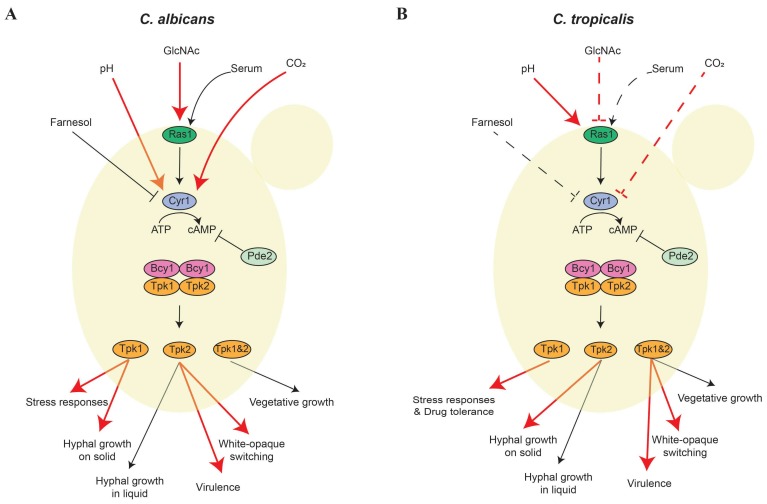
Fungal species undergo many morphological transitions to adapt to changing environments, an important quality especially in fungal pathogens. For decades, Candida albicans has been one of the most prevalent human fungal pathogens, and recently, the prevalence of Candida tropicalis as a causative agent of candidiasis has increased. In C. albicans, the ability to switch between yeast and hyphal forms is thought to be a key virulence factor and is regulated by multiple signaling cascades—including the cyclic adenosine monophosphate/protein kinase A (cAMP/PKA), calcineurin, high-osmolarity glycerol (HOG), and mitogen-activated protein kinases (MAPK) signaling pathways—upon receiving environmental cues. The cAMP/PKA signaling pathway also triggers white-opaque switching in C. albicans. However, studies on C. tropicalis morphogenesis are limited. In this minireview, we discuss the regulation of the yeast-hypha transition, virulence, and white-opaque switching through the cAMP/PKA pathway in the closely related species C. albicans and C. tropicalis.
Overview
The claims and statistics of this paper haven’t been checked yet.
Free: it reads the open-access text and checks the first 5 claims that cite a source we can check. Create a free account to check every claim.
Integrity signals
Registry
Cites
Statistics
Figures
Verification
Claims the paper makes
The claims and statistics of this paper haven’t been checked yet.
Free: it reads the open-access text and checks the first 5 claims that cite a source we can check. Create a free account to check every claim.
Claims other papers make about this one
Each is checked against this paper’s own text: does it say what the citing paper says it does?
The cited source says what the claim attributes to it.
In the citing paper
“The cAMP/PKA signalling pathway plays a core role in regulating the filamentation of C. albicans [30]”
From The F 1 F o -ATP synthase α subunit of Candida albicans induces inflammatory responses by controlling amino acid catabolism (2023) · cites this paper as [30]
The cited source says what the claim attributes to it.
In the citing paper
“This pathway is controlled by many signalling molecules [30] and one of them is pH [31].”
From The F 1 F o -ATP synthase α subunit of Candida albicans induces inflammatory responses by controlling amino acid catabolism (2023) · cites this paper as [30]
The cited source says what the claim attributes to it.
In the citing paper
“The cAMP/PKA pathway is the core signalling pathway regulating filamentation [30].”
From The F 1 F o -ATP synthase α subunit of Candida albicans induces inflammatory responses by controlling amino acid catabolism (2023) · cites this paper as [30]
Self-check
Percentages, sums and reported differences re-computed from the paper’s own numbers.
The self-check needs the paper’s full text.
Citations
Cites
Hidden Killers: Human Fungal Infections
Brown, G. D., Denning, D. W., Gow, N. A. R., Levitz, S. M., Netea, M. G., & White, T. C. (2012) · Science Translational Medicine · doi:10.1126/scitranslmed.3004404 · Cited by 4,284 · cited 1×
“Candida species are common causative agents of superficial and invasive fungal infections worldwide [1,2].”
BackgroundEpidemiology of Invasive Candidiasis: a Persistent Public Health Problem
Pfaller, M. A., & Diekema, D. J. (2007) · Clinical Microbiology Reviews · doi:10.1128/cmr.00029-06 · Cited by 4,174 · cited 1×
“parapsilosis—in patients with candidiasis or candidemia has increased [4,5].”
BackgroundCandida albicans pathogenicity mechanisms
Mayer, F. L., Wilson, D., & Hube, B. (2013) · Virulence · doi:10.4161/viru.22913 · Cited by 1,848
Nonfilamentous C. albicans Mutants Are Avirulent
Lo, H.-J., Köhler, J. R., DiDomenico, B., Loebenberg, D., Cacciapuoti, A., & Fink, G. R. (1997) · Cell · doi:10.1016/s0092-8674(00)80358-x · Cited by 1,809
Evolution of pathogenicity and sexual reproduction in eight Candida genomes
Butler, G., Rasmussen, M. D., Lin, M. F., Santos, M. A. S., Sakthikumar, S., Munro, C. A., Rheinbay, E., Grabherr, M., Forche, A., Reedy, J. L., et al. (2009) · Nature · doi:10.1038/nature08064 · Cited by 1,065
Quorum Sensing in the Dimorphic Fungus Candida albicans Is Mediated by Farnesol
Hornby, J. M., Jensen, E. C., Lisec, A. D., Tasto, J. J., Jahnke, B., Shoemaker, R., Dussault, P., & Nickerson, K. W. (2001) · Applied and Environmental Microbiology · doi:10.1128/aem.67.7.2982-2992.2001 · Cited by 983
Silva, S., Negri, M., Henriques, M., Oliveira, R., Williams, D. W., & Azeredo, J. (2012) · FEMS Microbiology Reviews · doi:10.1111/j.1574-6976.2011.00278.x · Cited by 969
Candida albicans morphogenesis and host defence: discriminating invasion from colonization
Gow, N. A. R., van de Veerdonk, F. L., Brown, A. J. P., & Netea, M. G. (2012) · Nature Reviews Microbiology · doi:10.1038/nrmicro2711 · Cited by 888
Andes, D. R., Safdar, N., Baddley, J. W., Playford, G., Reboli, A. C., Rex, J. H., Sobel, J. D., Pappas, P. G., Kullberg, B. J., & for the Mycoses Study Group (2012) · Clinical Infectious Diseases · doi:10.1093/cid/cis021 · Cited by 793 · cited 1×
“parapsilosis—in patients with candidiasis or candidemia has increased [4,5].”
BackgroundGlobal trends in the distribution of Candida species causing candidemia
Guinea, J. (2014) · Clinical Microbiology and Infection · doi:10.1111/1469-0691.12539 · Cited by 680 · cited 1×
“albicans is the most prevalent and has been responsible for >60% of candidemia cases worldwide for decades [3].”
Background
Cited by
Candida albicans—The Virulence Factors and Clinical Manifestations of Infection
Talapko, J., Juzbašić, M., Matijević, T., Pustijanac, E., Bekić, S., Kotris, I., & Škrlec, I. (2021) · Journal of Fungi · doi:10.3390/jof7020079 · Cited by 794
“The most important is cAMP-dependent protein kinase A (cyclic adenosine monophosphate PKA) [3,26].”
BackgroundThe regulation of hyphae growth in Candida albicans
Chen, H., Zhou, X., Ren, B., & Cheng, L. (2020) · Virulence · doi:10.1080/21505594.2020.1748930 · Cited by 277
Mechanism of Candida pathogenesis: Revisiting the vital drivers
Mba, I. E., & Nweze, E. I. (2020) · European Journal of Clinical Microbiology & Infectious Diseases · doi:10.1007/s10096-020-03912-w · Cited by 143
The role of Candida albicans stress response pathways in antifungal tolerance and resistance
Iyer, K. R., Robbins, N., & Cowen, L. E. (2022) · iScience · doi:10.1016/j.isci.2022.103953 · Cited by 88
“Moreover, studies have specifically highlighted a role for Tpk2 and Cyr1 in regulating drug tolerance at least in part through the regulation of efflux pump expression (Jain et al., 2003; Lin and Chen, 2018).”
BackgroundKim, J.-S., Lee, K.-T., Lee, M. H., Cheong, E., & Bahn, Y.-S. (2021) · mBio · doi:10.1128/mbio.02729-21 · Cited by 53
“In Candida albicans, the cAMP/PKA pathway modulates stress response, vegetative and hyphal growth, virulence, and biofilm formation (15).”
We need to talk about Candida tropicalis : Virulence factors and survival mechanisms
dos Santos, M. M., & Ishida, K. (2023) · Medical Mycology · doi:10.1093/mmy/myad075 · Cited by 60
Laurian, R., Dementhon, K., Doumèche, B., Soulard, A., Noël, T., Lemaire, M., & Cotton, P. (2019) · Frontiers in Microbiology · doi:10.3389/fmicb.2019.00327 · Cited by 50
“273 albicans [41,42], we checked the ability of hexokinase and glucokinase mutants to undergo a 274”
MethodAdhesion and biofilm formation by the opportunistic pathogen Candida tropicalis: what do we know?
de Souza, C. M., dos Santos, M. M., Furlaneto-Maia, L., & Furlaneto, M. C. (2023) · Canadian Journal of Microbiology · doi:10.1139/cjm-2022-0195 · Cited by 44
cAMP Signalling Pathway in Biocontrol Fungi
Sun, Z., Yu, S.-F., Wang, C.-L., & Wang, L. (2022) · Current Issues in Molecular Biology · doi:10.3390/cimb44060179 · Cited by 39
“AC catalyses ATP-synthesised cAMP, while PDE degrades cAMP [8].”
BackgroundRoth, C., Murray, D., Scott, A., Fu, C., Averette, A. F., Sun, S., Heitman, J., & Magwene, P. M. (2021) · PLoS Genetics · doi:10.1371/journal.pgen.1009313 · Cited by 31
“Both of these pathways regulate multiple physiological and morphological traits in Cryptococcus as well as other fungi including S. cerevisiae (Granek et al., 2011), Candida albicans (Brown et al., 2014; Lin and Chen, 2018), and Candida auris (Day et al., 2018).”
BackgroundProtein kinase A controls yeast growth in visible light
Molin, M., Logg, K., Bodvard, K., Peeters, K., Forsmark, A., Roger, F., Jörhov, A., Mishra, N., Billod, J., Amir, S., et al. (2020) · BMC Biology · doi:10.1186/s12915-020-00867-4 · Cited by 26
Wang, X. (2021) · Infectious diseases · doi:10.5772/intechopen.87410 · Cited by 22
Farh, M. E.-A., Abdellaoui, N., & Seo, J. (2021) · Frontiers in Microbiology · doi:10.3389/fmicb.2021.672661 · Cited by 21
Phenotypic instability in fungi
Silar, P. (2019) · Advances in applied microbiology · doi:10.1016/bs.aambs.2019.03.002 · Cited by 19
Comprehensive Review on Candidemia: Epidemiology, Diagnosis, Treatment, and Future Directions
Dong, H., Song, M., Sun, J., Luan, X., Zhang, M., Wang, Y., Dong, Y., Sai, L., Li, Y., & Chang, W. (2026) · iFungi · doi:10.26599/ifungi.2026.9670005 · Cited by 18
Das, S., Bhuyan, R., Bagchi, A., & Saha, T. (2019) · Heliyon · doi:10.1016/j.heliyon.2019.e01916 · Cited by 18
“Additionally many of them are already declared as drug target due to their virulence property in candidiasis [57, 58, 59, 60, 61, 62].”
BackgroundZhang, Q., Xu, L., Yuan, S., Zhou, Q., Wang, X., Wang, L., Hu, Z., & Yan, Y. (2020) · International Journal of Molecular Sciences · doi:10.3390/ijms21114036 · Cited by 16
“tropicalis filamentation, with shifts in nutrient levels, temperature, pH, and available carbon sources all driving this transition [24,25].”
BackgroundResearch advances and public health strategies in China on WHO priority fungal pathogens
Wang, Y., Han, L., Gong, J., Liu, L., Miao, B., & Xu, J. (2025) · Mycology: An International Journal on Fungal Biology · doi:10.1080/21501203.2025.2561612 · Cited by 15
“The hyphae formation is mediated by several signal transduction pathways encompassing cAMP-dependent protein kinase A (Lin and Chen 2018).”
H89 Treatment Reduces Intestinal Inflammation and Candida albicans Overgrowth in Mice
Dumortier, C., Charlet, R., Bettaïeb, A., & Jawhara, S. (2020) · Microorganisms · doi:10.3390/microorganisms8122039 · Cited by 14
“albicans PKA contains two catalytic subunits (Tpk1 and Tpk2) that activate downstream targets such as Efg1 and promote various transcriptional regulatory circuits [46].”
BackgroundZeng, G., Xu, X., Kok, Y. J., Deng, F.-S., Chow, E. W. L., Gao, J., Bi, X., & Wang, Y. (2023) · Cell Reports · doi:10.1016/j.celrep.2023.113473 · Cited by 14
Special Issue: Candida and Candidiasis
Nett, J. E. (2018) · Journal of Fungi · doi:10.3390/jof4030074 · Cited by 12
“I would like to take the opportunity to thank each of the authors for contributing their expertise to this Special Issue on Candida and Candidiasis.”
InfluentialAlternative Oxidase – Aid or obstacle to combat the rise of fungal pathogens?
Edrich, E. S. M., Duvenage, L., & Gourlay, C. W. (2024) · Biochimica et Biophysica Acta (BBA) - Bioenergetics · doi:10.1016/j.bbabio.2024.149031 · Cited by 13
“Active infection and dissemination inside the host is presumed to be energetically demanding for pathogenic yeasts, especially for switches to hyphal growth forms for Candida albicans via the Ras1/cAMP/PKA signalling pathway [49,50].”
N-acetylglucosamine-mediated morphological transition in Candida albicans and Candida tropicalis
Lew, S. Q., & Lin, C. (2021) · Current Genetics · doi:10.1007/s00294-020-01138-z · Cited by 11
Self-citationAziz, S., Ahmed, A., Singh, P., & Mukhopadhyay, S. (2025) · iScience · doi:10.1016/j.isci.2025.114363 · Cited by 13
“139,140 This morphological plasticity enables C. albicans to counteract macrophage defences, ensuring survival and proliferation in the host.”
Bohner, F., Papp, C., Takács, T., Varga, M., Szekeres, A., Nosanchuk, J. D., Vágvölgyi, C., Tóth, R., & Gácser, A. (2023) · Journal of Fungi · doi:10.3390/jof9121148 · Cited by 10
“Based on the known downstream effectors of the cAMP/PKA pathway in Candida species, we hypothesized that BCY1 mutations can affect the biofilm-forming ability of azole-evolved C. auris strains [57].”
BackgroundZhang, R., Liu, X., Xu, J., Chen, C., Tang, Z., Wu, C. C., Li, X., Su, L., Liu, M., Yang, L., et al. (2024) · mBio · doi:10.1128/mbio.00996-24 · Cited by 9
Roles of alcohol dehydrogenase 1 in the biological activities of Candida albicans
Wang, Z., Zhang, Q., Zhang, H., & Lu, Y. (2024) · Critical Reviews in Microbiology · doi:10.1080/1040841x.2024.2371510 · Cited by 9
“…the conserved cAMP-PKA pathway plays a crucial role in fungal cellular respiratory regulation (tao et al. 2017) and the pathogenesis of C. albicans (lin and chen 2018), the energy metabolic processes influenced by ADH1 deletion may regulate adhesion, biofilm formation, mycelial structure…”
Lin, C.-J., Yang, S.-Y., Hsu, L.-H., Yu, S.-J., & Chen, Y.-L. (2023) · Medical Mycology · doi:10.1093/mmy/myad004 · Cited by 7
Self-citationLi, R., Yang, X., Dan, W., & Dai, J. (2025) · Bioorganic & Medicinal Chemistry · doi:10.1016/j.bmc.2025.118435 · Cited by 9
Ishchuk, O. P., Sterner, O., Ellervik, U., & Manner, S. (2019) · Antibiotics · doi:10.3390/antibiotics9010010 · Cited by 7
The Adenylate Cyclase-Encoding Gene crac Is Involved in Clonostachys rosea Mycoparasitism
Yu, S.-F., Sun, Z., Li, S., Hu, Y.-F., Ren, Q., Xu, J.-L., Song, H.-J., & Sun, M. (2023) · Journal of Fungi · doi:10.3390/jof9080861 · Cited by 7
“The cAMP signaling pathway consists of several components: G-protein coupled receptors, heterotrimeric G-proteins, adenylate cyclase, cAMP-dependent protein kinase, and downstream effectors [13,14].”
BackgroundWang, F., Wang, B., Gao, J., Yang, X., Jia, Y., Tian, S., Li, X., Zhang, N., Zhang, X., Wei, Y., et al. (2024) · Journal of Basic Microbiology · doi:10.1002/jobm.202400008 · Cited by 6
“In Candida albicans , their ability to switch between yeast and hyphal forms is regulated by multiple signaling cascades, including cAMP/PKA and other signaling pathways [31].”
BackgroundEicosapentaenoic acid as an antibiofilm agent disrupts mature biofilms of Candida albicans
Wang, S., Xie, S., Li, T., Liu, J., Wang, P., Wang, Y., Gu, L., Luo, D., & Wei, M. (2024) · Biofilm · doi:10.1016/j.bioflm.2024.100251 · Cited by 8
“This leads to activating the downstream transcription factor Efg1 [40].”
Alqahtani, F. M., Handy, S. T., Sutton, C. L., & Farone, M. B. (2021) · Frontiers in Microbiology · doi:10.3389/fmicb.2021.708267 · Cited by 6
Pathogenicity Mechanism of Candida albicans
Pattnaik, S., Maharana, L., & Sethi, M. (2021) · Infectious diseases · doi:10.5772/intechopen.99737 · Cited by 9
Patiño-Medina, J. A., Vargas-Tejeda, D., Reyes-Mares, N. Y., Alejandre‐Castañeda, V., Torres-Cortes, C. J., Arques, C. P., Ruíz‐Herrera, L. F., Ramírez-Emiliano, J., Vellanki, S., Valle-Maldonado, M. I., et al. (2025) · Fungal Genetics and Biology · doi:10.1016/j.fgb.2025.103974 · Cited by 5
Mo, F., Zhang, P., Li, Q., Yang, X., Ma, J., & Zhang, J. (2022) · Microbial Drug Resistance · doi:10.1089/mdr.2021.0242 · Cited by 5
Yao, S., Feng, Y., Islam, A., Shrivastava, M., Gu, H., Lu, Y., Sheng, J., Whiteway, M. S., & Feng, J. (2020) · Computational and Structural Biotechnology Journal · doi:10.1016/j.csbj.2020.11.034 · Cited by 5
Underlying mechanisms of the effect of minocycline against Candida albicans biofilms
Zou, L., Zhao, M., Guan, T., Zhang, B., & Deng, Q. (2021) · Experimental and Therapeutic Medicine · doi:10.3892/etm.2021.9857 · Cited by 5
“F, forward primer; R, reverse primer; CAP1, adenylate cyclase‑asso‑ ciated protein 1; TPK1, thiamin pyrophosphokinase 1; CDC35, adenylate cyclase; EFG1, enhanced filamentous growth protein 1; Tec1, transcription factor; RAS1, ras family GTPase; PDE, 2,3',5'‑cyclic‑nucleotide phosphodiesterase; ALS3, agglutinin‑like pr…”
BackgroundInfluentialLi, S., Liu, Y., Weng, L., Zhao, Y., Zhang, Y., Zhang, Z., Yang, Y., Chen, Q., Liu, X., & Zhang, H. (2023) · Virulence · doi:10.1080/21505594.2023.2190645 · Cited by 3
Analysis and engineering of quorum sensing-based communications between bacteria and fungi
Zhou, Y., Tang, L., Chen, D., Li, Y., Wu, S., & Qiao, J. (2026) · mBio · doi:10.1128/mbio.03838-25 · Cited by 4
“They can affect morphogenesis by inhibiting the cAMP/PKA pathway (64) of C. albicans .”
Uschner, F., & Klipp, E. (2019) · Current Opinion in Biotechnology · doi:10.1016/j.copbio.2019.03.011 · Cited by 4
Zhang, B., Hou, S., Zhang, A., Yang, J., Zhang, W., Zhu, S., Chen, H., & Huang, R. (2026) · Molecular Oral Microbiology · doi:10.1111/omi.70026 · Cited by 2
“Ras1–cAMP/PKA pathway involves the following key elements: two small Ras GTPases Ras1 and Ras2; the adenylyl cyclase Cyr1; the PKA catalytic subunits Tpk1 and Tpk2; and the PKA regulatory subunit Bcy1 (Huang et al. 2019 ; Lin and Chen 2018 ).”
Morais‐Braga, M. F. B., Leal, A. L. A. B., de Oliveira, A. H., Carneiro, J. N. P., dos Santos, A. T. L., Sales, D. L., Fonseca, V. J. A., Rocha, J. E., de Freitas, T. S., Campina, F. F., et al. (2022) · South African Journal of Botany · doi:10.1016/j.sajb.2022.03.017 · Cited by 2
Inhibition of the morphological transition of Candida spp. by riparins I–IV
da Silva, M. L. Q., de Sousa, N. F., dos Santos, A. T. L., de Sousa, G. R., Fonseca, V. J. A., Coutinho, H. D. M., Barbosa‐Filho, J. M., Ferrari, J., Scotti, L., Ribeiro‐Filho, J., et al. (2024) · Fundamental and Clinical Pharmacology · doi:10.1111/fcp.13007 · Cited by 2
Tang, J., Liu, Y., Lai, F., Zhou, Y., Zhang, H., Ni, B., & Lv, W. (2026) · Journal of environmental chemical engineering · doi:10.1016/j.jece.2026.121504 · Cited by 1
Essential anticandidal targets
Kumar, A., & Jha, A. (2023) · Elsevier eBooks · doi:10.1016/b978-0-443-18744-5.00009-5 · Cited by 1
Domi, O. K. H. B., & Darmani, H. (2023) · Journal of Herbs Spices & Medicinal Plants · doi:10.1080/10496475.2023.2196463 · Cited by 1
“albicans is one of the key determinants of its pathogenesis.([2,3,7,8]) This morphological plasticity is important for its ability to colonize and parasitize host tissues.”
BackgroundHutomo, S., Larope, C. G., Sooai, C. M., & Merry, M. S. (2023) · Jurnal Kedokteran Meditek · doi:10.36452/jkdoktmeditek.v29i2.2622 · Cited by 1
“tropicalis, Cyr1 mengubah ATP menjadi cAMP untuk mengikat subunit PKA (Bcy1) dan membebaskan subunit katalitik (Tpk1 dan Tpk2) yang berperan dalam respon stress fungi, toleransi obat, pertumbuhan filamen.(15) Disfungsi mitokondria menyebabkan morfogenesis dan jalur cAMP dalam respon stres fungi akan gagal.”
BackgroundSecondary Metabolites of Endophytic Fungi Against Candidiasis
Sudharsan, M. S., Haripriya, M., Lakshmipriya., S., Hari, S., & Romauld, S. I. (2023) · Interdisciplinary biotechnological advances · doi:10.1007/978-981-99-4939-7_12 · Cited by 1
Regulación por NDR kinasas durante el crecimiento polarizado en C. albicans
Almeida, A. S. (2021) · Gredos (University of Salamanca) · doi:10.14201/gredos.148417
Wang, F., Wang, B., Yang, X., Jia, Y.-B., Tian, S., Li, X., Zhang, X., Wei, Y., Zhang, J., & Cai, K. (2024) · doi:10.22541/au.171150183.32390868/v1
Bohner, F. (2024) · SZTE Repository of Dissertations (University of Szeged) · doi:10.14232/phd.12031
Tan, J., Liu, Q., Liu, Z., Cao, Y., Yu, X., Zhao, Q., Hu, N., Liu, Y., Wan, Y., Zhang, Y., et al. (2025) · mBio · doi:10.1128/mbio.01253-25
“Our discovery that Fmp28 regulates Als3 through the cAMP-PKA pathway provides new insights into the mechanisms by which C. albicans coordinates its stress adaptation and pathogenic programs.”
InfluentialLi, S., Chen, W., Shi, Z., Xu, Z., Xu, L., Wang, Y., Qu, Y., Sun, C., Chen, M., & Li, Z. (2025) · Current Microbiology · doi:10.1007/s00284-025-04355-2
“In addition, the decreased transduction efficiency of the cAMP–PKA pathway enhances Ca 2+ signaling, activates ER-related effectors such as the calcineurin/Crz1 axis, and improves protein folding efficiency [49, 50].”
Tryptophan end-tagging confers antifungal activity to a tick-derived antimicrobial peptide
Chiramba, C. K. (2024) · UpSpace Institutional Repository (University of Pretoria) · doi:10.25403/upresearchdata.26272000
Kenneth Tan, L. S. (2023) · University of Malaya Students Repository
Shah, D., Martoliya, Y., Mathivathanan, S., Shrivastava, A., Asthana, S., & Varahan, S. (2026) · ACS Infectious Diseases · doi:10.64898/2026.04.23.720332
Bohner, F., Szilovics, Z., Veres, É., Papp, C., Nosanchuk, J. D., & Gácser, A. (2026) · Virulence · doi:10.1080/21505594.2026.2664993
“In C. albicans these genes, TPK2 and BCY1 , encode key components of the cAMP-dependent protein kinase A (PKA) pathway [46].”
Interaction of Pathogenic Fungi with Host Cells: Molecular and Cellular Approaches
Zafar, S., Ashraf, M. A., Khan, I. M., Arshad, M. F., Shahzad, A., Ahmad, K. S., Akram, M. S., Zafar, M. N., Ahmad, M., & Rasheed, R. (2026) · Fungal biology · doi:10.1007/978-981-95-8601-1_5
Metadata
- Authors
- Lin, C.-J., & Chen, Y.-L.
- Affiliations
- National Taiwan University (TW)
- Corresponding author
- Chen, Ying-Lien
- Venue
- Journal of Fungi
- Publisher
- MDPI AG
- Published
- 2018-06-08
- Volume
- 4
- Issue
- 2
- Pages
- 68
- ISSN
- 2309-608X (ISSN-L)
- PMC
- PMC6023519
- OpenAlex
- W2805402060
- Cited by
- 55
- References
- 99
- Citations by year
- 2026: 5 · 2025: 6 · 2024: 7 · 2023: 11 · 2022: 4 · 2021: 10 · 2020: 6 · 2019: 5 · 2018: 1
- FWCI
- 0.54
- Type
- journal article
- Language
- en
- Open access
- gold
- dx.doi.org
- Licence
- Locations
- Journal of Fungi (publishedVersion, cc-by)
- Europe PMC (PubMed Central) (publishedVersion, other-oa)
- PubMed Central (publishedVersion, cc-by)
- PubMed (publishedVersion)
- DOAJ (DOAJ: Directory of Open Access Journals) (submittedVersion, cc-by-sa)
- Funders
- Ministry of Science and Technology, Taiwan (104-2320-B-002-063-MY3, 106-2923-B-002-001-MY3)
- Topics
- Life Sciences › Biochemistry, Genetics and Molecular Biology › Molecular Biology › Fungal and yeast genetics research
- Health Sciences › Medicine › Infectious Diseases › Antifungal resistance and susceptibility
- Health Sciences › Medicine › Infectious Diseases › Fungal Infections and Studies
- Keywords
- cAMP/PKA signaling, Candida albicans, Candida tropicalis, yeast-to-hypha transition, morphogenesis, white-opaque switching, fungal virulence, calcineurin signaling, MAPK signaling, candidiasis, fungal pathogens
About these checks
Registry, retraction, Cites and statistics results are computed, not judged, with one exception: a printed reference that no index lists is read once by a model before it counts as a citation error. Claims are extracted by a model and kept only when their quote appears verbatim in the text; each cited source is then checked, with a model’s help, for whether it says what the claim relies on. Those verdicts can be wrong — read the claim’s quote and the cited source before relying on one.
Statistics and arithmetic are recomputed, not judged.
Confidence bands are shown only for fields calibrated on our annotated test set. None is calibrated yet, so no band is shown.
What counts as a claim ›How we measure confidence ›How we check this ›
Are you an author, or do you see a problem with this page? Request a review
Data sources
Bibliographic data: Semantic Scholar, OpenAlex, Crossref.
Contains information from the Semantic Scholar Academic Graph Datasets, made available under the ODC Attribution License (ODC-BY 1.0).
Semantic Scholar’s data is described in: Kinney, R., et al. (2023). The Semantic Scholar Open Data Platform. arXiv:2301.10140.
