

Conserved and Divergent Functions of the cAMP/PKA Signaling Pathway in Candida albicans and Candida tropicalis
Open accessThe DOI matches its Crossref record; 98 of the 99 references it cites were found in a registry or an index.
Abstract
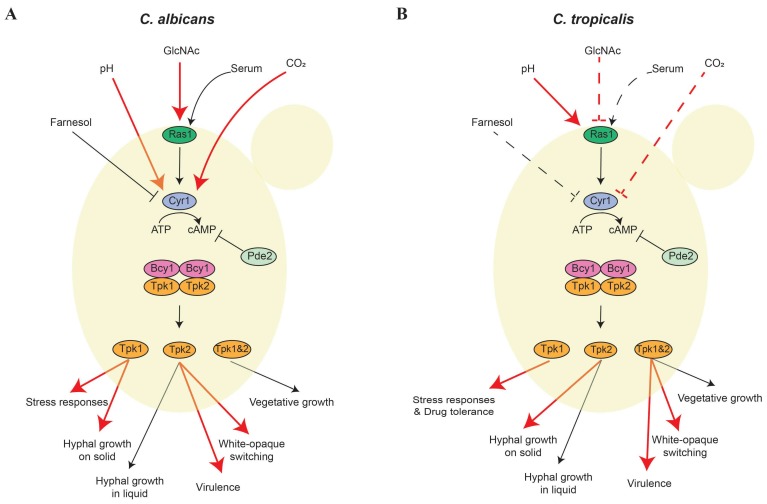
Fungal species undergo many morphological transitions to adapt to changing environments, an important quality especially in fungal pathogens. For decades, Candida albicans has been one of the most prevalent human fungal pathogens, and recently, the prevalence of Candida tropicalis as a causative agent of candidiasis has increased. In C. albicans, the ability to switch between yeast and hyphal forms is thought to be a key virulence factor and is regulated by multiple signaling cascades—including the cyclic adenosine monophosphate/protein kinase A (cAMP/PKA), calcineurin, high-osmolarity glycerol (HOG), and mitogen-activated protein kinases (MAPK) signaling pathways—upon receiving environmental cues. The cAMP/PKA signaling pathway also triggers white-opaque switching in C. albicans. However, studies on C. tropicalis morphogenesis are limited. In this minireview, we discuss the regulation of the yeast-hypha transition, virulence, and white-opaque switching through the cAMP/PKA pathway in the closely related species C. albicans and C. tropicalis.
Overview
The claims and statistics of this paper haven’t been checked yet.
Free: it reads the open-access text and checks the first 5 claims that cite a source we can check. Create a free account to check every claim.
Integrity signals
Registry
Cites
Statistics
Figures
Verification
Claims the paper makes
The claims and statistics of this paper haven’t been checked yet.
Free: it reads the open-access text and checks the first 5 claims that cite a source we can check. Create a free account to check every claim.
Claims other papers make about this one
Each is checked against this paper’s own text: does it say what the citing paper says it does?
The cited source says what the claim attributes to it.
In the citing paper
“The cAMP/PKA signalling pathway plays a core role in regulating the filamentation of C. albicans [30]”
From The F 1 F o -ATP synthase α subunit of Candida albicans induces inflammatory responses by controlling amino acid catabolism (2023) · cites this paper as [30]
The cited source says what the claim attributes to it.
In the citing paper
“This pathway is controlled by many signalling molecules [30] and one of them is pH [31].”
From The F 1 F o -ATP synthase α subunit of Candida albicans induces inflammatory responses by controlling amino acid catabolism (2023) · cites this paper as [30]
The cited source says what the claim attributes to it.
In the citing paper
“The cAMP/PKA pathway is the core signalling pathway regulating filamentation [30].”
From The F 1 F o -ATP synthase α subunit of Candida albicans induces inflammatory responses by controlling amino acid catabolism (2023) · cites this paper as [30]
Self-check
Percentages, sums and reported differences re-computed from the paper’s own numbers.
The self-check needs the paper’s full text.
Citations
Cites
Hidden Killers: Human Fungal Infections
Brown, G. D., Denning, D. W., Gow, N. A. R., Levitz, S. M., Netea, M. G., & White, T. C. (2012) · Science Translational Medicine · doi:10.1126/scitranslmed.3004404 · Cited by 4,284 · cited 1×
“Candida species are common causative agents of superficial and invasive fungal infections worldwide [1,2].”
BackgroundEpidemiology of Invasive Candidiasis: a Persistent Public Health Problem
Pfaller, M. A., & Diekema, D. J. (2007) · Clinical Microbiology Reviews · doi:10.1128/cmr.00029-06 · Cited by 4,174 · cited 1×
“parapsilosis—in patients with candidiasis or candidemia has increased [4,5].”
BackgroundCandida albicans pathogenicity mechanisms
Mayer, F. L., Wilson, D., & Hube, B. (2013) · Virulence · doi:10.4161/viru.22913 · Cited by 1,848
Nonfilamentous C. albicans Mutants Are Avirulent
Lo, H.-J., Köhler, J. R., DiDomenico, B., Loebenberg, D., Cacciapuoti, A., & Fink, G. R. (1997) · Cell · doi:10.1016/s0092-8674(00)80358-x · Cited by 1,809
Evolution of pathogenicity and sexual reproduction in eight Candida genomes
Butler, G., Rasmussen, M. D., Lin, M. F., Santos, M. A. S., Sakthikumar, S., Munro, C. A., Rheinbay, E., Grabherr, M., Forche, A., Reedy, J. L., et al. (2009) · Nature · doi:10.1038/nature08064 · Cited by 1,065
Quorum Sensing in the Dimorphic Fungus Candida albicans Is Mediated by Farnesol
Hornby, J. M., Jensen, E. C., Lisec, A. D., Tasto, J. J., Jahnke, B., Shoemaker, R., Dussault, P., & Nickerson, K. W. (2001) · Applied and Environmental Microbiology · doi:10.1128/aem.67.7.2982-2992.2001 · Cited by 983
Silva, S., Negri, M., Henriques, M., Oliveira, R., Williams, D. W., & Azeredo, J. (2012) · FEMS Microbiology Reviews · doi:10.1111/j.1574-6976.2011.00278.x · Cited by 969
Candida albicans morphogenesis and host defence: discriminating invasion from colonization
Gow, N. A. R., van de Veerdonk, F. L., Brown, A. J. P., & Netea, M. G. (2012) · Nature Reviews Microbiology · doi:10.1038/nrmicro2711 · Cited by 888
Andes, D. R., Safdar, N., Baddley, J. W., Playford, G., Reboli, A. C., Rex, J. H., Sobel, J. D., Pappas, P. G., Kullberg, B. J., & for the Mycoses Study Group (2012) · Clinical Infectious Diseases · doi:10.1093/cid/cis021 · Cited by 793 · cited 1×
“parapsilosis—in patients with candidiasis or candidemia has increased [4,5].”
BackgroundGlobal trends in the distribution of Candida species causing candidemia
Guinea, J. (2014) · Clinical Microbiology and Infection · doi:10.1111/1469-0691.12539 · Cited by 680 · cited 1×
“albicans is the most prevalent and has been responsible for >60% of candidemia cases worldwide for decades [3].”
BackgroundThevelein, J. M., & De Winde, J. H. (1999) · Molecular Microbiology · doi:10.1046/j.1365-2958.1999.01538.x · Cited by 677
"White-opaque transition": a second high-frequency switching system in Candida albicans
Slutsky, B., Staebell, M., Anderson, J., Risen, L., Pfaller, M., & Soll, D. R. (1987) · Journal of Bacteriology · doi:10.1128/jb.169.1.189-197.1987 · Cited by 570
Candida albicans cell-type switching and functional plasticity in the mammalian host
Noble, S. M., Gianetti, B. A., & Witchley, J. N. (2017) · Nature Reviews Microbiology · doi:10.1038/nrmicro.2016.157 · Cited by 521 · cited 1×
“albicans, the cAMP/PKA pathway plays critical roles in growth, morphogenesis, white-opaque switching, and virulence in murine models of systemic infection [16,18,64,65].”
BackgroundBiswas, S., Van Dijck, P., & Datta, A. (2007) · Microbiology and Molecular Biology Reviews · doi:10.1128/mmbr.00009-06 · Cited by 516 · cited 1×
“albicans, the cAMP/PKA pathway plays critical roles in growth, morphogenesis, white-opaque switching, and virulence in murine models of systemic infection [16,18,64,65].”
BackgroundControl of Filament Formation in Candida albicans by the Transcriptional Repressor TUP1
Braun, B. R., & Johnson, A. D. (1997) · Science · doi:10.1126/science.277.5322.105 · Cited by 515
NRG1 represses yeast–hypha morphogenesis and hypha‐specific gene expression in Candida albicans
Murad, A. M. A., Leng, P., Straffon, M., Wishart, J., Macaskill, S., MacCallum, D., Schnell, N., Talibi, D., Marechal, D., Tekaia, F., et al. (2001) · The EMBO Journal · doi:10.1093/emboj/20.17.4742 · Cited by 452
Fungal Adenylyl Cyclase Integrates CO2 Sensing with cAMP Signaling and Virulence
Klengel, T., Liang, W.-J., Chaloupka, J., Ruoff, C., Schröppel, K., Naglik, J. R., Eckert, S. E., Mogensen, E. G., Haynes, K., Tuite, M. F., et al. (2005) · Current Biology · doi:10.1016/j.cub.2005.10.040 · Cited by 409 · cited 1×
“albicans, Cyr1 (which is not an essential gene) regulates hyphal growth induced by serum, CO2, or bacterial peptidoglycan [28,31,74], while the phosphodiesterase Pde2 plays a role in limiting intracellular cAMP levels.”
BackgroundHigh-Frequency Switching of Colony Morphology in Candida albicans
Slutsky, B., Buffo, J., & Soll, D. R. (1985) · Science · doi:10.1126/science.3901258 · Cited by 399
Morphogenesis in Candida albicans
Whiteway, M., & Bachewich, C. (2007) · Annual Review of Microbiology · doi:10.1146/annurev.micro.61.080706.093341 · Cited by 388
Sanglard, D., Ischer, F., Marchetti, O., Entenza, J., & Bille, J. (2003) · Molecular Microbiology · doi:10.1046/j.1365-2958.2003.03495.x · Cited by 350
Pan, X., & Heitman, J. (1999) · Molecular and Cellular Biology · doi:10.1128/mcb.19.7.4874 · Cited by 349 · cited 1×
“ScTpk2 positively regulates pseudohyphal growth upon nitrogen starvation, while the other two catalytic subunits, (ScTpk1 and ScTpk3) negatively influence pseudohyphal growth [62,63].”
BackgroundGlucose depletion causes haploid invasive growth in yeast
Cullen, P. J., & Sprague, G. F. (2000) · Proceedings of the National Academy of Sciences · doi:10.1073/pnas.240345197 · Cited by 349
Ras Signaling Is Required for Serum-Induced Hyphal Differentiation in Candida albicans
Feng, Q., Summers, E., Guo, B., & Fink, G. (1999) · Journal of Bacteriology · doi:10.1128/jb.181.20.6339-6346.1999 · Cited by 346
Rocha, C. R. C., Schröppel, K., Harcus, D., Marcil, A., Dignard, D., Taylor, B. N., Thomas, D. Y., Whiteway, M., & Leberer, E. (2001) · Molecular Biology of the Cell · doi:10.1091/mbc.12.11.3631 · Cited by 344 · cited 2×
“albicans, Cyr1 (which is not an essential gene) regulates hyphal growth induced by serum, CO2, or bacterial peptidoglycan [28,31,74], while the phosphodiesterase Pde2 plays a role in limiting intracellular cAMP levels.”
Csank, C., Schröppel, K., Leberer, E., Harcus, D., Mohamed, O., Meloche, S., Thomas, D. Y., & Whiteway, M. (1998) · Infection and Immunity · doi:10.1128/iai.66.6.2713-2721.1998 · Cited by 328
The three yeast A kinases have specific signaling functions in pseudohyphal growth
Robertson, L. S., & Fink, G. R. (1998) · Proceedings of the National Academy of Sciences · doi:10.1073/pnas.95.23.13783 · Cited by 326 · cited 1×
“ScTpk2 positively regulates pseudohyphal growth upon nitrogen starvation, while the other two catalytic subunits, (ScTpk1 and ScTpk3) negatively influence pseudohyphal growth [62,63].”
BackgroundThe myriad roles of cyclic AMP in microbial pathogens: from signal to sword
McDonough, K. A., & Rodriguez, A. (2012) · Nature Reviews Microbiology · doi:10.1038/nrmicro2688 · Cited by 325 · cited 1×
“Environmental cues such as glucose, amino acids, and serum can trigger the cAMP/PKA signaling pathway by activating adenylyl cyclase (Cyr1) to convert ATP to cAMP [44,47].”
BackgroundD'Souza, C. A., Alspaugh, J. A., Yue, C., Harashima, T., Cox, G. M., Perfect, J. R., & Heitman, J. (2001) · Molecular and Cellular Biology · doi:10.1128/mcb.21.9.3179-3191.2001 · Cited by 318 · cited 1×
“obtained a tpk1/tpk1 tpk2/tpk2 double deletion mutant that exhibited severe growth defects [69]—in line with previous studies in other pathogenic fungi such as Cryptococcus neoformans and Aspergillus fumigatus—showing that PKA is not essential for, but does regulate, fungal growth [49,70].”
ResultHarnessing calcineurin as a novel anti-infective agent against invasive fungal infections.
Steinbach, W. J., Reedy, J. L., Cramer, R. A., Perfect, J. R., & Heitman, J. (2007) · Nature Reviews Microbiology · doi:10.1038/nrmicro1680 · Cited by 313 · cited 1×
“A similar approach in the calcineurin pathway [94] has shown that calcineurin inhibitors exhibit antifungal activity alone or synergistically with other existing drugs, such as fluconazole, against C.”
BackgroundHsp90 Orchestrates Temperature-Dependent Candida albicans Morphogenesis via Ras1-PKA Signaling
Shapiro, R. S., Uppuluri, P., Zaas, A. K., Collins, C., Senn, H., Perfect, J. R., Heitman, J., & Cowen, L. E. (2009) · Current Biology · doi:10.1016/j.cub.2009.03.017 · Cited by 311 · cited 1×
“albicans [30,90], and small chemical compounds have also been found to control its morphogenesis”
BackgroundLeberer, E., Harcus, D., Broadbent, I. D., Clark, K. L., Dignard, D., Ziegelbauer, K., Schmidt, A., Gow, N. A. R., Brown, A. J. P., & Thomas, D. Y. (1996) · Proceedings of the National Academy of Sciences · doi:10.1073/pnas.93.23.13217 · Cited by 311
Xu, X.-L., Lee, R. T. H., Fang, H.-M., Wang, Y.-M., Li, R., Zou, H., Zhu, Y., & Wang, Y. (2008) · Cell Host & Microbe · doi:10.1016/j.chom.2008.05.014 · Cited by 289 · cited 1×
“albicans, Cyr1 (which is not an essential gene) regulates hyphal growth induced by serum, CO2, or bacterial peptidoglycan [28,31,74], while the phosphodiesterase Pde2 plays a role in limiting intracellular cAMP levels.”
BackgroundKöhler, J. R., & Fink, G. R. (1996) · Proceedings of the National Academy of Sciences · doi:10.1073/pnas.93.23.13223 · Cited by 283
The Regulation of Filamentous Growth in Yeast
Cullen, P. J., & Sprague, G. F. (2012) · Genetics · doi:10.1534/genetics.111.127456 · Cited by 278
Singh, N., Alexander, B. D., Lortholary, O., Dromer, F., Gupta, K. L., John, G. T., del Busto, R., Klintmalm, G. B., Somani, J., Lyon, G. M., et al. (2007) · The Journal of Infectious Diseases · doi:10.1086/511438 · Cited by 264
Candidemia and invasive candidiasis in adults: A narrative review
Antinori, S., Milazzo, L., Sollima, S., Galli, M., & Corbellino, M. (2016) · European Journal of Internal Medicine · doi:10.1016/j.ejim.2016.06.029 · Cited by 257 · cited 1×
“Candida species are common causative agents of superficial and invasive fungal infections worldwide [1,2].”
BackgroundAdachi, K., & Hamer, J. E. (1998) · The Plant Cell · doi:10.1105/tpc.10.8.1361 · Cited by 249
Unique phenotype of opaque cells in the white-opaque transition of Candida albicans
Anderson, J. M., & Soll, D. R. (1987) · Journal of Bacteriology · doi:10.1128/jb.169.12.5579-5588.1987 · Cited by 237
The Flo8 Transcription Factor Is Essential for Hyphal Development and Virulence in Candida albicans
Cao, F., Lane, S., Raniga, P. P., Lu, Y., Zhou, Z., Ramon, K., Chen, J., & Liu, H. (2006) · Molecular Biology of the Cell · doi:10.1091/mbc.e05-06-0502 · Cited by 207
N-Acetylglucosamine Induces White to Opaque Switching, a Mating Prerequisite in Candida albicans
Huang, G., Yi, S., Sahni, N., Daniels, K. J., Srikantha, T., & Soll, D. R. (2010) · PLoS Pathogens · doi:10.1371/journal.ppat.1000806 · Cited by 204 · cited 2×
“albicans has a similar rate of white-opaque switching compared to the wild type in various culture conditions [69], but loss of CYR1 results in low intracellular cAMP concentration, and a tpk1/tpk1 tpk2/tpk2 mutant without obvious PKA activity showed severe defects in white-opaque switching [69,87,88].”
Bockmühl, D. P., Krishnamurthy, S., Gerads, M., Sonneborn, A., & Ernst, J. F. (2001) · Molecular Microbiology · doi:10.1046/j.1365-2958.2001.02688.x · Cited by 193 · cited 3×
“CaTpk1 contributes to filamentation on solid medium, while CaTpk2 is involved in hyphal growth in liquid medium [67,72,78,79].”
BackgroundProtein kinase A encoded by TPK2 regulates dimorphism of Candida albicans
Sonneborn, A., Bockmühl, D. P., Gerads, M., Kurpanek, K., Sanglard, D., & Ernst, J. F. (2000) · Molecular Microbiology · doi:10.1046/j.1365-2958.2000.01705.x · Cited by 187 · cited 3×
“CaTpk1 contributes to filamentation on solid medium, while CaTpk2 is involved in hyphal growth in liquid medium [67,72,78,79].”
BackgroundThe Ras/cAMP/PKA signaling pathway and virulence in Candida albicans
Hogan, D. A., & Sundstrom, P. (2009) · Future Microbiology · doi:10.2217/fmb.09.106 · Cited by 186
CO2 Regulates White-to-Opaque Switching in Candida albicans
Huang, G., Srikantha, T., Sahni, N., Yi, S., & Soll, D. R. (2009) · Current Biology · doi:10.1016/j.cub.2009.01.018 · Cited by 180 · cited 2×
“albicans has a similar rate of white-opaque switching compared to the wild type in various culture conditions [69], but loss of CYR1 results in low intracellular cAMP concentration, and a tpk1/tpk1 tpk2/tpk2 mutant without obvious PKA activity showed severe defects in white-opaque switching [69,87,88].”
BackgroundIncidence and species distribution of candidaemia in Asia: a laboratory-based surveillance study
Tan, B. H., Chakrabarti, A., Li, R. Y., Patel, A. K., Watcharananan, S. P., Liu, Z., Chindamporn, A., Tan, A. L., Sun, P.-L., Wu, U.-I., et al. (2015) · Clinical Microbiology and Infection · doi:10.1016/j.cmi.2015.06.010 · Cited by 176
Self-citationOpaque cells signal white cells to form biofilms in Candida albicans
Daniels, K. J., Srikantha, T., Lockhart, S. R., Pujol, C., & Soll, D. R. (2006) · The EMBO Journal · doi:10.1038/sj.emboj.7601099 · Cited by 173
Nucci, M., & Colombo, A. L. (2007) · Diagnostic Microbiology and Infectious Disease · doi:10.1016/j.diagmicrobio.2006.11.009 · Cited by 172
Bockmühl, D. P., & Ernst, J. F. (2001) · Genetics · doi:10.1093/genetics/157.4.1523 · Cited by 170
Liebmann, B., Müller, M., Braun, A., & Brakhage, A. A. (2004) · Infection and Immunity · doi:10.1128/iai.72.9.5193-5203.2004 · Cited by 168
Regulation of phenotypic transitions in the fungal pathogen Candida albicans
Huang, G. (2012) · Virulence · doi:10.4161/viru.20010 · Cited by 163
Choosing the right lifestyle: adhesion and development in Saccharomyces cerevisiae
Brückner, S., & Mösch, H.-U. (2012) · FEMS Microbiology Reviews · doi:10.1111/j.1574-6976.2011.00275.x · Cited by 162
Colombo, A. L., Guimarães, T., Silva, L. R. B. F., Monfardini, L. P. D. A., Cunha, A. K. B., Rady, P., Alves, T., & Rosas, R. C. (2007) · Infection Control & Hospital Epidemiology · doi:10.1086/513615 · Cited by 162
White–opaque switching in Candida albicans
Lohse, M. B., & Johnson, A. D. (2009) · Current Opinion in Microbiology · doi:10.1016/j.mib.2009.09.010 · Cited by 156
Signalling pathways in the pathogenesis of Cryptococcus
Kozubowski, L., Lee, S. C., & Heitman, J. (2009) · Cellular Microbiology · doi:10.1111/j.1462-5822.2008.01273.x · Cited by 148
Insights into Candida tropicalis nosocomial infections and virulence factors
Negri, M., Silva, S., Henriques, M., & Oliveira, R. (2012) · European Journal of Clinical Microbiology & Infectious Diseases · doi:10.1007/s10096-011-1455-z · Cited by 132
Why does Candida albicans switch?
Soll, D. R. (2009) · FEMS Yeast Research · doi:10.1111/j.1567-1364.2009.00562.x · Cited by 129
Candida glabrata Biofilms: How Far Have We Come?
Rodrigues, C., Rodrigues, M., Silva, S., & Henriques, M. (2017) · Journal of Fungi · doi:10.3390/jof3010011 · Cited by 129
Chlamydospore Formation in Candida albicans Requires the Efg1p Morphogenetic Regulator
Sonneborn, A., Bockmühl, D. P., & Ernst, J. F. (1999) · Infection and Immunity · doi:10.1128/iai.67.10.5514-5517.1999 · Cited by 126
Porman, A. M., Alby, K., Hirakawa, M. P., & Bennett, R. J. (2011) · Proceedings of the National Academy of Sciences · doi:10.1073/pnas.1112076109 · Cited by 118 · cited 1×
“tropicalis white cell colonies exhibit a rounded, smooth surface, while colonies of opaque cells have an elongated, pimpled surface [40,82].”
BackgroundGrahl, N., Demers, E. G., Lindsay, A. K., Harty, C. E., Willger, S. D., Piispanen, A. E., & Hogan, D. A. (2015) · PLOS Pathogens · doi:10.1371/journal.ppat.1005133 · Cited by 111 · cited 2×
“Inhibition of mitochondrial activity resulted in reduced Ras1 and Cyr1 activity and consequently attenuated filamentation [89].”
BackgroundHu, S., Zhou, X., Gu, X., Cao, S., Wang, C., & Xu, J. (2014) · Molecular Plant-Microbe Interactions · doi:10.1094/mpmi-10-13-0306-r · Cited by 97
Kontoyiannis, D. P., Lewis, R. E., Alexander, B. D., Lortholary, O., Dromer, F., Gupta, K. L., John, G. T., del Busto, R., Klintmalm, G. B., Somani, J., et al. (2008) · Antimicrobial Agents and Chemotherapy · doi:10.1128/aac.00990-07 · Cited by 97
The Hsp90 Co-Chaperone Sgt1 Governs Candida albicans Morphogenesis and Drug Resistance
Shapiro, R. S., Zaas, A. K., Betancourt-Quiroz, M., Perfect, J. R., & Cowen, L. E. (2012) · PLoS ONE · doi:10.1371/journal.pone.0044734 · Cited by 86 · cited 1×
“albicans [30,90], and small chemical compounds have also been found to control its morphogenesis”
BackgroundCandida albicans White and Opaque Cells Undergo Distinct Programs of Filamentous Growth
Si, H., Hernday, A. D., Hirakawa, M. P., Johnson, A. D., & Bennett, R. J. (2013) · PLoS Pathogens · doi:10.1371/journal.ppat.1003210 · Cited by 85
Cassola, A., Parrot, M., Silberstein, S., Magee, B. B., Passeron, S., Giasson, L., & Cantore, M. L. (2004) · Eukaryotic Cell · doi:10.1128/ec.3.1.190-199.2004 · Cited by 75 · cited 2×
“However, the bcy1/bcy1 mutant was obtained in a tpk2/tpk2 mutant background, which has reduced PKA activity, and showed defects in hyphal growth [66].”
BackgroundXie, J., Du, H., Guan, G., Tong, Y., Kourkoumpetis, T. K., Zhang, L., Bai, F.-Y., & Huang, G. (2012) · Eukaryotic Cell · doi:10.1128/ec.00047-12 · Cited by 74 · cited 1×
“tropicalis white cell colonies exhibit a rounded, smooth surface, while colonies of opaque cells have an elongated, pimpled surface [40,82].”
Comparison of Human and Soil Candida tropicalis Isolates with Reduced Susceptibility to Fluconazole
Yang, Y.-L., Lin, C.-C., Chang, T.-P., Lauderdale, T.-L., Chen, H.-T., Lee, C.-F., Hsieh, C.-W., Chen, P.-C., & Lo, H.-J. (2012) · PLoS ONE · doi:10.1371/journal.pone.0034609 · Cited by 73
Self-citationCloutier, M. (2003) · Fungal Genetics and Biology · doi:10.1016/s1087-1845(02)00520-0 · Cited by 72 · cited 1×
“albicans, Tpk1 and Tpk2 have redundant roles in growth and dimorphic switching, but each has distinct roles in hyphal development in various filamentation-inducing conditions [67,72,77,78].”
BackgroundThe cAMP phosphodiesterase encoded by CaPDE2 is required for hyphal development in Candida albicans
Jung, W. H., & Stateva, L. I. (2003) · Microbiology · doi:10.1099/mic.0.26517-0 · Cited by 72 · cited 1×
“Loss of PDE2 results in reduced hyphal growth and attenuated virulence in a murine model of systemic infection [75,76].”
BackgroundZuza-Alves, D. L., de Medeiros, S. S. T. Q., de Souza, L. B. F. C., Rocha, W. P. D. S., Francisco, E. C., de Araújo, M. C. B., de Lima-Neto, R. G., Neves, R. P., Melo, A. S. D. A., & Chaves, G. M. (2016) · Frontiers in Microbiology · doi:10.3389/fmicb.2016.01783 · Cited by 72
Cao, C., Wu, M., Bing, J., Tao, L., Ding, X., Liu, X., & Huang, G. (2017) · Molecular Microbiology · doi:10.1111/mmi.13681 · Cited by 70
Calcineurin Controls Hyphal Growth, Virulence, and Drug Tolerance of Candida tropicalis
Chen, Y.-L., Yu, S.-J., Huang, H.-Y., Chang, Y.-L., Lehman, V. N., Silao, F. G. S., Bigol, U. G., Bungay, A. A. C., Averette, A., & Heitman, J. (2014) · Eukaryotic Cell · doi:10.1128/ec.00302-13 · Cited by 68
Self-citationRas Signaling Gets Fine-Tuned: Regulation of Multiple Pathogenic Traits of Candida albicans
Inglis, D. O., & Sherlock, G. (2013) · Eukaryotic Cell · doi:10.1128/ec.00094-13 · Cited by 66 · cited 1×
“albicans, the cAMP/PKA pathway plays critical roles in growth, morphogenesis, white-opaque switching, and virulence in murine models of systemic infection [16,18,64,65].”
BackgroundLi, Y., Zhang, X., Hu, S., Liu, H., & Xu, J. (2017) · PLoS Genetics · doi:10.1371/journal.pgen.1006954 · Cited by 65
Choi, J., Vogl, A. W., & Kronstad, J. W. (2012) · Molecular Microbiology · doi:10.1111/j.1365-2958.2012.08134.x · Cited by 60
Wilson, D., Tutulan‐Cunita, A., Jung, W., Hauser, N. C., Hernandez, R., Williamson, T., Piekarska, K., Rupp, S., Young, T., & Stateva, L. (2007) · Molecular Microbiology · doi:10.1111/j.1365-2958.2007.05788.x · Cited by 55 · cited 1×
“Loss of PDE2 results in reduced hyphal growth and attenuated virulence in a murine model of systemic infection [75,76].”
BackgroundHsueh, P., Graybill, J. R., Playford, E. G., Watcharananan, S. P., Oh, M., Jaalam, K., Huang, S., Nangia, V., Kurup, A., & Padiglione, A. A. (2009) · International Journal of Antimicrobial Agents · doi:10.1016/j.ijantimicag.2009.03.014 · Cited by 54
Fuller, K. K., Richie, D. L., Feng, X., Krishnan, K., Stephens, T. J., Wikenheiser‐Brokamp, K. A., Askew, D. S., & Rhodes, J. C. (2011) · Molecular Microbiology · doi:10.1111/j.1365-2958.2010.07509.x · Cited by 53 · cited 1×
“obtained a tpk1/tpk1 tpk2/tpk2 double deletion mutant that exhibited severe growth defects [69]—in line with previous studies in other pathogenic fungi such as Cryptococcus neoformans and Aspergillus fumigatus—showing that PKA is not essential for, but does regulate, fungal growth [49,70].”
ResultGiacometti, R., Kronberg, F., Biondi, R. M., & Passeron, S. (2009) · Yeast · doi:10.1002/yea.1665 · Cited by 53
Protein kinase A and fungal virulence: A sinister side to a conserved nutrient sensing pathway
Fuller, K. K., & Rhodes, J. C. (2012) · Virulence · doi:10.4161/viru.19396 · Cited by 53
Candida tropicalis affects the virulence profile of Candida albicans: an in vitro and in vivo study
de Barros, P. P., Rossoni, R. D., Freire, F., Ribeiro, F. D. C., Lopes, L. A. D. C., Junqueira, J. C., & Jorge, A. O. C. (2018) · Pathogens and Disease · doi:10.1093/femspd/fty014 · Cited by 47
Finding a Missing Gene: EFG1 Regulates Morphogenesis in Candida tropicalis
Mancera, E., Porman, A. M., Cuomo, C. A., Bennett, R. J., & Johnson, A. D. (2015) · G3 Genes|Genomes|Genetics · doi:10.1534/g3.115.017566 · Cited by 46 · cited 1×
“tropicalis showed that Efg1, a transcription factor that is a potential downstream target of cAMP/PKA, is involved in the yeast-hypha transition, biofilm formation, and white-opaque switching [55].”
BackgroundRegulation of filamentation in the human fungal pathogen Candida tropicalis
Zhang, Q., Tao, L., Guan, G., Yue, H., Liang, W., Cao, C., Dai, Y., & Huang, G. (2016) · Molecular Microbiology · doi:10.1111/mmi.13247 · Cited by 45 · cited 4×
“tropicalis results in severe growth defects and reduced hyphal development [41].”
InfluentialGiacometti, R., Kronberg, F., Biondi, R. M., & Passeron, S. (2011) · Yeast · doi:10.1002/yea.1839 · Cited by 44 · cited 2×
“CaTpk1 contributes to filamentation on solid medium, while CaTpk2 is involved in hyphal growth in liquid medium [67,72,78,79].”
BackgroundMethionine is required for cAMP‐PKA‐mediated morphogenesis and virulence of Candida albicans
Schrevens, S., Van Zeebroeck, G., Riedelberger, M., Tournu, H., Kuchler, K., & Van Dijck, P. (2018) · Molecular Microbiology · doi:10.1111/mmi.13933 · Cited by 39
Saputo, S., Kumar, A., & Krysan, D. J. (2014) · Eukaryotic Cell · doi:10.1128/ec.00148-14 · Cited by 37
N-acetyl-D-glucosamine-induced morphogenesis in Candida albicans.
Cassone, A., Sullivan, P. A., & Shepherd, M. G. (1985) · PubMed · Cited by 36
Wang, L. (2004) · Microbiology · doi:10.1099/mic.0.27162-0 · Cited by 31
Protein kinase A governs growth and virulence in Candida tropicalis
Lin, C.-J., Wu, C.-Y., Yu, & Chen, Y.-L. (2018) · Virulence · doi:10.1080/21505594.2017.1414132 · Cited by 30 · cited 2×
“obtained tpk1/tpk1 tpk2/tpk2 mutants that exhibited severe defects in cell growth, filamentation, and white-opaque switching [43,73].”
BackgroundSelf-citationDing, X., Cao, C., Zheng, Q., & Huang, G. (2017) · Frontiers in Microbiology · doi:10.3389/fmicb.2016.02127 · Cited by 29 · cited 5×
“albicans cAMP/PKA pathway is highly involved in white-opaque switching [68,69,87,88].”
BackgroundInfluentialHuang, G., Yi, S. S., Sahni, N., Daniels, K. J., Srikantha, T., & Soll, D. R. (2010) · PLoS Pathogens · doi:10.1371/annotation/ed4d1473-cf80-4e85-ad9d-7a390be260f6 · Cited by 27
Environmental and genetic regulation of white‐opaque switching in Candida tropicalis
Zheng, Q., Zhang, Q., Bing, J., Ding, X., & Huang, G. (2017) · Molecular Microbiology · doi:10.1111/mmi.13862 · Cited by 26
Xie, J. L., O’Meara, T. R., Polvi, E. J., Robbins, N., & Cowen, L. E. (2017) · mSphere · doi:10.1128/msphere.00056-17 · Cited by 23
Global Role of Cyclic AMP Signaling in pH-Dependent Responses in Candida albicans
Hollomon, J. M., Grahl, N., Willger, S. D., Koeppen, K., & Hogan, D. A. (2016) · mSphere · doi:10.1128/msphere.00283-16 · Cited by 22
Pujol, C., Daniels, K. J., & Soll, D. R. (2015) · Eukaryotic Cell · doi:10.1128/ec.00146-15 · Cited by 16
Methionine is required for cAMP‐PKA mediated morphogenesis and virulence of Candida albicans
Schrevens, S., Zeebroeck, G. V., Riedelberger, M., Tournu, H., Kuchler, K., & Dijck, P. V. (2018) · Molecular Microbiology · doi:10.1111/mmi.14065 · Cited by 10
Tong, Y., Cao, C., Xie, J., Ni, J., Guan, G., Li, T., Zhang, L., & Huang, G. (2013) · Fungal Genetics and Biology · doi:10.1016/j.fgb.2013.10.005 · Cited by 9
Higher concentration of CO₂ and 37°C stabilize the less virulent opaque cell of Candida albicans.
Liu, Z., Li, M., Lu, X., She, X., Hu, S., Chen, W., & Liu, W. (2010) · PubMed · Cited by 7
Cited by
Candida albicans—The Virulence Factors and Clinical Manifestations of Infection
Talapko, J., Juzbašić, M., Matijević, T., Pustijanac, E., Bekić, S., Kotris, I., & Škrlec, I. (2021) · Journal of Fungi · doi:10.3390/jof7020079 · Cited by 794
“The most important is cAMP-dependent protein kinase A (cyclic adenosine monophosphate PKA) [3,26].”
BackgroundThe regulation of hyphae growth in Candida albicans
Chen, H., Zhou, X., Ren, B., & Cheng, L. (2020) · Virulence · doi:10.1080/21505594.2020.1748930 · Cited by 277
Mechanism of Candida pathogenesis: Revisiting the vital drivers
Mba, I. E., & Nweze, E. I. (2020) · European Journal of Clinical Microbiology & Infectious Diseases · doi:10.1007/s10096-020-03912-w · Cited by 143
The role of Candida albicans stress response pathways in antifungal tolerance and resistance
Iyer, K. R., Robbins, N., & Cowen, L. E. (2022) · iScience · doi:10.1016/j.isci.2022.103953 · Cited by 88
“Moreover, studies have specifically highlighted a role for Tpk2 and Cyr1 in regulating drug tolerance at least in part through the regulation of efflux pump expression (Jain et al., 2003; Lin and Chen, 2018).”
BackgroundKim, J.-S., Lee, K.-T., Lee, M. H., Cheong, E., & Bahn, Y.-S. (2021) · mBio · doi:10.1128/mbio.02729-21 · Cited by 53
“In Candida albicans, the cAMP/PKA pathway modulates stress response, vegetative and hyphal growth, virulence, and biofilm formation (15).”
Metadata
- Authors
- Lin, C.-J., & Chen, Y.-L.
- Affiliations
- National Taiwan University (TW)
- Corresponding author
- Chen, Ying-Lien
- Venue
- Journal of Fungi
- Publisher
- MDPI AG
- Published
- 2018-06-08
- Volume
- 4
- Issue
- 2
- Pages
- 68
- ISSN
- 2309-608X (ISSN-L)
- PMC
- PMC6023519
- OpenAlex
- W2805402060
- Cited by
- 55
- References
- 99
- Citations by year
- 2026: 5 · 2025: 6 · 2024: 7 · 2023: 11 · 2022: 4 · 2021: 10 · 2020: 6 · 2019: 5 · 2018: 1
- FWCI
- 0.54
- Type
- journal article
- Language
- en
- Open access
- gold
- dx.doi.org
- Licence
- Locations
- Journal of Fungi (publishedVersion, cc-by)
- Europe PMC (PubMed Central) (publishedVersion, other-oa)
- PubMed Central (publishedVersion, cc-by)
- PubMed (publishedVersion)
- DOAJ (DOAJ: Directory of Open Access Journals) (submittedVersion, cc-by-sa)
- Funders
- Ministry of Science and Technology, Taiwan (104-2320-B-002-063-MY3, 106-2923-B-002-001-MY3)
- Topics
- Life Sciences › Biochemistry, Genetics and Molecular Biology › Molecular Biology › Fungal and yeast genetics research
- Health Sciences › Medicine › Infectious Diseases › Antifungal resistance and susceptibility
- Health Sciences › Medicine › Infectious Diseases › Fungal Infections and Studies
- Keywords
- cAMP/PKA signaling, Candida albicans, Candida tropicalis, yeast-to-hypha transition, morphogenesis, white-opaque switching, fungal virulence, calcineurin signaling, MAPK signaling, candidiasis, fungal pathogens
About these checks
Registry, retraction, Cites and statistics results are computed, not judged, with one exception: a printed reference that no index lists is read once by a model before it counts as a citation error. Claims are extracted by a model and kept only when their quote appears verbatim in the text; each cited source is then checked, with a model’s help, for whether it says what the claim relies on. Those verdicts can be wrong — read the claim’s quote and the cited source before relying on one.
Statistics and arithmetic are recomputed, not judged.
Confidence bands are shown only for fields calibrated on our annotated test set. None is calibrated yet, so no band is shown.
What counts as a claim ›How we measure confidence ›How we check this ›
Are you an author, or do you see a problem with this page? Request a review
Data sources
Bibliographic data: Semantic Scholar, OpenAlex, Crossref.
Contains information from the Semantic Scholar Academic Graph Datasets, made available under the ODC Attribution License (ODC-BY 1.0).
Semantic Scholar’s data is described in: Kinney, R., et al. (2023). The Semantic Scholar Open Data Platform. arXiv:2301.10140.
