

The DOI matches its Crossref record; 243 of the 243 references it cites were found in a registry or an index.
From Pre-Diabetes to Diabetes: Diagnosis, Treatments and Translational Research
Open accessAbstract
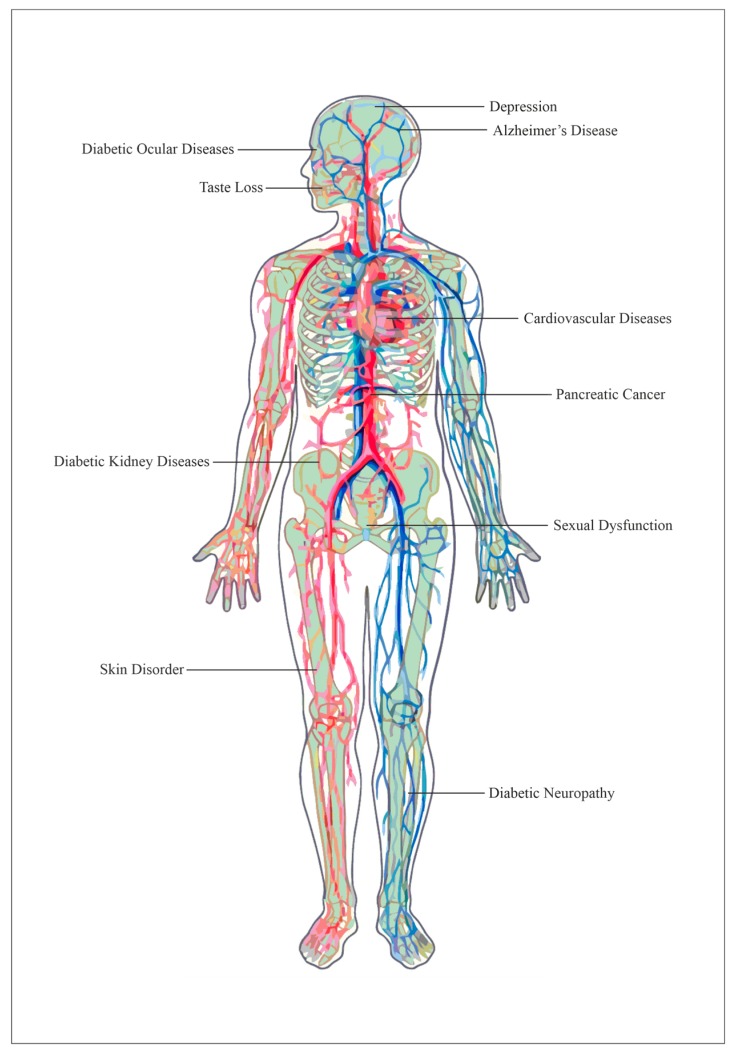
Diabetes, a silent killer, is one of the most widely prevalent conditions of the present time. According to the 2017 International Diabetes Federation (IDF) statistics, the global prevalence of diabetes among the age group of 20–79 years is 8.8%. In addition, 1 in every 2 persons is unaware of the condition. This unawareness and ignorance lead to further complications. Pre-diabetes is the preceding condition of diabetes, and in most of the cases, this ultimately leads to the development of diabetes. Diabetes can be classified into three types, namely type 1 diabetes, type 2 diabetes mellitus (T2DM) and gestational diabetes. The diagnosis of both pre-diabetes and diabetes is based on glucose criteria; the common modalities used are fasting plasma glucose (FPG) test and oral glucose tolerance test (OGTT). A glucometer is commonly used by diabetic patients to measure blood glucose levels with fast and rather accurate measurements. A few of the more advanced and minimally invasive modalities include the glucose-sensing patch, SwEatch, eyeglass biosensor, breath analysis, etc. Despite a considerable amount of data being collected and analyzed regarding diabetes, the actual molecular mechanism of developing type 2 diabetes mellitus (T2DM) is still unknown. Both genetic and epigenetic factors are associated with T2DM. The complications of diabetes can predominantly be classified into two categories: microvascular and macrovascular. Retinopathy, nephropathy, and neuropathy are grouped under microvascular complications, whereas stroke, cardiovascular disease, and peripheral artery disease (PAD) belong to macrovascular complications. Unfortunately, until now, no complete cure for diabetes has been found. However, the treatment of pre-diabetes has shown significant success in preventing the further progression of diabetes. To prevent pre-diabetes from developing into T2DM, lifestyle intervention has been found to be very promising. Various aspects of diabetes, including the aforementioned topics, have been reviewed in this paper.
Overview
The claims and statistics of this paper haven’t been checked yet.
Run the check — free, no account needed. It reads the open-access text and checks the sources it cites.
Integrity signals
Registry
Cites
Statistics
Figures
Verification
Claims the paper makes
The claims and statistics of this paper haven’t been checked yet.
Run the check — free, no account needed. It reads the open-access text and checks the sources it cites.
Claims other papers make about this one
Each is checked against this paper’s own text: does it say what the citing paper says it does?
In the citing paper
“it has been shown that more than 50% of the diabetics are obese (10).”
From Diabetes and Sarcopenic Obesity: Pathogenesis, Diagnosis, and Treatments (2020) · cites this paper as [10]
Self-check
Percentages, sums and reported differences re-computed from the paper’s own numbers.
The self-check needs the paper’s full text.
Citations
Cites
Toprak, Ö., Kurt, H., Sarı, Y., Şarkış, C., Us, H., & Kırık, A. (2017) · Kidney & Blood Pressure Research · doi:10.1159/000468530 · Cited by 29,772
Reduction in the incidence of type 2 diabetes with lifestyle intervention or metformin
(2002) · New England Journal of Medicine · doi:10.1056/nejmoa012512 · Cited by 19,011 · cited 3×
“concluded that in people with a BMI higher than 35, aged less than 65 years, and having a fasting PG higher than 110 mg/dL, Metformin reduced the chances of developing T2DM as effectively as lifestyle intervention [133].”
BackgroundWild, S., Roglic, G., Green, A., Sicree, R., & King, H. (2004) · Diabetes Care · doi:10.2337/diacare.27.5.1047 · Cited by 15,297
Diagnosis and Classification of Diabetes Mellitus
American Diabetes Association (2010) · Diabetes Care · doi:10.2337/dc11-s062 · Cited by 14,094
Empagliflozin, Cardiovascular Outcomes, and Mortality in Type 2 Diabetes
Zinman, B., Wanner, C., Lachin, J. M., Fitchett, D., Bluhmki, E., Hantel, S., Mattheus, M., Devins, T., Johansen, O. E., Woerle, H. J., et al. (2015) · New England Journal of Medicine · doi:10.1056/nejmoa1504720 · Cited by 12,315 · cited 1×
“Some of the most common side effects of this class of medication is urogenital tract infection, genital infection, breast and bladder cancer [203,204].”
BackgroundTuomilehto, J., Lindström, J., Eriksson, J. G., Valle, T. T., Hämäläinen, H., Ilanne-Parikka, P., Keinänen-Kiukaanniemi, S., Laakso, M., Louheranta, A., Rastas, M., et al. (2001) · New England Journal of Medicine · doi:10.1056/nejm200105033441801 · Cited by 10,873 · cited 1×
“Therefore, both the Finnish DPS and DPP were consistent in results [149].”
ResultGlobal estimates of the prevalence of diabetes for 2010 and 2030
Shaw, J. E., Sicree, R. A., & Zimmet, P. Z. (2010) · Diabetes Research and Clinical Practice · doi:10.1016/j.diabres.2009.10.007 · Cited by 7,216
Chen, X., Xiu, M., Xing, J., Yu, S., Min, D., & Guo, F. (2017) · Cellular Physiology and Biochemistry · doi:10.1159/000479439 · Cited by 5,760
Diagnosis and classification of diabetes mellitus
American Diabetes Association (2010) · Diabetes Care · doi:10.2337/dc10-s062 · Cited by 5,491
Global estimates of diabetes prevalence for 2013 and projections for 2035
Guariguata, L., Whiting, D. R., Hambleton, I., Beagley, J., Linnenkamp, U., & Shaw, J. E. (2014) · Diabetes Research and Clinical Practice · doi:10.1016/j.diabres.2013.11.002 · Cited by 4,642
Research works printed but not linked: 1
- Sazonov, E., and Neuman, M.R. (2014). Chapter 2.1—Wearable Bio and Chemical Sensors. Wearable Sensors, Academic Press.
Cited by
Sorted by citations
Diabetes and Sarcopenic Obesity: Pathogenesis, Diagnosis, and Treatments
Wang, M., Tan, Y., Shi, Y., Wang, X., Liao, Z., & Wei, P. (2020) · Frontiers in Endocrinology · doi:10.3389/fendo.2020.00568 · Cited by 231
Self-citationDiabetes and cancer: Epidemiological and biological links
Wang, M., Yang, Y., & Liao, Z. (2020) · World Journal of Diabetes · doi:10.4239/wjd.v11.i6.227 · Cited by 158
Self-citationRole of Cellular Senescence in Type II Diabetes
Narasimhan, A., Flores, R. R., Robbins, P. D., & Niedernhofer, L. J. (2021) · Endocrinology · doi:10.1210/endocr/bqab136 · Cited by 133
Mechanism of Traditional Chinese Medicine in Treating Knee Osteoarthritis
Wang, M., Liu, L., Zhang, C. S., Liao, Z., Jing, X., Fishers, M., Zhao, L., Xu, X., & Li, B. (2020) · Journal of Pain Research · doi:10.2147/jpr.s247827 · Cited by 104
Self-citationConcentrated ambient PM2.5exposure affects mice sperm quality and testosterone biosynthesis
Yang, Y., Yang, T., Liu, S., Cao, Z., Zhao, Y., Su, X., Liao, Z., Teng, X., & Hua, J. (2019) · PeerJ · doi:10.7717/peerj.8109 · Cited by 58
Self-citationA Nudge-Inspired AI-Driven Health Platform for Self-Management of Diabetes
Joachim, S., Forkan, A. R. M., Jayaraman, P. P., Morshed, A., & Wickramasinghe, N. (2022) · Sensors · doi:10.3390/s22124620 · Cited by 49
Han, Z., & Wang, L. (2025) · Patient Preference and Adherence · doi:10.2147/ppa.s552727 · Cited by 2
Metadata
- Authors
- Khan, R., Chua, Z., Tan, J., Yang, Y., Liao, Z., & Zhao, Y.
- Affiliations
- Nanyang Technological University (SG)
- Tongji University (CN)
- Corresponding author
- Liao, Zehuan
- Zhao, Yan
- Venue
- Medicina
- Publisher
- MDPI AG
- Published
- 2019-08-29
- Volume
- 55
- Issue
- 9
- Pages
- 546
- ISSN
- 1010-660X (ISSN-L)
- 1648-9144
- PMC
- PMC6780236
- OpenAlex
- W2971340278
- Cited by
- 484
- References
- 243
- Citations by year
- 2026: 40 · 2025: 94 · 2024: 100 · 2023: 106 · 2022: 70 · 2021: 49 · 2020: 22 · 2019: 3
- FWCI
- 5.60
- Type
- journal article
- Language
- en
- Open access
- gold
- dx.doi.org
- Licence
- Locations
- Medicina (publishedVersion, cc-by)
- Europe PMC (PubMed Central) (publishedVersion, cc-by)
- PubMed Central (publishedVersion, cc-by)
- PubMed (publishedVersion)
- DOAJ (DOAJ: Directory of Open Access Journals) (submittedVersion, cc-by-sa)
- Funders
- Nanyang Technological University (SBS18005)
- Topics
- Health Sciences › Medicine › Endocrinology, Diabetes and Metabolism › Diabetes Management and Research
- Health Sciences › Medicine › Endocrinology, Diabetes and Metabolism › Diabetes Treatment and Management
- Health Sciences › Medicine › Endocrinology, Diabetes and Metabolism › Diabetes, Cardiovascular Risks, and Lipoproteins
- Keywords
- prediabetes, type 2 diabetes, diabetes diagnosis, fasting blood glucose, oral glucose tolerance test, blood glucose monitoring, diabetes complications, microvascular complications, macrovascular complications, genetic and epigenetic factors, lifestyle intervention, diabetes prevention, gestational diabetes mellitus, type 1 diabetes
- MeSH terms
- Adult, Aged, Blood Glucose, Diabetes Mellitus, Type 2, Female, Glucose Tolerance Test, Humans, Hyperglycemia, Insulin Resistance, Male, Middle Aged, Prediabetic State, Risk Factors, Diabetes Complications, Translational Research, Biomedical
About these checks
Registry, retraction, Cites and statistics results are computed, not judged, with one exception: a printed reference that no index lists is read once by a model before it counts as a citation error. Claims are extracted by a model and kept only when their quote appears verbatim in the text; each cited source is then checked, with a model’s help, for whether it says what the claim relies on. Those verdicts can be wrong — read the claim’s quote and the cited source before relying on one.
Statistics and arithmetic are recomputed, not judged.
Confidence bands are shown only for fields calibrated on our annotated test set. None is calibrated yet, so no band is shown.
What counts as a claim ›How we measure confidence ›How we check this ›
Are you an author, or do you see a problem with this page? Request a review
